mermaidcamp
Keeping current in wellness, in and out of the water
You can scroll the shelf using ← and → keys
You can scroll the shelf using ← and → keys

Quaker
Jeffrey Horney was a Quaker born in Maryland. His father was a planter who left his estate to his children in 1738. Jeffrey inherited “Cottingham”:
Horney, Jeffery, planter,Talbot Co.,11th Jan., 1737;
27th Mch., 1738.
To son William and hrs., “Dixon’s Gift,” Queen Anne’s Co.; and personalty.
To son Jeffery and hrs., “Cottingham,” sd. son dying without issue sd. tract to son Philip and hrs.; and personalty.
To sons Philip, James and daus. Jane and Prissillia, personalty, some of which des. as bou. of John Carslake. Residue of personal estate to 4 sons and 4 daus. divided equally.
Son Jeffery, ex., to have care of sons Philip and James until they come to age of 18.
Test: Robert Harwood, John Regester, Edward Perkins. 21. 861. MARYLAND CALENDAR OF WILLS: Volume 7
Since I have ancestors born in Maryland named Nichols, I was very interested to learn about the Nicholite movement, also known as New Quakers. The Nichols in my tree marry into the family about 100 years later in Pennsylvania.
Jeffrey Horney (1723 – 1779)
is my 8th great grandfather
Mary Horney (1741 – 1775)
daughter of Jeffrey Horney
Esther Harris (1764 – 1838)
daughter of Mary Horney
John H Wright (1803 – 1850)
son of Esther Harris
Mary Wright (1816 – 1873)
daughter of John H Wright
Emiline P Nicholls (1837 – )
daughter of Mary Wright
Harriet Peterson (1856 – 1933)
daughter of Emiline P Nicholls
Sarah Helena Byrne (1878 – 1962)
daughter of Harriet Peterson
Olga Fern Scott (1897 – 1968)
daughter of Sarah Helena Byrne
Richard Arden Morse (1920 – 2004)
son of Olga Fern Scott
Pamela Morse
I am the daughter of Richard Arden Morse
Jeffrey Horney [III] was born before 1720 in Talbot County, Maryland. He married Deborah Baynard outside of the Quaker faith without the consent of the Friends. Their marriage license was dated October 6, 1739 in Talbot County, Maryland. Eight years later in 1747, Jeffrey and Deborah Horney would sell their land in Talbot County and move to Dorchester [now Caroline] County. On the 27th of October 1747, Jeoffery and Deborah Horney sold fifty acres of Cottingham in Talbot County to William Thomas, Gentleman. Less than one month later, on the 12th of November 1747, Jeffrey Horney of Talbot County purchased Piersons Chance [Pearsons Chance] from John Pierson of Dorchester County, formerly laid out for Thomas Pierson. The property was in two parts; one part contained 100 acres and the other part contained 50 acres. The land was located on Watts Creek, off of the Choptank riverjust south of Denton in what is now Caroline County, Maryland. As the crow flies, Piersons Chance was less than 15 miles northeast of Cottingham and was about 5 miles from the Delaware line of Kent County, Delaware.
Nov 12, 1747 John Pierson of Dor Co, planter, to Jeofrey Horney of Talb co, planter: two parts of a tract formerly laid out for Thomas Pierson called “Piersons Chance,” conveyed by said Thomas to said John by separate deeds, on Watts Creek, one part containing 100 a. and the other part containing 50 a. more or less. Wit: T. Waite, Jno. Caile, Hall Caile. Ackn by John Pierson and Elizabeth his wife before Thos. Foster abd Benj Keene, Justices. (See receipt, Dorchester County Land Records 14 Old 169).
For the first seven years of their marriage, Jeffrey and Deborah Horney lived at Cottingham, and any of their children born within the first seven years between 1740 and 1747 were born at Cottingham in Talbot County. After November 1747 when Jeffrey and Deborah purchasedPiersons Chance in Dorchester County, any subsequent children they may have had were born in Dorchester County, Maryland. This land now lies in Caroline County Maryland which was not established until 1773 from parts of Dorchester and Queen Anne’s Counties. This explains why Jeffrey and Deborah Horney and their children are subsequently found in Caroline County records. The land on which they were living from November 1747 onward,Pierson’s Chance, was once in Dorchester County in an area that became Caroline County in 1773. At least three of their children, John, Philip and William Horney, left Maryland between the 1780s and 1790’s when they may have followed the Nicholite movement into the Deep River section of Guilford County, North Carolina. Some lines would remain in North Carolina while others would move onto Ohio, Illinois and beyond.
There is a local legend surrounding the area on Watts Creek where Jeffrey and Deborah settled. It was believed that in the 1600s and early 1700s notorious pirates and privateers, such as Captain William Kidd and Edward Teach [Thatch, Thach, Thache], otherwise known asBlackbeard, may have hid or buried treasure along the shores of Watts Creek. A local legend began to circulate (or re-circulate) in 1916 when Swepson Earle wrote Manor houses on the Eastern Shore. He claimed that “Tradition says [Watts Creek, south of Denton] once provided refuge for Captain Kidd, whose ‘buried treasure’ has been sought on its banks.” Later, in the 1940s when Hulbert Footner wrote his book, Rivers of the Eastern Shore, he related that“There is such a hole near the mouth of Watts Creek that is ninety feet deep. It is called Jake’s Hole. Its exact depth is known because it’s been sounded often enough, and I’ll tell you why. There was aplenty pirates round here in the old time. The one that mostly cruised in these waters was Blackbeard; Edward Teach was his right name. Well, Blackbeard picked Jake’s Hole for one of his caches, and dropped an oaken chest bound round with copper bands in there. It’s still there. God knows what’s inside it!”However, according to Donald Shomette who more recently wrote Pirates of the Chesapeake, neither Blackbeard or Captain Kidd ever sailed into the Bay, but their legends did.
Whether or not the legends of Watts Creek spun by the old-timers were fact or fiction, there were pirates and privateers who sailed in and around the Chesapeake Bay. Among them, Roger Makeele, was found in Maryland records in 1685 when he and his band of pirates lured the crews of tobacco sloops to their camp on Watts Island. They would seize the crew and confiscate their sloops before leaving the men in the Marshes of Dorchester County. Makeele sailed the Choptank river which separated Dorchester County from Talbot County where the early Horney’s lived. Incidentally, that same year Jeffrey Honey [Horney] was testator to the will of Emanuel Jenkinson of Talbot County Maryland. It is likely the early Horney men, as well as other settlers in the area, heard of these pirates and were in peril of loosing their tobacco crops and their sloops to the pirates of the Chesapeake.
During this time, local Indians lived in the area. Their ancestors arrived in the area long before the European settlers. When John Burnyeat appointed a general meetingfor all of the Friends in the province of Maryland. George Fox wrote about that meeting in his journal, (Two Years in America 1671-1673 Chapter XVIII) It was upon me from the Lord to send to the Indian emperor and his kings to come to that meeting. The emperor came and was at the meeting. His kings, lying further off, could not reach the place in time. Besides the Horneys who married into Quaker families, other religions would later play a part in their lives. Among the early churches and societies, early Horney families were or became Puritans, Anglicans and Episcopalians. In 1760, when Joseph Nichols of Kent County, Maryland and Delaware founded the Nicholites [New Quakers], at least one branch of Horney’s were found in Nicholite Petitions. [Most likely Jeffrey and Deborah Horney and/or their descendants.] The early Horney’s also became Methodist and Methodist-Episcopal. On June 17, 1703 John Wesley, the founder of Methodism, was born in Epworth, Lincolnshire, England. By 1771, John Wesley’s teachings reached the Eastern Shore of Maryland. When Francis Asbury came to Maryland to spread Wesley’s word, the Methodist religion took a strong hold in Maryland. More than a few Horney families converted to Methodism. However, Wesley’s Tory beliefs may not have sat well with the Horney’s who served [on the American side] in the Revolutionary War.
The rivers on Maryland’s Eastern Shore defined the early transportation routes of religion. During their lifetime, the settlers of the area, did much of their traveling on the rivers, tributaries, creeks and branches which crossed the Eastern Shore of Maryland, east of the Chesapeake Bay. They lived near and traveled many of these waterways including the Choptank, Wye, St. Michaels, (now Miles),Tred Avon (Third Haven), and Tuckahoe Rivers. The Tred Avon was and still is the location of Third Haven Meeting House near what is now Easton, Talbot County, Maryland. The St. Michaels, (now Miles) River was the location ofBetty’s Cove Meeting House.
To see photos of the Choptank and Tuckahoe river areas in Talbot and Caroline counties where the Horney families lived and traveled, select the pdf file from the Upper Choptank and Tuckahoe River Cultural Resources Inventory. Another helpful tool is the Choptank and Tuckahoe Rivers Sections Map. Take a two day canoe trip on the Choptank River Sojourn, a journey of Maryland’s Eastern Shore through areas where the earliest Horneys settled and the route that Jeffrey Horney III and his wife Deborah Baynard traveled and settled after 1747. Areas mentioned throughout this river journey are Choptank, Denton, Dover Bridge, Greensboro, Hillsboro, Tuckahoe and Watts Creek. All of these locations were found in 1600 – 1700 HORNEY records in Caroline, Talbot, and Dorchester Counties, Maryland. The journey described was a likely route traveled by Jeffrey Horney III and his wife, Deborah Baynard and their children as they left Talbot County, Maryland and settled in Dorchester [now Caroline] County, Maryland.
Each of us has a child archetype within our psyche. Carolyn Myss outlines six kinds of archetypal children. They are:
The eternal child has an attachment to youth and immaturity. The positive eternal child is the stuff that ads are made of, enthusiastic, fresh and free. The shadow eternal child has a resistance to responsibility and rejection of the aging process. The need to stay youthful may lead to extreme dependence on others for security. The puer aeternus is a man who never accepts responsibility. He is frequently a character in fiction, and sadly appears often in real life. Peter Pan is a modern eternal youth story with Tinkerbell playing the puella aeterna. Clinging to youth can prevent one from reaching the full range of emotions and insights. Youthful enthusiasm and a willingness to make fresh starts are the positive aspects of this child persona. Adults who are consistently unreliable or dependent on others reflect the worst aspects of the eternal child.
 Peter Pan
Chivalry is one of those double edged swords. Knights are loyal and honorable as an ideal; love and honor do not always triumph. The good knight is brave in service to a higher calling or just ruler. The shadow knight is romantically delusional and may serve a corrupt ruler. Self image is all important to the knight, since he needs to be seen as helpful and brave. He may find himself drawn into needless drama to save damsels and others who signal distress. This may become a pattern in life, endlessly saving others.
Today the knight may be spiritually correct, always defending worthy causes. His love of honor and his loyalty to cause or leader can be very confusing in this character. If the leader demands self sacrifice and self neglect, this archetype can feel self righteous about taking this shadowy path. Loyalty to destructive or greedy powers can be the undoing of the modern knight, just as it was in history. Romantic notions of service can be a cover for the absence of chivalry and honor. It is usually easy to spot the knight riding either a black horse or a white one that symbolizes intent. This archetype distinguishes itself from all the characters by being loyal as well as romantic. The knight displays his loyalty above all else, since it is the source of his identity. Do you know any knights in your life?

healthy food
The way words are used has a big effect on culture and expectations. The words health care have come to mean prescription drugs and medical procedures. Wellness has come to mean any kind of body work, cleanse, or restrictive diet. What is even more debilitating to the public health is that insurance policies determine the care most people use. There is abuse on both sides, by wellness quacks and medical losers. Wellness or health coaches are essentially practicing counseling in everything from nutrition to psychiatry. The unhealthy American population is vulnerable and guilty, willing to jump to all kinds of conclusions, buying into all kinds of cures and programs. The market is so crowded the consumer has been confused by all the possibilities. Now the public will need to understand how health insurance functions. This is a giant leap for the citizens, a shock to the system.
I made a living teaching and promoting health and wellness through water for many years. I have enjoyed waters and spas all over the world and had the pleasure of teaching many wonderful students. I have a strong healthy body that I treat to the best food and body work I can afford to give it. Since I love movement, I move. I don’t take any prescription drugs; my plan is to avoid them. The reasons I am keeping my insurance policy as it is, and not vexing myself trying to read all the options are:
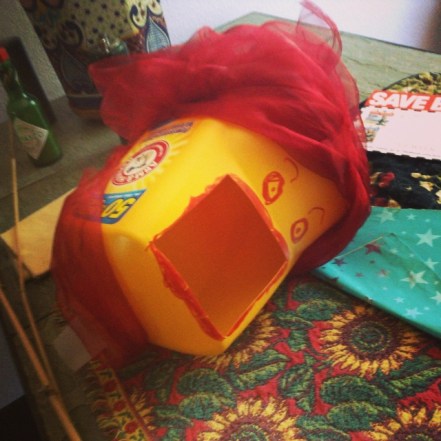
message for dog owners
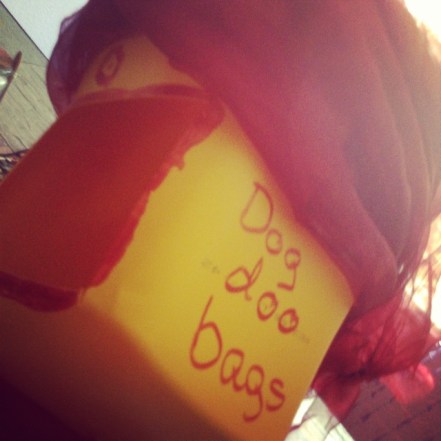
practical design
Our midtown Tucson neighborhood has pride of ownership issues. The landlords are not prone to take care of rental properties and the residents have become used to a very low level of environmental pride. Tagging of gang signs is chronic and dog owners leave waste behind everywhere. Doolen-Fruitvale Neighborhood, or DooFru for short, has an elementary school, an art college, and a Boys and Girls Club all adjacent to each other. I am asking the kids interested in art and design to enter a competition. The DooFru Design Derby will be an annual competition to design the best small enhancement to our neighborhood environment. We want to create a positive artful outlet that says we care about the space in which we live. We don’t have a place for mural art or sculpture, but we can do small, individual projects that make a difference.
This year we are designing dog doo bag dispensers out of used plastic containers. When filled with plastic bags, they not only remind dog owners to do the right thing, but provide the means with which to do it. Some other neighborhoods have employed the bag dispensers with great success. I walk my dog in one of these adjoining areas and have noticed a big improvement in the waste problem since they put up the bag dispensers. We hope by involving kids and art we will have an even bigger impact to create a cleaner and more well cared for environment. The kids from Boys and Girls Club have joined in many neighborhood clean up efforts, only to see the same trashy behavior arise. I believe they can have a bigger influence than adults if they sincerely take on the #DooFrudumpsdogdoo initiative. They can shame the adults and set a standard of awareness simply by making art for the good of the neighborhood. My own design is designed to give the idea to the kids, but definitely not to win the derby. My #DooFrudumpsdogdoo lady is a neighborhood spokesperson in need of kids’ art.

#Pumpkin
Those who do not use the blue bird for communication often say some amusing things about twitter. What is funnier is reading twitter streams to feel the pulse of the twittaverse. I recommend @Pontifex to any twitter beginner just to get the feel of the thing. I tweet less than I did when I first began to explore the possibilities of twitter. I have not joined a chat for months, but leave that option open for the future. I do still enjoy joking and being silly with other silly tweeps, but spend less time engaged in #sillyhashtagfun. I recently tried to explain the use of hashtags to my neighbor but I failed miserably. Now I will be able to send her this video clip so she can understand fully the grave importance of #hashtagging and tweeting itself.
The trickster is a character popular in many ancient mythical stories. This archetype pranks us and fools us in various ways. Like all of the Sacred Contracts, our interactions with this particular role will continue until we finally recognize the trick. The joke may be on us, or we may be the joker in the case. Good natured pranking can be done in a kind spirit; Often the dark side of the trickster misleads and harms the easily duped. When the joke is recognized as a dark misdeed the trickster is usually nowhere to be found.
I can see a pattern in my life of believing in financial tricksters. I did not carefully identify or assess risk to my own finances in my youth. I was a hedonist on a roll with no fear of failure. Even now when I believe I have done careful due diligence and consideration I am too lenient and trusting of others. While I don’t think anyone has been out to get me financially, I could have been surrounded with more trustworthy and helpful folks in my early years. The very good news is that I have become more cautious. I investigate potential partnerships and investments with much more vigor than I did in the past. I have some residual financial damage that keeps me vigilant today for any possible tricksters at work in my life. I hope I am all done with them. I can’t afford to be around them. If you have been tricked by tricksters were they stealing love, money, security, or all of the above?

memorial
My 10th great-grandfather was a carpenter who agreed to go to Maine in 1634 to stay for 5 years. He agreed to build a sawmill, a gristmill, and tenement houses for his employer, John Mason.
As extracted from Everett S. Stackpole’s “The First Permanent Settlement in Maine’
In 1634 there was an important development of the colony. Carpenters and millwrights were sent over from England in the Pied Cow, led by William Chadbourne, to build a sawmill and a “stamping mill” at the upper falls. This was the first grist-mill in New England to run by water, though Boston had a wind-mill to grind corn, and Piscataqua sent a small shipload there to be ground, James Wall was one of the carpenters and he made a deposition the 21st of the third month, 1652.
William CHADBOURNE (1582 – 1652)
is my 10th great grandfather
Patience Chadbourne (1612 – 1683)
daughter of William CHADBOURNE
Margaret SPENCER (1633 – 1670)
daughter of Patience Chadbourne
Moses Goodwin (1660 – 1726)
son of Margaret SPENCER
Martha Goodwin (1693 – 1769)
daughter of Moses Goodwin
Grace Raiford (1725 – 1778)
daughter of Martha Goodwin
Sarah Hirons (1751 – 1817)
daughter of Grace Raiford
John Nimrod Taylor (1770 – 1816)
son of Sarah Hirons
John Samuel Taylor (1798 – 1873)
son of John Nimrod Taylor
William Ellison Taylor (1839 – 1918)
son of John Samuel Taylor
George Harvey Taylor (1884 – 1941)
son of William Ellison Taylor
Ruby Lee Taylor (1922 – 2008)
daughter of George Harvey Taylor
Pamela Morse
I am the daughter of Ruby Lee Taylor
1. WILLIAM1 CHADBOURNE (RobertA), baptized Church of St Editha, Tamworth, Warwickshire, England 30 Mar 1582 (Tamworth parish register); died after his last appearance in Maine 16 Nov 1652 (qv); married Tamworth 8 Oct 1609 (ibid)ELIZABETH SPARRY, born perhaps about 1589, died after 1 Jun 1623 (birth of her last known child, Tamworth parish register). Her parentage has not been discovered; however, her surname is common in Staffordshire. William was the son of Robert and Margery or Margaret (Dooley) Chadbourne of Preston, Lancashire, and Tamworth, Warwickshire, England.
William arrived in New England aboard the Pied Cow 8 Jul 1634 (vide post) with James Wall and John Goddard. The three were under contract with Capt John Mason of London’s Laconia Company, a joint-stock company seeking profits in the new world. The purpose of the contract, dated 16 Mar 1633/4, was to build mills in Berwick. William was referred to as a housewright or master carpenter. The men began to build the first water-powered saw mill and grist mill in New England on 22 Jul 1634.
James Wall, carpenter and millwright, deposed on 21 May 1652 that about the year 1634 he and his partners William Chadbourne and John Goddard, carpenters, came over to Mason’s land on his account and their own, that Mr [Henry] Joslyn, Mason’s agent, brought them to certain lands at Asbenbedick Falls, as the Indians called the place, later the Great Works River in Berwick, where they carried on a sawmill and a stamping mill for corn three or four years. Wall built a house there and Chadbourne built another (Pope, The Pioneers of Maine and New Hampshire, 1623 to 1660, 218-19).
The house William built may be the one said by Stackpole in 1926 to be the oldest house in Maine. Part of its foundation is under the present house on the northwest corner of Brattle and Vine Streets on the road from the Lower Landing (Hamilton House) to the original mill site at Asbenbedick (later Great Works) Falls. William Chadbourne deeded the home to his son-in-law, Thomas Spencer, and a nice picture of it appeared in the Boston Evening Transcript of 25 Jun 1938. Other accounts suggest that the property occupied by Spencer was actually a second, later house, and that the early home stood in the northwesterly angle of the intersection of Brattle Street leading to the mouth of the Great Works River and the highway to Eliot.
The Asbenbedick Great Works was the site of a mill with nineteen saws built by the Leader brothers in the 1650s. The river was called Chadbournes River by many before and after, due to the Chadbourne dam and mill erected downstream in the late 1630s.
A copy of the Mason contract referred to above survives in the MA Archives 3:437. It stipulates that they were to stay five years and receive three fourths of the profits from the mills and own three fourths of the houses, which Mason was to furnish. At the termination of the contract they were to have fifty acres on lease for the term of “three lives” at the annual rent of three bushels of corn.
The articles brought on the vessel, which were taken from the company’s store were: one great iron kettle, for which Thomas Spencer was responsible, Irish blankets, one Kilkenny rug, one pair of sheets, one pentado coverlet, one brass kettle and seven spoons.
It is not clear when other members of William’s family arrived. His daughter Patience may have preceded him, since her husband Thomas Spencer came four years earlier and they may have had children between 1630 and 1634. Mason’s list of stewards and workmen sent contains the names “William Chadborn, William Chadborn, jun., and Humphry Chadborn,” but also indicates twenty-two women who are unnamed. It is known that the Pied Cow had made at least one crossing in 1631 and that the bark Warwick had made several early crossings, all for Capt Mason, but it is unlikely that William came on any of these trips, given the phrasing of Wall’s deposition which implies that he came in about 1634 (NEHGR 21:223-4).
Elizabeth is mentioned only in the couple’s marriage record. It is not known when or where she died. She may have come to Maine, for there is no burial record for her in Tamworth; however, no account of her has been found in the New World. Some have conjectured that William may have returned to England after deeding his Berwick homestead to son-in-law Thomas Spencer. No record of William’s death has been located in England or Maine.
In 1640, he and his sons were listed as NH residents (NHPP, Vol 1) before purchasing land in Kittery in those regions now called S Berwick and Eliot. Both William Sr and William Jr were in Boston in 1643 (LND, 134).
The Chadbournes, like the other people brought to ME by Mason, were not dissenters from the Church of England, emigrating for religious freedom, as was the case with most of the settlers in New England in this period. William’s father Robert, raised Catholic, professed to fear God as his reason for not attending the Church of England; but William’s family were members of the Church of England who perhaps intended to return to England after the terms of Mason’s contract were fulfilled. Indeed, that may be what William and Elizabeth Chadbourne did.
William Chadbourne, as a respected master carpenter and housewright, may have been contracted to build the so-called Great House at Strawbery Banke (now Portsmouth NH) used to house the Laconia Company’s stores and serve as a dwelling for the company workmen. The site of this building has recently been found, near the present Stawbery Banke village historic site. Claims have been made in published sources that the Great House was built by William’s son Humphrey circa 1631. Humphrey was said to have come on the Warwick in 1631, and no evidence has been found of William’s arrival before 1634. An error could have occurred because of a poorly-written paragraph in James Sullivan’s book, The History of the District of Maine , published in Boston MA in 1795, where William1, who built the Great House, and Humprhey2, who purchased land fromMr Rowles, are rolled into one. If Humphrey was baptized as an infant in 1615 he would have been sixteen at the time the Great House was built. He may very well have worked on it, although it is more likely that his father was given the contract for its building. The contract hasn’t survived and which of the Chadbournes was responsible for the building remains conjecture.
One William Chadbourne was admitted an inhabitant to the town of Portsmouth RI 25 February 1642[/3] (The Early Records of the Town of Portsmouth, Providence RI: The RI Historical Society, 1901, 19). He was granted land there in 1642 (ibid, 11), but the grant was not finalized, and it is doubtful he ever resided there. He was certainly gone by 28 Sep 1647 (ibid, 36). This may have been another William Chadbourne who is known to have come from Winchcombe (see discussion on this man in the Appendix).
On 3 Mar 1650/1, William and his sons, with others, were accused by Mrs Ann (Green) Mason, widow of Capt John Mason, of embezzling her husband’s estate. The claim was based on a contract which was not honored by either party because of the death of Capt Mason, and also based on the first recorded Indian deed in ME in 1643. The Chadbourne claim was upheld by the selectmen of Kittery and the Government of the Massachusetts Bay in New England.
On 4 May 1652, William Chadbourne was one of the chosen men assigned to a Kittery committee to pick a lot and build a meeting house. He was the first signer of the Kittery Act of Submission, 16 November 1652. We have no certain record of William after this date.
On September 21 the ancient Greek feast celebrating life, beauty, death, and rebirth began. The Rites of Eleusis resembled All Saints/Thanksgiving/Christmas is some obvious ways. Harvest celebrations started on the equinox and continued until the end of September, with ritual and a secret sacred mystery school. The drama of Demeter and Persephone was reenacted to symbolize the descent of the queen of the underworld every fall, and her rebirth every spring. These celebrations were well attended by people from all over Europe who came to participate in a secret initiation. Rituals celebrating goddess power continued day and night until September 30 when the last of the initiations were performed, deep in caves of the temple.
The British occultist Aleister Crowley produced his own version in 1910 in London, which later seems to have become a rock opera:
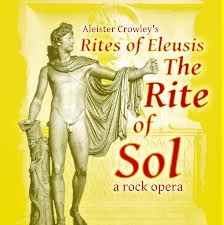
Rites of Eleusis
How do you celebrate the end of summer and the return of darkness? Octoberfest?



At the end of summer when I teach kids to swim I like to hold a show off party so they can impress themselves and others. I had two students this year who worked hard, and came to lessons almost every weekend day all summer. The mermaid blue belt was awarded and the official last call for swimmers to enjoy a dip took place. Conquering fear of water is a metaphor for all new environments that will face these young ladies for the rest of their lives. Being safe and cooperative are the key elements of water fun. Performance skills are not as important as the news that practice works and changes everything. They are in the deep end with appropriate safety measures having a good time, which was not possible in June when they began.

