mermaidcamp
Keeping current in wellness, in and out of the water
You can scroll the shelf using ← and → keys
You can scroll the shelf using ← and → keys
Do you have enough stuff? What kind of stuff do you lack? Do you have goals that do not involve material stuff? My parents were heavily into possessions, and at the end of their lives it seemed that those things they loved so much robbed them of any kind of peace. They struggled to keep objects and wealth long after they even knew what any of the objects were. They wanted to keep an image of themselves in society, and other transitory status rather than seeking truth. There was nothing I could do to help them with that.
I am doing a meditative practice about abundance now. I have special feelings about one of the biblical phrases used in this practice. “All things that the Father hath are mine.” John 16:15. This is talking about the Father with a big F, not my dad. If I have all that my dad had I would be filled with greed, alcoholism, and relative anger at all times. If I concentrate on the Father, as in spirit, I can feel the difference. We inherit objects as well as traits from our parents. The kingdom of heaven is ours if we tune into it. How about you, gentle reader? Do you stand to inherit the earth?
Sports fans and all Americans need to be ashamed that this much institutionalized racism can exist in professional sports. When I was a child I was a Pittsburgh Pirates fan, with special emphasis on my love for Roberto Clemente. I went in person to many games at Forbes Field, and listed to the others on my transistor radio. I hold a big grudge against my dad for an incident that took place when I was about 10. We went to lunch at The University Club before games, then walked to the field. One such day Roberto himself was eating in the dining room at the University Club before a game. I wanted to get his autograph, naturally. My dad was very strict and gave a lecture about treating everyone with respect. Of course this was the first black person I had seen eating in that dining room, and it may have been many years before there was another. Richard Arden Morse was a bit of a racist in some ways, but he was firm about not disturbing Roberto to indulge me. I was angry (and still am, if truth be told), but I will always remember the point. It had to do with dignity, and making sure his visit to our snooty club was treated as a natural event. I loved Roberto for his athleticism, and was unaware until later in life of his fight to attain equality as a black baseball player. He is still me favorite athlete of all time.
This rings in my mind when I see this Sterling guy still living some horrible stereotype lifestyle that belongs in the distant past. The nasty truth about this story must be exposed. In no uncertain terms we must reject his behavior. Each of us has some part to play in this, if only by voicing an opinion. I am with Magic in thinking he needs to say he does not want to own a team now. What do you think, gentle reader? Does this freak you out?





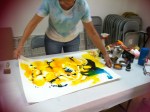

















Yesterday I enjoyed making art in a new way with Jeanne Fellow at Blue Raven Art School. I had visited her studio and purchased a couple of her beautiful pieces and learned about the LumenArt class. My classmate Jeannie Gentry had done exactly the same thing. We both were very excited to try our hand at making one of these very special lamps. Our 5 hour class went by very quickly. Everything was set up for us on the shaded patio. Each of us had our own work table and basic tools. After a thorough demonstration of the basic techniques we chose colors and started our own experiment in color mixing. Some of the inks are iridescent, but those also block the light from within when it is a finished LumenArt. The fun of it all is that you don’t know how it will really look until you light it. Jeanne encouraged us to feel free and confident to play around. Both students created three possible candidates for lighting. The class materials include two sheets of incredible paper that allows all kinds of layering and special techniques without tearing. We each bought one extra sheet because we had enough time and were seriously into it. When dry we selected one to become our lamp. Choosing color for the base and tearing the final design we had supervision and plenty of encouragement from our teacher. This project is practically impossible to do badly. The materials guarantee that the finished product will be thrilling. She teaches a class in using these techniques on fabrics that will also be fun. If you are an experienced artist/craftperson you will love this class. If you think you are not creative and have no talent for art you will be blown away by your own amazing abilities when Jeanne shows you how to release them. My LumenArt is now making me very happy and proud in my living room at home. I also have two other fabulous pieces of art that I made. I even love my scraps. I would encourage anyone to investigate creativity and find your own inner light in one of Jeanne’s classes. She rules.



Stealing is a way of life. Sometimes we are the victims and other times we are the thief. Laverna is the goddess of darkness and criminal intent. She is the patron goddess of thieves and robbers. She teaches a very strong lesson about mortality. If we value that which can be stolen we will be too involved in a world that has no meaning. If we, instead, focus our efforts to create lasting creative work that benefits others it will be impossible to steal those benefits. Dishonest tradesman pray to her for the power to deceive and persuade. She is con woman herself who uses trickery to gain advantage over humans.
None of us will go through life without being tricked or robbed. Frequently these losses are caused by people we know. Financial ignorance is an aspect of Laverna. Allowing others to steal energy, time or valuable assets is submission to her power. The lesson of what is valuable and can never be taken from you is the wisdom she can bestow. Looking back at your life you will be able to find times when you felt significantly cheated or robbed. It is also possible to identify yourself in the role of con artist. Young children often deceive their parents and siblings, for instance. Taking a realistic look at the past, what has treachery and robbery taught you, gentle reader? Have you found that which you own that nobody can steal? Have you ever caught yourself stealing from yourself?
Americans have trouble understanding the whole British royalty and fancy person hierarchy. My own British family has been fairly fancy in their time, but I have nothing to show for it except my family tree. In history brutal repression of common people, or peasants, was the way commerce was conducted. The United States is returning to a system of government that separates the elite in a special world of privilege and security while the majority of the population is loosing security of every kind. Our country goes around bullying other nations about lack of democratic systems that protect the population. Who will come to the United States and reprimand us for this recent class and income discrepancy we are growing? Since many around the world are already hardened against the United States for our politics about war and violence, the facts about our upper crust citizens will cause more disgust for our economically bifurcated culture. In an odd twist of fate, Americans who often use Brit accents and royalty to make fun of snooty class struggles, are making big strides creating inequity of our own. What do you think will happen to our reputation abroad, gentle reader?
I will visit Austin, TX in the middle of the summer. I look forward to spending time downtown where I have rented a fabulous vintage Airstream from Air BnB as my abode. I will attend a reunion party for which I will need a car, but I am investigating the choices and prices I have while I am in the city. Car rental at the airport for the entire time would cost about $1000. Since I like being driven more than I like to drive, especially in a city, I am trying Lyft as a way to buy one ride at a time. My Airstream home is near public bus lines, and I can rent a bike for $10 a day. I like to go on foot to see the detail around me when I visit a new area. I know Austin has a system of bike taxis that are fun to use, especially when traffic is jammed for cars. When we went to Austin City Limits Music Festival we made use of the bike taxis, water taxis, and took a sunset party cruise on a well equipped floating live music bar. Considering all these choices renting a car and finding parking for it wherever I go sounds less appealing than biking, floating or being driven.
During my career as a travel agent I was always grateful and happy to stay in hotels and use suppliers on the commercial market. I made extra effort to rent private flats when I traveled. Now that the market has changed drastically I am pleased to be able to rent with assurance from Air BnB, and now ride with assurance provided by Lyft, Uber, and probably other apps I have yet to discover. I just joined Lyft and have received a message that the first ride is on the company as my gift for being a Lyft pioneer. What is not to like? We plan to go out this weekend, so I will give that free ride a trial when we want to come home after happy hour. I will find out if they are active in Tucson and test the service. I prefer the free ride home to any chocolate bunny. Thanks, Lyft.
From the time we learned our first Dr Seuss rhyme we were being educated by poets. Nursery rhymes and fairy tales are used to teach morals and ethics to children. There is value in the use of language to enchant and stick in the memory. Poets are feeding the artistic as well as the language skills of readers. Our own stories can only be told by our own voice. To develop a voice as a writer or a poet one simply needs to start. Children are ready to rhyme and laugh at almost any word. Adults often loose enthusiasm for word play as they grow older. Since poetry stimulates creativity, and is a tool to jog the memory it makes sense to read and write poems. Often hidden meaning can be found in song and story, as it is in Calypso. Political protest can be carried out in a rhyme using allegory to mask the obvious. Some of our nursery rhymes today were once hot treason against authorities. What kind of symbolic words would you use to write a poetic protest today?
Prophecies are made all the time about the end of the world. I am not very interested in the end of the world because it is such a relative term. I noticed the blood moon tetrad news was of interest to astronomers and astrologers. Now I see it is being discussed by those who see at as a sign that Jesus is returning. Tonight is the first night of Passover which will begin at sunset. After the seder in the middle of the night the moon will be seen as blood red during the total lunar eclipse. This is the chance for everyone in North America to witness this unusual spectacle of a full lunar eclipse appearing as a red full moon.
While I agree to a certain extent with the end of timers, I am not sure if we have 4,000 more years or 3 more weeks. Facing mortality is fine. That doesn’t mean we need to be morbid. If we are realistic we have to admit that Mother Earth is in dire straights. I plan to go out tonight and enjoy floating around while the moon turns red and listen for a message. I am not expecting prophecy, but I do think this is a special time. Those of use who have clear skies and a clear schedule can be bathed in the light of this auspicious blood mood whatever it may mean. What do you think the blood moons mean, Gentle Readers?

Netherlands
Mary Priest was born in the Netherlands. Her father Degory was a hatter who sailed to America on the Mayflower, and died in Plymouth Colony shortly after his arrival. His wife and children, including Mary, came later to Plymouth to inherit his allotment:
DEGORY PRIEST
ORIGIN: Leiden, Holland
MIGRATION: 1620 on Mayflower
FIRST RESIDENCE: Plymouth
OCCUPATION: Hatter (when admitted as a citizen of Leiden) [Leiden 216].
ESTATE: In the 1623 Plymouth land division “Cudbart Cudbartsone” received six acres as a passenger on the Anne in 1623 [ PCR 12:6]; four of these six shares would be for the deceased Degory Priest, his widow Sarah and his two daughters. In the 1627 Plymouth cattle division “Marra Priest” and “Sarah Priest” were the tenth and eleventh persons in the second company, just after their mother and stepfather [PCR 12:9].
BIRTH: About 1579 (aged about forty in 1619 [ Dexter 630]).
DEATH: Plymouth 1 January 1620/1 [ Prince 287].
MARRIAGE: Leiden 4 November 1611 [NS] “Sara Vincent, widow of Jan Vincent” [ MD 7:129-30; Leiden 216]; Priest is said to be of London. She was sister of ISAAC ALLERTON and married (3) Leiden November 1621 (betrothed 25 October 1621 [NS]) GODBERT GODBERTSON [Leiden 101].
CHILDREN:
i MARY, b. say 1612; m. by about 1630 PHINEAS PRATT.
ii SARAH, b. say 1614; m. by about 1632 JOHN COOMBS.
COMMENTS: Bradford includes “Digory Priest” in his list of those on the Mayflower, and in his accounting of 1651 says that Priest “died soon after … arrival in the general sickness,” but “had his wife and children sent hither afterwards, she being Mr. Allerton’s sister” [ Bradford 443, 447].
In 1957 John G. Hunt published the 1582 baptism for a “Digorius Prust” in Hartland, Devonshire [ NEHGR 111:320]; although there is nothing to connect this with Degory Priest of London, Leiden and Plymouth, it is a useful clue.
BIBLIOGRAPHIC NOTE: Degory Priest and his descendants have been given full and definitive treatment in the eighth volume of the Five Generations project of the General Society of Mayflower Descendants, compiled by Mrs. Charles Delmar Townsend, Robert S. Wakefield and Margaret Harris Stover, and edited by Robert S. Wakefield (Plymouth 1994). The Great Migration Begins
Sketches
PRESERVED PURITAN View Full Context

Mayflower increase
Mary Priest (1613 – 1689)
is my 12th great grandmother
Daniel Pratt (1640 – 1680)
son of Mary Priest
Henry Pratt (1658 – 1745)
son of Daniel Pratt
Esther Pratt (1680 – 1740)
daughter of Henry Pratt
Deborah Baynard (1720 – 1791)
daughter of Esther Pratt
Mary Horney (1741 – 1775)
daughter of Deborah Baynard
Esther Harris (1764 – 1838)
daughter of Mary Horney
John H Wright (1803 – 1850)
son of Esther Harris
Mary Wright (1816 – 1873)
daughter of John H Wright
Emiline P Nicholls (1837 – )
daughter of Mary Wright
Harriet Peterson (1856 – 1933)
daughter of Emiline P Nicholls
Sarah Helena Byrne (1878 – 1962)
daughter of Harriet Peterson
Olga Fern Scott (1897 – 1968)
daughter of Sarah Helena Byrne
Richard Arden Morse (1920 – 2004)
son of Olga Fern Scott
Pamela Morse
I am the daughter of Richard Arden Morse
She married Phineas Pratt, a joiner, who was part of a group that got into trouble with both Pilgrims and Natives:
Phineas Pratt was a member of a company of men sent from England by Thomas Weston. They arrived in New England in 1622 on three ships : the Sparrow, Charity and Swan (Pratt was a passenger on the Sparrow, the first to arrive). The approximately 67 men, many of them ailing, arrived with no provisions. The Pilgrims supported them throughout the summer of 1622.
In the fall of 1622, the Weston men left to colonize an area north of Plymouth called Wessagusset. They soon fell into difficulties through behaving, generally, in a very foolish and improvident fashion. They also severely angered the local Native Americans by stealing their corn.
Massasoit, sachem of the Wampanoags, informed the Plymouth colonists that there was a conspiracy among the Natives of the Wessagusset area to massacre the Weston men. Myles Standish prepared to head north with a small company of Plymouth men to rescue Weston’s men.
The same message was also delivered by one of Weston’s men, who came to Plymouth in March of 1623 “from the Massachusetts with a small pack at his back.”
Phineas Pratt was the man with the backpack. He had secretly snuck out of the Wessagusset settlement, traveling for several days without food through a snowy landscape on his 25-mile journey.
Myles Standish and a small contingent (minus Phineas, who was still recovering from his arduous journey) headed to Wessagusset to recognize Weston’s men. The Plymouth contingent killed several Native Americans in the process (for which, they were roundly scolded by their pastor, John Robinson). Soon afterwards, Weston’s group abandoned Wessagusset. Sometime in late 1623, Phineas joined the Plymouth settlement.
Sometime before May of 1648, when he purchased a house and garden in Charlestown (now a part of Boston), Pratt left Plymouth. In 1662, Pratt presented to the General Court of Massachusetts a narrative entitled “A declaration of the affairs of the English people that first inhabited New England” to support his request for financial assistance. The extraordinary document is Phineas Pratt’s own account of the Wessagusset settlement and its downfall.
Phineas Pratt was by profession a “joiner.” “Joining” was the principle method of furniture construction during the 17th century. “Joiners” were highly skilled craftsmen who specialized in this work; their skills were valued more highly than those of a carpenter.
Phineas Pratt married Mary Priest, daughter of Degory and Sarah Allerton Vincent Priest (the sister of Mayflower passenger Isaac Allerton, Sarah had been married to Jan Vincent and widowed before she married Degory Priest). Degory Priest journeyed to Plymouth on the Mayflower, his wife and two daughters intended to join him later. Priest died during the first winter. Before sailing for America, the widowed Sarah Allerton Vincent Priest married Godbert Godbertson, who became Mary Priest’s stepfather. The family (mother, stepfather and two daughters) were among the passengers of the Anne and Little James, arriving in Plymouth in 1623.
Phineas was probably born about 1593, Mary was probably born about 1612. It seems likely, given the probably age of their oldest child at the time of her death, that they married about 1631 or 1632. Phineas and Mary Pratt had 8 children.
According to his gravestone in the old Phipps Street Cemetery, in the Charlestown area of Boston, “Phinehas Pratt, agd about 90 yrs, decd April ye 19, 1680 & was one of ye first English inhabitants of ye Massachusetts Colony.” (Mayflower Descendant, Vol. 6, p. 1-2).

Priest and Pratt
The word cocktail originally meant a drink made with bitters and distilled spirits, but this has changed over time. There are many versions of how the name was derived, including a drink that was served with a garnish of feathers from a rooster. The bartender was more of a pharmacist, and the elements of the drinks were medicinal in the 1800’s. Morphine and heroin were sold on the open market and included in patent medicines in the early 1900’s, so mixed spirits were hardly the most dangerous potions one could use at that time. Bitters were concocted by bartender/pharmacists with the herbs and fruits they had on hand, with whatever knowledge they possessed about the healing qualities of those plants.
Today Angostura and Fee brothers are still producing bitters from ancient recipes while other new producers are entering the commercial market. It is easy to make your own bitters with flavors that work for you. I made a citrus vanilla infusion using an Alice Waters recipe and our organic grapefruit and Meyer lemons this winter which is delightful and has inspired me to dabble in bitters. The process is simple. Add flavors to vodka which is stored in the dark and shaken regularly for two weeks. Strain the herb/fruit/flower mixture and boil it in water to create a strong tea. Store both the vodka infusion and the strong tea for another two weeks, shaking the herbal tea frequently. Combine the tea and vodka after removing the solids and you have bitters. There are several mixtures of flavoring and bittering agents that appeal to me. I think I will make peach bitters when my peaches get ripe just to get started. The bitters can be used in non alcoholic drinks as well as in cooking. I often use Angostura bitters in food. It adds depth of flavor with great subtlety. I did not drink or make cocktails until about 3 years ago but I have become a student of the history and resurgence of the art of mixology. I enjoy seasonal fresh ingredients and the creativity of trying new combinations. What is your favorite cocktail, Gentle Reader?
 mermaidcamp