mermaidcamp
Keeping current in wellness, in and out of the water
You can scroll the shelf using ← and → keys
You can scroll the shelf using ← and → keys
It has come to my attention that April is not only National Poetry Month, but also National Grilled Cheese Sandwich Month. This combines several of my hobbies and interests in one action packed month. I hope before we get to May I will have written a decent poem to grilled cheese. There are no guarantees for my poetry, but I am no slouch in the kitchen, so I know I can create a vibrantly creative tribute to this classic comfort food that will be edible. Perhaps that will make me wax poetic…or better maybe I can crowdsource a poem, like we did yesterday on twitter, while improvising on grilled cheese combinations. Even better, as suggested by the fabulous Just Browsing blog by the Orem Public Library, I could throw a potluck featuring all kinds of cheese, breads, spreads and additives. I also love the idea of reading all the grilled cheese sandwich recipes on earth, in books and on the internet as a warm up.
I am currently in love with Romesco sauce, which seems to go on everything. I have been making cute mini pizzas with the sauce on flat bread with various toppings, including cheeses. It is a classic Spanish recipe which can be made several different ways, but the main ingredients are roasted tomatoes, roasted garlic, roasted hazelnuts, and roasted almonds. Variations abound, sort of like gazpacho. The basics are stable, but the methods and proportions differ in style. I started with dried ancho chilies, but have adapted my recipe already to include green chile. After a couple of days the sauce improves in the refrigerator, all the flavors melding. I have a big batch in a bowl right now, and am roasting more tomatoes as I write. I think this is the perfect time to invite people to my home to discover Romesco and grilled cheese. It is a twist on tomato soup that adds depth to the entire meal. How will you celebrate this famous sandwich’s month? If you write a grilled cheese poem, please send it to me. Bon appetite!!
Poetry is an expression of wonder. Painting a scene with words is one way to keep a vision eternal. I can see the Asyrians come down like a wolf on the fold when I hear this poem. The colorful battlefield Lord Byron creates poetically lasts forever. He was not at the battle, but he has made it part of our cultural memory. Each of us has experiences that are unique to us, that only we can express. Poetry is a vehicle for these stories or impressions to reach the mind’s eye of the reader. If we do not tell those tales or color in the details of the scenes we have seen, they will not be told. A sense of wonder and willingness to write are the only tools needed. There are good reasons to write poetry:
Consider celebrating Poetry Month this April by writing some of your own. You will not meet the poet within until you try. Tomorrow, April 9, 2014, at noon you can join NPR on twitter writing a collaborative poem. Using the hashtag #CSPoetry contribute a line to the poem. The Code Switch poem will be presented in the stream when completed. You just don’t know what will happen next. You only have to think of one good line. Go for it, Gentle Readers. Do some gentle writing.
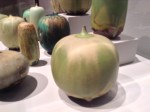


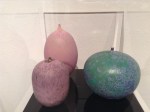


Athena is often mentioned as a war goddess because she was never defeated. She is also the goddess of wisdom and crafts. Her protection is important in firing the kiln. The ceramic demons that destroy a firing can take over without her blessing:
Homer’s Epigrams Fragment 14 (trans. Evelyn-White) (Greek epic C8th or C7th B.C.) :
“Potters, if you give me a reward, I will sing for you. Come, then, Athena [goddess of pottery], with hand upraised over the kiln. Let the pots and all the dishes turn out well and be well fired: let them fetch good prices and be sold in plenty in the market. Grant that the potters may get great gain and grant me so to sing to them. But if you turn shameless and make false promises, then I call together the destroyers of kilns, Suntribos (Shatter) and Smaragon (Smash) and Asbetos (Charr) and Sabaktes (Crash) and Omodamos (Crudebake) who can work this craft much mischief. Come all of you and sack the kiln-yard and the buildings: let the whole kiln be shaken up to the potter’s loud lament. As a horse’s jaw grinds, so let the kiln grind to powder all the pots inside.”
It is obvious to me that Rose Cabat made friends with Athena long ago in order to achieve such masterful results in the kiln. Her work is unique because her special glazes create a silky feel that is her secret weapon. The pots are vivid and beautifully shaped, inviting touch. The soft surface she creates is like no other. She calls the pots feelies, and has become famous for these special touchable forms. Her many collectors are happy to pay $400 and up for a tiny feelie because they only go up in value over time. Rose is still making pots from her wheel chair at age 100, and continues to be in very good standing with Athena. She has a show now at the Tucson Museum of Art featuring her work over her long career. It is incredible to see in person. I have seen her work over the years, but there are so many in one place that it delights the eye..and makes us wish we could feel them. There are some for sale in the Museum shop if you want your own to have and to hold.


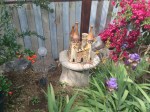







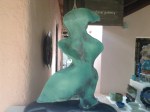

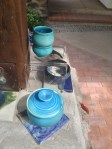


I recently reread the book Centering by Mary C Richards, a potter. In it she waxes very poetic about the subject of pottery. When I was covered with mud I considered Ms Richards to be fluffy and woo woo. About 35 years later I see how centering clay on a wheel is sheer poetry. I also notice my own approach to centering, which has never left me. I now like to center my body from the core in deep water, using tubular units for balance. This month as I attempt to write a poem a day I searched my memory for inspiration. Janet Burner, queen of all alchemists and artist of great skill and talent, popped into my mind. She has awesome technical skills and an alliance with fire like nobody I have ever seen. I like fire myself and enjoyed my time as a kiln queen. Janet has perfected various styles of firing to add variety and excitement to her work. She has always been famous for her raku. Now she has evolved other techniques, both modern and ancient, to bring her work to life.
In the kiln the pot is actually born. Just like an animal at birth, it also has a chance of dying. Potters must accept that some work will crack or be ruined in the firing. They must also accept that pottery is breakable, and glazes can only be controlled to a certain extent. Intimate knowledge and wisdom of the firing process results from practice and experimentation. I think of Janet Burner as the ultimate goddess of the fire. We talked about how ironic it is that her last name is Burner, both because of fire and because one of the oldest techniques used in finished ceramics is called burnishing. Her work today is created in a wonderful studio full of light, love, and art that she built herself. The artful courtyard garden serves as a gallery to display her work. She continues to teach at the Tucson Museum of Art School and grace our community with her participation in the Pima Arts Council Open Studio Tours. Next weekend you can visit artists and see their studios all over Tucson. This is an excellent way to find art and artists.
April is for poets, and we are all poets. There are many ways to celebrate. I have taken the challenge to write a poem each day in April. My approach is zen. The weekend workshop on ekphrastic poetry helped me find a place to begin. By responding to art, the ekphrastic poet reflects, or echoes the artist by interpreting the artwork. Memorizing a poem is another way to participate in the fun this month. My father could recite almost all of the Cremation of Sam McGee by Robert W Service, which was always impressive. Stories told in rhyme stay in the mind’s eye.
Poets.org has a poetry party happening right now. You can make a commonbook with quotes and poems using resources on the site. If you are lucky enough to live in Tucson you can visit our Poetry Center to experience space completely dedicated to poetry. Docents there are happy to give tours of the rare books and more if you call for an appointment. Today in Tucson the 31st annual Poetry Festival invites the public for free readings and activities all weekend. Fluency and artistry enhance the lives of those who listen. Tune in this month to hear what you may have been missing.

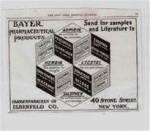

Drugs have won the war we have waged against them. Heroin is growing in popularity because it is a cheap substitute for the prescription drugs that are now the gateway. The profits are massive, and the corruption that accompanies the trade makes a joke of law enforcement. The name heroin was chosen by Bayer, the original marketers of the product, because it made the user feel like a hero. The company stopped manufacturing and selling heroin in 1913, and it was outlawed in the US in 1920. The Viet Nam war increased American use when 10-15% of our troops started using it while in Asia on deployment.
In the US today heroin use is on the rise . Young people between 18-25 are the fastest growing addict group. Mexican black tar heroin is smuggled in great quantity across the Arizona border. This corrupts our law enforcement and endangers our youth as it passes through on the way to it’s eventual market. The smuggling business includes all kinds of illicit drugs. It is organized by cartels run by very nasty individuals. The only way to pull the profit plug on the cartels is to reduce and eliminate demand on our side of the border. This is much easier said than done. From miracle cure to the ruin of our society, heroin has come a long way, baby.

Manchester coat of arms
My 8th great grandfather was part of an unusual settlement in New Haven, Connecticut. He probably arrived in 1638 with a group of Puritans from England:
On April 24, 1638, a company of five-hundred English Puritans led by the Reverend John Davenport and Theophilus Eaton, a wealthy London merchant, sailed into the harbor. They soon discovered that the Quinnipiacks and other local tribes were much distressed by raiding bands of Pequots and Mohawks from surrounding areas. It was for this reason that Momauguin, the sachem of the Quinnipiacks, and other tribe members agreed to sell the tribe’s land to the Puritans. In return, the settlers pledged to protect the natives and to allow them the use of the lands on the east side of the harborNew Haven’s founders not only hoped to create a Christian utopia, they also saw in New Haven’s spacious harbor an opportunity to establish a commercial empire that would control Long Island Sound and possibly the coastline as far south as Delaware Bay. By 1640 a complete government had been established and the settlement, originally called Quinnipiac, was renamed Newhaven. The town plan was based on a grid of nine squares. In accordance with old English custom, the central square, now the Green, was designated a public common. By 1641 New Haven had grown into a community of approximately 800.
Over the next few years, however, the flow of newcomers began to weaken and trade with the outside world shifted more and more to Boston. In an attempt to establish direct trade with England, the settlers managed to assemble enough produce to fill a vessel which would become known as the “Great Shippe.” However, after setting sail in January, 1646, the ship and its crew were never heard from again. This disaster ended the dream of creating an economic empire and over the years New Haven became overshadowed by New Amsterdam and Boston.
from: http://www.cityofnewhaven.com/Mayor/History_New_Haven.asp
Thomas Manchester, the Manchester immigrant ancestor, was born in England, and was a resident of New Haven, Connecticut, in 1639, in the year following the planting of the colony. Afterward, however, he settled at Portsmouth, Rhode Island, where he is first mentioned in the land records, January 25, 1655, when he and his wife sold to Thomas Wood twelve acres of land. He married Margaret, daughter of John Wood.
In the settlement of her father’s estate, it was ordered March 17, 1655, that the son John pay his sister, Margaret Manchester, eight pounds. Eight acres of land were granted at Portsmouth to Thomas Manchester, December 10, 1657, and he sold to Richard Sisson one-three-hundredth right in Canonicut and Dutch Islands. In 1680 he was taxed four shillings. He and his wife testified, June 7, 1686, that they heard and saw Ichabod Sheffield married by William Paulstone. He deeded to his son John. July 9, 1691, his mansion house and lands at Portsmouth, except the place at the lower end of the ground, in possession of his son Thomas, one-half to be his at the death of grantor and the other after the death of grantor’s wife,mother of grantee, provided he pay to the sons Thomas, William and Stephen, ten shillings each, to Job twenty shillings and daughters Mary and Elizabeth ten shillings each. He also gave to John his personal property, including cattle, tools, etc.
Thomas Manchester died in 1691; his wife in 1693. Children: Thomas, born about 1650; William, 1654; John, died in 1708; George, admitted freeman in 1680; Stephen, mentioned in his own biography; Job, died 1713; Mary; Elizabeth.
Source:
New England families, genealogical and memorial
By William Richard Cutter (pgs. 853-854)
Thomas Manchester (1620 – 1691)
is my 8th great grandfather
Elizabeth Manchester (1667 – 1727)
daughter of Thomas Manchester
Dr. James Sweet (1686 – 1751)
son of Elizabeth Manchester
Thomas Sweet (1732 – 1813)
son of Dr. James Sweet
Thomas Sweet (1759 – 1844)
son of Thomas Sweet
Valentine Sweet (1791 – 1858)
son of Thomas Sweet
Sarah LaVina Sweet (1840 – 1923)
daughter of Valentine Sweet
Jason A Morse (1862 – 1932)
son of Sarah LaVina Sweet
Ernest Abner Morse (1890 – 1965)
son of Jason A Morse
Richard Arden Morse (1920 – 2004)
son of Ernest Abner Morse
Pamela Morse
I am the daughter of Richard Arden Morse
Thomas Manchester was born in England about 1620, and died at Portsmouth, R.I., about 1691. He was an early pioneer of Quinnipiac, called New Haven after 1640, in the Plantation of Connecticut: since he is found there in 1639, it would seem probable that he was of the company of Yorkshire settlers who in 1638 came to America with Ezekiel Rogers, the famous non-conformist minister, with the view of joining the Quinnipiac Plantation, although many of them eventually settled elsewhere.
The New Haven colony differed very much from other colonies. Many of the colonists put up large houses. As an explanation why this style of building was so general, it may be said that the founders of New Haven were mainly gentlemen and merchants, used to living in superior houses in London and other parts of England. For a period,Thomas continued at Quinnipiac, but removed to Portsmouth, R.I, before 1642.
On February 25/1642 he was appointed to serve on the next jury. From 1674 till his death, he was Town Sergeant. He became a considerable landed proprietor. Prior to 1655 he acquired land on the island of Aquidneck, and on January 25/1655, he made a deed of a tract of 12 acres there to Thomas Wood.
On December 10/1657, he shared in the land division and received eight acres at Portsmouth. He also had sharein Dutch Island and Quononoquet Island, and conveyed his interest in 1/300th right therein to Richard Sisson on July 6/1658. His mansion and homestead was built on his Portsmouth land.
On July 9/1691, Thomas deeded to his son John, his mansion house and all lands at Portsmouth, except the piece at the lower end, which had been theretofore deeded to his son Thomas. According to the deed, half was to be John’s on hisbrother Thomas’ death, and the remaining half upon the death of his Mother, conditioned always that pay to his brothers Thomas, William and Stephen, 10 shillings each, to Job 20/-, and to his sisters Mary and Elizabeth, ten shillings each. John also received from his father his personal property, cattle, chattels, implements, bonds, sums of money, and whatever belonged to him at the time of his death.
Thomas Manchester married, prior to 1650, Margaret Wood, who died about 1693, daughter of John Wood of Portsmouth, R.I., who bequeathed to his daughter Margaret the sum of œ8.
Next Saturday, 5 April, 2014 will be a big day in Dragoon, Arizona. The first run in Texas Canyon is organized to coincide with a food festival, a wine and brew fest, and a spring fling. Dragoon is just about an hour’s drive away from Tucson on I-10. The Amerind Foundation Museum is primo Native art displayed perfectly. The collections are impressive, and the galleries designed with the greatest of care. If you have not visited the museum next Saturday is a great day to do it. Admission will be free for the day, and the festivals will round out the activities. Runners should register early if they want to compete in the trail run.
Ryan Redcorn, an Osage entrepreneur, has produced this video of smiling Indians. It is dedicated to Edward Curtis whose Native American images dominate the web and the memory. Just yesterday I was at the Arizona State Museum viewing some Curtis photos shot in Arizona, and all were new to me. His seemingly endless portfolio was shot in the first decades of the 20th century. The work has become controversial. Mr. Redcorn believes in producing yourself, which inspired him to create this video as a counterpoint to Curtis.
I was in Pawhuska, Oklahoma a few years ago on an ancestry hunt. My cousin and I were trying to sort out a story that our great-grandmother as Cherokee. We never found any evidence pro or con, but we went to the tribal headquarters of both the Osage and Cherokee tribes to seek answers. My cousin (like many Americans) was stuck on the romantic notion that we are Cherokee. When I saw the tiny museum in Pawhuska and talked to the curators I wanted to be Osage. They were always distinct among the 5 civilized tribes. They got rich from oil and spent much of their wealth buying products from France, especially elaborate fashion items. My father told me when he was a kid the Osage used to drive around in Cadillacs with goats in the back seat. I am probably not descended from the Osage tribe, but I do really admire the way they are. I loved the art, the history, and their sense of humor on my visit with them. Now I also love Ryan Redcorn who has a sense of humor and a bigger sense of justice.
Today at the Tucson Botanical Gardens docents from the U of A Poetry Center offered a reading and workshop in Ekphrastic Poetry. This style of poem is a response to a piece of art, the Ek being from Greek and referring to echo. The group attending was a mixture of students, visual artists, and poets. By far the most emotional poem of the day was read by a Nam Vet who sat behind me. He chose to read War Photograph by Kate Daniels. His choked up emotions brought tears to his eyes which brought tears to the eyes of the audience. The other poems were discussed and analyzed but we were all very touched and had nothing more to say after he read. At the end of the session participants wrote poems about the photos in the gallery. All were striking. I apologize, gentle reader, for cutting off the very beginning of some of these gentle readings. It was a well produced and very well appreciated poetry experience, and we all have beautiful handouts to finish at home. There is one more session this spring of Poetry in the Gardens, Native poetry on April 26, 2014. These programs are included with garden admission. It is SUCH A DEAL!!


!
 mermaidcamp