mermaidcamp
Keeping current in wellness, in and out of the water
You can scroll the shelf using ← and → keys
You can scroll the shelf using ← and → keys

ROW80
My poetic week was full of images of the deep south and history. I studied ancestors from Alabama who moved to Texas after the Civil War, which conjured up all kinds of images. There are descriptive written accounts of the places and events, especially the battles. The river flood plain where my people settled was deadly with cholera and disease. This may be the reason the father of the family died so young, but there is no evidence. I become very wrapped up in the general as well as the specific information I find about my ancestors. I imagine daily life as well as how the big events must have taken place. After their town became a ghost town my mother’s family loaded up ox carts and moved to Texas. There is a lot of water and low land on their route, and roads were not established everywhere. Elizabeth Langley must have been full of stories by the time she died at age 96. I have no pictures of her, but her image is forming in my imagination. She was no stranger to mosquitos, and she must have had a strong constitution. She is one of these people in my family tree who perfectly represents a certain time in history. She has the makings of a very interesting character in a story. I have decided to follow my fellow writers and make a draft of a story. I am not ready to outline, but for once I plan to draft, edit, edit, and add, rather than finish and publish whatever this will be. It may be a short story, or I might be able to make it rhyme…like Evangeline. I thank you all for showing me that I could use some extra steps to create better written works. I have faith that this will work.
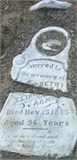
Elizabeth Langley, Texas
Scarlet O’Hara she clearly was not,
Her life was difficult, tragic, and hot
My range of subjects has been narrow but evolving, which is all I expect of my budding poetic voice. I have a new feeling about the poems, which is kind of a documentation of my progress as a writer. The worse they sound now, the more potential there is to see them improve over time. Sometimes I think of truly terrible rhymes, and hope to start using them instead of the trite kind of thing I do at this moment. I play around with bad rhymes in the pool, and later when I am dry they have gone to the place where bad rhymes hide. I need to work on this. I plan to write the daily poetry to keep the practice going while I write scenes or descriptions of Elizabeth Langley’s life. It was so long I may need to pick a short period to cover in the story. I might choose reaction to the end of the Civil War, which was a big deal for all involved.
I believe the best thing I have discovered through this challenge is poetry written by others. I listen and read poetry daily now, and think that alone is a wonderful upgrade to my life. Some work makes me laugh, and some brings out curiosity. I am thrilled to see so many different forms used to express poetic thoughts. It is liberating to find so many free style as well as highly formatted ways to go about painting with words. There is no right or wrong, but some have more impact than others. This week the UA Poetry Center will offer two readings I plan to attend, one in house and another next Saturday at the Tucson Botanical Gardens. The Valentine reading at the gardens is on birds. We will receive a packet of poems about birds, and they will be read and discussed. They have designed the perfect valentine for me!!!
I have the Confederate army records of my 2nd great-grandfather, William Ellison Taylor. Both he and his father in law applied and received Confederate pensions in Texas late in life. They came from the vicinity of what is now Selma, Alabama. The new movie about Selma has intrigued me although I have not seen it. I was alive to witness those events, and my mother’s family had a long history in Selma about which I recently learned. In fact, my 3rd great-grandmother owned a large tract of land in Old Town, Dallas, also known as Cahawba. She moved there from Georgia with her husband when it was the county seat, and maybe when it was still the capital of Alabama. It was a happening river port with a large warehouse. The area is now an archeological park with ongoing restoration projects. Elizabeth lived through the Civil War in Alabama, then moved to Texas with her son and extended family.

Old Town

Cahawba
Elizabeth Langley (1790 – 1885)
is my 3rd great grandmother
Thomas Armer (1825 – 1900)
son of Elizabeth Langley
Lucinda Jane Armer (1847 – 1939)
daughter of Thomas Armer
George Harvey Taylor (1884 – 1941)
son of Lucinda Jane Armer
Ruby Lee Taylor (1922 – 2008)
daughter of George Harvey Taylor
Pamela Morse
I am the daughter of Ruby Lee Taylor
Elizabeth was born in South Carolina and died in Texas. Her husband died before the Civil War. She obtained a land patent from the BLM. She sheltered her family there during the war.

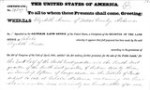
When the Armer family arrived in Waller, Texas they bought land with gold, then donated some of it to found the Shiloh Baptist Church, where Elizabeth is buried. I always wonder why they had gold since the men in the family were working in the service of the Confederacy, for Confederate money. When it became worthless the family must have had some tricks up the sleeves, or been able to sell the Alabama land for gold. They executed the move in oxcarts. They went to an area known for cotton farming, but I don’t think they grew cotton. In fact, the records do not reflect that the Armers owned slaves before the war. They were part of Confederate society, but either too poor or too religious to own slaves. In Texas they were preachers and subsistence farmers.
Elizabeth Langley, Texas
The parallel between what happened during Elizabeth’s life and the Civil Rights march in 1965 is striking. This story comes from the informative Facebook page of Cahawba:
In Gen’l James Wilson’s autobiography, he wrote that after meeting with Gen’l Forrest at Cahawba (after the Battle of Selma), they parted ways, and he returned to Selma then crossed the Alabama River and headed his Federal troops toward Montgomery. Here’s what he had to say about the enslaved African Americans that started to follow him: ” a great number of fugitives from the surrounding country flocked into the town and our march to the eastward had hardly begun when it became apparent that new crowds were following us, which made vigorous measures necessary for getting rid of them. The rear guard could keep them behind, but could not prevent them from taking the “ROAD TO FREEDOM.” Wow! The goosebumps started forming when I realized that this ROAD TO FREEDOM was exactly the same route that marchers for voting rights took exactly 100 years later! I can’t think of a better example of Selma’s tourism tag line, “Civil War to Civil Rights.”
FYI. Gen’l Wilson eventually organized, armed and equipped the able-bodied men and found them valuable additions to his force.
This is an amazing story and not a coincidence. I had not planned to go to Alabama again in my life, but now that they have put so much effort into uncovering the history of my 3rd great-grandmother’s lifetime in this place, I might need to visit. They specialize in birding, which is pretty cool. Visitors can participate in guided bird outings. Civil War to Civil Rights is a very interesting subject, still in progress.
These Italians have perfected the art of making containers from citrus peels. They use bergamot, but I have seen this kind of box made out of an orange peel. The scent remains for a few years after the box is created, making it perfect for tea, or other aromatic products. The specialty here is a tobacco pouch, which is light and fragrant. I am crazy about this idea, and am the producer of hundreds of grapefruit peels each year. I have so many that my compost gets full of citrus and hard to digest. I hate to waste them, but really do not eat candy. The candied peels are a treat to some, but require as much work as these containers. I have looked for a way to use these byproducts of my juicy winter crop, and I think I have found one to try. Martha Stewart does hers in the oven and keeps them right side out. I like the whole process the Italians use, but do not want a tobacco pouch as a result. I tried Martha’s oven method with some lemon peels, but they warped after I thought they were done. Her method is tedious and it requires the use of the oven. I live in Arizona where ample sunshine should be able to do this job. I will try a simple shape with a lid, and skip the sand step and building of presses. If they go free form, like my first attempt, I will need to deal with the fit of top to bottom. My lemon bowls are all wonky because I took them from the oven after 40 minutes. If I were in survival mode and had to use them, they might hold something, but they are a failure at a design level. I plan to try some grapefruit peels this week inside out to see if I can be a peel artist. These Italian ladies are obvious professionals, shaping it around the form like a pice of clay. I admire their skill, and aspire someday to make a swanky shape. Like clay, I need to start with a good cylinder and move on from that. I have at least 100 grapefruit still on the tree, so there will be plenty with which to experiment. Have you ever seen this done, Gentle Reader?

failed lemon box
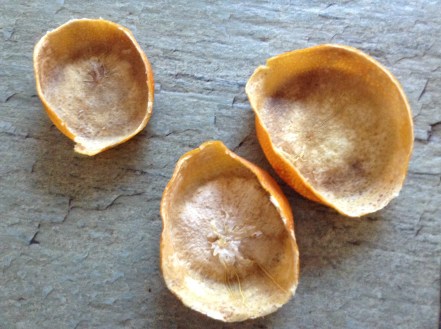
as tiny bowls


My study of poetry and the lives of poets has enlightened as well as encouraged me to continue my poetic practice. I also loved hearing the news about the secret manuscript discovered that was written by Harper Lee, famous reclusive author. The story of her one big hit, To Kill a Mockingbird, followed by a life out of the public eye entirely is compelling. She never spoke to press people, but her sister did. Now that her sister has died this old copy of a typewritten story was found in the safe deposit box attached to the original of the published novel. It is super romantic because her fans have hoped to make her write again, but she had done it even before they knew her work. Truly a blast from the past for all involved, the publication with cause all manner of excitement. It has captured my imagination about finding the writing of my ancestors in the safe deposit box of history.
I found a poem about writing that has a deeply funny sense of humor. Anne Bradstreet, my 9th great-grandmother, wrote a poem to her published book in which she describes the work as a child of hers. Although her work is usually pretty serious, this one strikes me as not only funny, but also prescient. The book of which she speaks made her a famous person in the history of poetry, but she is both humble and comical in her description of the work:
Thou ill-formed offspring of my feeble brain,
Who after birth did’st by my side remain,
Till snatcht from thence by friends, less wise than true,
Who thee abroad exposed to public view,
Made thee in rags, halting to th’ press to trudge,
Where errors were not lessened (all may judge).
At thy return my blushing was not small,
My rambling brat (in print) should mother call.
I cast thee by as one unfit for light,
The visage was so irksome in my sight,
Yet being mine own, at length affection would
Thy blemishes amend, if so I could.
I washed thy face, but more defects I saw,
And rubbing off a spot, still made a flaw.
I stretcht thy joints to make thee even feet,
Yet still thou run’st more hobbling than is meet.
In better dress to trim thee was my mind,
But nought save home-spun cloth, i’ th’ house I find.
In this array, ‘mongst vulgars may’st thou roam.
In critic’s hands, beware thou dost not come,
And take thy way where yet thou art not known.
If for thy father askt, say, thou hadst none;
And for thy mother, she alas is poor,
Which caused her thus to send thee out of door.

Anne Bradstreet’s poems
I really get the way she edits and finds more fault. She calls her book a bastard and herself poverty stricken, which I think she knows is a joke. She warns it to stay away from critics, then lets it go. By animating the book to human stature she paints a picture of an underprivileged child, some awkward and unpolished brat. At the publication (return) her blushing was not small. She was proud to be published, and yet as a Pilgrim could take no personal credit for the art. This has become my favorite work by Mistress Bradstreet because I clearly relate to her sense of comedy. In 1678 some of her work was published posthumously. She was, in a certain sense, a feminist. Now we learn she was also something of a comic, concerned about the cosmic.
Birth: 1612 Death: Sep. 16, 1672 Poet.
Born Anne Dudley to nonconformist parents Thomas Dudley and Dorothy Yorke Dudley in Northampton, England. Her father was the steward for the Earl of Lincoln and afforded his daughter an unusually complete education. About 1620 she married Simon Bradstreet, her father’s assistant. On March 29, 1630, Bradstreet and her family sailed for the New World. After several years, they finally settled on a farm in North Andover, Massachusetts in 1644. Simon Bradstreet became a judge, royal councilor, and twice a governor of the colony. Anne Bradstreet became mother to eight children and wrote only privately. She was frequently ill and apparently developed a vaguely morbid mind set and was continually distressed by the culturally ingrained condescension toward women. Her first public work may well have been the epitaph she penned for her mother in 1643. Four years later, her brother-in-law carried a collection of her poems with him to England where he had them published. They appeared as ‘The Tenth Muse Lately Sprung Up in America, By a Gentlewoman of Those Parts’ in the New World in 1650. While it did sell in England, the volume was not well received in Massachusetts. Although she continued to write for herself and her family, no more of her work was published in her lifetime. She was purportedly buried in the Old Burying Point in Salem, Massachusetts beside her husband, though other locations for her grave have also been proposed. In 1678 her ‘Several Poems Compiled with Great Variety of Wit and Learning’ was posthumously published followed by ‘The Works of Anne Bradstreet in Prose and Verse.’ She is now considered the earliest of American poets and among the finest of her age. (bio by: Iola)
Now that Anne is a little bit funny she is a better poetry muse to me. Dorothy Parker, as my muse, as nixed the whole #Trwurse and #Twessings concept. She did wonderful intricate play on words before twitter and is not at all amused by the substitution of tw to indicate twitter being witty. She is right, of course. Nursing mothers are already occupying the #Twursing hashtag, as is the PGA. Back to the word board, sans #tw. I still like the blessings and curses for twitter, but am now inclined to call them just that. I have also realized that February is the perfect time to write short and funny rhymes..on Valentines. I feel okay about breaking out of my impersonal poetic rut because I have written a food poem and one Valentine that are in new territory. I have not said anything very funny yet, but think I will sometime soon. I aspire to write jokes that would be understood hundreds of years into the future, in case they are discovered, but still be funny now. Contrived twitter words will not be funny enough to last hundreds of years, but will seem like Olde English does to us now. Best to go for eternal when crafting a joke or a pun….
ROW80

Joan Fitzalan
My 18th paternal great-grandmother is also the ancestor of my famous poet, Anne Dudley Bradstreet. Her father was beheaded at the Tower of London by Richard II. I wonder if I have a record number of ancestors beheaded at the Tower. When Henry IV came to the throne Joan and her sisters were restored to wealth and power. Her sister Elizabeth is my mother’s ancestor, so this cozy castle was once home to both my bloodlines:

Arundel Castle
Joan Fitzalan (1360 – 1435)
is my 18th great grandmother
Joan Elizabeth Beauchamp (1396 – 1430)
daughter of Joan Fitzalan
Elizabeth Butler (1420 – 1473)
daughter of Joan Elizabeth Beauchamp
Isabel Talbot (1444 – 1531)
daughter of Elizabeth Butler
Sir Richard Ashton (1460 – 1549)
son of Isabel Talbot
Sir Christopher Ashton (1493 – 1519)
son of Sir Richard Ashton
Lady Elizabeth Ashton (1524 – 1588)
daughter of Sir Christopher Ashton
Capt Roger Dudley (1535 – 1585)
son of Lady Elizabeth Ashton
Gov Thomas Dudley (1576 – 1653)
son of Capt Roger Dudley
Anne Dudley (1612 – 1672)
daughter of Gov Thomas Dudley
John Bradstreet (1652 – 1718)
son of Anne Dudley
Mercy Bradstreet (1689 – 1725)
daughter of John Bradstreet
Caleb Hazen (1720 – 1777)
son of Mercy Bradstreet
Mercy Hazen (1747 – 1819)
daughter of Caleb Hazen
Martha Mead (1784 – 1860)
daughter of Mercy Hazen
Abner Morse (1808 – 1838)
son of Martha Mead
Daniel Rowland Morse (1838 – 1910)
son of Abner Morse
Jason A Morse (1862 – 1932)
son of Daniel Rowland Morse
Ernest Abner Morse (1890 – 1965)
son of Jason A Morse
Richard Arden Morse (1920 – 2004)
son of Ernest Abner Morse
Pamela Morse
I am the daughter of Richard Arden Morse
Joan FitzAlan, Baroness Bergavenny (1375 – 14 November 1435) was an English noblewoman, and the wife of William de Beauchamp, 1st Baron Bergavenny of the Welsh Marches.
Family and Lineage
Lady Joan FitzAlan was born in 1375, at Arundel Castle, Sussex, England, one of the seven children of Richard Fitzalan, 11th Earl of Arundel, Earl of Surrey, and his first wife Elizabeth de Bohun. Her only surviving brother was Thomas Fitzalan, 12th Earl of Arundel, of whom Joan was his co-heiress. She had an older sister Lady Elizabeth FitzAlan who married as her second husband Thomas Mowbray, 1st Duke of Norfolk. Her paternal grandparents were Richard Fitzalan, 10th Earl of Arundel and Eleanor of Lancaster, and her maternal grandparents were William de Bohun, 1st Earl of Northampton and Elizabeth de Badlesmere. On 3 April 1385, her mother died. Joan was about ten years old. Her father married secondly, Philippa Mortimer on 15 August 1390, by whom he had a son, John Fitzalan, who was born in 1394. John died sometime after 1397.
On 21 September 1397, Joan’s father, the Earl of Arundel, who was also one of the Lords Appellant, was beheaded on Tower Hill, London, on charges of high treason against King Richard II of England. The Earl had always enjoyed much popularity with the citizens of London. His titles and estates were forfeited to the Crown.
In October 1400, the new king Henry IV who had ascended the throne following Richard’s deposition in 1399, restored the titles and estates to Thomas Fitzalan, Joan’s brother. He became the 12th Earl of Arundel and Earl of Surrey. Although he married Beatrice, an illegitimate daughter of King John I of Portugal and Inez Perez Esteves, he died childless on 13 October 1415. The Earldom and castle of Arundel passed to a cousin John Fitzalan, 13th Earl of Arundel, the rest of his inheritance was divided among Joan and her two surviving sisters, Elizabeth and Margaret.
Marriage and Issue
On 23 July 1392, Joan was married to William de Beauchamp, 1st Baron Bergavenny (c.1344- 8 May 1411) the son of Thomas de Beauchamp, 11th Earl of Warwick and Katherine Mortimer. He was more than thirty years Joan’s senior.
The marriage produced a son and a daughter:
· Richard de Beauchamp, 1st Earl of Worcester, 2nd Baron Bergavenny (born before 1397- 1422), married Isabel le Despenser, daughter of Thomas le Despenser, 1st Earl of Gloucester and Constance of York, by whom he had one daughter Elizabeth de Beauchamp, Lady of Abergavenny.
· Joan de Beauchamp (1396- 3 August 1430), married on 28 August 1413 James Butler, 4th Earl of Ormond, son of James Butler, 3rd Earl of Ormond and Anne Welles, by whom she had five children, including Thomas Butler, 7th Earl of Ormond. Anne Boleyn and Mary Boleyn were notable descendants.
Joan FitzAlan died on 14 November 1435, at the age of sixty. She was buried in Black Friars, Hereford.
References
Charles Cawley,Medieval Lands, Earls of Arundel 1289–1580 (Fitzalan).
Thomas B. Costain,The Last Plantagenets, pages 196–201
thePeerage.com
Charles Cawley,Medieval Lands, Earls of Arundel 1289- 1580 (Fitzalan)

Lady Elizabeth Fitzalan, Duchess of Norfolk
Elizabeth Fitzalan as well as her sister Joan are both my ancestors, on maternal and paternal sides of my family. Elizabeth is my mother’s ancestor. She had a remarkable life, outliving 4 husbands. She is probably buried in an alabaster tomb in the church in village of Hoveringham, England with my 17th great-grandfather who died in battle. She married him without a license, which angered the king.
I am lucky that Bruce Morrison is her descendant also. He has devoted time and study to give us many details about her life. Here is his research:
FOREWORD: The early 15th century alabaster tomb and effigies of Sir Robert Goushill and his wife Elizabeth Fitz-Alan Duchess of Norfolk are found at the parish church of the village of Hoveringham in Nottinghamshire, England. The tomb is located just to the right as you enter the church. The original medieval St. Michael church at Hoveringham was razed in 1865, and the present plain, small brick church was erected in it’s place. The above copyright photographs were taken during a visit to Hoveringham in 1991 by Bruce Morrison of Lexington, Kentucky, a descendant of Robert Goushill and Elizabeth Fitz-Alan. (I do not have Bruce’s photos)
THE TOMB & EFFIGIES: The effigies show effects of earlier vandalism and mutilation incurred during earlier centuries. The right arms of both effigies are broken and missing–they originally were holding hands. Some damage also occured when the monumemt was relocated when the present church was erected. The figures are of alabaster with Sir Robert Goushill shown wearing a camail and hawberk and plate armor on his arms and legs. His feet rest upon the figure of a dog, and his collar shows the badge of his Lancastrian loyalty. He wears a Bacinet on his head with a wreath which rests on a crowned Saracen’s head. The Saracen’s head was derived from the Goushill family crest. The Goushill of Hoveringham coat of arms was a barry of six or and gules with a canton ermine. The figure of Elizabeth Fitz-Alan is shown wearing a peeress gown with a coronet on her head emblematic of her rank as a duchess. The tomb was created after Sir Robert Goushill’s tragic death in 1403, probably by the design of his widow Elizabeth Fitz-Alan who lived to 1425. It is likely that she was also buried in the tomb, but no definitive proof or evidence exists. Robert Thoroton’s description of the tomb in the 17th century states that about the fair tomb were the arms of Leek, Longford, Babington, Chaworth impaling Caltofts, Remptons, and divers others. These are long lost as well as the tomb of Sir Nicholas Goushill, the son of Sir Thomas Goushill, who died in 1393. This stone was in the south isle of the original St. Michael Church. The lower base portion of the Goushill Fitz-Alan tomb is decorated by a series of shields on all sides which were probably the location of the large number of now lost coats of arms described in Thoroton’s History.
ROBERT GOUSHILL: Sir Robet Goushill was knighted by King Henry IV at the battle of Shrewsbury on July 21,1403. At the Battle of Shrewsbury the loyalist forces of Henry IV were opposed by the rebel army of Henry Percy (Hotspur). The army of King Henry IV won the day with the killing of Hotspur during the conflict. Casulties on both sides were high with estimates of 3000 killed or wounded on each side. Sir Robert Goushill was knighted the day of the battle for his gallantry, but was badly wounded in the side. Found lying wounded by his servant on the eve of the battle, Goushill asked that his armor be removed and a note sent to his wife Elizabeth in case of his death. The servant then stabbed and murdered Sir Robert Goushill and made off with his purse and ring. Another wounded man lying nearby recognized the servant, and he was later caught and hanged for the crime. The arms of Sir Robert Goushill would be placed in the Shrewsbury Battlefield Church by King Henry IV.
Robert Goushill was the son and heir of Sir Nicholas Goushill of Hoveringham. The date of his birth is unknown, but can be estimated to be circa 1360-1365. Likewise, the name of his mother also remains unknown. The Goushill family had held extensive lands in Nottinghamshire and Derbyshire since the 13th century. Walter Goushill, an early ancestor in the direct line, gained a number of these considerable holdings for the Goushills through his marriage to Maud (Matilda) Hathersage, the co-heiress of Mathew Hathersage in Derbyshire. (The early pedigree of the Goushill family of Hoveringham can be found in the History of Nottinghamshire by Dr. Robert Thoroton). In the calendar of patent rolls of Richard II on March 12, 1386, the King orders the arrest of Sir Nicholas Goushill the elder and his son Robert Goushill to answer the suit brought by William Birkes accusing the Goushills of threatning him with the loss of life and limb that he dare go about his business. On July 16, 1385, Sir Nicholas Goushill received the King’s pardon. During 1387, Nicholas Goushill knight of Hoveringham and his son Robert Goushill are found in the chancery records to owe a debt of 22 pounds to Robert Wells of London. The next mention of Robert Goushill occurs in 1390 when he receives the King’s pardon for alleged outlawry and other felonies through the supplication of Thomas Mowbray. Thomas Mowbray was at that time Earl of Nottingham and later would become the Duke of Norfolk. This evidences that Robert Goushill was already a supporter of Thomas Mowbray of whom he would be an employee of for the next decade. Elizabeth Fitz-Alan, the future wife of Robert Goushill, had been the wife of Mowbray since 1384.
During the 1390’s, Robert Goushill would be in the retinue of Thomas Mowbray, Earl of Nottingham, Marshal of England, and Duke of Norfolk, serving as Mowbray’s esquire and attorney. When Thomas Mowbray received his ducal elevation in 1397, he gave to his esquire Robert Goushill a 20 pound annuity for life from his manor at Willington. This grant was confirmed by Henry IV in November of 1399. In 1398, after the Duke of Norfolk was banished by Richard II, Robert Goushill was appointed one of the attorneys for Mowbray. At the coronation of King Edward IV on October 13, 1399, Robert Goushill would make a plea for the return of the banished Duke of Norfolk as Earl Marshall, not knowing Mowbray had already died of the plague in Venice, Italy on September 22, 1399. In the mid 1390’s, Robert Goushill had married as a first wife Joan Bracebrugge, who was the widow of Sir Ralph Bracebrugge of Kingsbury, Warwickshire. Joan (maiden name unknown) had married Ralph Bracebrugge in 1380 and his death occured in August, 1395. The marriage of Robert Goushill and Joan Bracebrugge likely was in 1396, and Joan would die early in the year 1400. (IPM Henry IV, 1-6). In 1397 Richard II appointed Sir William Bagot and Robert Goushill to seize into his hands the goods and chattels of Thomas the late Earl of Warwick. (Goushill served as Warwickshire sheriff in 1396/97). After Richard II was deposed, the new King Henry IV made a grant on Feb. 23, 1400 to his kinswoman Elizabeth, the wife of the late Duke of Norfolk, of the remaining goods of the late Duke as well as clearing the debts that the Duke had owed to the deposed Richard II. Others to share in the remaining goods of the deceased Duke of Norfolk included Robert Goushill.
Robert Goushill would marry the widowed Elizabeth Fitz-Alan, Duchess of Norfolk, in the latter part of 1400 or early 1401 without license. On August 19, 1401, King Henry IV seized the lands of Elizabeth, late widow of Thomas Mowbray, for marrying Robert Goushill without license. On September 28, 1401, Henry IV would pardon Robert Goushill esquire and Elizabeth, late wife of Thomas, duke of Norfolk, for their trespass for inter-marrying without license and that they shall have restitution of all lands assigned to her in dower with the issues from the time of their marriage. Joan Goushill, the 1st daughter of Robert and Elizabeth, would be born in 1401, and a 2nd daughter Elizabeth Goushill would be born in 1402. Many present day descendants of these two daughters trace their ancestry to the Plantagenet Kings of England through Joan Goushill who married Sir Thomas Stanley, 1st Baron Stanley, and Elizabeth Goushill who married Sir Robert Wingfield of Letheringham, Suffolk. (My own descent is through the Goushill-Wingfield marriage). A 3rd daughter named Joyce is now credited to Robert and Elizabeth. She was found in a 1407 lawsuit being named after older daughters Joan and Elizabeth. As she is not named in Robert Goushill’s Inq. Post Mortum of 1403, she would certainly seem to have been born after Robert Goushill’s death. No futher trace of Joyce Goushill has been found. After the tragic death of Sir Robert Goushill at the battle of Shrewsbury on July 21, 1403, his Inquisition Post Mortum was held August 6, 1403. His heirs are given as his daughters Joan and Elizabeth, aged two years and one year respectively. A final thought regarding the pedigree of the Goushill family of Hoveringham as given by Thoroton: the pedigree lists the Sir Nicholas Goushill dying in 1393 as the grandfather of Robert Goushill and Robert’s father as another Nicholas Goushill. This 2nd Nicholas Goushill listed in the pedigree was very likely confused with the Sir Nicholas Goushill of Barlborough, Derbyshire who was also at the battle of Shrewsbury. He was certainly a relative and contemporary of Robert Goushill and either brother or first cousin, but not his father. The first 1380’s records that mention Robert Goushill appear with Sir Nicholas Goushill the ELDER given as the father of Robert Goushill. I believe the evidence stongly suggests that the father of Robert Goushill was the Sir Nicholas Goushill who died in 1393 and was buried at St. Michael’s church Hoveringham.
ELIZABETH FITZ-ALAN: Elizabeth was the eldest daughter of Richard Fitz-Alan the 11th Earl of Arundel and his wife Elizabeth de Bohun. Both the Fitz-Alan and Bohun family lines were among the highest in the peerage of medieval England. Elizabeth Fitz-Alan had a double line of direct descent from the Plantagenet Kings of England. Through her mother’s Bohun line she was a direct descendant of King Edward I and Eleanor of Castile, and through her Fitz-Alan ancestry a direct descendant of King Henry III and Eleanor of Provence. She was also related by cousinship to both King Henry IV and to his first wife Mary Bohun. Elizabeth was born before 1372, (in 1415 she was given as aged 40 or more), and a best estimate would be closer to 1367. By December of 1378 she would be married to her first husband William de Montagu, son of the Earl of Salisbury. This marriage for Elizabeth would certainly have been in her childhood. William de Montagu was killed in a tilting match at Windsor in 1382. Elizabeth Fitz-Alan would marry as her 2nd husband Thomas Mowbray, the Earl of Nottingham and later the Duke of Norfolk, in July of 1384. This marriage would last for 15 years until Thomas Mowbray’s death in Venice on September 22, 1399. Elizabeth would have 2 sons and 2 daughters during her marriage with Thomas Mowbray. The sons were Thomas Mowbray 1385-1405 and John Mowbray 1390-1432, (both of these sons would assume the title Earl of Nottingham), the 2 daughters were Margaret who married Sir Robert Howard, and Isabel who married Henry Ferrers. In 1397 Thomas Mowbray was among those who accused and condemed Elizabeth’s father Richard Fitz-Alan, the Earl of Arundel. Richard Fitz-Alan was found guilty of treason and be-headed at Cheapside on September 21, 1397. One apocryphal rumor even had Thomas Mowbray as the actual executioner of his father-in-law Richard Fitz-Alan. The now twice widowed Duchess of Norfolk would next marry Sir Robert Goushill as previously discussed in length. After the death of Sir Robert Goushill at Shrewsbury in 1403, she would marry Sir Gerald Usflete of Yorkshire as her fourth husband before April 18, 1411. Sir Gerald Usflete was the steward of the Duchy of Lancaster in Lincolnshire. Elizabeth Fitz-Alan would become a co-heiress of her brother Thomas, Earl of Arundel and Surrey, in 1415. (Thomas had died sans progeny on October 13, 1415, and his sisters had become his heirs). Sir Gerald Usflete died by Feb. 1420/21, having written his will on September 13, 1420. No children were born to Elizabeth Fitz-Alan and Gerald Usflete.
Bruce Morrison is a professor emeritus of the University of Kentucky and lives in Lexington, Ky. He and his wife Barbara have been engaged in genealogical research since 1985, and have published a number of genealogy and biographical web sites in recent years. The photographs of the Hoveringham tomb were taken in May of 1991 during one of several genealogy related trips to Europe between 1985 and 2008. It is hoped that this site will be of interest to all of the many Goushill-Fitz-Alan descendants.
•Bruce & Barbara Morrison
•3488 Elmendorf Way
•Lexington, Ky. USA 40517
•859-272-4192
•© 2008
Elizabeth Duchess Norfolk Fitzalan (1366 – 1425)
is my 17th great grandmother
Lady Joan De Goushill Baroness Stanley (1402 – 1459)
daughter of Elizabeth Duchess Norfolk Fitzalan
Countess Elizabeth Sefton Stanley (1429 – 1459)
daughter of Lady Joan De Goushill Baroness Stanley
Thomas Sir 8th Earl of Sefton Molyneux (1445 – 1483)
son of Countess Elizabeth Sefton Stanley
Lawrence Castellan of Liverpool Mollenaux (1490 – 1550)
son of Thomas Sir 8th Earl of Sefton Molyneux
John Mollenax (1542 – 1583)
son of Lawrence Castellan of Liverpool Mollenaux
Mary Mollenax (1559 – 1598)
daughter of John Mollenax
Gabriell Francis Holland (1596 – 1660)
son of Mary Mollenax
John Holland (1628 – 1710)
son of Gabriell Francis Holland
Mary Elizabeth Holland (1620 – 1681)
daughter of John Holland
Richard Dearden (1645 – 1747)
son of Mary Elizabeth Holland
George Dearden (1705 – 1749)
son of Richard Dearden
George Darden (1734 – 1807)
son of George Dearden
David Darden (1770 – 1820)
son of George Darden
Minerva Truly Darden (1806 – 1837)
daughter of David Darden
Sarah E Hughes (1829 – 1911)
daughter of Minerva Truly Darden
Lucinda Jane Armer (1847 – 1939)
daughter of Sarah E Hughes
George Harvey Taylor (1884 – 1941)
son of Lucinda Jane Armer
Ruby Lee Taylor (1922 – 2008)
daughter of George Harvey Taylor
Pamela Morse
I am the daughter of Ruby Lee Taylor
ROW80
By joining the Round of Words in 80 Days writers I have been given the opportunity to peek into the process used by different people. Initially revealing goals, and now following the theme for 80 days of pursuit of those goals, we let each other know how our lives are proceeding. Some have chosen more personal ideals, and others are achieving astonishing numbers of words/outlines/rewrites and characters developed. I am impressed with all of the participants, and have started to think more about character development. I have not done this, but am now seeing the merit of telling stories of well-developed characters. From fairy tales to murder mysteries the characters hold our attention, and in some cases can bring about new stories or a series of tales. I live tweeted Downton Abbey last week and find it highly amusing to see how emotional the audience is about the characters. I also noticed that my own poetry is void of any characters. I make it all about the cosmos, memory, psyche, all very general and without personality. I need to work on this aspect of my poems.
There are three levels of character development I can identify in this challenge:
These three have all been at work in my life this week. I have been reading about Dorothy Parker, her life and times. Her character has been made larger than life since the internet. It dawned on me that Mrs Parker was a feminist in the early 20th century. She was a contemporary of my grandmother Olga, who got a masters in education and taught shorthand and typing. I was thinking about how odd it must have been to have no vote and be better educated than your husband. I wondered if Olga read Dorothy in Vanity Fair. I still prefer Mrs. Parker as my muse in poetry, but I must admit my grandmother was a feminist in a different part of the country. They were both strong characters, but I have real memories of Olga. I did write a poem about my grandmother, although it is short and sweet. This whole process has brought me to think it is very wise for me to use these characters in my family tree about whom I know so much. They inhabit my dreams and imagination, so I might as well use them as characters in my poems. I have written plenty about the facts in their lives, but I could focus on a more essential theme.
I gave myself two poetry days off this week, which I regret. I took a birthday holiday. This aspect goes back to number one on the list above, discipline and character. It is actually pleasurable to write a poem each day. The mindset that tells me I deserve a day off from this grueling task is quite bogus. I don’t plan to make up in penance for the lapse, or enhance guilt over this. I do notice that some silly side of my psyche wants to claim that poetry is hard and working on it is, oh my, such a burden on my important schedule. This is obviously rubbish made by some shadow character. I reject the claims of this looser. That character will not be developed. I will write about this poetic couple on the left in the photo below:

My grandparents on a double date
We will teleport in or specialty cloaks to Port of Spain, Trinidad today for our chat. We will have coffee at the inverted Hilton in Port of Spain. Trinidad is the southernmost Caribbean island, sitting right next to South America. There is no other place on earth like Trinidad because of the ethnic background and the history of the population. The Hilton is an old hotel built in a unique style right on the edge of the Savannah. It represents the upper crust, old wealth, and the oil business, a place to dress up and be formal. We are having coffee next to the window with a grand view across the Savannah. We can see the cricket players dressed in white, and those who understand the game know what they are doing. For the rest of us they are lovely white figures moving around on the super green grass. This is the perfect place to discuss imperialism, while still surrounded by a remnant of it. Thanks for meeting me here this morning. It is a beautiful setting with attentive service, quiet and refined. It is a relaxed and private atmosphere where we will not be disturbed. Do tell your stories to us here. You can be assured of our discretion. We might stay until tea time to listen to all the news we have to exchange.
This time of year the whole population of Port of Spain is involved in preparation for Carnival. Other countries have Mardi Gras traditions, and they evolve specifically to the region. When Carnival started as a celebration there were still African slaves, and later the newly liberated, invited to the masquerade. This was the one day of the year they had license to poke fun of their masters. They dressed in mock elegance and portrayed the master class..with humor. The significance of the humor carried over into calypso music. The lyrics in early calypso were hidden messages of political meaning. I remember hearing Philip My Dear by the Mighty Sparrow (sung above) when I was a kid and grasping right away that he was making fun of the queen. Now there are still soca and pan contests, and the deeper significance of political defiance through humor might be diluted, but will never be gone. The dazzling sparklers and the nearly naked parade for more hedonistic purposes now. They may know history and thank their forefathers for starting this party, but Trinis have oil now, so the past fades quickly into the present.
If this is your first visit to Trinidad I hope you will take time to look around the island before you cloak home. Fly over a coffee plant and inhale the aroma of the delicate white blossoms. It will blow your aromatic mind. I also recommend you walk around town and taste some street food when we part company. My own favorite is hot tasty doubles, a home made chick pea delight which you can request with plenty peppa for a spicy edge. Most of all enjoy these people and their outrageous sense of humor and performance. At least half of the population, and most of the farmers, are of Indian descent, so the cuisine is fabulously influenced by them. Between the African roots and the Indian farmers, the English influence is hard to find in the food…well they drink tea, but they don’t eat like Brits. Neither do most of them dress like Brits. They do speak like them, in a way, but much cuter and with more play on words. This place has managed to find a kind of peace between Hindus and Africans, Muslims and the Church of England. I think their key to success is humor. We should look into this.

#Weekendcoffeeshare

Bed Shopping
In December we decided to purchase a new bed. It became obvious that our old one was drooping and giving us less that the perfect night’s sleep. The large purchase was our holiday shopping splurge for the whole family and for the whole season. We stretched a little beyond our comfort zone on price because we found a mattress we both agreed was dreamy. Our sales associate was a perfect mixture of helpful and laid back. She handed us both pillows and directed us to the part of the store with the products we wanted to try. Mattress Firm represents several different brands, including Sealy and Tempurpedic. We both settled on a Sealy wanna be Tempurpedic, and to be honest the lower price point did factor into our decision. A delivery date was set for before New Year’s Eve, and we left the store very happy and satisfied that we had made a purchase that would enhance our sleep and therefore our whole lives. We feel great about the product now that we finally have it.
After waiting for my delivery, promised in a 3 hour window, I called to learn that not only my bed was missing from that day’s delivery schedule, but my mattress was not even in stock. I flipped my lid, verbally and otherwise. My sales associate, Tamara Flores, called my home on her day off to explain that the bed we ordered was not available although the warehouse had confirmed the delivery just the previous day. They had made a mistake and now could not bring us a bed for another 10 days. When that date approached Tamara had already talked her manager into offering us a higher quality mattress to make up for the unprofessional mistakes. Again she was forced to tell me all of the inventory was not in the warehouse, but she sent the upgraded Tempurpedic mattress with two temporary bases. The bases were back ordered, but the company agreed to replace the loaner bases when ours arrived. This new bed arrived, but did not fit the frame at all. We started sleeping on it and knew it was worth the wait, but we still needed to deal with the frame fit. A home visit from the delivery team confirmed that I needed a different frame. That change was made quickly and easily by ordering the correct size from Amazon and moving the bolts in the headboard ourselves. This was inexpensive as well as pretty easy to do. We started sleeping like babies.
Mattress Firm called me with a customer service survey. I let them know the individual employees are working hard and doing a professional job. The problems we encountered were the result of systems within the company that don’t seem to be working well. The sales staff that takes care of a customer can turn the nightmare unsatisfied buyer that I was into a happy return consumer. I threatened to disrespect Mattress Firm publicly in no uncertain terms, and now I am inclined to send my friends to Tamara for the best customer service ever. Her diligence as well as the professionalism of the delivery crew saved the day in my case. A good sales associate might represent the company for whom they work, but their loyal service honestly belongs to the people who buy the products. The sales person who goes the extra mile and follows up to find out if the buyer is happy will build a reputation for pleasing customers. I enthusiastically endorse Ms. Flores as one such exceptional employee. If you are listening, Mattress Firm, give this woman a big fat bonus for avoiding what I had planned to say about your company. She averted a potentially nasty problem….my anger. Now when I lay me down to sleep I trust Tamara my sale to keep. She did a great job, and I am sleeping very well.

Tamara Flores at work
I have told a few people in the last week that I am a poet. I believe I am trying it out to see if I like the title because I don’t think of myself as a poet. First I explained to my fiduciary who handles my investments and gives me advice for retirement that my most important interest at the moment is poetry. He knows, since we do split the money he makes in the market, that I am interested in his best performance with little or no chit-chat. He has incentive to do that since his own profit is tied directly to mine. He is not a stock broker, but has a fiduciary responsibility to me for which I pay him a percentage of the profits. I switched to this arrangement before the last presidential election because it all felt too volatile and risky. Since he has done a bang up job I feel secure to trust his future work on my (our) behalf. My debt free, secure financial position is one reason I can dabble with being a poet. I have arrived at a time in my life during which I can reflect and use my talents in any way I choose. Now that I have told the fiduciary I am a poet he is convinced I will not be producing any more income during my lifetime. I am fine with that because it puts the pressure on him to make sure I never become a staving artist.
Last night I told a friend I have known for many years who came over for a drink and conversation. He is visiting from out-of-town, so we had news about our lives to share since our last reunion. After he left I was kind of surprised that I had told him about the poetry writing at all, let alone describe myself to him as a poet. I did make it clear that although I publish it daily I am not promoting it per se because it is not very well-developed. I am not ashamed of it, but I have no pride in it either. It is a practice and a new persona. I told him I admire and want to emulate Dorothy Parker. He recited a couple of her witty lines. I am not sure how sincere he was, but he told me that I am like Dorothy Parker. We were laughing and joking together all evening, so this was part of the fun. In retrospect I am giddy about being compared to her, and this little exchange has given me new hope about my poetic prospects. With some work I do believe I can be witty, satirical, and poetic all at the same time. I have loaded up two books by Dorothy into my Kindle and pre-ordered another about her life, Dorothy Parker Drank Here, by Ellen Meister. Now I am carrying with me two poetic muses, both ghosts. Henry Howard represents Tudor England and Mrs. Parker post WWII New York City. That should cover everything.
It is in the spirit of Mrs. Parker that I am working on curses and blessings suitable for twitter. They must be short and pithy. I am calling them #Twurses and #Twessings. Join me if you like. I think there is a market. It is a bit of haiku in 130 characters, ideal length. I think rhyming makes it memorable. #Twurse the snow and howling wind, Super Bowl parties must begin. I am sure I can warm up and do better than that. Thanks to all the #ROW80 writers who have taught me to have a good time and just do it, as they say at Nike.
ROW80

