mermaidcamp
Keeping current in wellness, in and out of the water
You can scroll the shelf using ← and → keys
You can scroll the shelf using ← and → keys

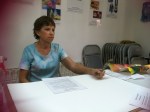













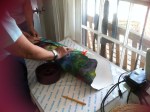







Yesterday I enjoyed making art in a new way with Jeanne Fellow at Blue Raven Art School. I had visited her studio and purchased a couple of her beautiful pieces and learned about the LumenArt class. My classmate Jeannie Gentry had done exactly the same thing. We both were very excited to try our hand at making one of these very special lamps. Our 5 hour class went by very quickly. Everything was set up for us on the shaded patio. Each of us had our own work table and basic tools. After a thorough demonstration of the basic techniques we chose colors and started our own experiment in color mixing. Some of the inks are iridescent, but those also block the light from within when it is a finished LumenArt. The fun of it all is that you don’t know how it will really look until you light it. Jeanne encouraged us to feel free and confident to play around. Both students created three possible candidates for lighting. The class materials include two sheets of incredible paper that allows all kinds of layering and special techniques without tearing. We each bought one extra sheet because we had enough time and were seriously into it. When dry we selected one to become our lamp. Choosing color for the base and tearing the final design we had supervision and plenty of encouragement from our teacher. This project is practically impossible to do badly. The materials guarantee that the finished product will be thrilling. She teaches a class in using these techniques on fabrics that will also be fun. If you are an experienced artist/craftperson you will love this class. If you think you are not creative and have no talent for art you will be blown away by your own amazing abilities when Jeanne shows you how to release them. My LumenArt is now making me very happy and proud in my living room at home. I also have two other fabulous pieces of art that I made. I even love my scraps. I would encourage anyone to investigate creativity and find your own inner light in one of Jeanne’s classes. She rules.


Well, shut my mouth!!!! My 21st great grandfather was the 184th Pope of the Roman Catholic Church. Imagine my surprise when I investigated Theobald Visconti, aka, Pope Blessed Gregory X:
Pope Blessed Gregory X Also known as Teobaldo Visconti
Theobald Visconti Memorial 9 January formerly 10 January
Profile Archdeacon of Liege, Belgium. Assigned the preach the last Crusade. Accompanied the Crusaders to Palestine, and was still there when elected the 184th Pope; elected before he was ordained a priest.
Called the Council of Lyons which briefly reconciled the Orthodox and Latin Churches. Tried to restore peace between the Guelphs and Ghibellines in Tuscany and Lombardy. Crowned Rudolf of Habsburg as emperor.
Born 1210 in Piacenza, Italy as Theobald Visconti
Papal Ascension elected 1 September 1271; ordained and consecrated as pope in 1272
Died 20 January 1276 at Arezzo, Italy
Beatified 8 July 1713 by Pope Clement XI (cultus confirmed)
Writings Protection of the Jews, 7 October 1272
Theobald Visconti (1220 – 1276)
is my 21st great grandfather
Matteo I Visconti (1250 – 1322)
son of Theobald Visconti
Stefan Visconti (1289 – 1327)
son of Matteo I Visconti
Bernabo Lord Milan di Visconti (1319 – 1385)
son of Stefan Visconti
Veridis Duchess Austria Visconti (1352 – 1414)
daughter of Bernabo Lord Milan di Visconti
Ernst I “Ironside” Archduke of Austria Habsburg (1377 – 1424)
son of Veridis Duchess Austria Visconti
Katharina Archduchess Austria Von Habsburg (1420 – 1493)
daughter of Ernst I “Ironside” Archduke of Austria Habsburg
Christof I VanBaden (1453 – 1527)
son of Katharina Archduchess Austria Von Habsburg
Beatrix Zahringen (1492 – 1535)
daughter of Christof I VanBaden
Sabine Grafin VonSimmern (1528 – 1578)
daughter of Beatrix Zahringen
Marie L Egmond (1564 – 1584)
daughter of Sabine Grafin VonSimmern
Richard Sears (1590 – 1676)
son of Marie L Egmond
Silas Sears (1638 – 1697)
son of Richard Sears
Silas Sears (1661 – 1732)
son of Silas Sears
Sarah Sears (1697 – 1785)
daughter of Silas Sears
Sarah Hamblin (1721 – 1814)
daughter of Sarah Sears
Mercy Hazen (1747 – 1819)
daughter of Sarah Hamblin
Martha Mead (1784 – 1860)
daughter of Mercy Hazen
Abner Morse (1808 – 1838)
son of Martha Mead
Daniel Rowland Morse (1838 – 1910)
son of Abner Morse
Jason A Morse (1862 – 1932)
son of Daniel Rowland Morse
Ernest Abner Morse (1890 – 1965)
son of Jason A Morse
Richard Arden Morse (1920 – 2004)
son of Ernest Abner Morse
Pamela Morse
I am the daughter of Richard Arden Morse
Things were much different then. Dude was married and was elected Pope?????
Gregory X
1271-1276
Theobald Visconti
The interval which separates the reign of Clement IV from that of Gregory X was signalized by the death of Louis IX before Tunis.
The king was attacked by plague. On Monday, August 25, 1270, the sun had scarcely glinted on the sea when the lilied flags slowly descended. At this announcement the whole camp shuddered. Knights, men at arms, the sick, the wounded, all rushed from their tents in terror; one side of the royal tent was raised, and Louis, supported by attendants made his appearance, clad in haircloth to his feet; his already livid hands bearing a crucifix, and his eyes fixed upon a bed of ashes spread upon the parched earth. The last breath of the head of the army was to be drawn upon that humble couch; it was his last command, and he had scarcely strength enough left to lie down upon it and to motion for the crucifix to be again placed before him.
Horrible convulsions seemed to rack his frame, and yet no complaint, no regret, no murmur escaped his lips. All that his dying voice was heard to utter was: “Noble Sire, God, have mercy upon this people that has followed me to this shore! Oh, conduct it to its own land, lest it be forced to deny thy holy name.” The very last words of the king “Jerusalem! We will go to Jerusalem!”
The legate who should have attended the king had himself perished of plague; but the love of the cross was so deep in the heart of the monarch and of the French that Rome, not withstanding her widowhood, had not to deplore any misfortune to the faith. The throne of Peter was vacant, but, with the aid of Louis IX, religion had no tears to shed. Yet it were not good that the great moderator should often be wanting to his children. Had Gregory X been sooner elected, the expedition against Tunis would probably have been abandoned, and Louis, upon the road to Syria and in the port of Antipatris, would have preserved his strength to lead the Christians a second time.
Blessed Gregory X, originally called Theobald Visconti, was of the family of that name at Piacenza, supposed to derive its origin from the Flavia family, to which Constantine the Great belonged. Other authors maintain that the Visconti sprang from Desiderius, king of the Lombards.
Theobald, son of Hubert, a brother of Otho Visconti, Archbishop of Milan and lord of that city, was at of Lyons, archdeacon of Liege, and then became legate in Syria. While there he was elected pontiff at Viterbo, on the 1st of September, 1271. The fifteen cardinals who composed the Sacred College could not agree upon a candidate. One of them proposed to authorize six cardinals to name the pope, all promising to recognize the one thus named by compromise. It was necessary to have recourse to such an expedient, for the conclave had lasted three years. Gatti, captain of the city, had already had the roof uncovered so that the inclemency of the weather might dispose the cardinals to make a final choice. In proceeding by compromise, the six cardinals put an end to the longest vacancy of the Holy See that had taken place since the persecutions. At first they thought of Saint Philip Benizi, of the order of Servites, who was then famous for his miracles; but learning the design from Cardinals Ottobuono Fieschi and Ubaldino, who had proposed him, Saint Philip went and hid himself on the top of Mount Tuniato until another was elected.
The six cardinals having agreed upon electing Theobald Visconti on the 1st of September, 1271, a courier was despatched to Saint Jean d’Acre, where he was with Prince Edward, eldest son of the King of England, waiting for a favorable moment to go to Jerusalem. Theobald, having received the news on the 27th of October, took the road for Italy, and disembarked at Brindisi on the 1st of January, 1272.
Accompanied by Charles, King of the Two Sicilies, he went to Benevento, and thence, by way of Capua, to Viterbo, where he found the cardinals. Thence he proceeded to and was crowned at the Vatican by Cardinal John Orsini on the 27th of March, 1272. On the day of the coronation he took possession at Saint John Lateran, preceded by a magnificent cavalcade; the King of the Two Sicilies held the pontiff’s stirrup, and, at the solemn banquet which followed, presented him with water to wash his hands, and served him with the first dish.
In 1273 the German electors, excepting the King of Bohemia, elected as king of the Romans Rudolph, Count of Hapsburg, the head of the house of Austria. The Holy Father approved the election, and induced Alphonso X, King of Castile, to renounce his claims upon the imperial diadem, to which he believed himself entitled, which that prince generously and promptly did, to show himself obedient to the Holy Father.
The same year Visconti, who had taken the name of Gregory X, wrote to Philip the Bold, King of France, to thank him for restoring to the Holy See the Venaissin, situated between Provence and Dauphiny, which was left to the Roman Church by Raymond, Count of Toulouse, who died in 1249, and which the kings of France had since held.
It was a pious, able, and generous thought that led the cardinals to elect a pope whose duties had led him to the Holy Land and who knew the distress of that unfortunate country.
The recovery of the Holy Land almost exclusive engaged the thoughts of Gregory. On the 1st of the preceding April he published a decree convoking at Lyons the fourteenth general council, and the second of Lyons, which was celebrated in that city in 1274. The pope was there even in 1273. On his way he crossed Tuscany, and paused at Florence to endeavor to restore peace between the Guelphs and the Ghibellines of that city.
History cannot ignore the conduct of Gregory X at Florence. At first he was accompanied by Baldwin II, son of Henry, brother of Baldwin I, and afterwards by Charles of Anjou, King of Naples and brother of Saint Louis.
The pope, delighted with the coolness of the water and the purity of the air, proposed to his august companions to pass the summer in that beautiful city. The Guelphs at had exiled the Ghibellines and treated them with undue rigor. On the 2nd of July the pope assembled the people of Florence and vicinity on the banks of the Arno, foot of the Rubaconte bridge. A platform having been erected to afford seats for the two princes, the pope from his throne forbade, on pain of interdict, any distinction to be made in future between Guelph and Ghibelline, and commanded the syndics of the Guelphs to embrace in his presence the syndics of the Ghibellines (the pope was head and protector of the Guelph faction). Gregory in his address to the people said: “He is a Ghibelline—yes; but he is a Christian, he is a citizen, and he is your neighbor. Is so much that we have done to bring about a union to be ineffectual? Is the very name of Ghibelline, empty as it is, to be more powerful for hatred than so many clear and substantial reasons for charity? You declare that you have embraced this party spirit in favor of the popes and against their enemies? We, Roman pontiffs, we have received these men to our heart, although they formerly offended us—these men, your fellow-citizens, who have returned to us; we have pardoned their insults, and now regard them as our children. Will you disobey your pontiff, and in his presence?”
From Florence, which no doubt he secretly blessed, Gregory went to Piacenza, his native city, and arrived there on 3rd of October. He took with him Otho Visconti, made Archbishop of Milan by Pope Urban IV, who had not been able yet to take possession of his see, because the Turriani, a revolted family, desired an archbishop of their own name. Having entered Milan, Gregory could not induce the people accept Otho Visconti, though regularly appointed and the bearer of bulls recently confirmed, and he was obliged to leave Milan in the same grief that had afflicted Florence.
The direction of the General Council of Lyons was intrusted to Saint Bonaventure. This fact is attested by the bull of canonization of that saint, issued by Sixtus IV. In that assemblage there were fifteen cardinals, two Latin patriarchs, seventy archbishops, five hundred bishops, and more than a thousand prelates and abbots. Never had there a more numerous council. The Greeks confessed that Holy Ghost proceeded from both Father and Son, and, for the fourteenth time, were reconciled to the Latin Church.
It was first decreed that considerable succor should be sent to the Holy Land. It must have been an imposing scene when the pontiff said: “We have seen the sufferings of those pilgrims; one by one we have followed all their misfortunes. Their courage never tires, no piety can be more submissive than theirs; they are true children of Jesus Christ, like the companions of Godfrey, but they have not wherewith to support life. Those who had money when they went hence, have been robbed of that money, and even of their clothes. Can our brethren in the desert ask alms of the wild beasts? These give only death. The Turk and the Jew some hearken to a cry of distress; but on that long pilgrimage there are so many cries! It is to the Holy Land that aid must go; there must be no ambition for kingdoms and provinces of Asia; Jerusalem and the Holy Sepulchre must be delivered.”
The Flagellants, wherever they were not suppressed, asserted that baptism by water was useless; that flagellation alone was effectual, which they called baptism by blood; that all religion consisted in flagellation. Baronius, according to Novaes, reproached Saint Peter Damian with having been, if not the founder, at least the propagator of this sect, so censured by the Church, and so wrong in deducing from a simple ordinary penance the consequences of the Flagellants.
This council passed thirty-one canons on ecclesiastical discipline. All except the nineteenth concern the sixth book of the Decretals. It was this council that enjoined every Catholic to bow the head as often as he hears the holy name of Jesus.
The Holy Father, remembering the length of the conclave in which he at last had been elected, passed laws to prevent like delays in future. These laws were frequently suspended and then restored whenever there was too long a conclave.
During this council the great Saint Thomas Aquinas died in the monastery of Fossa Nuova, whence he was about to repair to Lyons.
The council having terminated its sessions, the pontiff set out on the 6th of March, 1275, for Italy. He met Rudolph of Hapsburg, king of the Romans, at Lausanne on the 10th of October, and that prince swore to guarantee to His Holiness the exarchate of Ravenna and other Italian lands belonging to the Roman Church.
Gregory had governed four years, four months, and ten months, reckoning from his election, when he died at Arezzo, aged sixty-six years, on the 10th of January, 1276 (a fatal year, in which four pontiffs died), and he was interred in the cathedral of that city.
Monsignor Benedict Falconcini de Volterra, Bishop of Arezzo in 1704, solicited and obtained, under Pope Clement in 1713, at his own expense, the beatification of this illustrious pontiff.
Gregory had but little learning, but he was endowed with rare prudence. He always was the courageous defender of the faith and of the divine worship, inclined to peace and a conciliatory spirit, and an enemy to all partiality.
Platina gives the following judgment upon Gregory: “He was a man illustrious in life for prudence in affairs; for the strength of soul with which he disdained money and all low considerations; for his humanity, clemency, benevolence to poor Christians, and especially those who took refuge in the bosom of the Apostolic See.”
With reference to Saint Thomas Aquinas, Fleury says:” the life of this saint, who died at forty-nine years of age, seems short in comparison to his writings. The five first volumes are commentaries on most of the writings of Aristotle; then come the commentaries on Peter Lombard, the master of sentences; then a volume of theological questions, Summa against the Gentiles, the Summa Theologiae, many commentaries on the Holy Scripture, and, finally, short treatises to the number of seventy-three, some of which are doubted. In general, the best critics believe that many works are attributed to Saint Thomas which are only notes of his public lectures, called reportata in those days, and that a similarity of name has confounded with him Thomas the Englishman, or Jorzi, a friar of the same order who lived in the same century and at the beginning next.”
This biographical data is from “The Lives and Times of the Popes” by The Chevalier Artaud De Montor. Published by The Catholic Publication Society of New York in ten volumes in 1911. The pictures, included in the volumes, were reproduced from ” Effigies Pontificum Romanorum Dominici Basae.”

Valentina Doria
My 19th great-grandmother was from a noble family that still has branches in parts of Europe carrying titles. The Doria family was influential in northern Italy. She married Stefano Visconti, Duke of Milan, when she was 25:
Stefano Visconti (died 4 July 1327) was a member of the House of Visconti that ruled Milan from the 14th to the 15th century. He was the son of Matteo I Visconti.
In 1318 he married Valentina Doria, with whom he had three children: Matteo, Galeazzo and Bernabò, who shared the rule in Milan after his death.
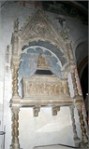
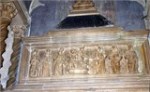
They are buried in a very fancy tomb in the church of Sant’Eustorgio in Milan. Now I have many reasons to return to Milan.
Valentina Doria (1293 – 1359)
is my 19th great grandmother
Bernabo Lord Milan di Visconti (1319 – 1385)
son of Valentina Doria
Veridis Duchess Austria Visconti (1352 – 1414)
daughter of Bernabo Lord Milan di Visconti
Ernst I “Ironside” Archduke of Austria Habsburg (1377 – 1424)
son of Veridis Duchess Austria Visconti
Katharina Archduchess Austria Von Habsburg (1420 – 1493)
daughter of Ernst I “Ironside” Archduke of Austria Habsburg
Christof I VanBaden (1453 – 1527)
son of Katharina Archduchess Austria Von Habsburg
Beatrix Zahringen (1492 – 1535)
daughter of Christof I VanBaden
Sabine Grafin VonSimmern (1528 – 1578)
daughter of Beatrix Zahringen
Marie L Egmond (1564 – 1584)
daughter of Sabine Grafin VonSimmern
Richard Sears (1590 – 1676)
son of Marie L Egmond
Silas Sears (1638 – 1697)
son of Richard Sears
Silas Sears (1661 – 1732)
son of Silas Sears
Sarah Sears (1697 – 1785)
daughter of Silas Sears
Sarah Hamblin (1721 – 1814)
daughter of Sarah Sears
Mercy Hazen (1747 – 1819)
daughter of Sarah Hamblin
Martha Mead (1784 – 1860)
daughter of Mercy Hazen
Abner Morse (1808 – 1838)
son of Martha Mead
Daniel Rowland Morse (1838 – 1910)
son of Abner Morse
Jason A Morse (1862 – 1932)
son of Daniel Rowland Morse
Ernest Abner Morse (1890 – 1965)
son of Jason A Morse
Richard Arden Morse (1920 – 2004)
son of Ernest Abner Morse
Pamela Morse
I am the daughter of Richard Arden Morse

La Scala
My 21st great grandfather was Lord of Verona. His father was a wool dealer with political connections that helped him gain power and wealth. His family became influential. Alberto’s great grand daughter married into the ruling family of Milan, and her descendant married into the Habsburg dynasty. Influence and power followed them all the days of their lives.
Alberto I DeScala (1241 – 1301)
is my 21st great grandfather
Alboino De La Scala Lord (1284 – 1311)
son of Alberto I DeScala
Mastino Della Scala (1300 – 1351)
son of Alboino De La Scala Lord
Regina Beatrice Della Scala (1321 – 1384)
daughter of Mastino Della Scala
Veridis Duchess Austria Visconti (1352 – 1414)
daughter of Regina Beatrice Della Scala
Ernst I “Ironside” Archduke of Austria Habsburg (1377 – 1424)
son of Veridis Duchess Austria Visconti
Katharina Archduchess Austria Von Habsburg (1420 – 1493)
daughter of Ernst I “Ironside” Archduke of Austria Habsburg
Christof I VanBaden (1453 – 1527)
son of Katharina Archduchess Austria Von Habsburg
Beatrix Zahringen (1492 – 1535)
daughter of Christof I VanBaden
Sabine Grafin VonSimmern (1528 – 1578)
daughter of Beatrix Zahringen
Marie L Egmond (1564 – 1584)
daughter of Sabine Grafin VonSimmern
Richard Sears (1590 – 1676)
son of Marie L Egmond
Silas Sears (1638 – 1697)
son of Richard Sears
Silas Sears (1661 – 1732)
son of Silas Sears
Sarah Sears (1697 – 1785)
daughter of Silas Sears
Sarah Hamblin (1721 – 1814)
daughter of Sarah Sears
Mercy Hazen (1747 – 1819)
daughter of Sarah Hamblin
Martha Mead (1784 – 1860)
daughter of Mercy Hazen
Abner Morse (1808 – 1838)
son of Martha Mead
Daniel Rowland Morse (1838 – 1910)
son of Abner Morse
Jason A Morse (1862 – 1932)
son of Daniel Rowland Morse
Ernest Abner Morse (1890 – 1965)
son of Jason A Morse
Richard Arden Morse (1920 – 2004)
son of Ernest Abner Morse
Pamela Morse
I am the daughter of Richard Arden Morse
Alberto I della Scala (died September 3, 1301) was lord of Verona from 1277, a member of the Scaliger family.
The son of Jacopino della Scala, he was podestà of Mantua in 1272 and 1275. In 1277, after the assassination of his brother Mastino, inherited the seigniory of Verona.
Alberto died in Verona in 1301. His son Bartolomeo succeeded him. His other sons Alboino and Francesco (Cangrande) were also lord of Verona from 1304 and 1312, respectively.
Sources
Carrara, M. (1966). Gli Scaligeri. Varese: Dell’Oglio.



Stealing is a way of life. Sometimes we are the victims and other times we are the thief. Laverna is the goddess of darkness and criminal intent. She is the patron goddess of thieves and robbers. She teaches a very strong lesson about mortality. If we value that which can be stolen we will be too involved in a world that has no meaning. If we, instead, focus our efforts to create lasting creative work that benefits others it will be impossible to steal those benefits. Dishonest tradesman pray to her for the power to deceive and persuade. She is con woman herself who uses trickery to gain advantage over humans.
None of us will go through life without being tricked or robbed. Frequently these losses are caused by people we know. Financial ignorance is an aspect of Laverna. Allowing others to steal energy, time or valuable assets is submission to her power. The lesson of what is valuable and can never be taken from you is the wisdom she can bestow. Looking back at your life you will be able to find times when you felt significantly cheated or robbed. It is also possible to identify yourself in the role of con artist. Young children often deceive their parents and siblings, for instance. Taking a realistic look at the past, what has treachery and robbery taught you, gentle reader? Have you found that which you own that nobody can steal? Have you ever caught yourself stealing from yourself?
Americans have trouble understanding the whole British royalty and fancy person hierarchy. My own British family has been fairly fancy in their time, but I have nothing to show for it except my family tree. In history brutal repression of common people, or peasants, was the way commerce was conducted. The United States is returning to a system of government that separates the elite in a special world of privilege and security while the majority of the population is loosing security of every kind. Our country goes around bullying other nations about lack of democratic systems that protect the population. Who will come to the United States and reprimand us for this recent class and income discrepancy we are growing? Since many around the world are already hardened against the United States for our politics about war and violence, the facts about our upper crust citizens will cause more disgust for our economically bifurcated culture. In an odd twist of fate, Americans who often use Brit accents and royalty to make fun of snooty class struggles, are making big strides creating inequity of our own. What do you think will happen to our reputation abroad, gentle reader?
I will visit Austin, TX in the middle of the summer. I look forward to spending time downtown where I have rented a fabulous vintage Airstream from Air BnB as my abode. I will attend a reunion party for which I will need a car, but I am investigating the choices and prices I have while I am in the city. Car rental at the airport for the entire time would cost about $1000. Since I like being driven more than I like to drive, especially in a city, I am trying Lyft as a way to buy one ride at a time. My Airstream home is near public bus lines, and I can rent a bike for $10 a day. I like to go on foot to see the detail around me when I visit a new area. I know Austin has a system of bike taxis that are fun to use, especially when traffic is jammed for cars. When we went to Austin City Limits Music Festival we made use of the bike taxis, water taxis, and took a sunset party cruise on a well equipped floating live music bar. Considering all these choices renting a car and finding parking for it wherever I go sounds less appealing than biking, floating or being driven.
During my career as a travel agent I was always grateful and happy to stay in hotels and use suppliers on the commercial market. I made extra effort to rent private flats when I traveled. Now that the market has changed drastically I am pleased to be able to rent with assurance from Air BnB, and now ride with assurance provided by Lyft, Uber, and probably other apps I have yet to discover. I just joined Lyft and have received a message that the first ride is on the company as my gift for being a Lyft pioneer. What is not to like? We plan to go out this weekend, so I will give that free ride a trial when we want to come home after happy hour. I will find out if they are active in Tucson and test the service. I prefer the free ride home to any chocolate bunny. Thanks, Lyft.
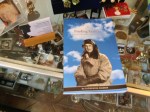
My neighbor, Cathy Harris, has written a fascinating book based on her uncle’s true experiences in as a pilot for the RAF in World War II. I interviewed her today in her shop about the new book, Finding Frances, Love Letters from a Flight Lieutenant. The way she has presented the book gives the reader a really good feel for his life and times. The letters are both historic and emotional because he tells what is happening in the war and pledges his love for Frances. The authentic snippets of his handwriting are a wonderful touch. I study family history so I am extra impressed with all the original documentation she has to show the reader. I was instantly in love with Eric as soon as I saw his pictures. I am sure with his accent and special British slang he must have been very exciting for a high school girl in Phoenix in the 1940s. I am glad she decided to put it all into book form to give us a glimpse into this dramatic part of our history in a personal, first hand account.



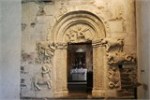
My 21st great-grandfather was born in Venice and is buried at Tirol Castle in Austria. Geography was much different in 1194, when the Holy Romans were still ruling in Europe. Today’s national boundaries have changed in recent times, and in the case of Ukraine, are changing now. Venice was once very powerful as a political as well as economic entity. Meinhard inherited power from his father as well as from his wife’s father. During his political struggles he was forced to leave two of his sons in jail in Salzburg for 6 years. I imagine jail time in Salzburg in 1252 must have been brutal. He survived to become an ancestor of the Habsburgs….and me.
Meinhard I Gorizia Tirol (1194 – 1258)
is my 21st great grandfather
Meinhard II Carinthia Duke of Gorz-Tyrol Tirol (1238 – 1295)
son of Meinhard I Gorizia Tirol
Consort Elisabeth the Romans Carinthia (1263 – 1313)
daughter of Meinhard II Carinthia Duke of Gorz-Tyrol Tirol
Albrecht Albert II ‘The Wise’ Duke of Austria Habsburg (1298 – 1358)
son of Consort Elisabeth the Romans Carinthia
Leopold III “Duke of Austria” Habsburg (1351 – 1386)
son of Albrecht Albert II ‘The Wise’ Duke of Austria Habsburg
Ernst I “Ironside” Archduke of Austria Habsburg (1377 – 1424)
son of Leopold III “Duke of Austria” Habsburg
Katharina Archduchess Austria Von Habsburg (1420 – 1493)
daughter of Ernst I “Ironside” Archduke of Austria Habsburg
Christof I VanBaden (1453 – 1527)
son of Katharina Archduchess Austria Von Habsburg
Beatrix Zahringen (1492 – 1535)
daughter of Christof I VanBaden
Sabine Grafin VonSimmern (1528 – 1578)
daughter of Beatrix Zahringen
Marie L Egmond (1564 – 1584)
daughter of Sabine Grafin VonSimmern
Richard Sears (1590 – 1676)
son of Marie L Egmond
Silas Sears (1638 – 1697)
son of Richard Sears
Silas Sears (1661 – 1732)
son of Silas Sears
Sarah Sears (1697 – 1785)
daughter of Silas Sears
Sarah Hamblin (1721 – 1814)
daughter of Sarah Sears
Mercy Hazen (1747 – 1819)
daughter of Sarah Hamblin
Martha Mead (1784 – 1860)
daughter of Mercy Hazen
Abner Morse (1808 – 1838)
son of Martha Mead
Daniel Rowland Morse (1838 – 1910)
son of Abner Morse
Jason A Morse (1862 – 1932)
son of Daniel Rowland Morse
Ernest Abner Morse (1890 – 1965)
son of Jason A Morse
Richard Arden Morse (1920 – 2004)
son of Ernest Abner Morse
Pamela Morse
I am the daughter of Richard Arden Morse
Meinhard I, Count of Gorizia-Tyrol
Spouse Adelaide of Tyrol
Noble family Meinhardiner
Father Engelbert III, Count of Gorizia
Mother Mathilda of Andechs
Born c. 1200/1205
Died January or February 1258
Meinhard I (c. 1200/1205 – January/February 1258) was Count of Gorizia from the House of Meinhardin was from 1231 and Count of Tyrol from 1253 until his death. He was the son of Count Engelbert III, Count of GoriziaEngelbert III]] of Gorizia (d. 1220) and Mathilda of Andechs, half-sister of Duke Berthold IV of Merania. He came in control over all his family’s Gorizian possessions upon the death of his uncle Meinhard the Old, and of Tyrol as a fief from his father-in-law Count Albert IV of Tyrol.
Meinhard strongly supported Emperor Frederick II of Hohenstaufen in his conflict with Pope Innocent IV and in return was appointed Imperial governor of the Duchy of Styria and the March of Carniola after the last Babenberg Duke Frederick II the Warlike had died without heirs in 1246. From 1250 onwards also governor in the Duchy of Austria, Meinhard facing the fall of the Hohenstaufen dynasty did not prevail: his rule in Carniola was challenged by the Carinthian House of Sponheim and in Austria and Styria he was expelled by Bohemian prince Ottokar II Přemysl in 1251.
Meinhard, backed by Albert IV of Tyrol, then tried to gain control over the Duchy of Carinthia but failed in an unsuccessful campaign against Duke Bernhard von Spanheim and his son Philipp, the elected Archbishop of Salzburg. On September 8, 1252, he was finally defeated and arrested at Greifenburg. According to the rules of the Treaty of Lieserhofen, concluded on December 27, 1252 he had to give his sons Meinhard II and Albert to Phillip as hostages. Both were imprisoned at Burg Hohenwerfen in Salzburg and not released until 1258. Meinhard and Albert IV also had to pay a compensation and to renounce certain possessions including Mittersill, Virgen, Matrei and Oberdrauburg.
After the death of Albert IV of Tyrol in 1253, Meinhard and his brother-in-law, Gebhard of Hirschberg, split Tyrol, of which Meinhard took the southern part with Meran. His son Meinhard II re-acquired the Hirschberg lands from Gebhard’s heirs in 1284 and two years later also received Carinthia from German king Rudolph of Habsburg.
Meinhard I died in 1258 and is buried at Tirol Castle.
Marriage and children
About 1237, Meinhhard married Adelaide, daughter of Albert IV of Tyrol. They had four known children:
Adelheid († 1291), married Count Frederick I of Ortenburg
Meinhard II (1238–1295), Count of Gorizia and Tyrol, Duke of Carinthia
Albert I († 1304), Count of Gorizia
Bertha († 1267), married Conrad, Count of Wullenstetten
From the time we learned our first Dr Seuss rhyme we were being educated by poets. Nursery rhymes and fairy tales are used to teach morals and ethics to children. There is value in the use of language to enchant and stick in the memory. Poets are feeding the artistic as well as the language skills of readers. Our own stories can only be told by our own voice. To develop a voice as a writer or a poet one simply needs to start. Children are ready to rhyme and laugh at almost any word. Adults often loose enthusiasm for word play as they grow older. Since poetry stimulates creativity, and is a tool to jog the memory it makes sense to read and write poems. Often hidden meaning can be found in song and story, as it is in Calypso. Political protest can be carried out in a rhyme using allegory to mask the obvious. Some of our nursery rhymes today were once hot treason against authorities. What kind of symbolic words would you use to write a poetic protest today?
 mermaidcamp