mermaidcamp
Keeping current in wellness, in and out of the water
You can scroll the shelf using ← and → keys
You can scroll the shelf using ← and → keys
Norfolk, England
My 9th Great Grandfather was probably the earliest Brit settler in Yarmouth, on Cape Cod. He was from Norfolk, England:
On the south side, West Yarmouth became populated with the descendants of the earliest settler Yelverton Crowe(ll). (Crowell remained the most prominent surname in the village well into the 20th century.) Although the Crowells were joined by other families, and married into many of the northside families, the village itself remained small and rural in nature. Homes with large acreage for subsistence farming dotted the county road (now Route 28) which ran from Parker’s River to Hyannis’ Main Street. A fulling mill in the village, established in the late 17th century, was the first known mill in Yarmouth. The Baxters, who operated the mill, also built a gristmill along the shores of Mill Creek in West Yarmouth — a mill which is still in working order and now an historic site owned by the town. Stores, however, were few and tradesmen were fewer. Many villagers transacted business in nearby Hyannis or in Yarmouth Port. Since the village remained rural and undeveloped throughout much of the 18th and 19th century, it presented a blank palette for developers who were to arrive with the turning of the twentieth century.
Yelverton Crowell (1621 – 1683)
is my 9th great grandfather
Elishua Crowell (1643 – 1708)
daughter of Yelverton Crowell
Yelverton Gifford (1676 – 1772)
son of Elishua Crowell
Ann Gifford (1715 – 1795)
daughter of Yelverton Gifford
Frances Congdon (1738 – 1755)
daughter of Ann Gifford
Thomas Sweet (1759 – 1844)
son of Frances Congdon
Valentine Sweet (1791 – 1858)
son of Thomas Sweet
Sarah LaVina Sweet (1840 – 1923)
daughter of Valentine Sweet
Jason A Morse (1862 – 1932)
son of Sarah LaVina Sweet
Ernest Abner Morse (1890 – 1965)
son of Jason A Morse
Richard Arden Morse (1920 – 2004)
son of Ernest Abner Morse
Pamela Morse
I am the daughter of Richard Arden Morse
He fought in King Philip’s War against my Wampanoag ancestors:
According to the book “History of Cape Cod: Annals of Barnstable County, Vol 2 by author Frederick Freeman: Both John Crowell and Yelverton Crowell fought with Distinction in King Phillip’s war at the battle of Mount Hope in the year 1675. John Crowell is listed as having lost one horse.
The son of an older Presbyterian minister and his much younger wife, Sylvester Graham became an orphan early in his life. His mother was committed to an insane asylum and his father died. He was admitted to Amherst, but left without graduating. He met the Reverend William Metcalf, founder of the first vegetarian church in Philadelphia, known as The Bible Christians. He was convinced to try vegetarianism and soon pronounced it to be the remedy for alcoholism. Graham was a crusader for the use of whole grains. He was outraged that beer and distilled spirits were using grains to create alcohol rather than whole grain foods. He was angry with bakers for using what was known as the “bolting cloth” a process that removed the bran from the flour. In 1837 he called physicians vampires in lectures given to his followers in Boston. He denounced the butchers and the bakers of the city, causing a revolt on the part of the aforementioned.
Today we know his name because the graham cracker is part of our American cuisine. The corn flake and other whole grain cereals followed the lead of Graham crackers. He became an ordained Presbyterian minister and an ardent opponent of the consumption of both alcohol and flesh. Since legal prohibition had been repealed in 1933 his views on alcohol were out of step with the times, and certainly nobody wanted to hear him go off on vegetarian diet when it was more unpopular. His hatred for the “bolting cloth” moved him to call it America’s shroud. Now that so many suffer from saccharine disease, his extreme beliefs that the removal of bran may seem prophetic. What is crazy is that the Graham cracker of today contains no whole grain. Unbleached white flour and sugar are the tasty main ingredient in our key lime pie crust, which would have made Sylvester freak out all over the place.
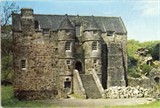
Rowallan Castle
Rowallan Castle is an ancient castle located near Kilmaurs, at NS 4347 4242, about 5 kilometres (3.1 mi) north of Kilmarnock, East Ayrshire, Scotland. The castle stands on the banks of the Carmel Water, which may at one time have run much closer to the low eminence upon which the original castle stood. The castle and barony has been owned or held by the medieval Mure family, the (Boyle) Earls of Glasgow, the (Campbell) Earls of Loudoun, the (Corbett) Barons Rowallan, and by Historic Scotland. It is said that the earliest piece of Lute music was written at Rowallan. It is said to have been visited by the unfortunate King James I of Scotland when on his way from Edinburgh to England. The first Mure holder, Sir J. Gilchrist Mure was buried in the Mure Aisle at Kilmarnock The original castle is thought to date back into the 13th century. Rowallan was said to be the birth place of Elizabeth Mure(Muir), first wife of Robert, the High Steward, later Robert II of Scotland.[6] She was mother to the Duke of Albany, and the Earls of Carrick, Fife and Buchanan. In 1513 the Rowallan Estate took its present day form. In about 1690 the estate was home to the Campbells of Loudoun, who held it into the 19th century
Row Allan, row!
A tale is told of one Allan of Stewarton
who was rowing a Scottish
chief off the Ayrshire coast.
The weather made a turn for
the worse and the chief became
anxious. The chief in his fear of
the ocean said to Allan, Row, Allan row! Bear me to safety and you will have the
rich lands of Carmelside,
wuth silver to build yourself
a castle. Hill and valley and
rivers of fish will be yours …. but just row, Allan, row!
Allan won his prize and named
the estate ‘Rowallan’ after his
adventure. The same story is
told in the form of a poem written
by the Rev. George Paxton from
Kilmaurs, pastor of a Secession Church from 1789 – 1807
…David de More, of the house of Polkelly, Renfrewshire, appears as a witness to a charter of Alexander II. Willielmi de Mora and Laurentii de Mora also occur in two charters granted by Robert the Bruce.The first on record of the family is stated to have been the above-named David de More. His successor is supposed to have been Sir Gilchrist More, the first of the name mentioned in the family ‘Historie.’
In the beginning of the reign of Alexander III., Sir Walter Cumyn took forcible possession of the house and living of Rowallan, “the owner thereof, Gilchrist More, being redacted for his safety to keep close in his castle of Pokellie.”The latter distinguished himself at the battle of Largs in 1263, and for his bravery was knighted. “At which time,” says the ‘Historie,’ “Sir Gilchrist was reponed to his whole inheritance, and gifted with the lands belonging to Sir Walter Cuming before mentioned, a man not of the meanest of that powerful tribe, which for might and number have scarcelie to this day been equaled in this land.”
He married Isobel, daughter and heiress of the said Sir Walter Cumyn, and in the death of his father-in-law, he found himself secured not only in the title and full possession of his old inheritance, but also in the border lands wherein he succeeded to Sir Walter Cuming, within the sheriffdom of Roxburgh. Sir Gilchrist “disponed to his kinsman Ranald More, who had come purposlie from Ireland for his assistance: in the time of his troubles, and also at the battle of Largs, the lands of Polkellie, which appear to have been the original inheritance of the family.
He died “about the year 1280, near the 80 year of his age,” and was buried “with his forfathers in his own buriell place in the Mures Isle at Kilmarnock.”
He had a son, Archibald, and two daughters, Elizabeth, the wife of Sir Godfrey Ross, and Anicia, married to Richard Boyle of Kelburne, ancestor of the earls of Glasgow.In the Ragman Roll, among those barons who swore fealty to Edward I. in 1296, we find the names of Gilchrist More of Craig and Reginald More de Craig, that is, the Craig of Rowallan. The former is stated to have been the ancestor of the Mures of Polkellie, who, Nisbet thinks, were “the stem of the Mures, and an ancienter family than the Rowallan.” The latter was in 1329 chamberlain of Scotland.
William More, the son and successor of Archibald, married a daughter of the house of Craigie, then Lindsay, and with two daughters, had a son, Adam, who succeeded him. Of William honourable mention is made in an indenture of truce with England in the nonage of King David, wherein he is designated Sir William.
He died about the time when King David was taken prisoner at the battle of Durham, fought 17th October 1346. There is supposed to have been an older son than Adam, named Reynold. The editor of the ‘Historie,’ on the authority of Crawford’s Officers of State, (vol. i. p. 290), says in a note: Reynold, son and heir of Sir William More, was one of the hostages left in England at David’s redemption.
This is certainly the same Sir William mentioned above, but whether of Rowallan seems still doubtful; If so, he must have lived long after 1348. There is a William More, Miles, mentioned in M’Farlane’s MS., as living in 1363. Supposing this Sir William More to have been of Rowallan, Reynold probably never returned from England, and thus the estate may have fallen to Sir Adam, a younger son. During the long protracted payment of the king’s ransom, many of the hostages died in confinement.
Sir Adam More, who, “in his father’s auld age,” had the management of all his affairs, both private and public, considerably enlarged and improved the estate. He married, in his younger years, Janet Mure, heiress of Polkellie, granddaughter of Ranald More, and thus restored that estate to the family. By this marriage he had two sons, Sir Adam, his successor, and Andrew, and a daughter, Elizabeth, married in 1348, to Robert, the high steward, afterwards King Robert II.
She was a lady of great beauty and rare virtues, and attracted the high steward’s regard in his younger years when living in concealment about Dundonald castle during Edward Baliol’s usurpation.
There was long considerable doubt as to this marriage, and Buchanan and earlier historians were of opinion that none had ever taken place. The fact of her marriage, however, is now set beyond all question, and the author of the ‘Historie’ says, “Mr. John Learmonth, chaplain to Alexander, archbishop of St. Andrews, hath left upon record, in a deduction of the descent of the house of Rowallan, collected by him at command of the said archbishop, that Robert, great steward of Scotland, having taken away the said Elizabeth, drew to Sir Adam her father ane instrument that he should take her to his lawful wife, which myself have seen, saith the collector, as also ane testimonie, written in Latin by Roger M’Adam, priest of our Ladie Marie’s chapel, (‘Our Lady’s Kirk of Kyle,’ in the parish of Monktown,) that the said Roger married Robert and Elizabeth foresaids.”
The editor of the ‘Historie’ remarks in a note: “Mr. Lewis Innes, principal of the Scots college at Paris, first completely proved the fallacy of Buchanan’s account of King Robert’s marriages, by publishing in 1694, a charter granted by him in 1364, which charter showed that Elizabeth More was the first wife of Robert, and made reference to a dispensation granted by the pope for the marriage. That dispensation was long sought for in vain, but was at length discovered in 1789, at which time a dispensation for the marriage with Euphemia Ross was also found. These discoveries have decided the question. The dispensation for the marriage with Elizabeth More is dated in December, in the sixth year of the pontificate of Clement VI. He was elected pope in 1342; this dispensation must therefore have been granted in December 1347. The dispensation for the marriage with Euphemia Ross is dated in the third year of the pontificate of Innocent VI. He was elected pope in 1352; this dispensation must therefore have been given in 1355.”
Sir Adam, the eldest son, had on his own resignation, a new charger from Robert III., of the barony of Rowallan and whole lands holden of the crown, as also of the barony of Polkellie, &c., with very ample privileg4es, the designation given him by the king being ‘consanguineus.’
He married Joan, daughter of Danielston of that ilk, and by her had three sons. “Caried away,” says the ‘Historie,’ “as appears with emptie surmises and hopes founded on court favors, he made unawares a new rent in his estate and provided his second son, Alexander, to the barronie of Pokellie, together with the lands of Limflare and Lowdonehill, wherein his lady was infeft in liferent, and wer given out by him, now the second time, to the great damage and prejudice of his house and posteritie. However, at that time the court seemed to smile upon him, his proper estate considerable, his friendship strong, and of the greatest of these times. He gave a quartered coat of the arms of Mure and cumin.
The hoarseness and asperitie of the Irish pronunciation of his title and lands is forgot, and Rigallane is now Rowallane, Pothkellath is now Pokellie, &c., and More is now Mure by the court dialect.

Elizabeth Mure
Elizabeth Mure (1320 – 1355)
Elizabeth Mure (died before May 1355) was mistress and then wife of Robert, High Steward of Scotland, and Guardian of Scotland (1338 – 1341 and from October 1346), who later became King Robert II of Scotland.
History
Elizabeth Mure (Muir) was said to be born at Rowallan Castle. Her parents were Sir Adam Mure of Rowallan and Joan Cunningham.
She initially became the Steward’s mistress. He married her in 1336 but the marriage was criticised as uncanonical, so he remarried her in 1349 following a papal dispensation dated at Avignon 22 November 1347.
She died before her husband inherited the crown at the rather advanced age of 54, and he married again (Papal Dispensation dated 2 May 1355), so she was never queen of Scotland.
On 27 March 1371, “–The Lord John (who later took the title of King Robert III, changing his name because of what he saw as John de Baliol’s unpatriotic desecration of the name John), Earl of Carrick and Steward of Scotland, first-born son of King Robert II–” was declared heir to the Crown by Parliament in Scone Abbey.
They had at least ten children – some accounts say thirteen. Doubts about the validity of her marriage led to family disputes over her children’s right to the crown.
* Robert III, born John Stewart, Earl of Carrick
* Walter Stewart, Lord of Fife
* Robert Stewart, Duke of Albany
* Andrew Stewart, Earl of Buchan
* Margaret Stewart, married John of Islay, Lord of the Isles
* Marjorie Stewart, married (1), John Dunbar, 5th Earl of Moray, and (2), Alexander Keith
* Johanna Stewart, married (1), Sir John Keith, (2), Sir John Lyon, and (3) in 1384, Sir James Sandilands.
* Isabella Stewart, married (1), James Douglas, 2nd Earl of Douglas, and (2), David Edmonstone
* Katherine Stewart, married Sir Robert Logan of Grugar and Restalrig, Lord High Admiral of Scotland
* Elizabeth Stewart, married Sir Thomas Hay, Lord High Constable of Scotland

Alexander Stewart

tartan
The Stewart Stewards of Scotland were powerful. Alexander took over as Steward from his father. Although there is some question about the parentage of his wife, there is no doubt about his children:
ALEXANDER Stewart, son of WALTER FitzAlan High Steward of Scotland & his wife — (-1283). The Liber Pluscardensisnames “dominus Alexander Stevart de Dundonald, pronepos primi Walteri Stewart”[1101]. The Visitation of Cambridge 1575 names “Alexander Stuart secundo genitus Gualt, Senescalli Scotie”[1102]. He succeeded his father as High Steward of Scotland. “Alexander filius Walteri Scotie senescallus” donated flour from “firma mea de Inchynnan” to Paisley monastery by charter dated Jan 1286 (presumably misdated)[1103]. The seal of “Alexandri filii Walterii senescalli regis Scotie” is appended to a charter under which “Alexander Stuart” donated lands at Machline and Carentabel to Melrose by charter dated to [1226] (presumably misdated)[1104]. John of Fordun´s Scotichronicon (Continuator) records the death in 1281 of “Alexander senescallus Scotiæ, avus…Walteri generi domini Roberti Bruce regis”[1105].
m JEAN, daughter of —. Balfour Paul names Jean of Bute heiress of the Isles of Bute and Arran, daughter of James Lord of Bute and Arran & his wife —, and records her marriage to Alexander Stewart, but does not cite the corresponding primary source[1106]. Andrew McEwen suggests that there is no evidence to indicate that the wife of Alexander Stewart was the daughter of James Lord of Bute[1107]. He adds that what evidence there is “suggests a double marriage alliance…about 1240 between Sir Walter fitz Alan II and Richard Comyn by which the Steward´s son and heir Alexander married Comyn´s daughter Joanna, while Comyn´s son and heir John married Sir Walter´s daughter Eva”, but he does not cite the nature of the evidence in question[1108].
Alexander Stewart & his wife had [six] children:
1. [JAMES Stewart (-young). The Visitation of Cambridge 1575 names “Jacobus Styward” as eldest son of “Alexander Stuart secundo genitus Gualt, Senescalli Scotie”, adding that he died young[1109].
2. JAMES Stewart ([1243]-16 Jul 1309). The Visitation of Cambridge 1575 names “Johannes Steward” as second son of “Alexander Stuart secundo genitus Gualt, Senescalli Scotie”, adding that he was killed in battle “ad variu´ Sacella”[1110]. He succeeded his father as High Steward of Scotland. He was appointed one of the six guardians of the kingdom on the death of King Alexander III in 1286[1111]. King Edward I confirmed the grant of “castro de Roo” made by “Ricardus de Burgo comes Ultoniæ et dominus Connactensis” to “Jacobo Senescallo Scotiæ et Egidiæ sorori ipsius comitis” by charter dated 10 Oct 1296[1112]. John of Fordun´s Scotichronicon (Continuator) records the death “XVII Kal Aug” in 1309 of “dominus Jacobus senescallus Scotie, pater…Walteri, generi regis Roberti Bruce”[1113]. [m firstly CECILIA de Dunbar, daughter of PATRICK Earl of Dunbar & his wife Cecilia —. Symson records that James Stewart married “Cecilia daughter to Patrick Earl of Dunbar…the first of that family who quitted that title and assumed that of March”, adding that Cecilia was the mother of James´s children. without citing the corresponding primary source[1114]. Andrew McEwen indicates that “no documentary evidence has been found” to support this statement, but adds that “though hardly free from error, Symson´s work is always deserving of respect”, and highlights that “it is highly unlikely that Muriel of Strathearn, whom he married in 1278, was James´s first wife”[1115].] [m secondly (before Jan 1279, [divorced before 1291]) as her second husband, MURIEL of Strathearn, widow of WILLIAM Earl of Mar, daughter of MALISE Earl of Strathearn & his first wife Marjory de Muschamp of Wooler ([1244]-[16 May/12 Nov] 1291). The evidence for this possible second marriage is indicated by an assize roll dated “7 Edw I” [Nov 1278/Nov 1279] which records a claim relating to the barony of Muschamp brought by “Jacobus filius Alexandri et Muriella uxor eius” and “Maria uxor Nicholai de Grame”, both represented by “Stephanum de Muschaump vel Thomam de Hagarston”, against “Thomam de Rok”[1116]. Pleas taken at Newcastle 20 Jan 1279 (N.S.) include a jury finding that “the heirs of Muschampe hold their barony by service of four knights, and making suit to the county of Newcastle”[1117]. Andrew MacEwen indicates that “Muriella…Maria” were the two daughters of Malise Earl of Strathearn by his first wife Marjory de Muschamp, and identifies “Jacobus filius Alexandri”, the husband of Muriel, as James Stewart the future High Steward of Scotland, although he cites no primary source which confirms that the latter identification is correct[1118]. The absence of any reference to Muriel´s husband “James” in the document dated 16 May 1291, which records the homage sworn to King Edward by “Muriellæ quæ fuit uxor Willelmi quondam comitis de Mar, filiæ et heredis Margeriæ filiæ Roberti de Muschaumps defunctæ” for the lands of “Margeria mater sua”[1119], suggests that her second marriage to “James” must have terminated before that date by divorce or annulment.] m [thirdly] EGIDIA de Burgh, daughter of WALTER de Burgh Earl of Ulster & his wife Aveline FitzJohn ([1260/70]-). King Edward I confirmed the grant of “castro de Roo” made by “Ricardus de Burgo comes Ultoniæ et dominus Connactensis” to “Jacobo Senescallo Scotiæ et Egidiæ sorori ipsius comitis” by charter dated 10 Oct 1296[1120]. The Visitation of Cambridge 1575 records that “Johannes Steward”, second son of “Alexander Stuart secundo genitus Gualt, Senescalli Scotie”, married “heredem de Bouthill”[1121]. According to Burke, James Stewart married “Cecilia, daughter of Patrick de Dunbar 7th Earl of Dunbar & March” by whom he fathered Walter Stewart[1122]. James Stewart & his [third] wife had [five] children:
a) ANDREW Stewart ([after 1290]-after 25 Aug 1306). The fact that Andrew was his father´s oldest [surviving] son is confirmed by a notarial confirmation dated 9 Aug 1306 which attested the verity of various documents, including one indicating that William Bishop of St Andrews had delivered “Andrew son and heir of Sir James the Steward of Scotland” to Robert de Brus[1123]. Malise Earl of Strathearn and John de Inchmartyn were ordered to produce “Andrew son of the Steward of Scotland and John son of John Earl of Athol” by charter dated 25 Aug 1306[1124]. These two documents presumably indicate that Andrew was still a minor in 1306, which confirms that he must have been from his father´s marriage to Egidia de Burgh.
b) WALTER Stewart ([1292]-9 Apr [1326/29]). The Liber Pluscardensis names “dominus Alexander Stevart de Dundonald, pronepos primi Walteri Stewart” as “proavus…nobilis Walteri Stevart qui filiam Roberti de Broys desponsavit”[1125]. He succeeded his father as High Steward of Scotland.
c) EGIDIA Stewart . Her parentage and marriage are confirmed by the charter under which “Alexandro de Meyners militi et Egidie Senescalli sponse sue” renounced “totam baroniam de Dorsidere” {Durrisdeir} in favour of her brother James, dated to [1315/21][1126]. m ALEXANDER de Meyners, son of —.
d) [JOHN Stewart (-killed in battle Dundalk 1318). “…Johe Senescallo…” witnessed a charter dated 9 Jul 1316 under which “Thomas Ranulphi comes Morauie et dns Mannie” confirmed a donation to Newbattle abbey[1127]. Andrew McEwen states that “if there was such a son [John], he must have been illegitimate”, but he does not explain his reasoning for this statement[1128].]
e) JAMES Stewart of Durisdeer (-after Nov 1330). “…Domino Malcolmo Flemyng, domino Jacobo senescallo fratre quondam domini Walteri quondam senescalli Scotie, domino Alano Senescallo…” subscribed the charter dated Nov 1330 under which “Malcolmus comes de Levenax” donated “ecclesiam de Kylpatrick” to Paisley monastery[1129].
3. ELIZABETH Stewart . The primary source which confirms her parentage and marriage has not yet been identified. Balfour Paul records her parentage and marriage without citing a precise source[1130]. The marriage is suggested by Barbour´s The Brus which records that “Walter Steward” and “Douglas” were “cosynis in ner degre”[1131]. m as his first wife, Sir WILLIAM Douglas “the Hardy” of that Ilk, son of Sir WILLIAM Douglas of Douglas & his wife — (-London in prison 1298).
4. [ANDREW Stewart (-after 1350). m — Beith, daughter of JAMES Beith & his wife —. The Visitation of Cambridge 1575 records the marriage of “Andreas Stuard iunior filius” (of Alexander Stuart secundo genitus Gualt, Senescalli Scotie) and “filiam Jacobi Bethe”, adding that he was decorated with a military swordbelt by “Johanne Francor´ Rege” and naming “Alexander Styward unicus filius Andree” who was awarded military honours by “Carolus rex Francor” (together with eight generations of Alexander´s alleged descendants in East Anglia)[1132]. The chronology of this entry is extremely shaky and it is unlikely that Andrew was the son of Alexander.]
5. Sir JOHN Stewart of Bonkyl (-killed in battle Falkirk 1298). A charter dated 15 May 1296 records the submission of “Johan le Seneschal frere Mons James Seneschal d Escoce” to Edward I King of England[1133]. m as her first husband, MARGARET Bonkyl, daughter and heiress of Sir ALEXANDER Bonkyl of that Ilk & his wife —. She married secondly as his first wife, David de Brechin. Sir John & his wife had six children:
a) Sir ALEXANDER Stewart of Bonkyl (-1317). m —. The name of Sir Alexander’s wife is not known. Sir Alexander & his wife had one child:
i) JOHN Stewart (-9 Dec 1331). He succeeded his father in 1319 at Bonkyl, co. Berwick. He was created Earl of Angus before 15 Jun 1329, when he is styled as such in a charter[1134].
Alexander 4th High Steward Stewart (1214 – 1298)
Alexander Stewart (c.1214-c.1283) was the hereditary High Steward of Scotland from c.1241 until his death. He was a member of the House of Stewart (later known as Stuart). Alexander was a son of Walter Stewart, 3rd High Steward of Scotland and his wife Bethóc of Angus. Bethóc was daughter of Gille Críst, Earl of Angus.
Alexander Stewart was instrumental in the Battle of Largs on October 2, 1263.
Marriage and Issue
The Stewart married Jean, daughter of James, Lord of Bute. They were parents to at least three children:
James Stewart, 5th High Steward of Scotland (c. 1243 – 1309).
Sir John Stewart, Lord of Bonkyl (before 1269 – 1298). Killed while fighting in the Battle of Falkirk.
Elizabeth Stewart.(d. before 1288) Married Sir William Douglas the Hardy, mother of the Good Sir James Douglas
Through their eldest son James, Alexander and Jean were the great-grandparents of King Robert II, the first Stewart to be King of Scots, and thus an ancestor of all subsequent Scottish monarchs and the later and current monarchs of Great Britain.
Alexander and Jean were also the direct male-line ancestors, through their second son, of Henry Stuart, Lord Darnley.

Roslin Castle ruins
My 24th great grandfather probably died in the Tower of London after Edward I took over Scotland:
1296 Edward I Invades Scotland & the Battle of Dunbar
When the Scots signed a treaty with England’s old enemy, France, King Edward I decided it was time to crush the Scots once and for all…thus started the wars of independence.
In 1296 an English army, said to number 35,000 men, marched up the East Coast of England on their way to invade Scotland. They crossed the Scottish border at the small town of Coldstream and then marched north onto the town of Berwick. The English sacked Berwick, then a rich Scottish burgh, slaughtering 16,000 of its inhabitants: men, women and children.
After sacking Berwick the English continued along the coast heading for the town of Dunbar. Before reaching Dunbar, Edward was met by a large but inexperienced Scottish army, which was heavily defeated by Edward at the Battle of Dunbar (1296). From then on there was very little to stop Edward and the English who soon occupied much of Scotland, advancing all the way to Elgin. The disputed King of Scotland, Balliol, surrendered at Brechin, earning his nickname Toom Tabard – empty coat – and was stripped of his office.
Edward took over control of Scotland, installing English garrisons in many castles. He eventually returned south, taking with him the Stone of Destiny and Coronation Chair, on which the kings of Scotland had been inaugurated, Edward stripped Scotland of many of it’s treasures.
Edward forced over 2,000 nobles, churchmen and landholders to swear allegiance to him. The list of their names became known as The Ragman Roll, after the ragged look of all the different seals and ribbons.
The Scots where now under English rule, Scotland had no king, no army and no weapons.
The good news is that the castle that stands on my ancestral home is now a holiday accommodation, so when I go to Scotland I can stay there:
Roslin Castle (sometimes spelt Rosslyn) is a partially ruined castle near the village of Roslin in Midlothian, Scotland. It is located around 9 miles south of Edinburgh, on the north bank of the North Esk, only a few hundred metres from the famous Rosslyn Chapel.
There has been a castle on the site since the early 14th century, when the Sinclair family, Earls of Caithness and Barons of Roslin, fortified the site, although the present ruins are of slightly later date. Following destruction during the War of the Rough Wooing of 1544, the castle was rebuilt. This structure, built into the cliffs of Roslin Glen, has remained at least partially habitable ever since. The castle is accessed via a high bridge, which replaced an earlier drawbridge. Roslin was renovated in the 1980s and now serves as holiday accommodation
William Sinclair (1230 – 1297)
is my 24th great grandfather
Annabel Sinclair (1269 – 1304)
daughter of William Sinclair
Michael Wemyss (1295 – 1342)
son of Annabel Sinclair
Margaret Wemyss (1322 – 1342)
daughter of Michael Wemyss
Isabel Inchmartin (1340 – 1399)
daughter of Margaret Wemyss
Margaret Erskine (1357 – 1419)
daughter of Isabel Inchmartin
Isabel Glen (1380 – 1421)
daughter of Margaret Erskine
Isabel Ogilvie (1406 – 1484)
daughter of Isabel Glen
Elizabeth Kennedy (1434 – 1475)
daughter of Isabel Ogilvie
Isabella Vaus (1451 – 1510)
daughter of Elizabeth Kennedy
Marion Accarson (1478 – 1538)
daughter of Isabella Vaus
Catherine Gordon (1497 – 1537)
daughter of Marion Accarson
Lady Elizabeth Ashton (1524 – 1588)
daughter of Catherine Gordon
Capt Roger Dudley (1535 – 1585)
son of Lady Elizabeth Ashton
Gov Thomas Dudley (1576 – 1653)
son of Capt Roger Dudley
Anne Dudley (1612 – 1672)
daughter of Gov Thomas Dudley
John Bradstreet (1652 – 1718)
son of Anne Dudley
Mercy Bradstreet (1689 – 1725)
daughter of John Bradstreet
Caleb Hazen (1720 – 1777)
son of Mercy Bradstreet
Mercy Hazen (1747 – 1819)
daughter of Caleb Hazen
Martha Mead (1784 – 1860)
daughter of Mercy Hazen
Abner Morse (1808 – 1838)
son of Martha Mead
Daniel Rowland Morse (1838 – 1910)
son of Abner Morse
Jason A Morse (1862 – 1932)
son of Daniel Rowland Morse
Ernest Abner Morse (1890 – 1965)
son of Jason A Morse
Richard Arden Morse (1920 – 2004)
son of Ernest Abner Morse
Pamela Morse
I am the daughter of Richard Arden Morse
Sir William Sinclair of Roslin, of the territorial Barony, of which he was granted a charter by Alexander II 14 Sep 1280 on the resignation of Henry de Roskelyn (probably Sir William’s father in law); opposed Edward I’s invasion of Scotland 1296-99; married Amicia, (probably) daughter of Henry de Roskelyn, and died (probably as a prisoner in the Tower of London). [Burke’s Peerage]
Note that Burke’s Peerage does not mention a second marriage to Matilda of Orkney, but I am retaining it.
Burke’s Peerage indicates that the parent of William Sinclair is Robert Sinclair, a Norman, and not Henry Sinclair of Rosslyn as much of the Rootsweb information on the internet states. However, according to Burke’s Peerage, William did marry Amicia daughter of Henry de Roskelyn, lord of Roslin/Rosslyn and was given charter to Rosslyn by Alexander II of Scotland. This puts the name of the entire ancestry of Henry in doubt, but I assume that the persons are the same. Thus I am keeping the same ancestry for Henry de Roskelyn, father-in-law of William, that many people have for Henry Sinclair, father of William.

APE Cover
In November I decided to go big and stay home with Amazon Prime. To make the most of the services one needs to own a Kindle for the lending library. I purchased the Kindle Fire and later the paperwhite. The Fire has an audio component with good sound. I enjoy the readers much more than I thought I might and new reasons are added all the time. Today as gift from Guy Kawasaki I received a free copy of APE, Author Publisher, Entrepreneur in my Kindle. Since the book was a gracious gift I added narration for an extra $1.99. I have not tried it yet, but it now gives me the option of reading or listening to the book. Since the paperwhite has no audio I will obviously use the Fire which so far I have used for cookbooks, instructional books, and poetry. This is such a cool transformer feature. I have always enjoyed audio books and frequently bought them after reading some book I liked. Now they are combined for one low price if you decide at the outset to purchase it. It bookmarks your place audio or reading. This is an upgrade. I am excited to try it.
The paperwhite reading experience is easy on the eye and fits perfectly into the hand. When I read A Religion of One’s Own on it recently I particularly enjoyed the vocabulary feature. When you touch a word you access a dictionary and the word is automatically added to your Kindle’s vocabulary builder list. The word remains on the list until you remove it manually. This feature thrills me because I am a word and language lover, but not always a stop and get the dictionary person. Reading should expand the vocabulary and glossing over meanings that are vague can lead to misunderstanding the author. I thought maybe I had been silly in buying the Fire model, but now am pleased I have one that can use the added narration feature. I love both of my Kindles and the fun eternal lending library which is included in Amazon Prime membership. I still love all the paper and print books in my home, but I see myself carrying all my books on Kindle as I buy them in the future. The advantages of Kindle ownership are numerous:
If you don’t have Amazon Prime you can do a free trial for a month, but to take full advantage of all it offers you need to own a Kindle. I am extremely pleased with my decision to join and to buy my Kindles. Now I am going to enjoy reading/listening to my new book to learn how to publish a book on Amazon. It is all very fitting.

Sancha of Castile

Sancha of Castile
Sancha of Castile was daughter of Alfonso VII of León and Castile and his first wife Berenguela of Barcelona. She was a member of the Castilian House of Burgundy.Sancha was the fifth child of seven born to her parents, and sister of Sancho III of Castile, Ferdinand II of León, Constance, Queen of France, and half-sister of Sancha, Queen of Aragon and predecessor as queen consort, Urraca the Asturian .
In 1157, Sancha married Sancho VI of Navarre. His reign was full of clashes with Castile and Aragon. He was a monastic founder and many architectural accomplishments date to his reign. He is also responsible for bringing his kingdom into the political orbit of Europe.
Sancho and Sancha had six children:
Sancho VII of Navarre
Ferdinand
Ramiro, Bishop of Pamplona
Berengaria of Navarre (died 1230 or 1232), married Richard I of England
Constance
Blanca of Navarre, married Count Theobald III of Champagne, then acted as regent of Champagne, and finally as regent of NavarreSancha died in 1179, aged forty and she left her husband a widower, he never remarried.
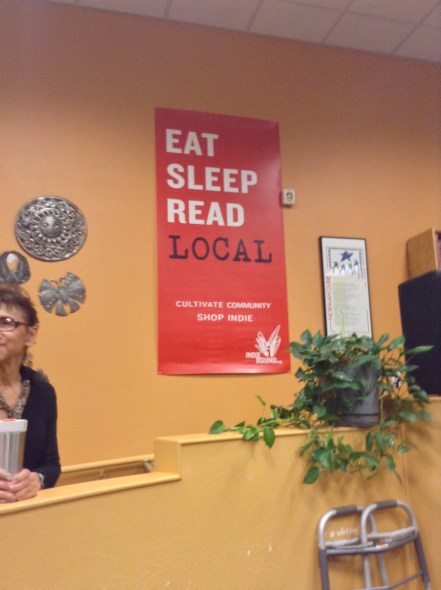
Changing Hands Bookstore
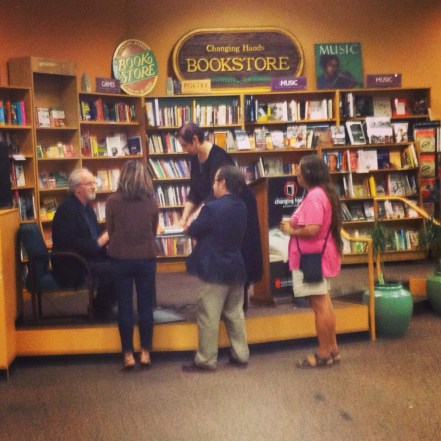
book signing
A reformation of religion is happening before our very eyes. As the formal religions loose members and believers the souls are still out there wandering around seeking some meaning in life. This is an era of very lost souls grasping at self help, self hypnosis, and the usual self delusion. I am lucky my parents did not really introduce religion into my life. They attempted, obviously out of guilt, to send me to the Presbyterians when I was about 11, but they told me it was for punishment. Maybe they let it slip, but I had the big picture which was that I was bad and the people at the Presbyterian church could whip me into shape. That was my initiation into fake religion and it did have deep meaning in my formative years. I saw the lack of ethical standards, and besides, that church had a God awful choir. I had no positive reinforcement that would incline me to want to ever go to church. I felt perfectly righteous to rebel, and saw myself as something of a martyr whenever I had to go to any religious service. I have something like the opposite of Catholic guilt. However, I have studied religion and read more books on the subject that most people, I think.
Last night in Tempe at The Changing Hands Bookstore I heard Thomas Moore speak to a crowd about his new book, A Religion of One’s Own, which I read and think is a grand opus…not a long and dry one…a deeply profound work that will change minds and souls. Tom Moore is to religion what Andrew Weil is to medicine. He has the education and credentials that are needed to start a reformation. I was surprised to hear the word reformation in his speech last night, but he knows of what he speaks. He talked about changing the world in the same way Pope Francis does when he makes his own breakfast. Since he spent years as a monk his piety can’t be questioned. Since he has a doctorate in world religion his knowledge of scripture, doctrines, and history are impeccable. Perhaps most important in our current soul crisis is his experience as a Jungian therapist. His direct experience with the suffering of his patients has shown him the sad results of religion served up with a side of hypocrisy and shame.
He asks the readers not to take this book lightly. I can’t imagine the kind of person who would do that, but they surely exist. He is sharing insight and wisdom that can extricate tortured souls from their day to day pain. He suggests that laborare est orare applies to all of us. In other words, each moment on earth has big potential in a sacred context. Every act, chopping wood, carrying water, or washing dishes provides an opportunity to make life a joyous celebration. Bliss and mysticism are states to which we can aspire and attain. We are supposed to be happy, weird, and free. So…here we have it, permission to go be free, from a verified expert in academic knowledge. I hope we will all take him up on this offer, and predict the book will change the world in a very positive way. (Read it.)
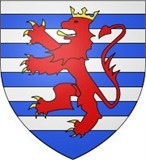
Coat of Arms
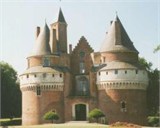
Chateau Rambures
My 18th great grandfather died of the black death at the age of 43. This line shows my relation to Margaret Woodville, but I am also a descendant of her sister, Elizabeth Woodville, Queen consort. It is complicated.
Peter of Luxembourg (1390-31 August 1433) was a son of John, Lord of Beauvoir and his wife Marguerite of Enghien. His inheritance included the counties of Brienne, Conversano and Saint-Pol.
Family
Peter had succeeded his father John, Lord of Beauvoir and mother Marguerite of Enghien. They had co-reigned as Count and Countess of Brienne from 1394 to her death in 1397.
John was a fourth-generation descendant of Waleran I of Luxembourg, Lord of Ligny, second son of Henry V of Luxembourg and Margaret of Bar. This cadet line of the House of Luxembourg reigned in Ligny-en-Barrois. This made Peter a distant cousin to John of Luxembourg, father of Charles IV, Holy Roman Emperor and Bonne, Duchess of Normany and Aquitaine.
Peter was a sixth-generation descendant of John II, Duke of Brittany and his wife Beatrice of England, through their daughter, Mary.[1]
Beatrice was a daughter of Henry III of England and his wife Eleanor of Provence.
Henry was son of John of England and his second wife Isabella of Angoulême.
Life
Peter succeeded his aunt Jeanne of Luxembourg, Countess of Saint-Pol and Ligny, as Count of Saint-Pol in 1430. His younger brother John II of Luxembourg, Count of Ligny, an ally of the English during the Hundred Years War, received Joan of Arc as his prisoner, and subsequently sold her to the English, for 10,000 livres.
On 8 May 1405, Peter married Margaret de Baux, daughter of Francesco del Balzo’s third wife Sueva Orsini, a relation of Clarice Orsini (wife of Lorenzo de’ Medici). Peter and Margaret had nine children , of these are:
L ouis of Luxembourg, Count of Saint-Pol, de Brienne, de Ligny, and Conversano, Constable of France (1418- 19 December 1475), married firstly, in 1435, Jeanne de Bar, Countess of Marle and Soissons (1415 – 14 May 1462), by whom he had issue, and from whom descended King Henry IV of France and Mary, Queen of Scots. He married secondly, Marie of Savoy (20 March 1448- 1475), by whom he had further issue. He was beheaded in Paris in 1475 for treason against King Louis XI.
Jacquetta of Luxembourg (1415/1 416- 30 May 1472), married firstly in 1433, John, Duke of Bedford, moursand secondly, in secret, c.1436, Richard Woodville, 1st Earl Rivers, by whom she had sixteen children, including Elizabeth Woodville, Queen consort of King Edward IV of England. Every English monarch after 1509 descended from her.
Thibaud of Luxembourg, Seigneur de Fiennes, Count of Brienne, Bishop of Le Mans, (died 1 September 1477), married Philippa de Melun, by whom he had issue.
Jacques of Luxembourg, Seigneur de Richebourg (died 1487), married Isabelle de Roubaix, by whom he had issue.
Valeran of Luxembourg, died young.
Jean of Luxembourg, died in Africa.
Catherine of Luxembourg (died 1492), married Arthur III, Duke of Brittany (24 August 1393- 26 December 1438).
Isabelle of Luxembourg, Countess of Guise (died 1472), married in 1443, Charles, Count of Maine (1414- 1472), by whom she had a daughter, Louise (1445- 1477), who in her own turn married Jacques d’Armagnac, Duke of Nemours, by whom she had six children.
The 14th and 15th centuries were well known for the Black Death, a deadly form of bubonic plague spread across the known world. Europe was badly hit by the pestilence, as a result of trading with countries with the plague; it grew to epidemic proportions, killing swiftly without discrimination. The plague hit Luxembourg, France, England and Spain causing the deaths of millions of people. Peter was among the dead. He died in 1433, aged 43 years. His wife died 36 years later.
One of Peter’s daughters, Jacquetta was the mother of Elizabeth Woodville, queen of Edward IV of England.
Elizabeth Woodville was mother of Edward V of England,
Richard of Shrewsbury, 1st Duke of York
Elizabeth of York.
Elizabeth Woodville’s sons are known as the princes of the tower. This comes from when they were locked up by their uncle, Richard III of England and were supposedly murdered.
Elizabeth of York married Henry VII of England, overthrowing Richard II and putting an end to the Wars of the Roses. Elizabeth and Henry were parents to:
Arthur, Prince of Wales,
Margaret, Queen of Scotland,
Mary, Queen of France
and the most famous, Henry VIII of England.
http://en.wikipedia.org/wiki/Peter_of_Luxembourg,_Count_of_Saint-Pol
 Target Hacking Spreads-Teen Hacker In Russia (via Repost Video News)
Target hack spreads; report says at least six other U.S. retailers hit by malware
 mermaidcamp