mermaidcamp
Keeping current in wellness, in and out of the water
You can scroll the shelf using ← and → keys
You can scroll the shelf using ← and → keys





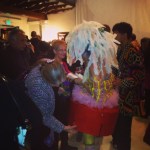











The Edible Art Gala hosted at Maker House last night by the Tucson Arts Brigade was extravagantly well produced. There were musicians in all areas, some dancers and other short acts entertaining all the guests. The food art was set out for tasting and also served by waiters circulating through the crowd. Artists with works in the silent auction were on hand, and everyone was encouraged to come in a costume that represented a work or art or a genre of art. The lively crowd enjoyed the historic setting and the Maker House bar which makes a perfect community gathering place. I tasted almost everything that had no meat, but the sensory excitement abounded, and I found I filled very quickly as I tasted my way around the tables. I am happy to have been introduced to several catering businesses that are new to me and do some seriously high quality original work. Everything I tested was delicious, but I saved myself for the scream cake as the last taste of the night. It was outstanding kiwi flavor with the icing of the dreamiest texture. I savored it with a lovely cappuccino from the bar as we enjoyed the outdoor patio with music under the stars. It was an example of Tucson at it’s best. Old friends, new art, and historic building turned community center…this is what I like to see happening in my city.
I have the news in my in box today that, although I have not been in a Target store for about 6 months, and have not shopped with them on line for years, my personal data has been lifted from their server. They inform you that they will help you monitor this intrusion for a year, but unknown bandits have your information and will, for the rest of your life, target you and sell information about you in order to hack your identity.
| You are a TARGET!!!!!! | |
|
Dear Target Guest,
As you may have heard or read, Target learned in mid-December that criminals forced their way into our systems and took guest information, including debit and credit card data. Late last week, as part of our ongoing investigation, we learned that additional information, including name, mailing address, phone number or email address, was also taken. I am writing to make you aware that your name, mailing address, phone number or email address may have been taken during the intrusion.
I am truly sorry this incident occurred and sincerely regret any inconvenience it may cause you. Because we value you as a guest and your trust is important to us, Target is offering one year of free credit monitoring to all Target guests who shopped in U.S. stores, through Experian’s® ProtectMyID® product which includes identity theft insurance where available
I have answered the mail and requested the year, which is entirely inadequate to deal with the issue at hand. The number of people who have been hacked at Target grows daily. Ironic that the whole thing is about targets. Have you been Targeted? How does it make you feel? I am not only no longer a customer of the store, I am into the idea of a class action law suit.
We are fortunate to have a wonderful teaching farm in Tucson, and I am lucky it is very close to my home. I visited the Tucson Village Farm during the U Pick hours on Tuesday this week. It is much more than I thought it was. This campus is organized to teach kids how to grow, prepare, and eat organic produce. Much is said about slipping healthy ingredients into the kid’s meals, but this is teaching an appreciation for the real thing. I picked lovely greens and tasted a really good salad made from the garden while I was there. I was pleased to see that many of the customers picking while I was there were kids and parents. This is a natural way to teach the love of gardening and good health.







There is no better way to eat than farm to table. It is encouraging to find this worthy institution making a difference in our city. The food is tasty, too.

Audley End House
My 15th great-grandfather was a lawyer and a complete tool of Henry VIII. When Henry dissolved the English Catholic monasteries, Thomas was given the Abbey at Walden, which he made his mansion, Audley End House. He replaced Sir Thomas More as Speaker of the House of Commons.
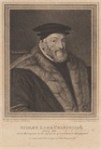

The 1st Lord Audley. Thomas Audley, 1st Baron Audley of Walden, KG, PC, KS (c. 1488 – 30 April 1544), Lord Chancellor of England, born in Earls Colne, Essex, the son of Geoffrey Audley, is believed to have studied at Buckingham College, Cambridge. He was educated for the law, entered the Middle Temple, was town clerk of Colchester, and was in the commission of the peace for Essex in 1521. In 1523 he was returned to Parliament for Essex, and represented this constituency in subsequent Parliaments. In 1527 he was Groom of the Chamber, and became a member of Wolsey’s household. On the fall of the latter in 1529, he was made Chancellor of the Duchy of Lancaster, and the same year Speaker of the House of Commons, presiding over the famous assembly styled the Reformation Parliament, which abolished the papal jurisdiction. The same year he headed a deputation of the Commons to the king to complain of Bishop Fisher’s speech against their proceedings. He interpreted the King’s “moral” scruples to parliament concerning his marriage with Catherine, and made himself the instrument of the King in the attack upon the clergy and the preparation of the Act of Supremacy. In 1531 he had been made a serjeant-at-law and king’s serjeant; and on 20 May 1532 he was knighted, and succeeded Sir Thomas More as Lord Keeper of the Great Seal, being appointed Lord Chancellor on the 26 January 1533. He supported the king’s divorce from Catherine and the marriage with Anne Boleyn; and presided at the trial of Fisher and More in 1535, at which his conduct and evident intention to secure a conviction has been criticised by some. Next year he was part of trial of Anne Boleyn and her “lovers” for treason and adultery. The execution of the king’s wife left him free to declare the king’s daughter Princess Elizabeth a bastard, and to marry Anne’s maid, Jane Seymour. Audley was a witness to the queen’s execution, and recommended to Parliament the new Act of Succession, which made Jane Seymour’s issue legitimate. In 1537 he condemned to death as traitors the rebels of the Pilgrimage of Grace. On 29 November 1538 he was created Baron Audley of Walden; and soon afterwards presided as Lord Steward at the trials of Henry Pole, Lord Montacute, and of the Marquess of Exeter. In 1539, though inclining himself to the Reformation, he made himself the King’s instrument in enforcing religious conformity, and in the passing of the Six Articles Act. On April 24, 1540 he was made a Knight of the Garter, and subsequently managed the attainder of Thomas Cromwell, Earl of Essex, and the dissolution of Henry’s marriage with Anne of Cleves. In 1542 he warmly supported the privileges of the Commons, but his conduct was inspired as usual by subservience to the court, which desired to secure a subsidy, and his opinion that the arrest was a flagrant contempt has been questioned by good authority. He resigned the great seal on 21 April 1544, and died on April 30, being buried at Saffron Walden, where he had prepared for himself a splendid tomb. He received several grants of monastic estates, including Holy Trinity Priory in Aldgate, London and the abbey of Walden, Essex, where his grandson, Thomas Howard, 1st Earl of Suffolk, built Audley End, doubtless named after him. In 1542 he endowed and re-established Buckingham College, Cambridge, under the new name of St Mary Magdalene, and ordained in the statutes that his heirs, “the possessors of the late monastery of Walden” should be visitors of the college in perpetuum. A Book Orders for the Warre both by Sea and Land (Harleian MS. 297, 144) is attributed to his authorship. He married Christina, daughter of Sir Thomas Barnardiston, and later Elizabeth, daughter of Thomas Grey, 2nd Marquess of Dorset, by whom he had two daughters. His barony became extinct at his death. Preceded by Sir Thomas MoreSpeaker of the House of Commons
1529–1533Succeeded by
Sir Humphrey Wingfield Preceded by
Sir Thomas More(Lord Chancellor)Keeper of the Great Seal
1532–1533 Succeeded by
The Earl of Wriothesley(Lord Chancellor)Lord Chancellor
1533–1544Preceded by
New CreationBaron Audley of Walden
Thomas Audley (1503 – 1544)
is my 15th great grandfather
Margaret Audley (1545 – 1564)
daughter of Thomas Audley
Margaret Howard (1561 – 1591)
daughter of Margaret Audley
Lady Ann Dorset (1552 – 1680)
daughter of Margaret Howard
Robert Lewis (1574 – 1645)
son of Lady Ann Dorset
Robert Lewis (1607 – 1644)
son of Robert Lewis
Ann Lewis (1633 – 1686)
daughter of Robert Lewis
Joshua Morse (1669 – 1753)
son of Ann Lewis
Joseph Morse (1692 – 1759)
son of Joshua Morse
Joseph Morse (1721 – 1776)
son of Joseph Morse
Joseph Morse III (1752 – 1835)
son of Joseph Morse
John Henry Morse (1775 – 1864)
son of Joseph Morse III
Abner Morse (1808 – 1838)
son of John Henry Morse
Daniel Rowland Morse (1838 – 1910)
son of Abner Morse
Jason A Morse (1862 – 1932)
son of Daniel Rowland Morse
Ernest Abner Morse (1890 – 1965)
son of Jason A Morse
Richard Arden Morse (1920 – 2004)
son of Ernest Abner Morse
Pamela Morse
I am the daughter of Richard Arden Morse

Margaret Audley
My 14th great-grandmother was Duchess of Norfolk. Elizabeth I beheaded her husband, who was her 5th cousin. She is buried in a church in Norwich.
Lady Margaret Howard 1540-1563/4
“The Virtuous Lady Margaret” was the daughter and sole heir of Thomas, Lord Audley of Walden and Elizabeth Grey. Lord Audley was a prominent Politician whose roles included Lord Chancellor to Henry VIII. Her first husband Lord Henry Dudley died before she was eighteen.
She subsequently married her cousin, Thomas Howard, 4th Duke of Norfolk, who had been widowed in 1557. Thomas was extremely rich and powerful and has been described as the “Premier Peer” in England between 1558 – 1568. The marriage was initially delayed whilst Norfolk’s lawyer negotiated in Rome for a Papal dispensation that would allow him to marry his cousin. Following the death of Queen Mary in 1558 and the accession of the protestant Queen Elizabeth the marriage went ahead without Papal approval. Subsequently in Elizabeth’s first parliament in 1559 the marriage received statutory ratification. Margaret brought a rich inheritance to the alliance, including Audley End in Essex.
During her short marriage she bore five children: two sons and three daughters. She died on 10th January 1564 three weeks after giving birth to her second son Lord William Howard, born on 19th December 1563. The monument, however, states she died 7th February 1563 ! This could be because although Margaret was buried with great dignity on the North Side of the Chancel in St John Maddermarket , she had no memorial there until this tablet was erected in 1791 by her descendant Lord John Howard of Walden. Although the monument here is very plain her effigy lies beside that of the Duke’s first wife Mary Fitzalan, on a splendid tomb in St Michael’s church, Framlingham Suffolk. A space had been left between the two figures, presumably for the effigy of their husband. He was never placed here having brought disgrace to the family and being beheaded for treason by Elizabeth I because of his attempts to marry Mary Queen of Scots.
‘
The Monument
This rather humble tablet was erected by Lord John Howard of Walden in 1791 in a style typical of the time; it was restored by Lord Howard de Walden in 1903.
Under the shield is quoted the Howard family motto ” Sola Virtus Invicta” – which translates to “Bravery Alone is Invincible.” The reference to “The virtuous Lady Margaret” on the monument could, however, be reference to an alternative translation “Virtue Alone is invincible”
Margaret Audley (1545 – 1564)
is my 14th great grandmother
Margaret Howard (1561 – 1591)
daughter of Margaret Audley
Lady Ann Dorset (1552 – 1680)
daughter of Margaret Howard
Robert Lewis (1574 – 1645)
son of Lady Ann Dorset
Robert Lewis (1607 – 1644)
son of Robert Lewis
Ann Lewis (1633 – 1686)
daughter of Robert Lewis
Joshua Morse (1669 – 1753)
son of Ann Lewis
Joseph Morse (1692 – 1759)
son of Joshua Morse
Joseph Morse (1721 – 1776)
son of Joseph Morse
Joseph Morse III (1752 – 1835)
son of Joseph Morse
John Henry Morse (1775 – 1864)
son of Joseph Morse III
Abner Morse (1808 – 1838)
son of John Henry Morse
Daniel Rowland Morse (1838 – 1910)
son of Abner Morse
Jason A Morse (1862 – 1932)
son of Daniel Rowland Morse
Ernest Abner Morse (1890 – 1965)
son of Jason A Morse
Richard Arden Morse (1920 – 2004)
son of Ernest Abner Morse
Pamela Morse
I am the daughter of Richard Arden Morse
Source: Wikipedia
Margaret Howard (née Audley), Duchess of Norfolk (1540 – 1564) was the sole surviving child[1] of Thomas Audley, 1st Baron Audley of Walden and Lady Elizabeth Grey, daughter of Thomas Grey, 2nd Marquess of Dorset and Margaret Wotton. Lady Elizabeth Grey was the aunt of Lady Jane Grey, de facto Queen of England for nine days in 1553 and, therefore, Margaret and Queen Jane were first cousins.
Margaret was a wealthy heiress and married first, without issue, Lord Henry Dudley, son of John Dudley, 1st Duke of Northumberland. Henry Dudley was killed at the Battle of St. Quentin, 20 August 1557
In December 1558, she became the second wife of Thomas Howard, 4th Duke of Norfolk, who was her fifth cousin, through their descent from Jacquetta of Luxembourg and Richard Woodville. Margaret’s line of descent came from the marriage of Elizabeth Woodville and John Grey, while Thomas Howard’s line of descent came through Elizabeth Woodville’s sister, Catherine, who had married Henry Stafford. They had four children, Elizabeth (who died as a child), Thomas Howard, 1st Earl of Suffolk, William, and Margaret. She died 9 January 1564, three weeks after the birth of her last child. She was buried at St. John the Baptist’s church at Norwich.
Eros Ramazzotti is my favorite Euro pop star and this song was his first giant hit in Europe. I had not seen this video story of his quest to find the love of his life. It is like a treasure hunt or scavenger hunt in which the destination is not known, but clues are gathered. This love story has dream qualities in which strong symbols compel him to continue the search. The Roman god Eros was involved with much mystery and trickery. Eros fell in love with Psyche but concealed his identity while he courted her nightly. His mother Aphrodite was jealous of Psyche’s beauty, and wished her harm. The story has many dramatic twists and turns but in the end the couple does marry and live happily.
Eros has a sexual spark, but it can represent beauty, vitality and flow of life. When a person place or thing turns you on it reminds you of the vital force within your own body. To be sexy or feel attracted is to confirm your own mysterious connection to love and your destiny as a lover. To follow each tiny vital impulse would prove too much, but how can we be sensitive and respond when true love calls? It is possible that only at the end of your life will you be able to look back and identify your true loves, your true dreams, and your true beliefs? Is the treasure hunt for love so subtle and full of mysterious layers that we can only understand in retrospect? What will you hunt for on Valentine’s Day? Where will you find Eros?
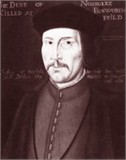
John Howard
My 16th great-grandfather died in battle in the War of the Roses:
John Howard, 1st Duke of Norfolk, 12th Baron Segrave, 11th Baron Mowbray, Earl Marshal (1421 – 22 August 1485) was an English nobleman, soldier, and the first Howard duke of Norfolk. He was a close friend and loyal supporter of King Richard III of England, with whom he died in combat at the Battle of Bosworth.
The Battle of Bosworth Field was the penultimate battle of the Wars of the Roses, the civil war between the House of Lancaster and the House of York that raged across England in the latter half of the 15th century. Fought on 22 August 1485, the battle was won by the Lancastrians. Their leader Henry Tudor, Earl of Richmond, became the first English monarch of the Tudor dynasty by his victory and subsequent marriage to a Yorkist princess. His opponent Richard III, the last king of the House of York, was killed in the battle. Historians consider Bosworth Field to mark the end of the Plantagenet dynasty, making it one of the defining moments of English history.http://en.wikipedia.org/wiki/Battle_of_Bosworth_Field
Retrieved on 7 May 2010 from:http://en.wikipedia.org/wiki/Battle_of_Bosworth_Field,http://en.wikipedia.org/wiki/John_Howard, _1st_Duke_of_Norfolk

Battle of Bosworth Field
John Howard (1421 – 1485)
is my 16th great grandfather
Lord Thomas HOWARD (1443 – 1524)
son of John Howard
Lady Katherine Howard Duchess Bridgewater (1495 – 1554)
daughter of Lord Thomas HOWARD
William ApRhys (1522 – 1588)
son of Lady Katherine Howard Duchess Bridgewater
Henry Rice (1555 – 1621)
son of William ApRhys
Edmund Rice (1594 – 1663)
son of Henry Rice
Edward Rice (1622 – 1712)
son of Edmund Rice
Lydia Rice (1649 – 1723)
daughter of Edward Rice
Lydia Woods (1672 – 1738)
daughter of Lydia Rice
Lydia Eager (1696 – 1735)
daughter of Lydia Woods
Mary Thomas (1729 – 1801)
daughter of Lydia Eager
Joseph Morse III (1752 – 1835)
son of Mary Thomas
John Henry Morse (1775 – 1864)
son of Joseph Morse III
Abner Morse (1808 – 1838)
son of John Henry Morse
Daniel Rowland Morse (1838 – 1910)
son of Abner Morse
Jason A Morse (1862 – 1932)
son of Daniel Rowland Morse
Ernest Abner Morse (1890 – 1965)
son of Jason A Morse
Richard Arden Morse (1920 – 2004)
son of Ernest Abner Morse
Pamela Morse
I am the daughter of Richard Arden Morse
Born around 1420, John Howard was the son and heir of Sir Robert Howard andMargaret, daughter of Thomas Mowbray, Duke of Norfolk. Through his mother and her female line, he was descended from Edward I, thus making him the premier Duke and heir to the title of Earl Marshall. Nothing is known of his childhood.
His first recorded service was in 1451, when he followed Lord L’Isle to Guienne. He was also present at the Battle of Chatillon in Jul two years later. It was at this time that he entered the service of John Mowbray, Duke of Norfolk.
On the first accession of Edward IV, Howard was knighted and appointed Constable of Colchester Castle, Sheriff of Norfolk and Suffolk. He was also one of the King’s Carvers.
Howard took an active part in John Mowbray’s quarrel with John Paston. In Aug 1461, he was involved in a violent brawl with Paston and used his influence withEdward IV against Paston. In Nov of the same year, Howard was imprisoned after giving offence at the election of Paston, causing many complaints against him.
The following year, he was appointed Constable of Norwich Castle and received grants of several manors forfeited by the Earl of Wiltshire. He was joined byWilliam Neville, Baron Fauconberg and Lord Clinton to “keep the seas“, taking Croquet and the Isle of Rhe. Later in the year, he was sent to help the Richard Neville, Earl of Warwick at Warkworth.
In the Spring of 1464, Howard helped Norfolk secure Wales for Edward IV. He bought the reversion of Bamburgh Castle in Jun of the same year and was withEdward IV and his court at Reading by the year’s end.
Howard was appointed Vice Admiral for Norfolk and Suffolk in 1466, and was charged with conveying envoys from England to France and the Duke of Burgundy. He remained in Calais from 15 May to 27 Sep.
He was elected Knight of the Shire for Suffolk in Apr 1467, having been elected Knight of the Shire for Norfolk in 1455. Nov 1467 saw him as an appointed Envoy to France as well as Treasurer to the Household, a post which he held until 1474. The following Jun (1468) he attended Margaret of York to Flanders for her marriage to Charles, Duke of Burgundy.
On the restoration of Henry VI, he was created Baron de Howard (15 Oct 1470). However, when Edward IV landed back in England in Mar 1471, after living in exile in Bruges, Howard proclaimed Edward to be King.
The following Jun, he was appointed Deputy Governor of Calais. When Edward IVinvaded France in Jul 1474, he was accompanied by John Howard, who was one of the commissioners who made a truce at Amiens. Howard received a pension from Louis XI and remained in France, briefly, as a hostage after Edward’s departure. On Howard’s return to England, he was granted manors in Suffolk and Oxfordshire forfeited by John de Vere, Earl of Oxford.
John Howard was also sent by Edward to treat with France on several occasions – Jul 1477, Mar 1478, and Jan 1479. Also, in 1479, he was put in charge of the fleet which was sent to Scotland.
At Edward IV’s funeral in Apr 1483, he carried Edward’s Banner. He then attached himself to Richard III. On 13 May 1483, he was appointed High Steward of the Duchy of Lancaster and was made a Privy Councillor. A month later, John Howard was created Duke of Norfolk and Earl Marshall.
He persuaded Elizabeth Woodville to let the young Duke of York join his brother Edward V in the Tower. He was possibly involved in the murder of the two princes in the Tower of London. At Richard III’s coronation, Howard performed many functions – he acted as High Steward, bore the crown, and, as Earl Marshall, was the King’s Champion. Shortly afterwards, he was created Admiral of England, Ireland, and Aquitaine, and was appointed Chief of Commissioners to negotiate with James III of Scotland on 12 Sep 1484 at Nottingham.
In Aug 1485, he summoned his retainers to Bury St. Edmunds and commanded the vanguard at the Battle of Bosworth, where he was killed. Howard was attainted at Henry VII’s first Parliament. Warned in the following distich: “Jockey of Norfolk be not too bold,/ For Dickon thy master is bought and sold“. He was buried in the conventual church at Thetford, Norfolk.
Juno is the Roman goddess of childbirth and marriage. She conceived and gave birth to her son, Mars, the god of anger, by taking an herb given to her by the goddess Flora. She acts as one of the three guardians of Rome together with Minerva and Jupiter. Both Juno and Jupiter are said to be able to throw thunderbolts. She was jealous when Jupiter gave birth to a fully armed Minerva from his head, so she gave birth to her own warrior son.
In Thomas Moore’s new book, A Religion of One’s Own, he explains that Juno can be perceived as a guardian angel spirit for women. Men have similar genius spirits, in a mythological sense. These guardian angels or personal spirit guides act to individuate and protect people. It is notable to me that either Jupiter or Juno can give birth to armed warriors for protection. Another key concept brought up in the book that is new to me is that Mars was considered to be a close friend of agriculture. Mars protected the crops from pests. Mars represents anger artfully directed, rather than repressed or exploded. That is why they are called martial arts, not lucha libre.
The idea of protection reminds me that it is fitting and healing to deal with dark emotions appropriately. The energy of the thunderbolt throwing parents of Minerva and Mars must be carefully directed and not treated lightly. War and anger may be a part of life, but they can be used to remove obstructions in an earthly or a spiritual realm. Primal anger, which we all have, is useful and instructive. It draws the line, but it can also cause great distress and confusion. I agree with the idea that we need to be aware of our anger and how we express and use it as an integral part of a personal awakening. I like the helpful imagery of my full time Juno guarding me, and plan to take her with me all the time. If you enjoyed a guardian angel as a child, or even if you never did, it is not too late to relate to yours.
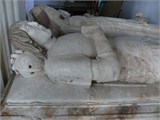
grave
My 16th great grandfather was the Sheriff of Essex at a very tricky time in history. I recently watched “the Tudors” on PBS. Those people were very wild. If Knight Wentworth was hanging out with Queen Katherine and the Emperor Charles he was close to Henry VIII, and we know how dangerous that could be. I had another ancestor who also attended the Cloth of Gold, but as a chaplain. I wonder if they knew each other. Sir Roger was:
Knight, of Cobham Hall, Wethersfield, and Gosfield, Essex, jure uxoris, Sheriff of Essex and Hertfordshire. Accompanied Queen Katherine at the Field of the Cloth of Gold in 1520; accompanied King Henry VIII to a meeting with Emperor Charles V at Canterbury in 1522.
Roger “Sir Knight””Sheriff of Essex” Wentworth (1460 – 1539)
is my 16th great grandfather
Margaret Wentworth (1492 – 1532)
daughter of Roger “Sir Knight””Sheriff of Essex” Wentworth
Isabell Harvey (1510 – 1594)
daughter of Margaret Wentworth
Edward Radcliffe (1535 – 1643)
son of Isabell Harvey
Lady Eleanor Elizabeth Radcliffe (Whitebread) (1550 – 1628)
daughter of Edward Radcliffe
Elizabeth Whitbread (1538 – 1599)
daughter of Lady Eleanor Elizabeth Radcliffe (Whitebread)
Thomas Spencer (1571 – 1631)
son of Elizabeth Whitbread
Thomas Spencer (1596 – 1681)
son of Thomas Spencer
Margaret SPENCER (1633 – 1670)
daughter of Thomas Spencer
Moses Goodwin (1660 – 1726)
son of Margaret SPENCER
Martha Goodwin (1693 – 1769)
daughter of Moses Goodwin
Grace Raiford (1725 – 1778)
daughter of Martha Goodwin
Sarah Hirons (1751 – 1817)
daughter of Grace Raiford
John Nimrod Taylor (1770 – 1816)
son of Sarah Hirons
John Samuel Taylor (1798 – 1873)
son of John Nimrod Taylor
William Ellison Taylor (1839 – 1918)
son of John Samuel Taylor
George Harvey Taylor (1884 – 1941)
son of William Ellison Taylor
Ruby Lee Taylor (1922 – 2008)
daughter of George Harvey Taylor
Pamela Morse
I am the daughter of Ruby Lee Taylor

A Religion of One’s Own
I just read A Religion of One’s Own by Thomas Moore, an author I admire. I met him in person last May when he had recently completed the book and was in the editing process. The workshop I took with him then was about soul, spirit, and the distinction between the two. This new book goes into detail on this subject. Like his other books I have enjoyed the subject matter is easily accessible although the reader becomes highly aware of Tom’s deep background and knowledge of world religions, art, music, history, and natural magic. He spent many years as a monk learning languages and music composition as he studied to be ordained as a priest. His knowledge of Greek and Latin always add depth to his concepts because he carefully traces true meanings in words. The words I learn from him stay in a special memory bank of super charged, precious possessions. They are magic words for me, with mystical value.
I read the book almost non stop on my Kindle paperwhite, a new gadget I now think is excellent. One feature of Kindle reading is the ability to look up words within the device as you read. The words you look up are added to your ongoing vocabulary list. Since I learn new words every time I read his work, this was fabulously useful. Here is my new vocabulary from this book:
Normally I would take the meaning from context and go on, but now I am a real vocabulary builder. What Thomas Moore is asking us all to do is to develop a much broader vocabulary and understanding of religion. The mystical and mysterious is essential to our fulfillment and happiness. Without soul, spirit, and practices that maintain the health and vigor of both in our lives we can become dead to the pleasure of being alive. Churches and formal religion have lost the leadership role they once maintained without question. Now it is important not to discard the sacred and the meaningful, but to make a unique personal system that is true to our own natures. Dogma and deterioration from institutions can be replaced by practices that feed our souls and our spirits, and nurture harmony in our communities.
I know all of Tom’s many fans will be happy to read this latest edition of his teaching. If you have not had the pleasure of meeting him in person or in writing you are missing a very special treat. He is a Renaissance Man in that he is honestly creating a renaissance vortex and map for his readers to follow. He is asking no less than a rebirth and re-empowerment of our sacred traditions so as not to loose the beauty and significance of them. He gives concrete suggestions and guidance to achieve this goal by treating all the religious traditions as one’s own. Personal wisdom and satisfaction are essential to living a blissful, peaceful life. Thomas Moore has once again created a meaningful and significant lesson we can all easily grasp. The book is short, compelling, and will leave you in a new frame of mind. It is worth reading, and even more worth practicing.

 mermaidcamp