mermaidcamp
Keeping current in wellness, in and out of the water
You can scroll the shelf using ← and → keys
You can scroll the shelf using ← and → keys
This is my first introduction to @JasonSilva. I lived in Venezuela in the 1960’s, which was a completely different era. He was born in 1982, when the country was undergoing rapid change and political upheaval. Some of my radical tendencies are a reaction to the petroleum princess lifestyle I enjoyed while living in a petroleum camp in eastern Venezuela. The imperialism of the situation became clear later when I became aware of politics.
His view on evolution is not only revolutionary, but very hopeful. I am glad I found him; I hope the gentle readers agree he is a gem to follow…brilliant in a brand new way:

Lanier coat of arms
My eighth great-grandfather came to Virginia with John Washington, and once owned Richmond:
John Thomas Lanier, son of Nicholas and grandson of Jerome was from
Bordeaux in 1603 to America with John Washington. He brought much of the
family furniture with him. He was given a grant of 10 miles or 1400 acres
of land on the South of James River and it included what is now Richmond,
located in what is now counties of Prince George, Brunswick, etc. He
subsequently moved to North Carolina (North border) and was very
prominent.
John Thomas Lanier (1631 – 1719)
is my 8th great grandfather
Sampson Lanier (1682 – 1743)
son of John Thomas Lanier
Elizabeth Lanier (1719 – 1795)
daughter of Sampson Lanier
Martha Burch (1743 – 1803)
daughter of Elizabeth Lanier
David Darden (1770 – 1820)
son of Martha Burch
Minerva Truly Darden (1806 – 1837)
daughter of David Darden
Sarah E Hughes (1829 – 1911)
daughter of Minerva Truly Darden
Lucinda Jane Armer (1847 – 1939)
daughter of Sarah E Hughes
George Harvey Taylor (1884 – 1941)
son of Lucinda Jane Armer
Ruby Lee Taylor (1922 – 2008)
daughter of George Harvey Taylor
Pamela Morse
I am the daughter of Ruby Lee Taylor
State-Wide, NC – Lanier Family Genealogical Tree
The following bible record is found on the LAGenWeb Archives at the
following http://files.usgwarchives.org/la/state/bible/lghsbible/
This record is “bible4-4.txt” in the list of records
Bible Records Published by Louisiana Genealogical and Historical Society.
Be it Known And Remembered: Vol. II, Bible Records 1961: Pages 1 – 60
Submitted to the USGenWeb Archives by LGHS, Jun. 1998
LANIER FAMILY GENEALOGICAL TREE
Taken from the Family Records of Mr. Lee Lanier of Amite, La. Submitted to
the Society by Mrs. Kathryne Watkins, Hammond, La., State Librarian of
Louisiana Daughters of the American Revolution.
Jerome Lanier of Brodeaux, France in 1558 emigrated with his family to
England, in the latter part of the reign of Queen Elizabeth. Jerome was a
Huguenot who fled from execution or persecution and finding himself
without means in a foreign land availed himself of his accomplishments and
secured a position in Queen Elizabeth’s household as Court musician. He
found great favor at the court and for about one hundred years – 1558 to
1666 – the Laniers flourished in England, distinguished themselves in
music, art and military genius. They were a family of means and culture in
France. Jerome Lanier had three sons: Nicholas, Clement and Jerome.
Nicholas Lanier was born in 1568, he was the most prominent of Jerome’s
sons. He enjoyed high favor under James the 7th reign and especially so
under Charles the 7th’s reign. English history says of him that he was one
of those artists whose various talents were so noticeable as to suit the
taste of Charles the 7th. He gathered Charles the 7th’s collection of
paintings. He was a skilled musician, artist and courier. Five of his
famous paintings are distributed as follows: one owned by Van Dyke, one in
the collection of Charles the 7th, one now in the music hall of Oxford.
Two owned by the Prince of Wales. He died in 1648 leaving two sons:
Nicholas, Jr. and John Thomas Lanier.
Nicholas Lanier, Jr., brother of John Thomas Lanier who migrated to
America in 1683; was also a noted musician and artist. He was frequently
seen at the court of England. He was made president of the English Society
of Musicians
Page 133
and Artists for life. He enjoyed many favors from the King. Other members
of the Society were Clement, Andreu, and Jerome. These appear to be of
another branch of Laniers.
(Comment of J. B. Lanier Plooard – 1947 – Apparently history closes out
all branches of the family who may have remained in England and the
Laniers in America seem to be descendants of John Thomas Lanier and
Elizabeth Washington, the aunt of George Washington.)
Jerome Lanier lives in a palatial house in Greenwich, was a great and
famous musician. Owned the greatest collection of paintings than in
existence. He had only one son.
Sir John Lanier in 1690 comes again in history of being knighted “Knight
of his valor, in the capture of Castle of Edinboro. He was Major General
of the “Horse & Dragon.” In the Irish war made himself prominent in Battle
of Boyne and fell at Battle of Steinkiek fighting gloriously along with
the brave Douglas. This closes his story as far as we know of Clement and
Jerome Lanier, so the family name was apparently perpetuated by the
descendants of the son Nicholas Lanier. They may have had daughters.
John Thomas Lanier, son of Nicholas and grandson of Jerome was from
Bordeaux in 1603 to America with John Washington. He brought much of the
family furniture with him. He was given a grant of 10 miles or 1400 acres
of land on the South of James River and it included what is now Richmond,
located in what is now counties of Prince George, Brunswick, etc. He
subsequently moved to North Carolina (North border) and was very
prominent. In 1688 he married Elizabeth Washington, daughter of John
Washington, aunt of George Washington. His will is on record in Prince
George County, Virginia. He was prosperous and left sons Sampson, Robert,
Nicholas, John Thomas and Buckner.
Nicholas Lanier, son of John Thomas Lanier, died 1779 and left two
daughters.
Sampson Lanier was the only surviving son of John Thomas Lanier and
Elizabeth Washington Lanier. He died in 1743 also rather young, but lived
a life of great usefulness as a plantation teacher and physician. His will
in Brunswick County, Va. left large estate to Thomas Dannell Lanier;
Sampson Lanier, Jr., James, Richard and Elizabeth.
Thomas Dannell Lanier died in 1745 and left two daughters.
Elizabeth married a Burch and second a Smith.
Richard Lanier had sons Lewis, Burwell, Buckner and daughter Winnifred.
Lewis, son of Richard Lanier, had a son Alexander Lanier that settled in
New York City. Alexander had a son James D. F. Lanier.
Burwell Lanier had one son David. David moved from Brunswick Co. to
Pittsylvania Co., Va. in 1772. The land is in what is now Henry Co., Va.
Va. records show that David Lanier was a Capt of a Co. in the revolution
distinguished himself as a brave military genius. He married Miss Mollie
Hicks.
Page 134
David Lanier, Jr. had son James Monroe Lanier, grandson Charles and
grandson James who named a son James Monroe Lanier, who was a Capt. in War
of 1812. Was of fine personal appearance and was a large land owner in
Virginia. Daughters of James Monroe Lanier, son of David, were Sally and
Judith.
John Hicks Lanier, Lucy and Nancy and Eliza were other children of David
Lanier.
John Hicks Lanier married a Miss Carter. She was the mother of his
children and when he married a second time the children could not get
along with the new wife and they moved to Missouri. Daughter Mary married
and moved to Lincoln Co., Mo. She married John Lovell__ Children: John,
Jr., Wilie and Allie. Son David had a daughter Mary. Mary first married
James Jones and then a Ferguson. John Hicks, Jr. married Sallie Robinson
and had children: David, Demarous, Mollie. Edward, son of John Hicks
Lanier, Sr. married Jane and had two sons. Robert, son of John H. Lanier,
Sr. married twice. His descendants live around St. Louis.
Sampson Lanier, Jr. – Sampson died 1757, Brunswick Co., Va. and it named
children:
Buckner Lanier, son of Sampson, Jr. was famous for ability to settle
disputes. Well educated – physician and planter. Had one son Sterling
Robert Lanier, son of Sterling, married Mary Anderson of Macon, Georgia.
Sterling Lanier had sons Sidney, the poet, who died of TB contracted
during the Civil War and son Clifford Lanier who went to Montgomery,
Alabama and settled. Sidney Lanier was born 1841.
These are old family records and are not documented; however, they are a
good finding list. There has recently been published a book regarding this
family that will bear out this information. Hillery and his brother
Benjamin were in the Florida Parishes section of Louisiana as early as
1873 but the court records do not show estate papers.
I recently joined instagram when I learned the 15 second videos became truly instant. I enjoy the challenge of making a real statement in that period of time. I haven’t done it yet, but have seen others who do. It will be challenging to story board and shoot some funny, informative, or entertaining 15 second shows. I have just entered the zone, but can see the potential. I do do see some feet and selfies, but there are also cool things and places I want to see. However, after hearing this song, I feel pressure to stop posting grams of my food and be purposeful and creative with the new toy. We shall see how that goes. It seems like the wave of the future. Careful preproduction has never meant so much.
My friend Nirvair Kaur Khalsa has had a long career as director of the Montessori schools she founded in Tucson. I met her yesterday at Khalsa Montessori ,where the Sikh community meets for gurdwara. Nirvair plays and sings the ancient ragas for the congregation on an instrument that has been revived by her teacher, the taus. This beautiful stringed instrument was played by the guru’s traveling teaching band during a time when peace flourished between Sufis, Sikhs, HIndus and Moslems. She explains some history of her religion here:
Her interest in religion made her curious about the origins of the teachings she follows. She has studied with Bhai Baldeep Singh, who is bringing back the instrument his ancestors made and played. These religious poems were sung by the Sikh gurus who used them for worship and teaching. The musical tradition was passed from person to person, so today Nirvair is one of a few people practicing and preserving the lovely peacock shaped stringed taus. She gave me a sample in her office:
I plan to return when she is singing during the ceremony. The instrument is a work of art in itself; it produces the sound of ancient India. Her vocation to learn and play these poems of traditional significance in the original way is impressive. I believe the gentle readers would like to see this peacock cello in full glory.
Science and art collide in the syesthesthetes. Color and odor are so closely related, as are color and taste. Sensory criss crossing is the particular talent of the synesthetes. To know what color or flavor an hour of the dawn is one must identify across the senses. This identification is natural to some, and can be enhanced through practice. Blind tasting is, in a way, a chance to create your own vision by tasting and smelling. Leonardo de Vinci called synesthesia one of his core values. Indian musicians compose ragas to be played at specific times of day and seasons of the year, like liturgy. When you enter a church with an ornate decorative style to hear chanting and smell incense you are being trained to cross your senses. Here is quiz to test your own synesthesia.
This device is used in art and literature to create a sensual background. If I write about cool colors or ice-cold professionalism, I ask you to feel the adjective. If I tell you the characters were swept away emotionally by the full moon and the soft ocean breeze, I want you to feel the set. Music videos evoke a feeling that is produced to add dimension to the songs. Here is one that is straight up color, geometry and sound. Enjoy!
“Shame is a soul eating emotion” Carl Gustav Jung
Today shame is often related to compulsive behavior. It seems also to be the reason for codependent rather than meaningful relationships. Everyone knows shame in some part of life, so it is a common denominator. In small doses it is the element that keeps us from enjoying being ourselves. In larger quantities it is crippling. It’s a shame so much energy is spent on shame. While it cannot be avoided completely during one’s life it can be kept in check.


My 4th great-grandfather was born in Virginia and died in the Revolutionary War in South Carolina.
His father, John TAYLOR, b. ca. 1723, migrated from Virginia in 1754 to the east bank of the Congaree River, 10 miles south of Columbia, South Carolina.
Captain John TAYLOR (b. 1746 m. Sarah HIRONS d. 1 Feb 1781) was wounded twice, at Fort Moultrie and Sullivan’s Island, and captured with Colonel Thomas TAYLOR (b. 10 Sept 1743 & John’s brother) at Fishing Creek, but escaped while being carried to Camden, South Carolina. He was one of three brothers who fought in the American Revolution for the SC Militia.The 3rd brother, James TAYLOR, married both Sarah’s sister, Mary HIRONS, & Sarah DANIELL. (Taylor info: http://www.geocities.com/bcvsmith/ 19 April 2002)
Captain John Taylor died of smallpox during the war.
John Taylor (1747 – 1781)
is my 4th great grandfather
John Nimrod Taylor (1770 – 1816)
son of John Taylor
John Samuel Taylor (1798 – 1873)
son of John Nimrod Taylor
William Ellison Taylor (1839 – 1918)
son of John Samuel Taylor
George Harvey Taylor (1884 – 1941)
son of William Ellison Taylor
Ruby Lee Taylor (1922 – 2008)
daughter of George Harvey Taylor
Pamela Morse
I am the daughter of Ruby Lee Taylor
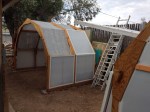
My visit with Michael Ray yesterday was fun and informative. Here he tells us about the benefits of the Nursetree Garden Arch:
I am impressed with his continual learning and improvement of his invention. I have been through the prototype process with Floatli and know it is both fun and frustrating. You can only learn through experiment. I believe Michael has created a wonderful tool desert gardeners will be needing more and more. A dozen years ago I bought 5 acres in Oracle, AZ with a gushing well, thinking I would grow food. When I sold the property last year the well was almost depleted for household use. In a way I was lucky I did not plant a big orchard and then loose the water for it. Today I garden in the city with an eye toward conservation of every kind. The garden arch is an innovative way to save water and grow food.
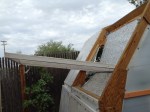
Michael Ray and I met at a small business group that meets at Tucson’s Ward 3 office once a month for a convo. When I saw the pictures of his invention I wanted one. After learning more in subsequent meetings, I asked to interview him about his gardening transformer, the Nursetree Arch. He developed this water catching temperature controlling environment for desert gardeners who have climate challenges. I love the way he can adapt his new prototype to the situation and economic needs of the particular client.
The fully decked out robotic arch in which Michael is growing papaya as well as brussels sprouts in Tucson on August fist is fancy indeed. He is recording data to help him refine his work. His outdoor garden benefits from his arch used as seedling starter in the winter.






 mermaidcamp