mermaidcamp
Keeping current in wellness, in and out of the water
You can scroll the shelf using ← and → keys
You can scroll the shelf using ← and → keys
I am in a chat group with some people who have been to est training or the Landmark Forum, but I have not done that. I enjoy their point of view, but am amused by much of the jargon. Recently somebody in that group asked if others had alienated others with special transformational language. I had to laugh and think of what my own transformational groups and languages have been:
There are sub groups,but these are the majors. I have recently been united with my early childhood neighbors and school friends, one of whom went to summer camp with me. I have also gotten in touch with many old friends and neighbors who lived in San Tomé, Venezuela in the early 1960’s. This mostly bilingual group has a language and a culture that is unique. I am not in contact with any high school or college friends, but a small group with whom I worked in a theater company in Cherokee, NC in 1968 has been drawn together through social media. The hippies, spa bunnies, swimmers, and vegetarians all switch places and morph into the current culture. I know a few of each group from the past. I stay in touch with Swiss friends, although I have not visited for a few years now.
The language, slang, and meaning of these transformational groups imprint on us as individuals, and as a collective groupthink. We share memories that fit together like jigsaw puzzles. In the last month I have been amazed to learn some of the things my elementary classmates remember about me, and what I know about them. The past plays back like a very funny movie, missing lots of dialog and motive. What seemed insignificant is memorable, and what was important at the time has lost significance. We do have a thread of common language, and some common ideas. Although we may no longer be a group who hangs out in real life, we somehow are still transforming each other. Even learning about the death of some of our old comrades shakes the foundation of mortality, the ultimate transformation.

post industrial reflection
We are pretending that the data analysts of the world are geeks and, therefore, benign. How silly can we be? My own father jumped from slide rule to mainframe computer just to get bigger data. The rest of his life was consumed by the opportunity to get more and bigger data. He taught petroleum engineering students how to analyze big data to manage oil fields. He was recruited by IBM in the late 1950’s to be a believer. Data was the future and the future was bigger data.
My parents and all their petroleum friends around the world distinguished themselves by the mass quantities of alcohol they consumed. They liked Ike, war, cars, and cocktails. I never saw them as particularly in touch with reality. They were, in their day, the big science data mangers trusted to produce energy for the planet. They were distinctly reckless, especially my father. He adored fracking and exploding stuff of all kinds. In his 60’s he became a reckless hot air balloonist, risking the lives of many to get his kicks. I am not saying they were evil..not at all. They were lots of fun, and popular for their party antics. What I am saying is that humans handle the data, and I suspect each person attracted to this kind of power (of geekiness and arcane knowledge) of wanting to pervert the universe. I see the greatest generation as having used science to do much damage. I think the Boomers will not be remembered so well in data history either. Control of politics and data has turned into a giant Red Rover dare. Protecting all the various digital borders is now impossible, so cyberinfo is a volatile hacking paradise.
Now there is so much data nobody has any idea how to manage it, let alone isolate the people ethical enough to handle it. This whole idea and verbiage of leak is indicative of the problem. We now have such a complex web of data moving non stop that leaks of all kinds are inevitable. People will now devote their lives and fortunes to creating and finding leaks of important data. The data came from Pandora’s box, but it is much too big to be contained now. We let it all out, then we dare Big Brother to come over. I witnessed first hand the people who conquered the oil fields with data and science. They suffered from intense ignorance. We do too. It is not the tool, but the user,who makes the decisions, who has the power to change the outcome. I am not so worried about NSA wasting time analyzing my data as I am about all misdirected data studies everywhere. This data smuggling and whistle blowing has only just begun, gentle reader. We have a tangled web of growing data to interpret, store and hide.

Thomas Kerr
Thomas Kerr was devoted to the interests of Mary, Queen of Scots, who was in turn, devoted to the martyrdom of my maternal 10th great-grandfather, Rowland Taylor. My family has been opposed to itself in history more than once. As a child in suburban Pittsburgh I lived very near a family named Kerr of fabulous, robber baron wealth of some kind. I now wonder if I was a distant relative of the Kerrs in my childhood neighborhood. They had a castle and loads of fine stuff they shared generously with all the kids in the area. I suppose I will never know. We do know quite a bit about Thomas, including his ruffled fashion statement:
Thomas Kerr (Carr) became the 9th Baron of Ferrniehirst Castle. He was also noted for his involvement with Mary Stuart, Queen of Scots. (From notes of David W Carr)The name of Carr, Kerr or Karre is as old as the Norman Conquest by William of Normandy in 1066. One of the followers of William I is recorded in the Roll Of The Gattle Abbey as the name of Karre.The early descendants of this Norman soldier and succeeding generations spread on both sides of the border of England and Scotland.Direct lines can be traced through various peerage books of England and Scotland to Andrew Kerr I, the 6th Baron of Fennehurst, Scotland. He was born in 1450 , created Baron in 1480 and knighted in 1483. He and his son Andrew II, 7th Baron of Fennehurst, were remarkable men for talent and undaunted courage, conspicious in reigns of James IV and James V. Andrew Kerr II, died in 1543. His son Sir John Kerr, 8th Baron of Fennehurst, did great service against the English and rescued Queen Mary from incursions by the English against the Scots. Sir Thomas, 9th Baron and son of Sir John, was also devoted to Queen Mary’s interests. (Quoted from Watson’s “The House of Carr”1926)
Thomas Kerr (1529 – 1586)
is my12th great grandfather
William Carr (1542 – 1655)
son of Thomas Kerr
Benjamin Carr (1592 – 1635)
son of William Carr
Caleb Carr (1623 – 1695)
son of Benjamin Carr
Sarah Carr (1682 – 1765)
daughter of Caleb Carr
John Hammett (1705 – 1752)
son of Sarah Carr
MARGARET HAMMETT (1721 – 1753)
daughter of John Hammett
Benjamin Sweet (1722 – 1789)
son of MARGARET HAMMETT
Paul Sweet (1762 – 1836)
son of Benjamin Sweet
Valentine Sweet (1791 – 1858)
son of Paul Sweet
Sarah LaVina Sweet (1840 – 1923)
daughter of Valentine Sweet
Jason A Morse (1862 – 1932)
son of Sarah LaVina Sweet
Ernest Abner Morse (1890 – 1965)
son of Jason A Morse
Richard Arden Morse (1920 – 2004)
son of Ernest Abner Morse
Pamela Morse
I am the daughter of Richard Arden Morse
Sir John’s son, Sir Thomas Kerr of Ferniehirst, was noted for his loyalty to Mary Queen of Scots, for whom he built a fortified house in the centre of Jedburgh. He raised the Royal Standard for her in Dumfries, helping her and her husband Darnley to put down an insurrection by a group of her nobles (she won at the time but was forced into exile a few years later). Subsequently he sheltered her English supporters after the rising of the Northern Earls (1568) and rescued Lady Northumberland, stranded by illness in a Liddesdale outlaw’s hide-out. He helped his father-in-law, Kirkcaldy of Grange, to defend Edinburgh Castle in the Queen’s name; when it was taken he lost precious family documents which were never seen again, but at least he escaped with his life (Kirkcaldy was beheaded) and fled abroad for some years. He was re-instated in his lands by James VI when the young King came of age and took power into his own hands. The townsmen of Jedburgh supported the Regent Morton (later also beheaded) against Mary; they “debagged” and publicly caned a herald sent out by Ferniehirst to read out a proclamation of loyalty to the Queen, also compelling him to eat his document.
From her English prison, Mary wrote to Sir Thomas, thanking him for his past services and encouraging him to keep up his loyalty. She seems to have taken a particular liking to his young son Andrew, the first Lord Jedburgh, and may have knighted him while still a child, for she asks in particular to be remembered to “Sir Andrew”.
Briefly imprisoned after the fall of Edinburgh Castle, Sir Thomas was in exile and unable to perform his duties as Warden at the time of the last major clash on the Border, the Raid of Redeswire. This incident developed on one of the “days of truce” when the Wardens or their deputes met to resolve various local problems and to exchange or hang wanted criminals. On this occasion the English Warden complained that the Scots had failed to hand over a thief known as “Farnstein” (not a German refugee or mercenary, as one might think, but an Englishman whose real name was Robson). This led to mutual insults, no doubt aggravated by the fact that both sides had been liquidating a great deal of liquid. The argument grew into a scuffle and the scuffle grew into a fight. Eventually the Jedburgh men arrived in strength and dispersed the English, killing a few and capturing others, who were later released without ransom.
Though he missed this particular incident, Sir Thomas was involved in a similar but smaller affray, on almost the same spot, ten years later. By then he was back in office as Warden of the Middle March; Forster, now 84, was still in charge on the other side, and Forster’s son-in-law, who was also a son of the Earl of Bedford, was killed. Elizabeth Tudor was not amused, and insisted on Ferniehirst’s punishment, though the rights and wrongs of the whole affair were by no means clear. Being anxious to succeed to the English throne, James VI sought to ingratiate himself with her, and exiled Sir Thomas to Aberdeen, where he died within a year. The inscription on his memorial in Jedburgh Abbey reads “Sir THOMAS KERR of Fernyherst, Warden of the Marches, Provost of Edinburgh and Jedburgh, Father of Andrew Lord Jedburgh, Sir James Kerr of Creylin (Crailing) and Robert Earl of Somerset. He died at Aberdeen on March 31, 1586 and lies buried before the Communion Table. He was a man of action and perfit loyaltie and constancie to Queen Marie in all her troubles. He suffered 14 years’ banishment besides forfaulter (forfeiture) of his lands. He was restored to his estates and honours by King James the Sext.”
Sir Thomas married twice. His children by his first wife, Janet Kirkcaldy, included Sir Andrew of Ferniehirst, first Lord Jedburgh (see below) and William, who took the name of Kirkcaldy to continue his mother’s line; his children, however, reverted to Kerr, having failed to inherit the Grange property. By his second marriage, to Janet Scott, Sir Thomas was the father of Sir James Kerr of Crailing (father of the second Lord Jedburgh) and of Robert Can, Earl of Somerset (see below). He had several other children by both his wives.


Simon Hirons was born in Delaware, which would later become part of Pennsylvania. I have his father’s name, but have not traced any more information about the parents. He moved to South Carolina, where he was married at age 19 in 1747. He and his wife, Grace Raiford, are buried at the Charleston First Baptist Church. The inscription on his grave says he died while attending a conference in Charleston.
Simon Hirons (1728 – 1778)
is my 5th great grandfather
Sarah Hirons (1751 – 1817)
daughter of Simon Hirons
John Nimrod Taylor (1770 – 1816)
son of Sarah Hirons
John Samuel Taylor (1798 – 1873)
son of John Nimrod Taylor
William Ellison Taylor (1839 – 1918)
son of John Samuel Taylor
George Harvey Taylor (1884 – 1941)
son of William Ellison Taylor
Ruby Lee Taylor (1922 – 2008)
daughter of George Harvey Taylor
Pamela Morse
I am the daughter of Ruby Lee Taylor

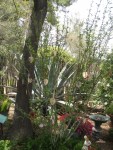
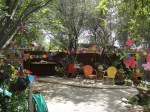


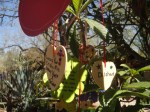



Milagro means miracle, and it also means a specific symbol used to make an offering. Offerings have meaning in the context in which they were made. Churches around the world have tokens left in hope, remembrance, or gratitude. In Ted DeGrazia’s Virgin of Guadalupe chapel people have left these symbols for many years. The oldest chapel I have seen like this has many offerings from sailors that include hats. It is in Cap D’Antibes, France. The chapel of Notre Dame de Garoupe is enchanting as well as historic. In Tucson we also have shrines known as El Tiradito and the Virgin shrine at San Javier del Bac Mission:
An offering can be made in nature, in a chapel, or in a garden. Altars exist in every form. The meaning is in the heart of the person making the offering. Milagros express hope, faith, and dedication. They tell the history of people’s aspirations, tragedies, and triumphs. The spirit of the place is reflected in the objects left on the altar. The altar assumes a collective consciousness by making space for all the offerings and their symbolic powers. It becomes an archive of religion.
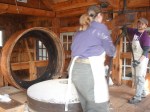
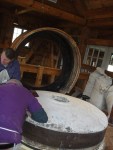

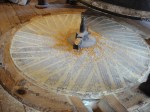


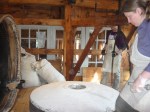



One of the most fascinating displays maintained by Plimouth Plantation is the grist mill. A recent acquisition, the mill grinds corn to show visitors how water powered mills made life possible in the colonies. Because the space is intimate the employees can be very helpful and informative. I learned a lot from my brief visit, and was given some good references to lean more. They employees are very well trained and seem to enjoy working with the visiting public.
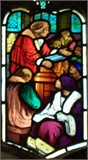
Rev John Taylor
John Taylor (c. 1480 – 1534) was Master of the Rolls of the Court of Chancery from 1527 to 1534, following a successful career as a priest and civil servant. Taylor would have been notable just for the circumstances of his birth: he was the firstborn of healthy triplets who all survived to adulthood, which was virtually unheard of in the 15th century.
King Henry VII met John and his brothers Rowland and Nathaniel in their childhood, and undertook responsibility to educate the three boys if they came to manhood; this informal act, and others like it, later inspired Queen Victoria’s Royal Bounty for Triplets which continued until the reign of Elizabeth II. There is note in the Royal Privy Purse expenses of 1498 “for the wages of the King’s Scoler John Taillor at Oxenford.”[1]
During his lifetime, Taylor donated money towards the building of St. James Church in Barton-under-Needwood, Staffordshire, the village where he grew up. Construction began in 1517 and was completed in 1533. The John Taylor High School, a specialty science school founded in Barton-under-Needwood in 1957, was named in his honor.[2]
In 1503, Taylor was ordained Rector at Bishop’s Hatfield, and then became Rector of Sutton Coldfield in 1504. He served as one of the Royal Chaplains at Henry VII’s funeral, 21 April 1509, and was afterwards appointed by King Henry VIII as the King’s Clerk and Chaplain-he was later one of the commissioners to decide if Henry VIII’s marriage to Catherine of Aragon was valid. In 1511, he was made Clerk to the Parliament.
Taylor was appointed as Archdeacon of Derby in 1515, then as Royal Ambassador to Burgundy and France and Prolocutor of Convocation. In 1516, he was appointed Archdeacon of Buckingham, and was conferred the degrees of Doctor of Civil Law and Doctor of Canon Law at Cambridge in 1520. He was one of ten chaplains present at the Field of the Cloth of Gold in 1520. In 1528 he became Archdeacon of Halifax.
From 1527 to 1534 he was Master of the Rolls of the Court of Chancery — the presiding officer of the Civil Division of the Court of Appeal. This position was the third most senior judicial position in England (after Lord Chancellor and Lord Chief Justice).
References· “Taylor, John (d.1534)”. Dictionary of National Biography. London: Smith, Elder & Co. 1885-1900.1. Notable Bartonians: John Taylor (circa 1480 to 1534)2. John Taylor High School
Source: John Taylor (Master of the Rolls). (2011, September 20). In Wikipedia, The Free Encyclopedia. Retrieved 15:03, October 27, 2011, from http://en.wikipedia.org/w/index.php?title=John_Taylor_(Master_of_the_Rolls)&oldid=451553336
When we receive the news that servers are being used to analyze our communication there is no reason to be shocked. A wire tap by any other name would smell as foul. The purpose of big data is big analysis. If you think technology is virtuous, or if you think it is inherently evil you are missing the point. Every advance in technology has been tried and often improved by spies. Think of all the magic of James Bond and his low tech super powers. Does espionage happen because honorable people want to learn more about the activities of their neighbors? Certainly not. Defense includes what is classified as intelligence. If the US declares a war on anything ( drugs, terror, etc) they ride the interstate commerce laws right up into everyone’s business. Our government protects Monsanto and their ilk without batting an eye, because that is the power that is reigning at the moment.
In the spy game everyone wants the coolest and most able spies, but that can’t be possible for every country. Some will have current tech, and others will rely on ancient systems of corruption to procure data. Propaganda supports spying as protection of the population. It is more likely to be protection of a certain status quo. Politics, cartoons, and reality do overlap, gentle readers.


During the Civil War Thomas Armer was conscripted to serve in the Iron Works at Shelby, Alabama to make arms for the Confederacy. After the war his entire family moved to Texas with Lucinda Jane and her husband, William Taylor, a veteran who was wounded in the war. His widow applied for a Confederate pension, just as her daughter, Lucinda, did. The state of Texas granted both widows pensions to help them survive at the end of their lives. Thomas donated the land for the cemetery where they are now buried.
Thomas Armer (1825 – 1900)
is my 2nd great grandfather
Lucinda Jane Armer (1847 – 1939)
daughter of Thomas Armer
George Harvey Taylor (1884 – 1941)
son of Lucinda Jane Armer
Ruby Lee Taylor (1922 – 2008)
daughter of George Harvey Taylor
Pamela Morse
I am the daughter of Ruby Lee Taylor
The reunification of opposites in alchemy is called Coniunctio Oppositorum. The material is separated in the distillation process. In the collective consciousness imagery and music exist as powerful actors. The opposites can be soul and spirit, Republican and Democrat, or just black and white. Our individual dreams and psyches are influenced by all the opposites in the universe. It is an act of magic to distill your thoughts and ethical boundaries. It is an act of wisdom to recognize that we are each as magical as the other.

