mermaidcamp
Keeping current in wellness, in and out of the water
You can scroll the shelf using ← and → keys
You can scroll the shelf using ← and → keys
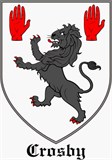
Crosby Coat of Arms
My 9th great-grandfather made it across the Atlantic Ocean to arrive in the new world at the age of 8 months, in 1635. He was born in England and his grave can be found today, located in Boston. He graduated from Harvard College and became a minister. There are conflicting reports about his formal ordination, but no doubt that he was employed to teach religion. He also got to trade ammo and alcohol. He made his money selling liquor, powder, and shot. This paints a funny picture if you ask me, but I am prejudiced against much of the founding fathers’ behavior. Thomas was well respected in his time as a preaching ammo and alcohol dealer. I appreciate that he survived so I can be here today. It would have been very easy to die on the voyage from England as an infant, but he had a different destiny.
Thomas Crosby (1635 – 1702)
He graduated from Harvard College in 1653. Although never ordained, he was hired in 1655 to preach in the church at Eastham, MA and continued as minister succeeding Reverend John Mayo there until 1670 at a salary of 50 pounds per annum. Reverend Crosby was also engaged in trade and in 1664 was among those who kept for sale “liquor, powder and shot”.
Later, he became a merchant at Harwich, Mass., and while on a business trip to Boston was found dead in bed there, 13 June 1702, aged sixty-seven years. His inventory totalled £1091-16-0 with debts of £717-16-0, leaving a net estate of £374-0-0. His heirs divided his property by agreement, 8 Aug. 1705.Marriage 2 Sarah FITCH b: in Mass.1662Children Thomas CROSBY, Jr. b: 7 APR 1663 Sarah CROSBY b: 24 MAR 1666/67 Joseph CROSBY b: 27 JAN 1668/69 John CROSBY b: 4 DEC 1670 in Eastham, Massachusetts William CROSBY b: 16 MAR 1672/73 Ebenezer CROSBY b: 28 MAR 1675 Anne CROSBY b: 14 APR 1678 Mercy CROSBY b: 14 APR 1678Increase CROSBY b: 14 APR 1678 Eleazer CROSBY b: 31 MAR 1680When Thomas was eleven years of age and his brother Joseph was seven, they removed with their Mother to Braintree, a Village on the south side of Boston, Mass. now Quincy, after her marriage to the Rev. William Tompson.After attending District School, with the assistance of Doctor Tompson, entered Harvard College, graduating in 1653, and was ordained a clergyman. He was minister at Eastham, Mass. from 1655 to 1670. He seems to have been engaged as a religious teacher to carry on the Sabbath Service at a salary of 50 pounds.While at Eastham, he was engaged in a trade. He resided near the burying ground, a place he bought of Jonathan Sparrow in 1665. He removed to Harwich, about 1670, here he was also engaged in a trade. His widow, Sarah, the mother of his 12 children, m. Apr. 28, 1703, John Miller, of Yarmouth. He died in 1702 and has many descendants living in the vicinity of Cape Cod, Mass. He had a half-sister Anna, born in 1648.
In about 1662 he married Sarah Fitch. Their children born in Eastham, MA were: 1. Thomas born April 7, 1663, died May 21, 1731. 2. Simon born July 5, 1665, died 1718 3. Sarah born March 24, 1666-7, married Silas Sears 4. Joseph born January 27,1668-9, died May 30, 1725. 5-6. JOHN (3) born December 4, 1670 and died May 25, 1717 and twin who died February 11, 1670/1 7. William born March 1672-3 8. Ebenezer born March 28, 1675 9-11. Anne, Mercy and Increase born April 14, 1678 (Anne married William (2) Luce, (Henry 1) on July 5,1704) 12. Eleazer born March 31, 1680Later he became a merchant at Harwich, MA and was one of the founders of the church in that town. On a business trip to Bostonhe was found dead in bed there on the 13th or 27th of June 1702, age 67 years. He is buried in the Old Granary Cemetery in Boston, MA. After his death, his widow Sarah married John (2) Miller of Yarmouth on April 8, 1703, son of Reverend John and Lydia Miller.

reflecting
Since returning home after ancestry quest I have tracked my dream life. I think am digesting centuries of action in my nightly dramatic interpretations. My homework assignment to record dreams and notice the archetypes I find in them has not been completed in a very rigorous fashion. During my weekend with Thomas Moore we talked about dreams and did a group discussion about one lady’s dream that she shared with us. My guilt about not doing homework as the rebel archetype dominates the teacher in my chart of origin, came into focus. I fell deeply to sleep that night and did start to notice and record dreams on a regular basis while I was still on the road. I visited homes and graves, museums and city streets where the specific ancestors lived and died. I started to have some strong emotions about history and groups of the dead.
Although Mayflower ancestry is highly valued by some, I am much more excited about those who rebeled against the Pilgrims. The sooner they dissed Plymouth, Salem, and the Pilgrim way of religious fascism the more I liked them. My special pride in my one Wampanoag ancestor makes me feel entitled to some explanations. They will not be forthcoming, and I need to understand that I am the sum total of many warring factions going back in time. While Mary Stuart was burning one ancestor at the stake, another ancestor was defending her in Scotland. This is how life works. We do not just have two crazy parents, we have all of karmic history in our collective inheritance.
I have had a dream now more than once that is symbolic and clear. I enter a big building, box, loft, kind of structure, where I am joined by all kinds of other beings from past and present..maybe future also. The place is intended to heal, but the multiple streams of energy mix and collide inside the space. The beings leave having exchanged symptoms with other people, leaving with new issues, side effects and thoughts. The desire to dump one’s own faults on others who are handy is at the root of this gift exchange gone so bad. Common practice is to blame the dead, or the absent for almost everything, trying to leave with only shining and laudable characteristics. This creates a mighty vortex that fills with neediness and greed once the door to the blame barn has been left ajar. A boomerang of dreadful feelings never fails to be returned to the sender. I am no dream interpretation expert, not even a very faithful recorder in the past. This series of dreams in the warehouse health space is about healing, boundaries, and inevitability. I haves used the flower essence Mexican Hat recently, which I find to be powerful and freaky. It is blooming in my garden in a few places. Under this hat’s influence the connections to others that we wish to ignore are highlighted. This flower essence refers to boundaries and healing, exactly like the dreams. Reflection is imperative to interpret both sides of symptoms, causes, and remedies.
Last at number ten, but not least, Zappos core value concerning humility is short and sweet. Be Humble. Humility is tightrope on which to stay centered. This trick is easier said than done, like all the core values of this company. There must be enough confidence to build self esteem and positive team spirit, and enough gravitas to accomplish intended goals. Restraint of ego mania in favor of pride in the entire workforce is a major element in delivering happiness. Hubris hoards potential joy in the corporate executive cafeteria. Zappos spreads it lavishly all over the company and customer base.
I had the idea 12 years ago when I invented Floatli that my teaching was such an important element of life that I naturally needed to create a teaching dynasty by certifying Floatli professionals. I was in a spa mentality and was influenced by my work experience. I became sidetracked by the demands of real life on this journey, and had to clarify my reasons several times for continued expenditure of time and effort on this business. Since I no longer live at spas I have a new perspective that is much more reasonable. I have reached the conclusion that Floatli is as obvious as a hula hoop or roller skates. No instruction is needed. No certification, no dynasty of teaching will enhance the fun. It is not a lifesaving device, but it is superior to other aquatic training equipment because it fits the anatomy of the user, no need to grip any thing with the hands to stay above water. It can be used in all bodies of water, but my experience says be super careful in surf or currents.
I want to work with Zappos as my marketing partner because their philosophy and values are dear to me, as is the quality of the merchandise they sell. I humbly request that the Zappsters share the joy in delivering floating happiness to zillions of customers who will have fun creating their own ways to use Floatli for training and fun. I sincerely believe we can deliver happiness in several different directions by empowering folks to find new ways to float.

Food handling

food charity scam in action

charity scam

donation drop off

food handling

truck of used bread

food handling
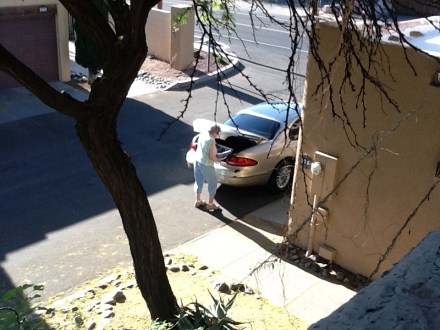
unload and load
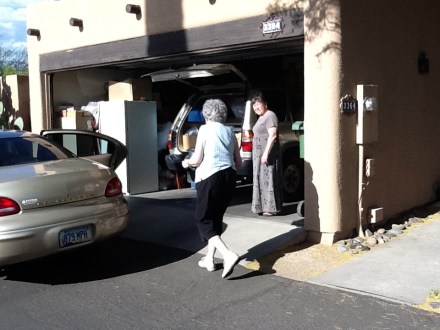

holiday traffic
The current uproar at the IRS highlights the much misunderstood function of granting tax exempt status and enforcing it. I have gone through the process of obtaining a 501C3 permit to run a non-profit corporation, and can tell you it is exhaustive and thorough. Like Medicare fraud, there must be pros who go about cheating and defrauding the system from within. Tax exempt status is given to legitimate corporations willing to go through strict accounting documentation to prove that they are satisfying the mission they stated in the original application. By submitting in good faith to this non-profit status scrutiny they are subject to a review of their activities constantly. Applying for the status is technical and rigorous, as it should be. Keeping it is equally serious in nature.
Going completely commando, soliciting donations from the public without any IRS permit or reporting of the donations whatsoever is the highly lucrative method that has been used in my neighborhood for many years. They have begged openly for donations of food, money, items, and labor. They ask for public support to store prepare food in a residential condo to be served randomly to presumably homeless people they find in parks. No laws are obeyed, from zoning, to health code, to revenue laws. They openly ask for donations on the internet, although multiple law enforcement agencies have been informed for many years of the crimes. This self-appointed charity does not feel the need to obey any laws because no laws are enforced. The lack of interest of the government agencies could be seen as negligence. You might believe, if you love conspiracy theory, that since these charity folks presumably vote liberal democratic tickets, they are allowed with the collusion of our local government, to break all these laws. That is too silly.
I don’t believe there is a conscious effort by government to allow crime to take over the neighborhood. My impression is that public servants feel resentful about serving the public. When opportunity arises to feel powerful through corruption, the loyalty of any public servant to act for the benefit of all concerned is questionable. This is where mental illness diagnosis is important. If only insane and or incompetent people are left to run the government, the government will continue to act against the citizens’ best interests. I do not think we have good or effective governance. I do not trust that the money collected by the IRS is well spent. I have always paid taxes, and benefit from no loopholes. I pay taxes knowing it must be done. Waste and corruption are not what I want to buy with my tax dollars, but they are all I see on the menu at the moment.
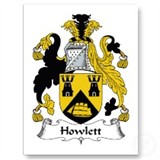
Howlett Coat of Arms
Thomas Howlett arrived in America on the ship Hopewell in 1630 to live in Boston. He was a carpenter, and had skills as a surveyor. He was active in church and military matters.
Thomas Howlett (1605 – 1678)
is my 10th great grandfather
Thomas Howlett (1638 – 1667)
son of Thomas Howlett
Mary HOWLETT (1664 – 1727)
daughter of Thomas Howlett
John Hazen (1687 – 1772)
son of Mary HOWLETT
Caleb Hazen (1720 – 1777)
son of John Hazen
Mercy Hazen (1747 – 1819)
daughter of Caleb Hazen
Martha Mead (1784 – 1860)
daughter of Mercy Hazen
Abner Morse (1808 – 1838)
son of Martha Mead
Daniel Rowland Morse (1838 – 1910)
son of Abner Morse
Jason A Morse (1862 – 1932)
son of Daniel Rowland Morse
Ernest Abner Morse (1890 – 1965)
son of Jason A Morse
Richard Arden Morse (1920 – 2004)
son of Ernest Abner Morse
Pamela Morse
I am the daughter of Richard Arden Morse
| Name | Thomas HOWLETT Sergeant, Ensign |
| Birth | 1605, Assington, Suffolk, England |
| Death | 24 Sep 1677, Topsfield, Essex, Massachusetts |
| Occupation | Carpenter |
| Father | William HOWLETT (1579-) |
Misc. NotesFrom co. Suffolk, England. Removed Ipswich 1633. Deposed 1658, aged 52. Church member 1630.29One of the first settlers in Agawam (Ipswich) 1632/33. Deputy from Ipswich 1635 and Topsfield 1665 and often employed in running lines and locating towns and farms.Ipswich, Massachusetts Deputy in 1635. Ensign of Ipswich Company under Captain Daniel Dennison, 3rd Regiment, Colonel John Endicott 1636.102Thomas Howlett was twenty-five years old when he came to New England in 1630 aboard the ship “Hopewell” as part of Governor Winthrop’s Fleet. He was a carpenter by trade, with origins in South Elmham Parish of Suffolk County, East Anglia in England. He first settled in Boston, as did a majority of Winthrop colonists, and became a member of the First Church on August 27, 1630. In the spring of 1633 he married Alice French, daughter of Thomas and Susan (Riddlesdale) French, who apparently had emigrated to New England prior to her parents. She was a member of the First Church and was eventually dismissed on September 10, 1643 to the church in Ipswich as “Our sister Alice French ye wife of Thomas Howlet of Ipswich.”Although Howlett later settled in Topsfield where he spent the latter years of his life, he was one of the nine originals of John Winthrop Jr’s 1633 party settling the Indian village Agawam, which the next year became the town of Ipswich. He was sworn a freeman at Ipswich on March 4, 1633.In 1634 Ipswich granted Howlett, in partnership with John Manning and others, on the neck of land on which the town stood, two acres of meadow and two and a half acres of marsh between the town riger and the lands of William Sergient (probably Sargent) and John Newman. Added to this in 1635 was a house lot in the town, thirty acres of upland and ten of meadow at the head of Chebacco Creek and ten acres north of the town toward the Reedy marsh. In 1637 he purchased forty acres from John Perkins, Sr. His later acquired Topsfield holdings are described in his will.Thomas Howlett’s highest political office came to him as a young man, when, in 1635, he represented Ipswich in the General Court. he served on the Essex County Jury of Trials in 1654, 1657, and 1665 and on the Grand Jury in 1650, 1659, 1666, and 1667 and served as Selectman of Topsfield in 1661.In 1640 he was sergeant of the Ipswich military defense company and later became its ensign. In 1643 he, as Sergeant, and ten other militiamen were voted compensation by the town for their three days acting in defense of the Agawam Indians against their tribal enemies. In 1672 he became a Deacon of the Topsfield Church and his contribution of five pounds to the salary of Rev. Jeremiah Hubbard was the largest of those made.There were eight children of Howlett’s marriage with Alice — Sarah (1633/34-1700), John (1633/34-1674/75), alice (1636-1696), Thomas, Jr. (1637/34-1667), Mary (1641/42-1718), Nathaniel (1646-1658), William (1649/50-1718), and Samuel (1654/55-1719/20). On June 6, 1666, after the death of Alice he married Rebecca Smith, widow of Thomas Smith if Ipswich and Newbury, with his step-son, Thomas Smith, in 1671, choosing him as his guardian.Thomas Howlett died in Topsfield, Essex County on September 24, 1677.Military Was in Pequot War32, No. 74, pg. 120, 1920Spouses
| 1 | Alice FRENCH |
| Birth | 9 Oct 1609 |
| Death | 26 Jun 1666, Topsfield, Essex, Massachusetts |
| Christen | 9 Apr 1610, Assington (St. Edmund’s), Suffolk, England |
| Father | Thomas FRENCH (<1584-<1639) |
| Mother | Susan RIDDLESDALE (<1584-1658) |
Misc. NotesProbably emigrated to America with her brother Thomas. Alice was dismissed from the Boston Church to Ipswich 16 Jun 1644.
| Marriage | 1 Jan 1633/34, Ipswich, Essex, Massachusetts |
| Children | Sarah (1633-1700) |
| Alice (ca1636-<1696) | |
| Thomas (1637-1667) | |
| Mary (1641-1718) | |
| John (1643-1675) | |
| Samuel (1645-1719) | |
| Nathaniel (ca1646-1658) | |
| William (1649-1718) |
| 2 | Rebecca SMITH |
| Death | before 1 Jan 1634/35 |
| Father | Thomas SMITH |
| Mother | Alice |
I was born in Tulsa in 1951, and although I moved to Pennsylvania when I was 4, I visited Oklahoma many times in my childhood. When the musical Oklahoma came out in 1955 I was thrilled and learned the words and music to sing ad infinitum. I was the soundtrack of some of my best years. I identified with my Oklahoma birthplace which was reinforced by frequent visits, and visiting Tulsans at our home in Pittsburgh. My parents hung out and had musical hootenannies with other petroleum engineer friends from Tulsa who had come to PA like my dad, to specialize in fracking for Gulf Oil. They brought much of their Okie lifestyle with them including Woody Guthrie, hickory chips and barbecue.
I went to Tulsa and drove all over the state a few years ago on my first ancestry discovery trip. I did feel very at home, although perhaps not in political alignment with the population. I particularly loved the grapes at the farmers market that reminded me of the grapes my grandpa grew when I was very young. While driving with my uncle to Bartlesville I asked as a joke what we do in case of a twister. He said we jump out of the car and hide in a drainage culvert. I started noticing how infrequently these culverts were there on the side of the road, and started having thoughts of vulnerability. I imagined hustling my fairly nimble but old uncle out of the car and into the ditch to save our lives and I just did not like that idea at all. I made it back and forth across Kansas and Oklahoma without incident, but did find graves and documents from my ancestors who lived through the dust bowl. I respect and admire those Boomer Sooners and pioneer petro peeps who formed the history of the Cherokee Strip and my family tree. I am sad that my fellow Okies are suffering so much natural disaster and destruction in their lives. Although I still feel the pride of being from Oklahoma, I know I could not handle living with the terror of tornadoes in my territory. I have adjusted to wildfires and floods here in Arizona as my natural disasters of choice. I wish the state of my birth a full and speedy recovery.
At the crossroads of sports performance and fitness training is a special intersection of interest and comparison. We compete with ourselves in many sports. Team sports have an extra dynamic, but freestyle sports played or performed by individuals offer a chance to bend the meaning of sports and scoring. Winter and summer X games are good examples of these evolving sports and athletes. Tricks and styles evolve each year to new heights and dangers. Extreme sports involve heavy risks, so most folks prefer to watch as fans. Others find sponsors and spend all their time in training or competition. What is the healthiest blend of training, practice, participation, and admiration of others? What is the best way to avoid injury and stay fit while playing or competing?
I believe prehabilitaion is important, mentally and physically. Life requires variety, balance, flexibility, and range of motion. In a healthy athletic training routine personal willpower and strength of spirit are the qualities we admire and aspire to reflect. The athlete archetype is the symbol of transcending limits. Physical limits, including handicaps, are frequently overcome in Special Olympics and Senior Olympics through training and competition. Expectations that build esteem for the whole sport and all the players are the healthiest. Entitlement, either to cheat or misuse athletic ability for selfish ends, is the shadow aspect of this archetype. Winning at all costs, taking power over others, flexing strength beyond games and into inappropriate settings is the activity of the bully, shadow athlete. Football thugs in Europe display this kind of trashy sportsmanship. The false sense of invulnerability and entitlement that lives on the dark side of competition is the enemy of good health and balance. Games are played on and off the field and the clock. All or none, win or loose mentality does not belong in every aspect of life. Check your inner athlete, and how your games are played to learn more about your own beliefs about winning, loosing, and dedication.

Perkins coat of arms
William Perkins was born in England, educated at Cambridge, and moved to New England in 1632. He served in the military and taught school after arrival. He was a very well educated man.
1. Rev.-Capt. William Perkins, son of William Perkins Merchant Taylor and Catharine Unknown, was
born on 25 Aug 1607, was christened in All Hallows, Bread Street, London, Eng., and died on 21 May 1682 in
Topsfield, MA at age 74.
General Notes: Robert Charles Anderson, The Great Migration Begins: immigrants to New England
1620-1633, New England Historic Genealogical Society, Boston, 1995, Three volumes.
From George Walter Chamberlain, History of Weymouth, Boston, 1923.
“Capt. William Perkins, the first schoolmaster of which there is any record, was voted ?10 for six months
schoohng, 10 Mar. 1651 (Weymouth Town Records.) He entered Emmanuel College, Cambridge, as a
pensioner at Michaelmas Term, 1625; afterwards immigrated to Christ’s College from which he
graduated, A.B., at lent term, 1627-28.
“He was son of William Perkins, a merchant tailor, of London, and was born 25 Aug. 1607, and came
in the ship William and Francis, leaving London, 7 Mar. 1631-32. This ship arrived at Boston, 5 June,
1632. (Drake’s, The Foumders of New England, 11.) He was made a freeman of the Massachusetts Bay
Colony, 3 Sept. 1634. He married at Roxbury, 30 Aug. 1636, Elizabeth Wootton, and removed to
Weymouth in 1643, where he resided till 1652, when he removed to Gloucester, and in 1655 to
Topsfield. He became the first munister of the latter place. He was deputy from Weymout in 1644 and
Captain there in 1645. He died at Topsfield, 21 May, 1682, aged 75 years.
“The General Court entered the following record on 7 Oct. 1641: ‘Mr. Willi Perkins, for his fathers
50, is granted 400 acres of land.’ (Massachusetts Bay Colony Records, 1:338.) He was to ‘have power to
end small causes at Waymoth,’ 29 May, 1644, and again, 14 May, 1645. (Ibid. 2: 73, 97.) He was a
deputy at the General Court, 29 May, 1644, and was called ‘Lieut. Wm. Perkms’ (Ibid. 66) and ‘Capt.,’ 4
Nov. 1746 (Ibid. 184.).”
——————–
William Perkins, 1607-82, A Study, The Essex Genealogist, vol 3, pp 65-76, May 1983, iss.2
We know from the Cambridge Alumni association that he was a preacher and a teacher:
Adm. at EMMANUEL, 1624. S. of William, merchant tailor, of London. B. there, Aug. 25, 1607. Schools, London and Colchester (Mr Danes). Matric. Michs. 1625. Migrated to Christ’s, Nov. 15, 1626. B.A. 1627-8. Went to New England, 1632. Resided at Roxbury, Mass., adm. a freeman of the Massachusetts Colony, 1634. Moved to Weymouth, Mass., 1643. Sent as deputy to the General Court, 1644; lieutenant, 1644, and captain, 1645, of the local military company; served as schoolmaster and preached occasionally. Removed to Gloucester, Mass., and taught school there, 1651-5. Retired to Topsfield, Mass., 1655. Died there, May 21, 1682. (Peile, I. 378; J. G. Bartlett.)




The 40th anniversary of the Watergate investigation is a national watershed moment. Credibility has been destroyed in all American political and religious institutions during those 40 years. The population forced to pay for the corrupt system has lost the belief that government works in their best interests. Religious institutions have been exposed and now have lower status and less respect. When I voted to end the war in Viet Nam the situation was known as “The Generation Gap”, as if this was the first, last ,and only generation so violently opposed to the politics and lifestyle of the previous. I suspect that each generation has a gap of various depth and breadth to be digested by the course of history. After my parents were dead I became interested in my ancestry. This study has shown me the drastic, religious and political beliefs of their ancestors. My father’s side is full of teachers, and my mother’s is full of preachers.
Tracing a spiritual and political timeline of my ancestors has shown me that rebellion was frequent and sometimes drastic. My ancestors rebelled against religious and political institutions by moving to America in the 1600’s. The entire protestant reformation was an act of rejecting an overly powerful Catholic church to become more pure. After crossing the Atlantic for religious freedom my ancestors founded and preserved institutions in the colonies. Other members of my family firmly rejected the Puritan way of life, setting out to live free in new territories rather than submit to the religious fascism of the Pilgrim fathers. The Wampanoag branch of my family tried hard to wipe out the British presence for good during King Philip’s War. I had family members in the military on both sides of the Civil War, when that happened. There may have been a few settled, stationary generations, but when I look at the ethical will of my ancestors they were generally busy rebelling and rejecting institutions as much as they were preserving them. A dynamic historical tension can be found in the cultural traditions of my ancestors. This explains why my parents were so crazy. It was imperative to reject the beliefs they embodied. It probably also explains why my own generation’s traditions and habits need a vigorous review. Generation gaps are forever. Barry Goldwater is fully dead, and only a faint glimmer of the military industrial complex as our worst internal nightmare has been superseded by the much freakier medical pharmaceutical complex. We have a new fall of civilization to manage now.
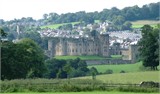
Alnwick Castle
My 16th great grandfather was born into a fancy Scottish family. Politics, diplomacy and treason were part of life in Scotland under King James III:
Robert Boyd (d.c.1470) Lord Boyd, was a Scottish Statesman.
A son of Sir Thomas Boyd (d. 1439), Robert Boyd belonged to an old distinguished family, of which one earlier Sir Robert Boyd, had fought with Sir William Wallace and Robert the Bruce.
Created Lord Boyd in 1454, he was one of the Regents during the minority of King James III, in 1460. He conspired with his brother, Sir Alexander Boyd, and obtained possession of the King’s person in 1466 and was made by Act of Parliament sole Governor of the Realm.
He negotiated the marraige between James and Margaret of Norway in 1469 and secured with it the cession of the Orkney Islands by Norway. He was appointed Great Chamberlain for life, and Lord Justice General in 1467.
Conflict broke out between the King and Boyd family. Robert, and his son Thomas Boyd, 1st Earl of Arran (who was married to Princess Mary), were out of the country involved in diplomatic activities when their regime was overthrown. Robert, 1st Lord Boyd was pronounced guilty of treason and fled firstly to Alnwick, Northumberland. His brother and assistant, Sir Alexander Boyd, was captured and beheaded on November 22, 1469.
Robert 1st Lord Boyd fought in the English service in the French wars, and died in exile.
He married Mariotta, daughter of Sir John Maxwell of Calderwood, and had numerous issue. One of his daughters, Elizabeth, married Archibald Douglas, 5th Earl of Angus.
Robert Boyd (1425 – 1470)
Lord Boyd conspired with his brother, Sir Alexander Boyd, and obtained possession of the young King’s person in 1466 and was made by Act of Parliament sole Governor of the Realm; and Great Chamberlain for life, and Lord Justice General in 1467.[4] Early in that year he procured the marriage of his eldest son, Thomas, (created Earl of Arran for that occasion) with Mary, elder sister of James III, which aroused the jealousy of the other nobles[1] and made his eventual downfall inevitable since the King regarded the marriage as an unforgivable insult.
Lord Boyd obtained the cession of the Orkney Islands to Scotland, 8 September 1468, from Christian I, King of Norway, for whose daughter Margaret, he negotiated a marriage with James III. While absent for that purpose he and his son Thomas (the Earl of Arran) and his brother (and coadjutor) Sir Alexander Boyd, were attainted for high treason, whereby his peerage became forfeited. He was living Easter 1480/1, and died before October 1482, it is said, at Alnwick in Northumberland where he had fled in 1469.[1]
James III’s biographer sums Boyd up as an unscrupulous political gambler and an inveterate optimist. To forcibly assume guardianship of an underage King was, indeed, a familiar path to power in mediaeval Scotland, but it was also a dangerous path. Boyd underestimated the dangers, overestimated his support, and made the fatal mistake of marrying his son to the King’s sister, an insult the King would not forgive.[5]
FamilyRobert Boyd belonged to an old and distinguished family, of which one earlier Sir Robert Boyd, had fought with Sir William Wallace and Robert The Bruce.[4] He was the son and heir of Sir Thomas Boyd of Kilmarnock (died 9 July 1439).[1] Robert married Mariot (or Janet), daughter of Sir Robert Maxwell of Calderwood. She died after 25 June 1472, apparently early in 1473.[1] They had three sons:[6]
[ edit] References
Attribution
 This article incorporates text from a publication now in the public domain: Chisholm, Hugh, ed. (1911). “Boyd, Robert Boyd”. Encyclopædia Britannica. 4 (11th ed.). Cambridge University Press. pp. 353,354. http://www.archive.org/stream/encyclopaediabri04chisrich#page/353/mode/1up. This article incorporates text from a publication now in the public domain: Cokayne, George Edward, ed. (1912). Complete peerage of England, Scotland, Ireland, Great Britain and the United Kingdom, extant, extinct or dormant (Bass to Canning). 2. London: The St. Catherine Press, ltd.. pp. 260,261. http://www.archive.org/details/completepeerageo02coka. This article incorporates text from a publication now in the public domain: Balfour, Paul, James (1904). The Scots peerage; founded on Wood’s edition of Sir Robert Douglas’s peerage of Scotland; containing an historical and genealogical account of the nobility of that kingdom. 5. Edinburgh: D. Douglas. pp. 145,146.
Peerage of ScotlandPre ceded byNew Creation Lord Boyd1454–1482Succeeded byJames Boyd
 mermaidcamp