mermaidcamp
Keeping current in wellness, in and out of the water
You can scroll the shelf using ← and → keys
You can scroll the shelf using ← and → keys
High finance is very easy to understand. The fact that everyone avoids understanding it makes it very easy to take advantage of the financial ignorance of the population. Bernie Maddoff you do not have to be, in order to screw your neighbor and your society out of maximum profit. Buy/borrow/die is all one has to do to benefit from the magic vanishing value of the currency everyone uses. Taxation avoidance, both legal and shady, is the province of those who already have their money in hand. Taxation without even a shabby lobbyist for representation is the fate of those who must claim earned income from jobs.
A carry trade is a calculated risk. The problem is that now the general public does not seem to know how to calculate risk, also known as random acts of unexpected circumstances. We hear the words risk-reward and carry trade, but think this is something that has nothing to do with us and our finances. This banker jargon is for people who wheel and deal, not for borrowers who pay interest on almost everything they buy during their lives. While occupying Wall Street may be symbolic, society would benefit by knowing how Wall Street profits while the population withers financially. If you carry credit card debt while your banker is free to gamble/borrow/invest in carry trades, you will come out as the big looser.
Do you ever wonder why carrying debt at a high interest rate all the time seems natural and unavoidable? Do you simply accept the idea that everything you buy is charged to the future, when presumably it will be so much easier to pay?
The Federal Reserve has become the banker of bankers. Now it is possible to predict with some certainty that interest rates will be kept at nothing for a long time. The certainty itself reduces risk for anyone who wants to gamble with money. Knowing how this will effect your own personal finances may be the single most valuable concept you have learned since you learned to count.
Zappos core value number six describes the goal of the communication systems. Any company has to be specific and mindful about communications within the company and with customers. Zappos takes this seriously. The open office design and the systems of training and benefits are conducive to better than average communication. Since the workers are encouraged to express their personalities in decor and office fashion, at least some nonverbal design language is included in the conversation.
If all companies bothered to find out if they really communicate what they think they are saying I believe huge leaps of employee satisfaction could result. Statistics show that most employees in the US are disengaged. What the disengagement does is psychically disconnect the employee from the mission of the company. Doing time in such an environment resembles jail more than it does a place of productive creativity. If the management has no clue about the reality of the workers, all possible loopholes will be used to avoid helping the company. For the purpose of oversight as well as for the purpose of clear discussion management today needs to interact rather than hand down dictums. Employees who feel at all unhappy with their work life will take it all out on your customer.






The fun starts at the front door at Zappquarters in Henderson, NV. Ties are cut and placed on the trophy board. The best communication device I noticed was the way they used your toilet time to make you look at the wellness information. Trapped in the stall you are educated about the opportunities to improve your overall health in the company wellness program. This is a fabulous message and delivery method. The Zappsters do not miss any opportunity to deliver that happy message honestly and clearly.

grave of Elizabeth Henchman
Elizabeth Henchman has a birthplace on file of Plymouth, MA. I doubt this is true, since in 1612 the Mayflower had not yet landed. She came from England with her parents, I believe. She married my 10th great grandfather in Plymouth in 1634. Her second husband, Richard Hildreth, was prominent in Cambridge, MA. They married in Cambridge in 1645. Her grave can still be located in Malden, MA.
The origin of the name is really from being a royal henchmen in history:
ENGLISH ORIGINS
The origin, genealogy, history, and traditions of the Henchman, Hensman, Hinchman, and Hincksman families are known to many family members today, because of the research and dedication of Robert Hinchman, Jr. (1921-1996), of Dallas, Texas, the founder and first president of the Hinchman Heritage Society. It is from this beginning in England that we may someday find connections to The Hinchman Family in America. The following two paragraphs were written by Robert for the October 1992 Hinchman Heritage Week in England.
“Legend has it that Thomas Crosborough of Magna Doddington, Northamptonshire, saved the life of King Henry VII during a hunt. Upon being rescued from the tusks of a wild boar the King said to him: “Truly, thou art my veritable henchman.” Thomas thereupon, changed his name to Henchman, and thus, the family began. His great grandson, Thomas, was apprenticed at the age of 12 to William Cokayne, Master of the Skinners’ Guild, and subsequently became a prominent merchant and Freeman of the City of London during the latter part of the reign of Elizabeth I. Thomas was the father of Humfry who was instrumental in aiding Charles II escape to France during the English Civil War. Thus, two Henchmans have helped save the lives of two English kings.”
“The scions of Thomas Crosborough Henchman are the progenitors of the Henchman/Hinchman and Hensman Families of today. The variations in spellings began to stabilize during the reign of James I and by the time of the restoration of Charles II in 1660, the orthography had become almost set .. but as a Hinchman, you well know that confusion still exists. The family began its migration to New England in 1637, to Maryland in 1664, and to Australia in the 1860’s. And, of course, English members continued down to this day. Our generation, wherever we live, are descendants of Thomas Crosborough Henchman, his sons and grandsons. It is an adventure for each of us to discover our particular origins.”
Elizabeth Henchman (1612 – 1693)
is my 10th great grandmother
Mercy Vaughn (1630 – 1675)
daughter of Elizabeth Henchman
Sarah Carr (1682 – 1765)
daughter of Mercy Vaughn
John Hammett (1705 – 1752)
son of Sarah Carr
MARGARET HAMMETT (1721 – 1753)
daughter of John Hammett
Benjamin Sweet (1722 – 1789)
son of MARGARET HAMMETT
Paul Sweet (1762 – 1836)
son of Benjamin Sweet
Valentine Sweet (1791 – 1858)
son of Paul Sweet
Sarah LaVina Sweet (1840 – 1923)
daughter of Valentine Sweet
Jason A Morse (1862 – 1932)
son of Sarah LaVina Sweet
Ernest Abner Morse (1890 – 1965)
son of Jason A Morse
Richard Arden Morse (1920 – 2004)
son of Ernest Abner Morse
Pamela Morse
I am the daughter of Richard Arden Morse
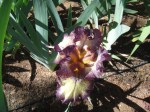

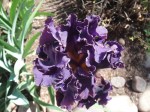


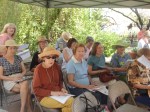


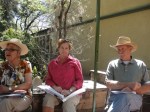

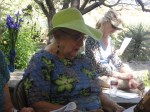
New this year at the Tucson Botanical Gardens is a collaboration with the U of A Poetry Center, bringing poetry to the gardens. I attended the class next to the iris garden yesterday and was surprised at the depth and education they packed into the experience. We learned about the Poetry Center’s history and the very good luck we have to live in a city with a center such as this. We learned about the botanical gardens and the history and meaning of the iris plant. An enthusiastic docent from the Tucson Botanical Gardens opened the readings with a poem of her own about iris and the field of everyday glory we can find in nature. We then read together a selection of poems, all in some way referring to the iris. Our favorite reader was dressed like an iris and has a British accent that enhanced her interpretation. It was an exceptional experience on all levels for me. I enjoyed the crowd, and had time after the class to get some technical growing advise from the lady who represented the Iris Society. Poetry and gardens do go together very well. Next month the group will meet by the cactus garden….a thorny subject. I am encouraged to use my poetic voice more often, and listen for stunning stories to tell.




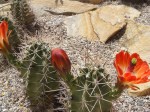

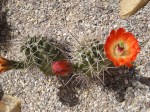
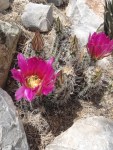
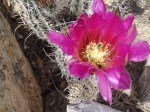
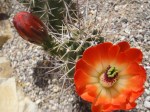



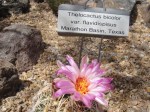


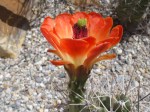

Cactus bloom quickly and with amazing flourish. The colors are often so bright they look almost shocking. The current cactus blooming color splash is a delight to the eye. There is little scent, but lots of pollen for the insects to enjoy and move. Our Sonoran desert environment is rich with diversity and beauty.



Iris means rainbow in Greek, the name of a messenger goddess . The flower has been used in medicine and perfumery for many centuries. The symbolic fleur-de-lis is a stylized iris used in many coats of arms, and by the New Orleans Saints. In healing the essence of iris is used for seeing. Notice that the iris can only look up.


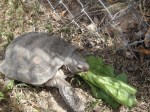


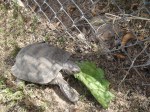
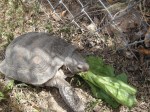



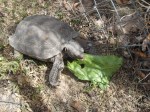

Turbo the Tortoise has been asleep all winter in his cozy tortoise den. His very small fellow tortoise, Teenytiny Turbo, slept the winter in a big box on the balcony to protect him from the cold. He is too little to be on his own. They started moving around slowly about two weeks ago, and now they are both warm, hungry, and on the move.
They both came from Wildlife Rescue here in Tucson. Do not pick up a tortoise out of the desert and take it home because it is not legal to do so. If you want to care for this cute pet, you need to inquire at Wildlife rescue for those who need homes. They are independent, but do know their people and ours even likes the dog, who is polite to him. He is very hungry now, so he really enthusiastically devours his romaine. He had green on his lips when I came to see him, so he had been munching wild plants, but he does prefer the wet juicy romaine leaves when he can get them. He doesn’t actually drink any water, even if you leave it out for him. He gets all his water from plants.
Any unexpected twist that makes a story intriguing demands our attention. We expect certain things to happen in context, so when they do not we begin to wonder about the nature of things. The term poetic justice was coined between 1720-1730. Much drama and some poetry contains this magical distribution of perfect reward and retribution in exactly the right proportion to all parties. Rarely do we see this in action in real life. It is more common to witness social, political, or just plain crazy injustice.
We can write stories and poems that highlight our own particular brand of justice. Simply focus and spotlight on causes like nature, environmental awareness, or animal cruelty can change hearts and minds. You can be a spokesperson for the things that matter to you. The impact you have may never be known to you, but that is not a good reason not to create and share your own version of poetic justice. If you bother to bring your message artfully and with grace you may hit the target you hoped to find in the gentle reader.
This month many writers are writing a poem a day in NaPoWriMo..the poetry challenge. I am accomplished in a few expressive ways, but I have not visited my poet for years. I was a prolific song writer as a teenager, and wrote poetry every day of some kind. I am a language fan, loving words because they sound funny or because they have obscure specific meanings. Being poetic, or even doing rhymes as improvisational humor, sharpens the wit, grows the vocabulary and enhances connections and metaphoric images.
When I was young I heard my father recite the Cremation of Sam McGee by Robert W Service. He knew it by heart. After a couple of drinks he liked to sing, dance or recite that poem. It was always entertaining. He was a research scientist by profession, but my parents loved music and dance more than anything. We had a player piano which was the scene of many sing a long parties. What was truly admirable about my parents was their artistry. They had regular suburban lives, but my dad was an accomplished musician, and my mother designed and executed both landscape environments and fashion with amazing professionalism. My mother was a prize-winning floral arranger, and avid flower show horticulturist.
I was encouraged , and in some cases forced, to practice art. Piano was a mandatory 30 minutes every day of my life, and a legal pad sheet of cursive handwriting had to be inspected by my father each night. I eventually realized I could recycle some of the handwriting, but there was no faking the piano. My guitar and voice lessons came with mandatory practice sessions when I was in high school. I learned the power of practice at a very young age. Discipline is never natural to kids and maybe my parents overdid the whole rigidity thing. Today, however, I thank Dick and Ruby Morse, the living artists, who gave me the self confidence to know that I can be any kind of artist I care to be. My art will reflect my practice, and with practice I will improve. All poems, all songs, all dances are alive and need to be brought forth. Practice is the vehicle in which they travel into the light.
Refinement of all the senses leads to a full and more interesting life. Leonardo da Vinci was a student of all phenomena. His seven guiding principals for living were at the heart of all his work. They are his core values, upon which his reputation rests. By reading his notebooks and studying his drawings we can see that his constant eagle eye was at work observing nature. Sensazione, or the development of all the senses, was a big reason Leonardo became as productive as he did. He felt that by making notes and drawings of his sensual observations he grasped more of the meaning around him. He used his notebooks to create, invent, and make beautiful art.
He gives advise on keeping a listener engaged by carefully noting his posture, body language, and facial expressions. By focus and intent to see clearly sight can be developed into insight. The training of all the senses to be more apt, more receptive, and more able to understand reality was a lifetime practice of the master. Vision, hearing, smell, taste, touch and synesthesia (the ability to describe one sense in terms of another) were all parts of this whole. Sight became the best developed of his abilities, which contributed to his artistic talent.
How do you use your senses to take in the world? Have you ever tried to improve on what you have in the sense department? I was a potter for many years, so my sense of touch was developed beyond the others during that time. I had to feel the center of the wheel, and the thickness of the clay with precision or….no pot was made…back to mud. Taste and smell may be my most developed senses now. I cook, bake, and experiment as a cocktail creator. I like making a variety of teas and baths with my garden herbs. Do you have one particular sense that is your strongest? We know what Leonardo would do. He would forever practice to refine them all.

