mermaidcamp
Keeping current in wellness, in and out of the water
You can scroll the shelf using ← and → keys
You can scroll the shelf using ← and → keys
My favorite author, teacher, and living spiritual expert is Thomas Moore. He is finishing a new book called A Religion of One’s Own. His concept is not to do away with religion, but to inspire and revive it. The Dalai Lama has recently spoken about a similar concept. Institutional religion is having momentum problems in the developed world. Yoga, in all the many forms, is still enjoying a growth in popularity in America. Although yoga was brought to the world by Hindus, yoga is not a religion in itself. It is a philosophy.
The casual way he talks about warming up for the book by translating the Gospels from ancient Greek lets you know what kind of scholar he is. He has taught in full on Latin, composed music, and become a well respected therapist. His own fluid path was probably never suspected by anyone, least of all him, when he became a monk. When is a monk more than a monk? I think we have two excellent living examples today. Both Thomas Moore and the Dali Lama of Tibet teach kindness, meditation, and natural magic. As experts in religion, as scholars, and as holders of the traditions, these men are shining stars. We are lucky that they have both chosen to write books for us, teach us, and even, bless their hearts, tweet us. They are both telling us we need to connect to spirit and each other for quality of life.
I think that worldwide the ways of communication have changed and the drift toward a meaningless existence has increased. Churches and temples reflect this in both a positive and negative way. If people look at their own religion as a sham, but still pay dues in order to just be a member of something, the future of those institutions is bleak. Keeping up the facade has become an expensive, and sometimes self destructive activity in some religious organizations. Personal practice that is designed to cultivate compassion and mindfulness can nourish the soul of the world. We are in need of this kind of responsibility taken and embraced by individuals and communities. We had religious reform, some have had revival. Let us have personal religious renaissance. The book will not be out for a while, but I am already in favor of the whole idea.

Wemyss castle
Mine is a lowland clan derived from the McDuffs. My 21st great- grandmother was born in her own castle in Fife in 1322. It has been rebuilt, but is still privately owned by my family in Fife. I know someone who went to her ancestral castle in Scotland, and was invited in and treated very well by the contemporary royal inhabitants. These clansmen can have a broad idea of family, if you are truly in the bloodline. I am not really expecting the Wemyss clan to welcome and embrace me, but I would not mind seeing the gardens open to the public that have been created by my clan.
Margaret Wemyss (1322 – 1342)
from Electronic Scotland Com. The Scottish Nation – Wemyss:
This Sir David Wemyss, the elder son of Sri Michael, had a son, Sir David Wemyss, who was one of the guarantees for the release of David II., and this baron’s son, also named Sir David, was one of the hostages for that monarch’s ransom. The latter left a daughter, Margaret, married to Sir Patrick de Inchmartine, and by him had a daughter, Isabel de Inchmartine, heiress of that barony. This last married Sir Alan Erskine, and had two daughters, his co-heiresses, Margaret, wife of Sir John Glen, and Isabel, married to Sir John Wemyss of Rires and Kincaldrum, the heir male of the family. Besides the lands he held from his father, and those disponed to him by his father-in-law, he had extensive grants of lands in Fife and elsewhere, from Robert II. and Robert III. He had three sons, the second of whom, Duncan, was one of the hostages on the liberation of James I., and the third, Alexander, was ancestor of the family of Wemyss of Lathocar

Tulsa race riot 1921

Race riot Tulsa 1921
My father, Richard Arden Morse, was a bit of a racist, but did not have any idea of his own pedigree. His great-grandfather came to New York from Ireland during the potato famine with his O’Byrne parents and siblings, who dropped the O’ to assimilate. When asked, my father would say he was Scots Irish. This American term refers to the Ulster Scots, who have all those Orange issues in Northern Ireland. A little flash of orange ribbon drives these people, and their neighbors, completely batty. You would need to be born in Ulster to understand this, I think. The troubles are a completely local phenomena, although both sides have supporters elsewhere.
Richard Arden was born in Independence, Kansas on Feb 18, 1920. In December of 1920 armed violence broke out between white and black citizens of that town. It was a very small town, and this had to be a big impact on the area. In 1921 the city of Tulsa, where I was born, was host to one of the most violent of race wars of all time. The Tulsa racial violence of 2 June, 1921 was distinctly ignored by Oklahoma official history until very recently. I only lived in Tulsa for about 4 years, and my dad also left Independence with his family to live near Ponca City, Oklahoma during his school years.
He was for sure Irish, and when Mr. Scott married Ms Byrne, he was trending Scot again. However, I do not think he knew what any of this meant. I believe that my father’s racial prejudice was a karmic and cultural affliction. He did not openly dislike anyone because of race, but his actions betrayed his deeper ethics. To his credit, he and my mom made an effort not to pass the racist culture on to my brother and me.
Bridget OByrne (1808 – 1880)
is my 3rd great grandmother
James Oscar Byrne (1840 – 1879)
son of Bridget OByrne
Sarah Helena Byrne (1878 – 1962)
daughter of James Oscar Byrne
Olga Fern Scott (1897 – 1968)
daughter of Sarah Helena Byrne
Richard Arden Morse (1920 – 2004)
son of Olga Fern Scott
Pamela Morse
I am the daughter of Richard Arden Morse
Bridget O’Byrne was typical, but lucky. She survived the passage to New York, and most of her kids did also. She had a home in upstate New York. Sarah Helena, her daughter in law, wrote the notes I used to start my tree. The O’Byrnes of Wilna, Jefferson, NY gave their estate to a Catholic church there, and left the records of their family history with that church. A treasure hunt awaits me in upstate New York that may reveal all the Irish information I can handle, including Bridget’s family name. The Catholics of Wilna have my bingo card, and I am grateful.

Grandmothers
The lady on the far right, Emiline P Nichols, was born in Pennsylvania in 1837, moved to Ohio, and then to Kansas. Her daughter, Harriet Peterson (to her left) married an Irishman, James Oscar Byrne, of County Meath. James died the year his daughter, Sarah Helena Byrne (big lady in the middle) was born. He is buried in a Catholic graveyard in Kansas. Without the hardship and adventure endured by James O’Byrne I would not have the luck of the Irish, so I am eternally grateful.
What is your relationship to God? Your archetypes will define and expose your spirit. While we may all want to be a visionary or some very special rare spiritually gifted being, our story may be stronger than our experience. If you know the spiritual archetype, you will also have some experience with the shadow of it. Spirit does not bring along only happy good time feelings. It brings lessons required for our own wisdom and advancement. If you really are a martyr you have used your own suffering to manipulate others. The depth of the reality depends on how truthful and open you are. None of us worships like our parents before us…well, very few. Do you give your spirit a rich practice or a platitude?

PA and Penn State Teach Fracking
In 1947 you could obtain from the Pennsylvania Mineral Industries Experiment Station a paper written by my father. It cost 25 cents to learn the science behind water flooding from The School of Mineral Industries. He and his friend, Pete Terwillager, a co-author of this paper, would go on to work together to frack many a well.

Science Behind Fracking
This was the work my father did to earn his masters degree before I was born. Water flooding is the subject of this research. When he graduated with his masters he went to work in Tulsa for Stanolind, and so did Pete Terwillager. He obtained a patent for fracking together with Stanolind. Now they were done with water injection as the displacement method, and had moved on to an oil like substance.
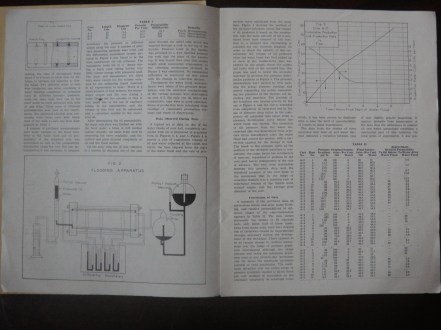
Fracking explained
My father grew up on the Cherokee Strip seeing all kinds of explosions done to procure petroleum. His father, Ernest Morse, drilled for oil with a crew before the invention of the rotary bit, so they were desperate. The fact that he eventually became the first man to make a numerical model of an oil field on a computer made him brilliant. It did not change his relationship with the resources of the earth. The wild-wild west, boomer sooner attitude is the reason they both lost and won. These barons of resources saw themselves as saviors of society. It was years after my father’s death in 2004 that fracking became a subject the public discussed. It came up as if the practice had recently been invented and applied. Not hardly.
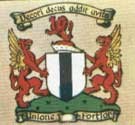
Erskine Coat of Arms
My 19th great grandmother was born in Scotland in 1357. Her father married an heiress to become lord of a castle. In a quirk of fate the children were all girls, which devolved the castle to their husbands when they married. Since they had some real estate and political power they married well. Her husband and my 19th great grandfather, John Glen, may or may not be an ancestor of the astronaut.
Margaret Erskine (1357 – 1419)
Little is known regarding the proprietary history of Balhall until shortly before the year 1440. At, and for some time previous to that period, it was possessed by Sir John Glen of Inchmartin, in the barony of Longforgan, which the family de, Inclimartin held from an early date. The first of those who figured conspicuously was John, one of the ten barons selected to make the peace of Scotland with Edward L in 1305; and, on the first appointment of sheriffs in that year, he was chosen for the county of Perth.In the following year, his son Sir David, who had been one of the original followers of Bruce, was hanged, with several other patriots, by order of Edward. His successor — perhaps a son — had a charter from Bruce of the lands of his sires; and about 1376, Sir Allan de Erskyne of Wemyss succeeded to the estates on marrying the heiress. Sir Allan died in 1401, leaving an only daughter, who married Sir John Glen, and the estate of Inchmartin devolved on that knight. He also left co-heiresses, one of whom married Sir Walter de Ogilvy, who succeeded to the half of Inchmartin, and other properties belonging to Glen, of which ” Balhalwell ” (Balhall) formed a part.
The Zappos fourth core value is about creativity and adventure. This aspect of life is my driving force. I enjoy being creative in everything I do. I have had great work environments with all my marketing partners. I was an outside sales travel agent , an independent contractor teaching at fabulous spas, and sometimes I would combine the two. I was a potter before that who had marketing partners in galleries. I supplied the creativity, sometimes the product, and they provide the infrastructure, like accounting. I embrace failure by being very productive..moving beyond errors by making lots of them. This core value at Zappos is an acceptance of failure as part of success. Without courage to fail you also lack courage to change anything.
I want Zappos to be my next marketing partner because I believe it can work very well for both of us. I think the product Floatli will be popular if marketed well, and that the sport, Floatli, can be a thinking, training, cooperation activity at Zappos. It can be totally non competitive, or mimic another game like volleyball wearing the equipment. By reversing gravity, the participant usually regresses and feels like laughing. If you loose control you just float to the top of the water, so injury is extremely unlikely while practicing Floatli in a pool, river, or lake. It can also feel good to move underwater with support when injury makes walking or running impossible. Prehabilitation is a great use of the Floatli system. With good range of motion and enhanced flexibility from movement n water, you are a lot less likely to hurt yourself at an active sport like skiing.
I am not looking for a job at Zappos, but a partnership, to sell the most innovative system for staying fit and flexible in the water. I will fly to Vegas, Tony, and give you a demo any time you feel adventurous and open minded enough to give me an opportunity to show you how it works. I believe we have very similar core values. I always love your products, and on my visit I loved the atmosphere at the office in Henderson. I admire the way you handle business and the happiness of all involved. I believe I can make a positive contribution to that mission, and add even more creativity to their already very zesty mix.
If you ask a group of Americans to raise their hands if they consider themselves to be middle class, almost all of them will raise them. The economic sophistication of our citizens is not adequate to survive. Lingering debt, choking all hopes of prosperity, is a driving force in most households in the United States, and yet concern is focused on government debt and misconduct. There are some fundamentals that are not at all understood, such as how money works and where it goes. If we were better educated I wonder if we would have a different outcome. The rose colored glasses are much rosier than we previously believed.
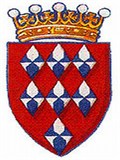
De Burgh Coat of Arms
My 20th great grandmother was born in Ulster, and died in Kildare, Ireland. Her father,Richard Og, was Earl of Ulster and a very powerful man:
Richard Og de Burgh, 2nd earl of Ulster (1259 – July 29, 1326), called The Red Earl, was one of the most powerful Irish nobles of the late 13th and early 14th centuries, a son of Walter de Burgh, the 1st Earl of Ulster (of the second creation) and Lord of Connacht.[1] His name, “Richard Og”, meant Richard the Young, probably a reference to his youth when he became earl in 1271, or to differentiate him from his grandfather, Richard Mor. He was also known as the Red Earl.
Richard Og was the most powerful of the de Burgh Earls of Ulster, succeeding his father in Ulster and Connacht upon reaching his majority in 1280.[1] He was a friend of King Edward I of England, and ranked first among the Earls of Ireland. Richard’s wife Marguerite de Guînes was the cousin of King Edward’s queen. He pursued expansionist policies that often left him at odds with fellow Anglo-Irish lords.
His daughter Elizabeth was to become the second wife of King Robert the Bruce of Scotland. However, this did not stop him leading his forces from Ireland to support England’s King Edward I in his Scottish campaigns and when the forces of Edward Bruce invaded Ulster in 1315, the Earl led a force against him, but was beaten at Connor in Antrim. The invasion of Bruce and the uprising of Felim O’Connor in Connacht left him virtually without authority in his lands, but O’Connor was killed in 1316 at the Second Battle of Athenry, and he was able to recover Ulster after the defeat of Bruce at Faughart.[1]
He died July 29, 1326 at Athassel Priory, near Cashel, County Tipperary.
Children and family
Lady Joan De Burgh, Baroness Darcy (1290 – 1359)
Lady Joan de Burgh was the daughter of Richard de Burgh, 2nd Earl of Ulster and Margaret.1 She married, firstly, Thomas FitzJohn FitzGerald, 2nd Earl of Kildare, son of John FitzThomas FitzGerald, 1st Earl of Kildare and Blanche de la Roche, on 16 August 1312 at Greencastle, County Down, Ireland.2 She married, secondly, Sir John Darcy, 1st Lord Darcy de Knayth, son of Sir Roger Darcy and Isabel d’Aton, on 3 July 1329.3 She died on 23 April 1359.1 From 16 August 1312, her married name became FitzGerald.1 As a result of her marriage, Lady Joan de Burgh was styled as Countess of Kildare on 12 September 1316. From 3 July 1329, her married name became Darcy.3
Children of Lady Joan de Burgh and Thomas FitzJohn FitzGerald, 2nd Earl of Kildare
· John FitzGerald2 b. 1314, d. 1323
· Maurice FitzThomas FitzGerald, 4th Earl of Kildare+1 b. 1318, d. 15 Aug 1390
· Richard FitzGerald, 3rd Earl of Kildare2 b. c 1319, d. 7 Jul 1333
Children of Lady Joan de Burgh and Sir John Darcy, 1st Lord Darcy de Knayth
· Elizabeth Darcy+3
· Aymer Darcy3
· Roger Darcy3
· Sir William D’Arcy+3 b. 1330
Citations
1. G.E. Cokayne; with Vicary Gibbs, H.A. Doubleday, Geoffrey H. White, Duncan Warrand and Lord Howard de Walden, editors, The Complete Peerage of England, Scotland, Ireland, Great Britain and the United Kingdom, Extant, Extinct or Dormant, new ed., 13 volumes in 14 (1910-1959; reprint in 6 volumes, Gloucester, U.K.: Alan Sutton Publishing, 2000), volume VII, page 222. Hereinafter cited as The Complete Peerage.
2. Charles Mosley, editor, Burke’s Peerage, Baronetage & Knightage, 107th edition, 3 volumes (Wilmington, Delaware, U.S.A.: Burke’s Peerage (Genealogical Books) Ltd, 2003), volume 2, page 2298. Hereinafter cited as Burke’s Peerage and Baronetage, 107th edition.
3. Charles Mosley, Burke’s Peerage and Baronetage, 107th edition, volume 1, page 1027.
 mermaidcamp