mermaidcamp
Keeping current in wellness, in and out of the water
You can scroll the shelf using ← and → keys
You can scroll the shelf using ← and → keys
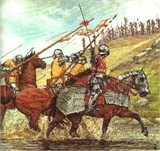
Battle of Blore Heath
My 15th great grandfather was a knight involved with Brit royalty. He lost his life defending it in a battle called Blore Heath. They were fighting about roses (red and white, although I am still not sure what the symbols meant) and the right to the throne. They were royals. They were angry. Things got bloody nasty:
The Battle of Blore Heath
September 23, 1459
After four years of uneasy peace the King presided over a wasting realm. No parliament had been summoned for three years, the country was sadly divided and distressed. The Yorkists were armed, armies were marching across all England. Lord Audley had recently raised a Lancastrian army centered round Market Drayton, and the Queen -through whom the King ruled- sent him orders to intercept Lord Salisbury, who was marching from Yorkshire to join the Duke of York at Ludlow. The two armies met head on two and a half miles east of Market Drayton at a place called Blore Heath. Salisbury, with 3,000 troops, was outnumbered by more than two to one, but could not avoid giving battle.
Audley took up a position just west of a little stream that crossed the Market Drayton-Newcastle-under-Lyme road, and Salisbury’s men were drawn up about 150 yards east of the present Audley Cross, which marks the spot where Lord Audley fell. The Yorkist left rested upon the boggy edge of a wood, but their right was in the air, and Salisbury made a laager of his wagons to protect this flank. Whether Salisbury feigned retreat in order to draw Audley on is not certain, but the Lancastrian commander was definitely the one to attack. Two cavalry charges were repulsed, the first with heavy loss to the Lancastrians, and then they mounted an infantry attack up the hill to the Yorkist position. But this too failed; there was no support from the cavalry, Lord Audley had already fallen and 500 Lancastrians chose this moment to desert to the enemy. Salisbury’s victory was complete and in the pursuit, which continued for two miles, the slaughter was very heavy. Possibly 2,000 Lancastrians perished in this battle, but fewer than 200 Yorkists fell.
For more information on the Battle of Blore Heath, contact Blore Heath 1459 online at http://www.bloreheath.org
YORKISTS LANCASTRIANS
Sir Christopher Conyers of Sokebourne, Durham
Sir Henry Bromflete, Wymington, Bedford
Sir John Conyers of Hornby, Yorkshire
Sir Robert del Booth of Wilmslow, Cheshire (killed in battle)
Sir Walter Devereux of Weobley, Herefordshire (killed in battle)
Sir John Bourchier of West Horsley, Surrey
Sir Richard Grey of Powis, Powis
Sir Hugh Calveley of the Lea, Cheshire (killed in battle)
Sir Richard Hamerton of Hamerton, Yorkshire
Sir William Catesby (Sr.) of Ashby St. Legers, Northamptonshire
Sir Thomas Harrington, Lancashire
Sir John Dawne of Cheshire
Sir Roger Kynaston of Hordley, Shropshire
Sir Jerkin Done of Wickington, Cheshire (killed in battle)
Sir Thomas Lumley of Lumley, Durham
Sir Robert Downes of Shrigley, (killed in battle)
Thomas Meering of Tong
Sir Thomas Dutton of Dutton, Cheshire (killed in battle)
Sir James Metcalfe of Nappa, Yorkshire
Sir John Dwnn of Cheshire, killed in battle
Sir John Middleton of Belsay Castle, Northumberland
Sir John Egerton of Egerton, Cheshire (killed in battle)
Sir Thomas Mountford of Hackforth, Yorkshire
Sir Nicholas of Eyton of Eyton, Shropshire
Sir Richard Neville (Earl of Salisbury) of Middleham, Yorkshire (fled to Calais)
Sir Richard Fitton of Gawsforth, Cheshire
Sir Richard Neville (Earl of Warwick) of Middleham, Yorkshire (fled to Calais)
Thomas Fitton, fate unknown
Sir Thomas Neville of Thornton Bridge, Durham
Sir John Haigh, killed in battle
Sir Robert Ogle of Ogle, Northumberland
Sir Edmund Hampden of Hampden, Buckinghamshire
Sir Thomas Parr of Kendal, Westmoreland
Sir Thomas Hesketh of Rufford, Lancashire
Richard Plantagenet, Duke of York, fled to Ireland
Sir Henry Holland of Darlington, Devon
Sir William Pudsey of Selaby, Durham
Sir John Legh of Booths, Cheshire (killed in battle)
Sir James Strangeways of Whorlton, Yorkshire
Sir Philip Maunsell of Scrurlage, Glamorgan
Sir Walter Strickland of Sizergh, Westmoreland
Sir Richard Molyneux of Sefton, Lancashire (killed in battle)
Sir John Wandesford of Kirklington, Yorkshire
Sir John Neville of Raby, Durham
Sir John Wenlock of Wenlock, Shropshire
Sir Ralph Shirley of Shirley, Sussex
Sir Walter Wrottesley of Wrottesley, Shropshire
Sir John Skidmore of Mochas, Herefordshire
Sir John Stanley of Pipe, Staffordshire
Sir Edmund Sutton of Dudley, Westmoreland
Sir John Sutton of Dudley, Westmoreland
Sir William Troutbeck of Dunham-on-the-Hill, killed in battle
James Touchet (Lord Audley) of Markeaton, Derbyshire (killed in battle)
Sir Hugh Venables of Kinderton (killed in battle)
©The Richard III Foundation, Inc.
Sir Richard Earl Sefton Molyneux (1422 – 1459)
is my 15th great grandfather
Thomas Sir 8th Earl of Sefton Molyneux (1445 – 1483)
Son of Sir Richard Earl Sefton
Lawrence Castellan of Liverpool Mollenaux (1490 – 1550)
Son of Thomas Sir 8th Earl of Sefton
John Mollenax (1542 – 1583)
Son of Lawrence Castellan of Liverpool
Mary Mollenax (1559 – 1575)
Daughter of John
Francis Gabriell Holland (1596 – 1660)
Son of Mary
John Holland (1628 – 1710)
Son of Francis Gabriell
Elizabeth Holland (1652 – 1737)
Daughter of John
Richard Dearden (1645 – 1747)
Son of Elizabeth
George Dearden (1705 – 1749)
Son of Richard
George Darden (1734 – 1807)
Son of George
David Darden (1770 – 1820)
Son of George
Minerva Truly Darden (1806 – )
Daughter of David
Sarah E Hughes (1829 – 1911)
Daughter of Minerva Truly
Lucinda Jane Armer (1847 – 1939)
Daughter of Sarah E
George Harvey Taylor (1884 – 1941)
Son of Lucinda Jane
Ruby Lee Taylor (1922 – 2008)
Daughter of George Harvey
Pamela Morse
I am the daughter of Ruby Lee

Hekate at the Crossraods
Toni Wolfe, colleague and lover of Carl Jung, identified 4 feminine archetypes. These cardinal qualities divide feminine characters into power centers, or capabilities. Toni understood when she created this foursome as a guide that no individual is purely one archetype on the stage of life. These are ways of looking at personality and talent, not so different from fairy tales and mythological tales.
Life is circular and the core, or center of the circle, is essentially a seed from which the rest of the circle sprouts. Our DNA, birthplace and time, our circumstances at birth are at the center. We contain unique combinations of archetypal power and symbology, both in waking life and in dreams. We begin in the middle of a complex mandala, and work our way out to the edges of consciousness. Limitations are imposed for our education and edification. Dream images give us hints to our own potential as well as to danger. Fairy, Wise Woman, Lover and Queen existed in most cultures before Toni Wolfe mapped out her quadruple qualities. These can be divided, in turn, into variations on a theme.
All people have both male and female archetypes, anima and animus. These might be thought of as north and south, visible and invisible, cardinal points that must also be balanced in the fully realized being. No individual is completely masculine or feminine, good or evil, right or wrong. Tyrants represent an imbalance, a shadow or hidden quality of power, a failure to employ wisdom. Wisdom was historically embodied in the Titan goddess Hekate, guardian of the crossroads. She has three faces, looking in three directions. She carries, along with three torches, a key, a rope, and a knife. She meets you at the crossroads of life and has the power to both assist and punish humans. If she didn’t have three heads, a polecat and a pack of hounds she would resemble the Virgin of Guadalupe, and have similar intercessional powers. Her ancient symbol is a wheel with three parts.

Hekate’s Wheel

Alchemy Symbols
Alchemy is the act of transformation. Throughout history the alchemists have studied nature and mystery. We participate in alchemy when we focus our spiritual talents on the elements of the earth. Inventors and those who are especially creative tap into alchemy to turn imagination into reality. It has been associated with medicine, but all science is the realm of the alchemist. Carl Jung brought alchemy and archetypes into psychiatry. The collective consciousness communicates through symbols and dreams. The alchemists, like wizards and magicians, use mythical power to transform or create.
Our time and space are literally created and projected by us. We are active participants in our entire experience of reality. My favorite alchemist in history is the Swiss Paracelsus, who practiced medicine and magic at the same time. He was searching for the Christian version of pagan natural magic. He promoted Jacob Boehme’s Doctrine of Signatures, a spiritual belief that plants are designed to communicate their healing properties to man. His work was both controversial and respected during his lifetime. What distinguishes the alchemist from a wizard or magician is a constant experiment. The science of chemistry was developed from the never ending experiments of the alchemists.
If you could focus your spiritual energy on nature to transform your life, what would you transform? If you were to focus do you think you could change the quality of your experience?
Cultural mendacity is a flawed belief system taught and accepted by groups. Plato and Tennessee Williams were very concerned about this subject. Folklore and folk medicine, like belief in the chupacabra, is brought over from the past. Political and commercial propaganda is created daily to influence cultural habits. Pavlov trained his dog to be delusional, consistently. You are trained to think buying Fruit Loops on credit is a fine practice for your budget and your health. The political parties are training you to donate money to feed the status quo without even knowing what the status quo is.
Lance, the psycho bully, Armstrong needs to stand tall as a role model for all of history. Protesting too much is a classic sign of dishonesty. Willful blindness extends to all layers of our society. Most of it is not as harmless (not to indicate that these crimes were petty) as doping cyclists. Mortgage fraud and investment banking fraud, as yet to explained to the victims in clear terms, are examples of cultural delusion. Sick work ethics that ignore misdeeds and reward anti social behavior fall into this category as well. Systems are mendacious, but cultures are easily duped. Like Pavlov’s dog, groupthink salivates at the sound of the bell because it has been taught to associate the bell with food. Pavlov in this experiment plays the part of the government. The bell is congress. The dog is the tax paying citizen. The dog food cupboard is full of imaginary dog food, known as the budget. Mendacity is the system in which we live.
Persephone stomps on Mintha
Mintha, Greek goddess of the mint plant is a fertile herbal mother. Stewing, growing, and drinking mint can cause euphoric uplift. Soothing, aiding digestion of food and intuition, mint tea opens the senses and the mind. Bathing or washing with mint stimulates the skin and the circulation. The high notes of these aromas evaporate quickly. The use of mint in aromatherapy is widespread and well accepted. Peppermint oil is used for everything from headache cure to memory tonic. In the middle east, especially Morocco, mint tea is the beverage of choice for all occasions.
Growing mint is easy. I grow several varieties, with the most dominant ones winning out and taking over the space. A source of moisture is all they need to spread like crazy underground. To harvest it, cut it and hang your bundles in a dry dark place until dry. I store mine in brown paper bags once dry because I have too much to use jars. I harvest mass amounts throughout the year. In the summer we drink it every day for the cooling qualities. Mints mix very well with other herbs and fruits to create flavor layers in tea.
Mintha, the water nymph of myth, had an affair with Haides, god of the underworld, pissing off Persephone, his wife. In an all too common scenario in Greek mythology, angry wife takes revenge on the nymph, in this case by by stomping on her. She turns into the mint plant so that every time Persephone steps on her the aroma of mint wafts all over the angry queen. So whether you want to uplift your spirits or annoy an angry queen, the goddess Mintha is the tool for the job.
The idea that all flesh is grass comes from the book of Isaiah. It is meant to signify that life is short. It has another connotation that applies to Lance Armstrong and all who create level playing fields for themselves. It means that when it all comes down you’ve got to get back to Mother Earth.
You are leaving a legacy, now, this minute. Your life’s work and your charism can take any form. Your talents and gifts can be lavish or downright undiscovered. Your soul is here to learn how to use power. Your ancestors have used power in a myriad of ways that incarnate in you without your awareness or consent. Your ethical will is a choice you make by either accepting blindly or seeking new wisdom in new ways. If you are easily angered, chances a very good that you are easily duped..by none other than yourself.

Elizabeth Darcy
My 19th great grandmother came from County Meath, Ireland, just like the O’Byrnes of the potato famine on my father’s side. She was a fancy lady with very famous ancestors herself. She was described by an historian as a wise and honorable lady.
Elizabeth Darcy (1331 – 1390)
is my 19th great grandmother
Johanna Hertforth (1345 – 1428)
Daughter of Elizabeth
Ellen Urswick (1364 – 1459)
Daughter of Johanna
Richard Molyneux (1386 – 1460)
Son of Ellen
Sir Richard Earl Sefton Molyneux (1422 – 1459)
Son of Richard
Thomas Sir 8th Earl of Sefton Molyneux (1445 – 1483)
Son of Sir Richard Earl Sefton
Lawrence Castellan of Liverpool Mollenaux (1490 – 1550)
Son of Thomas Sir 8th Earl of Sefton
John Mollenax (1542 – 1583)
Son of Lawrence Castellan of Liverpool
Mary Mollenax (1559 – 1575)
Daughter of John
Francis Gabriell Holland (1596 – 1660)
Son of Mary
John Holland (1628 – 1710)
Son of Francis Gabriell
Elizabeth Holland (1652 – 1737)
Daughter of John
Richard Dearden (1645 – 1747)
Son of Elizabeth
George Dearden (1705 – 1749)
Son of Richard
George Darden (1734 – 1807)
Son of George
David Darden (1770 – 1820)
Son of George
Minerva Truly Darden (1806 – )
Daughter of David
Sarah E Hughes (1829 – 1911)
Daughter of Minerva Truly
Lucinda Jane Armer (1847 – 1939)
Daughter of Sarah E
George Harvey Taylor (1884 – 1941)
Son of Lucinda Jane
Ruby Lee Taylor (1922 – 2008)
Daughter of George Harvey
Pamela Morse
I am the daughter of Ruby Lee
Elizabeth Darcy
Elizabeth Darcy, Countess of Ormond (3 April 1332- 24 March 1390), was the wife of James Butler, 2nd Earl of Ormond, and the mother of his six children, including James Butler, 3rd Earl of Ormond.
Family and lineageElizabeth Darcy was born on 3 April 1332 at Platten, County Meath, Ireland, the daughter of Sir John Darcy, 1st Baron Darcy of Knaith, Justiciar of Ireland, and his second wife Joan de Burgh. Sir John was a veteran of the Battle of Crecy. He held the offices of Constable of Nottingham Castle, Constable of the Tower of London, and Sheriff of Lancashire. From 1341- 1346, he was Chamberlain to King Edward III. Elizabeth had a brother Sir William Darcy, who married Catherine FitzGerald, by whom he had issue. She also had numerous half-siblings from her parents’ previous marriages. Her father’s first wife was Emeline Heron, by whom he had eight children, including his heir, John Darcy, 2nd Baron Darcy of Knaith. Elizabeth’s mother’s first husband had been Thomas FitzGerald, 2nd Earl of Kildare, by whom she had three sons, John FitzGerald, Richard FitzGerald, 3rd Earl of Kildare, and Maurice FitzGerald, 4th Earl of Kildare.Elizabeth’s paternal grandparents were Roger Darcy and Isabel d’Aton. Her maternal grandparents were Richard de Burgh, 2nd Earl of Ulster and Margaret de Burgh, daughter of Sir John de Burgh and Hawise of Lanvaley.One of her maternal aunts was Elizabeth de Burgh, wife of Robert the Bruce.Marriages and childrenOn 15 May 1346 in Ormond, Ireland, when Elizabeth was fourteen, she married her first husband James Butler, 2nd Earl of Ormond (4 October 1331- 18 October 1382), the son of James Butler, 1st Earl of Ormond and Lady Eleanor de Bohun. He was Lord Justice of Ireland in 1359, 1364, and 1376. He was also Constable of Dublin Castle in 1349. He was known as the Noble Earl, however, the Irish called him The Chaste.Upon her marriage to the Earl, Elizabeth assumed the title of Countess of Ormond.James and Elizabeth had six children: 1. Ralph Butler 2. Eleanor Butler (died 1392), married Gerald FitzMaurice FitzGerald, 3rd Earl of Desmond, by whom she had issue, including the 4th and 6th Earls of Desmond. 3. James Butler, 3rd Earl of Ormond (died 6 September 1405), before 17 June 1386, married firstly, Anne Welles, Countess of Ormond, daughter of John Welles, 4th Lord Welles and Maud de Ros, by whom he had issue, including James Butler, 4th Earl of Ormond. He married secondly, Katherine FitzGerald of Desmond, by whom he had further issue. In 1391, he purchased Kilkenny Castle. 4. Thomas Butler 5. Catherine Butler (born 1361), married firstly, Thomas Reade, by whom she had one son, Richard, and secondly, Thomas Fleming of Slane. 6. Joan Butler, married Tiege O’ Carroll
James Butler, 2nd Earl of Ormond, died on 18 October 1382 in Knocktopher and was buried in Gowran Church, Co. Kilkenny. Elizabeth married secondly, Sir Robert de Hereford, Seneschal of the Liberty of Tipperary, between 28 December 1383 and 30 March 1384.
DeathElizabeth Darcy died on 24 March 1390. She was not quite fifty-eight years old.
References 1. ^ Douglas Richardson, Kimball G. Everingham,Magna Carta Ancestry: A Study in Colonial and Medieval Families. p.161 2. ^ Charles Cawley, Medieval Lands, Earls of Ormond * http://www.Tudorplace.com.ar/DARCY.htm * http://www.Tudorplace.com.ar/BUTLER.htm * Charles Cawley, Medieval Lands, Earls of Ormond * Elizabeth Darcy at ThePeerage.com
The Romans had a pantheon similar to the Greeks. Fortuna represents wealth, commercial success, and abundance of all kinds. She is intimate with the infinite source of wealth, and acts as a conduit, bringing it to life on earth. Lakshmi is busy doing the same thing for the Hindu pantheon. In America, unfortunately, the Puritans have directly linked wealth to purity of behavior (as described by them). This narrow view of abundance is a vicious cycle of a bummer drag. They arrived in Plymouth Colony and were greeted by sophisticated and generous souls. Since the hospitable tribes did not read the Bible the Puritan fathers decided it would be fine to totally rip them off for everything they had. Things have gone downhill from that point.
As a priestess of Fortuna, you are required to make friends with money. She is the power behind all propitious events. It is possible to procure her guidance through meditation. You can ask questions with your dominant hand doing the writing, then pass the pen to Fortuna in your non dominant hand and let her answer. The handwriting may be very bad, but let it go. You are the only one who will read and interpret it. If you really wonder about your fate, your fortune, your lot in life, ask. Ask deeply, and you will find the answer. Oracles did some gas inhaling at you will not need in this exercise, but the concept is the same. Ask and you shall receive. Knock and the door will open. Same deal. Don’t allow some Puritan nerd from the past to rob you of your right to know. Be still, know. The truth will set you free….a whole lot freer than Salem during the witch trials, anyhow. Speak to Fortuna. She has something to tell you.
Yesterday I received a call from a lady at the TPD who identified herself as a detective. I told her that I am Nancy Drew and she was dead silent. I asked her if she knew who Nancy is, and she replied in the affirmative. This was the first clue that I had that this lady had called to play cat and mouse, having absolutely no idea that I am a tiger. She said she was investigating a peeping Tom incident from last year and had heard that I know a lot about our ‘hood. This was my second clue.
I have seen the Police Academy movies and think the whole thing looks like a lot of fun. Something happens to them between those heady days of graduation from the academy and grinding out the day-to-day police reports that goes terribly wrong. This detective lady called to find out if I am crazy or not. I let her know, in no uncertain terms, that I am indeed crazy from reporting the same crimes over many years to the TPD, until I am blue in the face. She asked about crimes in my area, I told her a few facts, and then told her what I thought about working conditions for the cops. She had no idea how to be the mouse, so she said she was only calling about the peeping Tom last year and would not be able to investigate the other crimes we discussed. Even Nancy Drew knows there is little point in trying to find out who was peeping last year when we have active full time, already confessed under oath, felonies going on right this minute. I had to hang up when she asked me to call 911 if I see anything. There is such a thing as insulting the intelligence of the public. These guys should have studied Tom and Jerry back at the academy.
The circus still bothers to come to Tucson, but we know a really big show when we see one. The Tucson Gem Show has grown into our most fun and profitable event. We are perfectly willing to give up restaurants and parking and even driving in some places to welcome our precious gemmers back to town for the party of the year. They role into town from all over the world ready to whip out their giant crystals and get busy doing some business. They bring objects of every kind, way beyond the scope of gems or jewelry.
The buyers of all kinds must be here to buy and make contacts for the year. Museum curators, knick knack shop owners, and hippie miners all converge to change the essential nature of our city for the first two weeks each February. I have been officially on restriction from buying anything at the show for years, but it does not really stop me. My birthday falls on Jan. 30, and Valentine’s Day is still on Feb 14. The favorable timing of my birth has resulted in an overstock of gifted gem show stuff. I could easily hold my own gem show, but am currently hoarding all the exotic things I have found. As any queen can tell you, you can only wear so much jewelry at the same time. I should have a museum to display my collection, but then I would truly be on restriction. Like assault weapons, no private citizen can rationalize owning this much jewelry.
I love to see them stream into town in their distinctive costuming, speaking all languages, and laying the bucks on the local merchants. The huge displays of crystals as high as an elephant’s eye crowd into tents and alter the vibration of the desert. Bring it!!! You are the financial savior that primes our pump each year….the economic engine we cannot afford to loose. We love you, gemmers, and wish you a prosperous show this year. Thank you for your exotic and generous presence. If there is any little thing we can do to make you feel more welcome, do not hesitate to ask.

