mermaidcamp
Keeping current in wellness, in and out of the water
You can scroll the shelf using ← and → keys
You can scroll the shelf using ← and → keys

badge
The theories used to administer law enforcement agencies have changed with the times. The current political climate demands a thorough examination of the criminal justice system from top to bottom. The DOJ’s 21st Century Guidelines are a step in the right idealistic direction. Much thought has been put into the basic “pillars” of law enforcement best practices. The country seems to be more divided each day on the subject of police relationships with the public. Some paint the entire force as rotten based on the criminal behavior now available for broadcast to the world. Others advocate for support for the cops no matter what they are doing. The second group always refers to a few rotten apples, but they never mention the rest of the proverb…a few rotten apples spoil the whole barrel. Staying with the fruit analogy, I think it is the responsibility of the administrators of cities to responsibly go through the barrels on a regular basis to assure that the law enforcement culture is not rotten.
The war on drugs has not only given us an opiate addicted society, but also great opportunity for the most common kinds of corruption to flourish. Arizona is a wild west state famous for “conservative” law enforcement, al estilo de Joe Arpaio. Indeed, Arizona has had some famous historical stand offs around law and order. The Gunfight at the OK Corral was exactly that. Doc and Wyatt are symbols of everything we love about Tombstone and the legends too tough to die. After the Earps and Doc shot the Clantons they high tailed it to Tucson, and the rest is history. The Arizona Rangers were founded in Tombstone during the Territory days, and still have a proud tradition, although today they are a volunteer organization. It is a serious challenge to maintain the proud traditions and, at the same time, be vigilant of corruption. It is not a black and white question.
How do you feel, gentle reader? Do you think there is a problem with individual cops, or with the leadership? Or do you feel everything is going well with the criminal justice system right now?

Ranger history

Doc and Wyatt

class clown

ain’t too proud to wear it
I think the time is right to bring back the tradition of wearing the dunce cap. John Duns Scotus ( yes, exactly like SCOTUS) created the dunce cap as an educational tool. He was born in Scotland in 1266, so he might well have been hanging out with my ancestors, perhaps even influencing their upbringing. Both of my parents have Scottish ancestry. The Subtle Doctor, as Scotus was known, was a famous philosopher, teaching in Oxford, Cambridge, and Paris before his fall from grace.
It seems the doctor was stabbed to death for his school of thinking. His students used their pens to kill him because he was trying to “make them think”. Now we have to ask ourselves which one of these “schools of thought” was crazier than the other, and also is the pen mightier than the sword.
For modern use I think we just make corrupt officials who are caught breaking the law to fashion their own caps out of construction paper. They all need to sent to sit in the corner for public humiliation until they repent of their stupidity. Do you think this could work, gentle reader?
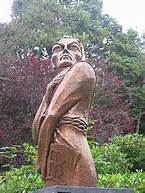
Scotus

Judge Celina

suiting out
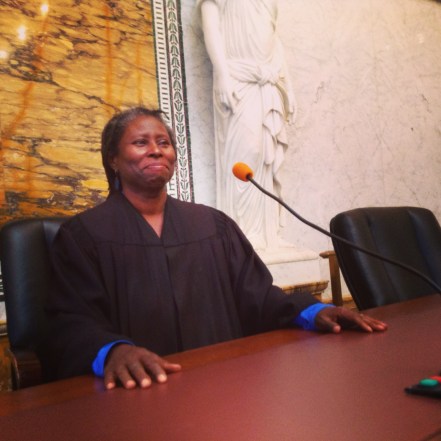
Judge Ardell

Judge Donna
A few years ago I went to California to take a workshop from a group called Tribal Truth. I was invited to go by a good friend who flaked out after I had paid for it. I decided to go because it was taking place at a hot spring I like in SoCal, so I figured I would have fun at the hot spring at least. We were assigned roommates to share dorm style accommodations. The lady assigned to me was a working Jungian therapist who told me right off the bat she had always been a “good girl”. She was relatively sophisticated…I mean, she did actually have a practice in Jungian therapy…but her “good girl” had been blinded by the light. I think her dad had been a preacher. She and I discussed the events of the first night and had different opinions about them. I thought the whole thing was bogus because the meditation they used was plagiarized from Carolyn Myss without crediting her, and they seemed generally lame.
I don’t remember how I found Celina and Donna, my rebel with a cause soul sisters, but we met and conferred about the nature of this Tribal Truth business. We had all paid a lot, and they had driven down from the fabulous east bay to make the most of the weekend. Donna had a lot of experience in the physic realm, along with some bad experiences with a “psychic” cult. She was instantly against the ethics in the room because she was sensitive to the use of so-called truth to control, rob and manipulate others. I didn’t like it because of the plagiarism and this idea that these leaders were somehow gifted, holy, and tribal. Celina is an osteopathic manual practitioner who is highly attuned to dishonesty too. On the first night in the conference room we were given our assignment for the weekend. We were to make up an imaginary business and pitch it to the crowd, like a start-up generator run by plagiarizing glitter fairies. Donna was born in the year of the dog. Both Celina and I were born in the year of the tiger. We decided our business would be the simplest of business plans. Our company, Two Tigers and a Dog Psychic Protection Agency would just sell stickers to put up on any home or business. The stickers would say “This building protected by Two Tigers and a Dog Psychic Protection Agency.” That’s it. We laughed uproariously.
When we told the group we were dropping out because we were all finished with our assignment they went crazy. They tried to shame us into “not breaking the sacred circle”. They made us stay to do something stupid with this circle concept, so I stood up and said something like “sacred, my ass”…and the three of us left to spend our day at the hot spring having fun. Two Tigers and a Dog had so much more fun than those who struggled to identify themselves with these bogus sprit guides. The Jungian therapist moved out of my room because I was a heretic to the tribal situation. This was the best because my room then had 3 beds for…two tigers and a dog to have slumber parties. We partied on, then parted.
We got together years later in the Mission District of SFO with my friend Ardell, a long time friend and personal healer. The federal government had been closed by the Zodiac Killer (Ted Cruz), but we were invited to visit the 9th circuit court of appeals building, probably the most elegant building in the city. We felt so lucky to see the building and meet justices. Then we all got to wear my friend Peter’s robe for a photo shoot. If I knew how to photoshop I would make that sticker for the protection agency, with us all dressed in Peter’s robe. Ardell is a snake, but that can be scary too. Two Tigers, a Dog, and a Snake Psychic Protection Agency is a thing. If you see these women on a sticker….just leave that property alone..don’t take a chance. We are watching you. You never know where we might be.
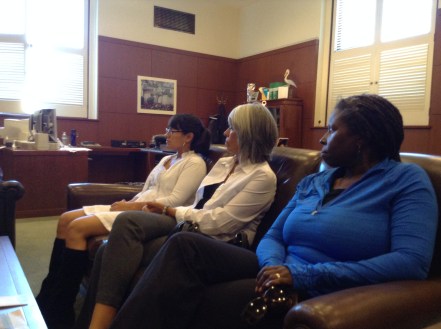
in chambers

Pamela the Persuasive

(MUNICH) — The teenager behind Friday’s deadly shooting rampage at a Munich mall had planned his attack for a year and chose his victims at random, investigators said Sunday. Bavarian investigator Robert Heimberger said the shooter, an 18-year-old German-Iranian identified only as David S., visited the site of a previous school shooting in the German…
via Munich Shooter Planned Attack for a Year, Officials Say — TIME
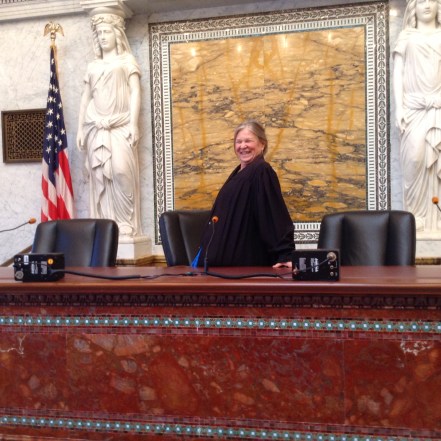
babes of justice
What is the opposite of resisting arrest? The cops resisting citizens who want to present evidence to stop crime is that. I have spent almost a decade trying to stop the obvious crime in my immediate neighborhood. This has turned out to be an illusive dream because I could not manage to show the TPD the evidence. Once this had been going on for a few years, we were then subjected to a fake neighborhood watch for the sole purpose of willfully denying crime is crime. This proved the point that crime left to fester just get worse. Now we were forced to keep all the crime in place, and pay taxes to support a fraudulent neighborhood watch. Everything has gone in the opposite direction of justice. We have been forced to keep the crime we have (which is significant) by a completely clueless system designed to serve and protect us. You don’t have to be shot in the back by the cops to have your life ruined by their dishonesty.
Finally, about a month ago I physically took the evidence to the station for the captain to review. During the month nobody has contacted me or informed me at all. This week TPD sent 3 cops to my house to ask what is happening, as if this is the first time they have heard of this. I showed them the evidence I still had at the house and told this very long complicated story one more time. They did not understand and asked me to call 911 if the ongoing financial fraud continued. This is not a realistic way to stop financial fraud.
Still TPD is completely silent. I told them I am not at all comfortable leaving that evidence at the station since the captain is on vacation, and he is specifically the only one I can trust. Silence. I fully expect that evidence to disappear at the Midtown police station and the whole 10 years of obstruction of justice to be swept under the table. We hear about corruption in government, but I have lived through a decade of it at the most extreme levels. These people aren’t even in collusion. They are simply clueless, too clueless to even collude. This is the scariest discovery I have made. They don’t intend to prevaricate. They just have no contact with reality. This corrupt bubble must be broken for the safety of us all.
fame, power, death
Fame is a food that dead men eat,-
I have no stomach for such meat.
In little light and narrow room,
They eat it in the silent tomb,
With no kind voice of comrade near
To bid the banquet be of cheer.
But Friendship is a nobler thing,-
Of Friendship it is good to sing.
For truly, when a man shall end,
He lives in memory of his friend,
Who doth his better part recall,
And of his faults make funeral.
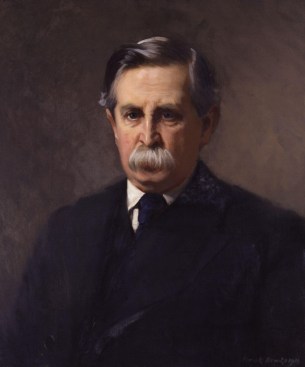
What impart I delivered from this poem? Praises and fame are heaped over the humans only after his death.
In the Cases of Majority of people especially famous people, the food of fame is not possible during their life time. If fame is considered as a food in most cases, it is supplied to the men only after his death, so fame is dead Men’s Food…
View original post 216 more words

resting place
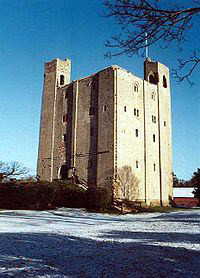
Birth Place-Hedingham Castle
Richard de Vere, 11th Earl of OxfordKG (15 August 1385 – 15 February 1417) was the son and heir of Aubrey de Vere, 10th Earl of Oxford. He took part in the trial of Richard, Earl of Cambridge and Lord Scrope for their part in the Southampton Plot, and was one of the commanders at Agincourt in 1415.
Richard de Vere, born 15 August 1385, was the eldest son of Aubrey de Vere, 10th Earl of Oxford, and his wife Alice Fitzwalter, daughter of John, 2nd Baron Fitzwalter, by Eleanor Percy, daughter of Henry de Percy, 2nd Baron Percy. The 10th Earl died on 23 April 1400 while Richard was underage. His wardship was initially granted to his mother, but after her death on 29 April 1401, King Henry IV granted it to his mother-in-law, Joan de Bohun, Countess of Hereford. Oxford had livery of his lands on 21 December 1406 without proof of age.
From 1410 onwards Oxford was appointed as a commissioner in Essex on various occasions, and in November 1411 was a Trier of Petitions from overseas in Parliament.
In August 1412 Oxford was among those who sailed to Normandy under Thomas of Lancaster, 1st Duke of Clarence, to aid the Armagnac party against the Burgundians. According to Pugh, the members of the nobility who accompanied the Duke of Clarence on this expedition did so in hope of financial gain, Oxford’s earldom in particular having suffered from forfeitures and attainders during the lives of his predecessors which had made him ‘the poorest member of the English higher nobility’. Another member of the Duke of Clarence’s expedition was Richard, 3rd Earl of Cambridge, and three years later, on 5 August 1415, Oxford was among the peers at the trial, presided over by the Duke of Clarence, which condemned to death Cambridge and Lord Scrope for their part in the Southampton Plot on the eve of Henry V’s invasion of France. A few days later Oxford sailed to France with the King, and was one of the commanders at Agincourt on 25 October 1415.
In May 1416 Oxford was invested with the Order of the Garter, and in that year sailed with the fleet to relieve Harfleur, taking part in the naval battle at the mouth of the Seine on 15 August.
Oxford died 15 February 1417, aged 31, and was buried at Earls Colne, Essex. His widow, Alice, married Sir Nicholas Thorley (d. 5 May 1442). She died 18 May 1452, and was buried at Earls Colne.
Oxford married firstly, before 1400, Alice Holland, daughter of John Holland, 1st Duke of Exeter by Elizabeth, sister of King Henry IV and daughter of John of Gaunt, Duke of Lancaster. There were no issue of the marriage.
Oxford married secondly, about 1406-7, Alice Sergeaux (c.1386 – 18 May 1452), the widow of Guy St Aubyn of St Erme, Cornwall, and daughter of Sir Richard Sergeaux of Colquite, Cornwall by his second wife, Philippe (d. 18 May 1452), the daughter and co-heiress of Sir Edmund de Arundel,who had been bastardized by the annulment in 1344 of the marriage of his parents, Richard Fitzalan, 10th Earl of Arundel and Isabel Despenser. They had three sons:
John de Vere, 12th Earl of Oxford.
Sir Robert Vere (1410-1461), of Haccombe, Devon, who married Joan Courtenay (d. before 3 August 1465), daughter of Sir Hugh Courtenay by Philippa Archdekne, and widow of Sir Nicholas Carew (d. before 20 April 1448). Sir Robert Vere and Joan Courtenay had one son, John Vere (d. before 15 March 1488), who married Alice Colbroke, and by her was father of John de Vere, 15th Earl of Oxford.
Sir Richard Vere, who married Margaret Percy (d. 22 September 1464), widow of Henry Grey, 6th Baron Grey of Codnor (d. 17 July 1444), and daughter and co-heiress of Sir Henry Percy ‘of Atholl’ of Harthill, Yorkshire, and his wife Elizabeth Bardolf, daughter of William Bardolf, 4th Baron Bardolf by Agnes Poynings.
References
· Cokayne, George Edward (1945). The Complete Peerage, edited by H.A. Doubleday X. London: St. Catherine Press.
· Castor, Helen (2004). Vere, John de, twelfth earl of Oxford,(1408-1462), magnate. Oxford Dictionary of National Biography. Retrieved 15 March 2011.
Sir Richard, 11th Earl of Oxford DeVere KG (1385 – 1417)
19th great-grandfather
Sir John 12th Earl of Oxford DeVere (1408 – 1462)
son of Sir Richard, 11th Earl of Oxford DeVere KG
John DeVere (1447 – 1509)
son of Sir John 12th Earl of Oxford DeVere
John DeVere (1490 – 1540)
son of John DeVere
Frances DeVere (1517 – 1577)
daughter of John DeVere
Thomas Howard (1536 – 1572)
son of Frances DeVere
Margaret Howard (1561 – 1591)
daughter of Thomas Howard
Lady Ann Dorset (1552 – 1680)
daughter of Margaret Howard
Robert Lewis (1574 – 1656)
son of Lady Ann Dorset
Robert Lewis (1607 – 1644)
son of Robert Lewis
Ann Lewis (1631 – 1686)
daughter of Robert Lewis
Joshua Morse (1669 – 1753)
son of Ann Lewis
Joseph Morse (1692 – 1759)
son of Joshua Morse
Joseph Morse (1721 – 1776)
son of Joseph Morse
Joseph Morse III (1756 – 1835)
son of Joseph Morse
John Henry Morse (1775 – 1864)
son of Joseph Morse III
Abner Morse (1808 – 1838)
son of John Henry Morse
Daniel Rowland Morse (1838 – 1910)
son of Abner Morse
Jason A Morse (1862 – 1932)
son of Daniel Rowland Morse
Ernest Abner Morse (1890 – 1965)
son of Jason A Morse
Richard Arden Morse (1920 – 2004)
son of Ernest Abner Morse
Pamela Morse
I am the daughter of Richard Arden Morse
Hedingham Castle
middle ages to the present , Essex, England
Aubrey de Vere was one of William the Conqueror’s most favoured knights. After the Battle of Hastings he was given land in many counties including Middlesex where he owned Kensington and Earls Court. His son Aubrey II built a huge castle at Hedingham c.1140 using the Archbishop of Canterbury as his architect. Aubrey III was created Ist Earl of Oxford by Queen Matilda and the castle remained the stronghold of the de Veres for 550 years and is still owned by a descendant. The Norman keep with its magnificent banqueting hall and minstrels’ gallery is now the only remaining evidence of this great medieval castle and its later extensive Tudor buildings.
The immensely rich and powerful de Veres were one of the most important medieval families who, as Lord Great Chamberlains, gave loyal service and military leadership to their kings and queens for over 500 years. Hedingham had many royal visitors including King Henry VII, King Henry VIII and Queen Elizabeth I.
The Earls of Oxford were great crusaders and Aubrey, 2nd Earl fought with Richard Coeur de Lion and Robert, 3rd Earl was one of the barons who forced King John to sign the Magna Carta in 1215. The following year Hedingham Castle was besieged by King John, and again by the Dauphin of France in 1217. The de Veres were commanders throughout history and featured at the Siege of Caerlaverock and the famous battles of Crecy, Poitiers, Agincourt and Bosworth. John, 15th Earl took part in the Battle of the Spurs and accompanied King Henry VIII at the Field of the Cloth of Gold, and as Lord
Great Chamberlain bore the crown at Anne Boleyn’s coronation. John, 16th Earl escorted young Elizabeth from Hatfield to London for her coronation in 1559 and his wife Margery became her maid of honour. In 1561 Queen Elizabeth I aged twenty-eight stayed at Hedingham from August 14th-19th, and Edward,17th Earl, became one of her favourites and was acclaimed to be the best of the courtier poets.
Aubrey, 20th Earl of Oxford, had no sons and when he died in 1703 this famous title became extinct. His daughter Diana married Charles, the illegitimate son of Nell Gwynne and King Charles II who was created 1st Duke of St. Albans. In 1713 the castle was purchased by Sir William Ashhurst, M.P., Lord Mayor of London. He landscaped the grounds and built a fine country house which was finished in 1719. The estate passed to his great granddaughter, Elizabeth Houghton who married Lewis Majendie. This family owned Hedingham for 250 years until Miss Musette Majendie left it to her cousin, The Honourable Thomas Lindsay, who is descended from the de Veres through both his mother and his father. His son Jason and his wife Demetra now live at Hedingham with their three small children.
The castle is now available to be seen and explored by visitors. It is even possible to have weddings and banquets there.
His monumental effigy was removed from the ruined priory at Earls Colne and placed at St Stephen’s Chapel in Bures, Suffolk.

A cenotaph is an “empty tomb” or a monument erected in honour of a person or group of people whose remains are elsewhere. The word derives from the Greek: κενοτάφιον = kenotaphion (kenos, one meaning being “empty”, and taphos, “tomb”).

Church of St Nicholas, burial place of Elizabeth de Vere, Countess of Oxford
Spouse John de Vere, 15th Earl of Oxford
My 16th great-grandmother was a lady-in-waiting to Ann Boleyn. She was the second wife of John de Vere, 15th Earl of Oxford.
Elizabeth de Vere (née Trussel), Countess of Oxford (1496 – before July 1527) was an English noblewoman. Through her daughter Frances, she was the mother-in-law of celebrated poet Henry Howard, Earl of Surrey.
Elizabeth was born in Kibblestone, Staffordshire, England on an unknown date in 1496 to Sir Edward Trussel and Margaret Dun. On 10 April 1509 at the age of about thirteen, she became the second wife of John de Vere, 15th Earl of Oxford. His first wife, Christian Foderingey had died about ten years earlier without having produced children. Together John and Elizabeth had seven children.
Children
1. Elizabeth de Vere (born about 1512)
2. John de Vere, 16th Earl of Oxford (1516 – 3 August 1562 married (1) Dorothy Neville (2) Margery Golding
3. Lady Frances de Vere (c. 1517 – 30 June 1577 married Henry Howard, Earl of Surrey
4. Aubrey de Vere (born about 1519) married (1) Margaret Spring (2) Bridget Gibbon
5. Robert de Vere (born about 1520)
6. Anne de Vere (c. 1522 – February, 1571/72) married Edmund Sheffield, 1st Baron Sheffield of Butterwick
7. Jeffrey de Vere (born about 1526) married Elizabeth Hardkyn daughter of Sir John Hardkyn of Colchester
From Wikipedia, the free encyclopedia
Elizabeth de Vere, Countess of Oxford
Church of St Nicholas, burial place of Elizabeth de Vere, Countess of Oxford
Spouse(s)John de Vere, 15th Earl of Oxford
Issue
John de Vere, 16th Earl of Oxford
Aubrey Vere
Robert Vere
Geoffrey Vere
Elizabeth Vere
Anne Vere
Frances VereNoble familyDe Vere (by marriage)FatherEdward TrussellMotherMargaret DonneBorn1496DiedBefore July 1527BuriedChurch of St Nicholas, Castle Hedingham, Essex
Elizabeth de Vere (née Trussell), Countess of Oxford (1496 – before July 1527) was an English noblewoman. As a young child she became a royal ward. She married John de Vere, 15th Earl of Oxford, and by him was mother of the 16th Earl and grandmother ofSir Francis and Sir Horace Vere, the ‘fighting Veres’.
Family
Elizabeth Trussell, born in 1496,was the daughter of Edward Trussell (c.1478 – 16 June 1499) of Elmesthorpe, Leicestershire, only son of Sir William Trussell (d. before 24 June 1480) of Elmesthorpe, Knight of the Body for King Edward IV, by Margaret Kene. The Trussells were a ‘very ancient Warwickshire family’; Elizabeth’s ancestor, Sir Warin Trussell, was of Billesley, Warwickshire.
Elizabeth Trussell’s mother was Margaret Donne, the daughter of Sir John Donne (1450–1503) of Kidwelly, Carmarthenshire, and Elizabeth Hastings (c.1450 – 1508), daughter of Sir Leonard Hastings and Alice Camoys, and sister of William Hastings, 1st Baron Hastings. Sir John Donne’s mother, Joan Scudamore, was the granddaughter of the Welsh rebel, Owain Glyndŵr.
Elizabeth had a brother, John Trussell (d.1499), to whom she was heir.
Through her father’s family, Elizabeth was a descendant of King Henry II by his mistress, Ida de Tony.
Elizabeth Trussell’s grandfather, Sir John Donne, from the Don triptych by Hans Memling.
Elizabeth’s father, Edward Trussell, had been a ward of William Hastings, 1st Baron Hastings, and at Hastings’ death in 1483 was still a minor. In his will, Hastings expressed the wish that Trussell’s wardship be purchased by Hastings’ brother-in-law, Sir John Donne:
Also I will that mine executors give to my sister Dame Elizabeth Don 100 marks . . . Also where I have the ward and marriage of Edward Trussell, I will that it be sold and the money employed to the performing of this my will and for the weal of my soul; and if my brother Sir John Don will buy the said ward, I will that he be preferred therein before any other by £10.[9]
After her father’s death on 16 June 1499 and the death of her brother, John, in the same year,[10] Elizabeth Trussell became a royal ward. Her wardship and marriage were initially purchased from King Henry VII by George Grey, 2nd Earl of Kent (d. 21 December 1503), who intended her as a bride for Sir Henry Grey (d. 24 September 1562), the 2nd Earl’s son by his second marriage to Katherine Herbert, daughter of William Herbert, 1st Earl of Pembroke, by Anne Devereux, the daughter of Sir Walter Devereux. However after the 2nd Earl’s death, Richard Grey, 3rd Earl of Kent, the 2nd Earl’s eldest son and heir by his first marriage to Anne Woodville, abducted Elizabeth Trussell, a crime for which the King levied a heavy fine against him:
Aged at least twenty-five when he succeeded his father in 1503, [the 3rd Earl] wasted his family’s fortunes — possibly, as Dugdalesays, he was a gambler. In a striking series of alienations he gave away or sold most of the lands, principally in Bedfordshire, that he had inherited . . . The earl also fell quickly into debt to the king: he failed to pay livery for his father’s lands, and he was fined 2500 marks for abducting Elizabeth Trussell, whose wardship the second earl had left to Richard’s half-brother Henry; he then failed to keep up the instalments laid down for the payment of the fine.
As a result of these events Elizabeth Trussell’s wardship and marriage again came into the hands of the King, who sold it on 29 April 1507[12] to John de Vere, 13th Earl of Oxford, and his cousin John de Vere, later 15th Earl of Oxford, for an initial payment of 1000 marks and an additional £387 18s to be paid yearly, less £20 a year for Elizabeth’s maintenance. The annual value of Elizabeth’s lands had been estimated in the inquisition post mortem taken after her brother John’s death at £271 12s 8d a year.
Marriage and issue
Between 29 April 1507 and 4 July 1509 Elizabeth became the second wife of John de Vere, 15th Earl of Oxford, whose first wife was Christian Foderingey (born c. 1481, died before 4 November 1498), the daughter and co-heiress of Thomas Foderingey (c. 1446 – 1491) ofBrockley, Suffolk, by Elizabeth Doreward (c. 1473 – 1491), daughter of William Doreward of Bocking, Essex, by whom the 15th Earl had no issue.
By her marriage to the 15th Earl of Oxford, Elizabeth had four sons and three daughters:
John de Vere, 16th Earl of Oxford (1516 – 3 August 1562), who married firstly, Dorothy Neville (died c. 6 January 1548),[16] second daughter of Ralph Neville, 4th Earl of Westmorland, by whom he had a daughter, Katherine de Vere, who married Edward Windsor, 3rd Baron Windsor. The Earl married secondly, Margery Golding (d. 2 December 1568), by whom he had a son, Edward de Vere, 17th Earl of Oxford, and a daughter, Mary de Vere.
Aubrey de Vere (d. 1580), who married firstly Margaret Spring, the daughter of John Spring of Lavenham, by whom he had a daughter, Jane, who married Henry Hunt of Gosfield,Essex, and a son, Hugh Vere,[18] who married Eleanor Walsh, the daughter of William Walsh. Hugh Vere and Eleanor Walsh had a son, Robert, who inherited the title as 19th Earl of Oxford. Aubrey de Vere married secondly, Bridget Gibbon, the daughter of Sir Anthony Gibbon of Lynn, Norfolk.
Robert de Vere (died c. 1598), who married firstly, Barbara Berners, by whom he had a son, John Vere, and a daughter, Mary Vere, and secondly, Joan Hubberd, sister of Edward Hubberd (d. 1602), by whom he had no issue.
Geoffrey Vere (d. 1572), who in 1556 married Elizabeth Hardekyn (d. December 1615), daughter of Richard Hardekyn (d. 1558) of Wotton House near Castle Hedingham, by whom he had four sons, John Vere (c. 1558 – 1624) of Kirby Hall near Castle Hedingham, Sir Francis Vere (born c. 1560), Robert Vere (b. 1562), and Sir Horatio Vere (b. 1565), and a daughter, Frances Vere (born 1567), who married, as his second wife, the colonial adventurer and author, Sir Robert Harcourt (1574/5–1631), of Nuneham on 20 March 1598.
Elizabeth de Vere (born c. 1512), who married, as his second wife, Thomas Darcy, 1st Baron Darcy of Chiche (d. 28 June 1558), by whom she had three sons, John Darcy, 2nd Baron Darcy of Chiche (d. 3 March 1581), Aubrey (d. 1558–68) and Robert (died c. 1568), and two daughters, Thomasine and Constance, of whom the latter married Edmund Pyrton (died c. 1609).
Anne de Vere, (born c. 1522, died c. 14 February 1572), who married firstly, Edmund Sheffield, 1st Baron Sheffield of Butterwick, Lincolnshire, second but eldest surviving son of Sir Robert Sheffield by Margaret Zouche, by whom she had a son and three daughters. Edmund Sheffield was slain 31 July 1549 during the suppression of Kett’s rebellion. Anne de Vere married secondly, John Brock, esquire, of Colchester, Essex, son and heir of John Brock of Little Leighs, Essex, by Agnes Wiseman, by whom she had no issue.[23]
Frances de Vere (c. 1517 – 30 June 1577), who married firstly, Henry Howard, Earl of Surrey, by whom she was the mother of Jane Howard, Thomas Howard, 4th Duke of Norfolk, Margaret Howard, Henry Howard, 1st Earl of Northampton, and Katherine Howard. Frances de Vere married secondly, Thomas Steynings, by whom she had no issue.
Elizabeth died before July 1527, and was buried in the Church of St Nicholas, Castle Hedingham, Essex, where her effigy can be seen on the black marble tomb erected for Elizabeth and her husband, the 15th Earl.
Footnotes
She is usually said to have been born at the Trussell manor of Cubleston or Kibblestone near Barlaston and Stone, Staffordshire.

Elizabeth DeVere, Countess of Oxford
Elizabeth Trussel (1494 – 1527)
16th great-grandmother
Frances DeVere (1517 – 1577)
daughter of Elizabeth Trussel
Thomas Howard (1536 – 1572)
son of Frances DeVere
Margaret Howard (1561 – 1591)
daughter of Thomas Howard
Lady Ann Dorset (1552 – 1680)
daughter of Margaret Howard
Robert Lewis (1574 – 1656)
son of Lady Ann Dorset
Robert Lewis (1607 – 1644)
son of Robert Lewis
Ann Lewis (1631 – 1686)
daughter of Robert Lewis
Joshua Morse (1669 – 1753)
son of Ann Lewis
Joseph Morse (1692 – 1759)
son of Joshua Morse
Joseph Morse (1721 – 1776)
son of Joseph Morse
Joseph Morse III (1756 – 1835)
son of Joseph Morse
John Henry Morse (1775 – 1864)
son of Joseph Morse III
Abner Morse (1808 – 1838)
son of John Henry Morse
Daniel Rowland Morse (1838 – 1910)
son of Abner Morse
Jason A Morse (1862 – 1932)
son of Daniel Rowland Morse
Ernest Abner Morse (1890 – 1965)
son of Jason A Morse
Richard Arden Morse (1920 – 2004)
son of Ernest Abner Morse
Pamela Morse
I am the daughter of Richard Arden Morse

Amazon Echo with back up band
I swore I would not buy an Echo from Amazon until I was in a wheelchair, or somehow disabled. I have never spoken to Siri, the voice inside my phone and iPods. She leaves me cold. Amazon’s voice robot is Alexa, but her priorities and capabilities are different from Siri’s. She is naturally equipped to shop Amazon by voice command, but she does so much more. The Echo arrived at my house yesterday after I was convinced by Prime Day sales to go ahead and buy one. I have now entered the world of magic voice command control of my audio life. Alexa knows all and can find any song in Amazon music in a split second. She is also pretty good as a DJ, selecting a radio station I liked off the bat. She speaks only when spoken to, and projects absolutely no drama. I now can’t imagine how I lived my life without her. I bought the full version that plugs in and uses the wifi at home. There are new portable units, but the stay at home model is right for my needs. I have just started to investigate what she does. I don’t think I will tell her to go shopping on Amazon. I will still do that in person. Right now she is playing all the Grateful Dead in Amazon music and later she will read me a book. She is talented and versatile. Most of all, she gives me no attitude. If she can’t answer a question she just makes a tiny electronic noise and shuts up. Try to find a human who will do that every time. She is polite to a T. I have no idea why I hesitated to bring her into the living room.
I have always been an early adopter of all things electronic. I resisted this new phase because I believed it was going to make me lame somehow. It is really super good for those who truly have mobility issues because Echo will handle lights, thermostat, etc, once you set up the reciprocal systems at home. Alexa will happily have all your needs delivered to your door if you can’t make it out for some reason. She is a real pal. She will create shopping lists for you even if you want to shop yourself, the old fashioned way. You can tell her that you want to make a certain kind of cake and she will create a list of everything you need. She is no slacker when it comes to data. I understand she can call Uber, so today my goal is to set that up because that will be a power move. “Alexa, call me an Uber” will be a very magical thing to say once I know how to do it.
Do you have an Echo, gentle reader? What is your favorite part of Alexa’s many charms?


