mermaidcamp
Keeping current in wellness, in and out of the water
You can scroll the shelf using ← and → keys
You can scroll the shelf using ← and → keys

Margaret Howard
Margaret Howard was the daughter of Thomas Howard, 4th duke of Norfolk (March 10, 1538-June 2, 1572) and his second wife, Margaret Audley (1539-January 10, 1564). Her father’s execution for treason when she was ten limited her choice of husbands but in February 1569 she married Robert Sackville of Bolbrooke and Buckhurst, Sussex and Knole, Kent (1561-February 27, 1609), later Lord Buckhurst and earl of Dorset. They had three sons and three daughters, including Richard (1590-1624), Edward (1591-1652), Anne, and Cecily. After her death, Robert Southwell published a small volume in her honor and Sackville described his late wife as “a lady . . . of as great virtue . . . as is possible for any man to wish to be matched withal.” He asked to be buried at Withyham “as near to my first dearly beloved wife . . . as can be” and ordered that £200 to £300 be spent on their tomb, with effigies of them both. A devout Catholic, she influenced his religious beliefs.

Robert Sackville and Margaret Howard
Margaret Howard (1561 – 1591)
13th great-grandmother
Lady Ann Dorset (1552 – 1680)
daughter of Margaret Howard
Robert Lewis (1574 – 1656)
son of Lady Ann Dorset
Robert Lewis (1607 – 1644)
son of Robert Lewis
Ann Lewis (1631 – 1686)
daughter of Robert Lewis
Joshua Morse (1669 – 1753)
son of Ann Lewis
Joseph Morse (1692 – 1759)
son of Joshua Morse
Joseph Morse (1721 – 1776)
son of Joseph Morse
Joseph Morse III (1756 – 1835)
son of Joseph Morse
John Henry Morse (1775 – 1864)
son of Joseph Morse III
Abner Morse (1808 – 1838)
son of John Henry Morse
Daniel Rowland Morse (1838 – 1910)
son of Abner Morse
Jason A Morse (1862 – 1932)
son of Daniel Rowland Morse
Ernest Abner Morse (1890 – 1965)
son of Jason A Morse
Richard Arden Morse (1920 – 2004)
son of Ernest Abner Morse
Pamela Morse
I am the daughter of Richard Arden Morse
Robert Sackville, 2nd Earl of Dorset, married first, in February 1580, Lady Margaret, by then only surviving daughter of Thomas Howard, 4th Duke of Norfolk, then suspected as a crypto-Catholic. By her he had six children, including:
Richard Sackville, 3rd Earl of Dorset (18 March 1589 – 28 March 1624)
Edward Sackville, 4th Earl of Dorset (1591 – 17 July 1652)
Anne, married Sir Edward Seymour, eldest son of Edward Seymour, Viscount Beauchamp, and, secondly, Sir Edward Lewis (d.1630) by whom she had issue
Cecily, married Sir Henry Compton, K.B.
Lady Margaret died on 19 August 1591; Robert Southwell, who never met her, published in her honour, in 1596, Triumphs over Death, with dedicatory verses to her surviving children
My 15th great-uncle, Thomas Sackville, inherited a calendar house, Knole House, in Kent, where they, no doubt, all visited. The house became famous:
Knole is an English country house in the town of Sevenoaks in west Kent, surrounded by a 1,000-acre (4.0 km2) deer park. One of England’s largest houses, it is reputed to be a calendar house, having 365 rooms, 52 staircases, 12 entrances and 7 courtyards. It is known for the degree to which its early 17th-century appearance is preserved, particularly in the case of the state rooms: the exteriors and interiors of many houses of this period, such as Clandon Park in Surrey, were dramatically altered later on. The surrounding deer park has also survived with little having changed over the past 400 years except for the loss of over 70% of its trees in the Great Storm of 1987.
In 1566, during the reign of Queen Elizabeth I, it came into the possession of her cousin Thomas Sackville whose descendants the Earls and Dukes of Dorset and Barons Sackville have lived there since 1603 (the intervening years saw the house let to the Lennard family). Most notably, these include writer Vita Sackville-West (her Knole and the Sackvilles, published 1922, is regarded as a classic in the literature of English country houses); her friend and lover Virginia Woolf wrote the novel Orlando drawing on the history of the house and Sackville-West’s ancestors. The Sackville family custom of following the Salic rules of primogeniture prevented Sackville-West herself from inheriting Knole upon the death of her father Lionel (1867–1930), the 3rd Lord Sackville, and her father bequeathed the estate to his brother Charles (1870–1962).

Dropping the truth bomb
In Tucson we experience a major dilution of our tattle as it passes through needless layers of middlemen to reach law enforcement central. We report one thing and the bureaucrats report quite another, which results in chronic problems that might be solved by collecting really reliable intelligence in the first place. Pure tattle goes from your lips to the ears of the principal. It does not travel through the teachers, the students, or the PTA. Tattle, and the need to deliver pure, unadulterated tattle, is not only a basic human right, but a basic human instinct. To make use of this instinct one simply needs to direct and manage it professionally. A vessel, a place, and a time must be established for the task of collecting pure intelligence from citizens and using it to both prevent and stop chronic crime.
I am urging my police department to initiate a program on-line as well as in person at the station near me to give folks a chance to express themselves for ten minutes at ten a.m. each Tuesday. I am choosing this increment of time because they always say they are too busy to try new communication methods. They can’t possibly argue that they don’t have 10 minutes a week. Citizens in my neighborhood have gone to the station with evidence of black tar heroin in a vial and a report of on going crime near their home, but were turned away at the window of the cop shop and the vial of evidence was thrown in the trash in front of the two ladies. We need a system that works much better than that. We need to trust that what we report and evidence we submit is used to help solve the crime problems here. I think a funnel that directs intelligence to the attention of the police live on a regular basis will make a difference to the level of trust in the whole operation. I believe intelligence is the most valuable commodity police can have. It protects both them and us.
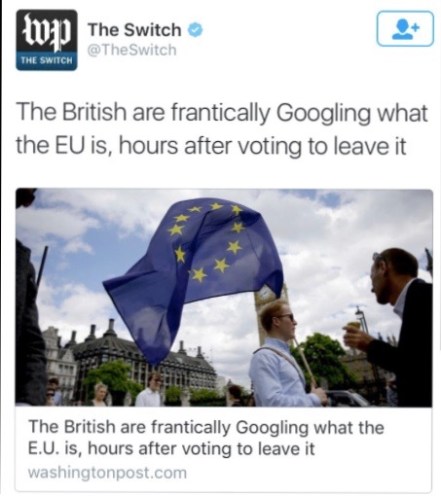
Brits become curious
https://twitter.com/biancatesfaye1/status/746394668485742593
The British voted to leave the European Union and then started to google “What is the EU?” They also started to inquire into getting Irish passports, since Ireland is in the EU. The vote was dramatically divided between young and old in the electorate. Scotland is furious because they stayed in Great Britain recently because the Brits told them that by leaving Britain they would leave the EU. Now they voted overwhelmingly to stay, and feel mighty baited and switched. To add insult to injury Donald Trump flew to Scotland to “celebrate” the Brexit with his peeps. Ever the party boy, he started tweeting his glee to the horror of Scottish people. He has run into controversy in that country with conservation groups. Now he is indicating he is thrilled at the collapse of the currency because more people will visit his golf course. He knows how to make a point. Sometimes the only way to deal with current events is to laugh at them.
https://twitter.com/Jenn_Abrams/status/746388211195248641
https://twitter.com/RosieBlackadder/status/746392996682285058
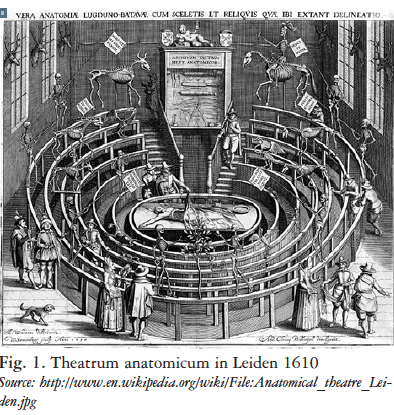
Anatomical theater Leiden 1610

Anatomical theater in Padua 1594
The dead teach the living is the meaning of the phrase mortui vivos docent. It was used to justify dissection of human bodies for science. In the middle ages there was fear of dead bodies that, coupled with real danger present in corpses, made dissection dangerous. The biggest danger faced by science, however, was the long arm of Catholic Church. Miguel Serveto (1511-1553), was a physician and theologist who studied medicine in Paris at Sylvius’. He published work describing post mortem examinations of corpses. For this sin Serveto was burnt at the stake along with his books, both medical and religious, sentenced to death by the Holy Inquisition.
The Greek physician Gallen taught anatomy in the second century, teaching by direct empirical observation. Ironically, his teachings were used to dissect one or two executed prisoners a year in the Middle Ages, but this practice was done more for theater than for research. In 1543 of Andreas Vesalius published his masterpiece, De Humani Corporis Fabrica. Vesalius, a young physician and professor at the University of Padua, changed the course of medical history. He demonstrated the importance of direct observation, creating illustrations of anatomy in action, teaching the secrets of the inner workings of the human body. Public dissection for educational purposes became popular.
The Middle Ages were plagued by the black death. Those dark ages were characterized by superstition and ignorance. The Renaissance occurred when science, art, and humanism gave rise to new philosophies. Some of these same ideas drove my ancestors to colonial America in the 1600’s. One of my ancestors, Dr John Greene, was perhaps the first surgeon in America. I have to wonder if he ever did any dissection in his training. I have not. I puked in the clay bucket for the art class (located right next to the science lab) in the 10th grade and was excused for frog dissection. It was never mentioned again, and boy was I glad.
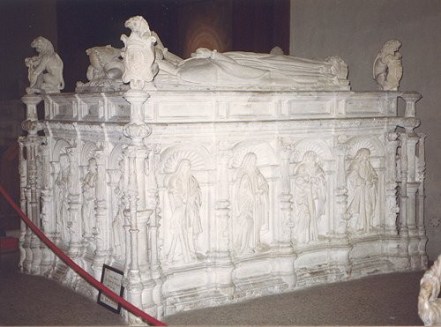
Tomb of Thomas Howard – 3rd Duke of Norfolk St. Michael’s Church; Suffolk,England Thomas Howard was buried here after his death on Aug. 25, 1554. It is possibly the best preserved ornate stonework in Europe. Although both Thomas and his wife, Elizabeth Stafford appear on the same monument, only he is buried there. She was interred in the Howard Chapel in St. Mary’s Church, Lambeth. This was due to the unhappy marriage and final separation.
Thomas Howard, 3rd Duke of Norfolk (1473 – 25 August 1554) was a prominent Tudor politician. He was uncle to two of the wives of Henry VIII, Anne Boleyn and Catherine Howard, and played a major role in the machinations behind these relationships. After falling from favor he was imprisoned in the Tower of London with his dukedom forfeit, and was released on the accession of Mary I. He aided in securing Mary’s throne, setting the stage for alienation between his Catholic family and the Protestant royal line that would be continued by Elizabeth I.
As with all the Dukes of Norfolk, Thomas Howard was descended from Edward I. He was the son of Thomas Howard, 2nd Duke of Norfolk, and Elizabeth Tilney. Thomas Howard succeeded his younger brother Edward as Lord High Admiral in 1513. Until 1524 he was styled Earl of Surrey.
Norfolk first married Anne of York, daughter of Edward IV of England and Elizabeth Woodville on 4 February 1494 at Greenwich Palace. The couple had at least two children: Thomas Howard (c. 1496-1508) and a stillborn child (c. 1499). There are also suggestions of short-lived Henry Howard and William Howard resulting from this marriage.
Following Anne’s death in 1511 he married Elizabeth Stafford, daughter of Edward Stafford, 3rd Duke of Buckingham and Alianore Percy on 8 January 1512. They had three children: Lady Mary Howard (c. 1513-1555) who married Henry Fitzroy, illegitimate son of Henry VIII; Henry Howard (1517-1547) was one of the founders of Renaissance poetry; and Thomas Howard (c.1520-1582). The marriage with Elizabeth was unhappy. When Elizabeth complained about his mistress, Bess Holland, the Duke beat her. The couple remained estranged until Norfolk’s death.
On his father’s death in 1524 he inherited the dukedom of Norfolk and was named Lord High Treasurer and Earl Marshal, making Howard one of the most premier nobles in the kingdom. He distinguished himself many times in battle, and was an able soldier. His power increased somewhat after his niece Anne Boleyn became Henry VIII’s mistress, sometime around 1527. However, their relationship was fraught with difficulty since Anne found her uncle to be selfish and untrustworthy. Although they were political allies throughout the late 1520s alongside Howard’s brother-in-law Thomas Boleyn, Anne’s father, Norfolk once complained that Anne used words to him “that one would not use to a dog.” She was crowned queen in 1533, and was probably influential along with Queen Anne in securing the marriage of Norfolk’s daughter Mary to Henry Fitzroy.
Queen Anne’s religious and political vision was more radical than Norfolk’s, and their relationship deteriorated throughout 1535 and 1536 as Henry VIII became increasingly unfaithful, including with Anne’s cousin, Mary Shelton. Putting his own security before family loyalties, he presided over Queen Anne’s trial in 1536, giving a death sentence despite her probable innocence. The next day, he condemned to death his nephew, Anne’s brother George for the crime of incest with his own sister, the Queen.
After the death of Jane Seymour he used another of his nieces, the teenaged Catherine Howard to strengthen his power at court by orchestrating an affair between her and the 48 year-old king. He used Henry’s subsequent marriage to Catherine as an opportunity to dispose of his long-term enemy Thomas Cromwell, who was beheaded in 1540. Queen Catherine’s reign was a short one, however, since Thomas Cranmer, the Archbishop of Canterbury, discovered that she was already secretly betrothed before her marriage to Henry and had been extremely indiscreet since. Catherine was beheaded in February 1542, and numerous other Howards were imprisoned in the Tower – including the duke’s stepmother, brother, two sisters-in-law and numerous servants.
Catherine Howard’s execution was his downfall, despite Norfolk’s desperate efforts to heal the rift. He had become the leader of the premier family in England; as the uncle of Anne Boleyn and Catherine Howard, and the great-uncle of Jane Seymour[1] He had also benefited from the influence of several of the King’s mistresses, his nieces Mary Boleyn and Elizabeth Carew and his wife’s aunt, Anne Stafford, Countess of Huntingdon. In 1546, Norfolk allegedly hatched a plot to make his daughter, Mary Howard, the King’s mistress, even though she was the widow of Henry’s illegitimate son.[2] In December 1546, he was arrested in company with his son Henry and charged with treason. Henry VIII died the day before the execution was due to take place, and Norfolk’s sentence was commuted to imprisonment. The Earl of Surrey was less fortunate and had been executed a few days previously.
Norfolk remained in the Tower throughout the reign of Edward VI of England and his dukedom remained forfeit. He was released by Mary I in 1553, due to the Howards being an important Catholic family, and the dukedom was restored. The Duke showed his gratitude by leading the forces sent to put down the rebellion of Thomas Wyatt, who had protested against the Queen’s forthcoming marriage to Philip II of Spain and had planned to put Anne Boleyn’s daughter, the future Elizabeth I on the throne in Mary’s place. The result of Norfolk’s suppression of the Wyatt Rebellion was Princess Elizabeth’s imprisonment in the Tower (although there was not enough evidence to convict her on treason, since she clearly had not been party to the rebels’ precise intentions) and the execution of the Queen’s cousin Lady Jane Grey. Norfolk died not long after the Wyatt Rebellion and was succeeded by his grandson Thomas. The 4th Duke, also a Catholic, was executed on Elizabeth’s orders for illegally plotting to marry Mary Queen of Scots.
Thomas Howard’s tomb is situated in Framlingham Church, Suffolk. It is among the best preserved example of ornate stonework in Europe
Lord Thomas Howard (1473 – 1554)
15th great-grandfather
Lady Katherine Howard Duchess Bridgewater (1495 – 1554)
daughter of Lord Thomas Howard
William ApRhys (1522 – 1588)
son of Lady Katherine Howard Duchess Bridgewater
Henry Rice (1555 – 1621)
son of William ApRhys
Edmund Rice (1594 – 1663)
son of Henry Rice
Edward Rice (1622 – 1712)
son of Edmund Rice
Lydia Rice (1649 – 1723)
daughter of Edward Rice
Lydia Woods (1672 – 1738)
daughter of Lydia Rice
Lydia Eager (1696 – 1735)
daughter of Lydia Woods
Mary Thomas (1729 – 1801)
daughter of Lydia Eager
Joseph Morse III (1756 – 1835)
son of Mary Thomas
John Henry Morse (1775 – 1864)
son of Joseph Morse III
Abner Morse (1808 – 1838)
son of John Henry Morse
Daniel Rowland Morse (1838 – 1910)
son of Abner Morse
Jason A Morse (1862 – 1932)
son of Daniel Rowland Morse
Ernest Abner Morse (1890 – 1965)
son of Jason A Morse
Richard Arden Morse (1920 – 2004)
son of Ernest Abner Morse
Pamela Morse
I am the daughter of Richard Arden Morse
My 15th great-grandfather, Thomas Howard, 3rd Duke of Norfolk, KG (1473 – 25 August 1554) aided Mary in securing her throne, which ended him and his family in a world of trouble. He was fully immersed in the politics of Henry VIII, and paid the price for it. Those were treacherous times to be close to the king.

Thomas Howard
The phases of the moon influence tides and other liquid phenomena. Farmers have traditionally used the moon phases to plan planting and harvest schedules. The Farmer’s Almanac, formerly very widely used, is still published. It still distributes information about the moon to all the gentle readers of the publication. In 2016, the solstice falls on June 20 at 6:34 p.m. EDT. This is the “summer” solstice in the Northern Hemisphere. For the first time in 70 years the solstice is coinciding with the full strawberry moon.
This year the Farmer’s Almanac is hosting a live stream of the full moon event on Monday evening 20 June. Bob Berman will be looking through a giant telescope at the Moon, courtesy of Slooh, and streaming it live to any and all visitors here. We have come a long way since Galileo took a walk on the wild side and had to face the Catholic church for his efforts.

Galileo before the Holy Office
Step outside to enjoy this special moon event, or watch it stream live on your computer. This is the right night to toast Galileo with a strawberry daiquiri. Cheers, gentle reader.
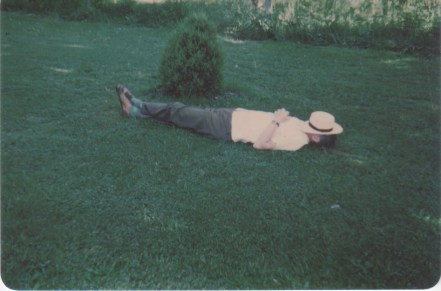
Richard Arden Morse snoozing
My dad loved to smoke food outside on his Hasty Bake. He collected his hickory wood in Arkansas and cured it by soaking it in water in small pieces. He was serious about his ribs, but smoked lots of fish too because he was a fisherman. In fact, fishing and cooking were my dad’s only hobbies until he took up hot air ballooning with my mom in his 60’s. We lived blocks from a famous golf club, and our town was golf obsessed, but my parents did not play the game. They were dancers. They like to have friends over to sing at the player piano.
He did not play competitive sports except when he was on a bolas criollas (bocce) team in Venezuela for a few years. He never went hunting, owned no guns, and had very poor eyesight. He was obsessed with catching fish. Money was no object when fishing was involved. Deep sea, tropical jungle, or lake..it made no difference to my dad. He did not fly fish..that was not his thing. He flew to South America and spent tons of money to go on jungle fishing trips with his friends. I did some fishing with him in my childhood, but not very much. I took up fishing seriously later in life with a hand line in the Bahamas. I never liked the rod and reel system. I did not like the complication of it. You can feel the fish on a hand line, but your choices are fewer. His parents both liked to fish, and there are written reports I have that his mother was an expert angler in her childhood in Kansas.
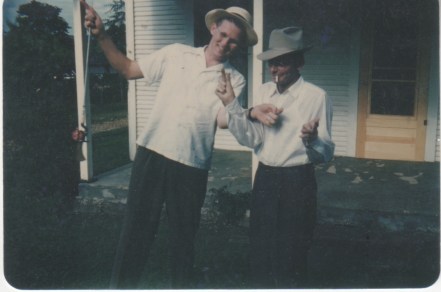
My father and his father

Dick on a family fishing grip
What I remember doing as a team sport with my father was brunch. We made crepes Suzettes and broiled grapefruit from his Wolf in Chef’s Clothing cookbook. We had a small kitchen so there was just enough room for the two of us to make the crepes and the set them on fire in a chafing dish. Our regular menu had nothing so exciting as flambé food. I used to beg for that brunch, but it only came around on very rare occasions. The other popular dish, for which my dad got credit but was actually concocted by my mom, was home-made ice cream. We had the only ice cream freezer in my immediate neighborhood, so this memorable dish made my back yard a very popular place to be. My friends and I would sit on the top of the freezer when it got harder to turn the handle. This usually happened during a barbecue while he was watching the smoker.
I have some very fond memories of cooking with my dad. His repertoire was small, but each dish was very special. Did you cook with your father in your childhood, gentle reader?

sunset
Celeritas et veritas is my new favorite Latin phrase. It means promptness and truth. My father had a catch phrase by which he was known during his career which was, “Hurry every chance you get.” I think hurrying is overrated, and truth underrated. If I create my own coat of arms I will make Celeritous et Veritas my motto. I have been very attached to my 3 P’s for decades. They are:
In my mind these are the tenants that apply to best practices in business, pleasure, and civic matters. I judge people on their ability to be prompt, allowing for circumstances. Some folks have erratic schedules and responsibility loads based on family or career. I have been in that position myself, juggling multiple tasks. We are not always able to be perfectly prompt, but if tardiness is a chronic habit politeness and professionalism are completely destroyed. Those who never show up on time are passively aggressive and are shunned in my world after a reasonable trail period. All relationships would benefit from more promptness and truth. What is your Latin motto, gentle reader?
I have been a client and fan of Justine Robbins for many years. She is a very talented and skilled cranio-sacral therapist as well as a lymphatic drainage expert. She knows my body well, and has always helped me keep my health in balance. I believe regular lymphatic drainage by a competent therapist is one of the best investments I can make to my long-term well-being. The lymphatic system is an often overlooked key player in the body’s defense against disease. The lymph carries away inflammation and infection. When it is out-of-order consequences can be very serious our health. The lymphatic flow can heal itself and rebuild pathways to bring back function to the area. If it is damaged therapy relieves swelling and inflammation by rerouting the lymphatic fluid. In time the body establishes working routes for this crucial drainage.
Any time you have an incision you will cut and disrupt the lymphatic system. I recently had a surgery on my arm that resulted in some puffiness around the site. It is not serious or painful, but I wanted to test Justine’s new laser system. Her new office is close to home, which I love. The treatment consists of socially catching up with Justine (in my case) while she runs the laser over the area for about 10 minutes. She has discovered the therapy works best if short consecutive sessions are used. Of course I can’t know how my arm would be if I had done nothing, but I can see and feel a difference in the swelling present today. I will continue the series to speed the healing on my incision. I am pleased to know that this space age treatment is available to me in the future. Theralase is my new best friend.
If you live in Tucson you can visit Justine’s practice, LightSpeed Therapy at 3333 N. Campbell Ave, Suite 2. She can be reached at 520-908-8907. I highly recommend her services and this new cool tool. Some Canadian insurance covers this kind of treatment, and we hope in time the US will discover the efficacy of this non invasive therapy.
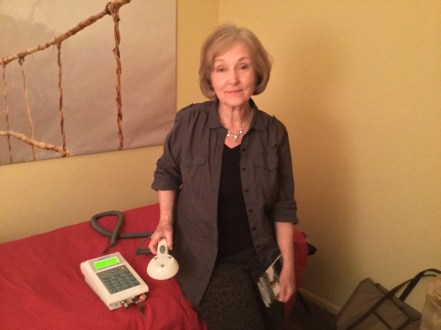
Justine and Theralase
 mermaidcamp