mermaidcamp
Keeping current in wellness, in and out of the water
You can scroll the shelf using ← and → keys
You can scroll the shelf using ← and → keys



My week has been graced by the presence of a real writer. I went to hear the poet Simon Ortiz who was in Tucson for a reading of his work. I was deeply moved and highly impressed with his writing, which he delivered with lavish explanations about his process. He is now writing an epic poem, an idea he joked about by saying there is no real rule about exactly how long an epic has to be. He will include within the epic some of his older works, which he shared with the group who had come to the U of A Poetry Center to listen to him. I purchased his book, Sand Creek, which he signed for me after the reading. I told him how much I loved hearing him and he responded that he really loved reading to us. His genuine joy in sharing his work was evident. We were all truly blessed to be there. Some of his poems are funny, and some carry tragic stories from history, like Sand Creek.
The Poetics and Politics of Water series has evolved. Dr. Ofelia Zepeda is a poet and professor who collaborates to put together this very special program of Native American writers. She and her colleague Larry Evers introduced Politics and Poetics in 1992. I look forward to the next reading which will be given by Dr. Zepeda herself. She uses her native language from this region, Tohono O’odham, to welcome the visitors to her land and bless the participants. It is beautiful. She translates the traditional greeting in to English when she is done.

Ofelia Zepeda introduction
I have written and read some this week with mixed results. I believe the most profound thing that happened to set my poetic self on the path was my chance to hear Mr Ortiz. He said prose and poetry are all the same, and in the end, all language is poetry. He certainly was all poetic in every part of his being. He talked about his own recovery from alcoholism, and his father’s inability to recover from it. His identity as Acoma with deep religious and cultural heritage is important to him. His father exposed Simon to sorrow through addiction, but he also taught him his traditional language and mystical history. The last poem he read to us was about his father’s death. It was sung as a song, a chant, a rhythmic tribute to the spirit of his father and all he had inherited. It was a wonderful way to show his talent and end on a solemn, serious, meaningful note.


This week in #ROW80 I found a world of information and poetry in apps and podcasts. This vast free library of poems and poets would keep me occupied forever, but I have started a new ritual that is intended to create an atmosphere conducive to creating poetry. I now listen to my daily podcast poems while I draw my first art piece of the day. I am also, for an unrelated reason, soaking my feet in hot water with epsom salts for about an hour while I drink tea and coffee. I am not sure which element is most important, but I am enjoying the soaking in both hot water and poetic streams first thing in the morning. The Poetry Foundation features information about poets’ lives. I was curious to find Frances DeVere, wife of Henry Howard, in the data base. She is missing, but he is a very big figure in the history of poetry. I started to read his work and study the details of his life. His maternal grandfather was beheaded before him in the Tower. His father narrowly escaped death because the king died the day before his scheduled execution. This non-fiction story is full of twists. There is shocking drama in this real history of my DNA.
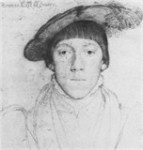
In the court of Henry VIII life could be very opulent, but all that could turn in the blink of an eye. Henry was capricious to say the least. The most famous of all the English monarchs wielded power with great vigor. In the year 1547 my was charged with treason. He was beheaded on Tower Hill after a one day trial. When he was under house arrest he wrote poetry. When he was sentenced to die, he wrote poetry and translated the Bible. He was a real troubadour in Tudor England. Some scholars believe he created the sonnet and was first to use free verse in English. His wife Frances was also a poet, but I have not found any of her work. I think the double whammy of dualing poets in the Tudor court should be a big advantage to me. I should be able to make some poems about them, or somehow inspired by their lives. During the next week I plan to make some stabs at this idea. The anniversary of his beheading is in 5 days. Maybe I can come up with a tribute of sorts.
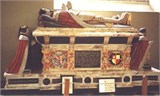
St Michael’s at Framlingham
Henry Howard (1517 – 1547)
is my 15th great grandfather
Thomas Howard (1536 – 1572)
son of Henry Howard
Margaret Howard (1561 – 1591)
daughter of Thomas Howard
Lady Ann Dorset (1552 – 1680)
daughter of Margaret Howard
Robert Lewis (1574 – 1645)
son of Lady Ann Dorset
Robert Lewis (1607 – 1644)
son of Robert Lewis
Ann Lewis (1633 – 1686)
daughter of Robert Lewis
Joshua Morse (1669 – 1753)
son of Ann Lewis
Joseph Morse (1692 – 1759)
son of Joshua Morse
Joseph Morse (1721 – 1776)
son of Joseph Morse
Joseph Morse III (1752 – 1835)
son of Joseph Morse
John Henry Morse (1775 – 1864)
son of Joseph Morse III
Abner Morse (1808 – 1838)
son of John Henry Morse
Daniel Rowland Morse (1838 – 1910)
son of Abner Morse
Jason A Morse (1862 – 1932)
son of Daniel Rowland Morse
Ernest Abner Morse (1890 – 1965)
son of Jason A Morse
Richard Arden Morse (1920 – 2004)
son of Ernest Abner Morse
Pamela Morse
I am the daughter of Richard Arden Morse
On this day in history, the 19th January 1547, the poet, courtier and soldier Henry Howard, Earl of Surrey and son of Thomas Howard, 3rd Duke of Norfolk, was executed by beheading on Tower Hill. He was laid to rest at All Hallows-by-the-Tower (All Hallows Barking) but was moved in 1614 by his son Henry, Earl of Northampton, to a beautiful tomb in the family church, St Michael’s at Framlingham.
He had been found guilty of treason on the 13th January 1547 at a common inquest at Guildhall, where evidence was given “which concerned overt conspiracy as well as the usurpation of the royal arms”1. It was alleged that “he had on 7 October 1546 at Kenninghall displayed in his own heraldry the royal arms and insignia, with three labels silver, thereby threatening the king’s title to the throne and the prince’s inheritance”2, yet when he had been arrested in December the questions had focused on “his determination for the rule of the prince; his procuring his sister to be the royal mistress; his slandering of the royal council; and his plans to flee the realm”3, not his use of the royal arms and insignia. His trial lasted a day and he gave a spirited defence but it was no good, he was found guilty and sentenced to death.
Historian Susan Brigden writes of how Surrey spent his last days in the Tower writing, paraphrasing Psalms 55, 73 and 88, “the prayers of the psalmist abandoned and betrayed, thinking upon death and judgment”4. His work showed not only his sense of betrayal but also his evangelical religious beliefs.
He was executed on Tower Hill on the 19th January 1547 but his father, the Duke of Norfolk, who had also been setenced to death for treason, escaped execution because Henry VIII died before his scheduled execution. Norfolk was released and pardoned by Mary I in 1553 and died naturally on 25th August 1554.
Susan Brigden writes of how Surrey was “the first poet in English to explore what might be said without rhyme” and he is viewed as one of the founders of English Renaissance poetry and “Father of the English Sonnet”, along with Thomas Wyatt and, I believe, George Boleyn. You can find Surrey’s poetry and also his paraphrases of Psalms 55 and 88 at Luminarium: Anthology of English Literature5. I’ll leave you with one if his poems:-
Set me whereas the sun doth parch the green…
Set me whereas the sun doth parch the greenOr where his beams do not dissolve the ice,
In temperate heat where he is felt and seen;
In presence prest of people, mad or wise;
Set me in high or yet in low degree,
In longest night or in the shortest day,
In clearest sky or where clouds thickest be,
In lusty youth or when my hairs are gray.
Set me in heaven, in earth, or else in hell;
In hill, or dale, or in the foaming flood;
Thrall or at large, alive whereso I dwell,
Sick or in health, in evil fame or good:
Hers will I be, and only with this thought Content myself although my chance be nought.
Notes and Sources
Susan Brigden, ‘Howard, Henry, earl of Surrey (1516/17–1547)’, Oxford Dictionary of National Biography, Oxford University Press, 2004
Luminarium: Anthology of English Literature


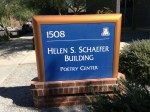

April is Poetry month, with many activities and projects running around the country. I have taken the challenge to write a poem every day in April for the last two years. I push my way through the writing, with a fully punched card in participation, but have not really put my full attention into the whole process. We are lucky in Tucson to have a world-famous Poetry Center at the U of A, open to the public. Each time I visit the place I tell myself I will make a regular habit of spending time there. It is an inspiring place to read, write, meditate, or take part in one of the workshops or readings. The only resolution I need to make for 2015 is to honor the poet within me all year. There is a haunting feeling in my memory and in my dreams of a productive and expressive poet I believe is within my spirit. This artist/alchemist/poet has not been nurtured as well as it needs to be. I work with words daily but am not arching to new heights or even developing a larger vocabulary. When I do push myself to write poetry daily I can feel a response in my dream world toward more color and rich dramatic story lines. It is as if there are stories, poems, maybe even novels, deeply stored in my writing practice, but I do very little to develop my ability in these realms. The poetry is essentially trapped within my lazy writing practice. I plan to liberate this struggling poetic artist next year and allow her to explore and create in new ways.
As 2015 approaches I contemplate the 3 words I will use to ground my meditation, my health, and my creativity next year. This is a practice started and promoted by Chris Brogan. I have done it before and always find the quest for the right words to be very helpful. This year I want to make some kind of significant progress as a poet and creative writer. By using these key words all year I believe I can be a better poet in April and beyond. Moreover, I think these words fit perfectly with my goals to clear out excess clutter in my home and my life. I am working on this now, cleaning out my closet before the end of the year. I can honestly say that the results I see and feel in my closet after patiently and persistently ridding myself of extraneous clothing and accessories are nothing short of poetic. Poetry has more to do with what is edited than with what remains. The fewer words used to convey an idea, the more powerful each word becomes. Now my closet is more like a haiku than an epic drama. I am feeling much better when I walk into it now.
These words fit perfectly with my health and fitness goals. Movement and variety of enjoyable physical activities create strong healthy bodies. It does not matter if time is spent playing an active sport, hiking, swimming, or yoga, the key to success is always persistence. I like to cross train, in other words, do different physical activities, to keep things interesting. This is good for the body as well as the mind. I like doing some activities outdoors, but the gym makes me very happy too. In 2015 I plan to create a fitness regime that offers me a chance to improve my levels of grace, balance, and coordination. I plan to end 2015 as poetry in motion, retaining all my flexibility and enthusiasm for fitness and health. Too much of any one thing can cause burn out or injury, so there is no need to fixate on any one aspect of health or fitness. Balance is an important element of health.
My words have meaning for me in many aspects of living. They are good universal guiding principals that are easy to remember:
Do you do the 3 word challenge, Gentle Reader? Have you found it to be helpful?
The poet archetype is insightful and artistic. Symbolic language captures the spirit of a person, place or time to place it in the timeline of history. Painters paint and dancers dance to express wonder. Joy, sorrow, and the deepest amazement can be brought to the surface through art. The audience, the reader, or the viewer is symbolically imprinted by the artists’ insight and ability. Poetic styles change with language as it evolves over time. Essence is the poet’s product. Language is capable of painting subtle watercolors, and leaving haunting images with the reader. Poetic language does not always need to appear in published poems. Poetry and motion have similar qualities. There is style, strength, and expression in everything we do. If we were to become conscious of a story that is ours to tell, and begin to tell it, we will be poetic.
My 9th great grandmother was the first woman poet to be published in America:
Anne Bradstreet (1612-1672) is one of the most important figures in the history of American Literature. She is considered by many to be the first American poet, and her first collection of poems, “The Tenth Muse Lately Sprung Up in America, By a Gentlewoman of Those Parts”, doesn’t contain any of her best known poems, it was the first book written by a woman to be published in the United States. Mrs. Bradstreet’s work also serves as a document of the struggles of a Puritan wife against the hardships of New England colonial life, and in some way is a testament to plight of the women of the age. Anne’s life was a constant struggle, from her difficult adaptation to the rigors of the new land, to her constant battle with illness.
It is clear to see that Anne’s faith was exemplary, and so was her love for children and her husband, Governor Simon Bradstreet. Anne’s poems were written mainly during the long periods of loneliness while Simon was away on political errands. Anne, who was a well educated woman, also spent much time with her children, reading to them and teaching them as her father had taught her when she was young. While it is rather easy for us to view Puritan ideology in a bad light because of it’s attitude towards women and strict moral code, her indifference to material wealth, her humility and her spirituality, regardless of religion, made her into a positive, inspirational role model for any of us.
Another one of Anne’s most important qualities was her strong intuition, although only subtly hinted at in her work, probably for fear of reprisal from the deeply religious Puritan community, one cannot help but feel her constant fascination with the human mind, and spirit, and inner guidance.
Her style is deceptively simple, yet speaks of a woman of high intelligence and ideals who was very much in love, and had unconditional faith. While it was difficult for women to air their views in the 17th Century, Anne Bradstreet did so with ease, as her rich vocabulary and polyvalent knowledge brought a lyrical, yet logical quality to her work which made it pleasant for anyone to read.
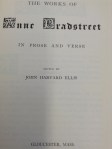

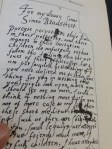
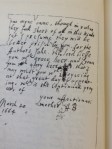






Anne Dudley Bradstreet was protected by her father and husband at a time when women were not supposed to think, let alone write poetry. She wrote history as she lived it as an Englishwoman in New England. I visited the University of Arizona Poetry Center this week to see the word shrine for the dead. I was very happy to also find a big blue book by Anne Bradstreet on the shelves. I enjoyed the wonderful space and visited with my ancestor by reading her works for about an hour. I had seen some of the work before, but since I was thinking of ancestry I really enjoyed the note she wrote to her son Simon (brother of my own ancestor). There is a copy preserved in her own hand, which I love to see. It gives me some intuition into her soul’s journey. Being a Pilgrim was not easy, but if your father and husband were governors you had some obvious advantages.
It is a wonderment of synchronicity to find my ancestor’s work preserved at the Poetry Center very near my home where I can go visit and read her any time.
 mermaidcamp