mermaidcamp
Keeping current in wellness, in and out of the water
You can scroll the shelf using ← and → keys
You can scroll the shelf using ← and → keys
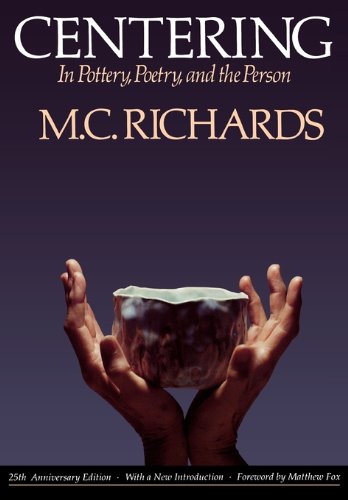
Centering by Mary Richards
I made pottery on the wheel when I was young. Two books were read by almost all the potters I knew in those days, Clay and Glazes for the Potter by Daniel Rhodes, and Centering by MC Richards. The first technical manual often called simply Rhodes gave formulas and facts needed to produce pottery. The centering book was all about zen and becoming one with the clay in the middle of the wheel. I used to think the centering book was too silly, but now I think it is brilliant. I have not thrown pots for at least 30 years, but the practice did make a difference in my philosophy. To center the clay one must be centered. All work is exactly like that. If you are not centered, balanced, able to focus, your clay will be hard to manage. Your vision will not quite be achieved because of distraction. With clay it is possible to endlessly recycle it if it has not been fired. However, if one works for too long on a thrown piece it is very likely to collapse. Brevity and self assurance are the essence of throwing pots.
Centering was taken from an inspirational speech given to fellow craftsmen. Mary Richards was asked to elaborate on that talk in a book. The 25th anniversary edition is out so I have zapped it into my Kindle. In her introduction Ms Richards states, “The imagery of centering is archetypal. To feel the whole in every part.” Chapter one begins, “CENTERING: that act which precedes all others on the potter’s wheel.” This seems obvious, but the metaphors are many. Whatever raw materials we have must be treated as a whole to make the most of them. Many mediums are not as forgiving as clay. Once wood or fabric has been cut it can’t be thrown into a slip barrel and become new. An unfired pot that does not meet standards can begin as a new lump of clay. Sensitivity and refined touch are the main skills needed to center and throw pots. Porcelain has different feel and qualities to stoneware. Each clay body has potential and personality. Each will take glazes differently. The chemical process of fusing glaze to pot happens at high heat and must be cooled slowly to avoid cracking and crazing. There is technical accuracy, just as in distillation. One follows a recipe and keeps a firing log in order to attain exact desired results on a regular basis. There will sometimes be pots that are ruined in the kiln, and this is a fact that must be accepted. Not every pot will survive.
Mary Richards quotes Emerson who said the law is: “Do the thing, and you shall have the power. But they who do not the thing, have not the powers.” When I read this book about centering today I know that being a potter early in my life gave me an appreciation for practice and balanced design in all things. I enjoy making my own clothes, growing my own food, and designing my own life. The concept of centering means connecting from my center to the center of others, touching the core. That is the essence of life. Stay centered, my friend.
The poet archetype is insightful and artistic. Symbolic language captures the spirit of a person, place or time to place it in the timeline of history. Painters paint and dancers dance to express wonder. Joy, sorrow, and the deepest amazement can be brought to the surface through art. The audience, the reader, or the viewer is symbolically imprinted by the artists’ insight and ability. Poetic styles change with language as it evolves over time. Essence is the poet’s product. Language is capable of painting subtle watercolors, and leaving haunting images with the reader. Poetic language does not always need to appear in published poems. Poetry and motion have similar qualities. There is style, strength, and expression in everything we do. If we were to become conscious of a story that is ours to tell, and begin to tell it, we will be poetic.


My father read Tom Sawyer and Huck Finn aloud to me when I was very young. There were other books that followed, but he really loved those two stories, and made them come alive while reading them. He liked to sing and recite poetry. We sang at parities all the time. Since we had a player piano, talent was no barrier to musical contribution. I pumped happily away for hours singing with the piano rolls. I still know the words to most of those songs, or could with some prompting, remember the lyrics. I wrote songs myself as a teen, but do not remember them at all, which is funny. I do remember The Cremation of Sam McGee by Robert W Service, which my father knew by heart. As an Okie in Pennsylvania I know he identified heavily with Sam McGee because he frequently and randomly said “Since I left Plumtree, down in Tennessee, it’s the first time I’ve been warm.”
My dad was a funny troubadour of sorts who did not know that his 8th great grandmother was Mistress Bradstreet, Pilgrim poet. He did often say,” You’re a poet, your feet show it, they’re Longfellows.” Now that I have discovered the Bradstreet connection I am revising the rhyme:
Keep the beat,
Think on your feet,
You’re a Bradstreet.
Since I found Mistress Bradstreet at the Poetry Center I am wondering about my own relationship to words and poetry. Do I have any poetic DNA that I need to develop? Curious, I attended the inauguration of Arizona’s new poet laureate, Alberto, Tito, Rios of Nogales, AZ. He addressed the crowd, read some poems, then answered some questions from the audience. He is a professor so he found it easy to teach the group. His style includes plenty of comedy, which holds the attention. An audience question was, “What is the difference between writing poetry and writing prose?” His answer was perfect and memorable. He said, ” Each line in a poem should be able to stand by itself. If one of my poems shattered and all the lines were left alone, each should be strong enough to get a good job in another poem.” I love that. I also love the Poetry Center which is very near my home. I don’t really think the lines in my poem above could find work elsewhere, but if I work on it, perhaps the spirit of Mistress Bradstreet will guide me to achieve better outcomes.
The other fine advice Mr Rios gave, which he illustrated with a story from his youth, was that you observe events and happenings in your life that will die without a story if you do not tell them. His attitude is that all of us have the potential to use words in a poetic way, and the experience enhances our own lives when we do it. We also liberate objects and events that want their stories to be told. This magical reality view of the objects comes naturally from his bilingual and bicultural background. In Spanish reflexive verbs make the world a highly animated place in which things take action. I believe Tito Rios is the perfect artistic and cultural representative who could have been chosen as our official poet. I am pleased to have been in the special inaugural audience.
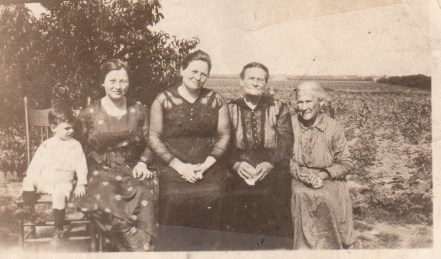
My Grandmothers
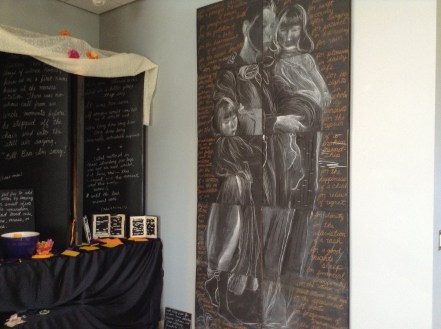
UA Poetry Center
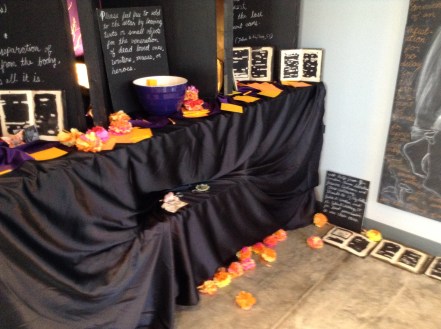
altar to honor the dead

art in chalk
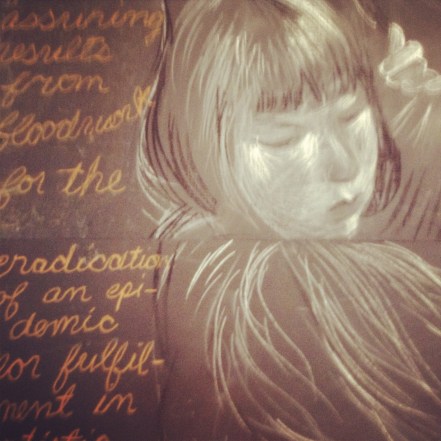
images and words
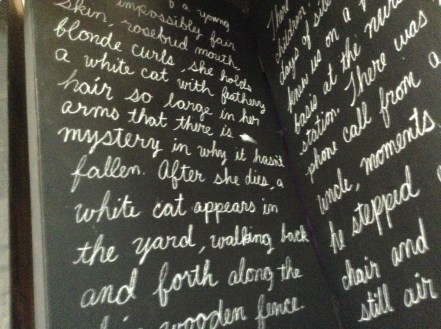
poem in chalk
I went to the U of A Poetry Center to leave an offering I made for my mom at the altar. While I was there I found my paternal ancestor’s book of poems and read for a while. Mistress Bradstreet had a style that showed her knowledge of history, astrology, and nature. She offered meditations to her son to guide him in the future when she was no longer alive. I truly had to wonder if she had ever thought her 9th great granddaughter might read her work and try to imagine her living presence. Knowing facts about the lives of my ancestors is fun, but the creative writing of my grandmother is more personal. I wrote an ode to all of the people who survived in order for me to exist today.
Ancestry Garden
Rows of ancestors spread out in the garden of research
Roots reveal; Some conceal, the same deal
What do they leave for us?
What do we keep as our own?
They still offer, they still have wisdom
Connected by birth/death/recognition.
They tell us the secrets of mortality.

My 9th great-grandmother was a published poet. She was born in England and died in Massachusetts. Much is known about her because of her famous father and husband, but for a Pilgrim she was a feminist. Her poems were about cosmology and the elements. She was an intellectual in her own right. This is a good account from http://www.famouspoetsandpoems.com:
Anne Bradstreet
Anne Bradstreet was born in 1612 to a nonconformist former soldier of Queen Elizabeth, Thomas Dudley, who managed the affairs of the Earl of Lincoln. In 1630 he sailed with his family for America with the Massachusetts Bay Company. Also sailing was his associate and son-in-law, Simon Bradstreet. At 25, he had married Anne Dudley, 16, his childhood sweetheart. Anne had been well tutored in literature and history in Greek, Latin, French, Hebrew, as well as English.The voyage on the “Arbella” with John Winthrop took three months and was quite difficult, with several people dying from the experience. Life was rough and cold, quite a change from the beautiful estate with its well-stocked library where Anne spent many hours. As Anne tells her children in her memoirs, “I found a new world and new manners at which my heart rose [up in protest.]”a. However, she did decide to join the church at Boston. As White writes, “instead of looking outward and writing her observations on this unfamiliar scene with its rough and fearsome aspects, she let her homesick imagination turn inward, marshalled the images from her store of learning and dressed them in careful homespun garments.”Historically, Anne’s identity is primarily linked to her prominent father and husband, both governors of Massachusetts who left portraits and numerous records. Though she appreciated their love and protection, “any woman who sought to use her wit, charm, or intelligence in the community at large found herself ridiculed, banished, or executed by the Colony’s powerful group of male leaders.”Her domain was to be domestic, separated from the linked affairs of church and state, even “deriving her ideas of God from the contemplations of her husband’s excellencies,” according to one document.This situation was surely made painfully clear to her in the fate of her friend Anne Hutchinson, also intelligent, educated, of a prosperous family and deeply religious. The mother of 14 children and a dynamic speaker, Hutchinson held prayer meetings where women debated religious and ethical ideas. Her belief that the Holy Spirit dwells within a justified person and so is not based on the good works necessary for admission to the church was considered heretical; she was labelled a Jezebel and banished, eventually slain in an Indian attack in New York. No wonder Bradstreet was not anxious to publish her poetry and especially kept her more personal works private.Bradstreet wrote epitaphs for both her mother and father which not only show her love for them but shows them as models of male and female behavior in the Puritan culture.An Epitaph on my dear and ever honoured mother, Mrs. Dorothy Dudley, Who deceased December 27, 1643, and of her age, 61Here lies/ A worthy matron of unspotted life,/ A loving mother and obedient wife,/ A friendly neighbor, pitiful to poor,/ Whom oft she fed, and clothed with her store;/ To servants wisely aweful, but yet kind,/ And as they did, so they reward did find:/ A true instructor of her family,/ The which she ordered with dexterity,/ The public meetings ever did frequent,/ And in her closest constant hours she spent;/ Religious in all her words and ways,/ Preparing still for death, till end of days:/ Of all her children, children lived to see,/ Then dying, left a blessed memory.Compare this with the epitaph she wrote for her father:Within this tomb a patriot lies/ That was both pious, just and wise,/ To truth a shield, to right a wall,/ To sectaries a whip and maul,/ A magazine of history,/ A prizer of good company/ In manners pleasant and severe/ The good him loved, the bad did fear,/ And when his time with years was spent/ In some rejoiced, more did lament./ 1653, age 77There is little evidence about Anne’s life in Massachusetts beyond that given in her poetry–no portrait, no grave marker (though there is a house in Ipswich, MA). She and her family moved several times, always to more remote frontier areas where Simon could accumulate more property and political power. They would have been quite vulnerable to Indian attack there; families of powerful Puritans were often singled out for kidnapping and ransom. Her poems tell us that she loved her husband deeply and missed him greatly when he left frequently on colony business to England and other settlements (he was a competent administrator and eventually governor). However, her feelings about him, as well as about her Puritan faith and her position as a woman in the Puritan community, seem complex and perhaps mixed. They had 8 children within about 10 years, all of whom survived childhood. She was frequently ill and anticipated dying, especially in childbirth, but she lived to be 60 years old.Anne seems to have written poetry primarily for herself, her family, and her friends, many of whom were very well educated. Her early, more imitative poetry, taken to England by her brother-in-law (possibly without her permission), appeared as The Tenth Muse Lately Sprung Up in America in 1650 when she was 38 and sold well in England. Her later works, not published in her lifetime although shared with friends and family, were more private and personal–and far more original– than those published in The Tenth Muse. Her love poetry, of course, falls in this group which in style and subject matter was unique for her time, strikingly different from the poetry written by male contemporaries, even those in Massachusetts such as Edward Taylor and Michael Wigglesworth.Although she may have seemed to some a strange aberration of womanhood at the time, she evidently took herself very seriously as an intellectual and a poet. She read widely in history, science, and literature, especially the works of Guillame du Bartas, studying her craft and gradually developing a confident poetic voice. Her “apologies” were very likely more a ironic than sincere, responding to those Puritans who felt women should be silent, modest, living in the private rather than the public sphere. She could be humorous with her “feminist” views, as in a poem on Queen Elizabeth I:Now say, have women worth, or have they noneOr had they some, but with our Queen is’t gone?Nay, masculines, you have taxed us long;But she, though dead, will vindicate our wrong.Let such as say our sex is void of reason,Know ’tis a slander now, but once was treason.One must remember that she was a Puritan, although she often doubted, questioning the power of the male hierarchy, even questioning God (or the harsh Puritan concept of a judgmental God). Her love of nature and the physical world, as well as the spiritual, often caused creative conflict in her poetry. Though she finds great hope in the future promises of religion, she also finds great pleasures in the realities of the present, especially of her family, her home and nature (though she realized that perhaps she should not, according to the Puritan perspective).Although few other American women were to publish poetry for the next 200 years, her poetry was generally ignored until “rediscovered” by feminists in the 20th century. These critics have found many significant artistic qualities in her work.
Anne Dudley (1612 – 1672)
is my 9th great grandmother
John Bradstreet (1652 – 1718)
son of Anne Dudley
Mercy Bradstreet (1689 – 1725)
daughter of John Bradstreet
Caleb Hazen (1720 – 1777)
son of Mercy Bradstreet
Mercy Hazen (1747 – 1819)
daughter of Caleb Hazen
Martha Mead (1784 – 1860)
daughter of Mercy Hazen
Abner Morse (1808 – 1838)
son of Martha Mead
Daniel Rowland Morse (1838 – 1910)
son of Abner Morse
Jason A Morse (1862 – 1932)
son of Daniel Rowland Morse
Ernest Abner Morse (1890 – 1965)
son of Jason A Morse
Richard Arden Morse (1920 – 2004)
son of Ernest Abner Morse
Pamela Morse
I am the daughter of Richard Arden Morse
Here is an example her work:
Part of the poem “Contemplations” said to be the finest of Anne Dudley Bradstreet’s poems:
“Sometimes now past in the autumnal tide,
When Phoebus wanted but hour to bed,
The trees all richly clad, yet void of pride,
Were gilded O’er by his rich golden head.
Their leaves and fruits seemed painted, but was true
of green, of red, of yellow, mixed hue,
Rapt were my senses at this delectable view
I wist not what to wish, yet sure, thought I
If so much excellence abide below,
How excellent is He that dwells on high,
Whose power and beauty by His works we know,
Sure He is goodness, wisdom, glory, light,
That hath this underworld so rightly sight,
More Heaven than Earth was her, no winter & no night.”
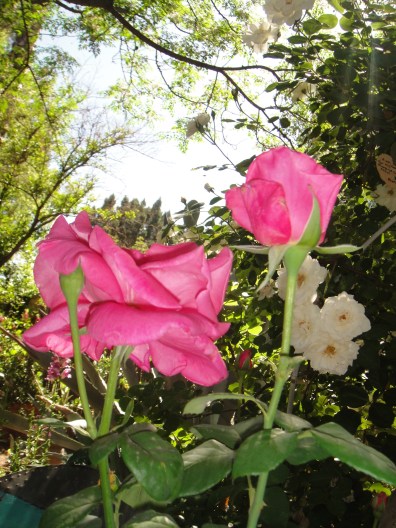
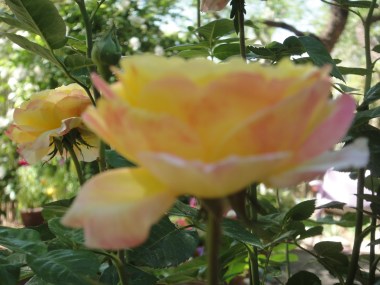
roses

roses
Today is National Haiku Poetry Day.
Daylight springs
Scent travels fast
Morning blast
If you have not written poetry this may be the day it is easy to become a poet. Try your hand. You have nothing to loose. Nobody can make you publish it. Pay attention. Be amazed. Tell the story.

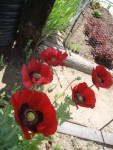
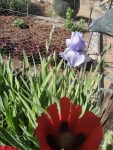

Taste with your eyes, smell with your feet.
Take in the story with all our might
While there is color, while there is light.
Dreamtime reorders sensuality
In living color.
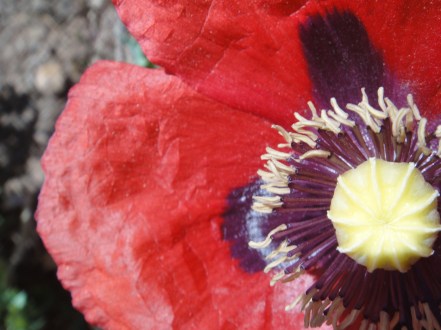
poppy

bee on orange blossom

white orchid spray
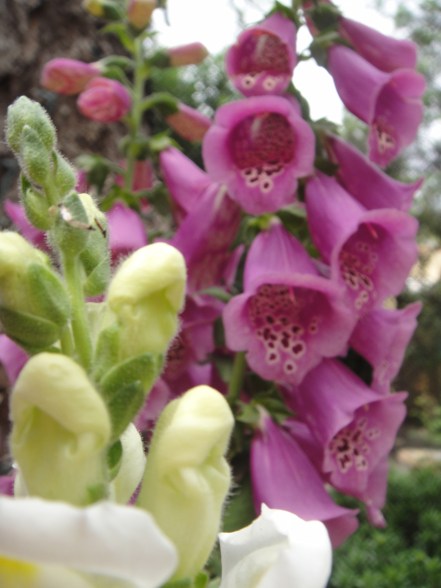
foxglove snapdragon

orchids
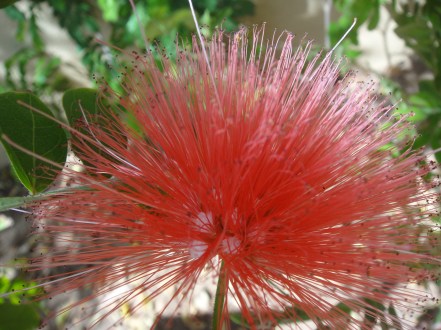
fairy duster
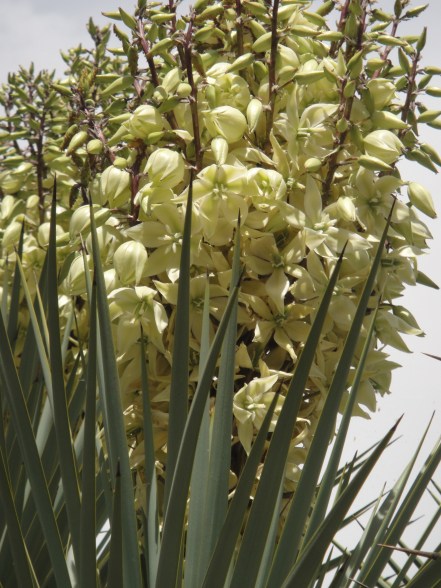
Yucca

rose Virgin of Guadalupe

rosebud
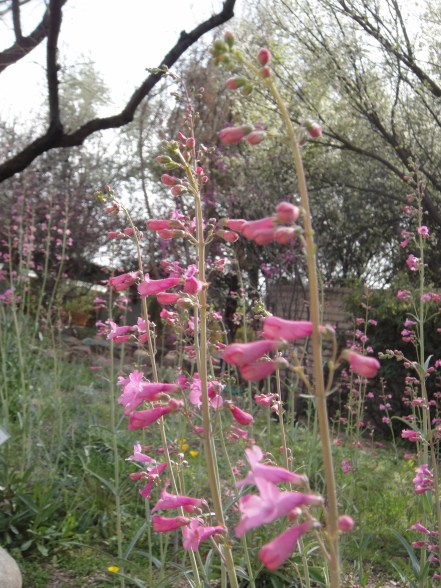
penstemon
Life blooms before our eyes daily.
The colors saturate the background of our set.
Our bodies also color the landscape, and change it.
We paint our story in a range of colors we have learned from nature.
Flowers speak volumes, directly to our emotions.
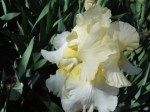
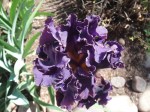


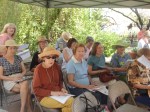

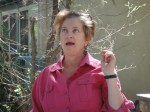

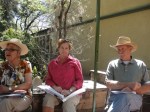

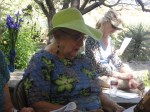
New this year at the Tucson Botanical Gardens is a collaboration with the U of A Poetry Center, bringing poetry to the gardens. I attended the class next to the iris garden yesterday and was surprised at the depth and education they packed into the experience. We learned about the Poetry Center’s history and the very good luck we have to live in a city with a center such as this. We learned about the botanical gardens and the history and meaning of the iris plant. An enthusiastic docent from the Tucson Botanical Gardens opened the readings with a poem of her own about iris and the field of everyday glory we can find in nature. We then read together a selection of poems, all in some way referring to the iris. Our favorite reader was dressed like an iris and has a British accent that enhanced her interpretation. It was an exceptional experience on all levels for me. I enjoyed the crowd, and had time after the class to get some technical growing advise from the lady who represented the Iris Society. Poetry and gardens do go together very well. Next month the group will meet by the cactus garden….a thorny subject. I am encouraged to use my poetic voice more often, and listen for stunning stories to tell.
Any unexpected twist that makes a story intriguing demands our attention. We expect certain things to happen in context, so when they do not we begin to wonder about the nature of things. The term poetic justice was coined between 1720-1730. Much drama and some poetry contains this magical distribution of perfect reward and retribution in exactly the right proportion to all parties. Rarely do we see this in action in real life. It is more common to witness social, political, or just plain crazy injustice.
We can write stories and poems that highlight our own particular brand of justice. Simply focus and spotlight on causes like nature, environmental awareness, or animal cruelty can change hearts and minds. You can be a spokesperson for the things that matter to you. The impact you have may never be known to you, but that is not a good reason not to create and share your own version of poetic justice. If you bother to bring your message artfully and with grace you may hit the target you hoped to find in the gentle reader.
 mermaidcamp