mermaidcamp
Keeping current in wellness, in and out of the water
You can scroll the shelf using ← and → keys
You can scroll the shelf using ← and → keys
When I graduated from high school in Texas I went to work for the summer in an outdoor drama called “Unto These Hills” produced in Cherokee, North Carolina. I was a singer in the chorus and a costumer. It was my first job, and I enjoyed it very much. I was 17 years old, the youngest and the lowest paid member of the company. I learned about the history of the Cherokee people, since the play was all about that. I can still sing the eagle dance in Cherokee language, if required (but usually when it is neither required nor requested). I spent a lot of time and money chasing clues about my father’s Cherokee heritage, which has no legs. My grandfather lived on the Cherokee res in Oklahoma in 1900, but our ancestors on my father’s side did not marry Native Americans. Now I am discovering that my mother’s side descends from the east coast Cherokee people, before the trail of tears forced them to Oklahoma Indian Territory. I was born in Tulsa. People tell me I look like a Native American–just as many tell me I look like a Russian. I always liked the idea of Native ancestors. Now, thanks to DNA clues I received from ancestry.com about common lineage, I am happy to say I found some.
This Englishman who sailed to Jamestown and married my eleventh great-grandmother was trained to be a water witch!!!! His progeny inherited the skill to find water. I LOVE that. I think it is wonderfully ironic that his grave is a few miles from the place I worked when I was 17. I can also recite the 23rd psalm in Cherokee, which now seems perfectly apt. It pays to study your ancestors.
Thomas Pasmere “Corn Planter” Carpenter (1607 – 1675)
12th great-grandfather
Trader Tom Amatoya Carpenter Moytoy (1635 – 1693)
son of Thomas Pasmere “Corn Planter” Carpenter
Aganonitsi Quatsy Woman Wolf ClanTellico Cherokee Tellico (1650 – 1692)
daughter of Trader Tom Amatoya Carpenter Moytoy
Delaware Indian Fivekiller (1674 – 1741)
son of Aganonitsi Quatsy Woman Wolf ClanTellico Cherokee Tellico
Solomon John Cherokee Kimborough (1665 – 1720)
son of Delaware Indian Fivekiller
Mourning Kimbrough (1689 – 1756)
daughter of Solomon John Cherokee Kimborough
Jane Jeanette Little (1713 – 1764)
daughter of Mourning Kimbrough
Andrew Armour (1740 – 1801)
son of Jane Jeanette Little
William Armor (1775 – 1852)
son of Andrew Armour
William Armer (1790 – 1837)
son of William Armor
Thomas Armer (1825 – 1900)
son of William Armer
Lucinda Jane Armer (1847 – 1939)
daughter of Thomas Armer
George Harvey Taylor (1884 – 1941)
son of Lucinda Jane Armer
Ruby Lee Taylor (1922 – 2008)
daughter of George Harvey Taylor
Pamela Morse
I am the daughter of Ruby Lee Taylor
Thomas Pasmere Carpenter was descended from the noble Anglo-Norman family of Vicomte Guillaume de Melun le Carpentier. Thus, Moytoy’s European lineage can be traced to the Frankish Duke Ansegisel of Metz Meroving, Peppin II, and Charles Martel. This ancestry also makes the Cherokee Moytoys cousins to the Carpenter Earl of Tyrconnell, and thus related to the current British royal family.
The Carpenter family of Devonshire & Plymouth England were small sailing ship owners, many of which were leased out to the East India Trading Company, an affiliation dating to the formation of that company December 31, 1600. Documented ownership of fifteen different ships owned by the Carpenter family, those of which were involved with moving furs between the Gulf Ports & Glasgow, or Dublin, and trade goods for North America. These ships usually made stops both directions at Barbados where the family had banking connections set up. These ships were small and fast, often able to make the crossing from Scotland and Ireland in less than thirty days. They were shallow draft ships, capable of handling shallow water ports with ease. The first documented trip made by Thomas Pasmere Carpenter occurred April 1640, sailing from Maryland to Barbados aboard the Hopewell, and returning on the Crispian in September 1640. He made another trip in March 1659 departing Charleston South Carolina aboard the Barbados Merchant, returning on the Concord in August 1659.
Twenty year old Thomas Pasmere Carpenter came to Jamestown, Virginia from England in 1627, living in a cave near the Shawnee. Thomas was called “Cornplanter” by the Shawnee, derived from their sign language that matched as near as possible to the work of a carpenter. He married a Shawnee woman named “Pride” and bore a son around 1635 named Trader Carpenter.
Trader was taught to “witch” for water with a willow stick by the Shawnee. He married a Shawnee named Locha in 1658 and the clan grew quickly. In 1660, they were driven south by the Iroquois. They moved along the Tennessee River, starting the villages of Running Water (where Thomas died in 1675), Nickajack, Lookout Mountain, Crowtown and Chota. He was Chief of Chota, which was created as a merging place of refuge for people of all tribes, history or color. It became similar to a capital for the Cherokee nation. These villages grew to about 2000 people by 1670 when the Carpenter clan moved to Talikwa (Great Tellico) where the Tellico River emerges from the Appalachian Mountains. Here Trader married a Cherokee, Quatsy of the Wolf Clan in 1680. He had become so adept at water witching that the Cherokee called him “water conjurer” or Ama Matai (Ama is Cherokee for water). Ama Matai eventually became pronounced as Amatoya. It was later shortened to “Moytoy”, so he is known as Moytoy I.
In 1730, his son, Trader-Tom (Moytoy II) took over as Chief, receiving what was described as the “Crown of Tannassy”. Tanasi was where the previous Chief resided and the traditional headdress was passed on to him. The fur trading Carpenter family owned many ships. Though he served as Cherokee Chief, Thomas made several trips to Barbados over the years where the Carpenters did banking, and even to Scotland and Ireland. On occasion he took Trader, and Trader Tom with him. They traded furs and healing herbs brought from America.
Cherokee traded furs for cloth. The cloth was not only used for clothing, but also to pay the Shamans for treatment. Though the medicine men did not charge for medical practice, they required a form of payment for performing love charms, hunting ceremonials, and other conjures. Beads were used in many instances, which the patient was required not only to furnish the beads, but also a certain quantity of new cloth upon which to place them. At the close of the ceremony the medicine man would roll up the cloth, beads and all, and take it with him. Custom required that he not use the cloth, but had to be sold. The practice was sometimes repeated over a period of days, each time requiring new cloth. Some Shamans would sell the required cloth to the patient himself, then take the used cloth with him.
The Cherokee, Shawnee and other Shamans (medicine men) traded secrets when they met. These were passed on orally before the Sequoya method of writing was developed. According to archeologist James Mooney “It was the practice when one shaman met another whom he thought might give him some valuable information, would say to him, “Let us sit down together.” This was understood by the other to mean, “Let us tell each other our secrets.” It was necessary to cultivate a long memory, as none were repeated more than once for his benefit. It was considered that one who failed to remember after the first hearing was not worthy to be accounted a shaman.”[1] When illness struck the white settlers and traditional methods of healing failed, they sometimes turned to friendly Cherokee nearby. This also provided the medicine men with new opportunities to obtain cloth and other goods from them in return. These methods were soon incorporated into the beliefs the settlers brought with them from Europe.
The Cherokee believed in at least two types of witches. The “Night Goer” or “sûnnâ’yï edâ’hï “ came at night to bring to the home. Alternatively, what might be called a good witch, “u’ya igawa’stï “ saturated the medicine given by the medicine man and by counteracting the spell, killed the Night Goer.[2] The settlers absorbed these ideas into their lives to the point that even milk that soured could be caused by the “evil eye” or the look of a witch. Soured milk came to be called “blinked milk”.
The settlers combined elements of their own witchcraft traditions with those of the native Cherokee. Some witches in this tradition specialized in dowsing, or healing and midwifery.
The isolation of mountain communities protected the traditions of Appalachian Granny Magic from alteration or persecution from outside. The people of the Appalachians lived a farming life that changed little from the 1700s to the 1900s, and their close connection to the earth kept Appalachian Granny Magic relevant throughout this time.
Beliefs and Traditions
The Scottish and Irish settlers believed that their fairy folk and leprechauns followed them to the new country. In addition, the Cherokee had little neighbors of their own who were called “Yunwi Tsunsdi,” meaning “The Little People.” The Appalachian Mountain Witches give offerings to the wee people daily. A granny woman will make offerings by leaving a bowl of cream at the back door. She will throw a bit of cornbread cake out of her window before serving the rest to her family. The Appalachian Witches also believe in spirits of the dead and seek out the guidance of ancestral spirits. One type of ancestral spirit that is feared are the angry “Haints”. One spell that protects a home against haints requires that its doors be painted Haint Blue, which is a baby blue color with a slight tint of periwinkle.
Many of the older Granny Magic spells are sung and danced; clogging is one of the forms of dance. Appalachian spells are also known to have chants, gigs, and lullabies. During Samhain and funerals the song “Auld Lang Syne” is sung. It is also sung during the secular new year.
Divination is popular with Granny Witches. Appalachian Granny Witches read tea leaves, tarot cards and regular playing cards, and clouds. They will also use bowls of dirt, sand, or water for scrying. Rods made from dogwood or other types of flowering tree such as an apple or peach tree are used for water dowsing, and metal rods are used for energy dowsing. A cauldron is usually preferred over a chalice by an Appalachian Witch. A cauldron displayed in a granny witch’s front yard lets people know that her services are available. Brooms, pottery, candles, mirrors and baskets, all made by hand in the home, are other tools used in this tradition. Appalachian witches have usually considered ritual clothing to be impractical, but some modern Appalachian Witches have begun to use ritual clothing in order to preserve their way of life and religion for future Appalachian Granny Witches.
^ Sacred Forumulas of the Cherokee Shamans by James Mooney. Cherokee Heritage Documentation Center (2008). Retrieved on 2008-06-22.
^ Sacred Formulas of the Cherokees by James Mooney. Cherokee Heritage Documentation Center (2008). Retrieved on 2008-06-22.
Retrieved from “http://en.wikipedia.org/wiki/Appalachian_Granny_Magic”
Cleopatra married Opechancanough who was her father’s adopted brother and her adopted uncle
Matachanna traveled to England to be with her half-sister, Pocohontas, before she died. Matachanna went back to Virginia where she lived and died.
Cleopatra Powhatan the Shawano was born in 1590, near Jamestown colony, and died in 1680
Cleopatra Powhatan was half sister of Pocahontas
Going back to the era of John Smith . . . In the late 1500s/early 1600s a Powatan chief name Wahunsunacock [one of numerous variant spellings] had united some 30 Alonquian tribes into a powerful confederation. He had created the empire through conquest and alliances. He actually ruled as an emperor, not just a tribal chief. When the Jamestown colonists arrived, Wahunsunacock’s domain encompassed the entire region that was to become Virginia. Wahunsunacock did not use a title other than chief of the Powhatans. The colonists referred to him as simply “The Powhatan”, denoting his position as emperor over numerous tribal chiefs of the Powhatan nation. The Powhatan was not friendly toward the colonists, seeing them as encroachers.
Wahunsunacock’s younger brother, or half-brother, Opechanacanough, was the tribal chief who captured John Smith. He immediately took the captive Smith to Emperor Wahunsunacock who imposed the death sentence. Tradition holds that Wahunsunacock’s daughter Matoaka “LIttle Snow Feather”, nicknamed Pocahantas or “Playful One”, pleaded for her father to spare John Smith’s life. Pocahantas became an emissary between her father and the colonists and as such was instrumental in providing the food which saved them during the hard winter. The colonists, in turn, showed their appreciation by capturing and holding Pocahantas for ransom. After they had extracted the full ransom from Wahunsunacock, then they forged an alliance with him by marrying Pocahantas to John Wolfe, a planter in the Jamestown colony who is credited with introducing tobacco as a cash crop.
That much is familiar history. Then comes the chapter that is really relevant to our family. At the death of the elderly Wahunsunacock, his younger brother [it’s uncertain if he was a brother or a half-brother] Opchanacanough became successor to Wahunsunacock as emperor. As such, he is frequently also called The Powhatan. To distinguish between the two men I have chosen to use the technically accurate term “Emperor” for Wahunsunacock and “Chief” for Opechanacanough, since Opechanacanough was promoted from a “chief” to succeed Wahunsunacock who had forged the “empire”. In reading other histories, however, it is necessary to note that some writers use the term Powhatan for both brothers interchangeably which is unnecessarily confusing and actually incorrect. Sometimes I get the impression that some genealogy researchers do not grasp that they are two different men.
Emperor Wahunsunacock perhaps had hundreds of wives and children. Several of them are noted in historical documents, but none so well as Pocahantas and, to our benefit, her sister Cleopatra. Not only was Cleopatra a daughter of the Emperor, she was wife to the successor Chief/Emperor Opechanacanough. Now if you were paying attention and recall that Opehanacanough and Wahusunacock were brothers/half-brothers, you might realize that she was also Opechanacanough’s niece [or half-niece as the case may be]. They were a royal dynasty and keep in mind that the family lineage was preserved by most Native Americans, as they still do now, through the matriarchal line.
The relationship of Cleopatra and Pocahantas as full sisters is fully documented. After the death of Pocahantas, Pcahantas’ son had to apply for rights to get to visit his Indian relatives and in his written legal request specifically asks to visit his “mother’s sister Cleopatra” by name. Cleopatra obviously was not her Indian name, but rather what she was called by the colonists because since her husband was the successor ruling Chief/Emperor she was in fact Queen. The title seemed especially apropos to the colonists since not only was she Queen, but her exotic dark looks and elaborate trappings also seemed very regal, and reminiscent of the Egyptian queen.
Only I and probably 30 million other people descend from this royal hierarchy. While everyone is eager to prove their ancestry to Pocahantas because of her fame, Cleopatra was the only one to ascend to actual Queen. Pocahantas, for all her fame, was a mere Princess. The modern day Native American line of this family adapted the surname Powhatan from very early times.
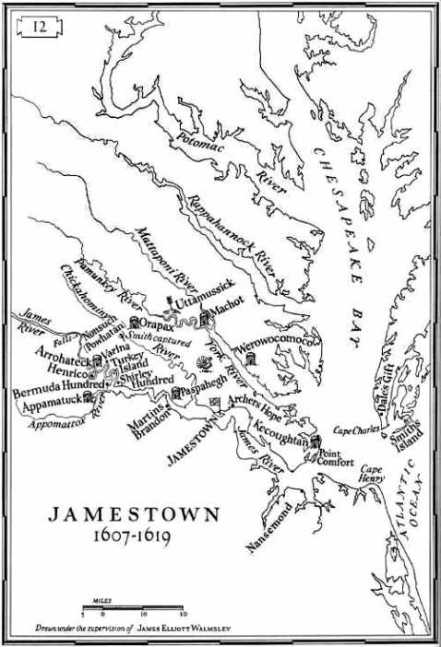
Jamestown

Constant Southworth in the Colony
Constant Southworth was born circa 1614 at Leyden, So. Holland, Netherlands. He married Elizabeth Collier, daughter of William Collier and Jane Clarke, on 2-Nov-1637 at Duxbury, Plymouth County, Massachusetts. Constant Southworth died on 10-Mar-1678/79 at Duxbury, Plymouth County, Massachusetts.
Constant Southworth, the son of Edward and Alice (Carpenter) Southworth, was probably born at Leiden ca. 1614-16, for his parents married there 28 May 1613 (Leiden Records, as in MD 10:2). The same records show that Edward Southworth had a brother Thomas then living in Leiden. Edward Southworth died, and his widow Alice came to Plymouth and married Gov. William Bradford on 14 August 1623.
Constant came to Plymouth in 1628, probably on the White Angel, and a contemporary account shows that the Plymouth Company paid twenty shillings for his passage and four shillings, eight pence per week for eleven weeks for his food (MHS Collections, 3rd Series, 1:199). It is assumed that he, and his brother Thomas, who must have come over later, lived with their mother and step-father, Governor Bradford. The Southworth family was apparently of gentle birth, but claims that Edward Southworth was identical with the Edward Southworth, son of Thomas and Rosamond (Lister) Southworth, or Samlesbury Hall, Lancashire, are not adequately supported. Constant Southworth married Elizabeth Coller daughter of William Collier (PCR 1:68). In his will, dated 27 February 1678/79, inventory 15 March 1678/79, he named his wife Elizabeth, son Edward; son Nathaniel; son William; daughter Mercy Freeman; daughter Alice Church, daughter Mary Alden daughter Elizabeth Southworth provided she did not marry William Fobes; daughter Priscilla Southworth; grandson Constant cousin Elizabeth Howland; and his brother Thomas. Constant held many important posts, including treasure, and ensign in the Duxbury military company.
Constant Southworth (1615 – 1679)
10th great-grandfather
Alice Southworth (1645 – 1719)
daughter of Constant Southworth
Elizabeth Church (1665 – 1691)
daughter of Alice Southworth
William Little Jr (1685 – 1756)
son of Elizabeth Church
Jane Jeanette Little (1713 – 1764)
daughter of William Little Jr
Andrew Armour (1740 – 1801)
son of Jane Jeanette Little
William Armor (1775 – 1852)
son of Andrew Armour
William Armer (1790 – 1837)
son of William Armor
Thomas Armer (1825 – 1900)
son of William Armer
Lucinda Jane Armer (1847 – 1939)
daughter of Thomas Armer
George Harvey Taylor (1884 – 1941)
son of Lucinda Jane Armer
Ruby Lee Taylor (1922 – 2008)
daughter of George Harvey Taylor
Pamela Morse
I am the daughter of Ruby Lee Taylor
Constant Southworth was born about 1614, based on his date of marriage. He died on March 11, 1678/9, in Duxbury. His ship was possibly White Angel, 1628
He lived in Holland. Constant Southworth was the son of Edward and Alice (Carpenter) Southworth, married in Leiden on May 28, 1613. His father was a say worker [weaver] there.
The family attempted to emigrate to New England in 1620, but apparently abandoned the voyage at London. In August 1620, Robert Cushman wrote a letter to Edward Southworth, the father, addressing it to Heneage House in London. It is unclear whether Edward Southworth died there or returned to Leiden.
Alice Southworth, the mother, emigrated to Plymouth Colony in 1623, leaving her two sons behind, either in England or Leiden. She probably left them with their Aunt Julia, the aunt who brought them both over in 1628. Alice Southworth married Governor William Bradford as his second wife that same year, soon after arriving.
Constant came to Plymouth in 1628, where he was admitted a freeman on January 1, 1637/8.
Constant Southworth married Elizabeth Collier on November 2, 1637, in Plymouth and had eight children. She died after February 20, 1678/9.
Constant’s brother, Thomas, is my paternal 10th great-grandfather. Their mother, Alice Carpenter, came to Plymouth a widow and married Governor Bradford in the first year after arrival.
Thomas Southworth (1617 – 1669)
10th great-grandfather
Elizabeth Southworth (1645 – 1716)
daughter of Thomas Southworth
Elizabeth Howland (1673 – 1724)
daughter of Elizabeth Southworth
Eleazer Hamblin (1699 – 1771)
son of Elizabeth Howland
Sarah Hamblin (1721 – 1814)
daughter of Eleazer Hamblin
Mercy Hazen (1747 – 1819)
daughter of Sarah Hamblin
Martha Mead (1784 – 1860)
daughter of Mercy Hazen
Abner Morse (1808 – 1838)
son of Martha Mead
Daniel Rowland Morse (1838 – 1910)
son of Abner Morse
Jason A Morse (1862 – 1932)
son of Daniel Rowland Morse
Ernest Abner Morse (1890 – 1965)
son of Jason A Morse
Richard Arden Morse (1920 – 2004)
son of Ernest Abner Morse
Pamela Morse
I am the daughter of Richard Arden Morse
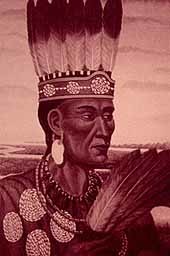 Powhatan 1545-1618
I recently received an advisory of a DNA match from my ancestry.com account that has brought me to a very exciting destination. This very famous Native American, the very same one we learned about in grade school, is my ancestor. I am excited, but want to verify all my results with more evidence. The DNA was from the Little family, and they brought me the information about all these Native American ancestors. I have not had a DNA test that has found any Native DNA. These results area combination of DNA, and record keeping (which can be faulty and has brought me to felonious conclusions in the past). I hope I can conclusively prove all the data, but in the meantime I am excited! It looks like my mother is descended from Pocahantas’ sister, Cleopatra.
Powhatan (born June 17, 1545; died April 1618), whose proper name was Wahunsenacawh (alternately spelled Wahunsenacah, Wahunsunacock or Wahunsonacock), was the paramount chief of Tsenacommacah, an alliance of Algonquian-speaking Virginia Indians in the Tidewater region of Virginia at the time English settlers landed at Jamestown in 1607.
Powhatan, alternately called “King” or “Chief” Powahatan by the English, led the main political and military power facing the early colonists, was probably the older brother of Opechancanough, who led attacks against the English in 1622 and 1644. He was the father of Pocahontas, who eventually converted to Christianity and married the English settler John Rolfe.
Captain John Smith described Powhatan as “…a tall well proportioned man… his head some what grey…. His age near 60; of a very able and hardy body to endure any labour. What he commandeth they dare not disobey in the least thing.”
 Powhatan’s Cloak in a museum at Oxford
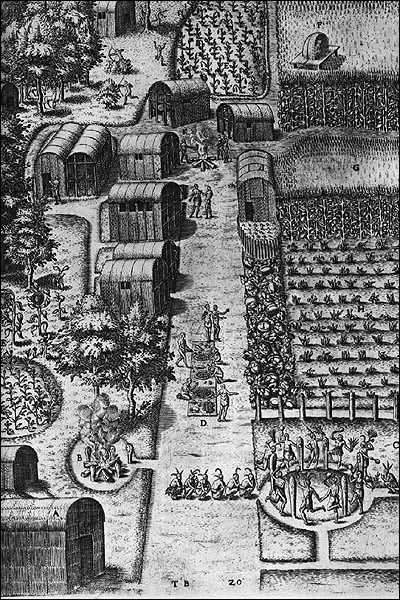 Powhatan Village called Towne of Secoton
Powhatan. The ruling chief and practically the founder of the Powhatan confederacy (q. v.) in Virginia at the period of the first English settlement. His proper name was Wahunsonacock, but he was commonly known as Powhatan from one of his- favorite residences at the falls of James r. (Richmond). According to Smith, of some 30 cognate tribes subject to his rule in 1607, all but six were his own conquests. At the time of the coming of the English, Powhatan is represented to have been about 60 years of age, of dignified bearing, and reserved and stern disposition. His first attitude toward the whites was friendly although suspicious, but he soon became embittered by the exactions of the newcomers. On the treacherous seizure of his favorite daughter, Pocahontas (q. v.), in 1613, he became openly hostile, but was happily converted for the time through her marriage to Rolfe. He died in 1618, leaving the succession to his brother, Opitchapan, who however was soon superseded by a younger brother, the noted Opechancanough.
Chief Wahunsonacock Powhatan (1547 – 1618)
14th great-grandfather
Princess Cleopatra Shawano Powhatan (1590 – 1680)
daughter of Chief Wahunsonacock Powhatan
Pride Chalakahatha Elizabeth (Cornstalk) Shawnee (1615 – 1679)
daughter of Princess Cleopatra Shawano Powhatan
Trader Tom Amatoya Carpenter Moytoy (1635 – 1693)
son of Pride Chalakahatha Elizabeth (Cornstalk) Shawnee
Quasty Woman (1650 – 1692)
daughter of Trader Tom Amatoya Carpenter Moytoy
Delaware Indian Fivekiller (1674 – 1741)
son of Quasty Woman
SOLOMON JOHN CHEROKEE KIMBOROUGH (1665 – 1720)
son of Delaware Indian Fivekiller
Mourning Kimbrough (1689 – 1756)
daughter of SOLOMON JOHN CHEROKEE KIMBOROUGH
Jane Jeanette Little (1713 – 1764)
daughter of Mourning Kimbrough
Andrew Armour (1740 – 1801)
son of Jane Jeanette Little
William Armor (1775 – 1852)
son of Andrew Armour
William Armer (1790 – 1837)
son of William Armor
Thomas Armer (1825 – 1900)
son of William Armer
Lucinda Jane Armer (1847 – 1939)
daughter of Thomas Armer
George Harvey Taylor (1884 – 1941)
son of Lucinda Jane Armer
Ruby Lee Taylor (1922 – 2008)
daughter of George Harvey Taylor
Pamela Morse
I am the daughter of Ruby Lee Taylor
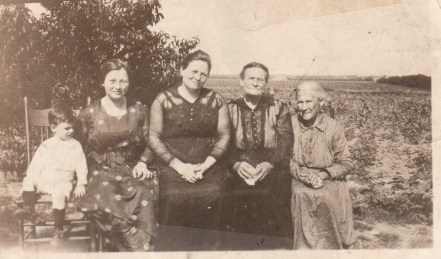
The grandmothers
What do you think you learned studying our family history?
Have you reached conclusions about the nature of human existence?
I believe the most pertinent thing I have learned is about delusion
We stay in deep canyons of ignorance in groups habitually
Are you saying we are all ignorant, or that you are so enlightened?
Not at all, dear ancestors, for my own generation I am frightened
Have you seen how the people are destroying Mother Earth?
You should know that this battle began in earlier centuries
That you choose what role you play by the company you keep
All your relations continue to speak directly to your soul’s mysteries

napo2018button
This is day 2 of National Poetry Writing Month. Join the fun all over the internet by following the hashtag #NaPoWriMo2018. Meet poets from around the world and submit your own work here. Let yourself bust a rhyme. Now is the time!!
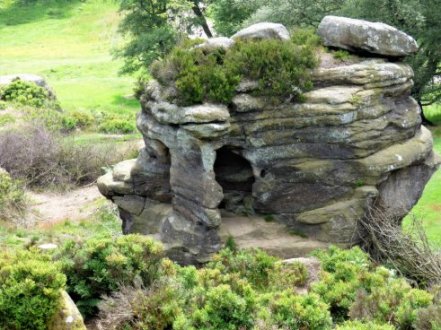
hideout
When they lived along the river the whole family used to hike up to the rock hideout a few times every year for a party, a picnic, and some music. Families wandered more in those times. They met folks from other towns, learned new songs from them, and exchanged some goods. The den in the rocks was used for festive purposes before the flood. They never had to worry about thieves or tricksters in those days. Life was simple. There was plenty for everyone. They had not known tragedy or loss. Then one day a wall of water rushed down the valley, washing away everything on both sides of the river for miles.
When the water finally subsided and they surveyed the damage it was decided that moving to higher ground was practical. If they were to rebuild and start anew, they wanted to be sure they could not be wiped out so suddenly by the whims of the river. They looked for signs. They decided to make their new headquarters in the old hideout. It had some sentimental value to them, and they were emotionally fragile. The loss of their home and possessions took a heavy toll.
They used the cave as a shelter, a watchtower, and a place to store their belongings while they built new lives. The significance of the place to the family became legend. When we come up here now we like to tell stories about the time when our ancestors camped in this place in order to survive.
#writephoto
This piece is a response to the photo prompt on Sue Vincent’s Echo this week. Every week she posts a new photo to inspire poetry or prose, long or short. Join us for a wide variety of responses every Thursday. The fun is in seeing all the ways people write about the same image.
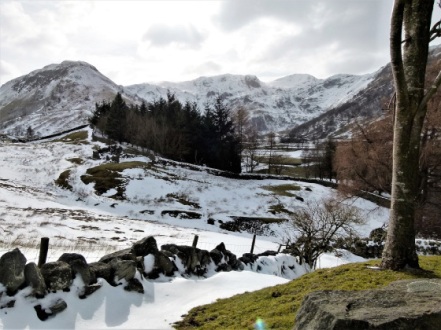
thaw
Crimson mittens kept our fingers warm as we marched up the hill in the forrest. Our lunch was still heavy in our systems while we trudged through the snow on the icy path looking for firewood. The night before we had slept at our grandparents’ cabin, full of memories, old books, letters, and games. We sifted through the boxes of photos, finding some that had been taken of our childhood visits. Those black and white images of our grandparents before their hair turned white flooded us with sentimentality.
We sat next to the fireplace telling stories and laughing about our youth until we had consumed all the dry wood. Watching the embers die and darkness descend was like witnessing the energy drained from those gentle ancestors who left us this cabin. They spent their lives in remote isolation, content with nature’s schedule. The grandchildren came for a month every summer, but returned to the city for the rest of the year. Now that they were gone we came out on winter holiday to take care of the place and decide what to do with it. It was the first time we had seen the place in winter. It was the only time we had been there without our grandparents.
We found a few pieces of dry wood tucked into a cranny in the rocks. We carried enough back to the house to make one more fire. This time the stories turned solemn, and spirits joined together in a mutual sadness and loss. We had busy lives, rarely stopping to reflect. None of us gathered our own firewood or even cleaned our own houses in the city. Our family was warmed in the glow of the fire, and let go of the daily grind. We recognized the loss of our grandparents was also the loss of a way of life none of us had embraced. The cabin contained traditions and memories that were melting like the snow, dissolving into the earth. This year the thaw will wash away most of our family’s connection to this place. It is possible to gain a fortune and lose it again many times. Once time is gone, it will never return.
#writephoto
Please join Sue Vincent each Thursday for a photo prompt on her Echo. Read, comment, or write your own story, poem, or essay here. The responses are many and varied.

Spotswood Headrights
My seventh great-grandfather came to Virginia in 1717 with a group of Lutheran immigrants. Their unscrupulous ship captain not only landed at the wrong port, but sold them into indentured servitude. Captain Andrew Tarbett had spent the passage given him by the Germans, then took them to Virginia rather than their promised destination, Pennsylvania. He sold them to Lt.Governor Alexander Spotswood.
Lieutenant Governor Alexander Spotswood’s lawsuits against his indentured servants. From 1723 through 1726, Spotswood claimed that several Germans had failed to carry out the terms of their “contract” with him. My ancestor was sued in 1924. He proved his importation in 1926 with his wife on the ship Scott. He patented land on June 24, 1926.
These emigrants left their villages in southern Germany (Baden and Württemberg) about 12 Jul 1717 enroute for Pennsylvania by way of London. Starvation took the lives of several of the passengers (probably 50 people perished, most of them children) who had been swindled by their captain who was retained in London. The ship held about 138 passengers and did not land in Pennsylvania but to Virginia where the passengers were sold as indentured servants to Governor Spotswood.
The base for this reconstructed list comes from:
Research by Zimmerman & Cerny has shown that several who were thought to have come to Virginia in 1719-1720 were actually more likely part of the 1717 group. The strongest evidence for this is the absence of any references to each of these families in Germany after 1716 and the fact that they would have left from others from the same town at that time.
Note: Hans is short for Johannes which is John in English
Below research provided courtesy of Tom Bowen:
“From “Before Germanna,” by Johni Cerni and Gary J. Zimmerman, No. 5,
January 1990, The Ancestry of the Sheible, Peck, Milker Smith and Holt Families:
“The Evangelical Lutheran minister [for Gemmingen, Baden] began a new set of parish registers in 1693, and the marriage entries of the Schmidt brothers are recorded therein:
married 21 January 1710 Hanns Michael Schmid, son of Michael Schmid, deceased, court official here, step-son of Alt [Old]
Hans Hecker, to Anna Margaretha, daughter of deceased Josoph Sauter, deceased courth official here.”
On 12 July 1717 the minister at Gemmingen listed in the parish death register the “parents, together with their children, [who] expect to move away from here, wanting to take ship to Pennsylvania, and there in the hardship of the wilderness better their piece of bread than they could here.” Included were:
Hans Michael Schmidt, age 28
wife Anna Margaretha, same age,
son Hans Michael, age 5 1/2
son Christopher, age 1/2
his in-laws.
Also listed was Matthäus Schmidt, age 25/30, wife Regina Catherina, same age, son Matthäus, age 3 1/2 and daughter Anna Margaretha, age 1/2.
They arrived in Virginia near Germanna in then Essex Co., now Culpeper Co., in late 1717 or early 1718 according to today’s calendar, being members of the so-called second Germanna Colony of 1717. The colony moved about 25 miles west to the Robinson River area of Spotsylvania Co. in 1725. This area became Orange Co. in 1734, Culpeper Co. in 1748, and Madison Co. in 1793.”
We have a copy of his will:
25 Feb. 1760, from Culpeper Co. Will Book A, p. 243:
In the name of God Amen, I John Michael Smith of the Parish of Brumfield in Culpeper County being old weak & helpless, but thanks be unto God of perfect Mind and Memory, & calling unto Mind the Mortality of my Body & knowing it is appointed for all men once to die, do make & ordain this my last will and Testament. That is to say principally & first of all I give & recommend my Soul into the Hands of Almighty God that gave it, & my Body I recommend to the Earth to be buried in decent Christian Burial nothing doubting that at the General Resurrection I shall receive the same again, by the mighty Power of God. and as touching such worldly Estate wherewith it hath pleased God to bless me in this Life, I do give demise & dispose of the same in the following manner & form, viz.
I do give bequeath & make over unto my dearly beloved only Son John Michael Smith Junior & his heirs forever all my Estate personal as well as real, that he may take the sole & full Possession of it, & all the Lands Goods & Chattels forever after my decease, reserving unto me only the Claim to my Estate as long as I live, & thereby I do revoke & disannull all Wills made before by me & I do acknowledge to be this my last Will & Testament never to be revoked
Signed Sealed & delivered Witness my Hand & Seal
in the presence of us
in the year of our Lord God Michael Schmid?
1760. 25th of February (signed in German)
Adam (AY) Jager,
Henry Ayler
At Court held for the County of Culpeper on Thursday the 19th day of February 1761 This last Will and Testament of John Michael Smith decd was exhibited to the Court by John Michael Smith his only son & heir and the Executor therein named and was proved by the oaths of Adam Yeager & Henry Aylor Witnesses thereto and ordered to be recorded and on the motion of the said Executor Certificate is granted him for obtaining a Probate thereof he giving Bond & Security according to Law and also took the oath of an Executor.

According to the Farmer’s Almanac, December 3rd’s Full Moon will appear brighter and larger than any Moon this year. It is 2017’s one and only “Supermoon.” This means that the rising of the Full Moon happens at its closest distance to Earth, causing the Moon to appear up to 14 percent larger and 30 percent brighter than usual. So definitely make […]
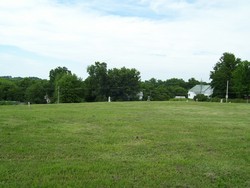
Sunbridge Cemetery
Also known as: City Cemetery, Saint Joseph City Cemetery
Saint Joseph, Buchanan County, Missouri, USA
My fifth great-grandfather was born in Virginia and died in Buchannan County, Missouri after a long and prosperous life. He was a pioneer who crashed with Daniel Boone in his youth.
Samuel Harris Vassar was the son of Abraham Vassar and his wife Rhoda. His birth place lay in the beautiful county of the Flat Creekwatershed of Amelia co. VA. He found his way to Kentucky. Later, after the death of his father in 1779, he learned he had been given 200 acres of the Flat Creek Plantation a a deed of gift that he see to the care of his mother and young sister Delilah after the father was dead.His elder sister Martha Catherine Deaton and her husband Levi lived onthe place until 1803. Levi Deaton had died in 1799 leaving Martha a widow.
On the return trip to Kentucky, Samuel and his mother and sister took refuge in Daniel Boone’s Fort. Later, in 1803, Rhoda Harris Vassar died in Clark Co, KY.
During the time he was in Kentucky, Samuel Harris Vassar acquired a200 acre farm on the south side of the Red River at its mouth and theKentucky river on its east bank. This spot had a workable salt desposit which he developed. In addition to the regular farm crops, hehad a water mill on Calloway Creek which ran along his southern line.
Samuel Harris Vassar met the daughter of Peter and Mary Ann Goossee, named for her mother and nicknamed “Polly”. Samuel was 38. However consent must be had from the father of the child to be married if the child was between the ages of 12 1/2 and 16. Thus, a bond was given as reguired: Clark Co KY; January 21, 1795; Samuel H Vassar to Polly Goossee, the father. Bondsman, Peter Goossee, JR. To this union were born 5 sons and 2 daughters.
In 1818, Simpson R, son of Samuel and Polly, went to Missouri territory as a fur trader for a St Louis based fur company. Upon returning to KY with his wife and new son, he told tales of the newland opening up. These stories led Samuel at the age of 61 to go to Howard Co, MO with his wife and 3 unmarried children. Another son, Samuel Jenkins, became an Indian Trader for the Chouteaus of St Louis. Elizabeth and Benjamin remained with their parents until their marriages in Clay co, MO.
About this time, in 1830, Mary “Polly” the mother died. She is buried near the north county line of Clay co in a graveyard with other Goosey family members. In 1835 Samuel married Cynthia (Simpson) Castile, the widow of Joseph Castile. Both Samuel and Cynthia were advanced in age. Samuel never returned to KY. He sold his holdings there by Power of Attorney. He and his son Benjamin operated a grist mill in Clinton Co, MO. At his death he held many notes. One of thesefor a few hundred dollars was on Joseph Robidoux, the founder of St Joseph MO. This note was never paid. He died 24 Oct 1846 and is buried in the NE corner of Sunbridge Cemetery in Buchanan Co, MO. A statementon file in the Buchanan Probate Papers records that he was “taken inhis 89th year”.
After the death of Samuel, Cynthia, his second wife, lived with a son by her first marriage. The 1850 census shows David Castile, age 36, born TN, to have a wife and 6 children and Cynthia Vassar living with this family. Castile Creek, which headed in the new county of DeKalb, MO and flowed through Clinton and Caly counties emptying eventually into a tributary of the Missouri River was named for Joseph Castile.
Samuel Harris VASSAR (1757 – 1846)
5th great-grandfather
Mary VESSOR (1801 – 1836)
daughter of Samuel Harris VASSAR
Margaret Mathews (1831 – 1867)
daughter of Mary VESSOR
Julia McConnell (1854 – 1879)
daughter of Margaret Mathews
Minnie M Smith (1872 – 1893)
daughter of Julia McConnell
Ernest Abner Morse (1890 – 1965)
son of Minnie M Smith
Richard Arden Morse (1920 – 2004)
son of Ernest Abner Morse
Pamela Morse
I am the daughter of Richard Arden Morse
 mermaidcamp