mermaidcamp
Keeping current in wellness, in and out of the water
You can scroll the shelf using ← and → keys
You can scroll the shelf using ← and → keys
Most luxury goods from ice cream to cars are marketed as being self-indulgent. The idea that we deserve some luxury is a tried and true method used to sell overpriced goods. Obviously luxury has to mean different things to each one of us, and our fortunes limit what we include in our worldly possessions. We do have to choose and over time our choices change. We move into a new phase or environment or hobby and find that what was a big treat in the past is not even interesting now. We may own something we thought we needed and wanted that now we no longer like. This is natural.
I am in favor of self-indulgence if it is done in a true spirit of enhancing the self. Self care and self-awareness are valid and necessary for a healthy balanced personality. To make good long-term investments in self ask yourself:
There may be another element to consider when finding a reward for yourself that will reap future dividends. Would I enjoy this time/money/thing more if I gave it away or shared it with others in some other way? I personally can think of at least a million things I would rather own than the yacht A, and a million people who could make good use of a more reasonable boat. Everything is relative. To each her own. Choose wisely, gentle reader.
I lived in Venezuela in the early 1960s. My father was manager of operations for Mene Grande Oil Company, aka Gulf Oil. I lived in San Tomé in a remote petroleum camp in the llanos. I lived as a petroleum princess and listened to Radio Havana because it was the only station that came in clearly. We lived an opulent life surrounded by fences and guards. Trinidadians usually worked as servants in our homes because they were bilingual. We had one very high lifestyle in every respect.
John Kennedy was shot before I moved to South America, which was unsettling. Race riots were taking place in the states, but we were isolated from that reality hanging out at our private social club in the tropics. We lived in extreme segregation, but thought nothing of it. The seeds of revolution are planted many years before they mature. The wealth discrepancy in South America was shocking, but since it was all to our advantage we were told it was inevitable. These experiences all became part of my knowledge of the world and later part of my politics. I distrust all imperialists and their motives.
With a simplistic agenda to end unbearable insecurity the students began to march last week in all the cities in Venezuela. The outcome of this battle will be significant and was long in the making.

MGO employee handbook

Helvetia in Bern
Helvetia is the lady who holds the cantons of Switzerland in the palm of her hand. She is an evolution of Abundantia, and represents the confederacy. She presides over an extreme form of democracy in the heart of Europe. Her resources are many and very well managed. Her people are healthy wealthy and wise. Her needs are few. She gets by on a minimalistic budget that covers the Swiss Army, and leaves big taxation to the cantons. This allows her to live in relaxed elegance in comparison to her neighbors. For centuries the Swiss have depended on foreign labor by executing contracts that required the guest worker (many from Italy before the EU) to return to the home country several times a year. Hotels and resorts close the doors and the workers go home during soft tourism seasons. In season the hotels provided lodging and meals for the imported workers. Although the Helvetian Confederation did not join the EU it had to make a series of trade agreements in order to survive and thrive in the very middle of the EU countries. I used to spend a lot of time in Switzerland before the EU and I honestly did not think Europe would even pull it off in the beginning. I was not alone in this belief.
The Swiss are very liberal in social terms and conservative in fiscal terms. They are brilliantly efficient and endlessly frugal and creative. They have generously accommodated Tibetans, Africans, Tamil Tigers and other refugees, providing education and finding employment for many. Now they have an influx of Germans and Eastern Euros that have taken over much of the service segment. This is a cultural nightmare for Helvetia and her healthy economy. It is not so surprising to see that the rural populations are the one’s most opposed to the mass immigration. The Italian canton, Ticino, which is inundated with Italians who wish to stay voted with those in the countryside. They have preserved an individual culture in a confederacy with four official languages and do not wish to see history and tradition lost.
This is a small version of a big issue, which is why some are saying this could be the beginning of the end of the EU. I respect the Swiss who want to keep the identity and independence that is an integral part of their society. I used to tell my Swiss friends they need not vex themselves because they own the source of both the Rhine and the Rhone, the last clean water in Europe. They can simply do what they do best, and set up meters to measure and sell that water. Although that sounds outlandish now, there will be certain political and economic repercussions following this restriction of immigration. My bet is on Helvetia, who is wise and has the best interests of her people in mind. She will have to defend her confederacy now.
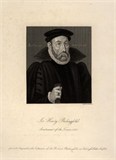
Henry Bedingfield
My 13th great-grandfather was instrumental in placing Mary Tudor on the throne of England.
Son of Edmund Bedingfield and his wife Grace, dau. of Henry Marney, first B. Marney. He was the grandson of Sir Edmund Bedingfield who had served in the Wars of the Roses, and to whom were granted by Edward IV for his faithful service letters patent authorizing him “to build towers, walls, and such other fortifications as he pleased in his manors of Oxburgh, together with a market there weekly and a court of pye-powder”. Henry’s father, other Edmund, had been Catalina of Aragon’s custodian during her last sad years at Kimbolton Castle.
Sir Henry Bedingfield and his fellow-Member Sir William Drury were included in Cecil’s list of gentlemen who were expected to transact ‘affairs for Queen Jane’, but in the event both rallied to Mary. Sir Henry was mainly instrumental, together with Sir Henry Jerningham, in placing Mary Tudor on the throne. In ‘The Chronicle of Queen Jane and of two years of Queen Mary’, the anonimous author said:
‘… The 12. of Jul word was brought to the Councell, being then at the Tower with the lady Jane, that the Lady Mary was at Keninghall castle in Norfolk, and with her the earle of Bath, sir Thomas Wharton sonne to the lord Wharton, sir John Mordaunt sonne to the lord Mordaunt, sir William Drury, sir John Shelton, sir Henry Bedingfield, master Henry Jerningham, master John Sulierde, master Richard Freston, master sergeant Morgan, master Clement Higham of Lincolnes inne, and divers others; and also that the earle of Sussex and master Henry Ratcliffe his sonne were comming towards her…’
He proclaimed her at Norwich, and for his loyalty received an annual pension of £100 out of the forfeited estates of Sir Thomas Wyatt. Ultimately he became Lieutenant of the Tower of London and Captain of the Yeomen of the Guard.
As jailer of Princess Elizabeth, who was suspected of complicity in Wyatt’s rebellion, he has been persistently misrepresented by Foxe and others. On 5 May 1554, Sir John Gage was relieved of his office as Constable of the tower and Sir Henry Bedingfield placed in his room. Bedingfield marched in to take over command of the Tower bringing with him a hundred men in blue liveries, and Elizabeth’s reacción to this ‘sudden mutation’, at least as described by John Foxe, clearly illustrates her state of mind. The arrival of Sir Henry, being ‘a man unknown to her Grace and therefore the more feared’, seems to have induced a fit of panic. She demanded to be told ‘whether the Lady Jane’s scaffold were taken away or no?’ Reassured on this point, but still not entirely satisfied, she went on to ask who Sir Henry Bedingfield was and whether, ‘if her murdering were secretly committed to his charge, he would see the execution thereof?’
On 19 May, at one o’clock in the afternoon he joined Sir John Williams and Sir Leonard Chamberlain to escort Elizabeth from the Tower to Woodstock. Foxe, in his “The myracolous preservation of Lady Elizabeth, nowe Queen” said:
“… In conclusión, on Trinitie Sonday being the 19. day of Maye, she was remooved from the Tower, the Lorde Treasurer being then there for the lading of her Cartes and discharging the place of the same. Where Syr Henry Benifielde (being appoynted her Gailer) did receive her wyth a companie of rakehelles to Garde her, besides the Lorde of Darbies bande, wayting in the Countrey about for the mooneshine on the water. Unto whome at length carne my Lorde of Tame, ioyned in Commission with the sayd Syr Henry, for the guiding of her to prisone: and they together conveied her grace to Woodstock, as hereafter followeth…”
Foxe’ s narrative contains many circumstantial anecdotes of her imprisonment, intended to emphasise her constant danger, and the boorish behaviour of Sir Henry. In fact, he seems to have been nomore than conscientious, and Elizabeth herself understood that. The whole history of his custodianship of Elizabeth is contained in a series of letters addressed to the Queen and the Privy Council, and in their replies. This correspondence, which has been published by the Norfolk and Norwich Archæological Society, completely exonerates Sir Henry from either cruelty or want of courtesy in his treatment of the royal captive.
Thomas Parry, the princess cofferer had to provide for her household but on 26 May, three days after her arrival at Woodstock, the Council told Bedingfield that there was no reason for Parry to stay there. Elizabeth’s guardian communicated this decision to Parry, who baffled him by staying in the town. Parry now proceeded to make Bedingfield’s life a misery. He first objected to the provisioning of his retinue out of Elizabeth’s resources, until Bedingfield was commanded to supply them by a special warrant. This was simply a harassing tactic, for books were being conveyed to Elizabeth, some of which Bedingfield suspected of being seditious, and when Parry sent him two harmless ones he was forced to return them for want of explicit instructions. Bedingfield complained that he was helpless, as ‘daily and hourly the said Parry may have and give intelligence’, and once again the cofferer’s position was referred to the Council. Early in Jul Parry was at the Bull inn, ‘a marvellous colourable place to practise in’, receiving every day as many as 40 men in his own livery, besides Elizabeth’s own servants. At length the Council forbade such large meetings and, from Bedingfield’s subsequent silence on the point, it seems that the order was obeyed.
Sir Henry Bedingfield also informed the Council of a meeting at Woodstock, Oxfordshire, between Francis Verney and a servant of the late Duke of Suffolk and cited Sir Leonard Chamberlain’s judgement that “if there be any practice of ill within all England, this Verney is privy to it”. Bedingfield apologised to the Council for the fact that he was being ‘enforced, by the importunate desires of this great lady, to trouble your lordships with more letters than be contentful to mine own opinion’. In Apr 1555 Henry Bedingfield, escort Elizabeth to Hampton Court, where she met the Queen. A weeks later ended a period of close restraint for the Princess, which had lasted just over fifteen months. It would probably be difficult to say whether prisoner or jailer was the more relieved.
On Elizabeth’s accession he retired to Oxborough and was called upon in a letter, in which the Queen addressed him as “trusty and well-behaved”, to furnish a horse and man armed, as his contribution to the defence of the country against an expected invasion of the French.
When, however, the penal laws against Catholics were enforced with extreme severity, Sir Henry Bedingfield was not spared. He was required to pay heavy monthly fines for non-attendance at the parish church, while his house was searched for priests and church-furniture, and his servants dismissed for refusing to comform to the new state religion. Together with his fellow-Catholics, he was a prisoner within five miles of his own house and might pass that boundary only by a written authorization of the Privy Council.
In his will of 24 Jul 1561 Sir Richard Southwell bequeathed over 10,000 sheep to members of his family and left his personal armour to his ‘cousin and friend’ Sir Henry Bedingfield.
He died 22 Aug 1583, and was buried in the Bedingfeld chantry at Oxborurgh.
Family and Education
b. by 1509, 1st s. of Sir Edmund Bedingfield of Oxborough by Grace, da. of Henry Marney, 1st Baron Marny. educ. L. Inn, adm. 1528. m. by 1535, Catherine, da. of Sir Roger Townshend of Raynham, Norf., 5s. 5da. Kntd. by July 1551; suc. fa. June 1553.1
J.p. Norf. 1538-53, q. 1554-58/59, q. Suff. 1554-58/59; commr. relief, Norf. 1550; other commissions Norf., Suff. 1534-60 PC Aug. 1553-Nov. 1558; lt. Tower Oct. 1555-c.Sept. 1556; v.-chamberlain of the Household and capt. of the guard Dec. 1557-Nov. 1558.2
Henry Bedingfield came from an old Suffolk family with extensive estates in East Anglia. After his marriage to the daughter of one of the most favoured crown officials in the region he was named to the Norfolk bench; however, while his father lived he was not outstanding in either national or county affairs, although in 1544 he led a troop of his tenants to the army at Boulogne. In 1549 he helped the Marquess of Northampton to put down Ket’s rebellion, but was himself captured and only released after its suppression. Bedingfield seems to have supported or at least acquiesced in the Duke of Northumberland’s rise to power, for he was recommended by the Council as knight of the shire for Suffolk to the second Parliament of Edward VI’s reign. Although noted by Cecil on a list of those thought to be sympathetic to Lady Jane Grey he was one of the first to rally to Mary. His decisiveness during the succession crisis earned for him the trust of the Queen and a place on her Council. As one close to her and a major landowner in his own right following his father’s death he was elected one of the knights of the shire for Norfolk to the first Parliament of the new reign and re-elected to its successor early in 1554. When after Wyatt’s rebellion the Queen sought a stricter guardian for her sister, she found in Bedingfield the qualities necessary—honesty, loyalty, obedience and perhaps a certain lack of initiative. Possibly she realized the touch of irony in her setting as guard over Elizabeth the son of the man who had been her own mother’s custodian. Bedingfield remained at Woodstock as guardian of the princess from May 1554 to April 1555. His correspondence with the Council and Queen concerning his duties hardly bears out Foxe’s accusation of cruel treatment of his charge. It shows, rather, a severe and rigid man of limited imagination and lacking in humour, but by no means cruel; it also indicates that he had much to endure from Elizabeth’s temper and her constant importunity.3
In June 1556 Bedingfield surrendered an annuity of £100 (granted to him for his services in July 1553), together with two Yorkshire manors, receiving in return the manor of Uphall and the reversion of numerous other lands in Norfolk. His promotion at court in December 1557 marked a further stage in the growth of his power and influence, and preceded his re-election for a third and final time as a knight of the shire for Norfolk. There seemed no obvious limit to his career when the death of Mary and the accession of his former charge brought his career to an abrupt close. He asked Elizabeth’s forgiveness for his treatment of her at Woodstock; the Queen showed no malice but hinted that she would prefer not to see him at court. In 1569 he refused to subscribe to the Act of Uniformity, and had to enter into a bond for his good behaviour. Nine years later he was accused of refusing to attend services and giving refuge to papists, and bound over in £500 to remain at Norwich: not long afterwards he was summoned to London but excused on account of ill-health. The last years of his life were troubled by similar actions against him, but he was fortunate in having at court a son-in-law, Henry Seckford, who in December 1581 obtained permission to take the old man into his own home ‘until he may pass over the remembrance of the lady his wife, lately deceased’. Bedingfield made his will on 16 Aug. 1583. He had previously settled some of his lands on his younger sons and he divided his goods between them and his daughters, apart from some heirlooms which were to descend with Oxborough manor. Bedingfield died on 22 Aug. and was buried at Oxborough.4
Ref Volumes: 1509-1558Author: Roger Virgoe
Henry Bedingfield (1509 – 1583)
is my 13th great grandfather
Edmund Bedingfield (1534 – 1585)
son of Henry Bedingfield
Nazareth Bedingfeld (1561 – 1622)
daughter of Edmund Bedingfield
Elishua Miller Yelverton (1592 – 1688)
daughter of Nazareth Bedingfeld
Yelverton Crowell (1621 – 1683)
son of Elishua Miller Yelverton
Elishua Crowell (1643 – 1708)
daughter of Yelverton Crowell
Yelverton Gifford (1676 – 1772)
son of Elishua Crowell
Ann Gifford (1715 – 1795)
daughter of Yelverton Gifford
Frances Congdon (1738 – 1755)
daughter of Ann Gifford
Thomas Sweet (1759 – 1844)
son of Frances Congdon
Valentine Sweet (1791 – 1858)
son of Thomas Sweet
Sarah LaVina Sweet (1840 – 1923)
daughter of Valentine Sweet
Jason A Morse (1862 – 1932)
son of Sarah LaVina Sweet
Ernest Abner Morse (1890 – 1965)
son of Jason A Morse
Richard Arden Morse (1920 – 2004)
son of Ernest Abner Morse
Pamela Morse
I am the daughter of Richard Arden Morse


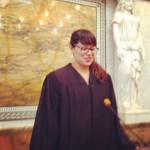

I had a magical experience that changed my life last year. During the government shut down my friends and I were treated to a tour of a working monument to justice in San Francisco. The very special building, which is owned by the taxpayers, was still open for business while the irresponsible part of the federal government was having an irrational fit at the taxpayers’ expense. We each had a chance to put on a robe and pose with the babes of justice, as my friend who works with them calls them. We all felt very special and talked later about being so lucky and having so much fun that day. Sometimes events take on more meaning as time reveals a larger meaning. I was being baptized on that bench and accepting a big mission that I recognize now. We were joking and laughing, really being free and happy, but a vow to liberate others through justice was happening at the same time. Let me explain:
My first teacher of Buddhism was Claude D’Estree, a monk who hangs tight with the Dalai Lama of Tibet. When we were lucky enough to receive teachings from his holiness in September of 1993 Claude flew down from Denver once a month for a year before his arrival to initiate us to Tibetan Buddhist teachings in preparation. We had classes at St Phil’s in the Hills Episcopal Church, and held retreats on that beautiful campus to learn about the three jewels. The subject was new to me, but Claude is an excellent teacher. From the dedication of merit to dependent arising, he covered the material in such a way that very complex concepts became clearer. I will never forget an example he used to explain compassion, using his own personal life experience.
He had worked as a federal prosecutor, who has the obvious job of defending justice and fighting evil. This job exposed him to egregious wrongdoing. As a monk he has the job of using compassion to save the world from pride, delusion, and anger by practicing patience. This seems like a paradox, and it is. He taught us that the most compassionate thing to do for people who are delusional, destructive and angry is to stop them. The trick about doing it as a prosecutor-monk, or monk-prosecuter is to do it without any attachments or aversions, in other words, without anger. Compassion turns anger into patience, an alchemical process that takes much dedication and study to achieve. He had to prosecute very serious criminals in the line of duty. He had also taken the Bodhisattva vow to return to earth until all beings are free and happy. He has undertaken this giant mission to meditate and cultivate diligence for those whose minds are slack and wondering ( a seemingly unending group). Since we all were given the rare opportunity to tread the path of buddhahood Claude was showing us how to meditate and turn our own merit into bliss for others who are suffering. I think of him and his teaching often when my patience is challenged.
The year of study and retreat was a deeply religious experience, but did not require the student to become a proclaimed Buddhist, or join any group or movement. The teachings were given to help us comprehend the even deeper experience of our time with his holiness. We were initiated to Green Tara and introduced to Shantideva. These are deep teachings that can take lifetimes to comprehend, but the Dalai Lama encouraged the women in the class by telling us that we have a better chance of spontaneous or instant enlightenment than the guys. We learned the mantra for Green Tara, who has the specialty of speed. She is the Mother of all Buddhas who saves us from our envy, wrong view and avarice.
For years I have been involved in an anger/patience/justice drama about my home. Now I am going to have to do some serious patience practice while I sue the flaming pants off the city of Tucson for violating federal revenue law and obstructing justice like crazy fire. I am calling on Green Tara to save me from attachment and doubt in order to liberate our neighborhood from evil. I have taken the vows too, and have a responsibility. Green Tara and I are now both babes of justice. Wish me luck as I walk through the valley of the shadow of anger.
Changing Hands Bookstore
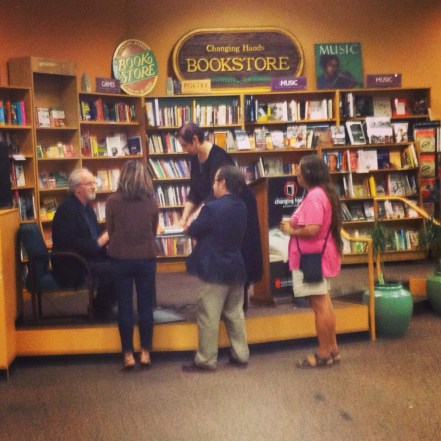
book signing
A reformation of religion is happening before our very eyes. As the formal religions loose members and believers the souls are still out there wandering around seeking some meaning in life. This is an era of very lost souls grasping at self help, self hypnosis, and the usual self delusion. I am lucky my parents did not really introduce religion into my life. They attempted, obviously out of guilt, to send me to the Presbyterians when I was about 11, but they told me it was for punishment. Maybe they let it slip, but I had the big picture which was that I was bad and the people at the Presbyterian church could whip me into shape. That was my initiation into fake religion and it did have deep meaning in my formative years. I saw the lack of ethical standards, and besides, that church had a God awful choir. I had no positive reinforcement that would incline me to want to ever go to church. I felt perfectly righteous to rebel, and saw myself as something of a martyr whenever I had to go to any religious service. I have something like the opposite of Catholic guilt. However, I have studied religion and read more books on the subject that most people, I think.
Last night in Tempe at The Changing Hands Bookstore I heard Thomas Moore speak to a crowd about his new book, A Religion of One’s Own, which I read and think is a grand opus…not a long and dry one…a deeply profound work that will change minds and souls. Tom Moore is to religion what Andrew Weil is to medicine. He has the education and credentials that are needed to start a reformation. I was surprised to hear the word reformation in his speech last night, but he knows of what he speaks. He talked about changing the world in the same way Pope Francis does when he makes his own breakfast. Since he spent years as a monk his piety can’t be questioned. Since he has a doctorate in world religion his knowledge of scripture, doctrines, and history are impeccable. Perhaps most important in our current soul crisis is his experience as a Jungian therapist. His direct experience with the suffering of his patients has shown him the sad results of religion served up with a side of hypocrisy and shame.
He asks the readers not to take this book lightly. I can’t imagine the kind of person who would do that, but they surely exist. He is sharing insight and wisdom that can extricate tortured souls from their day to day pain. He suggests that laborare est orare applies to all of us. In other words, each moment on earth has big potential in a sacred context. Every act, chopping wood, carrying water, or washing dishes provides an opportunity to make life a joyous celebration. Bliss and mysticism are states to which we can aspire and attain. We are supposed to be happy, weird, and free. So…here we have it, permission to go be free, from a verified expert in academic knowledge. I hope we will all take him up on this offer, and predict the book will change the world in a very positive way. (Read it.)

A Religion of One’s Own
I just read A Religion of One’s Own by Thomas Moore, an author I admire. I met him in person last May when he had recently completed the book and was in the editing process. The workshop I took with him then was about soul, spirit, and the distinction between the two. This new book goes into detail on this subject. Like his other books I have enjoyed the subject matter is easily accessible although the reader becomes highly aware of Tom’s deep background and knowledge of world religions, art, music, history, and natural magic. He spent many years as a monk learning languages and music composition as he studied to be ordained as a priest. His knowledge of Greek and Latin always add depth to his concepts because he carefully traces true meanings in words. The words I learn from him stay in a special memory bank of super charged, precious possessions. They are magic words for me, with mystical value.
I read the book almost non stop on my Kindle paperwhite, a new gadget I now think is excellent. One feature of Kindle reading is the ability to look up words within the device as you read. The words you look up are added to your ongoing vocabulary list. Since I learn new words every time I read his work, this was fabulously useful. Here is my new vocabulary from this book:
Normally I would take the meaning from context and go on, but now I am a real vocabulary builder. What Thomas Moore is asking us all to do is to develop a much broader vocabulary and understanding of religion. The mystical and mysterious is essential to our fulfillment and happiness. Without soul, spirit, and practices that maintain the health and vigor of both in our lives we can become dead to the pleasure of being alive. Churches and formal religion have lost the leadership role they once maintained without question. Now it is important not to discard the sacred and the meaningful, but to make a unique personal system that is true to our own natures. Dogma and deterioration from institutions can be replaced by practices that feed our souls and our spirits, and nurture harmony in our communities.
I know all of Tom’s many fans will be happy to read this latest edition of his teaching. If you have not had the pleasure of meeting him in person or in writing you are missing a very special treat. He is a Renaissance Man in that he is honestly creating a renaissance vortex and map for his readers to follow. He is asking no less than a rebirth and re-empowerment of our sacred traditions so as not to loose the beauty and significance of them. He gives concrete suggestions and guidance to achieve this goal by treating all the religious traditions as one’s own. Personal wisdom and satisfaction are essential to living a blissful, peaceful life. Thomas Moore has once again created a meaningful and significant lesson we can all easily grasp. The book is short, compelling, and will leave you in a new frame of mind. It is worth reading, and even more worth practicing.

Chadbourne coat of arms
We are lucky to have the will of my 11th great-grandfather. He was a sawyer who lived in Lancashire and was brought up during the reign of Henry VIII. When Elizabeth I demanded that everyone attend church on Sunday Robert responded that he had not been to church for ages. Despite being married in the Anglican church and allowing his children to be baptized there, it is clear from the deposition in John Fisher’s book that Robert Chadbourne was a Roman Catholic. He clearly states that he was raised in the time of Henry VIII when there was a “different order” (officially-sanctioned Roman Catholicism). His words in the original Olde English thrill me.
Robert Chadbourne (1530 – 1622)
is my 11th great grandfather
William CHADBOURNE (1582 – 1652)
son of Robert Chadbourne
Patience Chadbourne (1612 – 1683)
daughter of William CHADBOURNE
Margaret SPENCER (1633 – 1670)
daughter of Patience Chadbourne
Moses Goodwin (1660 – 1726)
son of Margaret SPENCER
Martha Goodwin (1693 – 1769)
daughter of Moses Goodwin
Grace Raiford (1725 – 1778)
daughter of Martha Goodwin
Sarah Hirons (1751 – 1817)
daughter of Grace Raiford
John Nimrod Taylor (1770 – 1816)
son of Sarah Hirons
John Samuel Taylor (1798 – 1873)
son of John Nimrod Taylor
William Ellison Taylor (1839 – 1918)
son of John Samuel Taylor
George Harvey Taylor (1884 – 1941)
son of William Ellison Taylor
Ruby Lee Taylor (1922 – 2008)
daughter of George Harvey Taylor
Pamela Morse
I am the daughter of Ruby Lee Taylor
y have a descriptive meaning, such as “Chad’s brook,” or “Chad’s ford,” but it is generally thought to denote a person from the village of Chatburn in the parish of Whalley, near Clitheroe, about twenty miles northeast of Preston, Lancashire. At least one other place name in the area bears the prefix “Chad,” i.e., Chadswell.
A false clue has long obscured the true ancestry of immigrant William Chadbourne of Kittery, Maine (Sybil Noyes, Charles Thornton Libby, and Walter Goodwin Davis, Genealogical Dictionary of Maine and New Hampshire [Portland, Me.: The Anthoensen Press, 1928-1939 (reprinted Baltimore, 1972)], 134, 651-2). Libby, Noyes, and Davis repeated a speculation that William was from Winchcombe, Gloucestershire, and indeed, a William does appear in the baptismal register for that parish. An exhaustive search of the Winchcombe registers produced nearly one hundred Chadbourne entries between 1595 and 1635 and nineteen distinct Chadbourne families, but failed to reveal a William with children Humphrey and Patience, as seen in the Kittery family. Probably influenced by the Banks manuscripts at the Library of Congress, Libby, Noyes, and Davis went on to mention Tamworth, Staffordshire, a parish about 90 miles north of Winchcombe, in their Chadbourne entry.
That Tamworth was the true origin of the American Chadbournes was communicated sometime before April, 1959, by R.O. Wilson, then living in Richmond, Surrey, England, to the late Fred Babson Chadbourne of New York, New York, who hired Noel Currer-Briggs to look into the matter. Here we find the names Patience, Humprey, and William as children of a William Chadbourne, the exact combination which appears in the records of Maine, and this family disappears from English records at precisely the time we would expect the immigrants to Maine to do so. A short manuscript synopsis of Currer-Briggs’ work was compiled by Fred B. Chadbourne in May of 1959 and circulated privately to interested family members.
In 1972 the will of Robert Chadbourne of Tamworth, father of the immigrant William, was abstracted and published by Noel Currer-Briggs on page 80 in his English Wills of Colonial Families, (Cottonport, La.: Polyanthos, 1972). Since that time, several people have published sketchy outlines of the correct Chadbourne pedigree, most notably Helen and Evelyn Stager of Luverne, Minnesota (A Family Odyssey, The Ancestors and Descendants of Joseph Harrison and Ada Belle (Marsh) Stager [Pipestone, Minn.: The Authors, 1983]).
Tamworth straddles the border between Staffordshire and Warwickshire, but since the parish church of St Editha, where William Chadbourne’s family was recorded, is in the Staffordshire part of the city, references to Tamworth here will use Staffordshire for consistency. It is noted, however, that Robert Chadbourne, in his will, states his residence as Tamworth in Warwickshire, and it may be that the family resided in that portion of the parish.
The following are abstracts of all Chadbourne entries from the parish registers of the Church of St Editha, Tamworth (Percy W.L. Adams, ed., Staffordshire Parish Registers Society. “Deanery of Tamworth. Tamworth Parish Register. Part I – 1558-1614 [n.p.: all printed, 1917], and from the original parish register thereafter, as noted below.
Tamworth, StaffordshireBook I – 4 March 1556/7 to 19 July 1614 (all entries mixed)
1575, Aug 21 Thomas, s. of Thomas Chadburne, bpt1575, Aug 30 Thomas s. of Thomas Chadburne, bur.
1576, Sep 14 Robert, s. of Thomas Chadburne, bur.
1576/7, Jan 28 Robert Chadburn & Margaret Dooley, m
1578, Apr 9 Robert, s. of Robert Chadburne, bpt
1579/80, Feb 15 Margery, d. of Robert Chadburne, bpt
1582, Mar 30 Willm, s. of Robert Chadburne, bpt
1584, June 3 John, s. of Robert Chadburne, bpt
1586/7, Mar 17 Walter Chadborne, Tamworth, bur.
1587, Apr 9 Randall, s. of Robert Chadborne, bpt
1589, Aug 15 Willm Bawdwyn, Chadbornes servant, bur.
1590, May 11 Thomas, s. of Robert Chadborne, bpt
1604, Oct 9 Richard Hewer & Margery Chadburne, m
1609, Oct 8 William Chadburne & Elizabeth Sparry, m
1610, Sep 30 Willm, s. of Willm. Chadburne, bpt1612, Nov 8 Patience, d. of William Chadburne, bpt
Book I, and others – 19 July 1614 to 31 December 1675 searched
Baptisms
1615, Apr 23 Humfrey, s. of Wm Chadburne1617/8, Feb 22 Susanna, d. of Wm Chadburne
1619, Sep 6 Edward, s. of Thomas Chadburne
1619, Oct 29 Judeth, d. of John Chadburne
1620, Oct 15 Willm, s. of Wm Chadburne
1622, Sep 25 Anne, d. of Thomas Chadburne
1623, June 1 Robert, s. of Willm Chadburne
1623, Sep 28 Alice, d. of Randall Chadburne
1624/5, Feb 8 Robert, s. of John Chadburne
1625, Mar 29 Walter, s. of Randall Chadburne
1625/6, Jan 1 Eliz & Margarett, ds. of Thomas Chadburne of Wigginton
1627, 9 Dec John, s. of Randell Chadburne of Tamworth
1629, May 24 Margrait, d. of John Chadburne
1629, Aug 9 John & Isabell, children of Thomas Chadburn of Wiginton
1630, June 13 Mary, d. of Randle Chadburne of Tamworth
1632/3, Feb 17 Eliz, d. of Randle Chadburne of Tamworth
1633, July 28 Edward, s. of John Chadburne of Tamworth
1634, Dec 14 Thomas, s. of Tho Chadburn
1635, Apr 19 Sara, d. of Randle Chadburn: Tamworth
1635/6, Mar 20 Alice, d. of John & Jone Chadburne
1636/7, Mar 19 Barbra, d. of Thomas & Ann Chadburn
1638, May 20 Susanah, d. of Randle Chadburn
1642, May 1 Wm, s. of Thom Chadburne
1645, July 27 Sarah, d. of Edward Chadburne Tamw: sould
1646/7, Jan 24 Elizabeth, d. of Edward Chadburne Tamw
1648/9, Mar 7 Samuel, s. of Edward Chadburne
1650, Apr 10 Samuel, s. of Edward Chadborne
1651/2, Jan 24 Ann, d. of Edward Chadburne
1653, Dec 24 Joana, d. of Edward Chadborne was borne
1659/60, Feb 20 Robert, s. of Edward Chadburn was borne
1665, Apr 25 Ester, d. of Walter Chadburne of Tamworth & Margret ux
1669, Sep 12 Frances, d. of Walter Chadburne of Tamworth & Margret ux1670, Nov 20 Willm, s. of Tho Chadburne of Hoppas & Alice ux
Marriages
1618, Nov 10 Thomas Chadburne & Anne Mare1618/9, Jan 21 John Chadburne & Jone Owres
1632, Oct 1 Thomas Chadburne & Anne Bull
1648, Apr 15 Joseph Reignolds & Anne Chadburne
1653, June 1 Randl Fernsworth & Mary Chadbn
1655, June 14 William Smart & Isabell Chadburne both of Wiginton by banns
1656/7, Jan 26 James Jackson of the psh of Dronfield & Susana Chadburn of Tamworth by banns
1662, Apr 8 John Garnet & Alice Chadburne both of Tamworth
1665/6, Feb 27 William Burcher & Barbara Chadburne1671/2, Feb 8 John Ling & Johanna Chadburne
Marriage Banns
1654, Sep 24 William Battman sherman & Margret Chadboorneboth of Tameworth 3rd and last time
Burials
1616, Apr 18 William, s. of William Chadburne1618, Apr 26 Susanna Chadburne infant
1622, Dec 16 Robert Chadburne of Tamworth
1625/6, Jan 18 Margarett, d. of Thos Chadborn
1626, Sep 23 Margery Chadburne widdow Tamworth
1626/7, Jan 19 Robt, s. of Willm Chadburne of Tamworth
1629, June 9 Elizabeth, d. of Tho Chadburn
1630, June 26 Alice, d. of Randle Chadburne: Tamworth
1632, June 10 Anne, w. of Thomas Chadburne of Wigenton
1633, July 11 D. of Thomas Chadburne of Wiginton
1638/9, Mar 20 Sara, d. of Randle Chadburn of Tam
1647, May 3 The body of John s. of Randle Chadburn of Tam
1649, Apr 18 The body of Samuel s. of Ed Chadburn
1649, Apr 24 The body of a child of Edeth Chadburn – a bastard
1649, Sep 19 The body of Ann wife of Tho Chadburn
1650, May 30 The body of Elizah wife of Edward Chadburn
1650, Dec 5 Samuel, s. of Edward Chadbon
1652, Aug 31 The body of Mary the wife of Randle Chadbourne of Tamworth
1653, Aug 23 The body of Randle Chadborne
1653, Sep 17 Eedeth, d. of widow Chadburne
1660, May 4 Ann, d. of Edward Chadburne of Tamworth
1660/1, Feb 2 Edward Chadburne of Tamworth weaver
1644, May 17 Mary d. of widdow Chadburne of Tamw
1664/5, Jan 1 Sarah, d. of Walter Chadburne of Tamworth
1664/5, Jan 14 A female child of Edward Chadburne
1667, Oct 28 Joane Chadburne of Tamworth widdow
1672, Sep 19 Thomas Chadburne of Hoppa1673, Apr 29 Mary, d. of Thomas Chadburne of Hoppas
My search has turned up a most extraordinary account which gives us a rare insight into the background of the Chadbourne family. In The Book of John Fisher, Town Clerk and Deputy Recorder of Warwick 1580-1588, transcribed and edited by Thomas Kemp, Deputy-Mayor of Warwick, 1900, we find a very informative deposition by Robert Chadbourne, father of the immigrant, which survives in this day-to-day diary of a judicial officer. This rare manuscript shows the range of cases seen in the late 1500s before the justices of the peace, everything from horse stealing and complaints about beggars to the imposition of sanctions against Catholic recusants (report of John S. Griffiths to the writer, then the date 3 Sep 1985).
By the Act of Uniformity, Elizabeth I decreed that all persons were to attend church on Sundays and Holy Days or pay 12d per offense. Persons over 16 who defied this Act were fined £20 for every month of absence (The Book of John Fisher, 115). The deposition reads as follows:
primo die novembris Anno xxiiijo of Rne Elizabethe [1582] coram humfrid Crane Johni Fisher et Thome Powell
Robart Chadborne borne in Lancashire in Preston in Andens a Sawer being examyned when he was at the church to heare dyvyne servise saiith, That he was in the church at Tonworth within this half yere or there about in the company of one Richard dolphyn & many more only to goo through the church But he saith that he was not in any church to hear dyvyn servyce the space of foure or fyve yeres or there about as he remembreth.
And being askid whie he wold not come to the church he saith yt was bycause his father and mother brought him up in the tyme of King henry the eight and then there was other order And he myndith to observe that order and to serve the lord god above all things.
Being askid what is in the church that he mislikith, or thinkith is not wth the service of god he answreth that he praith the hearers to pardon him for he will say no more.
Being demaundid whither he thinks that the Quenes maty Q. Elizabeth is supreme governor over all causes as well ecclesiasticall or tmpall within this Realme of England he answeereth that he thinkiith so.
Being damaundid whither the quenes mats ought to be obeyed in those lawes that she makith and that those lawes which be made by her ought to be obsved and kept as well in matters ecclesiasticall as tempall, he aunswereth That first he is afrayd to displease god above all things. And then afraide to displease his mighty prynce.
Being demaundid whither the order set downe and agreed uppon & comaundid by the quenes maty to be & that is now comonly used in the Church of Englond is acording to gods institutyon or as it ought to be. he aunswerith that it is against his conscyens.
Being offred to be set at libtye upon condycion that he will this night goo to the church and resort to the church in the tyme of dyvyne sruice & sermons uppon Saboath and holy dayes he utterly refusith it & will not doo yt
(The Book of John Fisher…, pp. 114-115).
From his deposition, we learn that Robert Chadbourne was born in Preston, Lancashire, and brought up in the reign of Henry VIII. There are virtually no Lancashire wills prior to 1550, and although many were indexed in the 19th century, some have gone missing since that date. Many were transported to Richmond in open carts in 1748 and more than 10,000 were lost, large numbers disappearing when at least one cart overturned in Wensleydale. Almost all from the deanery of Amounderness were lost (Anthony J. Camp, Wills and Their Whereabouts [Bridge Place, near Canterbury: The Society of Genealogists, 1963], 35). Eight wills and administrations for Chadbournes between 1550-1650 were indexed, and those extant have been examined. The most promising was that of Thomas Chatburne of Elswick in the parish of St Michael on Wyre. Not only was it near Preston and in the Deanery of Amounderness, it also named a son Robert. No further supporting information has been found and it has been impossible to reliably connect this Thomas with our Robert from existing records.
This will is badly damaged and a large part of the right side of the sheet has been torn away. It is dated 7 July (possibly 1560), but the year is missing (presumably torn away); it was proved that year, but the probate clause is absent. A short abstract of the names found in the surviving fragment of this will was made by Dr. Alan G. Crosby of Preston, Lancashire, as follows:
1560 Thomas Chatburne of Elswick, parish of St Michael on Wyre, Deanery of Amounderness, Lancashire
Rowland…Henry…
…Brown
Robert Ballard
son Robert Chatburne to be sole executor
witnesses: …Kyrkby, Robert Ballard, Thomas Brown
a list of debts owed to the deceased names the following:
Edward Turner of Crossbrake (?)
William Swartbrecke of Risicar
Robert Horneby
Robert Ballard
Richard Bond
Thomas Browne
Henry KyrkebyeJohn Cotton
The will of Katherine Chatburne of Elswick, probated in 1561, might be that of Thomas’ widow, but this will has been missing for many years and not even an abstract survives. There are no manorial court records for Elswick at the Lancashire Record Office.
Some of the papers of the Earls of Derby are deposited there, but no mention of Chadbournes is to be found among them.
The absence of Preston parish registers for the 16th century made it impossible to follow the family of Robert Chadbourne there. The registers of St John, Preston, the only church there in the 16th century, do not begin until 1611, and the Bishop’s Transcripts only date from 1616. The parish registers of St Michael on Wyre do not start until 1659. Parishes adjacent to the latter were checked for Chadbournes, and although a few were found, none seemed relevant.
A thorough search of the Tamworth parish registers shows very few people named Chadbourne, but all appear to have been related. The repetition of the names Thomas, Walter, and Robert among each group supports this conclusion.
A. ROBERTA CHADBOURNE, born Preston, Lancashire, probably 1530s or later; buried Tamworth, Staffordshire, 16 December 1622; married there 28 January 1576/7, MARGARET DOOLEY who, as “Margery Chadburne widdow” was buried there on 23 September 1626. Her parentage has not been discovered.
Despite being married in the Anglican church and allowing his children to be baptized there, it is clear from the deposition in John Fisher’s book that Robert Chadbourne was a Roman Catholic. He clearly states that he was raised in the time of Henry VIII when there was a “different order” (officially-sanctioned Roman Catholicism). Henry reigned from 1509 to 1547 and declared the new order in 1537. There was considerable religious confusion at this time, and the subsequent reigns of Edward VI and his sister Mary did little to settle the matter. It was not until Elizabeth I succeeded to the throne in 1558 that things began to stabilize and the “new order” was identifiable. Robert Chadbourne may well have been referring to the “time of Henry VIII” in a very broad sense since, if he was truly brought up in that reign, he was unusually old at the time of his marriage.
We get few clues about the status of Robert’s family. From his deposition we know that he was a sawyer. The Preston Guild Merchant kept reliable records, updated every twenty years. These records were published and edited by W.A. Abram in 1882, but neither Robert nor anyone of the surname Chadbourne appears on the rolls.
The burial on 15 August 1589 of William Bawdwyn, “Chadbornes servant,” indicates that the household was at least of a size to support one servant.
Will of Robert Chadburne
Consistory Court of the Bishop of Lichfield and Coventry, 14 Dec 1622
In the name of God Amen In the yeare of or Lord god 1622 in the xxth yeare of the Raigne of or Sovraigne Lord king James the xiiijth day of December &c. I Robert Chadburne of Tamworth in the County of Warwicke Carpenter beinge sicke in bodie yet thanks be to god in good and parfit Remembrance remembringe the uncrtayne hower of Death Doe ordayne and make this to be my Last will & Testamt in manner and forme Followinge First I give & bequeath my soule to Almightie god and my bodie to be buried in Tamworth church yarde Item I give & bequeath unto Margret my wyfe all my worldlie goods wch I possesse moveable & unmoveable payinge unto evry one of my chilldren xijd apeece And alsoe that my sonne Randulphe and his wife shall have hold & quietlie enioye the one halfe of the house and Backeside Wt my aforesaid wife duringe the tearme of my Lease wthout any let or molestation And yf it happen that my wiffe duringe this tyme wch I have in my house shoulde be so mynded to sett or assigne over hir tyme wch is yet to come that then it shall be Lawfull for my Sonne Randulphe to have the refuse of the same givinge as another should give Alsoe I do ordayne & make to be my overseers of this my will to be Pformed Christopher Wilcox & my sonne William Chadburne Wittnesse unto the same
/s/ Christopher Wilcox/s/ William Rutter
fuit administrato scdum tenorum testamenti suprascripti Margarete Chadborne Relici & c.
Commissio mro Johanni Oldacre Clico Currato de Tamworth. Ob: dca Margareta Chadborne de Tamworth in Com Warw vide et Ranulphus Chadborne de ead Carpenter.
Ro. Master.
Entry from the Administration Act Book
Apud 31 dei decembris Ao Dni 1622. Comissa fuit administraco bonorum Robti Chadburni dum vixit paroch Tamworth defuncti Margarete eius Relict iurat curam mro Johanne Oldacres Jurat ibm &c Ad administrand ead iuxa tenorem testamti dci def lris administrator annex &c.
Inventory
The Imventtory of the goods and Cattaile of Roberte Chadburne of Tamworth Latte decessed preseid by Thomas Righte Copper Thomas Egginton day laborer as Followithe
First his parrell
0 -10s-0
Itm his linnene
2£ -3s-4d
Itm his beadinge
1£ -0 -0
Itm all hiss wooden Stuffe
1£ -3s-4d
Itm his Tulls and all yorne [iron] stuffe
0 -16s-8d
Itm peutter & brasse
1£ -10s-0
Itm a smalle lease of a house
1£ -10s-0
Itm Cowe
1£ -10s-0
Itm part of a pigge
0 -4s-0
Some-10£ -7s-4d
Thomas Righthis marke
Thomas Eggintonhis marke
Children, all baptized in Tamworth, Staffordshire, surname CHADBOURNE:
i. ROBERT1, bpt 9 Apr 1578; no further record.
ii. MARGERY, bpt 15 Feb 1579/80; m Tamworth 9 Oct 1604 RICHARD HEWER. Children, all bpt Tamworth, surname Hewer: 1. Alice, bpt 1 May 1605. 2. Margaret, bpt 11 Nov 1606; bur there 27 Dec 1606. 3. Richard, bpt 27 Dec 1607. 4. Robert, bpt 26 Nov 1609. 5. Elizabeth, bpt 29 June 1611. 6. Thomas, bpt 23 Apr 1613. 7. John, bpt 14 Aug 1618.
1. iii. WILLIAM, bpt 30 Mar 1582, became the emigrant to North America (q.v.).
iv. JOHN, bpt 3 June 1584; m Tamworth, 21 Jan 1618/9 JONE OWRES, bur Tamworth 28 Oct. 1667. If Jone is the widow Chadbourne mentioned in the burial of Edith Chadbourne, then John was deceased before 17 Sep 1653. Children, all bpt Tamworth, surname Chadbourne: 1. Judeth, bpt 29 Oct 1619. 2. Robert, bpt 8 Feb 1624/5. 3. (perhaps) Edith, bur there 17 Sep 1653. 4. Margaret, bpt 24 May 1629. 5. Edward, bpt 28 July 1633. 6. Alice, bpt 20 Mar 1635/6.
v. RANDALL/RANDULPHE, bpt 9 Apr 1587; bur Tamworth 23 Aug 1653; m MARY _____, who was bur. in Tamworth 31 Aug 1652. Children, all bpt Tamworth, surname Chadbourne: 1. Alice, bpt 28 Sep 1623, bur. there 26 June 1630. 2. Walter, bpt 29 Mar 1625. 3. John, bpt 9 Dec 1627, bur there 3 May 1647. 4. Mary, bpt 13 June 1630. 5. Elizabeth, bpt 17 Feb 1632/3. 6. Sara, bpt 19 Apr 1635, bur. there 20 Mar 1638/9. 7.Susanah, bpt 20 May 1638.
vi. THOMAS, bpt 11 May 1590; m1 Tamworth 10 Nov 1618 ANN MARE, who was bur. there 10 June 1632; m2 there 1 Oct 1632 ANNE BULL, who was bur Tamworth 19 Sep 1649. By the burial of his first wife in 1632, he was of Wigginton, a chapelry of Tamworth, one mile and three quarters north of the town. Children by his first wife, all bpt Tamworth, surname Chadbourne: 1. Edward, bpt 6 Sep 1619. 2. Anne, bpt 25 Sep 1622. 3. Elizabeth [twin], bpt 1 Jan 1625/6, bur there 9 June 1629. 4. Margaret [twin], bpt 1 Jan 1625/6, bur there 18 Jan 1625/6. 5. John (twin), bpt 9 Aug 1629. 6. Isabel (twin), bpt 9 Aug 1629. Children by his second wife, all bpt Tamworth, surname Chadbourne: 7. daughter, bur there 11 July 1633. 8. Thomas, bpt 14 Dec 1634. 9. Barbra, bpt 19 Mar 1636/7. 10. William, bpt 1 May 1642.
THOMASA CHADBOURNE, his marriage and further career are unknown. He is a contemporary and possibly a sibling of Robert. Two of his children are seen in the Tamworth parish register.
Children, surname CHADBOURNE:
i. THOMAS, bpt 21 Aug 1575; bur 30 Aug 1575.
ii. ROBERT, bur. 14 Sep 1576.
WALTERA CHADBOURNE, buried Tamworth 17 Mar 1586/7, was possibly a sibling of Robert, or some other adult relative. The first-born son of Robert’s son, Randall, was named Walter, as well (q.v.).
Research in England was funded through contributions by John Carleton Chadbourne, George Freeman Sanborn Jr., Theodore Saunders Chadbourne, Mrs Jack T Bennett, and the English Research Fund of the Chadbourne Family Association, to which many members generously donated. Searches were conducted in English records by John S Griffiths and Dr Alan G Crosby. Records in Salt Lake City, Utah, were searched by Gordon L Remington. Useful conversations with Jerome E Anderson, Melinde Lutz Sanborn, George Freeman Sanborn Jr, and Robert Charles Anderson are acknowledged. By prior agreement of the Chadbourne Family Association, a similar presentation of the English ancestry of William Chadbourne may be found in the July/October 1993 issue of The New Hampshire Genealogical Record.
Contributed by George Freeman Sanborn, Jr, F.A.S.G. of New England Historic and Genealogical Society, 101 Newbury St, Boston, MA.
GO TO 1ST GENERATION
Return to Home Page
http://www.chadbourne.org/English.html
Social Media is changing the way crime is done. Be aware of the connection. Keep yourself save and secure by knowing the odds and the methods, which are constantly evolving. Since the big fat Target at Christmas event we need to evaluate how and when we do anything on line.
If you had a robot to live part of your life you preferred not to live, what would that machine do? I saw a news segment on PBS last night featuring Sherry Turkle, author of Alone Together. She was appearing with robots who are built to illicit emotions from humans. I had heard of her book from friends who read it and were very impressed. Her ideas already made sense to me, but the robot segment clenched the deal. I always think of slot machines when I think of machines that are built to beguile. Now there are robots in development to “care” for seniors. This is pretty freaky, gentle readers. I know I do not want robot care in my dotage.
The medium used to be the message; now it is the messenger as well. There is growing evidence that the ties that bind us are the same ones that are making us lame. I am a big fan of technology, but it needs to be the servant not the master in the relationship. What strikes me as most ironic is that devices are used for self hypnosis of a kind. In the trance state induced by too much busy busy update/like/comment one is an easy target for marketers and anyone with ulterior motives. I believe it is time to reel in the relationships with devices in favor of more time connecting to nature (which includes other humans in real life).

