mermaidcamp
Keeping current in wellness, in and out of the water
You can scroll the shelf using ← and → keys
You can scroll the shelf using ← and → keys
We are influenced daily, and there are people claiming to representing us daily, but we are unaware of most of it. As we forge our futures we find obstacles to happiness of both physical and spiritual natures. Our quest is never a solo, even if we think we act alone. We are slaves to certain beliefs and we ensalve others to our beliefs as much as we can. If we do not transform the way we look at our habits and our regrettable past behavior we are likely to be stuck in repeating, regretting, and then repeating the same patterns.
Metanoia is the concept of repentance that has been badly used and understood. Confession can be way to act temporarily sorry to absolve oneself of responsibility for past transgressions. As a practice it may teach that we are out of control, will repeat, and then feel very guilty about our behavior ad infinitum. This constant cycle of guilt and repeated undesirable action has little hope of creating liberation or happiness. The guilt is an almost certain sign that the action will be repeated. It is the currency of pain. Repentance of the depressing kind is a revolving door or shame leading to more guilt.
My favorite author, Thomas Moore, has written a new book, A Religion of One’s Own, which will be zapped into my Kindle in a few days. To warm up for this book he translated the Gospels from the original Greek language. To warm up for reading the new book I am reading Writing in the Sand, a book Thomas Moore wrote about the meaning of the Gospels. Chapter 2 of Writing in the Sand is about Metanoia, but not of the shameful kind. This word refers to a change of mind so profound as to cause a shift in vision. Thomas breaks down the literal meaning to bring a completely different sense to the word and what it represents. His knowledge of the original language brings back the meaning of the Gospels. I agree that we all need a spiritual and a soulful context for living. Thomas Moore is an ethical voice with a powerful message. I hope you will have a chance to read his work. It constantly inspires me.
Flaunta was the second cousin of the goddess Aphrodite. She became the goddess of confidence. Her journey to her vocation to inspire and represent confidence was a story of self discovery. Aphrodite needed no outside assurance to know she was a great beauty. She exuded it. The young Flaunta was not convinced of her own powers, but passed through a jealousy of earth women who enjoyed and were confident in their own good looks. She studied the powerful and confident women, learning their secrets. Eventually her cousin would bestow the title and the powers of confidence goddess on Flaunta. She is active today in the complicated self image issues women face about appearance and competence. Being authentic and unique leads to the highest kind of confidence, as Tank Girl can attest. Confident women know:
Get to know Flaunta, and take her with you next time you need to look something or somebody right in the eye. Nothing says “I got this” like control of your gaze. Bluffing or not, the first impression you give will remain strong when you show self assurance.
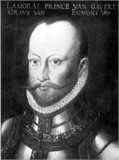
The Count

his statue in Brussels
My 12th great grandfather was a count who was very political and fancy. He was beheaded in Brussels in front of the town hall. He is the ancestor of the Pilgrim Richard Sears, who was fancy and political in Plymouth Colony. He has been immortalized by Goethe and Beethoven. He came before William of Orange, and was a big part of the history of Dutch independence.
from Wikipedia: http://en.wikipedia.org/wiki/Lamoral,_Count_of_Egmont
Lamoral, Count of Egmont, Prince of Gavere (November 18, 1522 – June 5, 1568) was a general and statesman in Flanders just before the start of the Eighty Years’ War, whose execution helped spark the national uprising that eventually led to the independence of the Netherlands.
The Count of Egmont headed one of the wealthiest and most powerful families in the Low Countries. Paternally, a branch of the Egmonts ruled the sovereign duchy of Guelders until 1538. Lamoral was born in La Hamaide near Ellezelles. His father was John IV of Egmont, knight in the Order of the Golden Fleece. His mother belonged to a cadet branch of the House of Luxembourg, and through her he inherited the title prince de Gavere.[2] During his youth, he received a military education in Spain. In 1542, he inherited the estates of his elder brother Charles inHolland. His family’s stature increased further in 1544 when he wed, in the presence of the Holy Roman Emperor Charles V and of the Archduke Ferdinand Iat Spires, the Countess Palatine Sabine of Simmern, whose brother became theElector Palatine Frederick III.[1]
In the service of the Spanish army, he defeated the French in the battles of Saint-Quentin (1557) and Gravelines (1558). Egmont was appointed stadtholder of Flanders and Artois in 1559, aged only 37.
As a leading Flemish nobleman, Egmont was a member of King Philip II of Spain‘s official Council of State for Flanders and Artois. Together with William, Prince of Orange and the Count of Horn, he protested against the introduction of theinquisition in Flanders by the cardinal Antoine Perrenot Granvelle, bishop of Arras. Egmont even threatened to resign, but after Granvelle left, there was a reconciliation with the king. In 1565, Egmont went to Madrid to beseech Philip II, the king of Spain, for a change of policy in the Netherlands, but met with little more than courtesy.[1]
Soon thereafter, the Iconoclasm started, and resistance against the Spanish rule in the Netherlands increased. As a devout Catholic, Egmont deplored the iconoclasm, and remained faithful to the Spanish king.
After Philip II sent the Duke of Alba to the Netherlands, William of Orange decided to flee Brussels. Having always declined to do anything that smacked of lèse majesté, Egmont refused to heed Orange’s warning, thus he and Horn decided to stay in the city. Upon arrival, Alba almost immediately had the counts of Egmont and Horn arrested on charges of treason, and imprisoned them in a castle inGhent, prompting Egmont’s wife and eleven children to seek refuge in a convent. Pleas for amnesty came to the Spanish king from throughout Europe, including from many reigning sovereigns, the Order of the Golden Fleece, and the king’s kinsman the Emperor Maximilian II, all to no avail.
On 4 June Egmont and Horn were condemned to death, and lodged that night in the maison du roi. On June 5, 1568, both men, aged only 46 and 44 respectively, were beheaded in the Grote Markt in Brussels, Egmont’s uncomplaining dignity on the occasion being widely noted. Their deaths led to public protests throughout the Netherlands, and contributed to the resistance against the Spaniards. The Count of Egmont lies buried in Zottegem.[3]
Nowadays, a statue erected on the Petit Sablon / Kleine Zavel Square in Brussels commemorates the Counts of Egmont and Horn, in historical overview usually mentioned together as “Egmond en Hoorne” and hailed as the first leaders of the Dutch revolt, as the predecessors of William of Orange, who grew to importance and obtained the leadership after their execution, and who was assassinated in 1584 in Delft, having succeeded in liberating parts of The Netherlands in the early years of the Eighty Years’ War (1568–1648).
Egmont’s offices and vast estates were forfeited upon his execution. By inheritance he had been count of Egmont (or Egmond), prince de Gavre and van Steenhuysen, baron de Fiennes, Gaesbeke and La Hamaide, seigneur de Purmerent, Hoogwoude, Aertswoude, Beyerland, Sottenghien, Dondes, Auxy and Baer. Some of these lands were eventually returned to his heirs. By appointment, he was Captain General of the Lowlands under Charles V, knight of the Golden Fleece since 1546, and Imperial Chamberlain. Despite the taint of treason and the family’s impoverishment, his niece Louise of Lorraine-Mercouer, was chosen to became the Queen consort of Henry III of France in 1575.
Literary treatments
The Count of Egmont is the main character in a play by Goethe, Egmont. In 1810Ludwig van Beethoven composed an overture and incidental music for a revival of the play.
Phillip Lamoral VanEgmond (1530 – 1568)
is my 12th great grandfather
Marie L Egmond (1564 – 1584)
daughter of Phillip Lamoral VanEgmond
Richard Sears (1590 – 1676)
son of Marie L Egmond
Silas Sears (1638 – 1697)
son of Richard Sears
Silas Sears (1661 – 1732)
son of Silas Sears
Sarah Sears (1697 – 1785)
daughter of Silas Sears
Sarah Hamblin (1721 – 1814)
daughter of Sarah Sears
Mercy Hazen (1747 – 1819)
daughter of Sarah Hamblin
Martha Mead (1784 – 1860)
daughter of Mercy Hazen
Abner Morse (1808 – 1838)
son of Martha Mead
Daniel Rowland Morse (1838 – 1910)
son of Abner Morse
Jason A Morse (1862 – 1932)
son of Daniel Rowland Morse
Ernest Abner Morse (1890 – 1965)
son of Jason A Morse
Richard Arden Morse (1920 – 2004)
son of Ernest Abner Morse
Pamela Morse
I am the daughter of Richard Arden Morse
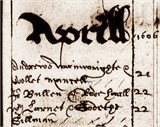
marriage record

coat of arms (with leg)

Goodith’s grave
My 12th great-grandmother arrived in Massachusetts Colony before 1632, and joined the church in Charlestown with her well respected husband. Her unusual first name is often misspelled in records, but it is an old English name.
Note: From “The Great Migration Begins…”: :’Goodith’ was a distinct given name, not to be confused with ‘Judith’, and not to be interpreted as ‘Goodwife,’ as has been done. “The Winthrop Society shows Goodith’s birth as circa 1585 and death as before 1632.
Judith Gillman was also known as Goodith Gillman. She was born in 1594 at Bermondsey, London, England. On 22 April 1606 at St. Olive, Southwork, Surrey, England, Judith married William Learned. Judith Gillman and William Learned were admitted to the church on 6 December 1632 at Woburn, Middlesex County, Massachusetts. Judith Gillman died on Friday, 24 June 1661 at Malden, Middlesex County, Massachusetts, at age 67 years.
[S466] Ancestral File. Family History Library, Salt Lake City, Salt Lake County, Utah, 1994. [S14] Wyman, Thomas Bellows. The Genealogies and Estates of Charlestown, Massachusetts 1629-1818. 1879. Reprint Somersworth, New Hampshire: New England History Press, 1982.
WILLIAM LEARNED d. Woburn, MA 1 Mar 1646, m. GOODITH GILMAN, d. 24 Jan 1661.
William Learned came from Bermondsey, Surrey, England and settled at Charlestown in the Massachusetts Bay in or before 1632, possibly in 1630 with the Winthrop fleet. He and his wife Judith were admitted to the First Church of Charlestown on Dec. 6, 1632, their names being the first two on the list of members. “1632, 10 mo., day 6, William Learned and Goodeth, his wife, were admitted”, being the first admissions after the separation from the Boston Church. He became a freeman on May 14, 1634 and a Selectman on Feb. 13, 1635-6. On March 2, 1637 he was chosen one of four to divide, for stinting, the common land, and on Feb. 12, 1637-8 he and Mr. Greene were appointed to settle the wages of the school-master.[2] On April 26, 1638 William Learned and five others were on a committee “to consider of some things tending toward a body of laws”
William was a subscriber to the town orders for Woburn, drawn up at Charlestown Dec. 18, 1640. In 1641 William moved to Woburn where he was one of the seven original members of the church on August 14, 1642. He was chosen constable April 13, 1643 and Selectman of Woburn in 1643 and 1645. These offices were only given to trusted and respected men.
Goodith Gillman (1592 – 1661)
is my 12th great grandmother
Sarah Learned (1604 – 1652)
daughter of Goodith Gillman
Mary Ewer (1637 – 1693)
daughter of Sarah Learned
Mehitable Jenkins (1655 – 1684)
daughter of Mary Ewer
Isaac Hamblin (1676 – 1710)
son of Mehitable Jenkins
Eleazer Hamblin (1699 – 1771)
son of Isaac Hamblin
Sarah Hamblin (1721 – 1814)
daughter of Eleazer Hamblin
Mercy Hazen (1747 – 1819)
daughter of Sarah Hamblin
Martha Mead (1784 – 1860)
daughter of Mercy Hazen
Abner Morse (1808 – 1838)
son of Martha Mead
Daniel Rowland Morse (1838 – 1910)
son of Abner Morse
Jason A Morse (1862 – 1932)
son of Daniel Rowland Morse
Ernest Abner Morse (1890 – 1965)
son of Jason A Morse
Richard Arden Morse (1920 – 2004)
son of Ernest Abner Morse
Pamela Morse
I am the daughter of Richard Arden Morse
I was born in 1951 when this map had very little activity. We had drills in my elementary school for bomb preparedness. My parents voted Republican, and strongly opposed JFK. I remember the cold war well as a formative part of my thinking. My parents, and later the national government, seemed either unaware or unethical to me. In my family history there are knights and military heroes. In modern times my uncles fought in WWII, but my father was nearly blind, so he did not serve. I believe the atom bomb has changed the potential for corruption, destruction, and total Armageddon. What was settled with swords in the middle ages is now settled by dangerous committee. Human nature has not changed all that much, but the swiftness and anonymity with which all creation can now be destroyed is daunting.



My father read Tom Sawyer and Huck Finn aloud to me when I was very young. There were other books that followed, but he really loved those two stories, and made them come alive while reading them. He liked to sing and recite poetry. We sang at parities all the time. Since we had a player piano, talent was no barrier to musical contribution. I pumped happily away for hours singing with the piano rolls. I still know the words to most of those songs, or could with some prompting, remember the lyrics. I wrote songs myself as a teen, but do not remember them at all, which is funny. I do remember The Cremation of Sam McGee by Robert W Service, which my father knew by heart. As an Okie in Pennsylvania I know he identified heavily with Sam McGee because he frequently and randomly said “Since I left Plumtree, down in Tennessee, it’s the first time I’ve been warm.”
My dad was a funny troubadour of sorts who did not know that his 8th great grandmother was Mistress Bradstreet, Pilgrim poet. He did often say,” You’re a poet, your feet show it, they’re Longfellows.” Now that I have discovered the Bradstreet connection I am revising the rhyme:
Keep the beat,
Think on your feet,
You’re a Bradstreet.
Since I found Mistress Bradstreet at the Poetry Center I am wondering about my own relationship to words and poetry. Do I have any poetic DNA that I need to develop? Curious, I attended the inauguration of Arizona’s new poet laureate, Alberto, Tito, Rios of Nogales, AZ. He addressed the crowd, read some poems, then answered some questions from the audience. He is a professor so he found it easy to teach the group. His style includes plenty of comedy, which holds the attention. An audience question was, “What is the difference between writing poetry and writing prose?” His answer was perfect and memorable. He said, ” Each line in a poem should be able to stand by itself. If one of my poems shattered and all the lines were left alone, each should be strong enough to get a good job in another poem.” I love that. I also love the Poetry Center which is very near my home. I don’t really think the lines in my poem above could find work elsewhere, but if I work on it, perhaps the spirit of Mistress Bradstreet will guide me to achieve better outcomes.
The other fine advice Mr Rios gave, which he illustrated with a story from his youth, was that you observe events and happenings in your life that will die without a story if you do not tell them. His attitude is that all of us have the potential to use words in a poetic way, and the experience enhances our own lives when we do it. We also liberate objects and events that want their stories to be told. This magical reality view of the objects comes naturally from his bilingual and bicultural background. In Spanish reflexive verbs make the world a highly animated place in which things take action. I believe Tito Rios is the perfect artistic and cultural representative who could have been chosen as our official poet. I am pleased to have been in the special inaugural audience.
My 9th great grandmother was the first woman poet to be published in America:
Anne Bradstreet (1612-1672) is one of the most important figures in the history of American Literature. She is considered by many to be the first American poet, and her first collection of poems, “The Tenth Muse Lately Sprung Up in America, By a Gentlewoman of Those Parts”, doesn’t contain any of her best known poems, it was the first book written by a woman to be published in the United States. Mrs. Bradstreet’s work also serves as a document of the struggles of a Puritan wife against the hardships of New England colonial life, and in some way is a testament to plight of the women of the age. Anne’s life was a constant struggle, from her difficult adaptation to the rigors of the new land, to her constant battle with illness.
It is clear to see that Anne’s faith was exemplary, and so was her love for children and her husband, Governor Simon Bradstreet. Anne’s poems were written mainly during the long periods of loneliness while Simon was away on political errands. Anne, who was a well educated woman, also spent much time with her children, reading to them and teaching them as her father had taught her when she was young. While it is rather easy for us to view Puritan ideology in a bad light because of it’s attitude towards women and strict moral code, her indifference to material wealth, her humility and her spirituality, regardless of religion, made her into a positive, inspirational role model for any of us.
Another one of Anne’s most important qualities was her strong intuition, although only subtly hinted at in her work, probably for fear of reprisal from the deeply religious Puritan community, one cannot help but feel her constant fascination with the human mind, and spirit, and inner guidance.
Her style is deceptively simple, yet speaks of a woman of high intelligence and ideals who was very much in love, and had unconditional faith. While it was difficult for women to air their views in the 17th Century, Anne Bradstreet did so with ease, as her rich vocabulary and polyvalent knowledge brought a lyrical, yet logical quality to her work which made it pleasant for anyone to read.
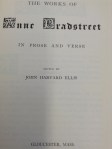

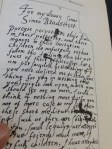







Anne Dudley Bradstreet was protected by her father and husband at a time when women were not supposed to think, let alone write poetry. She wrote history as she lived it as an Englishwoman in New England. I visited the University of Arizona Poetry Center this week to see the word shrine for the dead. I was very happy to also find a big blue book by Anne Bradstreet on the shelves. I enjoyed the wonderful space and visited with my ancestor by reading her works for about an hour. I had seen some of the work before, but since I was thinking of ancestry I really enjoyed the note she wrote to her son Simon (brother of my own ancestor). There is a copy preserved in her own hand, which I love to see. It gives me some intuition into her soul’s journey. Being a Pilgrim was not easy, but if your father and husband were governors you had some obvious advantages.
It is a wonderment of synchronicity to find my ancestor’s work preserved at the Poetry Center very near my home where I can go visit and read her any time.

skull and crossbones
The human condition known as revenge is ancient and well documented. The Greek goddess Nemesis represents retribution. She lives in the underworld with Hecate. She feels no remorse and hesitates at nothing to deal out vengeance when it is required. She is a neutral spirit with a balanced approach. She has the task of taking happiness from the undeserving while bringing more joy to those who earn it. She is pictured with a balance scale, doing calculations. She is concerned with issues of money. Her name is related to the word number, and the word economy. She is not vengeful, but is an accountant from the underworld.
The collective as well as your personal consciousness about wealth, money and right livelihood are the province of Nemesis. She keeps the accounts in balance. Abundance and prosperity follow the laws of nature. Knowledge as well as belief influence the outcome of all your earthly investments. Spiritual integrity in work and business ethics are measured against one’s degree of avarice and destructive behavior. Can you find ways that your beliefs about receiving limit you now? Can you think of ways to budget a more secure financial future for yourself through awareness? Some Americans call her “Death and Taxes”, to say she is hard to avoid. She is impossible to avoid, and she is counting all the time. She will deliver what is due from the wheel of karma because that is her job.

Quaker
Jeffrey Horney was a Quaker born in Maryland. His father was a planter who left his estate to his children in 1738. Jeffrey inherited “Cottingham”:
Horney, Jeffery, planter,Talbot Co.,11th Jan., 1737;
27th Mch., 1738.
To son William and hrs., “Dixon’s Gift,” Queen Anne’s Co.; and personalty.
To son Jeffery and hrs., “Cottingham,” sd. son dying without issue sd. tract to son Philip and hrs.; and personalty.
To sons Philip, James and daus. Jane and Prissillia, personalty, some of which des. as bou. of John Carslake. Residue of personal estate to 4 sons and 4 daus. divided equally.
Son Jeffery, ex., to have care of sons Philip and James until they come to age of 18.
Test: Robert Harwood, John Regester, Edward Perkins. 21. 861. MARYLAND CALENDAR OF WILLS: Volume 7
Since I have ancestors born in Maryland named Nichols, I was very interested to learn about the Nicholite movement, also known as New Quakers. The Nichols in my tree marry into the family about 100 years later in Pennsylvania.
Jeffrey Horney (1723 – 1779)
is my 8th great grandfather
Mary Horney (1741 – 1775)
daughter of Jeffrey Horney
Esther Harris (1764 – 1838)
daughter of Mary Horney
John H Wright (1803 – 1850)
son of Esther Harris
Mary Wright (1816 – 1873)
daughter of John H Wright
Emiline P Nicholls (1837 – )
daughter of Mary Wright
Harriet Peterson (1856 – 1933)
daughter of Emiline P Nicholls
Sarah Helena Byrne (1878 – 1962)
daughter of Harriet Peterson
Olga Fern Scott (1897 – 1968)
daughter of Sarah Helena Byrne
Richard Arden Morse (1920 – 2004)
son of Olga Fern Scott
Pamela Morse
I am the daughter of Richard Arden Morse
Jeffrey Horney [III] was born before 1720 in Talbot County, Maryland. He married Deborah Baynard outside of the Quaker faith without the consent of the Friends. Their marriage license was dated October 6, 1739 in Talbot County, Maryland. Eight years later in 1747, Jeffrey and Deborah Horney would sell their land in Talbot County and move to Dorchester [now Caroline] County. On the 27th of October 1747, Jeoffery and Deborah Horney sold fifty acres of Cottingham in Talbot County to William Thomas, Gentleman. Less than one month later, on the 12th of November 1747, Jeffrey Horney of Talbot County purchased Piersons Chance [Pearsons Chance] from John Pierson of Dorchester County, formerly laid out for Thomas Pierson. The property was in two parts; one part contained 100 acres and the other part contained 50 acres. The land was located on Watts Creek, off of the Choptank riverjust south of Denton in what is now Caroline County, Maryland. As the crow flies, Piersons Chance was less than 15 miles northeast of Cottingham and was about 5 miles from the Delaware line of Kent County, Delaware.
Nov 12, 1747 John Pierson of Dor Co, planter, to Jeofrey Horney of Talb co, planter: two parts of a tract formerly laid out for Thomas Pierson called “Piersons Chance,” conveyed by said Thomas to said John by separate deeds, on Watts Creek, one part containing 100 a. and the other part containing 50 a. more or less. Wit: T. Waite, Jno. Caile, Hall Caile. Ackn by John Pierson and Elizabeth his wife before Thos. Foster abd Benj Keene, Justices. (See receipt, Dorchester County Land Records 14 Old 169).
For the first seven years of their marriage, Jeffrey and Deborah Horney lived at Cottingham, and any of their children born within the first seven years between 1740 and 1747 were born at Cottingham in Talbot County. After November 1747 when Jeffrey and Deborah purchasedPiersons Chance in Dorchester County, any subsequent children they may have had were born in Dorchester County, Maryland. This land now lies in Caroline County Maryland which was not established until 1773 from parts of Dorchester and Queen Anne’s Counties. This explains why Jeffrey and Deborah Horney and their children are subsequently found in Caroline County records. The land on which they were living from November 1747 onward,Pierson’s Chance, was once in Dorchester County in an area that became Caroline County in 1773. At least three of their children, John, Philip and William Horney, left Maryland between the 1780s and 1790’s when they may have followed the Nicholite movement into the Deep River section of Guilford County, North Carolina. Some lines would remain in North Carolina while others would move onto Ohio, Illinois and beyond.
There is a local legend surrounding the area on Watts Creek where Jeffrey and Deborah settled. It was believed that in the 1600s and early 1700s notorious pirates and privateers, such as Captain William Kidd and Edward Teach [Thatch, Thach, Thache], otherwise known asBlackbeard, may have hid or buried treasure along the shores of Watts Creek. A local legend began to circulate (or re-circulate) in 1916 when Swepson Earle wrote Manor houses on the Eastern Shore. He claimed that “Tradition says [Watts Creek, south of Denton] once provided refuge for Captain Kidd, whose ‘buried treasure’ has been sought on its banks.” Later, in the 1940s when Hulbert Footner wrote his book, Rivers of the Eastern Shore, he related that“There is such a hole near the mouth of Watts Creek that is ninety feet deep. It is called Jake’s Hole. Its exact depth is known because it’s been sounded often enough, and I’ll tell you why. There was aplenty pirates round here in the old time. The one that mostly cruised in these waters was Blackbeard; Edward Teach was his right name. Well, Blackbeard picked Jake’s Hole for one of his caches, and dropped an oaken chest bound round with copper bands in there. It’s still there. God knows what’s inside it!”However, according to Donald Shomette who more recently wrote Pirates of the Chesapeake, neither Blackbeard or Captain Kidd ever sailed into the Bay, but their legends did.
Whether or not the legends of Watts Creek spun by the old-timers were fact or fiction, there were pirates and privateers who sailed in and around the Chesapeake Bay. Among them, Roger Makeele, was found in Maryland records in 1685 when he and his band of pirates lured the crews of tobacco sloops to their camp on Watts Island. They would seize the crew and confiscate their sloops before leaving the men in the Marshes of Dorchester County. Makeele sailed the Choptank river which separated Dorchester County from Talbot County where the early Horney’s lived. Incidentally, that same year Jeffrey Honey [Horney] was testator to the will of Emanuel Jenkinson of Talbot County Maryland. It is likely the early Horney men, as well as other settlers in the area, heard of these pirates and were in peril of loosing their tobacco crops and their sloops to the pirates of the Chesapeake.
During this time, local Indians lived in the area. Their ancestors arrived in the area long before the European settlers. When John Burnyeat appointed a general meetingfor all of the Friends in the province of Maryland. George Fox wrote about that meeting in his journal, (Two Years in America 1671-1673 Chapter XVIII) It was upon me from the Lord to send to the Indian emperor and his kings to come to that meeting. The emperor came and was at the meeting. His kings, lying further off, could not reach the place in time. Besides the Horneys who married into Quaker families, other religions would later play a part in their lives. Among the early churches and societies, early Horney families were or became Puritans, Anglicans and Episcopalians. In 1760, when Joseph Nichols of Kent County, Maryland and Delaware founded the Nicholites [New Quakers], at least one branch of Horney’s were found in Nicholite Petitions. [Most likely Jeffrey and Deborah Horney and/or their descendants.] The early Horney’s also became Methodist and Methodist-Episcopal. On June 17, 1703 John Wesley, the founder of Methodism, was born in Epworth, Lincolnshire, England. By 1771, John Wesley’s teachings reached the Eastern Shore of Maryland. When Francis Asbury came to Maryland to spread Wesley’s word, the Methodist religion took a strong hold in Maryland. More than a few Horney families converted to Methodism. However, Wesley’s Tory beliefs may not have sat well with the Horney’s who served [on the American side] in the Revolutionary War.
The rivers on Maryland’s Eastern Shore defined the early transportation routes of religion. During their lifetime, the settlers of the area, did much of their traveling on the rivers, tributaries, creeks and branches which crossed the Eastern Shore of Maryland, east of the Chesapeake Bay. They lived near and traveled many of these waterways including the Choptank, Wye, St. Michaels, (now Miles),Tred Avon (Third Haven), and Tuckahoe Rivers. The Tred Avon was and still is the location of Third Haven Meeting House near what is now Easton, Talbot County, Maryland. The St. Michaels, (now Miles) River was the location ofBetty’s Cove Meeting House.
To see photos of the Choptank and Tuckahoe river areas in Talbot and Caroline counties where the Horney families lived and traveled, select the pdf file from the Upper Choptank and Tuckahoe River Cultural Resources Inventory. Another helpful tool is the Choptank and Tuckahoe Rivers Sections Map. Take a two day canoe trip on the Choptank River Sojourn, a journey of Maryland’s Eastern Shore through areas where the earliest Horneys settled and the route that Jeffrey Horney III and his wife Deborah Baynard traveled and settled after 1747. Areas mentioned throughout this river journey are Choptank, Denton, Dover Bridge, Greensboro, Hillsboro, Tuckahoe and Watts Creek. All of these locations were found in 1600 – 1700 HORNEY records in Caroline, Talbot, and Dorchester Counties, Maryland. The journey described was a likely route traveled by Jeffrey Horney III and his wife, Deborah Baynard and their children as they left Talbot County, Maryland and settled in Dorchester [now Caroline] County, Maryland.
Watching the US congressional dramatists perform for the nation I wonder how these folks make contact with reality. Systems thinking, or connessione provides a holistic, integrated, well proportioned view. The interests of many networks can be connected for the good of the entire system. Our congressional employees seem stuck on the idea that hostile, unproductive bickering is what the taxpayers deserve. Fractured care for our precious resources is eroding the national confidence. Rather than forming natural helpful alliances bills are created with purposeful conflicts of interests from the get go. It looks as if these representatives of the people are on some kind of very bad bummer trip, unable to view any kind of broad picture for fear of heavy freak out. They use their imaginations and creativity to whip up disharmony rather than working to connect the whole.
How can we use our own creativity as taxpayers to force these clowns to get it together on behalf of the American people? Can we imagine them working for us rather than wasting our money? I find that difficult. In the season of Halloween let us consult history and the ancestors to learn from the past. How did our ancestors off insane rulers? There have been plenty of them. We must connect the dots to understand the deep lessons history teaches. We must find the strength and the will to create a congress that works for us. We are capable of balance, even if we are not witnessing it in our elected officials.

