mermaidcamp
Keeping current in wellness, in and out of the water
You can scroll the shelf using ← and → keys
You can scroll the shelf using ← and → keys

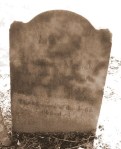
Like his father Ebenezer served as Justice of the Peace in Fairfield County, Connecticut. He also served in the military and as deputy in the assembly. Late in life he married a very young woman.
Ebenezer Mead II was born in Greenwich on October 25, 1692, the eldest son of Ebenezer Mead and Sarah Knapp.
He was married on December 12, 1717, to Hannah Brown, the daughter of Peter Brown of Rye NY, and they had Ebenezer, Silas, Abraham, Jonas, Solomon, Deliverance, Amos, Edmund, Hannah, Jabez, Jared and Abraham.
On May 9, 1728, Ebenezer was commissioned a Lieutenant of the East Company, or Train-band, at Horseneck. On May 11, 1738, he was commissioned a Captain of the same company.
He was a Justice of the Peace for Fairfield County from 1733 to 1758, and was a deputy to the assembly in 1733, 1734, 1737 and 1738.
Late in life, in 1759, when he was approaching 70, he was married for a second time, this time to Naomi Weed, the daughter of Abraham Weed. She was about twenty years old at the time.
Ebenezer Mead’s will was dated June 3, 1772, and probated June 15, 1775. In it he mentions his wife Naomi and children Deliverance, Jared, Silas, Jonas, Solomon, Amos, Abraham, Jr.; his grandson Enoch Mead, granddaughter Hannah, and grandson Ebenezer, the children of his son Ebenezer, who had predeceased him. His executor was his son Jared. The witnesses were Daniel Smith, Joshua Smith, and Jesse Parsons.
Ebenezer Mead (1692 – 1775)
is my 7th great grandfather
Deacon Silas Meade (1730 – 1807)
son of Ebenezer Mead
Abner Mead (1749 – 1810)
son of Deacon Silas Meade
Martha Mead (1784 – 1860)
daughter of Abner Mead
Abner Morse (1808 – 1838)
son of Martha Mead
Daniel Rowland Morse (1838 – 1910)
son of Abner Morse
Jason A Morse (1862 – 1932)
son of Daniel Rowland Morse
Ernest Abner Morse (1890 – 1965)
son of Jason A Morse
Richard Arden Morse (1920 – 2004)
son of Ernest Abner Morse
Pamela Morse
I am the daughter of Richard Arden Morse
Summer is extreme in Tucson. We change many of our daily routines in order to deal with the heat and intense sun. In our household this means we seriously crank up our consumption of iced tea. We drink tea all year, usually iced, but in summer two of us consume gallons every day. I have been a highly satisfied customer of Adagio Teas for years. My orders have included fruit, herbal, and roiboos teas in the past. Recently I have read a lot about different kinds of teas, so I decided to expand my repertoire by tasting some new varieties. I have tried green tea in the past, but thought I did not like it. Perhaps I brewed it badly. I have become such a raving fan in a few weeks that I have given up my morning coffee. There is caffeine in green tea, so it does the job of waking me up, and my stomach seems to like it much better. I may return to coffee when winter comes, but for now I am very happy with my morning tea. Who knows how far I will take this exploration? I love the ritualistic treatment given to tea by the Asians, and the formality and style the Brits use when they serve tea. So far I have not developed any real tea drinking rituals, but one never knows how this could end.
The flavored varieties that converted me to a green tea lover are:
Cherry Green– this lively bright flavor is the one I choose for morning. It is delicious.
Calypso Green– This one has a hint of coconut and other tropical fruit, tasty for all day
I have also ordered some new green types to try and a green roiboos. Roiboos is probably my favorite flavor, and luckily it is extremely healthful. The green, unfermented roiboos is higher in antioxidants and other nutrients. It is very beneficial to the skin, and can be applied topically to heal burns and abrasions. After drinking healthy liquids all day and staying hydrated I have even found some green tea cocktails!!! At least one ingredient will be good for me!
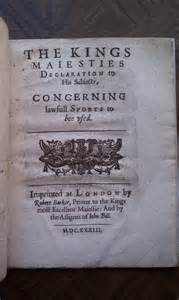
Book of Sports
When James I of England published the Book of Sports in 1617 it caused an uproar from the Puritans. The belief that no work or pleasure should take place on the sabbath was much debated at that time in Britain. The book was published after King James had his very own translation of the Bible released. Trouble was brewing in the British Isles that would eventually lead to the settlement of Plymouth Colony. The Puritans believed that all citizens must be required to attend religious services on Sunday, and they wanted them mandatory morning and evening on that day. Many of my own ancestors left England to live in Holland for a decade about that time, before sailing on the Mayflower to America. All the countries in Europe posed problems to their ideals except the Netherlands. There they could practice their severe brand of religion. There they built up strength to go to the new world.
The concept is taught to American children that these people came to America for religious freedom. That is only partially the case. They wanted to be free to dominate others and force them to follow Puritan rules. The freedom was just for their own religious beliefs, but did not apply to the beliefs of others. They were convinced of the righteousness of their logic. This made life in the new colony very contentious. It was easy to run afoul of the Pilgrim fathers who were all about sabbath and strict adherence.
Charles I reissued the Declaration of Sports in 1633, continuing the tradition of requiring attendance to religious services (in the Church of England) to qualify to dance, leap, or play sports on Sunday. There were a few sports not permitted on the sabbath such as bear and bull baiting and bowling. Charles I expanded the merriment to include local fairs and festivals on the list of sanctioned Sunday activities. England was trending Puritan in the 1630’s. In 1643 the book was publicly burned. When Charles II was restored to the throne after the English Civil War in 1660 the country was liberated from the strict sabbath rules and could once again party on Sunday afternoons.
When we think about sports and religion in America today we observe a very different story. Church attendance and membership are dropping off dramatically, but sports dominate the public attention. It is ironic to think that our initial colony was founded to make sure that Sunday would be sport free for everyone. I wonder what the Pilgrim fathers would think of the NFL and the NBA.
The term community policing has been tossed around in the media lately by experts and citizens of all kinds. This trending topic has been defined by the US Department of Justice:
Community policing is a philosophy that promotes organizational strategies, which support the systematic use of partnerships and problem-solving techniques, to proactively address the immediate conditions that give rise to public safety issues such as crime, social disorder, and fear of crime. Community policing is composed of three key components:
Partnerships – Collaborative partnerships between the law enforcement agency and the individuals and organizations they serve to develop solutions to problems and increase trust in police.
Organizational Transformation – The alignment of organizational management, structure, personnel, and information systems to support community partnerships and proactive problem solving.
Problem Solving – The process of engaging in the proactive and systematic examination of identified problems to develop and evaluate effective responses.
I hope incorporation of these policies will take place as soon as possible. Within the organizational transformation plan is a geographic approach to assignments. In other words, provide neighborhood cops who know and interact with a certain area by assigning them to that area. This is essential in my opinion, and would be helpful where I live. The advice given is to despecialize the force, creating a more generally skilled team to handle most situations. Problem solving and cooperation with the public have been missing elements to improving the safety in our city. Obvious ongoing crime would be obvious to any cop who patrolled here all the time. The force would see what we see, and even become known to the neighbors. These concepts will improve safety for both officers and the public.

sky
The systems now available to measure and monitor health are mind blowing. This slice of health care/technology is growing more popular each day. I started using Fitbit last fall to increase my movement. It is effective motivation to see performance increase over time, complete with graphs. I recently became most interested in the sleep measuring ability of my little wrist band.
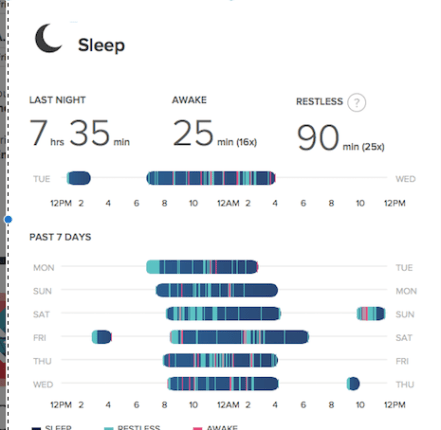
MY SLEEP LOG
As you can see I am frequently awakened during the night. My dog needs to go out and I must walk down a flight of stairs to do the task, so it does disturb my slumber. I am working this week to push back towards longer deeper sleep by using honey. Last night on the 3rd trip down with the dog I drank a shot of honey and warm milk, which seemed to work pretty well. I am also napping after lunch when possible because at that time I zonk out easily. I do not pay for the advanced membership to Fitbit that provides constant reports and comparisons to your age group in the population. However, I am taking advantage of the offer to create a one week report for free. My results will be final on Saturday, and graphed. I feel very competitive and funny about this challenge. I want to see an improvement in my sleep in one week. This may prove to be irrational as a goal, but I am still trying it. I wonder if I can will myself to be a better sleeper in the long run. Over the last three days I have managed to increase my total time, but without the naps it would not have been the case. This is one challenge for which gearing up is against my better interests. How does one become a sleep champion?
Do you use any fitness monitoring devices or apps? Have you found the feedback helpful in changing your habits? What kind of sleep secrets have you learned, gentle reader? I am on a quest for better rest.

Roger La Zouche
Roger la Zusche, for his fidelity to King John, had a grant from that monarch of the manors of Petersfield and Maple Durham, co. Southampton, part of the lands of Geoffrey de Mandeville, one of the rebellious barons then in arms. In the next reign he was Sheriff of Devonshire, and had further grants from the crown. Roger la Zouche, Sheriff of Devonshire, between 1228 and 1231,was a younger son of Alan la Zouche and Alice de Belmeis. He was born circa 1182 in Ashby, Leicestershire, England. He was the heir of his brother William in 1199. He married Margaret (?) before 1203. He was a witness to Henry III’s confirmation of the Magna Charta. He died before 14 May 1238. The Roger la Zouche family manor, built in the 12th century, was converted into Ashby de la Zouche Castle in 1447 by Lord William Hastings.
Roger la Zouche [elder brother William dsp 1199], of Ashby-de-la-Zouche, Leics; served in Poitou, possibly under Geoffrey (died 1205), an illegitimate son of King John who held the homour of Perche and led an expedition of mercenaries to France in 1205, and again in 1214, though under some other leader; served in Ireland 1210; took an oath to uphold the baronial enforcement of Magna Carta 1215 but witnessed a charter issued by John 1216, hence had presumably switched support to the King by then; benefited from substantial land grants in Cambs, Devon, Hants and Norfolk at John’s and Henry III’s hands; Sheriff of Devon 1228-31; a witness to Henry III’s confirmation of Magna Carta Jan 1236/7; married Margaret (died in or after 1220 or even as late as 1232 or after) and died by 14 May 1238. [Burke’s Peerage]
Roger la Zusche who, for his fidelity to King John, had a grant from that monarch of the manors of Petersfield and Maple Durham, co. Southampton, part of the lands of Geffrey de Mandeville, one of the rebellious barons then in arms. In the next reign he was sheriff of Devonshire and had further grants from the crown. By Margaret, his wife, he had issue, Alan, his successor, and William, who left an only dau., Joice, who m. Robert Mortimer, of Richard’s Castle, and had issue, Hugh Mortimer, summoned to parliament as Lord Mortimer, of Richard’s Castle; and William Mortimer, who assumed the surname of Zouche, and was summoned to parliament as Lord Zouche, of Mortimer. He was s. by his elder son, Sir Alan la Zouche. [Sir Bernard Burke, Dormant, Abeyant, Forfeited, and Extinct Peerages, Burke’s Peerage, Ltd., London, 1883, p. 598, Zouche, Baron Zouche, of Ashby, co. Leicester]—————–Ancestral Roots, p. 43, younger son (of Alan Ceoche of La Coche), heir to brother William 1199, sheriff of Devonshire 1228-31, a witness to Henry III’s confirmation of the Magna Carta, d. shortly before 14 May 1238. Browning, p. 308, lists him as son of Roger, son of Alain IV, Viscount de Rohan, Count of Brittany and Mabilla, dau. of Raoul II, Lord of Fourgeres.————————————————————————– ———–ROGER LA ZOUCHE, brother and heir, paid £100 to have William’s lands in 1199. Those in England were seized, before 1204, while he was in Brittany, because of the war in Normandy, and he proffered 100m. to regain possession of them in that year. He served in Poitou, 1204-05 and 1214; was in Ireland, 1210; and swore to support the Barons who were enforcing Magna Carta in 1215. However, he soon joined the King, for he witnessed a royal charter, 11 June 1216, and was rewarded, both at the end of John’s reign and during the opening years of Henry III, with numerous grants of land. He had licence to go on pilgrimage to Santiago, 6 August 1220; was given money as a royal messenger, October 1224; was going to Brittany, with the King’s leave, May 1228; Sheriff of Devon, 10 November 1228-April 1231. In May 1229 he, with Philip Daubeney and Godfrey de Crawcombe, was allowed 100m. to cover the costs of a mission across the seas for the King. He served in Brittany, 1230; was ordered to find one knight at the King’s cost to aid the Duke of Brittany, 1234; and was among those who witnessed Henry III’s confirmation of Magna Carta at Westminster, 28 January 1236/7. He married Margaret, who was living in 1220 and presumably 1232. He died shortly before 14 May 1238. [Complete Peerage XII/2:931-2, (transcribed by Dave Utzinger)]
Roger Devonshire La Zouche (1175 – 1238)
is my 20th great grandfather
Sir Knight Alan II Knight Baron of Ashby Constable of the Tower of London de la Zouche (1205 – 1270)
son of Roger Devonshire La Zouche
Eudo LaZouche (1245 – 1279)
son of Sir Knight Alan II Knight Baron of Ashby Constable of the Tower of London de la Zouche
Elizabeth La Zouche (1274 – 1297)
daughter of Eudo LaZouche
Nicholas Poyntz (1303 – 1376)
son of Elizabeth La Zouche
Nicholas Poyntz (1355 – 1372)
son of Nicholas Poyntz
Pontius Poyntz (1372 – 1393)
son of Nicholas Poyntz
John Poyntz (1412 – 1447)
son of Pontius Poyntz
William Poyntz (1455 – 1494)
son of John Poyntz
Thomas Poyntz (1480 – 1562)
son of William Poyntz
Lady Susanna Elizabeth Poyntz (1528 – 1613)
daughter of Thomas Poyntz
Elizabeth Saltonstall (1557 – 1621)
daughter of Lady Susanna Elizabeth Poyntz
Henry Wyche (1604 – 1678)
son of Elizabeth Saltonstall
Henry Wyche (1648 – 1714)
son of Henry Wyche
George Wyche (1685 – 1757)
son of Henry Wyche
Peter Wyche (1712 – 1757)
son of George Wyche
Drury Wyche (1741 – 1784)
son of Peter Wyche
Mary Polly Wyche (1774 – 1852)
daughter of Drury Wyche
John Samuel Taylor (1798 – 1873)
son of Mary Polly Wyche
William Ellison Taylor (1839 – 1918)
son of John Samuel Taylor
George Harvey Taylor (1884 – 1941)
son of William Ellison Taylor
Ruby Lee Taylor (1922 – 2008)
daughter of George Harvey Taylor
Pamela Morse
I am the daughter of Ruby Lee Taylor
Baron Zouche is a title that has been created three times in thePeerage of England. The de la Zouche family descended from Alan de la Zouche, sometimes called Alan de Porhoët and Alan la Coche (c. 1093-1150), a Breton who settled in England during the reign of Henry II. He was the son of Vicomte Geoffrey I de Porhoët and Hawisa of Brittany. He married Adeline (Alice) de Belmeis, daughter of Phillip de Belmeis and Maud la Meschine and died at North Molton in North Devon. He obtained Ashby in Leicestershire(called after him Ashby-de-la-Zouch) by his marriage. His son was Roger la Zouche (c. 1175 – bef. 14 May 1238). Roger La Zouche became the father of Alan la Zouche (1205–1270) and Eudo La Zouche. Alan was justice of Chester and justice ofIreland under Henry III of England. He was loyal to the king during the struggle with the barons, fought at the Battle of Lewesand helped to arrange the peace of Kenilworth. As the result of a quarrel over some lands with John de Warenne, 6th Earl of Surrey, he was seriously injured in Westminster Hall by the earl and his retainers, and died on 10 August 1270.Eudo La Zouche married Millicent de Cantilupe. Alan’s grandson, Alan la Zouche, was summoned to Parliament on 6 February 1299 as Baron la Zouche of Ashby. He was governor of Rockingham Castle and steward of Rockingham Forest. However, this barony fell into abeyance on his death in 1314. Another grandson of Alan de la Zouche was William la Zouche, Lord of Haryngworth, who wassummoned to Parliament as Baron Zouche, of Haryngworth, on 16 August 1308. His great-great-great-grandson, the fifth Baron, married Alice Seymour, 6th Baroness St Maur, and assumed this peerage in her right. Their son succeeded to both titles; his stepmother, Elizabeth St. John, was an aunt of the future Henry VII, a connection which proved useful to later members of the family. The seventh Baron was attainted in 1485 for loyalty to Richard III but was eventually restored to his title and a portion of his lands. On the death in 1625 of the eleventh and twelfth Baron, the peerages fell into abeyance between the latter’s daughters Hon. Elizabeth and Hon. Mary. However, in 1815 the Barony of Zouche was called out of abeyance in favour of Sir Cecil Bishopp, 8th Baronet, of Parham Park (see Bishopp baronets of Parham), who became the twelfth Baron Zouche. Through his mother he was a descendant of the aforementioned Hon. Elizabeth. The Barony of St Maur, however, remains in abeyance to this day. His two sons had died before him and on his death in 1828 he was succeeded in the Baronetcy by a cousin, while the Barony of Zouche once again fell into abeyance, this time between his two daughters Hon. Harriet Anne Curzon and Katherine Annabella, Lady Brooke-Pechell. His eldest son Lieutenant-Colonel Cecil Bisshopp had died in 1813 at age 30 at Ontario, Canada, from wounds received in action against the Americans in the War of 1812. The abeyance was terminated the following year in favour of Hon. Harriet Anne, who became the thirteenth Baroness. Known as Baroness de la Zouch, she was the wife of Hon. Robert Curzon, younger son of Assheton Curzon, 1st Viscount Curzon. Her son was the fourteenth Baron. On his death the title passed to his son, the fifteenth Baron, and then to the latter’s sister, the sixteenth Baroness. She never married and was succeeded by her second cousin, the seventeenth Baroness, the granddaughter of a younger son of the thirteenth Baroness. She was succeeded by her grandson, the eighteenth and (As of 2013) present Baron, who had already succeeded his father as 12th Baronet in 1944.Another grandchild of the original Alan de la Zouche, Joyce la Zouche, married Robert Mortimer of Richard’s Castle; one of their younger sons, William la Zouche, took the name of la Zouche and bought Ashby-de-la-Zouch from Alan in 1304, the latter to hold it until his death (1314). On 26 December 1323, he was created, by writ, Baron Zouche of Mortimer. This peerage became abeyant in 1406.Barons la Zouche of Ashby (1299)[edit]Alan la Zouche, 1st Baron la Zouche of Ashby (1267–1314) (abeyant 1314)Barons Zouche of Haryngworth (1308)[edit]Barons Zouche of Haryngworth:[1]William la Zouche, 1st Baron Zouche (18 or 21 December 1276– 11 or 12 March 1351)William la Zouche, 2nd Baron Zouche (c.25 December 1321 – 23 April 1382)William la Zouche, 3rd Baron Zouche (c. 1355 – 4 May 1396)William la Zouche, 4th Baron Zouche (c. 1373 – 3 November 1415)William la Zouche, 5th Baron Zouche (c. 1402 – 25 December 1462)William la Zouche, 6th Baron Zouche, 7th Baron St Maur (c. 1432 – 15 January 1468/9)John la Zouche, 7th Baron Zouche, 8th Baron St Maur (1459 – c. March 1525/6) (His attainder of 1485 was reversed in 1495)John la Zouche, 8th Baron Zouche, 9th Baron St Maur (c. 1486 – 10 August 1550)Richard la Zouche, 9th Baron Zouche, 10th Baron St Maur (c. 1510 – 22 July 1552)George la Zouche, 10th Baron Zouche, 11th Baron St Maur (c. 1526 – 19 June 1569)Edward la Zouche, 11th Baron Zouche, 12th Baron St Maur (6 June 1556 – 18 August 1625) (abeyant 1625)Cecil Bisshopp, 12th Baron Zouche (29 December 1752 – 11 November 1828) (abeyance terminated 1815; abeyant 1828)Harriet Anne Curzon (née Bisshopp), 13th Baroness Zouche (7 September 1787 – 15 May 1870) (abeyance terminated 1829)Robert Curzon, 14th Baron Zouche (16 March 1810 – 2 August 1873) son of 13th BaronessRobert Nathaniel Cecil George Curzon, 15th Baron Zouche (12 July 1851 – 31 July 1914) son of 14th BaronDarea Curzon, 16th Baroness Zouche (1860–1917) sister of 15th BaronMary Cecil Frankland, 17th Baroness Zouche (1875–1965) second cousin of 16th BaronessJames Assheton Frankland, 18th Baron Zouche and 12th Baronet (b. 1943) grandson of 17th BaronessThe heir apparent is the present holder’s son Hon. William Thomas Assheton Frankland (b. 1983).Barons Zouche of Mortimer (1323)[edit]William la Zouche, 1st Baron Zouche of Mortimer (d. 1337)Alan la Zouche, 2nd Baron Zouche of Mortimer (1317–1346)Hugh la Zouche, 3rd Baron Zouche of Mortimer (1338–1368)Robert la Zouche, 4th Baron Zouche of Mortimer (d. 1399)Joyce Burnell, 5th Baroness Zouche of Mortimer (d. 1406) (abeyant 1406)See also[edit]House of RohanBaron St MaurBishop baronets, of ParhamFrankland baronets, of ThirkelbyNotes[edit]Jump up^ Cokayne, George Edward (1910–1959). The Complete Peerage of England, Scotland, Ireland, Great Britain, and the United Kingdom. London: The St. Catherine Press.[page needed]References[edit]Leigh Rayment’s Peerage Pages [self-published source][better source needed]Burke’s Dormant and Extinct Peerages, London, 1883

sky
Symbols in dreams are personal. We dream only of faces we have seen before, even if we are barely familiar with the person. The character, or archetype played by the face depends completely on personal experience. Dream dictionaries and aids to interpret meaning found in dreams can only make references to universal archetypes. To grasp the personal message brought to the dreamer the images themselves must be savored and visited in waking time. Writing in a diary upon awaking before moving or engaging in the activities of the day is helpful. By keeping these notes on a regular basis you may discover themes that you can identify in a personal way.
Sometimes at crossroads in life a person will receive a vivid memorable message during sleep. The images and meaning of mythic dreams are significant beyond the every day way the unconscious communicates. The protagonists in the drama make a deep impression that lasts and speaks to the psyche for a long time. Carl Jung identified seven basic archetypes making appearances in dream time.
Loaded images and story lines float through our heads while we sleep. If we have a problem on the mind it is possible to solve it during a dream. Practice and meditation on our own dream images will make clearer the point of the communication. Our subconscious warns us, encourages us, and sometimes tells us we are foolish. It is never straightforward, but over time we can dig more deeply into the messages our dreams deliver on a nightly basis. Have you ever kept a dream diary, gentle reader? Have you ever had a mythic dream that changed your thinking?

desert

Green Things Nursery
In business clients have many choices. They can patronize establishments that consistently recognize them, treat them with respect and value their patronage. Some people like to know they are paying the lowest prices for everything they buy, without regard to quality. The service aspect is less important to these folks. Utilitarian objects are valuable if they last, require little care, and are simple to operate. Environments in which people spend time like stores, salons, restaurants, hotels, or spas, are delivering a designed experience beyond the consumer goods they offer for sale. They offer a feeling of being important and unique. I believe the difference between average service and stellar service is attention to the importance of the customer’s special preferences. This might sound basic, but think about times when you feel happy because everything is just the way you like it to be. When services are applied with a broad brush, one size fits all, the result is rarely satisfying to the recipient. Some minor as well as major attention must be paid to how the customer likes to proceed in order to create a service that customer will value highly.
I like to know that my service providers of all kinds are professional. I can tell right off the bat because showing up on time is the first way to impress me that my business is center of attention. Manners matter. Punctuality, as well as finishing on target, are part of the customer service tool kit. I remember those providers who make me wait without a call or explanation of the tardiness. They do not get invited to return to my house. On the other hand once I find a professional, punctual, polite provider my loyalty is fierce. I don’t shop around for lower prices when I am pleased with the services I receive. I will happily pay a little extra to know that my job will be done with pride.
When I need to call on a warranty for a service or product I am always impressed if that repair or replacement is done quickly and well. I sent back a Bunn coffee maker three times while under warranty. I now have that third model for years, working perfectly. I was very pleased when they sent me new ones without hesitation along with a Fedex prepaid voucher to send the broken one back for investigation. I will probably be a Bunn customer for life both for the product quality and the customer relationship. I feel the same way about my health club, my contractor, mechanic, and massage therapists. As a consumer I am particular, but not hard to please. Once I have found a match that works well for me I stick with it. What kind of customer are you, gentle reader? Are you more loyal or adventurous?

Green Things Nursery

Morse Monument This monument was erected to the memory of seven Puritans who emigrated from England to America in 1935-39. The front inscriptions are: John Mosse, Born 1604, settled at N. Haven, died 1707 at Wallingford Ct. Samuel Morse, born 1585, settled at Dedham 1636, died at Medfield 1654. Joseph Morse, settled at Ipswich where he died 1646. Anthony Morse, born at Marlborough Engl’d 1616, died at Newbury 1686. William Mors B. 1608, D. 1683 and Robert & Peter brothers, settled and d in N. J. Rear inscriptions: Elizth Morse wid. of Samuel D. June 26, 1654. Samuel Morse Col in Cromwell’s ARmy D. at the Eastward Sept. 24, 1688. John, D at Boston 1657. Daniel, D. at Sherborn JUne 5, 1688. Jeremiah, D in the Civil War in Eng. Joseph, D in Medfield 1653. Lt. Samuel who D. in Medf. Feb. 28, 1718, CPT. Joseph who D. in Sherboren Feb. 19, 1718 and Jeremiah who D. in Medf. February 19, 1716. Taken from The Morse Society Webmaster
Anthony Morse of Newbury, MA came from Marlborough, Wiltshire, England and settled in Newbury, Massachusetts in 1635. He and his brother, William Morse, registered as shoemakers. Anthony arrived in Boston with his brother William, on the “James” June 3, 1635 which sailed from Southampton on April 5, 1635. Anthony built a house about 1/2 mile south of the cemetery in what is now called Newbury old town. He was admitted as a Freeman May 25, 1636.
Anthony Morss (1606 – 1686)
is my 10th great grandfather
Robert Morse (1629 – 1677)
son of Anthony Morss
Joshua Morse (1669 – 1753)
son of Robert Morse
Joseph Morse (1692 – 1759)
son of Joshua Morse
Joseph Morse (1721 – 1776)
son of Joseph Morse
Joseph Morse III (1756 – 1835)
son of Joseph Morse
John Henry Morse (1775 – 1864)
son of Joseph Morse III
Abner Morse (1808 – 1838)
son of John Henry Morse
Daniel Rowland Morse (1838 – 1910)
son of Abner Morse
Jason A Morse (1862 – 1932)
son of Daniel Rowland Morse
Ernest Abner Morse (1890 – 1965)
son of Jason A Morse
Richard Arden Morse (1920 – 2004)
son of Ernest Abner Morse
Pamela Morse
I am the daughter of Richard Arden Morse
Last Will and Testament of Anthony Morse of Newbury, Mass I anthony Morss of Newbury in the name of god amen i being sensible of my own frality and mortality being of parfit memory due make this as my last will and testament commanding my sole to god that gave it and my body to the dust in hope of a joyful resurixition and as for my wourly good I dispose of as foloieth. I give and bequeth to my son Joshua Morse making him my lawful eaire all my housing and lands both upland and meddow with my freehould and privilidge in all comon land both upland and meddow alweais provided that it the town of Newbury dou divide any part of the comon lands that then the on half part of that land which belongeth to me which cometh by vartu of my freehould shall be the lawful inheritance of my son benieman (Benjamin)morse all so I geve to my son Joshua morse all my cattell an horsis and sheep, swuine and all my toules for the shumaking trade as allso my carte wheles dung pot plow harrow youkes chains houses forkes shovel spad grin stone yt as allso on father bed which he lieth on with a bouister and pillo and a pair of blinkets and covrlitt and tou pair of shetes scillet and to platars and a paringer and a drinking pot and tou spoons and the water pails and barils and tobes all these about named I geve to my son Joshua and his eaires of his own body begotten lawfully than then all aboue geven to my son Joshua shall Return to the Rest of my children upon the peayment on good peay to my sons widow besides waht estate she att any time brought to her husband she the said widdow shall enjoy the houl estate on half year before she shall surrenter – also I geve to my son Robard (Robert) Morse Eighteen pounds or his children to my son Peter Morse or children L3, to my son Anthony Morse children I geve L3 to my son Joseph Morses children I geve L12 to my son Benieman Morse or children I geve L12 to my dafter Thorlo or children L12 to my dafter Skickney or children I geve L12 to my dafter Newman children I geve L12 to my dafter Smith or children I geve L12 to my grandson Richard Thorlo I geve an sheep, to my grandson Robard Homes I giev fiev pounds allso I geve the Remainder of my housall which is not in partikelar geven to my son Joshua in the former part of this my will to all my children equally to be devided between them and my grand children hous parents are dead, namely anthonys children, Josephs children hanahs children, allso I dou by this my last will allow and geve loberty to mu son Joshua morse hou is my Eaire to make said and dispose of that land by the pine swamp which I had of Nenieman lacon of that pece of land by John Akisons hous if he see Resan so to do. also I du by this my will apoynt my son Joshua morse to be my sole esecutor to peay all debts and legacies by this will geven and to Rceve all debtes allso I dou apoynt my loving and crisian frinds Cap danil Pears and Tristram Coffin and thomas noyes to be oversers of this my last will also I dou apoynt my Exicutor to peay my son Robard and son peter within one yeare after my death on the the other to be peaid within three years the plas of peayment to be newbury my will is tyhat my son benieman shall have the on half of all comon lands when devided as above said in witness thereof I anthony morse have hereunto Set my hand and seall this 28th Aprell, 1680. Sinid selid and onid in the presense of us James Coffin Mary Brown that whereas I anthong Morse in this my will abou said have geven on half of all common lands if devided to my sonn benieman mors; my meaning iss that my sons benieman shall haev the on half of my proportion of lands when devided, but my sonn Joshua to haev all my Rights in the lower comon this is my mind and will as witnes my seall this 20 of aprell 1680. Anthony Morse (Seal) Witness to this part of my will James Coffin Mary Brown Joshua Morse is allowed Exer to this will. from – The Morse Genealogy, 1903-05 – Will is on file at Salem, Essex County, Massachusetts. From History of Newbury – Newbury MA Web site: The settlers of Newbury were much like those of what is now northern Essex county. They were not religious enthusiasts or pilgrims who fled from religious persecution in England. The were substantial, law abiding, loyal English tradesmen of that staunch middle class that was the backbone of England. Those that settled Newbury came at different times and on different ships between the end of April 1634 and July 1635. In one of the first ships arriving in 1645, was Thomas Parker, a minister who came along with a small company of settlers. They were first at Agawan (Ipswich) and later along with their countrymen, who came from Wiltshire England to Newbury. The first settlers came by water from Ipswich through Plum Island Sound and up the Quascacunquen River, which was later renamed the Parker River. There had been a few fisherman occupying the banks of the Merrimac and Parker rivers before this, but they were not permanent settlers. These settlers came to New bury in May or June of 1635. Ships from England began to arrive almost immediately with cattle and more settlers. Governor Winthrop in his history of New England under the date of June 3, 1635, records the arrival of two ships with Dutch cattle along with the ship James from Southampton bringing more settlers. Newbury was therefore begun as a stock raising enterprise and the settlers came to engage in that business and to establish homes for themselves. In total 15 ships came in June and one each in August, November and December, bringing still more families to the settlement. There is no record of how many families arrived in the first year. Houses were erected on both sides of the Parker River. The principal settlement was around the meeting house on the lower green. The first church in Newbury could not have been formed before June as some of those recorded at its formation are not recorded as having arrived until June. In the division of land, the first settlers recognized the scripture rule “to him that hath shall be given” and the wealth of each grantee can be estimated by the number of acres given him. The reason for establishing Newbury, as stated above, was not from fleeing religious persecutions, but to utilize vacant lands and to establish a profitable business for the members of a stock-raising company. When they arrived in Massachusetts, the settlers found that the state had established the Congregational form of religion. Everyone was taxed to support the Congregational Society and was commanded to attend worship at the meeting house. The Reverend Thomas Parker was a member of the stock raising company and was also the minister of the settlers. The outlying settlers had a long journey to the meeting house. The congregations were in danger of attacks from Indians and wild beasts on their way to and from worship. There was a constant dread of attack during the time of services and all able bodied inhabitants were required to bring their weapons to church. Sentinels were posted at the doors. In spite of the hardship and danger, the population steadily increased in number and gradually improved its worldly condition. Being cramped for room, the settlers moved up to the upper or training green. This was in order to get tillable land and engage in commercial pursuits. This movement began in 1642. Each had been allotted half an acre for a building lot on the lower green. On the upper green each was to have four acres for a house lot. Also on the upper green a new pond was artificially formed for watering cattle. The new town gradually extended along the Merrimac River to the mouth of the Artichoke River. It appears that all desirable land in this region was apportioned among the freeholders by October 1646. The land beyond was ordered to lie perpetually common. This tract of common land was a part of Newbury and what is now West Newbury. The Indian threat had disappeared as most of the Indians in the region had been exterminated by an epidemic. The first record of an Indian living in Newbury is in January 1644, when a lot was granted to “John Indian”. In 1639 Edward Rawson began the manufacture of gun powder in what was probably America’s first powder mill. Newbury had a trial for witchcraft thirteen years before the trials in Salem. In 1679 Elizabeth Morse, sister-in-law to our ancestor, Anthony, was accused. She was condemned three times to die, but was reprieved and spent her last years in her home at what is now Market square in Newburyport. The first American born silversmith was Jeremiah Dummer of Newbury, who apprenticed to John Hull, an Englishman. He practiced his trade at what is now Newburyport. Jeremiah was the father of Governor William Dummer the founder of Gov. Dummer Academy. Jeremiah’s brother-in-law John Coney, engraved the plates for the first paper money made in America. In 1686, when the upper Commons (West Newbury) were divided among the freeholders of the town of Newbury, Pipestave Hill was covered with a dense forest of oak and birch. These trees were cut and used to make staves for wine casks and molasses hogsheads. For many years, this industry, the first of its kind in American, flourished and the place is still called Pipestave Hill. Limestone was discovered in Newbury in 1697. Previous to this all the lime used for building was obtained from oyster and clam shells. Mortar made from this lime was very durable and came in time, to be almost as hard as granite. This business prospered for many years until a superior quality of lime was discovered elsewhere. The first toll bridge and shipyard in America were also in Newbury. The latter giving rise to the ship building industry, which was to determine the prosperity of Newburyport in the coming centuries. In West Newbury, in 1759, Enoch Noyes began making horn buttons and coarse combs of various kinds. This was the beginning of the comb making business in Newbury and other places. This business continued and grew, moving to Newburyport inn its later years, closing in 1934. Lt Gov. William Dummer, in his will of 1761 directing that a school house be erected on the most convenient part of his farm. In 1762, the first schoolhouse was erected, a low one story building about twenty feet square commencing its sessions in 1783, this is the oldest boarding school in America. In 1764, that part of Newbury, which had become the commercial center was divided off and made Newburyport. This action relegated Newbury to a rural and fishing community. Today Newbury is a quiet New England town, rich in heritage, the birthplace of many things American, not the least of which is an abiding reverence for our past. The Landing at Parker River from Ould Newbury – Historical and Biographical Sketches by John L. Currier *196 – Damrell and Upham, Boston, Mass. debthomas660debthomas660 originally shared this to Thomas/Jones Family Tree22 Aug 2009
I worked as an outside sales travel agent for many years. I took care of my own clients and split my commissions with the agency where I worked. I served all kinds of different clients, mostly recreational. They knew the destination and how long they would stay. They wanted to find the best airfare. Back in the day only agents or the airlines themselves had access to the digital systems used for booking. Some people wanted nothing more than the best fare for a flight, but others wanted some guidance in planning. Naturally each vacationer wants to think they have a great bargain package, but very few would tell the agent how much they had planned to spend. This question was rarely answered. Today, of course, consumers shop for their own travel and have resources available to do research. Yelp and TripAdvisor help prospective clients judge destinations by reading the reviews of other holiday makers. This helps people fit the vacation to personal taste, and avoid costly bad matches in accommodations.
In summer thoughts turn to vacation. I no longer book travel for other people but I do want to offer some advice for a stress free and happy trip, no matter where you roam.
You need to budget both time and money in order to get the most value out of your time on holiday. Think first of the beginning and the end of the trip. Leave plenty of time on both ends for unexpected events and delays. Don’t fly to a wedding on a flight that is scheduled to arrive 3 hours before the ceremony. Don’t drive home for 12 hours straight on the last night of your time off from your job. I always like to have a full day at home before I have an appointment, just so I can recover and/or be delayed in transit. If you give yourself plenty of leisure time you will come back refreshed, even if you use it to be very energetic. Cramming too many destinations or plans into the time allowed can ruin the rhythm of your rest and relaxation. It is bad to return exhausted.
It is worse to return home in deep debt. A satisfying vacation is one you can afford without sweating. After you calculate your airfare and special events be reasonable about how you will want to dine, shop, and entertain yourself. There is a strong association between freewheeling spending and American Dreaming. Remember this especially if you plan to spend time in Nevada. I think the worst buyer’s remorse is that of the vacationer who has not yet paid for the trip that did not really come up to snuff. That charge on the credit card remains to add insult to injury for a long time. Please set a limit, a budget, and a goal for your holiday spending. Be creative to make the most of your free time. Bon voyage, gentle reader.
 mermaidcamp