mermaidcamp
Keeping current in wellness, in and out of the water
You can scroll the shelf using ← and → keys
You can scroll the shelf using ← and → keys


My 19th great grandmother is buried in the cathedral in Sevilla, just like Christopher Columbus. I always wanted to go to Sevilla to dance with gypsies. Now I have another reason to go:
María Díaz de Padilla (María de Padilla) (1334 – August 1361) was the mistress of King Peter of Castile whom she married in secret in 1353.
She was a Castilian noblewoman. Her father was Juan García de Padilla, 1st Lord of Villagera, her mother was his wife María Fernández de Henestrosa, a relative of Juan Fernández de Henestrosa, who mediated an apparent pardon to Fadrique Alfonso of Castile, a half-brother and rival of María de Padilla’s lover, King Peter.
In the summer of 1353, under coercion from family and court nobles, Peter denied the fact of his marriage to María to marry Blanche of Bourbon, but his relationship with María continued. María and Peter had at least four children: a daughter named Beatrice (born 1354), a daughter named Constance (1354–1394), another daughter named Isabella (1355–1394), and a son named Alfonso, crown-prince of Castile (1359 – October 19, 1362).
Two of their daughters were married to sons of Edward III, King of England. Isabella, married Edmund of Langley, 1st Duke of York, while the eldest, Constance, married John of Gaunt, 1st Duke of Lancaster, leading him to claim the crown of Castile on behalf of his wife. The daughter of Constance, Catherine of Lancaster, was married by Henry III of Castile in order to reunify any claim to succession that may have passed via Constance.
Depictions in fiction
Gaetano Donizetti composed Maria Padilla (1841), an opera about her relationship with King Peter.
Rudolf Gottschall wrote Maria de Padilla (18??), a drama about her life.
Maria Juana Depadilla (1335 – 1361)
is my 19th great grandmother
Isabella Perez Plantagenet (1355 – 1392)
daughter of Maria Juana Depadilla
Constance Plantagenet Despencer (1374 – 1416)
daughter of Isabella Perez Plantagenet
Eleanor DeHoland (1405 – 1452)
daughter of Constance Plantagenet Despencer
Ann Touchet (1441 – 1503)
daughter of Eleanor DeHoland
Anna Dutton (1449 – 1520)
daughter of Ann Touchet
Lawrence Castellan of Liverpool Mollenaux (1490 – 1550)
son of Anna Dutton
John Mollenax (1542 – 1583)
son of Lawrence Castellan of Liverpool Mollenaux
Mary Mollenax (1559 – 1575)
daughter of John Mollenax
Francis Gabriell Holland (1596 – 1660)
son of Mary Mollenax
John Holland (1628 – 1710)
son of Francis Gabriell Holland
Mary Elizabeth Holland (1620 – 1681)
daughter of John Holland
Richard Dearden (1645 – 1747)
son of Mary Elizabeth Holland
George Dearden (1705 – 1749)
son of Richard Dearden
George Darden (1734 – 1807)
son of George Dearden
David Darden (1770 – 1820)
son of George Darden
Minerva Truly Darden (1806 – 1837)
daughter of David Darden
Sarah E Hughes (1829 – 1911)
daughter of Minerva Truly Darden
Lucinda Jane Armer (1847 – 1939)
daughter of Sarah E Hughes
George Harvey Taylor (1884 – 1941)
son of Lucinda Jane Armer
Ruby Lee Taylor (1922 – 2008)
daughter of George Harvey Taylor
Pamela Morse
I am the daughter of Ruby Lee Taylor
King Peter met María in the summer of 1352 during an expedition to Asturias to battle his rebellious half-brother Henry. It was probably her maternal uncle, Juan Fernández de Henestrosa, who introduced them, as mentioned in the chronicle of King Peter’s reign written by Pero López de Ayala. . At that time, María was being raised at the house of Isabel de Meneses, wife of Juan Alfonso de Alburquerque, a powerful nobleman. They became lovers and their relationship lasted until her death despite the King’s other marriages and affairs.
In the summer of 1353, under coercion from family and the main court favorite, Juan Alfonso de Alburquerque, Peter wed Blanche of Bourbon, the grand-daughter of the king of France. Peter abandoned Blanche within three days when he learned that she had an affair with his bastard brother Fadrique Alfonso en route to Spain, and that the dowry was not coming.





I ate lunch today at my new favorite restaurant, Cafe Botanica. This charming restaurant is nestled into the exotic greenery at Tucson Botanical Gardens. I visit frequently and for no particular reason had never eaten there. When I met a neighbor who works there as a server I decided to make a point to try the food. To my great surprise the offerings are the most seasonal, the most creative, and for my personal taste, the most delightful plates in the city of Tucson. The concept is to make use of every kind of local, organic, sustainable source of ingredients. I think they go beyond any other restaurant to achieve this goal, but without the brilliance of Chef Cristopher and his wild creativity the concept would not be as smashing. He combines ingredients I would not have thought of, including some I have never eaten, such as radish tops. The result was exactly the kind of full flavor, gorgeous to see, plate of variety I want to eat all the time. The great news is that I have a garden, and they will trade me prepared food for some of my extra produce. This could become a serious habit…the kind with only positive effects!!!
New Summer hours will start on June 3, including a weekend brunch. Dog membership also begins on June 3, and has expanded to inviting member dogs on both Tuesday and Thursday this year. The innovative menu, and the fact that the gardens create a cooler micro climate for morning walks will be an exciting new addition to our neighborhood. There will also be Thursday dinners this summer with BYOB wine. This is a major upgrade for Tucson. I highly recommend Cafe Botanica to anyone. There is an air conditioned inside dining room for times when it is too hot. The gourmet, homemade dishes are very reasonably priced, and there is no chef more caring, and into it, than Christopher. Mandy, my friend and server, puts her heart into making guests feel right at home.
Our neighborhood has started to use Nextdoor.com to reach people in our vicinity. I am very impressed with the results after trying it for just a couple of months. We have 61 members, or 5% of the homes in our neighborhood participating. The San Diego Police Department has joined Nextdoor and is using it to inform citizens and get tips. In Tucson we are not yet so lucky as to have communication from or to the cops, but I believe in time all police departments will see the value in sharing information with the community. In San Diego it was very helpful for informing the public about the recent wildfire problems. The crime and safety features are excellent, but beyond that people are connecting about common interests such as pets (lost and found), gardening, and yard sales. There have been some really good offers of free construction materials and plants.
I believe this start up has the potential to improve quality of life in ways we have not yet discovered. I immediately started a garden club, but am not sure what it will do. I am sure it will not hold flower shows like my mother’s garden club did. We have met each other and exchanged some plants to break the ice. Water is precious and expensive around here, so gardeners sharing knowledge and plants could turn out to be very helpful. I don’t care what kind of garden club we become. I simply love to know others around me who have some common interests. I have met some of my long distance contacts on social media, but it required travel and some expense. Meeting my own neighbors is a bit of a cheap thrill in comparison. It is very fun for me.
As with all things digital the balance between privacy and safety must be considered. In order to join one must verify that one lives in the neighborhood. This becomes tricky because some people don’t want to publish their addresses. I have just now experienced someone joining with a fake ID that is not known at the address he used. I can’t imagine what a hacker/prowler would want with our lost cat information, but then again I am not a hacker/prowler. This issue may be a little sticky, but the benefits outweigh the demerits in my opinion. Also, the CEO of the company is in a spat about a driving incident in San Mateo which could prove to be a drag for the company’s future. This case will be handled in California courts, and it does not make me love our Nextdoor site any less. It is my very strong opinion that Nextdoor.com is not only the wave of the future for law enforcement but for an elevated standard of life, liberty and the pursuit of happiness. Oakland, CA, Pittsburgh,PA, and other cities have partnered with the site. If you are interested in starting a site for your neighborhood you only need 10 people to join to qualify for your free website. Nextdoor will send out free postcards to let your neighbors know about it. After you invite more people and the membership reaches about 50 it grows organically. I enthusiastically urge you to give it a try. If you start a new site and use my code: nextdoor.com/amazon/?r=awrupt we will both receive a $25 Amazon gift card. What is not to like about that?
You did not have to be psychic to know that Ho Chi Mihn would win. The United States had invaded a country in southeast Asia with no previous relationship with the people of that area. They had instituted a draft to conscript the youth of America to fight in a war of political insanity. Many died, many more became embittered and seriously addicted to opiates while fighting in a way made up by old white men to conquer Asia. Lyndon Johnson stood in the spotlight of this ill-conceived battle to create American supremacy throughout the world. He was a complete tool of what America stood for in the world…which all the youth of America quickly named bullshit. I was 17 years old, knew friends who joined the Marines, and found the entire idea despicable. I could not support this kind of slaughter of youth for the ego of old men in power. I did not want to sacrifice my high school friends to a stupid, ill-timed, ill-executed war for no reason.
I attended the University of Texas, not far from Johnson City, in 1968. Some high school friends had willingly joined the military, but more had done what they could to avoid being sent to Asia to kill people. I had no sympathy for those who thought our job was to police the world and make everyone pretend they are aligned with capitalism. I had already seen that capitalism and communism at that time were virtually the same thing…state capitalism. I wore a patch on the ass of my jeans that said war is not healthy for children and other living things, and I meant what I said. My young ass was not alone in expressing this sentiment. I have been to the war memorial in Washington,DC…I have been on Rolling Thunder weekend, during which ‘Nam Vets and others ride their bikes around our nation’s capitol to make a statement about defending this stuff. We do not have to believe in the motives or the politics of those who sent our young people into war to risk for no reason in order to honor the sacrifice made. Some are just loyal, even if the leadership is unethical and delusional. They die in large numbers throughout history to defend the popular ideas of a small privileged class. It is time for the United States of America to give up the role of moral police and defender of status quo in the entire word. It is time to honor those who serve by not sending them into useless and egotistical battles that defend nothing in the end. It is time to defend our ethics, out morals and our compassion, and in so doing defend the lives of those we put in danger. I marched on Washington and ae a little teargas but when the soldiers came back from Viet Nam, it was obvious they had suffered so much more. The big drug fling, including opiates, LSD, hashish, and more made the ‘Nam Vets the instant commandos of the drug scene upon return. They knew much more than civilians could know about drugs. These people had gone on killing sprees on LSD. This stuff does not just stop after the battle. PTSD and all the guilty feelings of being at war in somebody else’s country started in Viet Nam. The decline of the world’s respect for the United States also initiated with the Viet Nam War. In Viet Nam that war is known as the American War.
Risk is part of life. The gambler is excited by risk and winning against odds. This bold, sometimes foolish attitude toward taking risks lands the gambler in trouble. Betting on companies or new technology can result in very good returns for the confident intuitive investor. It can also backfire as quickly as a casino game. Each of us has a unique profile for risky behavior/spending/investing/loyalties. We may be suspicious of the stock market and decide to collect coins, precious metals, or guns. We might like to see our assets in the bank earning a little interest. We may believe that real estate makes us secure, although recent events have shown how volatile real property investments can be. The truth is that nobody knows what the future will bring. A well-adjusted approach to gambling is needed to moderate stress. We can neither gamble away our life savings without consequence, nor can we find a way to be 100% immune to losses.
When circumstances are completely out of your control, as in our recent banking crisis, freaking out will only add to the strain. Cutting losses is a concept we need to use in life, but we normally learn it by enduring some difficult losses while clinging to some delusion. The shadow gambler has developed a risk taking addiction, not necessarily in a casino or game setting. A strong compulsion to take risks will eventually create a personality nobody can trust. The danger exists in the loss of control over various types of greed. Politicians risk their reputations on a regular basis. Money, status, and freedom are at stake. Do you have a relationship with a gambler? How is your own relationship with risk?
We may not have had formal training in meditation as children, but we probably had profound spiritual experiences as a natural part of childhood. Contemplation is a normal activity. When life is undisturbed we contemplate our surroundings, our connection to the universe, and more. If you scan your past for times during which you felt connected, in a state of grace, or full of bliss you will find them. By bringing back the feeling of spontaneous enlightening experiences we might be able to recreate that magic today. Our conscious minds often cling to our problems, our challenges, and our individual specialty suffering, keeping these wounds close to the surface. Through practice we can train the mind to hold on to the positive, unexplained flashes of light and insight, treating them as our natural state. Bringing contemplation and spacious states of mind into our practice is liberating. The long term benefits can be compared to physical strength or agility in the body. We don’t know what demands the future will put on that preparation. We can only learn when an event challenges that strength. We know we will encounter stressful situations and loss in our lives. A meditative state of mind is the very best investment/tool to cope with adversity that can be acquired.
There are many forms of meditation. A qualified teacher is not always available, but can show the student how to create the transition into mindfulness. If you believe that you have never meditated, let your memory go over the special times of youth that stand out in your memory today. You will probably be able to identify a few enchanted, enlightened times that brought you a glimpse into eternity. That lightness is a state that is available to you always. What is required is a steady practice. Walking, chanting, sitting….the style does not matter as long as it suits the user. The pure state of bliss meditation brings the practitioner is the armor that protects the mind from stress and worry. It is the true fountain of youth.
Wisdom springs from meditation;
without meditation wisdom wanes.
Having known these two paths of progress and decline,
let one so conduct oneself that one’s wisdom may increase.
Dhammapada 20.282
The Buddha
Do you know places, people, or even things that have a healthy, restorative feeling for you? Some spots have been used as healing centers for centuries, acquiring a reputation and a following. Sometimes a professional office space or treatment room can resonate with peace and calm. Waterfalls are typical places that we imagine when we are seeking a retreat from stress and pain in daily life. Some of us reserve space in our homes dedicated to meditation, contemplation, or exercise. Altars at home are reminders of practice, devotion, and connections to spiritual beliefs. I have always been a big fan of visiting hot mineral springs to center my attention on nature and soul. Submersion is both literal and symbolic in healing waters.
I have gone to great lengths and spent a pretty penny to be in healing waters, treated by gifted therapists, relaxing in spectacular places in nature. The concept of healing travel, or wellness retreat must involve a capture of that serenity or wholeness to bring back to the daily practice. Perhaps in calm circumstances one can master a new meditation technique or discover new ways to practice. Maybe while the agenda is clean and clear one can let go of emotional and physical clutter that has daily life fully jammed. Travel to a different location does not guarantee a retreat or a lifestyle change. It is possible, and maybe even preferable, to turn normal living into a health reforming adventure. Finding calm, creating depth, and mastering the art of stress reduction can be practices we include in our routine.
To enter a new lifestyle, a healthier diet plan, a new willingness to live happily, we need to feel confidence. What are ways you establish a meditative, healthy, confident mood? Here are some ways I have tried that work for me:
Don’t wait for your vacation days to move into your personal health retreat mansion. Pick up the keys and live in your own healing presence. Build your confidence while you enhance your surroundings for a healthier, happier outlook.

Bitters
I bought a hard cover copy of Bitters by Brad Thomas Thompson after reading about the history of this elixir and the revival of its popularity today. I have always enjoyed cooking with bitters and had only ventured out from Angostura to a couple of other flavors until recently. I saw some sampler sets and bought chocolate, key lime and lavender in small bottles to try. I also bought a fancy one from Scotland that I adore. Experimenting with these flavors in cocktails and in food (I always put some is soups) has piqued my interest in producing some of my own with ingredients from my garden.
The medicinal use of bitters has a very long history of curing headache, indigestion, stomach cramps and more. The herbs and fruits used create both the flavor profile and the curative values. Bitters and soda is the classic companion for rich foods and an abundance of alcohol. There are two kinds, potable and cocktail bitters. Potable are sipped straight up as a digestif, like Campari or Fernet Branca. Cocktail bitters are used to marry flavors in drinks or cooking. They balance and enhance the other ingredients to create a complex synergy.
The book is very well written and researched. The history, the prominent producers today, and opinions from bartenders are covered in the opening chapters. The complete recipes and instructions to create 13 different kinds of homemade varieties follows. Most contain gentian, others calamus root, hops and cinchona bark (the main taste in tonic water) as the bitter element. Fruits and spices such as ginger, allspice and cardamom are used. Since I have ripe calamondins on my tree I plan to follow the orange or the lemon recipe to make my first batch using the citrus I have. The technique is simple, involves vodka and soaking for a month, and seems pretty foolproof. The exciting part is that I have a new way to use my garden herbs and fruits that preserves their flavor and creates a unique product not available on the open market. Mr Parsons suggests a bitters exchange party at which friends gather, make the mixture, and return after a month to finish the process and bottle. I am happy I have just met a neighbor how wants to be my bitters buddy. We are going to make one that includes turmeric for inflammation. I don’t think it will take very long to become expert bitters makers, and since a small amount is effective it will be great to share batches of new concoctions.
The greatest part of the book is dedicated to cocktail and cooking recipes. Beautiful pictures, detailed instructions and a wide variety of new and old make this section of the book really fun to own in hardcover. I have read more of the drinks than I have tried, but am fascinated with some of the non alcoholic drinks like smoked lemonade in which the lemons are smoked for up to an hour before the preparation. There are some flavor ideas that will spark your imagination and creativity. It is the complete guide to the adventure of making and using these curative combinations. Santé!
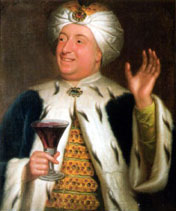
Sir Francis Dashwood
The word dilettante is derived from the Latin word delectare, to delight. The English word came to us from Italy, and originally had no negative connotation. Any person who loves art, sports, or cooking, for example, can launch a happy career as a dilettante. Amateur is a word that indicates love for a subject. I have no problem embracing the novice in myself. One does not need professional training or certificates to be delighted with a pursuit. This archetype seems to be blooming today with all the new ways to share our art work, recipes, or other accomplishments. I am comfortable with this surge in creativity. The shadow characteristic of the dilettante is a tendency to be superficial and shallow. We have all met this person who pretends to know, or sets themselves up as a master without foundation.
I think the meaning was turned on it’s head by the Dilettante Society, a club formed in London in 1734. Initially the society had a mission to transform public taste by supporting and importing arts from Greece and Italy. All of the original members had been on the Grand Tour and were wealthy. Sir Francis Dashwood was the first leader of the club, and an all around prankster. These rich Brits were the embodiment of the shadow of this archetype. They did a lot of boozing while they traveled and launched art and architecture studies. The Dilettantes of today are working to revive respect for those who dabble. After all, if you don’t attempt new things as an amateur how will you find out if you have talent for them? In support of this new wave I plan to show up for pickleball practice, a team sport at which I will, no doubt, suck. I have not been a team sport player since whiffle ball in the yard in elementary school. If I can’t cut the mustard on the court, I can always be a cheerleader.


My 19th great-grandfather was Justice of the Peace. He died at the age of 29, perhaps of the black plague, as many of his forefathers had done. The family had very bad luck with the black death.
John Lestrange, 4th Lord Strange (of Blackmere)
b. circa 1332, d. 12 May 1361
John Lestrange, 4th Lord Strange (of Blackmere) was born circa 1332 at Whitchurch, Hampshire, England. He was the son of John Lestrange, 2nd Lord Strange (of Blackmere) and Ankaret Boteler. He married Mary FitzAlan, daughter of Edmund Fitzalan, 9th Earl of Arundel and Alice de Warenne.1 He died on 12 May 1361.4
He was Justice of the Peace (J.P.) Salop 1360.5 He was also known as John le Strange. He gained the title of 4th Lord Strange, of Blackmere.1 He was created 1st Lord Lestrange in 1360. On 3 April 1360 1st LORD (Baron) STRANGE or LESTRANGE of a new created by writ of summons.
Children of John Lestrange, 4th Lord Strange (of Blackmere) and Mary FitzAlan
Joh n Lestrange, 5th Lord Strange (of Blackmere)+4 b. c 1353, d. 3 Aug 1375
Ankaret Lestrange+ b. c 1361, d. 1 Jun 1413
Citations
[S6] G.E. Cokayne; with Vicary Gibbs, H.A. Doubleday, Geoffrey H. White, Duncan Warrand and Lord Howard de Walden, editors, The Complete Peerage of England, Scotland, Ireland, Great Britain and the United Kingdom, Extant, Extinct or Dormant, new ed., 13 volumes in 14 (1910-1959; reprint in 6 volumes, Gloucester, U.K.: Alan Sutton Publishing, 2000), volume I, page 244. Hereinafter cited as The Complete Peerage.
[S6] Cokayne, and others, The Complete Peerage, volume XII/1, page 343.
[S37] Charles Mosley, editor, Burke’s Peerage, Baronetage & Knightage, 107th edition, 3 volumes (Wilmington, Delaware, U.S.A.: Burke’s Peerage (Genealogical Books) Ltd, 2003). Hereinafter cited as Burke’s Peerage and Baronetage, 107th edition.
[S6] Cokayne, and others, The Complete Peerage, volume XII/1, page 344.
[S37] Charles Mosley, Burke’s Peerage and Baronetage, 107th edition, volume 3, page 3473.
John IV Lord Strange 7th Lord Blackmere Le Strange (1332 – 1361)
is my 19th great grandfather
Ankaret Baroness le Strange (1361 – 1413)
daughter of John IV Lord Strange 7th Lord Blackmere Le Strange
General John Talbot * (1384 – 1453)
son of Ankaret Baroness le Strange
John Talbot (1413 – 1460)
son of General John Talbot *
Isabel Talbot (1444 – 1531)
daughter of John Talbot
Sir Richard Ashton (1460 – 1549)
son of Isabel Talbot
Sir Christopher Ashton (1493 – 1519)
son of Sir Richard Ashton
Lady Elizabeth Ashton (1524 – 1588)
daughter of Sir Christopher Ashton
Capt Roger Dudley (1535 – 1585)
son of Lady Elizabeth Ashton
Gov Thomas Dudley (1576 – 1653)
son of Capt Roger Dudley
Anne Dudley (1612 – 1672)
daughter of Gov Thomas Dudley
John Bradstreet (1652 – 1718)
son of Anne Dudley
Mercy Bradstreet (1689 – 1725)
daughter of John Bradstreet
Caleb Hazen (1720 – 1777)
son of Mercy Bradstreet
Mercy Hazen (1747 – 1819)
daughter of Caleb Hazen
Martha Mead (1784 – 1860)
daughter of Mercy Hazen
Abner Morse (1808 – 1838)
son of Martha Mead
Daniel Rowland Morse (1838 – 1910)
son of Abner Morse
Jason A Morse (1862 – 1932)
son of Daniel Rowland Morse
Ernest Abner Morse (1890 – 1965)
son of Jason A Morse
Richard Arden Morse (1920 – 2004)
son of Ernest Abner Morse
Pamela Morse
I am the daughter of Richard Arden Morse
“The case of the le Strange family demonstrates well what the Black Death and the courts could do to an unlucky upper-class family. The le Stranges lived in Whitchurch in Shropshire in the black-earth, high-grain-yielding country intensely competed for by gentry families. The rich le Stranges were ambitious and on the rise, and because of their upward mobility were starting to make marriages in some instances with younger daughters of the nobility.
“But the le Strange family was exceptionally unlucky in losing male family members during three successive outbreaks of the plague—two in 1349, and one each in 1361 and 1375. By 1375 not even the relative fecundity of the family in producing sons for the next generation could help them escape extinction in the male line. The plague had eliminated sons and left ambitious dowagers.
“The le Stranges going back to the 1330s were not originally a great gentry house. They were a family on the make, principally through marriages with rich women, plus good estate management. The enhancement of family fortunes was launched by the marriage of John le Strange the First [a.k.a. John, 2nd Lord Blackmere] to a wealthy gentry heiress, Anakretta [sic] le Botiler. In the next two generations the le Strange heirs married into the nobility. This raised their social and political profile and with luck would have accrued vast landed wealth to the family.
“But the Black Death countered that luck. Fulk le Strange, John I’s eldest son, married Elizabeth, the daughter of Earl Ralph of Stafford. Earl Ralph drove a hard marriage bargain. Fulk’s father, Ralph Stafford insisted, had to settle land worth two hundred marks a year (about a half-million dollars) jointly on the couple. This meant that if both John I and Fulk died close in time to each other and Fulk’s marriage to the heiress Elizabeth Stafford was short, the le Strange estate would be affected severely by loss of income from land held as dower for the widow.
“Fulk le Strange died in the Black Death on August 30, 1349. But Elizabeth Stafford lived to a ripe old age by medieval standards, not dying until 1376. During those three decades Elizabeth not only collected dower from her deceased husband’s estate but remarried twice, taking with her the succulent property that John I le Strange had to settle jointly on his son Fulk and Elizabeth Stafford to get Earl Ralph’s permission for the marriage. The land thus eventually passed to the family of Reginald, Lord Cobham, Elizabeth Stafford’s third husband.
“The story gets worse and more complicated for the pathetic le Stranges. Not only did Fulk le Strange, the elder son and prime heir of John I, die in the Black Death in August 1349, but the old man himself, John I le Strange of Whitchurch, had died of the plague only five weeks earlier. For a rich gentry family this blow was equivalent to a 60 percent crash in the stock market today—if every single asset was held in stock.
“Anakretta le Botiler survived her husband, John I le Strange, until the next visitation of the plague in 1361. This meant that there were now two living dowagers, Anakretta le Botiler le Strange and Elizabeth Stafford le Strange, both women from families powerful enough to get their full dower rights and then some. For the twelve years of her widowhood Anakretta held the family house at Whitchurch in Shropshire (contrary to custom, by which she should have vacated it within forty days of her husband’s death). She held on to one estate that came with her dowry, since it was jointly visited upon her and John I. For another piece of land she paid her son John II le Strange and his estate the modest sum of twenty marks (thirty thousand dollars) a year.
“This medieval soap opera in the age of the Black Death gets worse still for the le Strange gentry. John II le Strange got back some of his father’s lands when his mother, Anakretta, died in 1361, but he himself died of the plague in the same year. This left a third dowager to be taken care of from the le Strange lands, a great lady indeed, Mary, daughter of the earl—later duke—of Arundel [a.k.a. Mary FitzAlan].
“Mary Arundel le Strange had to be taken care of in the lifestyle she had come to expect as a product of the high aristocracy and as a lady dominating local society. She took possession of most of the income or actual real estate of the le Strange inheritance, dying in 1396. After the dowager Mary died, the remaining le Strange lands passed to Richard, Lord Talbot, who was married to Anakretta, the daughter of John II le Strange.
“The le Strange name thus disappeared from gentry history.”
From Cantor, Norman (2001) In the Wake of the Plague: The Black Death and the World it Made, pp. 130-134. New York: HarperCollins.
 mermaidcamp