mermaidcamp
Keeping current in wellness, in and out of the water
You can scroll the shelf using ← and → keys
You can scroll the shelf using ← and → keys


If we were having coffee this week in Tucson I would point out to you how dead the city is now. Obviously people leave to escape the heat. The snowbirds, the students, and everyone who can afford to go elsewhere for the summer have left the city. The businesses cut hours and do what they can to stay in business when their regular customers are basically all gone. If you were here now I would recommend you spend the night in a resort for less than half the winter rate, or dine at one of our fancier restaurants offering a summer special. For those of us who stay all year, this is a time to take advantage of the off peak bargains and less crowded streets. Everything is air conditioned, so you will not melt.
Please sit down and let me pour you some iced tea from the extensive collection. I have place an order for new teas, arriving any day, so I am taking inventory of all the teas I need to use in the order they were purchased. I have so many flavors, but this is a basic pleasure in our lives, as well as a healthy way to consume herbs and water. I get really excited about the prospect of new teas I have not tried. Next week my collection will have expanded to about 40 choices. I am drinking a honey bush mango with a fruity taste. What is your favorite kind of tea? I probably have it on hand. I hope you like the Allman Brothers Band. I am playing a tribute until further notice. I will turn down the volume because I want to listen to your stories. What is happening in your life and writing this week? I had an average writing week. I took one day off (yesterday) and produced nothing of great note. I wrote anther tea review, and am starting to like that segment. Are you trying any new ideas in your writing?


We enjoyed a superb brunch downtown yesterday in the spirit of off-peak excursions. We went to the Coronet, a restaurant we really enjoy but seldom frequent. We like the decor in a restored historical property. The service is always excellent, but with fewer customers it is even better now. The real reason we go is for the innovative menu and bar choices. Yesterday’s brunch was a perfect example. Bob loved his eggs Florentine with gravlax. I had a wonderful dish of poached eggs over grits served with black beans. Bob’s Bloody Mary had fabulous garnishes, including a picked tomatillo. That is the item I plan to knock off and use at home. I had never thought of doing that, but am a huge fan of the tomatillo, a green fruit that is NOT a tomato. We not only had the restaurant almost to ourselves, but the entire 4th Avenue shopping district was empty. We spent some time in a used book store, where I managed to buy just a single book. On the way home we stopped for ice cream at our favorite parlor, The Screamery. We each had full punch cards for a free scoop. We loved our dessert then took home a pint of blueberry cheesecake. All in all, it was a superb little holiday with all the gourmet trimmings. I am in the minority but I honestly love summer in Tucson. The hot ghost town suits me perfectly. You may want to jump in the pool before you head out. Stay hydrated. Take an iced tea with you. By any measure it is hot outside. You may want to stop and get some ice cream.

book shopping

ice cream
This movable digital beverage drinking party is hosted each week by Emily at Nerd in the Brain. Please join writers from around the world for a chat and a digital drink each weekend. Read, write, comment and share.

#WeekendCoffeeShare
This is inspired by Sue Vincent’s Thursday photo prompt

ruin
The building bitterly fell down around them in the end. They refused to move when the epidemic wiped out the neighbors and all the businesses. They decided to stay since they were the sole surviving members of the cult. The bishops foretold of a great sickness, and built shelters to hide from the inevitable. The underground bunkers that had been designed to save the people from harm turned out to be the source of the deadly mold that infected their lungs and spread like wild fire. After almost a year of suffering and loss the difficult decision was made to seal the enclosures with the infected population trapped inside.
Very few of the elders knew about the plan to bury those who were carrying the mold in order to save the few who remained healthy. The stone house was the headquarters of the operation. The six members of the board carried out their plan with precision and cold blooded planning. While the people in the bunkers slept they set off canisters of poison gas and closed the entrances. They were all killed as they dreamed. Those in charge knew they had murdered their own believers in what they decided was self defense. There was no excuse, and there would be no remorse from these reprobates. They only cared for their own survival at any cost.
Although they had years of food stored for the future of the community, when they opened the storehouse they found it swarming with all kinds of bugs. The seeds had been devoured by the hungry insects who now jumped out and started to eat the rest of the humans. They took refuge back in the stone house until the building itself heaved and crumbled to the ground. There was no earthquake or storm. The stones of the walls and the clay tiles on the roof rebelled against giving shelter to these selfish plotting fools. In an act of revenge they crushed the elders as they slept. Nature had the last word. Only a ruin stands now as a reminder of human greed and folly gone awry.
Please visit the photo prompt round up to read the entires from last week. Read, write, comment, contribute!
#writephoto

photo in exhibit
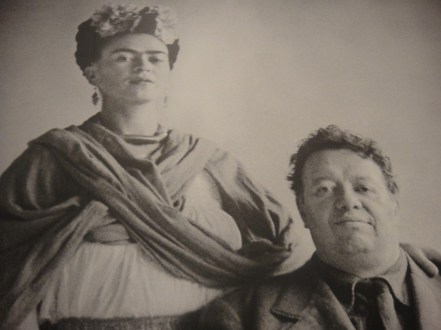
photo in exhibit

Frida and Leon Trotsky
In Arizona Frida Kahlo is a giant cultural icon, representing the art and rebellious spirit of the Mexican people. Her famous muralist husband, Diego Rivera, is less well known, or at least less of a modern figure here in the United States. He was very famous before they met, and she became famous after her death. They were highly influencial in the Mexican Revolution, Diego often painting large murals about the oppression of the masses. Frida had an affair with Leon Trotsky, who was in Mexico City after the Russians exiled him.
The prestigious Heard Museum is now showing an exhibit of their work, some original photos, and a wardrobe designed to show the way Frida distinctively dressed herself in indigenous hand woven garments. She changed classical art in Mexico by introducing the elements of folk art that she included in her clothing. She honored the colors, symbols, and methods used by Native Mexican tribes to bring new life and meaning to her paintings. Her political beliefs were expressed through her art.
This wonderful visiting exhibit is well worth the extra $7. It will be on display through 20 August. Prices go way down everything in the summer in Phoenix. The accommodations will be generously discounted when the heat rises. This makes it a perfect time for a bargain excision to the big city.
The permanent collection includes incredible Native American art. The book store and cafes are lovely. The gift shop is curated to offer the public super high quality work of Native artists. To look closely at the entire collection takes a few hours and some concentration. I am particularly fond of the kachina collection, full of detail and meaning. I recommend this museum to anyone of any age.

her wardrobe

exhibit at the Heard


vintage cookbook and tickets
If we were having coffee in Tucson today I would invite you to take a dip in the pool because it will reach 100 degrees this afternoon. I am drinking coffee in the early morning as we prepare to spend the day in Phoenix. I know it sounds counter intuitive to go down to the valley of the sun when the heat is cranking up. Here is my logic. This weekend will be a slow one at the Heard Museum, where there is a special exhibit of the paintings of Diego Rivera and Frida Kahlo. The universities have graduated the student population, and the snow birds have gone back to the north woods, so this is SLOW season in all of Arizona. It will reach 100 for the next 5 days in a row, which will just be a warm up (pun intended). We get good deals on hotels and other things in the summer. Natives handle the heat by going inside to air conditioned comfort in the middle of the day. Our reservation for the Rivera/Kahlo show is at 1 pm, which gives us time to see the rest of the museum. We have not been there for many years. The permanent collection has some amazing Native American art, including Barry Goldwater’s kachina collection. I am a real museum nut, and Bob does not mind spending lots of time checking out every detail of an exhibit. After you finish your coffee you can ride along in the red Mustang for the trip if you like. It should be a fun day. I plan to have crepes for brunch up in Tempe.
If we were having coffee today I would tell you a funny story about clearing clutter, about which I write frequently, and actually accomplish with less alacrity. I managed to take a large box of books to the used book store last week. Although they only purchased one book, I left the entire box for non profit organizations that pick them up there. I felt proud because I even managed to ditch some of my beloved, and never used, cookbooks. Yesterday in a Facebook group of people who used to live in the boonies in petroleum camps in Eastern Venezuela folks started saying they would pay to have a certain cookbook copied. I happen to have a copy, much used, and very special to me. The pride in ditching the old books has been replaced by pride in keeping the right one, San Tome Gourmet. San Tome was the name of our petroleum camp in Estate Anzoategui. It does contain some killer recipes. I have preserved history and culinary authenticity in my cookbook hoarding practice, so it is now very cool.


Tell me how your week and your writing has been. I have skipped too many days posting here this week, but did manage a couple of poems. Maybe next week I will be more productive and creative. I am calling on my summer muse to show up and inspire. She always shows up sooner or later…she is a little late. I hope your muses are serving you well and keeping your creative juicers flowing. Thanks for visiting this week. For those of you who want to keep up with bloggers around the world each weekend, check Nerd In The Brain for party invitations. Read, comment, or write your own digital beverage post. All are welcome.
#WeekendCoffeeShare

thorny
What is the hurry to rush to judgement before the truth is known?
Where is the discernment needed to tell fact from fiction?
Confusion reigns while some are making a living making up news
And others are taking it all in from morning until night every day
Is there a limit to the shadow nonsense information we consume?
We need an intervention from a natural reality with perspective
These newsflashes and their associated contempt and contention
Are fast occurring, tiny openings into the dystopian future we create

green passages
People tell stories about the time before the stone wall was built. The streams and rivers flowed freely and served everyone as they went by. Water to run small mills and to irrigate crops was plentiful and easy to find. Family farmers subsided and even thrived in years when the weather was favorable. The community members provided for each other, and the simple agricultural life was comfortable. They had plenty of food, shelter, and water.
Progress came to the area in the form of a land buy out by a large estate owner who wanted to experiment in modern farming techniques. His ignorance of nature combined badly with his lame and greedy attitude toward those with deep knowledge of working the land. He changed the landscape, moved the waterways to suit his purposes, and set out to build an empire. He had a monopoly on all the waterways in the valley, having sewn up all the land on which the tributaries flowed. His signature move was a large stone wall he built. It stood in the middle of stream, with tunnels to handle the water as it flowed beneath the structure. He was secure and pleased with his conquest of this natural resource when all hell literally broke loose. With a crack of thunder and a flash of lightening the sky broke open with a stormy and deadly response to his lack of respect for Mother Nature.
The flash flood poured over all the banks and rushed through the canals and tunnels like an angry dragon. Destruction and erosion brought famine to the land, once ripe and productive. Once the greedy land owner gave up the ghost the land itself returned to a riparian state. The farmers did not return, so the land has been fallow for centuries. It no longer feeds or shelters people. The natural world has taken the place of the former residents. The streams flow sweetly and green moss covers the ancient stone as if nothing had ever happened. All is forgotten.
#writephoto
This slice of fiction is a take on the prompt of this week by Sue Vincent. Visit Sue’s Daily Echo to read, comment, or submit your own story or poem.
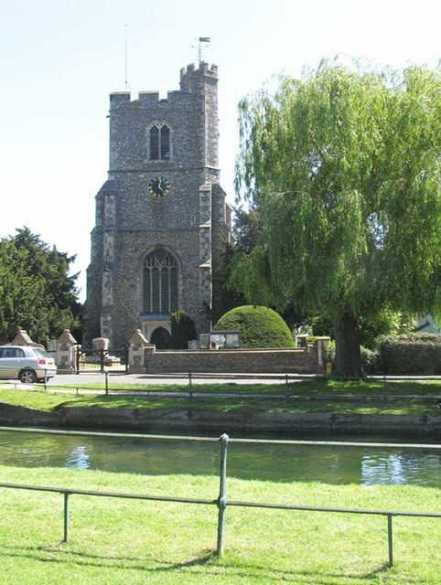
St Augustine, Broxbourne, Herts
Elizabeth Cheney (April 1422 – 25 September 1473) was an English aristocrat, who, by dint of her two marriages, was the great-grandmother of Anne Boleyn, Jane Seymour, and Catherine Howard, three of the wives of King Henry VIII of England, thus making her great-great-grandmother to King Edward VI, the son of Henry VIII and Jane Seymour, and Elizabeth I, the daughter of Henry VIII and Anne Boleyn. Her first husband was SirFrederick Tilney, and her second husband was Sir John Say, Speaker of the House of Commons. She produced a total of nine children from both marriages.
Born in Fen Ditton, Cambridgeshire in April 1422, she was the eldest child of Laurence or Lawrence Cheney or Cheyne, Esq. (c. 1396 – 1461), High Sheriff of Cambridgeshire and Elizabeth Cokayn or Cokayne[1] She had three younger sisters, Anne, wife of John Appleyard; Mary, wife of John Allington; Catherine, wife of Henry Barley, and one brother, Sir John Cheney who married Elizabeth Rempston, by whom he had issue. Sir John Cheney and his wife are ancestors of U.S. Vice President Dick Cheney. She had two half-brothers by her mother’s first marriage to Sir Philip Butler.
Her paternal grandparents were Sir William Cheney and Katherine Pabenham, and her maternal grandparents were Sir John Cockayne, Chief Baron of the Exchequer and Ida de Grey, the daughter of Reginald Grey, 2nd Baron Grey de Ruthyn and Eleanor Le Strange of Blackmere.[2]
Anne Boleyn, granddaughter of Elizabeth Tilney, eldest daughter of Elizabeth Cheney
On an unknown date, Elizabeth Cheney married her first husband Sir Frederick Tilney, of Ashwellthorpe, Norfolk, and Boston, Lincolnshire. He was the son of Sir Philip Tilney and Isabel Thorpe. They made their principal residence at Ashwellthorpe Manor. The couple had one daughter:
Elizabeth Tilney (before 1445 – 4 April 1497), married firstly in about 1466, Sir Humphrey Bourchier, by whom she had three children; and secondly on 30 April 1472, Thomas Howard, Earl of Surrey, who later became the 2nd Duke of Norfolk, by whom she had nine children. These children included Thomas Howard, 3rd Duke of Norfolk, Elizabeth Howard, mother of Anne Boleyn, and Lord Edmund Howard, father of Catherine Howard.
Sir Frederick Tilney died in 1445, leaving their young daughter Elizabeth as heiress to his estates. Shortly before 1 December 1446, Elizabeth Cheney married secondly Sir John Say, of Broxbourne, Hertfordshire, Speaker of the House of Commons, and a member of the household of King Henry VI. He was a member of the embassy, led by William de la Pole, which was sent to France in 1444 to negotiate with King Charles VII for the marriage between King Henry and Margaret of Anjou.[3] Her father settled land worth fifty marks clear per annum upon the couple and their issue before Candlemas, 1453. They made their home at Broxbourne, Hertfordshire.
Sir John Say and Elizabeth had three sons and four daughters:
Sir William Say (1452- 1529), of Baas (in Broxbourne), Bedwell (in Essendon), Bennington, Little Berkhampstead, and Sawbridgeworth, Hertfordshire, Lawford, Essex, Market Overton, Rutland, etc., Burgess (M.P.) for Plympton, Knight of the Shire for Hertfordshire, Sheriff of Somerset and Dorset, 1478–9, Sheriff of Essex and Hertfordshire, 1482–3, Justice of the Peace for Hertfordshire, 1486–1506, and, in right of his 1st wife, of East Lydford, Radstock, Spaxton, Wellesleigh, and Wheathill, Somerset, and, in right of his 2nd wife, of Wormingford Hall (in Wormingford), Essex, Great Munden, Hertfordshire, etc. He married (1st) before 18 November 1472 (date of letters of attorney) Genevieve Hill, daughter/heiress of John Hill, of Spaxton, Somerset. She was still alive in 1478. He married (2nd) shortly after 18 April 1480 Elizabeth Fray, widow of Sir Thomas Waldegrave, by whom he had two daughters, Mary Say and Elizabeth Say.
Mary, the eldest daughter married Henry Bourchier, 1st Earl of Essex and 6th Baron Bourchier, by whom she had one daughter, Anne Bourchier, 7th Baroness Bourchier.
Thomas Say, of Liston Hall, Essex.
Leonard Say, clerk, Rector of Spaxton, Somerset. See Testamenta Eboracensia, 4 (Surtees Soc. 53) (1869): 86–88 (will of Leonard Say, clerk).
Anne Say (died 1478/1494), married Henry Wentworth, K.B., of Nettlestead, Suffolk, Goxhill, Lincolnshire, Parlington and Pontefract, Yorkshire, and of London, Esquire of the Household, Knight of the Body, Sheriff of Norfolk and Suffolk, 1481–82, Sheriff of Yorkshire, 1489–90, 1492, Knight of the Shire for Yorkshire, 1491–92, by whom she had issue, including Margery Wentworth, mother of Jane Seymour.
Mary Say, married Sir Philip Calthorpe, Knt., by whom she had issue.
Margaret Say, married Thomas Sampson, Esq.
Katherine Say, married Thomas Bassingbourne.
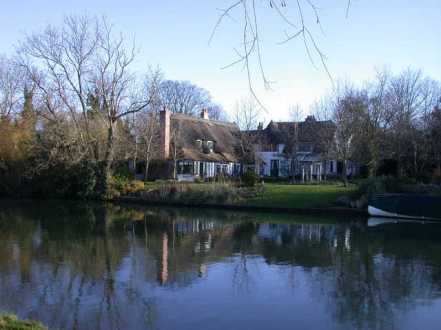
Fen Ditton from River Cam
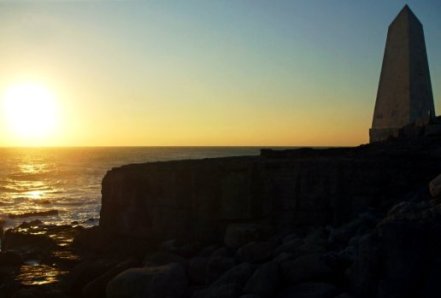
obelisk
The family sailed from England when they had a chance to come to America. The hardship of the voyage and the harsh conditions in the colonies took a toll on the surviving members of the family. They wondered about the decision to live in the new world, and felt lost without the comfort and status of British society. Carving out an existence turned out to be much more difficult than they had ever imagined. They lost touch with the roots of their family back in England and had no way to return even if they wanted to go. They had little money and just barely the time to protect and feed their offspring.
Eventually they came to feel pride in the American adventure they founded, and erected a monument to the first Morses to come to America. They had sailed from a harbor with a large assuming obelisk that bid them adieu when they left their homeland. The group decided to model the new world monument after the last sight they saw as the ship left the shore. British no more, but connected to the language and the culture of the motherland, the American obelisk builders were sure that God was on their side.

Morse Monument
This is a piece in response to Sue Vincent’s weekly photo prompt. Please join writers from around the world each week to read or submit your own story.
#writephoto

Elizabeth Tilney
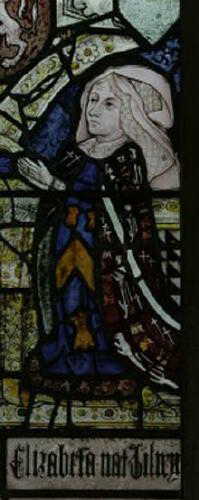
Elizabeth Tilney
Elizabeth Tilney, Countess of Surrey, was an English heiress and lady-in-waiting to two queens. She became the first wife of Thomas Howard, Earl of Surrey. She served as a lady-in-waiting to Queen consort Elizabeth Woodville, and later as Lady of the Bedchamber to the Queen’s daughter, Elizabeth of York, consort of King Henry VII of England. She stood as joint godmother to Princess Margaret Tudor at her baptism.
She was the mother of Thomas Howard, 3rd Duke of Norfolk. Through her daughter Elizabeth she was the maternal grandmother of Anne Boleyn, and through another son, Edmund, the paternal grandmother of Catherine Howard, both queens consort of King Henry VIII. Elizabeth’s great-granddaughter was Queen Elizabeth I of England.
Elizabeth was commemorated as the “Countess of Surrey” in John Skelton’s poem, The Garlande of Laurell, following his visit to the Howard residence of Sheriff Hutton Castle.
Elizabeth Tilney was born at Ashwellthorpe Hall sometime before 1445, the only child of Sir Frederick Tilney, of Ashwellthorpe, Norfolk, and Boston, Lincolnshire, and Elizabeth Cheney (1422–1473) of Fen Ditton, Cambridgeshire. Sir Frederick Tilney died before 1447, and before 1449 Elizabeth’s mother married as her second husband Sir John Say of Broxbourne, Hertfordshire, Speaker of the House of Commons, by whom she had three sons, Sir William, Sir Thomas and Leonard, and four daughters, Anne (wife of Sir Henry Wentworth of Nettlestead, Suffolk), Elizabeth (wife of Thomas Sampson), Katherine (wife of Thomas Bassingbourne), and Mary (wife of Sir Philip Calthorpe). A fifth daughter died as a young child. Henry VIII’s third queen consort, Jane Seymour, was the granddaughter of Henry Wentworth and Anne Say, and thus a second cousin to Henry VIII’s second and fifth queens consort, Anne Boleyn and Katherine Howard.
Elizabeth’s paternal grandparents were Sir Philip Tilney and Isabel Thorpe, and her maternal grandparents were Sir Laurence Cheney of Fen Ditton and Elizabeth Cockayne, widow of Sir Philip Butler. Elizabeth Cockayne was the daughter of Sir John Cockayne, Chief Baron of the Exchequer and Ida de Grey. Ida was a daughter of Welsh Marcher Lord Reginald Grey, 2nd Baron Grey de Ruthyn and Eleanor Le Strange of Blackmere. Through her mother, Ida was a direct descendant of Welsh Prince Gruffydd II ap Madog, Lord of Dinas Bran and his wife Emma de Audley.
Elizabeth was co-heiress to the manors of Fisherwick and Shelfield in Walsall, Staffordshire by right of her descent from Roger Hillary, Chief Justice of the Common Pleas (d.1356).
Elizabeth married her first husband, Sir Humphrey Bourchier, the son and heir of John Bourchier, 1st Baron Berners, and his wife Margery, in about 1466. The marriage produced a son, John Bourchier, 2nd Baron Berners and two daughters. Following her marriage, Elizabeth went to court where she served as lady-in-waiting to Queen Elizabeth Woodville, whose train she had carried at the latter’s coronation in May 1465 at Westminster Abbey. Elizabeth accompanied the Queen and her children into sanctuary at Westminster Abbey when King Edward IV had been ousted from the throne, and was present at the birth of the future King Edward V. She remained with the Queen until Edward IV was restored to power.
Sir Humphrey was killed at the Battle of Barnet on 14 April 1471 fighting on the Yorkist side. On 30 April 1472 Elizabeth married Thomas Howard, Earl of Surrey, a marriage arranged by the King. In 1475, Elizabeth inherited her father’s property of Ashwellthorpe Manor. Her second husband was a close friend and companion of Richard, Duke of Gloucester who was crowned king in 1483. Elizabeth was one of Queen Anne Neville’s attendants at Richard’s coronation, while her husband bore the Sword of State. On 22 August 1485 Thomas’s father John Howard, 1st Duke of Norfolk was killed at the Battle of Bosworth while fighting for Richard III; like his son, John was also one of King Richard’s dearest friends. Thomas Howard was wounded at Bosworth and imprisoned in the Tower for several years, and the dukedom of Norfolk was forfeited. Elizabeth was fortunate that Thomas’ attainder stipulated that she would not lose her own inheritance. On 3 October 1485, she wrote to John Paston, who was married to her cousin. The letter, which she had written from the Isle of Sheppey, mentioned how she had wished to send her children to Thorpe, pointing out that Paston had pledged to send her horses as a means of transporting them there. She continued to complain that Lord FitzWalter, an adherent of the new king Henry VII, had dismissed all of her servants; however, because of the stipulations in her husband’s attainder, FitzWalter was unable to appropriate her manor of Askwell. In December 1485 she was living in London, near St Katharine’s by the Tower, which placed her in the vicinity of her incarcerated husband. After Thomas was released from prison and his earldom and estates were restored to him, he entered the service of Henry VII. In November 1487, Thomas and Elizabeth attended the coronation of Henry’s consort Elizabeth of York, who appointed Elizabeth a Lady of the Bedchamber. Elizabeth was further honoured by being asked to stand as joint godmother to the Princess Margaret Tudor at her baptism in late 1489.
Her second marriage produced nine children, including Thomas Howard, 3rd Duke of Norfolk, Elizabeth Howard, mother of Queen Anne Boleyn, and Lord Edmund Howard, father of Queen Katherine Howard.
Elizabeth Tilney died on 4 April 1497 and was buried in the nun’s choir of the Convent of the Minoresses outside Aldgate. In her will, she left money to be distributed to the poor of Whitechapel and Hackney. By licence dated 8 November 1497 Thomas Howard married as his second wife her cousin, Agnes Tilney, by whom he had six more children.
Lady Elizabeth Tilney was governess to 1st Princess Mary Tudor and then later to Princess Elizabeth Tudor.
Elizabeth Tilney (1450 – 1497)
16th great-grandmother
Lord Thomas Howard (1473 – 1554)
son of Elizabeth Tilney
Lady Katherine Howard Duchess Bridgewater (1495 – 1554)
daughter of Lord Thomas Howard
William ApRhys (1522 – 1588)
son of Lady Katherine Howard Duchess Bridgewater
Henry Rice (1555 – 1621)
son of William ApRhys
Edmund Rice (1594 – 1663)
son of Henry Rice
Edward Rice (1622 – 1712)
son of Edmund Rice
Lydia Rice (1649 – 1723)
daughter of Edward Rice
Lydia Woods (1672 – 1738)
daughter of Lydia Rice
Lydia Eager (1696 – 1735)
daughter of Lydia Woods
Mary Thomas (1729 – 1801)
daughter of Lydia Eager
Joseph Morse III (1756 – 1835)
son of Mary Thomas
John Henry Morse (1775 – 1864)
son of Joseph Morse III
Abner Morse (1808 – 1838)
son of John Henry Morse
Daniel Rowland Morse (1838 – 1910)
son of Abner Morse
Jason A Morse (1862 – 1932)
son of Daniel Rowland Morse
Ernest Abner Morse (1890 – 1965)
son of Jason A Morse
Richard Arden Morse (1920 – 2004)
son of Ernest Abner Morse
Pamela Morse
I am the daughter of Richard Arden Morse
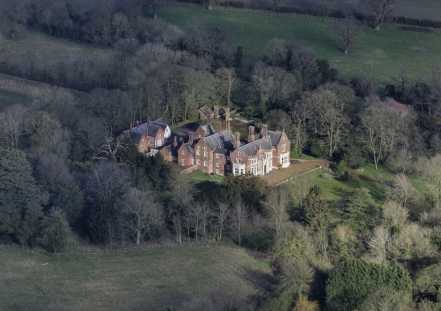
Ashwellthorpe
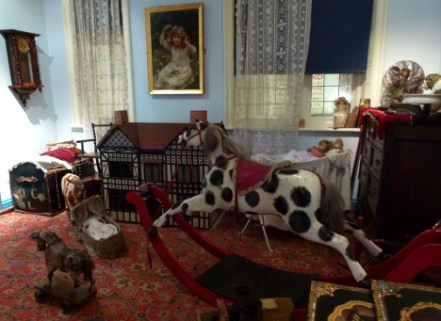
nostalgia nursery
The nursery was filled with heirloom toys and games
The aunts and uncles made suggestions for names
The curse was strong in the family, since the soothsayer
Foretold the demise of the monarchy by a betrayer
A child not of woman born would come along one day
To end the lineage of oppression by which royals play
Centuries have past since the spell had been cast
No heir to the throne has left the dollhouse and rocking horse alone
#writephoto
This poem is inspired by the photo by Sue Vincent, who shares a prompt each Thursday in The Daily Echo. Join writers from around the world to create your own story or poem.

#NaPoWriMo2017

#GloPoWriMo
Poets are still on board to submit 30 poems in thirty days on the poetry train. It is not too late to catch a ride at the #NaPoWriMo site. You may be a poet…and not even know it.

