mermaidcamp
Keeping current in wellness, in and out of the water
You can scroll the shelf using ← and → keys
You can scroll the shelf using ← and → keys

Cybele drives the lion chariot
At the Equinox everyone on earth has about the same amout of darkness and light. The sun is close to the equator as it shines for about 12 hours on all parts of the earth for a day. This seasonal shift is of significance to most native cultures. It signals either a lengthening or a shortening of daylight in the months ahead. It creates the conditions for spring planting or fall harvest, depending on the hemisphere in which you live. For a single day, however, we all have the same amount of light and dark in our experience. The literal meaning of the word equinox is equal night. Many calendars begin around the vernal equinox. Romans began the new year on the Ides of March, Astrology uses 21 March as the first of the year, as the Sun moves into Aires. A new year celebration makes sense at this time, as do celebrations to honor rebirth.
The Roman goddess Cybele was associated with rebirth in one of the first Spring break resurrection parties ever held. Romans were all about blood, so they used real bull blood…no chalice of red wine for them. Hilaria was a celebration of resurrection and eternal life held in Rome on the vernal equinox to honor Cybele. She ruled dangerous animals, fertility, and rebirth. She protects civilization. The fact that she is resurrecting her son, Attis, who is also her lover is not a big deal in Roman terms. These things happen in pantheons all the time. After all was ceremonially brought safely back to life Hilaria commenced in a frenzy of joy and mirth. We do not have any evidence of chocolate bunnies, but they were festive in their own Roman way, with orgies, and chariots drawn by lions, castration, and other stuff they liked. Violets are the flower of the day, since the blood of Attis when he died the first time became the violet we pick in the spring. Do not hesitate to decorate your eggs with violets if you want to get down Roman style this year. Unlike our own Virgin Mary, this mother drives a lion chariot, while holding a pineapple, and is on the violent side, so, caveat emptor.
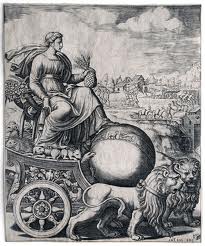
Roman goddess Cybele

Cybele with her lions
To move in synchronicity with others requires concentration and practice. The more a performing group practices the more it develops coordination and precision. From flying trapeze to marching band groups, timing and focus make all the difference. This Chinese troupe is hearing impaired, which makes the synchronization very impressive.
Synchronicity is not practiced, and may appear to be unrelated. The coordination of meaning is personal, but it depends on the oneness of the universe. The individual must notice and connect the dots to appreciate synchronicity. One must look from a new frame of reference to see the connections that fall into place every day.
Pope Francis has the twitter handle of the Vatican now, and this is his first tweet:
“Dear friends, I thank you from my heart and I ask you to continue to pray for me. Pope Francis.”
His style is matter of fact. He keeps asking for the people to pray for him. He breaks out and kisses babies. I think he is a very smart and astute cookie. The Jesuits are big into discernment as a key to practice. The order teaches ways to recognize the activities of the spirits in action in everyday life. They devote a good deal of time and effort into understanding the emotions and the spiritual meaning in the details. They listen for the voice of God. It is most tempting for the human ego to impersonate the Creator, rather than deeply search for divine guidance.
The Catholic church needs now to both listen to the membership and discern what is spiritually best for the world. A closed, authoritarian, dogmatic institution has the need for a live wire to bring it back to awareness. The first deliberate steps taken by Pope Francis (who I believe is named for both Francis of Assisi and Francis Xavier) signal a new direction. I am neither Catholic nor a fan of any church, but I do appreciate discernment. He seems ready willing and able to bring fresh discernment to a troubled institution. He has already changed the vibe.
My favorite author, teacher, and living spiritual expert is Thomas Moore. He is finishing a new book called A Religion of One’s Own. His concept is not to do away with religion, but to inspire and revive it. The Dalai Lama has recently spoken about a similar concept. Institutional religion is having momentum problems in the developed world. Yoga, in all the many forms, is still enjoying a growth in popularity in America. Although yoga was brought to the world by Hindus, yoga is not a religion in itself. It is a philosophy.
The casual way he talks about warming up for the book by translating the Gospels from ancient Greek lets you know what kind of scholar he is. He has taught in full on Latin, composed music, and become a well respected therapist. His own fluid path was probably never suspected by anyone, least of all him, when he became a monk. When is a monk more than a monk? I think we have two excellent living examples today. Both Thomas Moore and the Dali Lama of Tibet teach kindness, meditation, and natural magic. As experts in religion, as scholars, and as holders of the traditions, these men are shining stars. We are lucky that they have both chosen to write books for us, teach us, and even, bless their hearts, tweet us. They are both telling us we need to connect to spirit and each other for quality of life.
I think that worldwide the ways of communication have changed and the drift toward a meaningless existence has increased. Churches and temples reflect this in both a positive and negative way. If people look at their own religion as a sham, but still pay dues in order to just be a member of something, the future of those institutions is bleak. Keeping up the facade has become an expensive, and sometimes self destructive activity in some religious organizations. Personal practice that is designed to cultivate compassion and mindfulness can nourish the soul of the world. We are in need of this kind of responsibility taken and embraced by individuals and communities. We had religious reform, some have had revival. Let us have personal religious renaissance. The book will not be out for a while, but I am already in favor of the whole idea.

Tulsa race riot 1921

Race riot Tulsa 1921
My father, Richard Arden Morse, was a bit of a racist, but did not have any idea of his own pedigree. His great-grandfather came to New York from Ireland during the potato famine with his O’Byrne parents and siblings, who dropped the O’ to assimilate. When asked, my father would say he was Scots Irish. This American term refers to the Ulster Scots, who have all those Orange issues in Northern Ireland. A little flash of orange ribbon drives these people, and their neighbors, completely batty. You would need to be born in Ulster to understand this, I think. The troubles are a completely local phenomena, although both sides have supporters elsewhere.
Richard Arden was born in Independence, Kansas on Feb 18, 1920. In December of 1920 armed violence broke out between white and black citizens of that town. It was a very small town, and this had to be a big impact on the area. In 1921 the city of Tulsa, where I was born, was host to one of the most violent of race wars of all time. The Tulsa racial violence of 2 June, 1921 was distinctly ignored by Oklahoma official history until very recently. I only lived in Tulsa for about 4 years, and my dad also left Independence with his family to live near Ponca City, Oklahoma during his school years.
He was for sure Irish, and when Mr. Scott married Ms Byrne, he was trending Scot again. However, I do not think he knew what any of this meant. I believe that my father’s racial prejudice was a karmic and cultural affliction. He did not openly dislike anyone because of race, but his actions betrayed his deeper ethics. To his credit, he and my mom made an effort not to pass the racist culture on to my brother and me.
Bridget OByrne (1808 – 1880)
is my 3rd great grandmother
James Oscar Byrne (1840 – 1879)
son of Bridget OByrne
Sarah Helena Byrne (1878 – 1962)
daughter of James Oscar Byrne
Olga Fern Scott (1897 – 1968)
daughter of Sarah Helena Byrne
Richard Arden Morse (1920 – 2004)
son of Olga Fern Scott
Pamela Morse
I am the daughter of Richard Arden Morse
Bridget O’Byrne was typical, but lucky. She survived the passage to New York, and most of her kids did also. She had a home in upstate New York. Sarah Helena, her daughter in law, wrote the notes I used to start my tree. The O’Byrnes of Wilna, Jefferson, NY gave their estate to a Catholic church there, and left the records of their family history with that church. A treasure hunt awaits me in upstate New York that may reveal all the Irish information I can handle, including Bridget’s family name. The Catholics of Wilna have my bingo card, and I am grateful.
What is your relationship to God? Your archetypes will define and expose your spirit. While we may all want to be a visionary or some very special rare spiritually gifted being, our story may be stronger than our experience. If you know the spiritual archetype, you will also have some experience with the shadow of it. Spirit does not bring along only happy good time feelings. It brings lessons required for our own wisdom and advancement. If you really are a martyr you have used your own suffering to manipulate others. The depth of the reality depends on how truthful and open you are. None of us worships like our parents before us…well, very few. Do you give your spirit a rich practice or a platitude?
Everyman, also known as the regular guy, is one of the archetypes in Carl Jung’s core breakdown. The primary goal of this player in the personality is to be accepted. Blending in, not standing out, is the way the regular guy relates to society. Ad companies use this profiling to create messages that they hope will reach the market of choice. To be desirable to a regular guy a product needs to show that everyone uses it. The most common experience is the target.
This player has much in common with the orphan child archetype, having similar needs and fears. This personality will forfeit much in order to feel like a part of something. After finding the fold in which to fit, they often find it unrewarding and not what they had hoped it would be. The irony of seeking approval from others by being like them is that your own desires may never be made clear. If standing out in a crowd is your worst fear, your own dreams (and personality) may forever remain a mystery to you.
I do not respond well to messages aimed at Everyman. They have a negative effect by showing me that everyone is doing something. I recoil from that. A Eurofriend said this week she does not understand Oprah, the American phenomena. I tweeted her that Oprah is everywoman, as a joke. But, in truth, Oprah does market herself as everywoman (who can afford to buy $900 blouses). That is pretty ironic in itself, that her favorite things are out of range in price for most of her audience. She makes many feel like they are a part of her network, even if she is really the queen.
The eighth core value at Zappos is Do More with Less. This is an essential philosophy to make it in the world now. Using what we already have is a first step to achieve better results. Recent economic bubble popping has shown us how wasteful and risky spending can have dire consequences. As household and government debt grew so did people’s expectations that the prosperity could never end. Now that the economy is reorganized. People look for value and efficiency like never before. Many have embraced thrift over extravagance as a necessity.
Floatli does more with less by versatility. It uses the common floatation noodle, which is easy to replace. Since it works in all kinds of water, including a jacuzzi, it provides a new activity or sport to pools and natural bodies of water. From light to heavy work can be done, by everyone from elite athletes to those recovering from injury. That is another reason Floatli is the perfect official sport for Zappos. It works anywhere there is water, and will be really fun in Lake Mead in summer.

Jung’s Kundalini
One of Carl Jung’s most controversial theories was his view of the God within. He was drastically disappointed in his first communion at the Swiss Reform Church. His father was the pastor and Carl was a faithful member of his church. He expected something more, or different, when he attended that communion. He basically never stopped pursuing that ecstasy he had wanted through religion for the rest of his life.
His later years were consumed with individuation, which he considered to be the meaning of existence. He used artistic expression, dream journaling, and isolation in a primitive tower built by his own hand to achieve his own individuation. He studied ancient alchemy and philosophy. His belief that symbols contain the most direct and deep meaning lead him to study ancient texts and charts. To Jung individuation was not a substitute for God, but a deep search for the divine nature of self.
His investigations were deep and lengthy. He stated that he only studied of God as a psychological archetype and not as religious doctrine. His idea of the collective unconscious is that images and symbols are primordial. We absorb symbolic messages but do not analyze their meaning. That is why Jungian therapy can include sand box drawing, word association, and art to discover archetypes. Dream work is a pivotal part of Jungian analysis. In his tower, reading about ancient alchemists, living without modern conveniences, Jung came close to living in a dream. Most cannot afford such an extravagant personal quest for the divine, but we can all do a little dream investigation. Does God enter your dreams?

dream spiral
“My friends, it is wise to nourish the soul, otherwise you will breed dragons and devils in your heart.” ~Carl Jung, Red Book, Page-232.
Carl Jung changed the history and the practice of psychiatry. His work is used today by some who are not even aware of his influence or the story of his life. The Red Book was published posthumously after being locked in a bank vault in Switzerland for many years. Finally out of the shadows itself, the book serves as a deep reference as well as an artistic guide to the underworld. How would the Red Book of your soul look? When do you plan to create it?

Drawing Red Book
 mermaidcamp