mermaidcamp
Keeping current in wellness, in and out of the water
You can scroll the shelf using ← and → keys
You can scroll the shelf using ← and → keys
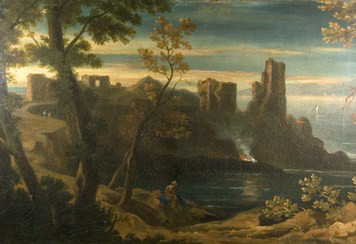
birthplace, Turnberry Castle


This is one of the ways I descend from the famous badass, Robert the Bruce:
Robert Bruce (1274 – 1329)
21st great-grandfather
Marjorie Bruce (1297 – 1316)
daughter of Robert Bruce
Robert II, King of Scotland, Stewart (1316 – 1390)
son of Marjorie Bruce
Robert Scotland Stewart (1337 – 1406)
son of Robert II, King of Scotland, Stewart
James I Scotland Stewart (1394 – 1434)
son of Robert Scotland Stewart
Joan Stewart (1428 – 1486)
daughter of James I Scotland Stewart
John Gordon (1450 – 1517)
son of Joan Stewart
Robert Lord Gordon (1475 – 1525)
son of John Gordon
Catherine Gordon (1497 – 1537)
daughter of Robert Lord Gordon
Lady Elizabeth Ashton (1524 – 1588)
daughter of Catherine Gordon
Capt Roger Dudley (1535 – 1585)
son of Lady Elizabeth Ashton
Gov Thomas Dudley (1576 – 1653)
son of Capt Roger Dudley
Anne Dudley (1612 – 1672)
daughter of Gov Thomas Dudley
John Bradstreet (1652 – 1718)
son of Anne Dudley
Mercy Bradstreet (1689 – 1725)
daughter of John Bradstreet
Caleb Hazen (1720 – 1777)
son of Mercy Bradstreet
Mercy Hazen (1747 – 1819)
daughter of Caleb Hazen
Martha Mead (1784 – 1860)
daughter of Mercy Hazen
Abner Morse (1808 – 1838)
son of Martha Mead
Daniel Rowland Morse (1838 – 1910)
son of Abner Morse
Jason A Morse (1862 – 1932)
son of Daniel Rowland Morse
Ernest Abner Morse (1890 – 1965)
son of Jason A Morse
Richard Arden Morse (1920 – 2004)
son of Ernest Abner Morse
Pamela Morse
I am the daughter of Richard Arden Morse
Robert The Bruce was born on 11 July 1274, probably in Turnberry Castle. He was descended from Scots, Gaelic and English nobility. His mother, Countess Marjorie of Carrick, was heir to a Gaelic earldom.
Robert’s grandfather, Robert Bruce ‘The Competitor’, was one of the claimants to the Scots throne. Bruce’s father, Robert de Brus of Annandale, fought in Wales for Edward I, was made governor of Carlisle Castle and fought on Edward’s side at the Battle of Dunbar in 1296. The Bruces refused to support John Balliol’s kingship and stayed close to Edward I. Balliol gave Bruce lands to the Comyns.
In 1298 Robert the Bruce became a guardian of Scotland alongside his great rival John ‘Red’ Comyn of Badenoch, and William Lamberton, Bishop of St Andrews. When Bruce and Comyn quarrelled Bruce resigned as guardian. In 1302 Bruce submitted to Edward I and returned ‘to the King’s peace’. Bruce married Elizabeth de Burgh.
Robert the Bruce’s father died in 1304. Bruce now had a viable claim to the throne. On 10 February 1306 Bruce met John Comyn of Badenoch at Greyfriars Kirk in Dumfries. A fight broke out, daggers were drawn and Bruce killed Red Comyn by the altar. The Pope excommunicated Bruce but Robert Wishart, Bishop of Glasgow, absolved him and made plans for Bruce to quickly take the throne. On 27 March 1306, Isobel of Fife, Countess of Buchan, crowned Bruce at Scone. His inauguration was small and hastily arranged but Robert Bruce was now King of Scots.
To Edward I the usurper King Robert was a rebel to be crushed. Edward’s reprisals were swift and brutal. Bruce was defeated at Methven. His wife, daughter and sisters were captured and imprisoned in England. Countess Isobel was locked in an iron cage at Berwick while Bruce’s brothers were hanged, drawn and beheaded. Bruce fled Edward’s wrath and spent a long winter hiding on the islands off the west coast and Ireland.
Bruce began a guerrilla war and struck at his enemies. His forces defeated Edward’s men at Glen Trool and Loudon Hill, then Edward I finally died in July 1307 – Bruce now faced Longshanks’ son, Edward II.
Bruce attacked his Scots enemies – destroying Comyn strongholds along the Great Glen and harrowing Buchan and the north east. His men cut a bloody swathe through Galloway and the south west.
One by one Scotland’s castles fell to Bruce and his supporters. Bruce had the castles ‘slighted’ – walls were torn down and defences were raised to the ground – the fortresses were made useless to an invading English army. As more castles fell more nobles pledged support to Bruce.
In 1314 Bruce watched Edward II’s army march toward Stirling Castle. Edward II had been given a year to relieve the besieged English force at Stirling or surrender the castle. Their forces met at the Battle of Bannockburn on 23 and 24 June 1314. Thousands died as the Scots defeated Edward’s army. The river was choked with the dead as Edward II fled the field and returned to England.
Bannockburn was not the end of Bruce’s struggle but it was a turning point. Captured English nobles were traded for his family and King Robert I gained international recognition. The Scots took the final English stronghold at Berwick in 1318 but Edward II still claimed overlordship of Scotland. Two years later the Scots sent a letter to the Pope – the Declaration of Arbroath – as part of an ongoing battle of words.
In 1327 Edward II was deposed by his Queen, Isabella. He was murdered in captivity. The English made peace with the Scots and renounced their claim of overlordship. The Black Rood, taken by Edward I, was returned to the Scots. It seemed that Bruce had finally won.
Robert the Bruce retired to Cardross near Dumbarton on the Firth of Clyde. He lived peacefully in a comfortable mansion house until his death on 7 June 1329. He asked that James Douglas take his heart on crusade. Bruce’s body was buried at Dunfermline Abbey, by his wife Elizabeth’s side, beneath an alabaster tomb. Bruce’s heart was finally buried at Melrose Abbey.
In the 1370s the Scots poet John Barbour wrote of Bruce, the hero-king, in ‘The Brus’.
Robert I, known as Robert the Bruce, was the king of the Scots who secured Scotland’s independence from England.
Here is another lineage:
Robert I “The Bruce” Bruce, King of Scotland (1274 – 1329)
21st great-grandfather
Margaret Bruce (1307 – 1346)
daughter of Robert I “The Bruce” Bruce, King of Scotland
John Glen (1349 – 1419)
son of Margaret Bruce
Isabel Glen (1380 – 1421)
daughter of John Glen
Isabel Ogilvie (1406 – 1484)
daughter of Isabel Glen
Elizabeth Kennedy (1434 – 1475)
daughter of Isabel Ogilvie
Isabella Vaus (1451 – 1510)
daughter of Elizabeth Kennedy
Marion Accarson (1478 – 1538)
daughter of Isabella Vaus
Catherine Gordon (1497 – 1537)
daughter of Marion Accarson
Lady Elizabeth Ashton (1524 – 1588)
daughter of Catherine Gordon
Capt Roger Dudley (1535 – 1585)
son of Lady Elizabeth Ashton
Gov Thomas Dudley (1576 – 1653)
son of Capt Roger Dudley
Anne Dudley (1612 – 1672)
daughter of Gov Thomas Dudley
John Bradstreet (1652 – 1718)
son of Anne Dudley
Mercy Bradstreet (1689 – 1725)
daughter of John Bradstreet
Caleb Hazen (1720 – 1777)
son of Mercy Bradstreet
Mercy Hazen (1747 – 1819)
daughter of Caleb Hazen
Martha Mead (1784 – 1860)
daughter of Mercy Hazen
Abner Morse (1808 – 1838)
son of Martha Mead
Daniel Rowland Morse (1838 – 1910)
son of Abner Morse
Jason A Morse (1862 – 1932)
son of Daniel Rowland Morse
Ernest Abner Morse (1890 – 1965)
son of Jason A Morse
Richard Arden Morse (1920 – 2004)
son of Ernest Abner Morse
Pamela Morse
I am the daughter of Richard Arden Morse
Both connect with Anne Dudley, my famous poet ancestor. One went through the Gordons for many generations, and the other went though the Kennedy family.
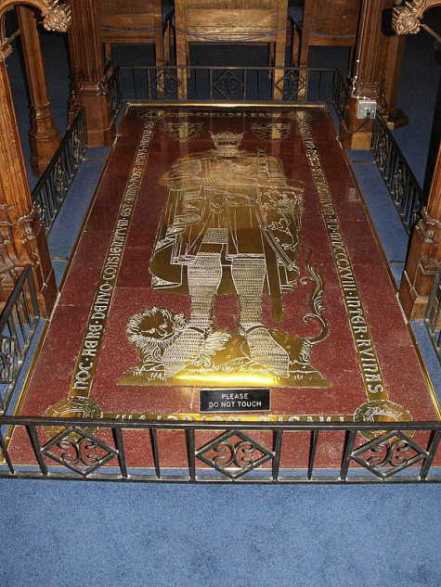
Robert’s grave
Robert was born on 11 July 1274 into an aristocratic Scottish family. Through his father he was distantly related to the Scottish royal family. His mother had Gaelic antecedents. Bruce’s grandfather was one of the claimants to the Scottish throne during a succession dispute in 1290 – 1292. The English king, Edward I, was asked to arbitrate and chose John Balliol to be king. Both Bruce and his father refused to back Balliol and supported Edward I’s invasion of Scotland in 1296 to force Balliol to abdicate. Edward then ruled Scotland as a province of England.
Bruce then supported William Wallace’s uprising against the English. After Wallace was defeated, Bruce’s lands were not confiscated and in 1298, Bruce became a guardian of Scotland, with John Comyn, Balliol’s nephew and Bruce’s greatest rival for the Scottish throne In 1306, Bruce quarrelled with Comyn and stabbed him in a church in Dumfries. He was outlawed by Edward and excommunicated by the pope. Bruce now proclaimed his right to the throne and on 27 March was crowned king at Scone. The following year, Bruce was deposed by Edward’s army and forced to flee. His wife and daughters were imprisoned and three of his brothers executed. Robert spent the winter on the island off the coast of Antrim (Northern Ireland).
Returning to Scotland, Robert waged a highly successful guerrilla war against the English. At the Battle of Bannockburn in June 1314, he defeated a much larger English army under Edward II, confirming the re-establishment of an independent Scottish monarchy. Two years later, his brother Edward Bruce was inaugurated as high king of Ireland but was killed in battle in 1318. Even after Bannockburn and the Scottish capture of Berwick in 1318, Edward II refused to give up his claim to the overlordship of Scotland. In 1320, the Scottish earls, barons and the ‘community of the realm’ sent a letter to Pope John XXII declaring that Robert was their rightful monarch. This was the ‘Declaration of Arbroath’ and it asserted the antiquity of the Scottish people and their monarchy.
Four years later, Robert received papal recognition as king of an independent Scotland. The Franco-Scottish alliance was renewed in the Treaty of Corbeil, by which the Scots were obliged to make war on England should hostilities break out between England and France. In 1327, the English deposed Edward II in favour of his son and peace was made with Scotland. This included a total renunciation of all English claims to superiority over Scotland. Robert died on 7 June 1329. He was buried at Dunfermline. He requested that his heart be taken to the Holy Land, but it only got as far as Spain. It was returned to Scotland and buried in Melrose Abbey.

Veridis Duchess Austria Visconti
My 17th great-grandmother was born into a noble family in trouble with the papacy. Veridis ( sometimes spelled Viridis) was born in Milan in 1352. Her father was excommunicated 1363 for opposing the Pope in Rome. She is buried at the Cistercian monastery in Sittich ,Obcina, Ljubljana, in modern and Slovenia. Her husband, the duke, died in Lucerne Switzerland, leaving her a widow at the age of 34.

Veridis Duchess Austria Visconti
Veridis Duchess Austria Visconti (1352 – 1414)
17th great-grandmother
Ernst I “Ironside” Archduke of Austria Habsburg (1377 – 1424)
son of Veridis Duchess Austria Visconti
Katharina Archduchess Austria Von Habsburg (1420 – 1493)
daughter of Ernst I “Ironside” Archduke of Austria Habsburg
Christof I VanBaden (1453 – 1527)
son of Katharina Archduchess Austria Von Habsburg
Beatrix Zahringen (1492 – 1535)
daughter of Christof I VanBaden
Sabine Grafin VonSimmern (1528 – 1578)
daughter of Beatrix Zahringen
Marie L Egmond (1564 – 1678)
daughter of Sabine Grafin VonSimmern
Richard Sears (1590 – 1676)
son of Marie L Egmond
Silas Sears (1638 – 1697)
son of Richard Sears
Silas Sears (1661 – 1732)
son of Silas Sears
Sarah Sears (1697 – 1785)
daughter of Silas Sears
Sarah Hamblin (1721 – 1814)
daughter of Sarah Sears
Mercy Hazen (1747 – 1819)
daughter of Sarah Hamblin
Martha Mead (1784 – 1860)
daughter of Mercy Hazen
Abner Morse (1808 – 1838)
son of Martha Mead
Daniel Rowland Morse (1838 – 1910)
son of Abner Morse
Jason A Morse (1862 – 1932)
son of Daniel Rowland Morse
Ernest Abner Morse (1890 – 1965)
son of Jason A Morse
Richard Arden Morse (1920 – 2004)
son of Ernest Abner Morse
Pamela Morse
You are the daughter of Richard Arden Morse
Viridis Visconti (1352–1414) was an Italian noblewoman, a daughter of Bernabò Visconti and his wife Beatrice Regina della Scala. By her marriage to Leopold III, Duke of Austria, Viridis was Duchess consort of Austria, Styria and Carinthia, she was also Countess consort of Tyrol.
Viridis was born in Milan, Italy and was the second of seventeen children.
Her sister, Taddea Visconti married Stephen III, Duke of Bavaria and was mother of Isabeau of Bavaria, wife of Charles VI of France. Viridis and the rest of her sisters secured politically-advantageous marriages.
Her maternal grandparents were Mastino II della Scala and his wife Taddea da Carrara. Her paternal grandparents were Stefano Visconti and his wife Valentina Doria.
Viridis’ father, Bernabò was described as a cruel and ruthless despot. He was also an implacable enemy of the Church. He seized the papal city of Bologna, rejected the Pope and his authority, confiscated ecclesiastical property, and forbade any of his subjects to have any dealings with the Curia. He was excommunicated as a heretic in 1363 by Pope Urban V, who preached crusade against him. When Bernabò was in one of his frequent rages, only the children’s mother, Beatrice Regina was able to approach him.
Viridis married Leopold III, Duke of Austria, son of Albert II, Duke of Austria and his wife Johanna of Pfirt. The couple had six children:
William
Leopold
Ernest the Iron
Frederick
Elisabeth (1378–1392)
Katharina (1385–?) Abbess of St. Klara in Vienna
Viridis was widowed in 1386 and so their eldest son, William became Duke of Austria.
William was engaged to Jadwiga of Hungary, youngest daughter of the neighboring king, was one of the first attempts of the House of Habsburg to extend their sphere of influence in Eastern Central Europe by marrying heiresses, a practice that gave rise to the phrase Bella gerant alii: tu felix Austria nube (Let others make war: thou happy Austria, marry). The wedding was broken off.
Viridis died in 1 March 1414 and out-lived at least three of six children, since her younger daughter, Katherine’s date of death is unknown. Viridis is buried in Sittich in Lower Carniola.
Source, Wikipedia

Nardostachys jatamansi
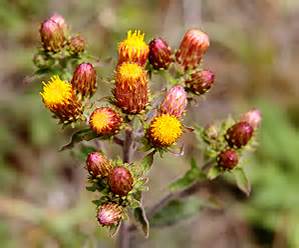
spikenard
Spikenard has been used for centuries as both a healing and a ceremonial plant. It is mentioned many times in the bible. In the Song of Songs 4:13-14, the bridegroom sings of spikenard:
Your plants are an orchard of pomegranates
With pleasant fruits,
Fragrant henna with spikenard,
spikenard and saffron,
calamus and cinnamon,
with every kind of incense tree,
with myrrh and aloes,
and all the finest spices.
The most well known biblical reference to spikenard is found in Mark 14:3-9, New King James Version
The Anointing at Bethany
3 And being in Bethany at the house of Simon the leper, as He sat at the table, a woman came having an alabaster flask of very costly oil of spikenard. Then she broke the flask and poured it on His head. 4 But there were some who were indignant among themselves, and said, “Why was this fragrant oil wasted? 5 For it might have been sold for more than three hundred denarii and given to the poor.” And they criticized her sharply.
6 But Jesus said, “Let her alone. Why do you trouble her? She has done a good work for Me. 7 For you have the poor with you always, and whenever you wish you may do them good; but Me you do not have always. 8 She has done what she could. She has come beforehand to anoint My body for burial. 9 Assuredly, I say to you, wherever this gospel is preached in the whole world, what this woman has done will also be told as a memorial to her.”
Many people know the phrase the poor will be with you always, but few know the context or the meaning. Mary Magdelene was preparing for Passover with Jesus, attending a seder at Simon the Leper’s house in Jerusalem. She anointed Jesus’ feet with spikenard then dried the excess oil with her hair. This is symbolic at many levels. She was devout sitting at his feet, but she uncovered her hair, which a Jewish woman would not have normally done. This business annoyed Judas, a guy known for stealing from the poor box. Judas wants to know why she did not sell the spikenard and put the proceeds in the poor box so he can steal it. Jesus explains that she is anointing him for burial. There is some discussion about whether it was his feet or his head or both that she anointed. This was not the main issue. She used a great deal of fragrant oil and then went around with it all in her hair as a human incense. This act was extremely unusual and divinely inspired. You notice Mary did not make it into the last supper paintings, but she has been depicted anointing.
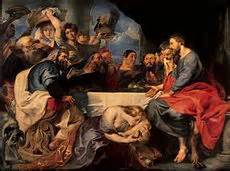
Mary Magdalene at Bethany
Pope Francis has used the spikenard in his coat of arms because in the Catholic church it represents Saint Joseph.

Pope Francis coat of arms
I like to wear some around my neck and shoulders when I feel I need to transform anything. I also love to fragrance my home with it, especially during winter. Although I guess it is an Easter symbol, I find the deep notes that linger in the air uplift my spirit in the darkest days. I buy a high quality essential oil, run a diffuser in my home, and also take it with me to the steam room for another way to feature it. I learned about spikenard kind of late in life, but am happily impressed with the results when I use it. It is a deep root note in perfume that holds the bass note long after the high notes have evaporated. Not everyone will love the smell as a single note, but with some mixing it works for most tastes. I am fond of mixing frankincense, myrrh and spikenard together, which are all very deep notes. I feel it lingering in the air. I like to saturate my home for full effects. Do you use essential oils, gentle reader? Aromatherapy is powerful medicine, often with deep historical meaning. The physical potential is excellent, but the symbolic and magical significance of spikenard can take you to a new place.
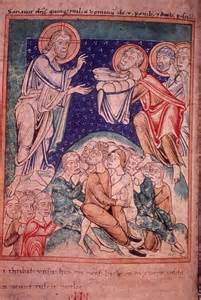
art by Hildegard von Bingen

Hildegard von Bingen
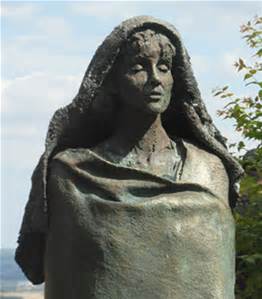
Hildegard von Bingen
“Even in a world that’s being shipwrecked, remain brave and strong.”
Hildegard von Bingen, mystic, visionary, polymath
Hildegard was born in 1098 in Bermersheim vor der Höhe, County Palatine of the Rhine, Holy Roman Empire. She died on17 September 1179 (aged 81) at Bingen am Rhein, County Palatine of the Rhine, Holy Roman Empire. She is venerated in Roman Catholic Church (Order of St. Benedict), Anglican Communion, and Lutheranism. She was canonized 10 May 2012 (equivalent canonization), Vatican City by Pope Benedict XVI. Her major shrine is Eibingen Abbey in Germany. Her parents gave her as an oblate to a Benedictine order when she was a child. She had visions before being enclosed in in order on All Saint’s Day, 1112.
She learned to read and write, wrote three books of visionary theology, and preached throughout the Rhineland during her lifetime. She was exceptional for her time, and her work still shines as poetry inspired by divine mysticism. She wrote music, created a written language, and was the author of what might have been the first morality play. Her place in history remains because of her prolific recorded work. She left us 70 poems and 9 books. She wrote music and was an accomplished artist. She recorded medical and pharmaceutical texts that are consulted and studied today. I know of pharmacies in Europe that offer her original formulas today. She wrote letters to popes, bishops and nuns that survive. We are lucky she learned to write, a rare privilege for a woman at that time. Her profound teachings apply to us now more than ever. The world needs mystics and visionaries to lift us out of this material rut in which we find ourselves. We all need to learn to be feathers on the breath of God. We are too dependent on the earth, and have forgotten to look up to the heavens for eternal blessings. What did she say about this?
“Listen: there was once a king sitting on his throne. Around Him stood great and wonderfully beautiful columns ornamented with ivory, bearing the banners of the king with great honor. Then it pleased the king to raise a small feather from the ground, and he commanded it to fly. The feather flew, not because of anything in itself but because the air bore it along. Thus am I, a feather on the breath of God.”
Hildegard von Bingen

baby Hildegard von Bingen

skull and crossbones
The death rate in the US has risen in 2015 for some alarming reasons. The new statistics for Alzheimer’s disease, chronic liver disease and cirrhosis show that our population suffers from toxic overload. The liver disease is normally caused by alcohol consumption, and Alzheimer’s is still a mystery. I took care of both of my demented parents until death. My own suspicion about their memory loss issues is that they were primarily caused by alcohol consumption that continued for more than 65 years. My parents were not seriously into drugs like people are today, but they did like to drink. Their diet choices and alcohol consumption worsened as they aged. I often wondered if could have been reversed if they had reformed rather then slipped into worsening habits. We will never know. For myself I am making different choices. I don’t think I have a genetic risk from my parents, as much as I cultural one, from being raised at a cocktail party.
Now the middle aged white population is into opioids. There is an increase in suicide by drug overdose happening in this group. Heroin is often a cheaper option for those who begin their use of opioids with a doctor’s referral. I don’t use any prescription drugs, but I know very few people of any age like me. Almost everyone is on something. The idea of taking meds for everything, real or imagined, has become so common that doctors have basically become drug dealers. Now Americans are killing themselves willfully and accidentally with these dangerous substances. I am concerned about our society. These are not social drugs, but drugs designed to kill pain. Have we no skills to deal with pain? I am afraid of this trend. I watch the evening news that is punctuated with drug commercials that must quickly mention the side effects. Often the side effects mentioned in the commercials include increased possibility of death. In my mind the whole country is on one dangerous drug or another with increased risk of death as a general side effect. I have no solution, gentle reader. I will close with the words of Prince, our recently deceased rock royalty:
You can be the president. I’d rather be the Pope.
You can be the side effect. I’d rather be the dope.
It is assumed that Prince’s death involved a drug overdose of pain killer.


When the Pope sprinkles holy water he dips it in a branch of rue. Ruta graveolens is used medicinally as well as ceremonially. In ancient Rome there were celebratory foods prepared with rue. It is poisonous in large amounts and should not be consumed by pregnant women at all. There is a homeopathic remedy that is very popular made with this plant. Mexican folk medicine prescribes leaves of the plant stuck directly into the ear to cure an earache. In gardening it is prized for its ability to repel insects from the area where it grows, making it a very good companion. I grow it at the back of my garden by the gate because it is a protector plant. It repels any unwanted attention, human, insect, or otherworldly.
The prophet Mohammed blessed this herb and none other. Early Christians used it to exorcise evil spirits. During the Middle Ages it was hung in the doorway to repel evil, the plague, and witches. Italians had a custom of adorning a silver amulet shaped like the top of rue plant, a cimaruta, with symbols of fertility. This magical charm was used to protect the user against the evil eye. Medicinal uses as well as magical ones have been recorded for centuries, but the way I like to use it is in the bath. Make a sachet of rue and create a strong tea in the bathtub by brewing in very hot water for 10 minutes or so before adding water to hit the bath temperature you desire. To add an extra helping of magic to this bath I spread honey on my face and leave it on while I soak in the tub. After rinsing the face feels very soft and the entire body, as well as the aura, is clean and clear. These baths are great before a meditation session or a creative project. Clearing and protecting are positive ways to influence your moods, your focus, and your ability to rest and relax. If you need protection from evil, or just from too much stress, try a rue bath.

Bayern COA
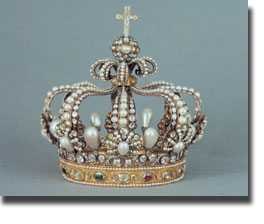
German Queen’s crown
Elisabeth of Bavaria, Queen of Germany was married to Conrad IV in her hometown of Landshut, Bavaria in 1246. Her husband the king was at war with the pope which lead to his early demise in 1254. Her second husband, Duke of Carinthia, is my ancestor. She is one of the only royal ladies in my tree who managed to avoid the monastic life.
Elisabeth of Bavaria, Queen of Germany (Landshut, c. 1227 – 9 October 1273) was the Queen consort of Conrad IV of Germany.
She was the eldest daughter of Otto II Wittelsbach, Duke of Bavaria and Agnes of the Rhine. Her maternal grandparents were Henry V, Count Palatine of the Rhine and Agnes von Staufer.
The elder Agnes was a daughter of Conrad of Hohenstaufen and Irmingard of Henneberg.
Marriages and children
Her father Otto II had become a supporter of Frederick II, Holy Roman Emperor in 1241, following initial conflict between them. Their political alliance would lead to the marriage of the elder daughter of the Wittelsbach and the elder son of the Hohenstaufen. Said son was Conrad IV of Germany, son and heir of Frederick II. Their marriage took place on 1 September 1246, in her native Landshut.
Elisabeth and Conrad would only have one son:
Her father-in-law Frederick II died on 13 December 1250. He was still involved in a war against Pope Innocent IV and his allies at the time of his death. Conrad IV would continue the war until his own death of malaria at Lavello, Basilicata on 21 May 1254.
Elisabeth remained a widow for five years. She married her second husband Meinhard, Duke of Carinthia in 1259. They had six children:
Elisabeth Wittelsbach Duchess Bavaria (1227 – 1273)
is my 20th great grandmother
Consort Elisabeth the Romans Carinthia (1263 – 1313)
daughter of Elisabeth Wittelsbach Duchess Bavaria
Albrecht Albert II ‘The Wise’ Duke of Austria Habsburg (1298 – 1358)
son of Consort Elisabeth the Romans Carinthia
Leopold III “Duke of Austria” Habsburg (1351 – 1386)
son of Albrecht Albert II ‘The Wise’ Duke of Austria Habsburg
Ernst I “Ironside” Archduke of Austria Habsburg (1377 – 1424)
son of Leopold III “Duke of Austria” Habsburg
Katharina Archduchess Austria Von Habsburg (1420 – 1493)
daughter of Ernst I “Ironside” Archduke of Austria Habsburg
Christof I VanBaden (1453 – 1527)
son of Katharina Archduchess Austria Von Habsburg
Beatrix Zahringen (1492 – 1535)
daughter of Christof I VanBaden
Sabine Grafin VonSimmern (1528 – 1578)
daughter of Beatrix Zahringen
Marie L Egmond (1564 – 1584)
daughter of Sabine Grafin VonSimmern
Richard Sears (1590 – 1676)
son of Marie L Egmond
Silas Sears (1638 – 1697)
son of Richard Sears
Silas Sears (1661 – 1732)
son of Silas Sears
Sarah Sears (1697 – 1785)
daughter of Silas Sears
Sarah Hamblin (1721 – 1814)
daughter of Sarah Sears
Mercy Hazen (1747 – 1819)
daughter of Sarah Hamblin
Martha Mead (1784 – 1860)
daughter of Mercy Hazen
Abner Morse (1808 – 1838)
son of Martha Mead
Daniel Rowland Morse (1838 – 1910)
son of Abner Morse
Jason A Morse (1862 – 1932)
son of Daniel Rowland Morse
Ernest Abner Morse (1890 – 1965)
son of Jason A Morse
Richard Arden Morse (1920 – 2004)
son of Ernest Abner Morse
Pamela Morse
I am the daughter of Richard Arden Morse
The coolest monk on earth has opened an instagram account. His Holiness the Dalai Lama of Tibet is now updating his travels with photos. This is so much more exciting that Pope Francis’ twitter streams, although I do applaud @Pontifex for multi-lingual tweeting to anyone who wants to stay in touch with him. If you have been in the presence of His Holiness (I have had the very good fortune of doing so in 3 different teachings) you never forget the way he laughs and smiles. He is infectious and inspires this adoration instantly by giggling. I have seen him teach in Tibetan, and even in the middle of serious rituals he jokes and giggles with his students. By the time we had our translations in our earbuds the Tibetans were laughing at his jokes. He connects on all levels with all people. Those who understand and practice the fine points of Buddhism learn deeply and some probably glimpse enlightenment in his presence. Those of us who come in relative ignorance to his teachings may come away with less refined ideas, but we are also subject to instant enlightenment in his presence. The ancient texts he uses for study require lifetimes of study and meditation to do them justice. When he flashes a smile from that cute baby monk face he touches everyone in exactly the same way. Now we can all follow his smile around the world as he keeps us updated.
He enjoys a hobby in horology, and since his youth has taken watches apart to rebuild them. I believe he is a geeky monk who appreciates technology and wants to understand and use it to the max. What ever his reason may be, I am following him, and suggest that the gentle readers might want to check out his account. He is changing the world with his smile.
Al Qaeda is using this hashtag to solicit ideas for media ops #اقتراحك_لتطوير_اﻹعلام_الجهادي — you should all send some.
— Don’t Panic Online (@dontpanic) August 15, 2013
This is a real twitter stream with some of the funniest tweets in history. Not since @Pontifex opened his papal twitter account has there been such a snark storm. The most feared terrorist organization in the world wants suggestions to improve on line presence and customer service. WOW!!!
If you enjoy irony take a few minutes to sift through the snark in response to this historic request. There are similarities to the papal stream, but this one is funnier, and nobody asks Al Qaeda to RT anything. Americans have snark!!!! I am proud of this quality we have to make fun of the obvious.




Ruta Graveolens is a medicinal and magical herb. It has meaning for the Pope as well as for Central American shamans. The herb of grace, as it is known, has been used for centuries to guard or protect entrances. The Catholic church uses the plant rue to sprinkle holy water. Shamans use it for bathing and ceremony. Bathing with it can be especially effective as a liberation. It is mentioned in the Bible, in Shakespeare, and in Ethiopian cooking. The smell is pungent and bitter, the flowers yellow and bright. I use this plant to guard the back entrance of my garden. It is spreading and doing an excellent job of keeping things safe.
 mermaidcamp