mermaidcamp
Keeping current in wellness, in and out of the water
You can scroll the shelf using ← and → keys
You can scroll the shelf using ← and → keys
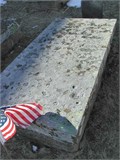
grave

Dr John
My 9th great-grandfather bought Shawomet, Warwick, RI for 144 fathoms of wampum:
Dr. John Greene was the fourth and youngest son of Sir Richard Greene, of Bowridge Hall. He was born in 9 Feb 1597 at Salisbury, Wiltshire, England. He came to Warwick, Rhode Island, sailing on the ship “James” 5 April 1635, arriving in Boston, Massachusetts, 3 June 1635. He moved his family to Providence, Rhode Island in 1637 all four of his sons being born in England. John born 15 Aug 1620, Peter born 10 Mar 1622, James born 21 Jun 1626, Thomas born 4 Jun 1628. His wife and sons all lived out their lives and are buried in Warwick, Rhode Island. He was one of the original 12 members of the Baptist Church. In January 1643, he and 10 others bought from Miantonimoh, Chief of the Narrowgansets (Native American Tribe), for 144 fathoms of Wampun, the tract of land called Shawomet (Warwick, Rhode Island). — A fathom (six feet of strung beads) of white wampum was worth ten shillings and double that for purple beads. A coat andBuskins “set thick with these Beads in pleasant wild works and a broad Belt of the same (Josselyn 1988: 101)” belonging to King Philip (Wampanoag) was valued at Twenty pounds. Even in the 1600s there was noted distinctiveness of Native-made wampum and the inability of others to counterfeit it, although attempts at imitations included beads of stone and other materials. — In 1644 Dr. John Greene went to England with Samuel Gorton and Randall Holden, returning in 1646, their mission successful. John Greene was Commissioner from 1654-57, Deputy Governer 1654. He married his first wife, Joan Tattersall, at Salisbury, England in St. Thomas Church, 4 Nov. 1619. Dr. John Greene died 11 Mar 1658. He is buried next to his wife Joan.
He married often and well:
JOHN GREENE, Surgeon, the progenitor of the Warwick Greenes, was the son of Richard and Mary (Hooker) Greene, and was born on his father’s estate at Bowridge Hill in the parish of Gillingham, County Dorset, England, about 1590. Though not so recorded, dates before and after him would seem to determine this as the year of his birth. His father, Richard, grandfather Richard, and great-grandfather, Robert, had for nearly one hundred years before him resided at Bowridge Hill, and were undoubtedly a branch of the Northamptonshire family of Greene through a younger son.
The mother of John Greene, surgeon, Mary Hooker, was the daughter of John Hooker (alias Vowell), who was born at Exeter, England, about 1524, his father, Robert Hooker, having been mayor of that city in 1520.
John Greene removed early to Sarum (Salisbury), the county town of Wiltshire, and was there married at St. Thomas’s Church,’ November 4, 1619, to Joanne Tattershall (or, as it was written on the church register, “Tatarsole”). Nothing is definitely known of her English connections. The name is frequently found in early records among post-mortem examinations, parliamentary writs, and charters, and is variously written Tatersall, Tateshall, Tatashall, Tatershal, and Tattershall. The first of the family of whom we have mention came in with William the Conqueror and obtained the lordship of Tattershall in Lincolnshire, where he seated himself and from which he took his surname. His descendants were seated in Berkshire and Norfolkshire, and were held in high repute. It is probable that other branches located in other counties, and it is not improbable to suppose that Joanne the wife of John Greene, who emigrated to America from Salisbury, County Wilts, was a connection of the family of George Tattershall, who was seated at Stapleford, County Wilts, which is about five miles distant from his Salisbury home ; but as yet this relationship has not been proved. The following note, recently received by the compiler in answer to an inquiry about records at Stapleford, may be of interest in this connection
“Stapleford Vicarage, Salisbury,” October 18, 1900.
“Madam: I have received your letter of the 25th September, but regret to say that I cannot help you in your research, as the Stapleford Register begins only with the year 1637. “J. F. D. HOERNLE, “Vicar of Stapleford.” [Joanne Tattershall ‘s marriage date was 1619, eighteen years earlier.]
The marriage of John Greene and the baptisms of all his seven children, recorded in the Parish Register of St. Thomas’s Church at Salisbury, England, are still extant. He is therein styled “Mr.” and “Gent,” a mark of some distinction at that date.” He resided at Salisbury with his family, following his profession, for about sixteen years. On April 6, 1635, he was registered for embarkation at Hampton, England with his wife and six children (one having probably died in England before this date),” in the ship James, of 200 tons, William Cooper, Master, for New England.” After a voyage of fifty-eight days he arrived at Boston, Mass., June 3, 1635. He first settled at Salem, Mass., where he was associated with Roger Williams, purchasing or building a house there, but soon after Mr. Williams’s flight from Salem (1636) he sold it and, joining Williams at Providence, secured his home lot, No.15, on the main street. He was one of eleven men baptized by Roger Williams, and one of the twelve original members of the first Baptist church on this continent, organized at Providence, R. I. He was the first professional medical man in Providence Plantations. He is alluded to in Goodwin’s Pilgrim Republic (p. 407) as “one of the two local surgeons” at Providence in 1638, though we are told “the people of Providence relied solely upon him for surgical aid long after his removal to Warwick in 1643.”
His first wife, Joanne Tattershall , the mother of all his children, died soon after his removal to Rhode Island and it is supposed was buried at Conimicut, Old Warwick (?). He married (2) ” Ailsce (Alice) Daniels, a widow” (recorded as proprietor of a home lot in Providence, 1637). They removed to Warwick, 1642-3. At the time of the persecution of the Shawomet pioneers (October, 1643), when “forty mounted and armed men,” sent from Boston to arrest them, fired over their houses, the women and children fled to the woods. Fright and exposure caused the death of the (second) wife of John Greene. (It seems more probable that this was the wife who was buried at Conimicut.) Samuel Gorton wrote of this attack of the Massachusetts troops: ” Afflicting our wives and children, forcing them to betake themselves some into the woods among the Indians, suffering such hardships as occasioned the death of divers of them, as the wife of John Greene, as also the wife of Robert Potter.” Judge Staples, in his Annals of Providence, mentions the fact that the second marriage of John Greene was not recorded, but he found evidence in Probate Records, where mention is made of the son of Alice Daniels as “John Greene’s stepson.”
Evidence of this marriage is also given in the following item:
“In the division of 52 House lots John Greene senior had lot between Thomas James on the North and John Smith on the South, and he inherited the lot of Alice Daniels his second wife between Wm. Harris on the North and John Sweet on the South” {Rhode Island Colonial Records [Printed], vol. i., p. 24).
In files. City Clerk’s office. Providence, is a book containing “A revised List of Lands and Meadows as they were originally lotted for the beginning of the Plantations of Providence in the Narragansett Bay in New England unto the [then] inhabitants of the said Plantations until anno i6—-.”
First in order are the “home lots,” beginning at the Mile-end Cove, south end of town, between Fox Point and Wickenden Streets, lots all bounded by Town (Main) Street on the west and by what is now Hope Street on the east. The name of Alice Daniels is found on this list.
Mr. Greene was married (3) in London, England, about 1644, to Phillippa (always written Phillip), who returned with him to Warwick, R. I., 1646. Her family name is not known. She died at Warwick, March 11, 1687, aged about eighty-seven years, having survived her husband for nearly thirty years.’ In further support that his third wife was from London we quote the words of Samuel Gorton, who, in a letter from Warwick addressed ” to Edward Calverly at his house by the east end of Christ Church in Newgate Market, London,” and dated November 20, 1649, wrote of this last wife of John Greene: ” Your auld neighbour, our loving friend, Mrs. Greene, hath writ a letter of advise to you [which] made me laugh not a little, which I heartily wish may come to your hands. She laies out the benefights of these parts better than I could have advised to have done. She takes well with the country and cheerfully performs her place [part], hath the love of all, non can open their mouth against her, which is a rare thing in these parts.”
Excerpt from the Book Title: The Greenes of Rhode Island, with historical records of English ancestry, 1534-1902 Author: General George Sears Greene (1801-1899) Publisher: Knickerbocker press Published in: New York Date of Publication: 1903 The Excerpt is Pages 54 – 56 The Document was retrieved from http://www.archive.org/details/greenesofrhodeis00gree





When I returned to Oakmont, PA this year to see my old friends from childhood I was not thinking about politics or history. I was intrigued to find out what my old home and school looked like, and how my old friends are today. The reunion was a resounding success and a big memory jog. We toured the school where I attended grades K-4, then returned for 7-8th grades. I left after the 8th grade to live in Venezuela as a petroleum princess. This week as we watch the footage and remember where we were when we heard the news JFK had been shot I can clearly picture it. We were in the gym, which had a large dividing wall between the girls and boys for the hour. When we finished the wall was always removed at the end of the school day. On that day when the wall was parted and we saw they boys we were also listening to the loudspeaker system announce to use that the president had been shot in Dallas. It was surreal and many of us started to cry. I am not sure if I cried or not, but I remember being in shock. We talked about it when we were on tour of the school and I had almost a flashback of the feeling on that day. We went home and learned that he had died. My parents did not vote for him but they were very upset about the assassination. After 50 years we all have a chance to process what happened to us and to the world on that day in Dallas. We may have been 8th graders but we all had mature feelings about the frightful news about our country.
I was born in 1951 when this map had very little activity. We had drills in my elementary school for bomb preparedness. My parents voted Republican, and strongly opposed JFK. I remember the cold war well as a formative part of my thinking. My parents, and later the national government, seemed either unaware or unethical to me. In my family history there are knights and military heroes. In modern times my uncles fought in WWII, but my father was nearly blind, so he did not serve. I believe the atom bomb has changed the potential for corruption, destruction, and total Armageddon. What was settled with swords in the middle ages is now settled by dangerous committee. Human nature has not changed all that much, but the swiftness and anonymity with which all creation can now be destroyed is daunting.

Richard landing with Pilgrims
Oct. 1665, John Cooke and his Brother-In-Law Nathaniel Warren, were appointed by Plymouth Colony to “treat with Philip the Sagamore about the sale of such lands as are to be sold by him, and to purchase them in the behalf of the country.” Philip the Sagamore, sometimes called Metacom, was the son or grandson of Massasoit, and leader of the Wampanoag Indians. He would later be dubbed “King Philip” during the Wampanoag’s war he led against the English in 1676.
His prepared his will in 1661 to resolve disputes over his father’s estate.
From the book “Mayflower Families Through Five Generations” Richard Warren, Volume Eighteen Part 1 – Third Edition by the General Society of Mayflower Descendants 2004
On June 11 1653 Jane Collyare (Collier) on behalf of her grandchild Sara, the wife of Nathaniel Warren. Elizabeth Warren and Nathaniel Warren agreed to let the court resolve their differences over certain lands of Mr. richard Warren deceased.
Nathaniel Warren became a Freeman 3 June 1657. On 1 June 1658 he was a Deputy from Plymouth, a position he frequently held.
On 15 oct 1661 Nathaniell Warren “aged thirty seaven yeares or thereabouts” made a deposition. NOTE: spelling in the ( )’s are exactly the way it was written back in 1661.
The will of Nathaniel Warren Sr. of Plymouth, dated 29 June 1667, codicil dated 16 July 1667, names wife Sarah; dau. Hope who is lame; other children (not named); the codicil mentions mother Elizabeth Warren; brother Joseph Warren; sisters Mary Bartlett, Sr., Ann Little, Sarah Cooke, Elizabeth Church and Abigail Snow. The inventory was taken 21 Oct 1667, sworn by widow Sarah Warren who was granted administration 30 Oct 1667.
On 9 Jan. 1689/90, Sarah Warren sold land in Plymouth to her son James Warren. On 9 Jan. 1689/90, the other heirs of Nathaniel Warren consented to the sale, they were: Richard Warren; Nathaniel Warren; Jabiz Warren; Elizabeth Green; Sarah Blackwell; Thomas Gibbs and wife Alice; Jonathan Delano and wife Mercy Delano.
On 19 Sept. 1694 Jabiz Warren of Plymouth, yeoman, sold to John Gibbs land in Middleboro which was bought by his father Nathaniel Warren.
My 9th great grandmother was the first woman poet to be published in America:
Anne Bradstreet (1612-1672) is one of the most important figures in the history of American Literature. She is considered by many to be the first American poet, and her first collection of poems, “The Tenth Muse Lately Sprung Up in America, By a Gentlewoman of Those Parts”, doesn’t contain any of her best known poems, it was the first book written by a woman to be published in the United States. Mrs. Bradstreet’s work also serves as a document of the struggles of a Puritan wife against the hardships of New England colonial life, and in some way is a testament to plight of the women of the age. Anne’s life was a constant struggle, from her difficult adaptation to the rigors of the new land, to her constant battle with illness.
It is clear to see that Anne’s faith was exemplary, and so was her love for children and her husband, Governor Simon Bradstreet. Anne’s poems were written mainly during the long periods of loneliness while Simon was away on political errands. Anne, who was a well educated woman, also spent much time with her children, reading to them and teaching them as her father had taught her when she was young. While it is rather easy for us to view Puritan ideology in a bad light because of it’s attitude towards women and strict moral code, her indifference to material wealth, her humility and her spirituality, regardless of religion, made her into a positive, inspirational role model for any of us.
Another one of Anne’s most important qualities was her strong intuition, although only subtly hinted at in her work, probably for fear of reprisal from the deeply religious Puritan community, one cannot help but feel her constant fascination with the human mind, and spirit, and inner guidance.
Her style is deceptively simple, yet speaks of a woman of high intelligence and ideals who was very much in love, and had unconditional faith. While it was difficult for women to air their views in the 17th Century, Anne Bradstreet did so with ease, as her rich vocabulary and polyvalent knowledge brought a lyrical, yet logical quality to her work which made it pleasant for anyone to read.
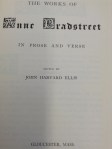

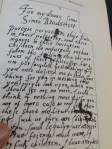
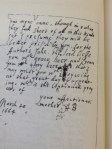







Anne Dudley Bradstreet was protected by her father and husband at a time when women were not supposed to think, let alone write poetry. She wrote history as she lived it as an Englishwoman in New England. I visited the University of Arizona Poetry Center this week to see the word shrine for the dead. I was very happy to also find a big blue book by Anne Bradstreet on the shelves. I enjoyed the wonderful space and visited with my ancestor by reading her works for about an hour. I had seen some of the work before, but since I was thinking of ancestry I really enjoyed the note she wrote to her son Simon (brother of my own ancestor). There is a copy preserved in her own hand, which I love to see. It gives me some intuition into her soul’s journey. Being a Pilgrim was not easy, but if your father and husband were governors you had some obvious advantages.
It is a wonderment of synchronicity to find my ancestor’s work preserved at the Poetry Center very near my home where I can go visit and read her any time.
The Avenger character is a masked marvel. Crusades for righteousness and fairness are the territory of this archetype. Comic book characters and super heroes use the avenger character to tell stories about balancing the scales of justice . The obvious shadow attribute the avenger can possess is the willingness to use violence to defend a cause. Frequently we see the misguided avenger on the loose; That is called the loose cannon because the lack of control is too obvious. They may be warriors or politicians, but their primary motive is to represent causes for the sake of others. They are aggressive.
Religious zealots in history have often convinced others to seek revenge or fight a holy war. Terrorism and family feuds are examples of avengers gone bad. When nations or political factions square off to avenge some perceived wrong this is the archetype in control. When the Republicans and the Democrats cut off all their noses to spite all their faces they are doing it because they believe they are finding vengeance. They tell the taxpayers they are fighting for us, but they are isolated in their own cartoon, unaware of the roles they play in our big drama. They fight because they feel entitled, and because we have allowed them to become so extreme. Their capes and masks must be recalled.

avenger card

Quaker
Jeffrey Horney was a Quaker born in Maryland. His father was a planter who left his estate to his children in 1738. Jeffrey inherited “Cottingham”:
Horney, Jeffery, planter,Talbot Co.,11th Jan., 1737;
27th Mch., 1738.
To son William and hrs., “Dixon’s Gift,” Queen Anne’s Co.; and personalty.
To son Jeffery and hrs., “Cottingham,” sd. son dying without issue sd. tract to son Philip and hrs.; and personalty.
To sons Philip, James and daus. Jane and Prissillia, personalty, some of which des. as bou. of John Carslake. Residue of personal estate to 4 sons and 4 daus. divided equally.
Son Jeffery, ex., to have care of sons Philip and James until they come to age of 18.
Test: Robert Harwood, John Regester, Edward Perkins. 21. 861. MARYLAND CALENDAR OF WILLS: Volume 7
Since I have ancestors born in Maryland named Nichols, I was very interested to learn about the Nicholite movement, also known as New Quakers. The Nichols in my tree marry into the family about 100 years later in Pennsylvania.
Jeffrey Horney (1723 – 1779)
is my 8th great grandfather
Mary Horney (1741 – 1775)
daughter of Jeffrey Horney
Esther Harris (1764 – 1838)
daughter of Mary Horney
John H Wright (1803 – 1850)
son of Esther Harris
Mary Wright (1816 – 1873)
daughter of John H Wright
Emiline P Nicholls (1837 – )
daughter of Mary Wright
Harriet Peterson (1856 – 1933)
daughter of Emiline P Nicholls
Sarah Helena Byrne (1878 – 1962)
daughter of Harriet Peterson
Olga Fern Scott (1897 – 1968)
daughter of Sarah Helena Byrne
Richard Arden Morse (1920 – 2004)
son of Olga Fern Scott
Pamela Morse
I am the daughter of Richard Arden Morse
Jeffrey Horney [III] was born before 1720 in Talbot County, Maryland. He married Deborah Baynard outside of the Quaker faith without the consent of the Friends. Their marriage license was dated October 6, 1739 in Talbot County, Maryland. Eight years later in 1747, Jeffrey and Deborah Horney would sell their land in Talbot County and move to Dorchester [now Caroline] County. On the 27th of October 1747, Jeoffery and Deborah Horney sold fifty acres of Cottingham in Talbot County to William Thomas, Gentleman. Less than one month later, on the 12th of November 1747, Jeffrey Horney of Talbot County purchased Piersons Chance [Pearsons Chance] from John Pierson of Dorchester County, formerly laid out for Thomas Pierson. The property was in two parts; one part contained 100 acres and the other part contained 50 acres. The land was located on Watts Creek, off of the Choptank riverjust south of Denton in what is now Caroline County, Maryland. As the crow flies, Piersons Chance was less than 15 miles northeast of Cottingham and was about 5 miles from the Delaware line of Kent County, Delaware.
Nov 12, 1747 John Pierson of Dor Co, planter, to Jeofrey Horney of Talb co, planter: two parts of a tract formerly laid out for Thomas Pierson called “Piersons Chance,” conveyed by said Thomas to said John by separate deeds, on Watts Creek, one part containing 100 a. and the other part containing 50 a. more or less. Wit: T. Waite, Jno. Caile, Hall Caile. Ackn by John Pierson and Elizabeth his wife before Thos. Foster abd Benj Keene, Justices. (See receipt, Dorchester County Land Records 14 Old 169).
For the first seven years of their marriage, Jeffrey and Deborah Horney lived at Cottingham, and any of their children born within the first seven years between 1740 and 1747 were born at Cottingham in Talbot County. After November 1747 when Jeffrey and Deborah purchasedPiersons Chance in Dorchester County, any subsequent children they may have had were born in Dorchester County, Maryland. This land now lies in Caroline County Maryland which was not established until 1773 from parts of Dorchester and Queen Anne’s Counties. This explains why Jeffrey and Deborah Horney and their children are subsequently found in Caroline County records. The land on which they were living from November 1747 onward,Pierson’s Chance, was once in Dorchester County in an area that became Caroline County in 1773. At least three of their children, John, Philip and William Horney, left Maryland between the 1780s and 1790’s when they may have followed the Nicholite movement into the Deep River section of Guilford County, North Carolina. Some lines would remain in North Carolina while others would move onto Ohio, Illinois and beyond.
There is a local legend surrounding the area on Watts Creek where Jeffrey and Deborah settled. It was believed that in the 1600s and early 1700s notorious pirates and privateers, such as Captain William Kidd and Edward Teach [Thatch, Thach, Thache], otherwise known asBlackbeard, may have hid or buried treasure along the shores of Watts Creek. A local legend began to circulate (or re-circulate) in 1916 when Swepson Earle wrote Manor houses on the Eastern Shore. He claimed that “Tradition says [Watts Creek, south of Denton] once provided refuge for Captain Kidd, whose ‘buried treasure’ has been sought on its banks.” Later, in the 1940s when Hulbert Footner wrote his book, Rivers of the Eastern Shore, he related that“There is such a hole near the mouth of Watts Creek that is ninety feet deep. It is called Jake’s Hole. Its exact depth is known because it’s been sounded often enough, and I’ll tell you why. There was aplenty pirates round here in the old time. The one that mostly cruised in these waters was Blackbeard; Edward Teach was his right name. Well, Blackbeard picked Jake’s Hole for one of his caches, and dropped an oaken chest bound round with copper bands in there. It’s still there. God knows what’s inside it!”However, according to Donald Shomette who more recently wrote Pirates of the Chesapeake, neither Blackbeard or Captain Kidd ever sailed into the Bay, but their legends did.
Whether or not the legends of Watts Creek spun by the old-timers were fact or fiction, there were pirates and privateers who sailed in and around the Chesapeake Bay. Among them, Roger Makeele, was found in Maryland records in 1685 when he and his band of pirates lured the crews of tobacco sloops to their camp on Watts Island. They would seize the crew and confiscate their sloops before leaving the men in the Marshes of Dorchester County. Makeele sailed the Choptank river which separated Dorchester County from Talbot County where the early Horney’s lived. Incidentally, that same year Jeffrey Honey [Horney] was testator to the will of Emanuel Jenkinson of Talbot County Maryland. It is likely the early Horney men, as well as other settlers in the area, heard of these pirates and were in peril of loosing their tobacco crops and their sloops to the pirates of the Chesapeake.
During this time, local Indians lived in the area. Their ancestors arrived in the area long before the European settlers. When John Burnyeat appointed a general meetingfor all of the Friends in the province of Maryland. George Fox wrote about that meeting in his journal, (Two Years in America 1671-1673 Chapter XVIII) It was upon me from the Lord to send to the Indian emperor and his kings to come to that meeting. The emperor came and was at the meeting. His kings, lying further off, could not reach the place in time. Besides the Horneys who married into Quaker families, other religions would later play a part in their lives. Among the early churches and societies, early Horney families were or became Puritans, Anglicans and Episcopalians. In 1760, when Joseph Nichols of Kent County, Maryland and Delaware founded the Nicholites [New Quakers], at least one branch of Horney’s were found in Nicholite Petitions. [Most likely Jeffrey and Deborah Horney and/or their descendants.] The early Horney’s also became Methodist and Methodist-Episcopal. On June 17, 1703 John Wesley, the founder of Methodism, was born in Epworth, Lincolnshire, England. By 1771, John Wesley’s teachings reached the Eastern Shore of Maryland. When Francis Asbury came to Maryland to spread Wesley’s word, the Methodist religion took a strong hold in Maryland. More than a few Horney families converted to Methodism. However, Wesley’s Tory beliefs may not have sat well with the Horney’s who served [on the American side] in the Revolutionary War.
The rivers on Maryland’s Eastern Shore defined the early transportation routes of religion. During their lifetime, the settlers of the area, did much of their traveling on the rivers, tributaries, creeks and branches which crossed the Eastern Shore of Maryland, east of the Chesapeake Bay. They lived near and traveled many of these waterways including the Choptank, Wye, St. Michaels, (now Miles),Tred Avon (Third Haven), and Tuckahoe Rivers. The Tred Avon was and still is the location of Third Haven Meeting House near what is now Easton, Talbot County, Maryland. The St. Michaels, (now Miles) River was the location ofBetty’s Cove Meeting House.
To see photos of the Choptank and Tuckahoe river areas in Talbot and Caroline counties where the Horney families lived and traveled, select the pdf file from the Upper Choptank and Tuckahoe River Cultural Resources Inventory. Another helpful tool is the Choptank and Tuckahoe Rivers Sections Map. Take a two day canoe trip on the Choptank River Sojourn, a journey of Maryland’s Eastern Shore through areas where the earliest Horneys settled and the route that Jeffrey Horney III and his wife Deborah Baynard traveled and settled after 1747. Areas mentioned throughout this river journey are Choptank, Denton, Dover Bridge, Greensboro, Hillsboro, Tuckahoe and Watts Creek. All of these locations were found in 1600 – 1700 HORNEY records in Caroline, Talbot, and Dorchester Counties, Maryland. The journey described was a likely route traveled by Jeffrey Horney III and his wife, Deborah Baynard and their children as they left Talbot County, Maryland and settled in Dorchester [now Caroline] County, Maryland.
Chivalry is one of those double edged swords. Knights are loyal and honorable as an ideal; love and honor do not always triumph. The good knight is brave in service to a higher calling or just ruler. The shadow knight is romantically delusional and may serve a corrupt ruler. Self image is all important to the knight, since he needs to be seen as helpful and brave. He may find himself drawn into needless drama to save damsels and others who signal distress. This may become a pattern in life, endlessly saving others.
Today the knight may be spiritually correct, always defending worthy causes. His love of honor and his loyalty to cause or leader can be very confusing in this character. If the leader demands self sacrifice and self neglect, this archetype can feel self righteous about taking this shadowy path. Loyalty to destructive or greedy powers can be the undoing of the modern knight, just as it was in history. Romantic notions of service can be a cover for the absence of chivalry and honor. It is usually easy to spot the knight riding either a black horse or a white one that symbolizes intent. This archetype distinguishes itself from all the characters by being loyal as well as romantic. The knight displays his loyalty above all else, since it is the source of his identity. Do you know any knights in your life?

healthy food
The way words are used has a big effect on culture and expectations. The words health care have come to mean prescription drugs and medical procedures. Wellness has come to mean any kind of body work, cleanse, or restrictive diet. What is even more debilitating to the public health is that insurance policies determine the care most people use. There is abuse on both sides, by wellness quacks and medical losers. Wellness or health coaches are essentially practicing counseling in everything from nutrition to psychiatry. The unhealthy American population is vulnerable and guilty, willing to jump to all kinds of conclusions, buying into all kinds of cures and programs. The market is so crowded the consumer has been confused by all the possibilities. Now the public will need to understand how health insurance functions. This is a giant leap for the citizens, a shock to the system.
I made a living teaching and promoting health and wellness through water for many years. I have enjoyed waters and spas all over the world and had the pleasure of teaching many wonderful students. I have a strong healthy body that I treat to the best food and body work I can afford to give it. Since I love movement, I move. I don’t take any prescription drugs; my plan is to avoid them. The reasons I am keeping my insurance policy as it is, and not vexing myself trying to read all the options are:
Watching the US congressional dramatists perform for the nation I wonder how these folks make contact with reality. Systems thinking, or connessione provides a holistic, integrated, well proportioned view. The interests of many networks can be connected for the good of the entire system. Our congressional employees seem stuck on the idea that hostile, unproductive bickering is what the taxpayers deserve. Fractured care for our precious resources is eroding the national confidence. Rather than forming natural helpful alliances bills are created with purposeful conflicts of interests from the get go. It looks as if these representatives of the people are on some kind of very bad bummer trip, unable to view any kind of broad picture for fear of heavy freak out. They use their imaginations and creativity to whip up disharmony rather than working to connect the whole.
How can we use our own creativity as taxpayers to force these clowns to get it together on behalf of the American people? Can we imagine them working for us rather than wasting our money? I find that difficult. In the season of Halloween let us consult history and the ancestors to learn from the past. How did our ancestors off insane rulers? There have been plenty of them. We must connect the dots to understand the deep lessons history teaches. We must find the strength and the will to create a congress that works for us. We are capable of balance, even if we are not witnessing it in our elected officials.

