mermaidcamp
Keeping current in wellness, in and out of the water
You can scroll the shelf using ← and → keys
You can scroll the shelf using ← and → keys
Gratitude is the practice. Liberation is the result.
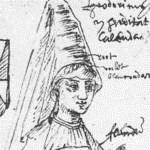
Sibilla Anjou
My 25th great grandmother was from the House of Anjou (like the pear) . Her father, Fulk, was a crusader who is buried at the Church of the Holy Sepulchre in Jerusalem, as King of Jerusalem, which is a very big deal, and pretty creepy. I have been there but did not think to look for my ancestors at the time. The Anjous are Plantagenets in that way that royal Euros had lots of different names and houses. The crusade thing is equally confusing. This is how the Anjous took over the English throne:
The Plantagenets are also called Angevins, because their immediate paternal progenitors were Counts of Anjou, an autonomous county in northern France. They descend in the male line from from the Counts of Gatinais, one of whom had married an heiress to the county, her Anjou ancestors deriving from an obscure 9th century nobleman named Ingelger. It is due to this lineage that the Plantagenets are sometimes referred to as the First House of Anjou. One of the more notable Counts was Fulk, a crusader who became King of Jerusalem. It was his son, Geoffrey, nicknamed Plantagenet, who gave his name to the dynasty, and Fulk’s grandson, Henry, was the first of the family to rule England.
Henry’ s claim to the English throne came through his mother, the Empress Matilda, who had claimed the crown as the daughter of Henry I of England. Empress Matilda’s brother William Adelin had died in the wreck of the White Ship, leaving Matilda her father’s only surviving legitimate child. However, on Henry’s death in 1135, Matilda’s cousin Stephen of Blois was supported by much of the Anglo-Norman nobility, and was able to have himself crowned instead. A tightly fought civil war known as The Anarchy ensued, with Matilda gaining support from her illegitimate half-brother, Robert, 1st Earl of Gloucester. The balance swayed both ways during the war, Matilda gained control at one point and carried the title “Lady of the English” before Stephen forced her out to Anjou. Unrest and instability continued throughout Stephen’s reign, while on the continent, Geoffrey managed to take control of the Duchy of Normandy for the Angevins in 1141 but seemingly showed no interest in campaigning across the Channel.
Sibilla went to Jerusalem where her father married the queen. Later she became a nun, like lots of my royal female ancestors:
Sibylla of Anjou (c. 1112-1165) was a daughter of Fulk V of Anjou and Ermengarde of Maine, and wife of William Clito and Thierry, Count of Flanders.
In 1123 Sibylla married to William Clito, son of the Norman Robert Curthose and future Count of Flanders. Sibylla brought the County of Maine to this marriage, which was annulled in 1124 on grounds of consanguinity. The annulment was made by Pope Honorius II upon request from Henry I of England, William’s uncle; Fulk opposed it and did not consent until Honorius excommunicated him and placed an interdict over Anjou. Sibylla then accompanied her widower father to the crusader Kingdom of Jerusalem, where he married Melisende, the heiress of the kingdom, and became king himself in 1131. In 1139 she married Thierry, Count of Flanders, who had arrived on his first pilgrimage to the Holy Land.
She returned to Flanders with her new husband, and during his absence on the Second Crusade the pregnant Sibylla acted as regent of the county. Baldwin IV, Count of Hainaut took the opportunity to attack Flanders, but Sibylla led a counter-attack and pillaged Hainaut. In response Baldwin ravaged Artois. The archbishop of Reims intervened and a truce was signed, but Thierry took vengeance on Baldwin when he returned in 1149.
In 1157 she travelled with Thierry on his third pilgrimage, but after arriving in Jerusalem she separated from her husband and refused to return home with him. She became a nun at the convent of St. Lazarus in Bethany, where her step-aunt, Ioveta of Bethany, was abbess. Ioveta and Sibylla supported Queen Melisende and held some influence over the church, and supported the election of Amalric of Nesle as Latin Patriarch of Jerusalem over a number of other candidates. Sibylla died in Bethany in 1165.
With Thierry she had six children:
Sibilla d’Anjou born about 1105 Anjou, France died 1165/67
father: *Foulques V “le Jeune” Count of Anjou & King of Jerusalemborn 1092 Anjou, France
died 10 November 1143 Jerusalem, Holy Landburied Church Of Holy Sepulchre, Jerusalem, Holy Land
mother: *Ermengarde (Ermentrude) du Maineborn about 1096 Maine, France
died 1126 Maine, Francemarried 11 July 1110 France
siblings:
*Geoffrey V “le Bon” Plantagenet born 24 August 1113 Anjou, France; died 7 September 1151 Chateau, France
Mathilde d’Anjou born about 1104 Angers, Maine-et-Loire, France; died 1154 Fontevrault Abbey, Fontevrault, Maine-et-Loire, France
Elias d’Anjou born about 1111 Anjou, France; died 15 January 1151 St Serge Abbey, Angers, Anjou, France buried L’Abbey des Sergela, Angers, France
spouse: *Dietrich (Thierry) d’ Alsaceborn about 1099 Alsace, France
died 17 January 1168married 1134
children:
*Marguerite de Lorraine born about 1135 Alsace, France died 15 November 1194
*Matthieu d’ Alsace born about 1137 Flanders, Belgium died 1214 buried St. Judoc, Ponthieu, France
Sacrifice is presented as desirable in some circles. Women in particular are lead to believe that sacrifice will be rewarded, even when the reward is not in sight. While we can’t go through life without any instances of victimhood, making a habit of it is a very bad idea. Feminism had a lot to do with rejecting victim status, and yet women today are wrapped up in a number of delusional mindsets that rob happiness. Perfection will not be attained for more than a few seconds in any arena, so expectations must be matched to that reality. Striving for more of everything without stopping to enjoy what we have will lead us in a downward cycle. There is no amount of money or status that can change the need to wallow in the role of the victim. Sore winners abound, and wining does not make them happy. Suffering is a matter of perspective and is not absolute.
I have been studying and meditating on Thomas Moore’s new book, A Religion of One’s Own, which I am enjoying. When I heard him talk about the book he said many of his patient’s in his counseling practice were treated too harshly in childhood. Since this heavy discipline was sometimes associated with religion, these adults suffer today from combinations of guilt and inappropriate self punishment. Mixed messages from our youth of spirituality and sacrifice can create havoc in the soul. Take good care of yourself, gentle reader.
The Declaration of Independence is often quoted saying:
“We hold these truths to be self-evident, that all men are created equal, that they are endowed by their Creator with certain unalienable Rights, that among these are Life, Liberty and the pursuit of Happiness.”
I believe that our short-sighted system that rewards politicians for serving special interests of all kinds is dishonest. Lobbyists and lawyers write the laws that favor their patrons. Our lawmakers just pass them with little revision or thought. This is not what the taxpayers intended when we paid our taxes. I wrote both a senator and a congressman about serious issues in the last year. The senator has not responded at all. The congressman never answered my concern but sent me an e-mail asking me to rate the quality of the help I had received from his office. I replied that there had been none, so it was not applicable. There has still been no response. I give it an F.
Education is the way out of this hole in which we find American democracy. It seems that the people who know who government works are abusing the systems, while the majority are not well served by the results. iCivics is addressing the problem of a large undereducated population that does not participate in elections. In the future we can hope educated people will make the bureaucracy responsive to all citizens. Learning how the government is intended to work is the first step toward making it work.
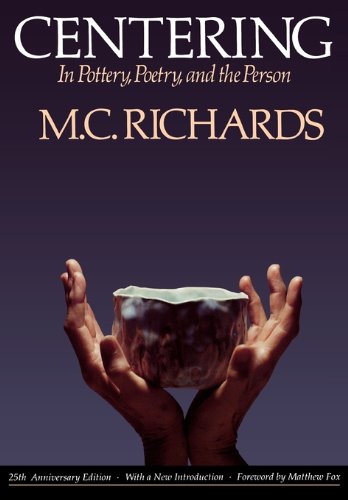
Centering by Mary Richards
I made pottery on the wheel when I was young. Two books were read by almost all the potters I knew in those days, Clay and Glazes for the Potter by Daniel Rhodes, and Centering by MC Richards. The first technical manual often called simply Rhodes gave formulas and facts needed to produce pottery. The centering book was all about zen and becoming one with the clay in the middle of the wheel. I used to think the centering book was too silly, but now I think it is brilliant. I have not thrown pots for at least 30 years, but the practice did make a difference in my philosophy. To center the clay one must be centered. All work is exactly like that. If you are not centered, balanced, able to focus, your clay will be hard to manage. Your vision will not quite be achieved because of distraction. With clay it is possible to endlessly recycle it if it has not been fired. However, if one works for too long on a thrown piece it is very likely to collapse. Brevity and self assurance are the essence of throwing pots.
Centering was taken from an inspirational speech given to fellow craftsmen. Mary Richards was asked to elaborate on that talk in a book. The 25th anniversary edition is out so I have zapped it into my Kindle. In her introduction Ms Richards states, “The imagery of centering is archetypal. To feel the whole in every part.” Chapter one begins, “CENTERING: that act which precedes all others on the potter’s wheel.” This seems obvious, but the metaphors are many. Whatever raw materials we have must be treated as a whole to make the most of them. Many mediums are not as forgiving as clay. Once wood or fabric has been cut it can’t be thrown into a slip barrel and become new. An unfired pot that does not meet standards can begin as a new lump of clay. Sensitivity and refined touch are the main skills needed to center and throw pots. Porcelain has different feel and qualities to stoneware. Each clay body has potential and personality. Each will take glazes differently. The chemical process of fusing glaze to pot happens at high heat and must be cooled slowly to avoid cracking and crazing. There is technical accuracy, just as in distillation. One follows a recipe and keeps a firing log in order to attain exact desired results on a regular basis. There will sometimes be pots that are ruined in the kiln, and this is a fact that must be accepted. Not every pot will survive.
Mary Richards quotes Emerson who said the law is: “Do the thing, and you shall have the power. But they who do not the thing, have not the powers.” When I read this book about centering today I know that being a potter early in my life gave me an appreciation for practice and balanced design in all things. I enjoy making my own clothes, growing my own food, and designing my own life. The concept of centering means connecting from my center to the center of others, touching the core. That is the essence of life. Stay centered, my friend.
Tomorrow, 5 March, 2014, use #VenezuelaMuereTuCallas to share concern for the violence in Venezuela. Brutality has broken out all around the globe lately, and none of it was spontaneous. The seeds of ugly war have been planted long before they bear fruit this bitter and horrid. It is hard to know if violence has been reduced or increased as a result of YouTube, twitter, and all digital formats. What is surely true is that we are exposed to it in direct ways that were not possible in the past. We shall know the truth and the truth will set us free…That is what I learned from reading the University of Texas tower, and I believe it.
The call to action bringing attention to the expanding crisis in this Caribbean nation with petroleum and a history of corruption is close to my heart. I still have friends who live there. With the violence heating up I am concerned for their safety. It is the least I can do to spend some time tomorrow tweeting leaders in Washington. You can use hash tags now on Facebook too, for those of you who don’t tweet. You just type it all as one word #VenezuelaMuereTuCallas. It means Venezuela is dying and you are mute. Please speak up and become informed, gentle readers.

Jakob I
My 16th great-grandfather was from Baden-Baden, Germany. I have been to Baden by Vienna and Baden by Zurich, both fabulous historical hot springs. I have not visited the fancy German double Baden, but have always wanted to go. Now I have all the more reason:
Jacob I of Baden (15 March 1407, Hachberg–13 October 1453, Mühlburg), was Margrave of Baden-Baden from 1431 to 1453.
He was the elder son of Bernard I, Margrave of Baden-Baden and Anna von Oettingen. Jacob I was a man of deep religious beliefs, well-known as a founder of churches. He founded the monastery at Fremersberg and was a major benefactor of the Stiftskirche at Baden-Baden.
According his father’s precepts, only two of his sons were to be considered heirs of the margravate. Therefore only Karl and Bernhard received a secular education; the other children had a strict religious upbringing. Georg, after making a religious profession in his youth, returned briefly to the world, but in 1454 reverted to holy orders and later became Bishop of Metz.
Jacob I was the opposite of his father; Enea Silvio de Piccolomini (Pope Pius II) characterized him as famous among the Germans for his justice and intelligence.
In his early years he was ruler of the family possessions in Hohenberg, until at the age of 24 he succeeded to the government of Baden. He was described as a pugnacious knight and a frugal father of the state and was popular among the princes as a mediator. Both Emperor Sigismund and Emperor Frederick III, under whom he served, thought highly of him.
When as the result of a miscarriage his sister Agnes fled in the middle of a conflict about inheritance, the Margrave lost his claim to the Duchy of Schleswig. He was so angry that he confined Agnes for the rest of her life in the castle of Alt-Eberstein. (The incident is remembered as the “Double Disaster of Gottorf”).
When in 1427 the Treaty of Sponheim came into force, he gained possessions on the Moselle. In 1442 he bought for 30,000 guilders from the descendants of Walter von Geroldseck half the lordship of Lahr and Mahlberg.
Family and children
He married 25 July 1422 Catherine of Lorraine, daughter of Charles II, Duke of Lorraine and Margaret of the Palatinate. They had the following children:
Charles I, Margrave of Baden-Baden (d. 24 February 1475, Pforzheim).
Bernard II, Margrave of Baden-Baden (later beatified) (1428–12 July 1458, Moncalieri).
Johann (1430–9 February 1503, Ehrenbreitstein), Archbishop of Trier.
George (1433–11 February 1484, Moyen), Bishop of Metz.
Markus (1434–1 September 1478), abbot in Liège.
Margarete (1431–24 October 1457, Ansbach), married 1446 to Albert III, Margrave of Brandenburg.
Matilde (d. 1485), Abbess of Trier.
He also had an illegitimate son, Rudolf of Baden.

castle of birth
Jakob I Von Baden (1407 – 1453)
is my 16th great grandfather
Karl I Von Baden (1424 – 1475)
son of Jakob I Von Baden
Christof I VanBaden (1453 – 1527)
son of Karl I Von Baden
Beatrix Zahringen (1492 – 1535)
daughter of Christof I VanBaden
Sabine Grafin VonSimmern (1528 – 1578)
daughter of Beatrix Zahringen
Marie L Egmond (1564 – 1584)
daughter of Sabine Grafin VonSimmern
Richard Sears (1590 – 1676)
son of Marie L Egmond
Silas Sears (1638 – 1697)
son of Richard Sears
Silas Sears (1661 – 1732)
son of Silas Sears
Sarah Sears (1697 – 1785)
daughter of Silas Sears
Sarah Hamblin (1721 – 1814)
daughter of Sarah Sears
Mercy Hazen (1747 – 1819)
daughter of Sarah Hamblin
Martha Mead (1784 – 1860)
daughter of Mercy Hazen
Abner Morse (1808 – 1838)
son of Martha Mead
Daniel Rowland Morse (1838 – 1910)
son of Abner Morse
Jason A Morse (1862 – 1932)
son of Daniel Rowland Morse
Ernest Abner Morse (1890 – 1965)
son of Jason A Morse
Richard Arden Morse (1920 – 2004)
son of Ernest Abner Morse
Pamela Morse
I am the daughter of Richard Arden Morse

seal of Jakob I

Sabine VonSimmern
My 12th great-grandmother was born in Germany and died in Belgium. She had a very long royal name: Sabine von Pfalz-Simmern (Wittelsbach, Pfalz-Simmern) (Sabine von Pfalz-Simmern) durch Heirat Gräfin von Egmond und Fürstin von Gavere. This did not help her when she begged to spare her knight husband’s life. Such was the fickle finger of royal fate in those days.
Sabine was the daughter of the Count Palatine and Duke John II of simmern (1492-1557) from his marriage to Beatrix (1492-1535), daughter of Margrave Christoph I of Baden. She was a sister of the Elector Friedrich III of the Palatinate.
On April 8, 1544, she married Egmond Lamoral, Prince of Gavre (1522-1568). The wedding was in the Diet of Speyer in the presence of Emperor Charles V and numerous other German imperial princes. The marriage was of great political importance but was described as extremely happy. Due to his link with the German Empire princess (Sabine was called “Bavaria” in the Netherlands), Egmond ranked among the Knights of the Golden Fleece, in 1546.
Sabine begged on her knees to the Duke of Alba to spare the life of her husband but he was beheaded in 1568 in Brussels. After Egmond’s death, Sabine and her children lived in poverty. She was buried beside her husband in Sottegem. The place Oud-Beijerland in the Netherlands is named after Sabine.
Tucson has rapidly developed a bevy of micro breweries and beer emporiums. Downtown is awash in beer, and this week is Arizona Beer Week. I am less of a beer fan these days, but I like to support local businesses and taste new flavors. Sentinel Peak Brewery was holding a launch party yesterday for two new beers. I have been wanting to visit this new nano (teenier than micro) gastro brew pub close to my home. In a shopping center in the middle of town, between Petsmart and Trader Joe’s, these smart entrepreneurial firefighters have opened a bar for fans of high quality, hand crafted beer. They hit the mark so well that the very first problem they had after opening was running out of beer much faster than they had anticipated. They are trending…and they still have jobs as firefighters, so they are in the process of dealing with their sudden popularity.
They maintain a very friendly atmosphere and welcoming service. Sara was serving me from behind the bar with enthusiasm and lots of knowledge. I learned that she sings sometimes with her guitar to entertain the guests. The lady sitting next to me at the bar was a friendly beer lover who had also come for the party. She had much more experience than I in beer world/Tucson, so I learned a lot from her as we enjoyed our beers. She let me know about a Sunday brunch wrapping up the festivities this week, hosted by a group known as Girls’ Pints Out. Just a few years ago I attended beer festival in Tucson that consisted of spending a few hours inside the baseball stadium with a few beer vendors and a small cup. Now we are not exactly Denver, but we are well on our way to serving the needs of the most discriminating local craft beer lovers. Life is good.
They are open now on weekends, and next week plan to expand to Thursday, and lunch. We must be patient while they brew enough beer to meet the demand. I bought a growler of the Dunkle Monsoon to bring beer week home to my partner Bob, who is a giant beer fan. We both enjoyed the growler with some rich oyster mushroom chowder I had made before I went out afternoon beer drinking. The creamy soup went well with the dark complex brew, and now we have an empty growler!!! To stay current with hours and new beers on tap like them on Facebook.

Flight of Firefighter Craft Beer
I lived in Venezuela in the early 1960s. My father was manager of operations for Mene Grande Oil Company, aka Gulf Oil. I lived in San Tomé in a remote petroleum camp in the llanos. I lived as a petroleum princess and listened to Radio Havana because it was the only station that came in clearly. We lived an opulent life surrounded by fences and guards. Trinidadians usually worked as servants in our homes because they were bilingual. We had one very high lifestyle in every respect.
John Kennedy was shot before I moved to South America, which was unsettling. Race riots were taking place in the states, but we were isolated from that reality hanging out at our private social club in the tropics. We lived in extreme segregation, but thought nothing of it. The seeds of revolution are planted many years before they mature. The wealth discrepancy in South America was shocking, but since it was all to our advantage we were told it was inevitable. These experiences all became part of my knowledge of the world and later part of my politics. I distrust all imperialists and their motives.
With a simplistic agenda to end unbearable insecurity the students began to march last week in all the cities in Venezuela. The outcome of this battle will be significant and was long in the making.

MGO employee handbook


