mermaidcamp
Keeping current in wellness, in and out of the water
You can scroll the shelf using ← and → keys
You can scroll the shelf using ← and → keys
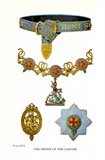
Order of the Garter
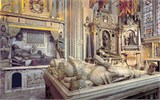
tomb
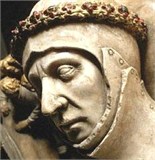
John Beaufort
It is a good thing I have picked up a copy of the book Royal Panoply to figure out what those royal Brits were doing because I seem to be descended from John of Gaunt at least 3 different ways. This makes the tree confusing to trace. The 1st Earl of Somerset was a Royal Bastard.
John Beaufort , 1st Earl of Somerset (1371 – 1410)
is my 18th great grandfather
Joan Beaufort (1407 – 1445)
daughter of John Beaufort , 1st Earl of Somerset
Joan Stewart (1428 – 1486)
daughter of Joan Beaufort
John Gordon (1450 – 1517)
son of Joan Stewart
Robert Lord Gordon (1475 – 1525)
son of John Gordon
Catherine Gordon (1497 – 1537)
daughter of Robert Lord Gordon
Lady Elizabeth Ashton (1524 – 1588)
daughter of Catherine Gordon
Capt Roger Dudley (1535 – 1585)
son of Lady Elizabeth Ashton
Gov Thomas Dudley (1576 – 1653)
son of Capt Roger Dudley
Anne Dudley (1612 – 1672)
daughter of Gov Thomas Dudley
John Bradstreet (1652 – 1718)
son of Anne Dudley
Mercy Bradstreet (1689 – 1725)
daughter of John Bradstreet
Caleb Hazen (1720 – 1777)
son of Mercy Bradstreet
Mercy Hazen (1747 – 1819)
daughter of Caleb Hazen
Martha Mead (1784 – 1860)
daughter of Mercy Hazen
Abner Morse (1808 – 1838)
son of Martha Mead
Daniel Rowland Morse (1838 – 1910)
son of Abner Morse
Jason A Morse (1862 – 1932)
son of Daniel Rowland Morse
Ernest Abner Morse (1890 – 1965)
son of Jason A Morse
Richard Arden Morse (1920 – 2004)
son of Ernest Abner Morse
Pamela Morse
I am the daughter of Richard Arden Morse
John Beaufort, 1st Earl of Somerset (1373 – 16 March 1410) was the first of the four illegitimate children of John of Gaunt, 1st Duke of Lancaster, and his mistress Katherine Swynford, later his wife. Beaufort was born in about 1371 and his surname probably reflects his father’s lordship of Beaufort in Champagne, France.
The family emblem was the portcullis which is shown on the reverse of a modern British 1p coin. John of Gaunt had his nephew Richard II declare the Beaufort children legitimate in 1390, Gaunt married their mother in January 1396. Despite being the grandchildren of Edward III, and next in the line of succession after the Lancasters, their father’s legitimate children, by agreement they were barred from the succession to the throne.
Early life
In May to September of 1390 Beaufort served in Louis II, Duke of Bourbon’s crusade in North Africa. In 1394 he was in Lithuania serving with the teutonic Knights
In 1396, after his parents’ marriage, John and his siblings were legitimated by a papal bull. Early the next year, their legitimation was recognized by an act of Parliament, and then, a few days later, John was created Earl of Somerset (10 February 1397).[5]
That summer the new Earl was one of the noblemen who helped Richard II free himself from the power of the Lords Appellant. As a reward on 29 September he was created Marquess of Dorset, and sometime later that year he was made a Knight of the Garter and appointed Lieutenant of Ireland. In addition, two days before his elevation as a Marquess he married the King’s niece, Margaret Holland, sister of the 3rd Earl of Kent, another of the counter-appellants.[5]
He remained in the King’s favour even after his half-brother Henry Bolingbroke (later Henry IV) was banished. In February 1397 he was appointed Admiral of the Irish fleet, as well as constable of Dover and Warden of the Cinque Ports. In May his Admiralty was extended to include the northern fleet.
Later career
After Richard II was deposed by Henry Bolingbroke in 1399, the new king rescinded the titles that had been given to the counter-appellants, and thus John Beaufort became merely Earl of Somerset again. Nevertheless, he proved loyal to his half-brother’s reign, serving in various military commands and on some important diplomatic missions. It was he who was given the confiscated estates of the Welsh rebel leader Owain Glyndwr in 1400, although Beaufort could not effectively come into these estates until after 1415. In 1404 he was Constable of England.
Family
John Beaufort and his wife Margaret Holland, the daughter of the Earl of Kent, had six children; his granddaughter Lady Margaret Beaufort married a son, (Edmund Tudor, 1st Earl of Richmond), of dowager queen Catherine of Valois by Owen Tudor — thus creating a powerful branch of the Lancastrian family which enabled the issue of that (Beaufort) marriage, Henry Tudor, ultimately to claim the throne, as Henry VII, in spite of the agreement barring the Beaufort family from the succession.
Somerset died in the Hospital of St Katharine’s by the Tower. He was buried in St Michael’s Chapel in Canterbury Cathedral.
His children included:
Henry Beaufort, 2nd Earl of Somerset (1401 – 25 November 1418)
John Beaufort, 1st Duke of Somerset (baptized 25 March 1404 – 27 May 1444)
Joan Beaufort, Queen of Scotland (1404 – 15 July 1445) married James I, King of Scots.
Thomas Beaufort, Count of Perche (1405 – 3 October 1431)
Edmund Beaufort, 2nd Duke of Somerset (1406 – 22 May 1455)
Margaret Beaufort, Countess of Devon (1409 – 1449) married Thomas de Courtenay, 13th Earl of Devon.

Sir Thomas
My 20th great-grandfather was a member of the Order of the Garter. He was a military commander and member of Parliament. The Hundred Years’ War was a huge drag because it lasted for 100 years. He fought in Flanders and in France for Britain.
Sir Thomas de Holand Wake Kent (1314 – 1360)
is my 20th great grandfather
Sir Thomas Holand Knight deHolland (1350 – 1397)
son of Sir Thomas de Holand Wake Kent
Margaret DeHoland (1385 – 1439)
daughter of Sir Thomas Holand Knight deHolland
Joan Beaufort (1407 – 1445)
daughter of Margaret DeHoland
Joan Stewart (1428 – 1486)
daughter of Joan Beaufort
John Gordon (1450 – 1517)
son of Joan Stewart
Robert Lord Gordon (1475 – 1525)
son of John Gordon
Catherine Gordon (1497 – 1537)
daughter of Robert Lord Gordon
Lady Elizabeth Ashton (1524 – 1588)
daughter of Catherine Gordon
Capt Roger Dudley (1535 – 1585)
son of Lady Elizabeth Ashton
Gov Thomas Dudley (1576 – 1653)
son of Capt Roger Dudley
Anne Dudley (1612 – 1672)
daughter of Gov Thomas Dudley
John Bradstreet (1652 – 1718)
son of Anne Dudley
Mercy Bradstreet (1689 – 1725)
daughter of John Bradstreet
Caleb Hazen (1720 – 1777)
son of Mercy Bradstreet
Mercy Hazen (1747 – 1819)
daughter of Caleb Hazen
Martha Mead (1784 – 1860)
daughter of Mercy Hazen
Abner Morse (1808 – 1838)
son of Martha Mead
Daniel Rowland Morse (1838 – 1910)
son of Abner Morse
Jason A Morse (1862 – 1932)
son of Daniel Rowland Morse
Ernest Abner Morse (1890 – 1965)
son of Jason A Morse
Richard Arden Morse (1920 – 2004)
son of Ernest Abner Morse
Pamela Morse
I am the daughter of Richard Arden Morse
Thomas Holland, 1st Earl of Kent, 1st Baron Holand, KG (c. 1314 – 26 December 1360) was an English nobleman and military commander during the Hundred Years’ War.
He was from a gentry family in Upholland, Lancashire. He was a son of Robert de Holland, 1st Baron Holand and Maud la Zouche. One of his brothers was Otho Holand, who was also made a Knight of the Garter.Military Career
In his early military career, he fought in Flanders. He was engaged, in 1340, in the English expedition into Flanders and sent, two years later, with Sir John D’Artevelle to Bayonne, to defend the Gascon frontier against the French. In 1343, he was again on service in France. In 1346, he attended King Edward III into Normandy in the immediate retinue of the Earl of Warwick; and, at the taking of Caen, the Count of Eu and Guînes, Constable of France, and the Count De Tancarville surrendered themselves to him as prisoners. At the Battle of Crécy, he was one of the principal commanders in the van under the Prince of Wales and he, afterwards, served at the Siege of Calais in 1346-7. In 1348 he was invested as one of the founders and 13th Knight of the new Order of the Garter.
Around the same time as, or before, his first expedition, he secretly married the 12-year-old Joan of Kent, daughter of Edmund of Woodstock, 1st Earl of Kent and Margaret Wake, granddaughter of Edward I and Margaret of France. However, during his absence on foreign service, Joan, under pressure from her family, contracted another marriage with William Montacute, 2nd Earl of Salisbury (of whose household Holland had been seneschal). This second marriage was annulled in 1349, when Joan’s previous marriage with Holland was proved to the satisfaction of the papal commissioners. Joan was ordered by the Pope to return to her husband and live with him as his lawful wife; this she did, thus producing 4 children by him.
Between 1353 and 1356 he was summoned to Parliament as Baron de Holland.
In 1354 Holland was the king’s lieutenant in Brittany during the minority of the Duke of Brittany, and in 1359 co-captain-general for all the English continental possessions.
His brother-in-law John, Earl of Kent, died in 1352, and Holland became Earl of Kent in right of his wife.
He was succeeded as baron by his son Thomas, the earldom still being held by his wife (though the son later became Earl in his own right). Another son, John became Earl of Huntingdon and Duke of Exeter.
Children
Thomas and Joan of Kent had four children:
Thomas Holland, 2nd Earl of Kent
John Holland, 1st Duke of Exeter
Joan Holland, who married John V, Duke of Brittany
Maud Holland, married Waleran III of Luxembourg, Count of Ligny
The liberator serves others in political and sometimes military capacities. Freeing others from injustice and adverse conditions is the role played by the archetype. The words terrorist and liberty have been used and diluted to the point that we are weary as well as wary of news of political freedom. Shadow liberation is often substitution of one violent group for another equally intolerant one. The kidnapping of the school girls in Nigeria has galvanized world opinion on the need for urgent action to find and free them. Jesus, Muhammad, and Buddha were liberators in their places and times in history. The goddess Tara is known as the swift liberator because her nature is to answer very quickly when she is called.
Mantra is a way to meditate and call on Tara to teach us to be free of the 8 fears. Green Tara is pictured with her right foot in front of her because she is symbolically ready to hurry to those who call her. If sound meditation is new to you, the power of it may come as a surprise. We need the swift and sure guidance of Tara to reach the girls and bring them to safety. The mantra above is easy to learn, but even if you simply listen with the idea of freeing the kidnappers as well as the girls from the situation, it is positive. Please join us, gentle reader, to #BringBackOurGirls. Let us create a worldwide mantra of liberation that will reach into the African jungle to bring them home.

Flagon and Trencher Society
My 11th great-grandfather was a tailor who sailed to America with his family in 1639. He was a tavern keeper and a deacon in Sudbury, MA. His tavern, licensed in 1653, was operated continuously as the Parmenter Tavern until 1880:
John PARMENTER Dea. was born about 1588 in England. In a publication (ParmenterStory) by Roland A Dahir, at the 400th birthday of Dea. John Parmenter he writes that, according to a Parmenter descendant, Marjorie J Parmenter and George M Parmenter, Dea. John was born in Sible Hedingham County Essex, England on 12 Jan 1588; he m Bridget in Little Yeldham on 12 Jun 1609; she was born at Bures St. Mary, Country Essex on 12 Feb 1589. He was buried on 1 May 1671 in Roxbury, Suffolk, MA.2,15
John and both children are mentioned in his father (William) Will in 1613, but he inherited no lands or tenements from his father. Following his father’s death in 1617 John moved to about eight miles from Little Yeldham into Bures St. Mary. John’s connection to Bures St. Mary can be seen in his association with Philemon Whale and Herbert Pelham, residents of Bures St. Mary who emigrated to Sudbury [The Puritan village, Sumner Chilton Powell, Appendix I, Wesleyan Univ. Press, 1963] A comparison of the signature of John Parminter as a witness in the original will of Henry Loker of Bures St. Mary with an autograph signature of Dea. John Parmenter as a commissioner of Sudbury, MA, 6 Jan 1639/40 shows that the two signatures were made by the same hand. [Suffolk Co. Court files, Boston, NO.162004]
In 1639 John Parmenter emigrated to New England with his wife Bridget and children Mary and John Jr; in his party were the widow Elizabeth Loker and her children. The name of the ship or port of departure is not known. John Parmenter was one of the original proprietors of Sudbury, and was assigned lands May 1640 by the General Court of the Massachusetts Bay colony [Suffolk court files, vol. I, No. 304, microfilm #A360, Univ MA, Amherst]. John was chosen early as a Selectman; then Deacon, and Commissioner; he desired to be made Freeman 13 May 1640 [NEHGS Reg. Vol 13, 261], and made freeman 10 May 1643.
Following the death of his first wife, he married Annis (Bayford)(Chandler) Dane and relocated to Roxbury where he died on 1 May 1671; his will was dated 25 Mar 1671, and proved 25 Jul 1671.
John PARMENTER Dea. and Bridget were married about 1609 in England.2,3 Bridget was born before 1599 in England. 2,3
Found on http://www.parmenter-fam-assn.org/PPA2%20Cln%20090105.PDF
John Parmenter (1588 – 1671)
is my 11th great grandfather
Mary Parmenter (1610 – 1690)
daughter of John Parmenter
John Woods (1641 – 1716)
son of Mary Parmenter
Lydia Woods (1672 – 1738)
daughter of John Woods
Lydia Eager (1696 – 1735)
daughter of Lydia Woods
Mary Thomas (1729 – 1801)
daughter of Lydia Eager
Joseph Morse III (1752 – 1835)
son of Mary Thomas
John Henry Morse (1775 – 1864)
son of Joseph Morse III
Abner Morse (1808 – 1838)
son of John Henry Morse
Daniel Rowland Morse (1838 – 1910)
son of Abner Morse
Jason A Morse (1862 – 1932)
son of Daniel Rowland Morse
Ernest Abner Morse (1890 – 1965)
son of Jason A Morse
Richard Arden Morse (1920 – 2004)
son of Ernest Abner Morse
Pamela Morse
I am the daughter of Richard Arden Morse
John and Bridget Parmenter
John – b. about 1588, probably at Little Yeldham, Essex, England; d. June 1, 1671, Roxbury, MA. Son of William PARMENTER and Margery. John, a tailor by trade, arrived with his family in New England from Great Yarmouth in 1639. He became freeman May 13, 1640 and served as a deacon and selectman of Sudbury, MA. By 1654, John PARMENTER was authorized by the town of Sudbury “to keep a house of common entertainment and that the court shall be moved on his behalf to grant a license to him” (Colonial Tavernrkeepers, Vol. 5, edited by Harriet Stryker-Rodda, 1982, page 19). His will, dated Mar. 25, 1671 and proved Jul. 25, 1671, names his second wife, son-in-law John WOOD, grandson John PARMENTER, and cousins CHEEVERS and John STIBBINS. John married second Aug. 9, 1660 at Roxbury, MA, Annis BAYFORD (d. Mar. 15, 1682/3, Roxbury, MA; bur. there Mar. 17, 1682/3), widow of William CHANDLER and John DANE. John and Bridget were married about 1609, probably at Bures St. Mary, Suffolk, England.
Bridget – b. probably at Bures St. Mary, Suffolk, England; d. Aug. 6, 1660, Sudbury, MA. She was probably the sister of Elizabeth, wife of Henry LOKER. Bridget and Elizabeth may have been daughters of William PERRY or of John SIMPSON, who both had daughters with their names baptized at Bures St. Mary between 1585 and 1593.
Children of John and Bridget Parmenter
Mary – b. about 1610, probably at Bures St. Mary, Suffolk, England; d. Aug. 17, 1690, Marlborough, MA. Married John WOODS.
John – b. about 1611, probably at Bures St. Mary, Suffolk, England; d. Apr. 12, 1666, Sudbury, MA. Married about 1638 in England to Amy. Son: John married Anna CUTLER.
Our own characters often resemble mythological beings in classic stories. Do we portray one myth more than any other? Are we stuck in a certain drama until we finally understand the meaning of it? The study of archetypes is a study of mythology. Metaphor and symbolism create stories that resonate with meaning in our lives. The admirable goddess qualities include wisdom, physical grace and strength, sensuality, beauty, and guidance. In our world today there are many shadow goddesses. The overly indulged celebrities can reflect the shadow goddess. There is commercial pressure to imitate the unhealthy, perfectionist, unkind diva. It may be helpful to learn more about the positive myths.
Do you know the stories of any of these goddesses?
The associations with female power and myth have been twisted in some modern contexts. Some study and meditation on the energy of these female figures in mythology can bring us closer to understanding our lives. Our relationship with Mother Earth could use some work. Do you bring the goddess concept into your meditations, gentle reader? Do you have a favorite goddess?
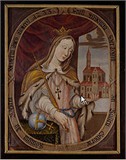
Ludmilla of Bohemia
After a life of royal responsibilities my 22nd great-grandmother became a widow when her husband was murdered. She founded a convent where she lived at the end of her life, and where she is buried.
Lidmila Bohemia (1170 – 1240)
is my 22nd great grandmother
OTTO II Wittelsbach of Bavaria (1206 – 1253)
son of Lidmila Bohemia
Elisabeth Wittelsbach Duchess Bavaria (1227 – 1273)
daughter of OTTO II Wittelsbach of Bavaria
Consort Elisabeth the Romans Carinthia (1263 – 1313)
daughter of Elisabeth Wittelsbach Duchess Bavaria
Albrecht Albert II ‘The Wise’ Duke of Austria Habsburg (1298 – 1358)
son of Consort Elisabeth the Romans Carinthia
Leopold III “Duke of Austria” Habsburg (1351 – 1386)
son of Albrecht Albert II ‘The Wise’ Duke of Austria Habsburg
Ernst I “Ironside” Archduke of Austria Habsburg (1377 – 1424)
son of Leopold III “Duke of Austria” Habsburg
Katharina Archduchess Austria Von Habsburg (1420 – 1493)
daughter of Ernst I “Ironside” Archduke of Austria Habsburg
Christof I VanBaden (1453 – 1527)
son of Katharina Archduchess Austria Von Habsburg
Beatrix Zahringen (1492 – 1535)
daughter of Christof I VanBaden
Sabine Grafin VonSimmern (1528 – 1578)
daughter of Beatrix Zahringen
Marie L Egmond (1564 – 1584)
daughter of Sabine Grafin VonSimmern
Richard Sears (1590 – 1676)
son of Marie L Egmond
Silas Sears (1638 – 1697)
son of Richard Sears
Silas Sears (1661 – 1732)
son of Silas Sears
Sarah Sears (1697 – 1785)
daughter of Silas Sears
Sarah Hamblin (1721 – 1814)
daughter of Sarah Sears
Mercy Hazen (1747 – 1819)
daughter of Sarah Hamblin
Martha Mead (1784 – 1860)
daughter of Mercy Hazen
Abner Morse (1808 – 1838)
son of Martha Mead
Daniel Rowland Morse (1838 – 1910)
son of Abner Morse
Jason A Morse (1862 – 1932)
son of Daniel Rowland Morse
Ernest Abner Morse (1890 – 1965)
son of Jason A Morse
Richard Arden Morse (1920 – 2004)
son of Ernest Abner Morse
Pamela Morse
I am the daughter of Richard Arden Morse
Ludmilla of Bohemia Countess consort of Bogen Duchess consort of Bavaria Spouse Adalbert VI, Count of Bogen
Louis I, Duke of Bavaria Issue Berthold IV, Count of Bogen
Albert IV, Count of Bogen
Diepold of Bogen
Otto II Wittelsbach, Duke of Bavaria
House House of Přemyslid (by birth)
House of Wittelsbach (by second marriage) Father Frederick, Duke of Bohemia Mother Elisabeth of Hungary Born c.1170
Bohemia Died 14 August 1240
Seligenthal convent, Landshut Burial Seligenthal convent, Landshut
Ludmilla of Bohemia (died 14 August 1240) was a daughter of Frederick, Duke of Bohemia and his wife, Elisabeth of Hungary. Ludmilla was a member of the Přemyslid dynasty. She was Duchess consort of Bavaria by her marriage to Louis I, Duke of Bavaria.
Ludmilla was the third of six children born to her parents. Her siblings were Helena of Bohemia, betrothed to Manuel I Komnenos but never married, and Sophia of Bohemia, wife of Albert, Margrave of Meissen. The rest of Ludmilla’s siblings were short-lived or died in early adulthood.
Ludmilla’s paternal grandparents were Vladislaus II of Bohemia and his first wife Gerturde of Babenberg. Her maternal grandparents were Géza II of Hungary and his wife Euphrosyne of Kiev.
Geza was son of Béla II of Hungary and his wife Helena of Raška.
Bela was son of Prince Álmos and his wife Predslava of Kiev, whom was daughter of Sviatopolk II of Kiev and an unknown Bohemian princess.
Marriages
Ludmilla married twice and had issue in both of her marriages. Her first marriage was to Adalbert VI, Count of Bogen, making Ludmilla Countess of Bogen. The couple had three children from their marriage, all sons:
Berthold IV, Count of Bogen (d.1218) married Kunigunda of Hirschberg, no known issue
Albert IV, Count of Bogen (d.1242) married Richeza of Dillingen
Diepold of Bogen (d.1219) a priest in Regensburg
Adalbert died in 1197 and was succeeded by his eldest son with Ludmilla, Berthold.
Ludmilla married Louis I, Duke of Bavaria, a former enemy of her first husband. The marriage was good for Louis because it created an alliance with Ludmilla’s uncle, Ottokar I of Bohemia. The couple had one son:
Otto II Wittelsbach, Duke of Bavaria (7 April 1206 – 29 November 1253), next Duke of Bavaria.
Louis and Ludmilla tried to find a suitable bride for their only child. Otto married Agnes of Palatinate in 1222. Within time, Agnes’ closer relatives died and she became Countess of Palatinate, which became part of the Bavarian inheritance, starting with Ludmilla’s grandson, Louis II, Duke of Bavaria.
Widowhood
Louis was murdered in 1231 on a bridge in Kelheim. The crime was never cleared up since the murderer was immediately lynched. Due to the following aversion of the Wittelsbach family the city of Kelheim lost its status as one of the ducal residences. Louis was buried in the crypt of Scheyern Abbey.
Ludmilla lived to see the birth of four or five grandchildren from Otto and Agnes: Louis II, Henry XIII, Duke of Bavaria, Elisabeth of Bavaria, Queen of Germany, Sophie and Agnes.
Ludmilla founded the Seligenthal convent, near Landshut, in 1232. She remained here for the rest of her days. Ludmilla died there 14 August 1240 and her body was buried there.

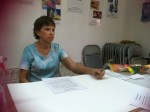


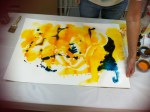
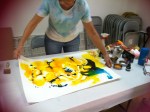


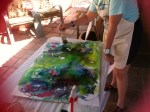
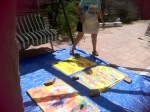
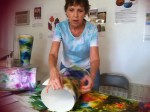



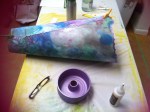
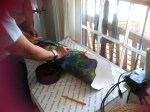





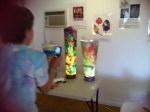

Yesterday I enjoyed making art in a new way with Jeanne Fellow at Blue Raven Art School. I had visited her studio and purchased a couple of her beautiful pieces and learned about the LumenArt class. My classmate Jeannie Gentry had done exactly the same thing. We both were very excited to try our hand at making one of these very special lamps. Our 5 hour class went by very quickly. Everything was set up for us on the shaded patio. Each of us had our own work table and basic tools. After a thorough demonstration of the basic techniques we chose colors and started our own experiment in color mixing. Some of the inks are iridescent, but those also block the light from within when it is a finished LumenArt. The fun of it all is that you don’t know how it will really look until you light it. Jeanne encouraged us to feel free and confident to play around. Both students created three possible candidates for lighting. The class materials include two sheets of incredible paper that allows all kinds of layering and special techniques without tearing. We each bought one extra sheet because we had enough time and were seriously into it. When dry we selected one to become our lamp. Choosing color for the base and tearing the final design we had supervision and plenty of encouragement from our teacher. This project is practically impossible to do badly. The materials guarantee that the finished product will be thrilling. She teaches a class in using these techniques on fabrics that will also be fun. If you are an experienced artist/craftperson you will love this class. If you think you are not creative and have no talent for art you will be blown away by your own amazing abilities when Jeanne shows you how to release them. My LumenArt is now making me very happy and proud in my living room at home. I also have two other fabulous pieces of art that I made. I even love my scraps. I would encourage anyone to investigate creativity and find your own inner light in one of Jeanne’s classes. She rules.



Stealing is a way of life. Sometimes we are the victims and other times we are the thief. Laverna is the goddess of darkness and criminal intent. She is the patron goddess of thieves and robbers. She teaches a very strong lesson about mortality. If we value that which can be stolen we will be too involved in a world that has no meaning. If we, instead, focus our efforts to create lasting creative work that benefits others it will be impossible to steal those benefits. Dishonest tradesman pray to her for the power to deceive and persuade. She is con woman herself who uses trickery to gain advantage over humans.
None of us will go through life without being tricked or robbed. Frequently these losses are caused by people we know. Financial ignorance is an aspect of Laverna. Allowing others to steal energy, time or valuable assets is submission to her power. The lesson of what is valuable and can never be taken from you is the wisdom she can bestow. Looking back at your life you will be able to find times when you felt significantly cheated or robbed. It is also possible to identify yourself in the role of con artist. Young children often deceive their parents and siblings, for instance. Taking a realistic look at the past, what has treachery and robbery taught you, gentle reader? Have you found that which you own that nobody can steal? Have you ever caught yourself stealing from yourself?
Americans have trouble understanding the whole British royalty and fancy person hierarchy. My own British family has been fairly fancy in their time, but I have nothing to show for it except my family tree. In history brutal repression of common people, or peasants, was the way commerce was conducted. The United States is returning to a system of government that separates the elite in a special world of privilege and security while the majority of the population is loosing security of every kind. Our country goes around bullying other nations about lack of democratic systems that protect the population. Who will come to the United States and reprimand us for this recent class and income discrepancy we are growing? Since many around the world are already hardened against the United States for our politics about war and violence, the facts about our upper crust citizens will cause more disgust for our economically bifurcated culture. In an odd twist of fate, Americans who often use Brit accents and royalty to make fun of snooty class struggles, are making big strides creating inequity of our own. What do you think will happen to our reputation abroad, gentle reader?
From the time we learned our first Dr Seuss rhyme we were being educated by poets. Nursery rhymes and fairy tales are used to teach morals and ethics to children. There is value in the use of language to enchant and stick in the memory. Poets are feeding the artistic as well as the language skills of readers. Our own stories can only be told by our own voice. To develop a voice as a writer or a poet one simply needs to start. Children are ready to rhyme and laugh at almost any word. Adults often loose enthusiasm for word play as they grow older. Since poetry stimulates creativity, and is a tool to jog the memory it makes sense to read and write poems. Often hidden meaning can be found in song and story, as it is in Calypso. Political protest can be carried out in a rhyme using allegory to mask the obvious. Some of our nursery rhymes today were once hot treason against authorities. What kind of symbolic words would you use to write a poetic protest today?

