mermaidcamp
Keeping current in wellness, in and out of the water
You can scroll the shelf using ← and → keys
You can scroll the shelf using ← and → keys
Prophecies are made all the time about the end of the world. I am not very interested in the end of the world because it is such a relative term. I noticed the blood moon tetrad news was of interest to astronomers and astrologers. Now I see it is being discussed by those who see at as a sign that Jesus is returning. Tonight is the first night of Passover which will begin at sunset. After the seder in the middle of the night the moon will be seen as blood red during the total lunar eclipse. This is the chance for everyone in North America to witness this unusual spectacle of a full lunar eclipse appearing as a red full moon.
While I agree to a certain extent with the end of timers, I am not sure if we have 4,000 more years or 3 more weeks. Facing mortality is fine. That doesn’t mean we need to be morbid. If we are realistic we have to admit that Mother Earth is in dire straights. I plan to go out tonight and enjoy floating around while the moon turns red and listen for a message. I am not expecting prophecy, but I do think this is a special time. Those of use who have clear skies and a clear schedule can be bathed in the light of this auspicious blood mood whatever it may mean. What do you think the blood moons mean, Gentle Readers?

Netherlands
Mary Priest was born in the Netherlands. Her father Degory was a hatter who sailed to America on the Mayflower, and died in Plymouth Colony shortly after his arrival. His wife and children, including Mary, came later to Plymouth to inherit his allotment:
DEGORY PRIEST
ORIGIN: Leiden, Holland
MIGRATION: 1620 on Mayflower
FIRST RESIDENCE: Plymouth
OCCUPATION: Hatter (when admitted as a citizen of Leiden) [Leiden 216].
ESTATE: In the 1623 Plymouth land division “Cudbart Cudbartsone” received six acres as a passenger on the Anne in 1623 [ PCR 12:6]; four of these six shares would be for the deceased Degory Priest, his widow Sarah and his two daughters. In the 1627 Plymouth cattle division “Marra Priest” and “Sarah Priest” were the tenth and eleventh persons in the second company, just after their mother and stepfather [PCR 12:9].
BIRTH: About 1579 (aged about forty in 1619 [ Dexter 630]).
DEATH: Plymouth 1 January 1620/1 [ Prince 287].
MARRIAGE: Leiden 4 November 1611 [NS] “Sara Vincent, widow of Jan Vincent” [ MD 7:129-30; Leiden 216]; Priest is said to be of London. She was sister of ISAAC ALLERTON and married (3) Leiden November 1621 (betrothed 25 October 1621 [NS]) GODBERT GODBERTSON [Leiden 101].
CHILDREN:
i MARY, b. say 1612; m. by about 1630 PHINEAS PRATT.
ii SARAH, b. say 1614; m. by about 1632 JOHN COOMBS.
COMMENTS: Bradford includes “Digory Priest” in his list of those on the Mayflower, and in his accounting of 1651 says that Priest “died soon after … arrival in the general sickness,” but “had his wife and children sent hither afterwards, she being Mr. Allerton’s sister” [ Bradford 443, 447].
In 1957 John G. Hunt published the 1582 baptism for a “Digorius Prust” in Hartland, Devonshire [ NEHGR 111:320]; although there is nothing to connect this with Degory Priest of London, Leiden and Plymouth, it is a useful clue.
BIBLIOGRAPHIC NOTE: Degory Priest and his descendants have been given full and definitive treatment in the eighth volume of the Five Generations project of the General Society of Mayflower Descendants, compiled by Mrs. Charles Delmar Townsend, Robert S. Wakefield and Margaret Harris Stover, and edited by Robert S. Wakefield (Plymouth 1994). The Great Migration Begins
Sketches
PRESERVED PURITAN View Full Context

Mayflower increase
Mary Priest (1613 – 1689)
is my 12th great grandmother
Daniel Pratt (1640 – 1680)
son of Mary Priest
Henry Pratt (1658 – 1745)
son of Daniel Pratt
Esther Pratt (1680 – 1740)
daughter of Henry Pratt
Deborah Baynard (1720 – 1791)
daughter of Esther Pratt
Mary Horney (1741 – 1775)
daughter of Deborah Baynard
Esther Harris (1764 – 1838)
daughter of Mary Horney
John H Wright (1803 – 1850)
son of Esther Harris
Mary Wright (1816 – 1873)
daughter of John H Wright
Emiline P Nicholls (1837 – )
daughter of Mary Wright
Harriet Peterson (1856 – 1933)
daughter of Emiline P Nicholls
Sarah Helena Byrne (1878 – 1962)
daughter of Harriet Peterson
Olga Fern Scott (1897 – 1968)
daughter of Sarah Helena Byrne
Richard Arden Morse (1920 – 2004)
son of Olga Fern Scott
Pamela Morse
I am the daughter of Richard Arden Morse
She married Phineas Pratt, a joiner, who was part of a group that got into trouble with both Pilgrims and Natives:
Phineas Pratt was a member of a company of men sent from England by Thomas Weston. They arrived in New England in 1622 on three ships : the Sparrow, Charity and Swan (Pratt was a passenger on the Sparrow, the first to arrive). The approximately 67 men, many of them ailing, arrived with no provisions. The Pilgrims supported them throughout the summer of 1622.
In the fall of 1622, the Weston men left to colonize an area north of Plymouth called Wessagusset. They soon fell into difficulties through behaving, generally, in a very foolish and improvident fashion. They also severely angered the local Native Americans by stealing their corn.
Massasoit, sachem of the Wampanoags, informed the Plymouth colonists that there was a conspiracy among the Natives of the Wessagusset area to massacre the Weston men. Myles Standish prepared to head north with a small company of Plymouth men to rescue Weston’s men.
The same message was also delivered by one of Weston’s men, who came to Plymouth in March of 1623 “from the Massachusetts with a small pack at his back.”
Phineas Pratt was the man with the backpack. He had secretly snuck out of the Wessagusset settlement, traveling for several days without food through a snowy landscape on his 25-mile journey.
Myles Standish and a small contingent (minus Phineas, who was still recovering from his arduous journey) headed to Wessagusset to recognize Weston’s men. The Plymouth contingent killed several Native Americans in the process (for which, they were roundly scolded by their pastor, John Robinson). Soon afterwards, Weston’s group abandoned Wessagusset. Sometime in late 1623, Phineas joined the Plymouth settlement.
Sometime before May of 1648, when he purchased a house and garden in Charlestown (now a part of Boston), Pratt left Plymouth. In 1662, Pratt presented to the General Court of Massachusetts a narrative entitled “A declaration of the affairs of the English people that first inhabited New England” to support his request for financial assistance. The extraordinary document is Phineas Pratt’s own account of the Wessagusset settlement and its downfall.
Phineas Pratt was by profession a “joiner.” “Joining” was the principle method of furniture construction during the 17th century. “Joiners” were highly skilled craftsmen who specialized in this work; their skills were valued more highly than those of a carpenter.
Phineas Pratt married Mary Priest, daughter of Degory and Sarah Allerton Vincent Priest (the sister of Mayflower passenger Isaac Allerton, Sarah had been married to Jan Vincent and widowed before she married Degory Priest). Degory Priest journeyed to Plymouth on the Mayflower, his wife and two daughters intended to join him later. Priest died during the first winter. Before sailing for America, the widowed Sarah Allerton Vincent Priest married Godbert Godbertson, who became Mary Priest’s stepfather. The family (mother, stepfather and two daughters) were among the passengers of the Anne and Little James, arriving in Plymouth in 1623.
Phineas was probably born about 1593, Mary was probably born about 1612. It seems likely, given the probably age of their oldest child at the time of her death, that they married about 1631 or 1632. Phineas and Mary Pratt had 8 children.
According to his gravestone in the old Phipps Street Cemetery, in the Charlestown area of Boston, “Phinehas Pratt, agd about 90 yrs, decd April ye 19, 1680 & was one of ye first English inhabitants of ye Massachusetts Colony.” (Mayflower Descendant, Vol. 6, p. 1-2).

Priest and Pratt
The word cocktail originally meant a drink made with bitters and distilled spirits, but this has changed over time. There are many versions of how the name was derived, including a drink that was served with a garnish of feathers from a rooster. The bartender was more of a pharmacist, and the elements of the drinks were medicinal in the 1800’s. Morphine and heroin were sold on the open market and included in patent medicines in the early 1900’s, so mixed spirits were hardly the most dangerous potions one could use at that time. Bitters were concocted by bartender/pharmacists with the herbs and fruits they had on hand, with whatever knowledge they possessed about the healing qualities of those plants.
Today Angostura and Fee brothers are still producing bitters from ancient recipes while other new producers are entering the commercial market. It is easy to make your own bitters with flavors that work for you. I made a citrus vanilla infusion using an Alice Waters recipe and our organic grapefruit and Meyer lemons this winter which is delightful and has inspired me to dabble in bitters. The process is simple. Add flavors to vodka which is stored in the dark and shaken regularly for two weeks. Strain the herb/fruit/flower mixture and boil it in water to create a strong tea. Store both the vodka infusion and the strong tea for another two weeks, shaking the herbal tea frequently. Combine the tea and vodka after removing the solids and you have bitters. There are several mixtures of flavoring and bittering agents that appeal to me. I think I will make peach bitters when my peaches get ripe just to get started. The bitters can be used in non alcoholic drinks as well as in cooking. I often use Angostura bitters in food. It adds depth of flavor with great subtlety. I did not drink or make cocktails until about 3 years ago but I have become a student of the history and resurgence of the art of mixology. I enjoy seasonal fresh ingredients and the creativity of trying new combinations. What is your favorite cocktail, Gentle Reader?
Poetry is an expression of wonder. Painting a scene with words is one way to keep a vision eternal. I can see the Asyrians come down like a wolf on the fold when I hear this poem. The colorful battlefield Lord Byron creates poetically lasts forever. He was not at the battle, but he has made it part of our cultural memory. Each of us has experiences that are unique to us, that only we can express. Poetry is a vehicle for these stories or impressions to reach the mind’s eye of the reader. If we do not tell those tales or color in the details of the scenes we have seen, they will not be told. A sense of wonder and willingness to write are the only tools needed. There are good reasons to write poetry:
Consider celebrating Poetry Month this April by writing some of your own. You will not meet the poet within until you try. Tomorrow, April 9, 2014, at noon you can join NPR on twitter writing a collaborative poem. Using the hashtag #CSPoetry contribute a line to the poem. The Code Switch poem will be presented in the stream when completed. You just don’t know what will happen next. You only have to think of one good line. Go for it, Gentle Readers. Do some gentle writing.
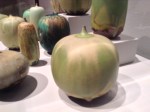


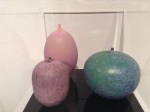


Athena is often mentioned as a war goddess because she was never defeated. She is also the goddess of wisdom and crafts. Her protection is important in firing the kiln. The ceramic demons that destroy a firing can take over without her blessing:
Homer’s Epigrams Fragment 14 (trans. Evelyn-White) (Greek epic C8th or C7th B.C.) :
“Potters, if you give me a reward, I will sing for you. Come, then, Athena [goddess of pottery], with hand upraised over the kiln. Let the pots and all the dishes turn out well and be well fired: let them fetch good prices and be sold in plenty in the market. Grant that the potters may get great gain and grant me so to sing to them. But if you turn shameless and make false promises, then I call together the destroyers of kilns, Suntribos (Shatter) and Smaragon (Smash) and Asbetos (Charr) and Sabaktes (Crash) and Omodamos (Crudebake) who can work this craft much mischief. Come all of you and sack the kiln-yard and the buildings: let the whole kiln be shaken up to the potter’s loud lament. As a horse’s jaw grinds, so let the kiln grind to powder all the pots inside.”
It is obvious to me that Rose Cabat made friends with Athena long ago in order to achieve such masterful results in the kiln. Her work is unique because her special glazes create a silky feel that is her secret weapon. The pots are vivid and beautifully shaped, inviting touch. The soft surface she creates is like no other. She calls the pots feelies, and has become famous for these special touchable forms. Her many collectors are happy to pay $400 and up for a tiny feelie because they only go up in value over time. Rose is still making pots from her wheel chair at age 100, and continues to be in very good standing with Athena. She has a show now at the Tucson Museum of Art featuring her work over her long career. It is incredible to see in person. I have seen her work over the years, but there are so many in one place that it delights the eye..and makes us wish we could feel them. There are some for sale in the Museum shop if you want your own to have and to hold.


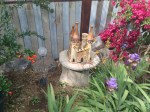







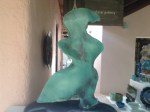

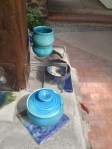


I recently reread the book Centering by Mary C Richards, a potter. In it she waxes very poetic about the subject of pottery. When I was covered with mud I considered Ms Richards to be fluffy and woo woo. About 35 years later I see how centering clay on a wheel is sheer poetry. I also notice my own approach to centering, which has never left me. I now like to center my body from the core in deep water, using tubular units for balance. This month as I attempt to write a poem a day I searched my memory for inspiration. Janet Burner, queen of all alchemists and artist of great skill and talent, popped into my mind. She has awesome technical skills and an alliance with fire like nobody I have ever seen. I like fire myself and enjoyed my time as a kiln queen. Janet has perfected various styles of firing to add variety and excitement to her work. She has always been famous for her raku. Now she has evolved other techniques, both modern and ancient, to bring her work to life.
In the kiln the pot is actually born. Just like an animal at birth, it also has a chance of dying. Potters must accept that some work will crack or be ruined in the firing. They must also accept that pottery is breakable, and glazes can only be controlled to a certain extent. Intimate knowledge and wisdom of the firing process results from practice and experimentation. I think of Janet Burner as the ultimate goddess of the fire. We talked about how ironic it is that her last name is Burner, both because of fire and because one of the oldest techniques used in finished ceramics is called burnishing. Her work today is created in a wonderful studio full of light, love, and art that she built herself. The artful courtyard garden serves as a gallery to display her work. She continues to teach at the Tucson Museum of Art School and grace our community with her participation in the Pima Arts Council Open Studio Tours. Next weekend you can visit artists and see their studios all over Tucson. This is an excellent way to find art and artists.
April is for poets, and we are all poets. There are many ways to celebrate. I have taken the challenge to write a poem each day in April. My approach is zen. The weekend workshop on ekphrastic poetry helped me find a place to begin. By responding to art, the ekphrastic poet reflects, or echoes the artist by interpreting the artwork. Memorizing a poem is another way to participate in the fun this month. My father could recite almost all of the Cremation of Sam McGee by Robert W Service, which was always impressive. Stories told in rhyme stay in the mind’s eye.
Poets.org has a poetry party happening right now. You can make a commonbook with quotes and poems using resources on the site. If you are lucky enough to live in Tucson you can visit our Poetry Center to experience space completely dedicated to poetry. Docents there are happy to give tours of the rare books and more if you call for an appointment. Today in Tucson the 31st annual Poetry Festival invites the public for free readings and activities all weekend. Fluency and artistry enhance the lives of those who listen. Tune in this month to hear what you may have been missing.
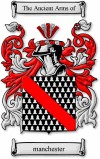
Manchester coat of arms
My 8th great grandfather was part of an unusual settlement in New Haven, Connecticut. He probably arrived in 1638 with a group of Puritans from England:
On April 24, 1638, a company of five-hundred English Puritans led by the Reverend John Davenport and Theophilus Eaton, a wealthy London merchant, sailed into the harbor. They soon discovered that the Quinnipiacks and other local tribes were much distressed by raiding bands of Pequots and Mohawks from surrounding areas. It was for this reason that Momauguin, the sachem of the Quinnipiacks, and other tribe members agreed to sell the tribe’s land to the Puritans. In return, the settlers pledged to protect the natives and to allow them the use of the lands on the east side of the harborNew Haven’s founders not only hoped to create a Christian utopia, they also saw in New Haven’s spacious harbor an opportunity to establish a commercial empire that would control Long Island Sound and possibly the coastline as far south as Delaware Bay. By 1640 a complete government had been established and the settlement, originally called Quinnipiac, was renamed Newhaven. The town plan was based on a grid of nine squares. In accordance with old English custom, the central square, now the Green, was designated a public common. By 1641 New Haven had grown into a community of approximately 800.
Over the next few years, however, the flow of newcomers began to weaken and trade with the outside world shifted more and more to Boston. In an attempt to establish direct trade with England, the settlers managed to assemble enough produce to fill a vessel which would become known as the “Great Shippe.” However, after setting sail in January, 1646, the ship and its crew were never heard from again. This disaster ended the dream of creating an economic empire and over the years New Haven became overshadowed by New Amsterdam and Boston.
from: http://www.cityofnewhaven.com/Mayor/History_New_Haven.asp
Thomas Manchester, the Manchester immigrant ancestor, was born in England, and was a resident of New Haven, Connecticut, in 1639, in the year following the planting of the colony. Afterward, however, he settled at Portsmouth, Rhode Island, where he is first mentioned in the land records, January 25, 1655, when he and his wife sold to Thomas Wood twelve acres of land. He married Margaret, daughter of John Wood.
In the settlement of her father’s estate, it was ordered March 17, 1655, that the son John pay his sister, Margaret Manchester, eight pounds. Eight acres of land were granted at Portsmouth to Thomas Manchester, December 10, 1657, and he sold to Richard Sisson one-three-hundredth right in Canonicut and Dutch Islands. In 1680 he was taxed four shillings. He and his wife testified, June 7, 1686, that they heard and saw Ichabod Sheffield married by William Paulstone. He deeded to his son John. July 9, 1691, his mansion house and lands at Portsmouth, except the place at the lower end of the ground, in possession of his son Thomas, one-half to be his at the death of grantor and the other after the death of grantor’s wife,mother of grantee, provided he pay to the sons Thomas, William and Stephen, ten shillings each, to Job twenty shillings and daughters Mary and Elizabeth ten shillings each. He also gave to John his personal property, including cattle, tools, etc.
Thomas Manchester died in 1691; his wife in 1693. Children: Thomas, born about 1650; William, 1654; John, died in 1708; George, admitted freeman in 1680; Stephen, mentioned in his own biography; Job, died 1713; Mary; Elizabeth.
Source:
New England families, genealogical and memorial
By William Richard Cutter (pgs. 853-854)
Thomas Manchester (1620 – 1691)
is my 8th great grandfather
Elizabeth Manchester (1667 – 1727)
daughter of Thomas Manchester
Dr. James Sweet (1686 – 1751)
son of Elizabeth Manchester
Thomas Sweet (1732 – 1813)
son of Dr. James Sweet
Thomas Sweet (1759 – 1844)
son of Thomas Sweet
Valentine Sweet (1791 – 1858)
son of Thomas Sweet
Sarah LaVina Sweet (1840 – 1923)
daughter of Valentine Sweet
Jason A Morse (1862 – 1932)
son of Sarah LaVina Sweet
Ernest Abner Morse (1890 – 1965)
son of Jason A Morse
Richard Arden Morse (1920 – 2004)
son of Ernest Abner Morse
Pamela Morse
I am the daughter of Richard Arden Morse
Thomas Manchester was born in England about 1620, and died at Portsmouth, R.I., about 1691. He was an early pioneer of Quinnipiac, called New Haven after 1640, in the Plantation of Connecticut: since he is found there in 1639, it would seem probable that he was of the company of Yorkshire settlers who in 1638 came to America with Ezekiel Rogers, the famous non-conformist minister, with the view of joining the Quinnipiac Plantation, although many of them eventually settled elsewhere.
The New Haven colony differed very much from other colonies. Many of the colonists put up large houses. As an explanation why this style of building was so general, it may be said that the founders of New Haven were mainly gentlemen and merchants, used to living in superior houses in London and other parts of England. For a period,Thomas continued at Quinnipiac, but removed to Portsmouth, R.I, before 1642.
On February 25/1642 he was appointed to serve on the next jury. From 1674 till his death, he was Town Sergeant. He became a considerable landed proprietor. Prior to 1655 he acquired land on the island of Aquidneck, and on January 25/1655, he made a deed of a tract of 12 acres there to Thomas Wood.
On December 10/1657, he shared in the land division and received eight acres at Portsmouth. He also had sharein Dutch Island and Quononoquet Island, and conveyed his interest in 1/300th right therein to Richard Sisson on July 6/1658. His mansion and homestead was built on his Portsmouth land.
On July 9/1691, Thomas deeded to his son John, his mansion house and all lands at Portsmouth, except the piece at the lower end, which had been theretofore deeded to his son Thomas. According to the deed, half was to be John’s on hisbrother Thomas’ death, and the remaining half upon the death of his Mother, conditioned always that pay to his brothers Thomas, William and Stephen, 10 shillings each, to Job 20/-, and to his sisters Mary and Elizabeth, ten shillings each. John also received from his father his personal property, cattle, chattels, implements, bonds, sums of money, and whatever belonged to him at the time of his death.
Thomas Manchester married, prior to 1650, Margaret Wood, who died about 1693, daughter of John Wood of Portsmouth, R.I., who bequeathed to his daughter Margaret the sum of œ8.
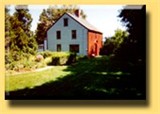
Philip Sherman’s house
My 8th great grandfather moved to Rhode Island as many of my ancestors did. He became a Quaker and the first secretary of Rhode Island Colony.
Philip Sherman (1610 – 1687)
is my 8th great grandfather
Eber Sherman (1634 – 1706)
son of Philip Sherman
Mary Sherman (1688 – 1751)
daughter of Eber Sherman
Thomas Sweet (1732 – 1813)
son of Mary Sherman
Thomas Sweet (1759 – 1844)
son of Thomas Sweet
Valentine Sweet (1791 – 1858)
son of Thomas Sweet
Sarah LaVina Sweet (1840 – 1923)
daughter of Valentine Sweet
Jason A Morse (1862 – 1932)
son of Sarah LaVina Sweet
Ernest Abner Morse (1890 – 1965)
son of Jason A Morse
Richard Arden Morse (1920 – 2004)
son of Ernest Abner Morse
Pamela Morse
I am the daughter of Richard Arden Morse
THE HON. PHILIP SHERMAN, WAS THE SON OF SAMUEL SHERMAN AND PHILIPPA WARD. HE MARRIED SARAH ODDING; THE DAUGHTER OF WILLIAM GEORGE ODDING AND MARGARET POTTER OF BRAINTREE, ESSEX CT, ENGLAND IN (1633/XX/XX),HE WAS A MAN OF MELANCOLY TEMPER WHO CAME TO BOSTON IN (1633/XX/XX) AND UPON A JUST CALLING HE WENT BACK TO ENGLAND AND RETURNED BETWEEN (1636-1637) WITH A BLESSING, IN (1637) BECAUSE OF HIS RELIGIOUS FEELINGS HE WAS BANISHED ALONG WITH JOHN COGGESHALL AND HENRY BULL FROM THE ROXBURY BAY COLONY, BOSTON, MASS, USA. LEAVING FOR RHODES ISLANDS WERE ALL BECAME RULING OFFICIALS CHOSEN TWONE CLERKE (JUNE 1649-1656), TOWNE MAGISTRATE (1656-1679), LAYER OUT OF HIGHWAYS (1683), MEMBER OF COMM. ADJUICATION (1684-1687), AND WAS THE FIRST SECRETARY AND RECORDER OF THE COLONY OF RHODES ISLANDS.
In Bertha L. Stratton’s book, “Sherman and Other Families,” she made the statement that Philip Sherman intended to settle in New Hampshre, but the climate proved too severe and so the lands there were abandoned. Upon discussion with Roger Williams at Providence, Rhode Island, the other people from Massachusetts bought Aquidneck Island in Narraganset Bay. Nineteen men signed the compact for the town in 1638. Upon leaving the church in Roxbury, Philip joined with the Friends. The Massachusetts Court ordered Philip to appear before them on 12 Mar 1638, he did not go. But he continued as a prominent figure in Rhode Island; he was the General Recorder in 1648-1652 & the Deputy to the Assembly in 1665-1667. Tradition says he was a “devout and determined man, and he was also a “neat and expert penman & an educated man,” and his Last Will & Testament “shows that he was wealthy for those times.”
Philip Sherman immigrated to Roxbury, MA and married Sarah Odding shortly after his arrival. He might have felt pressured to marry quickly, because bachelors especially of such an advanced age as 23 were looked upon with suspicion, and their single state could even effect business opportunities and social acceptance.
According to Representative Men of Old Families of Southeastern Massachussets, by J. H. Beers & Company, in a biographical entry of one of Philip’s descendants, Philip Sherman “took the side of Anne Hutchinson,” a brave woman in Salem, MA who maintained that women should be allowed to hold prayer meetings as well as men, and proceeded to hold such meetings in her home in defiance of the rules of the time and demands that she quit. She, with some members of her family including young grandchildren, were driven out of Salem into the wilderness of Rhode Island. Families in sympathy for her or in fear of retaliation for their past support and/or defense of her beliefs soon followed to Rhode Island, and Philip Sherman and his family were among the group that left Salem following her ouster.
In Providence, Philip met Roger Williams, founder of Rhode Island promising religious freedom to it’s citizens. Williams advised Philip andthe members of his party to purchase Aquidneck from the Indians, which they did on 1 Jul 1639. They created their own government with Coddington chosen to be the first governor of Rhode Island, and Philip chosen to be secretary.
Some historians believe that the death of Anne Hutchinson with most of her family during an attack of native Americans was the first act in several that led to the end of the Puritan Church. Members of the communities in all the colonies were horrified that she was banished for her beliefs and suffered so. Many felt banished themselves from England when their Puritan faith had been banned, and her treatment forced them to recognize their own harshness.
Philip left what is now called “the Congressional Church” and joined the Society of Friends, or Quakers.
He was the father of 13 children, and many of his descendants served America as congressmen and soldiers.
Learning about archetypes has taught me to look at life more closely, and free myself of some old restrictive self images. We all play different parts in our own lives. As we age our desires naturally change and our personalities become more complex. In our history we can discern times when one role has been the dominant one, giving way to another as time passed. Some of us never outgrow our rebel, and some are artists whose latent talent is not discovered until a ripe old age. We all have within our psyches a child, a victim, a saboteur, and a prostitute that are brought to the spotlight by different circumstances.
Plato called this phenomena forms. Carl Jung coined the phrase and defined basic archetypes. He taught that these pure images arise in dreams and in reality as a result of the collective consciousness. Carolyn Myss has evolved the work to include many more archetypes, and has created books, cards, and courses to teach the concepts. It is a powerful practice to draw a timeline of your own life and remember when you encountered strong archetypes in yourself and other people, and how that may have been repeated. All religions use archetypes to teach lessons because they are memorable. The archetype in my first house is the hedonist. When that hedonist is good she is very very good, and when she is bad she is horrid. Such is the case with all of these eternal and universal roles. They have both a light and a dark side. The possibilities are endless. Do you have a strong dominant role you have played throughout your life?

