mermaidcamp
Keeping current in wellness, in and out of the water
You can scroll the shelf using ← and → keys
You can scroll the shelf using ← and → keys

1000 Voices Speak for Compassion
Some very good examples were set for me early in life by teachers in school. My high school choir director extended great praise and patience to all his students. When you think about how awful a chorus of high schoolers can sound …..most of the time, this man was a true saint to struggle through each number until we finally could sing it. He loved music, and was still willing to hear it massacred year after year, day after day. He was generally good natured, and very dapper in his fashion. He was by far the best dressed teacher we had at our school, and seemed to be the most sophisticated somehow. He was generally fun and upbeat, but insisted on discipline in class. When he was upset with us he would say “Frank, C., Elephant, Coulter never forgets an infraction.” His stern delivery of that line was always enough to handle any issue. We never actually witnessed the elephant bring up past offenses. He worked to make our roles in the choir a constant source of pride and mutual understanding. He taught us all the value of practice, precision and harmony. He was a living example of patience as virtue.
As an adult I have been very fortunate to study in person with His Holiness the Dalai Lama of Tibet. He came to Tucson in September 1993 for a teaching on patience. That was my first introduction to the meditation practices of Tibetan Buddhism, which are complicated to say the least. I studied for a year previous to his visit to get some background and study under my belt before he arrived. He covered a lot of material and empowered us to Green Tara, all of which was new to me. The crash course was not intended to convey the entire teaching in a few days, but to instill the value of practice. Like my high school choir director, His Holiness teaches all kinds of people who have no previous experience or ability to meditate. He teaches each person and group from scratch, using the ancient texts on the Bodhisattva’s way of life. He reaches each mind according to the readiness of the student to comprehend. One question he took from an audience member was about the best way to begin a personal meditation practice. His answer was simple. He told her, “Be nice.”
Since 1993 I have made efforts to be nice, and have recognized that it is easier said than done. To transform anger into patience is the ultimate practice. If anger has no hold on your mind you are free. If what bothers you about people and life can be surmounted by a practice of patience in all things, you have reached Nirvana. This teaching, so pure, simple and true, provides a lifetime of practice. He taught us that the folks in your life who make you angry also teach you patience. They provide a special gift without which we could not become enlightened. Nipping anger in the bud, transforming it into patience, is compassion in action. Anger may be a natural sentiment, but it is helpful to nobody, least of all to the person who harbors it. Compassion is a conscious choice, starting with one’s own inner demeanor.
Each month on the 20th a round of compassion is raised here. Please join #1000Speak to add your voice to the choir.


Like his father Ebenezer served as Justice of the Peace in Fairfield County, Connecticut. He also served in the military and as deputy in the assembly. Late in life he married a very young woman.
Ebenezer Mead II was born in Greenwich on October 25, 1692, the eldest son of Ebenezer Mead and Sarah Knapp.
He was married on December 12, 1717, to Hannah Brown, the daughter of Peter Brown of Rye NY, and they had Ebenezer, Silas, Abraham, Jonas, Solomon, Deliverance, Amos, Edmund, Hannah, Jabez, Jared and Abraham.
On May 9, 1728, Ebenezer was commissioned a Lieutenant of the East Company, or Train-band, at Horseneck. On May 11, 1738, he was commissioned a Captain of the same company.
He was a Justice of the Peace for Fairfield County from 1733 to 1758, and was a deputy to the assembly in 1733, 1734, 1737 and 1738.
Late in life, in 1759, when he was approaching 70, he was married for a second time, this time to Naomi Weed, the daughter of Abraham Weed. She was about twenty years old at the time.
Ebenezer Mead’s will was dated June 3, 1772, and probated June 15, 1775. In it he mentions his wife Naomi and children Deliverance, Jared, Silas, Jonas, Solomon, Amos, Abraham, Jr.; his grandson Enoch Mead, granddaughter Hannah, and grandson Ebenezer, the children of his son Ebenezer, who had predeceased him. His executor was his son Jared. The witnesses were Daniel Smith, Joshua Smith, and Jesse Parsons.
Ebenezer Mead (1692 – 1775)
is my 7th great grandfather
Deacon Silas Meade (1730 – 1807)
son of Ebenezer Mead
Abner Mead (1749 – 1810)
son of Deacon Silas Meade
Martha Mead (1784 – 1860)
daughter of Abner Mead
Abner Morse (1808 – 1838)
son of Martha Mead
Daniel Rowland Morse (1838 – 1910)
son of Abner Morse
Jason A Morse (1862 – 1932)
son of Daniel Rowland Morse
Ernest Abner Morse (1890 – 1965)
son of Jason A Morse
Richard Arden Morse (1920 – 2004)
son of Ernest Abner Morse
Pamela Morse
I am the daughter of Richard Arden Morse
Summer is extreme in Tucson. We change many of our daily routines in order to deal with the heat and intense sun. In our household this means we seriously crank up our consumption of iced tea. We drink tea all year, usually iced, but in summer two of us consume gallons every day. I have been a highly satisfied customer of Adagio Teas for years. My orders have included fruit, herbal, and roiboos teas in the past. Recently I have read a lot about different kinds of teas, so I decided to expand my repertoire by tasting some new varieties. I have tried green tea in the past, but thought I did not like it. Perhaps I brewed it badly. I have become such a raving fan in a few weeks that I have given up my morning coffee. There is caffeine in green tea, so it does the job of waking me up, and my stomach seems to like it much better. I may return to coffee when winter comes, but for now I am very happy with my morning tea. Who knows how far I will take this exploration? I love the ritualistic treatment given to tea by the Asians, and the formality and style the Brits use when they serve tea. So far I have not developed any real tea drinking rituals, but one never knows how this could end.
The flavored varieties that converted me to a green tea lover are:
Cherry Green– this lively bright flavor is the one I choose for morning. It is delicious.
Calypso Green– This one has a hint of coconut and other tropical fruit, tasty for all day
I have also ordered some new green types to try and a green roiboos. Roiboos is probably my favorite flavor, and luckily it is extremely healthful. The green, unfermented roiboos is higher in antioxidants and other nutrients. It is very beneficial to the skin, and can be applied topically to heal burns and abrasions. After drinking healthy liquids all day and staying hydrated I have even found some green tea cocktails!!! At least one ingredient will be good for me!

Book of Sports
When James I of England published the Book of Sports in 1617 it caused an uproar from the Puritans. The belief that no work or pleasure should take place on the sabbath was much debated at that time in Britain. The book was published after King James had his very own translation of the Bible released. Trouble was brewing in the British Isles that would eventually lead to the settlement of Plymouth Colony. The Puritans believed that all citizens must be required to attend religious services on Sunday, and they wanted them mandatory morning and evening on that day. Many of my own ancestors left England to live in Holland for a decade about that time, before sailing on the Mayflower to America. All the countries in Europe posed problems to their ideals except the Netherlands. There they could practice their severe brand of religion. There they built up strength to go to the new world.
The concept is taught to American children that these people came to America for religious freedom. That is only partially the case. They wanted to be free to dominate others and force them to follow Puritan rules. The freedom was just for their own religious beliefs, but did not apply to the beliefs of others. They were convinced of the righteousness of their logic. This made life in the new colony very contentious. It was easy to run afoul of the Pilgrim fathers who were all about sabbath and strict adherence.
Charles I reissued the Declaration of Sports in 1633, continuing the tradition of requiring attendance to religious services (in the Church of England) to qualify to dance, leap, or play sports on Sunday. There were a few sports not permitted on the sabbath such as bear and bull baiting and bowling. Charles I expanded the merriment to include local fairs and festivals on the list of sanctioned Sunday activities. England was trending Puritan in the 1630’s. In 1643 the book was publicly burned. When Charles II was restored to the throne after the English Civil War in 1660 the country was liberated from the strict sabbath rules and could once again party on Sunday afternoons.
When we think about sports and religion in America today we observe a very different story. Church attendance and membership are dropping off dramatically, but sports dominate the public attention. It is ironic to think that our initial colony was founded to make sure that Sunday would be sport free for everyone. I wonder what the Pilgrim fathers would think of the NFL and the NBA.
The term community policing has been tossed around in the media lately by experts and citizens of all kinds. This trending topic has been defined by the US Department of Justice:
Community policing is a philosophy that promotes organizational strategies, which support the systematic use of partnerships and problem-solving techniques, to proactively address the immediate conditions that give rise to public safety issues such as crime, social disorder, and fear of crime. Community policing is composed of three key components:
Partnerships – Collaborative partnerships between the law enforcement agency and the individuals and organizations they serve to develop solutions to problems and increase trust in police.
Organizational Transformation – The alignment of organizational management, structure, personnel, and information systems to support community partnerships and proactive problem solving.
Problem Solving – The process of engaging in the proactive and systematic examination of identified problems to develop and evaluate effective responses.
I hope incorporation of these policies will take place as soon as possible. Within the organizational transformation plan is a geographic approach to assignments. In other words, provide neighborhood cops who know and interact with a certain area by assigning them to that area. This is essential in my opinion, and would be helpful where I live. The advice given is to despecialize the force, creating a more generally skilled team to handle most situations. Problem solving and cooperation with the public have been missing elements to improving the safety in our city. Obvious ongoing crime would be obvious to any cop who patrolled here all the time. The force would see what we see, and even become known to the neighbors. These concepts will improve safety for both officers and the public.

sky
The systems now available to measure and monitor health are mind blowing. This slice of health care/technology is growing more popular each day. I started using Fitbit last fall to increase my movement. It is effective motivation to see performance increase over time, complete with graphs. I recently became most interested in the sleep measuring ability of my little wrist band.
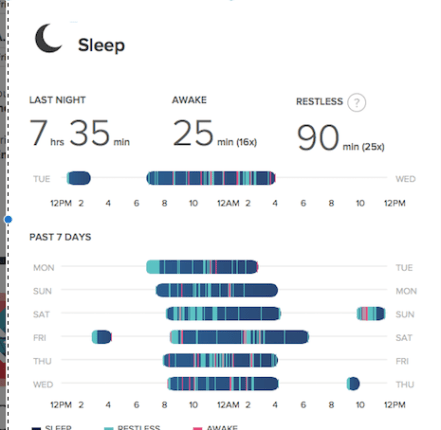
MY SLEEP LOG
As you can see I am frequently awakened during the night. My dog needs to go out and I must walk down a flight of stairs to do the task, so it does disturb my slumber. I am working this week to push back towards longer deeper sleep by using honey. Last night on the 3rd trip down with the dog I drank a shot of honey and warm milk, which seemed to work pretty well. I am also napping after lunch when possible because at that time I zonk out easily. I do not pay for the advanced membership to Fitbit that provides constant reports and comparisons to your age group in the population. However, I am taking advantage of the offer to create a one week report for free. My results will be final on Saturday, and graphed. I feel very competitive and funny about this challenge. I want to see an improvement in my sleep in one week. This may prove to be irrational as a goal, but I am still trying it. I wonder if I can will myself to be a better sleeper in the long run. Over the last three days I have managed to increase my total time, but without the naps it would not have been the case. This is one challenge for which gearing up is against my better interests. How does one become a sleep champion?
Do you use any fitness monitoring devices or apps? Have you found the feedback helpful in changing your habits? What kind of sleep secrets have you learned, gentle reader? I am on a quest for better rest.

Pool at Mission Inn
Summer is perfect for outdoor partying. Staying safe to enjoy the entire season injury free is important. Families in Arizona enjoy trips to lakes, some river rafting, and many gatherings around pools. Since the heat is intense and the sun is strong we take precautions. Sunscreen, or better yet, sunscreen garments and hats are needed even when the weather is cloudy. Altitude is a factor in the intensity of solar damage. Well above sea level, at 2388 ft, Tucson delivers sunburn fast. We need to be mindful for cosmetic reasons, and especially because we risk skin cancer from too much exposure.
When adults and kids gather poolside it is frequently assumed that “someone” is watching the kids next to the water. In settings where there is no lifeguard on duty it is imperative to designate one or more full time sentries to watch the pool. Switch frequently in order to share the responsibility and still enjoy the party. The person who is watching does not need to be a strong swimmer, but does need to establish order and discipline. With young people this is best done with humor and a complete up front understanding of what is permitted and what is prohibited. A teen who is mature can help guard the younger kids, but only if adults are on hand to deal with decision making. In the event that a person in the pool is in distress for any reason please remember to assist them in this order:
These rules apply for open water, where row boats are discharged before sending a swimmer. In a pool setting lots of things can be used to tow such as towels, floating noodles, or even a chair cushion. If you lie down on the deck and extend your arm you will be able to pull your swimmer to shore without being pulled in yourself. You can also wade into the water where you can stand and extend something to tow the person. Even if you think you are a strong swimmer avoid a swimming rescue if at all possible. Drowning folks find super human strength and are often irrational. The very worst pool parties end in double drownings.
Using good judgement avoids injury and trauma in the water and around the edge of the pool. If you establish a rule, such as no running, you must stick to it. I think when kids of different abilities to swim are together a no dunking rule is a wise one to make. In general, respect for all involved is the aim of regulating water fun. Lightening storms are common here, and come with a great deal of danger. Err on the side of caution getting out of the water when lightening is spotted. It can travel surprisingly quickly. Insist calmly that everyone exit the pool in order to be able to swim again another day. I have seen very intelligent people resist this notion. You may have to be very firm. It is so much better than crispy critters on the bottom of the pool. Good luck striking the right balance between cannon balls and discipline. Enjoy!!!

pool at night
The month of June is designated as National Safety Month in the US. Attention to safe practices and awareness is geared toward making the country safer. During this year we are faced with graphic evidence that one threat to our safety can be the police. The teen pool party in McKinney, Texas that turned ugly can only be seen as inappropriate. An enraged cop tackled a teen girl smashing her face into the lawn, then drew his gun on bystanders. I feel the fear as I watch these proceedings. I imagine what my own feelings might be if I was taken down by an irrational armed cop. This reality does make me fear and loathe what police do in my country.
The Department of Justice and the White House sponsored a task force to make recommendations for 21st century policing. The report names 6 pillars on which to focus:
There is a wider gap each day between the cops and the communities paying for police protection. It is not an easy task to build trust when we observe this kind of event on a regular basis. Law enforcement officers are hired to prevent crime and keep the peace. When they look like the most criminal among us, we are right to question the authority we have given them. I don’t know how to reverse this trend, other than doing what you can to love your neighbor and treat him as you want to be treated. That includes all of us.

honey
Sleeping has always been easy for me. I fall asleep quickly when I am tired, and normally sleep through noise and disturbances that bother others. For the last few months I am challenged to get a full night of rest because my dog needs to go out several times during the night. Once I have walked down the stairs and let her out for a few minutes my patterns have been disturbed. I have been searching for a remedy that fits this situation. I don’t want a sleep aid, even melatonin, because I do need to wake up for the chore. I am doing research into various ways to enhance or deepen sleep. In the meantime my fitbit reads my sleep efficiency. It reports the number of times awakened, and the time spent sleeping. My rate normally ranges between 79% and 85%, but last night I hit 73% sleep efficiency, with 23 times awakened. I need to take action to save my sanity.
Last week I read about honey hibernation. I have tried it several times and it seems to work. Sometimes I neglect to do it before retiring, but take the honey on my first trip downstairs with the dog. I think it might help me fall back into deep sleep. I am going to start a real experiment with the honey method to find out if it is making a significant difference. I have asked for a 7 day sleep report from fitbit and will now be religious about taking my son full of honey at 6 pm daily. Last night I got 57 minutes less sleep than I need. I did nap today, which I think is a fine solution to the overall rest situation, but I want a sound restful night as well. I have used self hypnosis in the past. That might be useful for my purpose, but I will see if I need more help, after a week of honey. Have you tried this method, gentle reader? It is for weight loss and better liver function, but a side effect is better sleep. I am up for all of the above, especially if it is all that easy.

sky
Symbols in dreams are personal. We dream only of faces we have seen before, even if we are barely familiar with the person. The character, or archetype played by the face depends completely on personal experience. Dream dictionaries and aids to interpret meaning found in dreams can only make references to universal archetypes. To grasp the personal message brought to the dreamer the images themselves must be savored and visited in waking time. Writing in a diary upon awaking before moving or engaging in the activities of the day is helpful. By keeping these notes on a regular basis you may discover themes that you can identify in a personal way.
Sometimes at crossroads in life a person will receive a vivid memorable message during sleep. The images and meaning of mythic dreams are significant beyond the every day way the unconscious communicates. The protagonists in the drama make a deep impression that lasts and speaks to the psyche for a long time. Carl Jung identified seven basic archetypes making appearances in dream time.
Loaded images and story lines float through our heads while we sleep. If we have a problem on the mind it is possible to solve it during a dream. Practice and meditation on our own dream images will make clearer the point of the communication. Our subconscious warns us, encourages us, and sometimes tells us we are foolish. It is never straightforward, but over time we can dig more deeply into the messages our dreams deliver on a nightly basis. Have you ever kept a dream diary, gentle reader? Have you ever had a mythic dream that changed your thinking?

desert
 mermaidcamp