mermaidcamp
Keeping current in wellness, in and out of the water
You can scroll the shelf using ← and → keys
You can scroll the shelf using ← and → keys

Apollo and the 9 muses
In Greek mythology the nine muses are daughters of Mnemosyne. She was the muse of memory. Zeus slept with her for 9 nights, resulting in the birth of the 9 muses. They were raised by Apollo and a nymph in a secluded atmosphere. They became completely dedicated to the arts. Each was in charge of a different aspect of culture:
June 14 is celebrated as the birthday of the muses. Have you ever tried to invite a muse for a visit in your creative world? I have wanted to be more poetic since I discovered my Pilgrim poet ancestor, Mistress Bradstreet. I made some effort in April to write a poem each day, but I think the missing piece is the muse. I have trudged away at the poems without inviting a spark or a mystic inspiration to reach into the creative process. I have assigned myself the job of poet, but have not consulted with the poetic energy that inspires and makes art possible. Words themselves need a creative current or tradition on which to flow, or the audience will be left flat. I love comedy the best, although Mistress Bradstreet was more about sacred hymns. Next time I go out into the world I will ask Thalia to accompany me to find the humor in what I experience. Which is your favorite muse? Could you call on them to enhance your creativity more often? I know I could.

chart of the day
This week is special because the full moon and Friday the 13th are falling at the same time. Just a few minutes after midnight on Friday, EDT the full moon will brighten the sky. For astrology buffs this moon holds aspects of jubilance and caution. For sky watchers the visual effects will be stunning, since the full moon is close to the summer solstice. Much ado is being made about the combination double whammy of the date and the moon, but I want to point out that if you live west of the Eastern time zone in the US or Canada, our full moon will happen on Thursday the 12th. I am in that lucky group. Our full moon party will be free of any other beliefs about dates. Here are some of the perils we may escape:
My parents were married on Friday the 13th, which was also my maternal grandmother’s birthday. Since she was not in approval, or invited, I think my parents might have meant it as a prank. The most significant thing that happened in history on that day was the Battle of Guadalcanal. I can’t say that it was lucky or unlucky for the marriage, but they did not divorce. The contract they initiated on Friday 13 Nov, 1942 lasted until death did them part in 2004. My parents were either bold or not superstitious. I consider 13 to be a lucky number. Do you have reservations or feelings about the upcoming full moon and the meaning it has in your life?

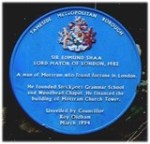
My 13th great-grandfather was Lord Mayor of London and a wealthy, influential goldsmith. My mother was always crazy about gold and jewelry. She would have been pretty excited to learn one of her ancestor’s healing rings is in the British Museum. I am excited myself.
Edmund Shaw (1434 – 1487)
is my 13th great grandfather
Elizabeth Shaw (1460 – 1493)
daughter of Edmund Shaw
Thomas Poyntz (1480 – 1562)
son of Elizabeth Shaw
Lady Susanna Elizabeth Poyntz (1528 – 1613)
daughter of Thomas Poyntz
Elizabeth Saltonstall (1557 – 1621)
daughter of Lady Susanna Elizabeth Poyntz
Henry Wyche (1604 – 1678)
son of Elizabeth Saltonstall
Henry Wyche (1648 – 1714)
son of Henry Wyche
George Wyche (1685 – 1757)
son of Henry Wyche
Peter Wyche (1712 – 1757)
son of George Wyche
Drury Wyche (1741 – 1784)
son of Peter Wyche
Mary Polly Wyche (1774 – 1852)
daughter of Drury Wyche
John Samuel Taylor (1798 – 1873)
son of Mary Polly Wyche
William Ellison Taylor (1839 – 1918)
son of John Samuel Taylor
George Harvey Taylor (1884 – 1941)
son of William Ellison Taylor
Ruby Lee Taylor (1922 – 2008)
daughter of George Harvey Taylor
Pamela Morse
I am the daughter of Ruby Lee Taylor
Dictionary of National Biography, 1885-1900, Volume 51Shaw, Edmund
by Charles Welch
SHAW or SHAA, Sir EDMUND (d 1487?), lord mayor of London, was the son of John Shaa of Dunkerfield in Cheshire. He was a wealthy goldsmith and prominent member of the Goldsmiths’ Company, of which he served the office of master. He was elected sheriff in 1474, and on his presentation the members of his company escorted him to Westminster (Herbert, Twelve Great Livery Companies, ii. 219). Shaa became alderman, and in 1485 migrated to the ward of Cheap, on the death of Sir Thomas Hill through the ‘sweating sickness.’ He was elected mayor in 1482, and towards the close of his mayoralty he took an active part in influencing the succession to the crown on the death of Edward IV. Shaa probably had financial dealings with the crown, and his intimacy with Edward IV appears from a bequest in his will for an obit for the soul of that ‘excellent prince’ and his sister, the Duchess of Exeter. He became nevertheless a strong supporter of Richard III, who made him a privy councillor, and whose claims to the throne he and his brother (see below) were doubtless largely instrumental in inducing the citizens to adopt. Shaa appears to have resided in Foster Lane, where, and in the neighbouring West Chepe, the goldsmiths kept their shops. He possessed, and probably occupied, the great mansion, with its adjoining tenements, in Foster Lane, in which Sir Bartholomew Reid had lived (ib. ii. 253).
He died about 1487, and was buried in the church of St. Thomas of Acon, where he founded a chantry for the souls of his wife Juliana (who died in 1493), his son Hugh, and others (Sharpe, Calendar of Husting Wills, ii. 612). This trust, with many singular injunctions attached, he placed under the charge of the Mercers’ Company (Watney, Account of the Hospital of St. Thomas of Acon, pp. 51–3). His will, dated 20 March 1487, was proved in the P. C. C. (Milles 12). Full effect was given to his intentions under the will of Stephen Kelk, goldsmith, who administered Shaa’s bequest under an agreement with his executors (Watney, p. 53; Prideaux, Goldsmiths’ Company, i. 33–4). One of these executors, John Shaa, goldsmith, may have been the Sir John Shaa (knighted on Bosworth Field and made a banneret by Henry VII) who was lord mayor in 1501, or a near relative. By another will, not enrolled, Shaa left four hundred marks for rebuilding Cripplegate, which was carried out by his executors in 1491. He also left property in charge of the Goldsmiths’ Company, producing an annual sum of 17l., to found a school ‘for all boys of the town of Stockport and its neighbourhood,’ in which place his parents were buried. This school was considerably developed and its advantages extended by the Goldsmiths’ Company (Herbert, ii. 252–3). Shaa also directed by his will that sixteen gold rings should be made as amulets or charms against disease, chiefly cramp. One of these rings, found in 1895 during excavations in Daubeney Road, Hackney, is now in the British Museum. On the outside are figures of the crucifixion, the Madonna, and St. John, with a mystical inscription in English; the inside contains another mystical inscription in Latin.
The lord mayor’s brother, Ralph or John Shaw (d. 1484), styled John by More and Holinshed, and Raffe by Hall and Fabyan, may without much doubt be identified with Ralph Shaw, S. T. B., who was appointed prebendary of Cadington Minor in the diocese of London on 14 March 1476–7, and was esteemed a man of learning and ability. He was chosen by the Protector (afterwards Richard III) to preach a sermon at St. Paul’s Cross on 22 June 1483, when he impugned the validity of Edward IV’s marriage with Elizabeth Woodville, and even asserted, according to More, that Edward IV and his brother Clarence were bastards. Fabyan states that he ‘lived in little prosperity afterwards,’ and died before 21 Aug. 1484 (Gairdner, Life of Richard III, 1878, pp. 100–4; FFabyan, Chronicle, 1811, p. 669; More, Life of Richard III, ed. Lumby, pp. 57, 70; Holinshed, Chronicles, ed. Hooker, iii. 725, 729; Hall, Chronicle, 1809, p. 365; Le Neve, Fasti Ecclesiæ Anglicanæ, ii. 372).
[Orridge’s Citizens of London and their Rulers, pp. 116–20; Sharpe’s London and the Kingdom, i. 320–2; Price’s Historical Account of the Guildhall, p. 186; Watney’s Hospital of St. Thomas of Acon, pp. 51–3; Sharpe’s Calendar of Husting Wills, ii. 612–17; Prideaux’s Memorials of the Goldsmiths’ Company, 1896, passim; Notes and Queries, 8th ser. xii. 345.]
When 21 June rolls around the season is about to change. Solstice is a holiday that has been celebrated around the world for centuries. For me summer has always meant time to go in the water. I like every kind of water sport from beaches, lakes, rivers , or pools. Swimming, surfing, sailing, paddle boarding, water skiing, or kayaking, I am happy to watch others with greater skill as well as indulge in trying it all. I am not a surfer but I admire the skill very much. I am also a huge fan of all the new ways to capture action video. My high risk sporting days are over, and I am happy to have survived. These are the sports I like to watch and imagine I am doing myself:
I watched X Games from Austin over the weekend and am inspired to see all the tricks and athleticism created by the participants. They continue to set the bar higher all the time by making up new tricks. I like all the events that are not motorized. The mini truck and moto cross rallies are not my style, but I understand that it takes plenty of practice and skill to do that too. I just can’t imagine myself flipping a motor bike, but somehow I can think of myself flipping and flying on a BMX bike. I applaud the new sports and the people who continually create them. I admire surfers the most. If I could magically be given the ability to surf I would consider all my lifetime wishes to have come true. What sporting ability do you wish you were granted as a gift on Solstice this year?
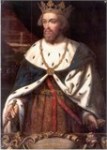
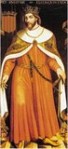
Jaime I Mallorc is my ancestor two times. Two of his children became my ancestors, Isabella and Peter, both leading to Ann Dudley, Pilgrim poet. She has the most royal of pedigrees. This is just one of them. She wrote about God and religion, but her DNA contained the royal history of Europe, crusades and all. Jaime was one of those royals who had his first marriage annulled when he wanted to marry another woman.
Jaime I Mallorc (1207 – 1276)
is my 23rd great grandfather
Isabella DeAragon (1247 – 1271)
daughter of Jaime I Mallorc
Charles DeValois (1270 – 1325)
son of Isabella DeAragon
Jeanne DeVALOIS (1294 – 1342)
daughter of Charles DeValois
Philippa deHainault (1311 – 1369)
daughter of Jeanne DeVALOIS
John of Gaunt – Duke of Lancaster – Plantagenet (1340 – 1399)
son of Philippa deHainault
Philippa Plantagenet (1370 – 1415)
daughter of John of Gaunt – Duke of Lancaster – Plantagenet
Beatrix DePinto (1403 – 1447)
daughter of Philippa Plantagenet
John Fettiplace (1427 – 1464)
son of Beatrix DePinto
Richard Fettiplace (1460 – 1511)
son of John Fettiplace
Anne Fettiplace (1496 – 1567)
daughter of Richard Fettiplace
Mary Purefoy (1533 – 1579)
daughter of Anne Fettiplace
Susanna Thorne (1559 – 1586)
daughter of Mary Purefoy
Gov Thomas Dudley (1576 – 1653)
son of Susanna Thorne
Anne Dudley (1612 – 1672)
daughter of Gov Thomas Dudley
John Bradstreet (1652 – 1718)
son of Anne Dudley
Mercy Bradstreet (1689 – 1725)
daughter of John Bradstreet
Caleb Hazen (1720 – 1777)
son of Mercy Bradstreet
Mercy Hazen (1747 – 1819)
daughter of Caleb Hazen
Martha Mead (1784 – 1860)
daughter of Mercy Hazen
Abner Morse (1808 – 1838)
son of Martha Mead
Daniel Rowland Morse (1838 – 1910)
son of Abner Morse
Jason A Morse (1862 – 1932)
son of Daniel Rowland Morse
Ernest Abner Morse (1890 – 1965)
son of Jason A Morse
Richard Arden Morse (1920 – 2004)
son of Ernest Abner Morse
Pamela Morse
You are the daughter of Richard Arden Morse
James I of Aragon (Spanish: Jaime I, Catalan: Jaume I) (Montpellier February 2, 1208 � July 27, 1276), surnamed the Conqueror, was the king of Aragon, count of Barcelona and Lord of Montpellier from 1213 to 1276.
He was the only child of Peter II of Aragon and Marie of Montpellier. As a child he was a pawn of power politics in Provence, where his father was engaged in struggles in the wars between the Cathars of Albi and Simon de Montfort. Peter endeavoured to placate the northern crusaders by arranging a marriage between his son James and Simon’s daughter, entrusting the boy to be educated in Montfort’s care in 1211, but Peter was soon forced to take up arms against them, and he was slain at the Battle of Muret September 12, 1213. Montfort would willingly have used James as a means of extending his own power. The Aragonese and Catalans, however, appealed to the pope, who forced Montfort to surrender him in May or June 1214.
James was now entrusted to the care of Guillen de Monredon, the head of the Knights Templar in Spain and Provence. The kingdom was given over to confusion till in 1216 the Templars and some of the more loyal nobles brought the young king to Saragossa.
He first married, in 1221, Leonor, daughter of Alfonso VIII of Castile, and then after having the marriage annulled (though a son was declared legitimate), in 1235, Yolande of Hungary, daughter of Andrew II of Hungary. His children were:
Alfonso (1229-1260), married Constanza de Moncada, Countess of Bigorre
Violante of Aragon (1236-1301), married Alfonso X of Castile
Peter III of Aragon
Constanza of Aragon (1239-1269), married Juan Manuel of Castile, son of Ferdinand III of Castile
James II of Majorca
Isabella of Aragon, married Philip III of France
Sancho, Archbishop of Toledo (1250-1279)
After a false start at uniting Aragon with Navarre through a scheme of mutual adoption, James turned to the south and the Mediterranean, conquered the Balearic Islands (from 1228 over the following four years) and Valencia (the city capitulated September 28, 1238).
With the French, James endeavoured to form a state straddling the Pyrenees, to counterbalance the power of France north of the Loire. As with the earlier Visigothic attempt, this policy was victim of physical, cultural and political obstacles. As in the case of Navarra, he was too wise to launch into perilous adventures. By the Treaty of Corbeil, with Louis IX, signed May, 1258, he frankly withdrew from conflict with the French king, and was content with the recognition of his position, and the surrender of antiquated and illusory French claims to the overlordship of Catalonia.
During his remaining two decades, James warred with the Moors in Murcia, on behalf of his son-in-law Alphonso the Wise of Castile. As a legislator and organizer he occupies a high place among the Spanish kings. The favor he showed his bastards led to protest from the nobles, and to conflicts between his sons legitimate and illegitimate. When one of the latter, Fernan Sanchez, who had behaved with gross ingratitude and treason to his father, was slain by the legitimate son Peter, the old king recorded his grim satisfaction.
At the close of his life King James divided his states between his sons by Yolande of Hungary, Peter receiving the Hispanic possessions on the mainland and James, the Kingdom of Majorca (the Balearic Islands and the counties of Roussillon and Cerdagne) and the Lordship of Montpellier, a division which inevitably produced fratricidal conflicts. The king fell very ill at Alcira, and resigned his crown, intending to retire to the monastery of Poblet, but died at Valencia July 7, 1276.
King James wrote or dictated at various stages a chronicle of his own life, “Llibre Dels Fets” in Catalan, which is the first self-chronicle of a Christian king. As well as a fine example of autobiography the “Book of Deeds” expresses concepts of the power and purpose of monarchy, examples of loyalty and treachery in the feudal order, the growth of national sentiment based on homeland, language and culture, and medieval military tactics.
The Roman goddess Pax is in charge of peace. When I think of Romans the first words that come to my mind are army, Latin, and empire. We did not translate Latin peace poems in school. We studied the Gallic Wars. We think of Roman soldiers at the crucifixion of Jesus, and building aqueducts and roads to Rome. They were strategists and conquerers the likes of which the world had never seen, and some might argue we have not seen since. They were organized. They believed in slavery and blood sports. They are famous for gluttony and excess. The United States is often compared to the Roman empire for some pretty obvious reasons.
Celebrations were a big part of Roman culture, and Pax has three holidays a year dedicated to her. The olive branch, a symbol of protection, safety, and peace was used to crown citizens’ heads for this holiday. She is the daughter of Justice and Jupiter. She is often depicted with a cornucopia, a symbol of abundance. The Romans believed that prosperity and peace reside together and depend on each other. The days dedicated to honoring Pax included processions, music, poetry, and olive branches for everyone. Today when we march for peace we are actually expressing anti-war ideals. We stop short of truly giving honor to the power of peace. The Romans managed to conquer the known world and hold processions for peace at the same time. If we look deeply into our current ideas about peace we might notice that we mean peace on our own terms, or peace by conquest of our enemies. This is a core issue that could shatter our empire.



The rose has been celebrated for fragrance and beauty. It is a symbol of the goddess Aphrodite. The Romans used garlands of roses and violets to commemorate the dead. Rosalia was a time to decorate with roses to show respect for the ancestors. The rose originated in Arabia where it was cultivated for perfume as well as for landscaping purposes. Crusaders brought plants back with them when they returned to Europe. This very popular flower continues to captivate our attention in gardens and in perfumery. The symbolic power of the rose is still in use as well. I found a Rosalia party in Maine, here in the US. The Maine folks will make a batch of rose mead, among other DIY rose products. Here are a few ways I have found to include roses in my life:
The roses I cultivate are Lady Banksia, or Tombstone roses that spread and like the very hot climate in Tucson. In season they yield many small white and pink flowers that I use for making flower essence. They are fragrant, and in an essence, very tasty. I drink the essence straight up rather than preserve it with alcohol. The taste is delicious. Many hybrid roses are without scent, so I usually prefer the old style, strong smelling, varieties. To preserve that smell for later use, simply spread the petals out in a single layer and dry on a basket in the dark until dry. I store herbs in paper bags or glass jars. The scent lasts longer if you use glass.
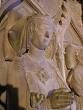
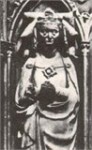
My 20th great grand-mother is buried in the cathedral in Basel, where I have been several times. It is a very impressive building on the Rhine. Basel is one of my favorite cities on earth. The Rhineland has a special kind of mysticism, culture, and history. I have been to the crypt of St. Verena right up the river in Bad Zurzach. Now I need to go again to visit my ancestor in the cathedral:
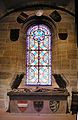
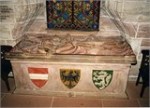
Many of her children were born in Rhinefelden, a mineral spa town with a salt water source next to the river. I took both my parents there to spa down many years ago. My father had had a stoke and was impressed with the way he felt after his water soaking and foot treatments in the Swiss therapy center. I remember telling him to take it all in because it was all part of his cure. We were sitting at that moment in the gardens (aka kurpark) watching the Rhine flow before dinner with the family. It was peaceful, beautiful, and my type A father seemed to get it for that moment. He was one with nature and the flow of life, and part of his own cure. I know now that these are not the only ancestors my father had who lived in the tiny town of Rhinefelden.
Gertrude Von Hohenberg (1225 – 1281)
is my 20th great grandmother
Albert I King of Germany Habsburg (1248 – 1308)
son of Gertrude Von Hohenberg
Albrecht Albert II ‘The Wise’ Duke of Austria Habsburg (1298 – 1358)
son of Albert I King of Germany Habsburg
Leopold III “Duke of Austria” Habsburg (1351 – 1386)
son of Albrecht Albert II ‘The Wise’ Duke of Austria Habsburg
Ernst I “Ironside” Archduke of Austria Habsburg (1377 – 1424)
son of Leopold III “Duke of Austria” Habsburg
Katharina Archduchess Austria Von Habsburg (1420 – 1493)
daughter of Ernst I “Ironside” Archduke of Austria Habsburg
Christof I VanBaden (1453 – 1527)
son of Katharina Archduchess Austria Von Habsburg
Beatrix Zahringen (1492 – 1535)
daughter of Christof I VanBaden
Sabine Grafin VonSimmern (1528 – 1578)
daughter of Beatrix Zahringen
Marie L Egmond (1564 – 1584)
daughter of Sabine Grafin VonSimmern
Richard Sears (1590 – 1676)
son of Marie L Egmond
Silas Sears (1638 – 1697)
son of Richard Sears
Silas Sears (1661 – 1732)
son of Silas Sears
Sarah Sears (1697 – 1785)
daughter of Silas Sears
Sarah Hamblin (1721 – 1814)
daughter of Sarah Sears
Mercy Hazen (1747 – 1819)
daughter of Sarah Hamblin
Martha Mead (1784 – 1860)
daughter of Mercy Hazen
Abner Morse (1808 – 1838)
son of Martha Mead
Daniel Rowland Morse (1838 – 1910)
son of Abner Morse
Jason A Morse (1862 – 1932)
son of Daniel Rowland Morse
Ernest Abner Morse (1890 – 1965)
son of Jason A Morse
Richard Arden Morse (1920 – 2004)
son of Ernest Abner Morse
Pamela Morse
I am the daughter of Richard Arden Morse
Gertrude of Hohenburg (c. 1225 – 16 February 1281, Vienna) was the first Queen consort of Rudolph I of Germany.
Family
She was born to Burchard V, Count of Hohenberg (d. 1253) and his wife Mechtild of Tübingen.
Her paternal grandparents were Burchard IV, Count of Hohenberg and his unnamed wife. Her maternal grandparents were Rudolph II, Count palatine and his wife, a daughter of Henry, Margrave of Ronsberg and Udilhild of Gammertingen.
Burchard IV was a son of Burchard III, Count of Hohenberg.
Burchard III was one of two sons of Burchard II, Count of Hohenberg. He was co-ruler with his brother Frederick, Count of Hohenberg. His brother had no known descendants and the two brothers consequently had a single successor.
Burchard II was one of five known sons of Frederick I, Count of Zollern and his wife Udachild of Urach.
Frederich I was the son of Burchard I, Count of Zollern. He was the founder of the so-called Burchardinger family line, male-line ancestors of the House of Hohenzollern.
Marriage and children
In 1245, Gertrude married Rudolph IV, Count of Habsburg. They had nine children:
Albert I of Germany (July 1255 – 1 May 1308), Duke of Austria and also of Styria.
Hartmann (1263, Rheinfelden–21 December 1281), drowned in Rheinau.
Rudolph II, Duke of Austria and Styria (1270–10 May 1290, Prague), titular Duke of Swabia, father of John the Patricide of Austria.
Matilda (ca. 1251/53, Rheinfelden–23 December 1304, Munich), married 1273 in Aachen to Louis II, Duke of Bavaria and became mother of Rudolf I, Count Palatine of the Rhine and Louis IV, Holy Roman Emperor.
Katharina (1256–4 April 1282, Landshut), married 1279 in Vienna to Otto III, Duke of Bavaria who later (after her death) became the disputed King Bela V of Hungary and left no surviving issue.
Agnes (ca. 1257–11 October 1322, Wittenberg), married 1273 to Albert II, Duke of Saxe-Wittenberg and became the mother of Rudolf I, Elector of Saxony.
Hedwig (d. 1285/86), married 1270 in Vienna to Otto VI, Margrave of Brandenburg and left no issue.
Klementia (ca. 1262–after 7 February 1293), married 1281 in Vienna to Charles Martel of Anjou, the Papal claimant to the throne of Hungary and mother of king Charles I of Hungary, as well as of queen Clementia of France, herself the mother of the baby king John I of France.
Jutte/Bona (13 March 1271–18 June 1297, Prague), married 24 January 1285 to King Wenceslaus II of Bohemia and became the mother of king Wenceslaus III of Bohemia, Poland and Hungary, of queen Anna I of Bohemia, duchess of Carinthia, and of queen Elisabeth I of Bohemia, countess of Luxembourg.
Her husband was elected King of Germany in Frankfurt on 29 September 1273, largely due to the efforts of her cousin Frederick III, Burgrave of Nuremberg. Rudolph was crowned in Aachen on 24 October 1273. She served as his Queen consort for the following eight years.
She died early in 1281. Rudolph remained a widower for three years and proceeded to marry Isabelle of Burgundy.


palo verde
The options we have for communication now boggle the mind. Some minds seem to be desperately boggled by what it takes to tell a story or get a message out to the world today. It is easier than ever because of all the free platforms we can use. It is harder than ever to reach individuals because the competition has grown to include just about everyone on earth. Our message must be not only short and sweet, but must also strike a universal chord. Leonardo da Vinci, especially toward the end of his life, often wrote about thinking in reverse: “Consider first the end.” and “Think well to the end.” were examples of his frequent statements on this subject. Leonardo left us with designs for flying machines and engineering that had not yet been proven when he died. His legacy is his art, certainly. He also left us a very strong and lasting gift of his philosophy. His practice of connessione refined his sense of mysticism and wholeness. He sought and found deep connection with all creation that inspired his work.
If you feel connected in a big way, or to a power larger than your own, confidence and ease are natural. On the other hand, if you feel disconnected from something greater it is possible to entirely loose touch with a realistic self image. We do not hold onto the same ideas or ideals for our entire life. The concept of connection may replace true connection, or maybe we always felt like we were separate and drifting. Now we can substitute chat/tweet/youtube views for personal relationships. The illusion that these clicks and likes make us part of a clubby group might just be the ruin of true connecting. Take a look at your physical worldly connections (so to speak) and how they relate or substitute for spiritual contact. I don’t think you need to join a religion or go to a certain building to make contemplation and meditation a part of your own practice. I feel connected to spirit whenever I:
This list is only a partial, and ever changing accounting of my own ways to notice connessione, or systems. Once you start to think about it you find that everything does depend on everything else, and we are all connected. If you feel distracted and want to center your thoughts, remember all the ways the universe has collaborated to create you and keep you alive. The systems that create us also sustain us.

aloe
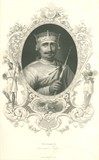
William Longsword (Plantagenet) (Earl of Salisbury) Longespee
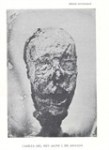
My 25th great-grandfather is buried at Salisbury Cathedral in England. He was allegedly poisoned. His body was exhumed 431 years after his death. The corpse of a rat was found within his skull, which can be seen at a museum in Salisbury. I think I am good just with the grave, no need to see the rat with traces of arsenic.
William Longsword (Plantagenet) (Earl of Salisbury) Longespee (1173 – 1226)
is my 25th great grandfather
Stephen Longespee (1216 – 1260)
son of William Longsword (Plantagenet) (Earl of Salisbury) Longespee
Ela Longespee (1246 – 1276)
daughter of Stephen Longespee
Alan laZOUCHE (1267 – 1314)
son of Ela Longespee
Maude LaZouche (1290 – 1349)
daughter of Alan laZOUCHE
Sir Thomas de Holand Wake Kent (1314 – 1360)
son of Maude LaZouche
Sir Thomas Holand Knight deHolland (1350 – 1397)
son of Sir Thomas de Holand Wake Kent
Margaret DeHoland (1385 – 1439)
daughter of Sir Thomas Holand Knight deHolland
Joan Beaufort (1407 – 1445)
daughter of Margaret DeHoland
Joan Stewart (1428 – 1486)
daughter of Joan Beaufort
John Gordon (1450 – 1517)
son of Joan Stewart
Robert Lord Gordon (1475 – 1525)
son of John Gordon
Catherine Gordon (1497 – 1537)
daughter of Robert Lord Gordon
Lady Elizabeth Ashton (1524 – 1588)
daughter of Catherine Gordon
Capt Roger Dudley (1535 – 1585)
son of Lady Elizabeth Ashton
Gov Thomas Dudley (1576 – 1653)
son of Capt Roger Dudley
Anne Dudley (1612 – 1672)
daughter of Gov Thomas Dudley
John Bradstreet (1652 – 1718)
son of Anne Dudley
Mercy Bradstreet (1689 – 1725)
daughter of John Bradstreet
Caleb Hazen (1720 – 1777)
son of Mercy Bradstreet
Mercy Hazen (1747 – 1819)
daughter of Caleb Hazen
Martha Mead (1784 – 1860)
daughter of Mercy Hazen
Abner Morse (1808 – 1838)
son of Martha Mead
Daniel Rowland Morse (1838 – 1910)
son of Abner Morse
Jason A Morse (1862 – 1932)
son of Daniel Rowland Morse
Ernest Abner Morse (1890 – 1965)
son of Jason A Morse
Richard Arden Morse (1920 – 2004)
son of Ernest Abner Morse
Pamela Morse
I am the daughter of Richard Arden Morse
William Longespée, jure uxoris 3rd Earl of Salisbury (c. 1176 – 7 March 1226) was an English noble, primarily remembered for his command of the English forces at the Battle of Damme and for remaining loyal to King John .
Early life
He was an illegitimate son of Henry II of England. His mother was unknown for many years, until the discovery of a charter of William mentioning “Comitissa Ida, mater mea” (engl. “Countess Ida, my mother”).
This Ida de Tosny, a member of the prominent Tosny or Toesny family, later (1181) married Roger Bigod, 2nd Earl of Norfolk.
King Henry acknowledged William as his son and gave him the Honour of Appleby, Lincolnshire in 1188. Eight years later, his half-brother, King Richard I, married him to a great heiress, Ela of Salisbury, 3rd Countess of Salisbury in her own right, and daughter of William of Salisbury, 2nd Earl of Salisbury.
During the reign of King John, Salisbury was at court on several important ceremonial occasions, and held various offices: sheriff of Wiltshire , lieutenant of Gascony , constable of Dover and warden of the Cinque Ports, and later warden of the Welsh Marches. He was then, circa 1213, appointed High Sheriff of Cambridgeshire and Huntingdonshire.
Military career
He was a commander in the king’s Welsh and Irish expeditions of 1210-1212. The king also granted him the honour of Eye .
In 1213, Salisbury led a large fleet to Flanders , where he seized or destroyed a good part of a French invasion fleet anchored at or near Damme . This ended the invasion threat but not the conflicts between England and France . In 1214, Salisbury was sent to help Otto IV of Germany, an English ally, who was invading France. Salisbury commanded the right wing of the army at their disastrous defeat in that year at the Battle of Bouvines, where he was captured.
By the time he returned to England, revolt was brewing amongst the barons. Salisbury was one of the few who remained loyal to John. He was appointed High Sheriff of Devon in 1217 and High Sheriff of Staffordshire and Shropshire in 1224. In the civil war that took place the year after the signing of the Magna Carta, Salisbury was one of the leaders of the king’s army in the south. He was made High Sheriff of Wiltshire again, this time for life. After raising the siege of Lincoln with William Marshall he was also appointed High Sheriff of Lincolnshire (in addition to his current post as High Sheriff of Somerset) and governor of Lincoln castle. However, after the French prince Louis (later Louis VIII) landed as an ally of the rebels, Salisbury went over to his side. Presumably, he thought John’s cause was lost.
After John’s death and the departure of Louis, Salisbury, along with many other barons, joined the cause of John’s young son, now Henry III of England. He held an influential place in the government during the king’s minority and fought in Gascony to help secure the remaining part of the English continental possessions. Salisbury’s ship was nearly lost in a storm while returning to England in 1225, and he spent some months in refuge at a monastery on the French island of Ré.
Death
He died not long after his return to England at Salisbury Castle. Roger of Wendover alleged that he was poisoned by Hubert de Burgh. He was buried at Salisbury Cathedral in Salisbury, Wiltshire, England.
William Longespee’s tomb was opened in 1791. Bizarrely, the well-preserved corpse of a rat which carried traces of arsenic, was found inside his skull. The rat is now on display in a case at the Salisbury and South Wiltshire Museum.
Family
By his wife Ela, Countess of Salisbury, he had four sons and four daughters :
• Willi am II Longespée (1212?-1250), who was sometimes called Earl of Salisbury but never legally bore the title because he died before his mother, Countess Ela, who held the earldom until her death in 1261;
• Richard, a canon of Salisbury ;
• Stephen (d. 1260), who was seneschal of Gascony and married Emeline de Ridelsford. Their two daughters were Eleanor Longspee, who married Sir Roger La Zouche and Emeline Longspee, who married Sir Maurice FitzMaurice, Justicar of Ireland.
• Nicholas (d. 1297), bishop of Salisbury
• Isabella, who married William de Vesey
• Ella, married William d’Odingsels
• Ela Longespée, who first married Thomas de Beaumont, 6th Earl of Warwick, and then married Philip Basset
• Ida, who first married Ralph de Somery, and then William de Beauchamp
 mermaidcamp