mermaidcamp
Keeping current in wellness, in and out of the water
You can scroll the shelf using ← and → keys
You can scroll the shelf using ← and → keys
I did not start studying genealogy with the expectation of spending years involved with my family tree. I did not expect to find much data, and thought I would be finished in a couple of weeks. In my sixth year of tracing my family back in time I could not imagine life without this research. I have now relearned history by tracing my own DNA through it. Believe me it becomes more interesting when you picture your own ancestors in events. The timeline is an important tool in life to assess progress and enlightenment. The same can be said of a much longer timeline, such as human history. I am starting to understand the mass migrations caused by religions that have shaped the political world. My people were motivated to take great risks and leave their known environments to follow religious convictions. They crossed the Atlantic in rickety boats with nothing but beer to drink. They froze and starved in the early American colonies. They adventured way out west to Ohio and beyond after the Revolutionary War. They fought on both sides of every British and American war, which is most revealing.
Ancestry.com is run by humans and therefore human error is part of it. The site has gathered and continues to gather public records to share as well as trees published by members who make them public. Often an unsubstantiated piece of data will be shared and repeated in the public tree arena. Fortunately there are also wizards who find some errors, and advise the owners of bogus trees to double check the data. I have twice needed to erase several generations of mistaken identity when I was given more information by a fellow family member. Bittersweet, erasing..I had become fond of the ancestors who were not really my own. It was a horrible blow to be wrong about them, but this study is about verification and facts, not just being up in your tree.
I have been asked which are my favorite ancestors, to which I generally reply I like them all for surviving so I could be here now. There are a few that I might love more than the others:
They are either well known or unknown, but all important to me and my existence. If you take the two week trial I bet you will find something remarkable in your own family history.
I am enthusiastic about Nextdoor.com. It has potential to become a tool of great value to fight crime and improve life. I invite everyone I know to start one for your neighborhood. I opened ours just a few days ago and we have gathered more than the minimum 10 members we need to have our site supported for free for our community. This is private, non commercial networking to improve the environment and create safer places to live. It is not connected to any government agency or political group. This start up knows that cities need this, and is developing the system with venture capital. It is brilliantly simple.
We have sunk to a new nadir in Tucson. Our neighborhood has a federally funded neighborhood watch consisting of only 5 households, for the sole purpose of willfully denying the presence of the charity scam, “Feeding the Homeless in Tucson’s Parks“. It is a sad state of affairs when your city will break federal revenue law, getting a grant to help a small group of white collar criminals break federal revenue law in front of everyone in the neighborhood. This makes it look like the best way to stay in any criminal business is to found a fake neighborhood watch to protect it, and help your local cops get a federal grant to help you deny that it is criminal to collect donations without reporting them to the IRS.
It is completely ironic to call this neighborhood watch when the majority has to watch the minority…and the authorities…openly break the law. This is why Nextdoor is an important way to clean up neighborhoods. When people know what is happening around them they can make improvements together for the benefit of all. When people live isolated lives, crime has more opportunity to exist. If there is a real neighborhood watch that succeeds in real life, I applaud you. In our case, we need to start by simply getting some neighbors to know their neighbors. That is progress in itself where I live.








I am happy I do not need to go to Babylon to savor the flavors of Iraq. The Babylon Market has all the groceries and deli items I could possibly desire. I enjoy learning to prepare new ethnic foods, and the ingredients I found make it easy for my to try my hand. I purchased $50 worth of groceries to get $5 credit at the deli. I had a great time searching around the store while my lunch was prepared. The store has a bakery and a butcher shop as well as a deli in the back. The store is stacked to the rafters with all things Mediterranean. I bought those red picked turnips, some canned stuffed grape leaves, some fresh Turkish bread, cheese stuffed pastry, honey, nuts, and spices. The atmosphere is friendly and buzzing as customers patronize the deli and shop like I did. The store is very popular for a good reason. The proprietors are helpful and happy, and the offer a wonderland of grocery and deli delights. I will surely return to this excellent and exotic establishment. My partner agreed that our lunch was outstanding.

Helvetia in Bern
Helvetia is the lady who holds the cantons of Switzerland in the palm of her hand. She is an evolution of Abundantia, and represents the confederacy. She presides over an extreme form of democracy in the heart of Europe. Her resources are many and very well managed. Her people are healthy wealthy and wise. Her needs are few. She gets by on a minimalistic budget that covers the Swiss Army, and leaves big taxation to the cantons. This allows her to live in relaxed elegance in comparison to her neighbors. For centuries the Swiss have depended on foreign labor by executing contracts that required the guest worker (many from Italy before the EU) to return to the home country several times a year. Hotels and resorts close the doors and the workers go home during soft tourism seasons. In season the hotels provided lodging and meals for the imported workers. Although the Helvetian Confederation did not join the EU it had to make a series of trade agreements in order to survive and thrive in the very middle of the EU countries. I used to spend a lot of time in Switzerland before the EU and I honestly did not think Europe would even pull it off in the beginning. I was not alone in this belief.
The Swiss are very liberal in social terms and conservative in fiscal terms. They are brilliantly efficient and endlessly frugal and creative. They have generously accommodated Tibetans, Africans, Tamil Tigers and other refugees, providing education and finding employment for many. Now they have an influx of Germans and Eastern Euros that have taken over much of the service segment. This is a cultural nightmare for Helvetia and her healthy economy. It is not so surprising to see that the rural populations are the one’s most opposed to the mass immigration. The Italian canton, Ticino, which is inundated with Italians who wish to stay voted with those in the countryside. They have preserved an individual culture in a confederacy with four official languages and do not wish to see history and tradition lost.
This is a small version of a big issue, which is why some are saying this could be the beginning of the end of the EU. I respect the Swiss who want to keep the identity and independence that is an integral part of their society. I used to tell my Swiss friends they need not vex themselves because they own the source of both the Rhine and the Rhone, the last clean water in Europe. They can simply do what they do best, and set up meters to measure and sell that water. Although that sounds outlandish now, there will be certain political and economic repercussions following this restriction of immigration. My bet is on Helvetia, who is wise and has the best interests of her people in mind. She will have to defend her confederacy now.


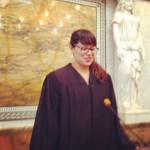

I had a magical experience that changed my life last year. During the government shut down my friends and I were treated to a tour of a working monument to justice in San Francisco. The very special building, which is owned by the taxpayers, was still open for business while the irresponsible part of the federal government was having an irrational fit at the taxpayers’ expense. We each had a chance to put on a robe and pose with the babes of justice, as my friend who works with them calls them. We all felt very special and talked later about being so lucky and having so much fun that day. Sometimes events take on more meaning as time reveals a larger meaning. I was being baptized on that bench and accepting a big mission that I recognize now. We were joking and laughing, really being free and happy, but a vow to liberate others through justice was happening at the same time. Let me explain:
My first teacher of Buddhism was Claude D’Estree, a monk who hangs tight with the Dalai Lama of Tibet. When we were lucky enough to receive teachings from his holiness in September of 1993 Claude flew down from Denver once a month for a year before his arrival to initiate us to Tibetan Buddhist teachings in preparation. We had classes at St Phil’s in the Hills Episcopal Church, and held retreats on that beautiful campus to learn about the three jewels. The subject was new to me, but Claude is an excellent teacher. From the dedication of merit to dependent arising, he covered the material in such a way that very complex concepts became clearer. I will never forget an example he used to explain compassion, using his own personal life experience.
He had worked as a federal prosecutor, who has the obvious job of defending justice and fighting evil. This job exposed him to egregious wrongdoing. As a monk he has the job of using compassion to save the world from pride, delusion, and anger by practicing patience. This seems like a paradox, and it is. He taught us that the most compassionate thing to do for people who are delusional, destructive and angry is to stop them. The trick about doing it as a prosecutor-monk, or monk-prosecuter is to do it without any attachments or aversions, in other words, without anger. Compassion turns anger into patience, an alchemical process that takes much dedication and study to achieve. He had to prosecute very serious criminals in the line of duty. He had also taken the Bodhisattva vow to return to earth until all beings are free and happy. He has undertaken this giant mission to meditate and cultivate diligence for those whose minds are slack and wondering ( a seemingly unending group). Since we all were given the rare opportunity to tread the path of buddhahood Claude was showing us how to meditate and turn our own merit into bliss for others who are suffering. I think of him and his teaching often when my patience is challenged.
The year of study and retreat was a deeply religious experience, but did not require the student to become a proclaimed Buddhist, or join any group or movement. The teachings were given to help us comprehend the even deeper experience of our time with his holiness. We were initiated to Green Tara and introduced to Shantideva. These are deep teachings that can take lifetimes to comprehend, but the Dalai Lama encouraged the women in the class by telling us that we have a better chance of spontaneous or instant enlightenment than the guys. We learned the mantra for Green Tara, who has the specialty of speed. She is the Mother of all Buddhas who saves us from our envy, wrong view and avarice.
For years I have been involved in an anger/patience/justice drama about my home. Now I am going to have to do some serious patience practice while I sue the flaming pants off the city of Tucson for violating federal revenue law and obstructing justice like crazy fire. I am calling on Green Tara to save me from attachment and doubt in order to liberate our neighborhood from evil. I have taken the vows too, and have a responsibility. Green Tara and I are now both babes of justice. Wish me luck as I walk through the valley of the shadow of anger.
I am thrilled to find a new and fabulous source of high quality sustainable food. Much to my surprise my favorite olive oil supplier has expanded and is now offering delicious cheese. Since I enjoy tasting more than stuffing myself this place was completely designed for me. It is about discovery and quality. My partner Bob will certainly love to taste the fancy meats they carry at the new restaurant, while I can indulge myself with exotic cheeses. The store is located close to home, and the Mercado San Augustin is becoming the hottest real estate in the city. I believe the deli/restaurant will be worth a visit, and will thrive in that location next to our finally becoming more hip downtown. Blu is my new favorite place. I have been to fancy cheese stores in Paris, but I like Nancy better than any of the French cheesemongers I have met. She is enthusiastic as well as knowledgeable.
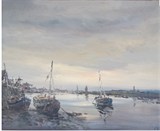
Norfolk, England
My 9th Great Grandfather was probably the earliest Brit settler in Yarmouth, on Cape Cod. He was from Norfolk, England:
On the south side, West Yarmouth became populated with the descendants of the earliest settler Yelverton Crowe(ll). (Crowell remained the most prominent surname in the village well into the 20th century.) Although the Crowells were joined by other families, and married into many of the northside families, the village itself remained small and rural in nature. Homes with large acreage for subsistence farming dotted the county road (now Route 28) which ran from Parker’s River to Hyannis’ Main Street. A fulling mill in the village, established in the late 17th century, was the first known mill in Yarmouth. The Baxters, who operated the mill, also built a gristmill along the shores of Mill Creek in West Yarmouth — a mill which is still in working order and now an historic site owned by the town. Stores, however, were few and tradesmen were fewer. Many villagers transacted business in nearby Hyannis or in Yarmouth Port. Since the village remained rural and undeveloped throughout much of the 18th and 19th century, it presented a blank palette for developers who were to arrive with the turning of the twentieth century.
Yelverton Crowell (1621 – 1683)
is my 9th great grandfather
Elishua Crowell (1643 – 1708)
daughter of Yelverton Crowell
Yelverton Gifford (1676 – 1772)
son of Elishua Crowell
Ann Gifford (1715 – 1795)
daughter of Yelverton Gifford
Frances Congdon (1738 – 1755)
daughter of Ann Gifford
Thomas Sweet (1759 – 1844)
son of Frances Congdon
Valentine Sweet (1791 – 1858)
son of Thomas Sweet
Sarah LaVina Sweet (1840 – 1923)
daughter of Valentine Sweet
Jason A Morse (1862 – 1932)
son of Sarah LaVina Sweet
Ernest Abner Morse (1890 – 1965)
son of Jason A Morse
Richard Arden Morse (1920 – 2004)
son of Ernest Abner Morse
Pamela Morse
I am the daughter of Richard Arden Morse
He fought in King Philip’s War against my Wampanoag ancestors:
According to the book “History of Cape Cod: Annals of Barnstable County, Vol 2 by author Frederick Freeman: Both John Crowell and Yelverton Crowell fought with Distinction in King Phillip’s war at the battle of Mount Hope in the year 1675. John Crowell is listed as having lost one horse.
The son of an older Presbyterian minister and his much younger wife, Sylvester Graham became an orphan early in his life. His mother was committed to an insane asylum and his father died. He was admitted to Amherst, but left without graduating. He met the Reverend William Metcalf, founder of the first vegetarian church in Philadelphia, known as The Bible Christians. He was convinced to try vegetarianism and soon pronounced it to be the remedy for alcoholism. Graham was a crusader for the use of whole grains. He was outraged that beer and distilled spirits were using grains to create alcohol rather than whole grain foods. He was angry with bakers for using what was known as the “bolting cloth” a process that removed the bran from the flour. In 1837 he called physicians vampires in lectures given to his followers in Boston. He denounced the butchers and the bakers of the city, causing a revolt on the part of the aforementioned.
Today we know his name because the graham cracker is part of our American cuisine. The corn flake and other whole grain cereals followed the lead of Graham crackers. He became an ordained Presbyterian minister and an ardent opponent of the consumption of both alcohol and flesh. Since legal prohibition had been repealed in 1933 his views on alcohol were out of step with the times, and certainly nobody wanted to hear him go off on vegetarian diet when it was more unpopular. His hatred for the “bolting cloth” moved him to call it America’s shroud. Now that so many suffer from saccharine disease, his extreme beliefs that the removal of bran may seem prophetic. What is crazy is that the Graham cracker of today contains no whole grain. Unbleached white flour and sugar are the tasty main ingredient in our key lime pie crust, which would have made Sylvester freak out all over the place.

APE Cover
In November I decided to go big and stay home with Amazon Prime. To make the most of the services one needs to own a Kindle for the lending library. I purchased the Kindle Fire and later the paperwhite. The Fire has an audio component with good sound. I enjoy the readers much more than I thought I might and new reasons are added all the time. Today as gift from Guy Kawasaki I received a free copy of APE, Author Publisher, Entrepreneur in my Kindle. Since the book was a gracious gift I added narration for an extra $1.99. I have not tried it yet, but it now gives me the option of reading or listening to the book. Since the paperwhite has no audio I will obviously use the Fire which so far I have used for cookbooks, instructional books, and poetry. This is such a cool transformer feature. I have always enjoyed audio books and frequently bought them after reading some book I liked. Now they are combined for one low price if you decide at the outset to purchase it. It bookmarks your place audio or reading. This is an upgrade. I am excited to try it.
The paperwhite reading experience is easy on the eye and fits perfectly into the hand. When I read A Religion of One’s Own on it recently I particularly enjoyed the vocabulary feature. When you touch a word you access a dictionary and the word is automatically added to your Kindle’s vocabulary builder list. The word remains on the list until you remove it manually. This feature thrills me because I am a word and language lover, but not always a stop and get the dictionary person. Reading should expand the vocabulary and glossing over meanings that are vague can lead to misunderstanding the author. I thought maybe I had been silly in buying the Fire model, but now am pleased I have one that can use the added narration feature. I love both of my Kindles and the fun eternal lending library which is included in Amazon Prime membership. I still love all the paper and print books in my home, but I see myself carrying all my books on Kindle as I buy them in the future. The advantages of Kindle ownership are numerous:
If you don’t have Amazon Prime you can do a free trial for a month, but to take full advantage of all it offers you need to own a Kindle. I am extremely pleased with my decision to join and to buy my Kindles. Now I am going to enjoy reading/listening to my new book to learn how to publish a book on Amazon. It is all very fitting.

Sancha of Castile

Sancha of Castile
Sancha of Castile was daughter of Alfonso VII of León and Castile and his first wife Berenguela of Barcelona. She was a member of the Castilian House of Burgundy.Sancha was the fifth child of seven born to her parents, and sister of Sancho III of Castile, Ferdinand II of León, Constance, Queen of France, and half-sister of Sancha, Queen of Aragon and predecessor as queen consort, Urraca the Asturian .
In 1157, Sancha married Sancho VI of Navarre. His reign was full of clashes with Castile and Aragon. He was a monastic founder and many architectural accomplishments date to his reign. He is also responsible for bringing his kingdom into the political orbit of Europe.
Sancho and Sancha had six children:
Sancho VII of Navarre
Ferdinand
Ramiro, Bishop of Pamplona
Berengaria of Navarre (died 1230 or 1232), married Richard I of England
Constance
Blanca of Navarre, married Count Theobald III of Champagne, then acted as regent of Champagne, and finally as regent of NavarreSancha died in 1179, aged forty and she left her husband a widower, he never remarried.
 mermaidcamp