mermaidcamp
Keeping current in wellness, in and out of the water
You can scroll the shelf using ← and → keys
You can scroll the shelf using ← and → keys

City Connect
I just learned about an app called City Connect that creates two way communication between citizens and cities. Our neighbors have been using Nextdoor, an app which connects neighbors for private secure communication. Our police department in Tucson joined Nextdoor in September, and has been using it to update the public on crime and safety issues. Nextdoor keeps private the neighbors’ interaction unless it is in response to an officer’s post. This system is excellent for building community and better communication between neighbors. It allows the police to give us vital information if an emergency should occur, and update us about crime trends and how to avoid being victims of those trends.
Nextdoor discussions range from yard sales to lost turkeys. I think our greatest achievement to date was the safe return of Lurkey the Turkey who escaped from his own yard, was spotted running up the street, captured, and lived to tell the story. Lurkey would have been a goner in this hood full of coyotes if neighborhood spirit had not saved his feathered tail to gobble another day. We have more members all the time, and the ability to communicate does enhance our safety and quality of life. I look forward to the growth and strengthening of Nextdoor in Tucson. We have just begun to use this fun and powerful digital tool.
We learned through an officer’s post on Nextdoor that City Connect offers a full menu of information about the TPD, everything you ever wanted to know. The one stop shop for information about the police and what they are doing includes:
Your city has to be a participant and have loaded up their profiles, etc. for you to be able to use this system. I am very pleased that our police department has taken this step to make communication smoother and easier. I think it will grow in popularity because it aggregates information in one place, and makes participation quick and painless. The same company has created another app called Citizens Connect, to enhance communication about civic matters. That sounds good too. Do any of the gentle readers have experience with either one of these apps? I think they are brilliant.

Citizens Connect

Thanksgiving SOS
This year No Kid Hungry is prepared to provide 100 holiday meals for every $49 donated. They use volume and organization to be very cost efficient, but they are also supported by large food companies. This nationwide effort is a system to end childhood hunger, which is much more common than most Americans might believe. If we start to consider the amount of waste and overindulgence set to transpire this week ( and last for some time) we might carve out $49 from our budget to feed children who do not have much security in their lives. I don’t know how much you can afford, but I know all of us are on one side or another of a great divide. The disparity of wages, privilege, civil rights, and dare I say, justice, is a major freak out. The symbol of children going hungry while some spend with lavish abandon is an embarrassment in the United States. It represents the worst of what we have allowed to happen to our society.
We can freak out all we want, but that is an unhelpful response to our crisis of inequality. Unless you are yourself in need of assistance (and sometimes even if you are) there is something you can do to be of service to others on earth. You can bring the gift of a smile if that is all you have to give. You can volunteer or quietly help someone you know is in need. An easy way to participate in the big feast of Thanksgiving is to be sure hungry kids have a seat at some table and something to eat. Bon appetite, gentle readers. Pass the equality, please.

Fill the Plate

Mayflower seal
My 15th great-grandfather was a big adventurer in the New World. He sailed to Jamestown in 1609, and was on the ill fated voyage to Bermuda that inspired William Shakespeare to write the Tempest. His wife died while he was in Virginia, so he returned to England to care for his three children. He brought his family to Plymouth on the Mayflower. As an experienced colonist he was an important part of the Pilgrim’s diplomatic mission to the Wampanoag tribe. He fell from grace when he opened a shop selling alcohol. He went down a slippery slope from allowing drinking and shuffleboard playing on Sunday to selling beer for twice what it was worth. He managed to stay in town, but did some jail time for defying the court. I am thankful to you, Grandpa Stephen, for attempting so many grand adventures and defying your odds of survival.
Stephen Hopkins was from Hampshire, England. He married his first wife, Mary, and in the parish of Hursley, Hampshire; he and wife Mary had their children Elizabeth, Constance, and Giles all baptized there. It has long been claimed that the Hopkins family was from Wortley, Gloucester, but this was disproven in 1998. Stephen Hopkins went with the ship Sea Venture on a voyage to Jamestown, Virginia in 1609 as a minister’s clerk, but the ship wrecked in the “Isle of Devils” in the Bermudas. Stranded on an island for ten months, the passengers and crew survived on turtles, birds, and wild pigs. Six months into the castaway, Stephen Hopkins and several others organized a mutiny against the current governor. The mutiny was discovered and Stephen was sentenced to death. However, he pleaded with sorrow and tears. “So penitent he was, and made so much moan, alleging the ruin of his wife and children in this his trespass, as it wrought in the hearts of all the better sorts of the company”. He managed to get his sentence commuted. Eventually the castaways built a small ship and sailed themselves to Jamestown. How long Stephen remained in Jamestown is not known. However, while he was gone, his wife Mary died. She was buried in Hursley on 9 May 1613, and left behind a probate estate which mentions her children Elizabeth, Constance and Giles. Stephen was back in England by 1617, when he married Elizabeth Fisher, but apparently had every intention of bringing his family back to Virginia. Their first child, Damaris, was born about 1618. In 1620, Stephen Hopkins brought his wife, and children Constance, Giles, and Damaris on the Mayflower (child Elizabeth apparently had died). Stephen was a fairly active member of the Pilgrims shortly after arrival, perhaps a result of his being one of the few individuals who had been to Virginia previously. He was a part of all the early exploring missions, and was used almost as an “expert” on Native Americans for the first few contacts. While out exploring, Stephen recognized and identified an Indian deer trap. And when Samoset walked into Plymouth and welcomed the English, he was housed in Stephen Hopkins’ house for the night. Stephen was also sent on several of the ambassadorial missions to meet with the various Indian groups in the region. Stephen was an assistant to the governor through 1636, and volunteered for the Pequot War of 1637 but was never called to serve. By the late 1630s, however, Stephen began to occasionally run afoul of the Plymouth authorities, as he apparently opened up a shop and served alcohol. In 1636 he got into a fight with John Tisdale and seriously wounded him. In 1637, he was fined for allowing drinking and shuffleboard playing on Sunday. Early the next year he was fined for allowing people to drink excessively in his house: guest William Reynolds was fined, but the others were acquitted. In 1638 he was twice fined for selling beer at twice the actual value, and in 1639 he was fined for selling a looking glass for twice what it would cost if bought in the Bay Colony. Also in 1638, Stephen Hopkins’ maidservant got pregnant from Arthur Peach, who was subsequently executed for murdering an Indian. The Plymouth Court ruled he was financially responsible for her and her child for the next two years (the amount remaining on her term of service). Stephen, in contempt of court, threw Dorothy out of his household and refused to provide for her, so the court committed him to custody. John Holmes stepped in and purchased Dorothy’s remaining two years of service from him: agreeing to support her and child. Stephen died in 1644, and made out a will, asking to be buried near his wife, and naming his surviving children.
Pilgrim Stephen Hopkins (1581 – 1644)
is my 15th great grandfather
Constance HOPKINS (1600 – 1677)
daughter of Pilgrim Stephen Hopkins
Sarah Snow (1632 – 1704)
daughter of Constance HOPKINS
Sarah Walker (1622 – 1700)
daughter of Sarah Snow
Sarah Warren (1649 – 1692)
daughter of Sarah Walker
Elizabeth Blackwell (1662 – 1691)
daughter of Sarah Warren
Thomas Baynard (1678 – 1732)
son of Elizabeth Blackwell
Deborah Baynard (1720 – 1791)
daughter of Thomas Baynard
Mary Horney (1741 – 1775)
daughter of Deborah Baynard
Esther Harris (1764 – 1838)
daughter of Mary Horney
John H Wright (1803 – 1850)
son of Esther Harris
Mary Wright (1816 – 1873)
daughter of John H Wright
Emiline P Nicholls (1837 – )
daughter of Mary Wright
Harriet Peterson (1856 – 1933)
daughter of Emiline P Nicholls
Sarah Helena Byrne (1878 – 1962)
daughter of Harriet Peterson
Olga Fern Scott (1897 – 1968)
daughter of Sarah Helena Byrne
Richard Arden Morse (1920 – 2004)
son of Olga Fern Scott
Pamela Morse
I am the daughter of Richard Arden Morse
Richard and his second wife had a child born at sea on the Mayflower. They named her Oceanus.
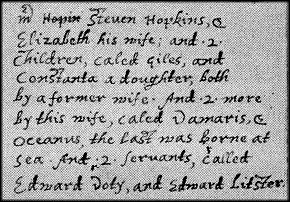
Mayflower record
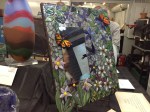


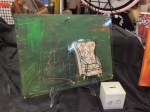




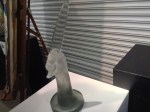








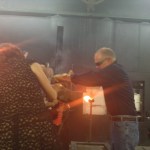

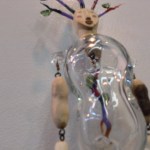
Last week I attended a very special event at The Sonoran Glass School in Tucson. The auction and live art in the making was designed as a fundraiser for the non-profit school. By inviting artists and others to design a piece of glass art to be executed by the students and faculty of the school they added an extra layer of creativity to the pieces. Lupin Murillo, a local broadcaster, designed a high heeled shoe with fancy trimmings. The fun really heats up when they auction the piece off before it is finished. The shoe was well received and fetched a nice price in the auction. The next live creation was done by a well-known photographer in Tucson, Bill Lesch. I had an excellent seat to see the forming of Bill’s globe. It was blown and shaped by the glass artists, with manipulations and creative decisions made by Bill. The collaboration had 4 people involved full-time in the making of the piece. Non-stop action and careful choreography was a real thrill to watch. I was sitting so close that I had to remove a layer of my outfit because I was right in the hot seat near the fire. It was exciting and unlike any event I have attended in the past. I will go again if they hold it next year. The food was catered by Blu, and was out of this world good. The items for auction were diverse examples of the breadth of glass art. I enjoyed seeing all of the work and meeting some of the artists. I am now interested in joining and taking some classes. The school is a great asset to our community. Our next flaming glass art event will be the Flame Off at the Fox Theater, the high point of Gem Show. If you have not seen a live glass event, I urge you to try one.

descendants of Massasoit
The Thanksgiving story is told in November to commemorate the precarious situation in which the Pilgrims of Plymouth Colony found themselves. By the good graces of the local tribe these English people managed to survive very far from home. They were not ready for the harsh winter and new surroundings. They were able to negotiate a treaty for mutual protection with Massasoit, the leader in the area. The meal shared to celebrate the treaty has been told for centuries, but there are a few written words from the time documenting this meeting. Most of us have an image from our school days of happy well dressed Pilgrims entertaining Native Americans at an extensive potluck supper. There is some mention that the Wampanoags supplied all the vittles, but we tend to gloss that over while we celebrate our highly revised impression of history and the Pilgrims.
These Pilgrim heroes soon broke down into all kinds of crazy religious infighting and banished each other for infractions. My own ancestors were banished to Sandwich and other little settlements on Cape Cod. Some had to leave because they had been secret Quakers, and one was banished to Barnstable for marrying a Native woman. We imagine Plymouth as some pure attempt at religious freedom because we have not looked very closely at what happened. Many of my ancestors went to Rhode Island to look for religious freedom and fair dealings with the Native Americans. I had several ancestors who fought on both sides of King Philip’s War, which I am sure we did not study in school. We just move on quickly to Boston and tea party and America without stopping to think what became of those people who gave the Pilgrims dinner and protection.
The big news that has been edited is all about that treaty. The pact worked for a while, but as time passed the English population grew and the agreements became strained. The English proved to be less than honorable when it came to keeping their word. The Wampanoags who survived King Philip’s War were shown no mercy. I have extra interest in the Native version of this event because I went to Cape Cod expecting to find traces of my Wampanoag family tree. I found that records do not exist to trace it although my Mayflower ancestors are very well documented. Intermarriage was very common so I am not the only one with a mystery branch in my tree. There is a very small group of people who are members of the Wampanoag tribe today, and their last names came from England. Survival for them meant adapting. This year, for a change, imagine the entire Thanksgiving story from the perspective of the original people.

Black Sphinx dates
I recently reached the conclusion that I have never in my life done menu planning. I love to cook and be creative, and I also aspire to healthy eating. I own so many cookbooks they are running out my ears, and I am tuned in to all kinds of digital food situations including television’s Food Network. I have never examined why I don’t follow recipes and don’t do meal planning even though my food life is very big. I tweet about dishes and preparations with my friends at #Mmgd all year. We sometimes gather under that hashtag for twitter parties that include recipes and pictures. Some of us have met in real life, but all of us are food friends forever. Digital food is non threatening and completely calorie free.
I like to watch people make food at least as much as I like to eat it. Iron Chef was always popular at our house, as are many of the holiday specials traditional to this time of year. On weekends we take in all manner of victuals visually before we venture out to taste anything in real life. We follow our instincts and our mood to decide where to dine or which farmers market to attend. We have favorites but are always on the lookout for new places to try. We don’t like to overeat, but enjoy being very gourmet in our selections.

ripe calamondins
I now see that my aversion to menu planning has been an excuse to avoid realistic assessment of my diet. I eat well, and shop pretty well, but the specific desire to freestyle every meal I prepare is a real flaw. I have been pretending that I need to be plan free in order to reach my creative potential as a chef. Nothing could be less realistic. Chefs know how they will use ingredients and tightly budget to make the most of all the provisions they purchase. I shop with wild abandon and then later I must put it all together and avoid waste. I am going to shift the emphasis from improvisation on random seasonal ingredients to balanced menu planning. I will still have a wild card from the fresh produce in season and in abundance. I will not be entirely without my creative hobby, but will elevate my planning to a more strategic level. I will still be spontaneous, but for the first time I will be working with a plan. What a concept!! How do you like to arrange your food preparation, gentle reader? Do you follow a plan, or like to freestyle in the kitchen? Do you make up your own meal plans or take advise from other sources? Bon Appetite! May your days be tasty and bright!
Write for your health!!!
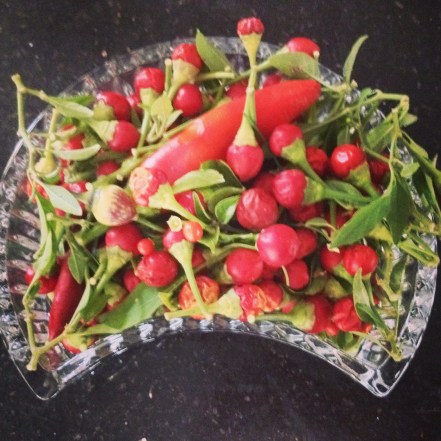
chiles from the garden

Tucson winter
I am pleased that our household is free to interpret holidays in our own way, which might include not at all. When I was younger I had many family gatherings at my house with heavy responsibility and expense. I am thankful that I am free of that kind obligation now. Good or bad, the traditions that my parents embraced are not my own. Bob and I live in a city with wonderful dining and entertainment options. We like the idea of supporting those local business owners who provide happy hours, dinners, and delicious lunches. We normally buy some gift cards this time of year when the restaurants offer discounts. It is a fun way for us to make plans to do something special together and save a few bucks at the same time. This year the restaurant we chose is excluding the use of the gift card on holidays and special occasions. At first I was miffed because we had planned to go on Thanksgiving. Upon consideration we realized we don’t even like to celebrate on the real day because it is always crowded with all the servers stressed. We will just go the night before or the day after the real holiday for our party and have the restaurant to ourselves.
This philosophy is catching on quickly here. Rather than bring out lots of decorations for the house I am doing a full deep cleaning and clearing of our home. We have very little space now because we have crammed things into every corner and cabinet. We love art, but can’t find a place to display what we already own. It makes no sense for us to acquire more. The most impressive and useful gift I can think of for our home is a serious removal of clutter and junk from top to bottom. We need a big haul to the Goodwill much more than any shopping trip for new items. We are not cutting corners on anything we like, want, or need. We just don’t want or need a busy expensive winter season. I am ready for the holidays because I don’t build any false obligations or social pressure.

Christmas cactus
Here at our house we celebrate by:
I am thankful for my stress free life. Less is the best for me. Is there anything you could easily eliminate to make this time of year less stressful?

Tucson sunset
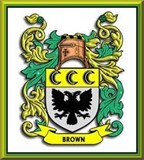
Brown Coat of Arms
Deliverance Brown was born in 1656 in Stamford, Fairfield, Connecticut. His father, Peter Brown, came to America in 1638 and settled in New Haven. In 1647 Peter moved the family to Stamford, Ct, where his wife died in 1657. Young Deliverance was a baby when his mother died. We don’t know much about him, but his brother is also my ancestor.
He owned land in Rye, NY (1678) and in Greenwich.
– In 1691 Deliverance was elected a vestryman in Rye.
– In 1697 Deliverance Brown and Thomas Merrit where sent to Hartford to convince the General Court of CT to take Rye back into it’s juristiction and in 1707 the two men were selected to settle a boundary question between Rye and Greenwich.
Deliverance Brown (1656 – 1727)
is my 8th great grandfather
Rachel Brown (1700 – 1716)
daughter of Deliverance Brown
Mary Mead (1724 – 1787)
daughter of Rachel Brown
Abner Mead (1749 – 1810)
son of Mary Mead
Martha Mead (1784 – 1860)
daughter of Abner Mead
Abner Morse (1808 – 1838)
son of Martha Mead
Daniel Rowland Morse (1838 – 1910)
son of Abner Morse
Jason A Morse (1862 – 1932)
son of Daniel Rowland Morse
Ernest Abner Morse (1890 – 1965)
son of Jason A Morse
Richard Arden Morse (1920 – 2004)
son of Ernest Abner Morse
Pamela Morse
I am the daughter of Richard Arden Morse

My parents
The idea that both glory and vengeance belong only to God is an often repeated concept. In the bible this is a giant theme that runs throughout both testaments. This is the keystone of the golden rule, “Do unto others” that we have heard so often in all religious teachings. Repressing anger and believing God is taking care of your personal earthly pay back is not the essence of this idea. Truly trusting that justice eventually prevails in ways we can’t imagine or fathom is a relief. Carrying our own grudges rather than letting go and trusting that the universe will provide both punishment and reward exactly in the perfect portions is senseless. If you step back and look at a bigger version of any drama on this earth you must notice that every action does have an equal and opposite reaction. Some understanding is within our reach, and plenty of mystery still abounds. We actually do not know enough to be effective in this realm.
I have been meditating on the idea that Everything that is the Father’s is mine because the Father and I are one. This, of course is the big father, not my personal dad, Richard Arden Morse. The meditation makes me consider that I do have traits, talents, and even possessions from my earthly father that are mine. I have worked hard not to inherit his anger and greed. The end of my parents’ lives would have been more peaceful and happy if my father had not considered himself to be righteously wrathful. He was angry at entire nations and at anyone he suspected of disrespecting him (the list only grew, never diminished). He used to sing the song “I Have a Little List” from the Mikado which makes fun of this phenomena. By the time he was old and demented his list was so long it tortured him and everyone around him.
Now that Richard has been dead and in the ground for 10 years I am sure he is over his violent feelings. He wants me to know that both glory and vengeance are not mine at all. He warns me with his memory about personally taking on too much anger. He assures me that the truth does set us free and there is no point in crying over spilled milk (this was a favorite expression of his). If you have started a list of those you find responsible for all evil, work to eliminate those beliefs before they make you very crazy. Also, remember, gentle readers, you are on somebody else’s list.

