mermaidcamp
Keeping current in wellness, in and out of the water
You can scroll the shelf using ← and → keys
You can scroll the shelf using ← and → keys
I am enthusiastic about Nextdoor.com. It has potential to become a tool of great value to fight crime and improve life. I invite everyone I know to start one for your neighborhood. I opened ours just a few days ago and we have gathered more than the minimum 10 members we need to have our site supported for free for our community. This is private, non commercial networking to improve the environment and create safer places to live. It is not connected to any government agency or political group. This start up knows that cities need this, and is developing the system with venture capital. It is brilliantly simple.
We have sunk to a new nadir in Tucson. Our neighborhood has a federally funded neighborhood watch consisting of only 5 households, for the sole purpose of willfully denying the presence of the charity scam, “Feeding the Homeless in Tucson’s Parks“. It is a sad state of affairs when your city will break federal revenue law, getting a grant to help a small group of white collar criminals break federal revenue law in front of everyone in the neighborhood. This makes it look like the best way to stay in any criminal business is to found a fake neighborhood watch to protect it, and help your local cops get a federal grant to help you deny that it is criminal to collect donations without reporting them to the IRS.
It is completely ironic to call this neighborhood watch when the majority has to watch the minority…and the authorities…openly break the law. This is why Nextdoor is an important way to clean up neighborhoods. When people know what is happening around them they can make improvements together for the benefit of all. When people live isolated lives, crime has more opportunity to exist. If there is a real neighborhood watch that succeeds in real life, I applaud you. In our case, we need to start by simply getting some neighbors to know their neighbors. That is progress in itself where I live.








I am happy I do not need to go to Babylon to savor the flavors of Iraq. The Babylon Market has all the groceries and deli items I could possibly desire. I enjoy learning to prepare new ethnic foods, and the ingredients I found make it easy for my to try my hand. I purchased $50 worth of groceries to get $5 credit at the deli. I had a great time searching around the store while my lunch was prepared. The store has a bakery and a butcher shop as well as a deli in the back. The store is stacked to the rafters with all things Mediterranean. I bought those red picked turnips, some canned stuffed grape leaves, some fresh Turkish bread, cheese stuffed pastry, honey, nuts, and spices. The atmosphere is friendly and buzzing as customers patronize the deli and shop like I did. The store is very popular for a good reason. The proprietors are helpful and happy, and the offer a wonderland of grocery and deli delights. I will surely return to this excellent and exotic establishment. My partner agreed that our lunch was outstanding.

Helvetia in Bern
Helvetia is the lady who holds the cantons of Switzerland in the palm of her hand. She is an evolution of Abundantia, and represents the confederacy. She presides over an extreme form of democracy in the heart of Europe. Her resources are many and very well managed. Her people are healthy wealthy and wise. Her needs are few. She gets by on a minimalistic budget that covers the Swiss Army, and leaves big taxation to the cantons. This allows her to live in relaxed elegance in comparison to her neighbors. For centuries the Swiss have depended on foreign labor by executing contracts that required the guest worker (many from Italy before the EU) to return to the home country several times a year. Hotels and resorts close the doors and the workers go home during soft tourism seasons. In season the hotels provided lodging and meals for the imported workers. Although the Helvetian Confederation did not join the EU it had to make a series of trade agreements in order to survive and thrive in the very middle of the EU countries. I used to spend a lot of time in Switzerland before the EU and I honestly did not think Europe would even pull it off in the beginning. I was not alone in this belief.
The Swiss are very liberal in social terms and conservative in fiscal terms. They are brilliantly efficient and endlessly frugal and creative. They have generously accommodated Tibetans, Africans, Tamil Tigers and other refugees, providing education and finding employment for many. Now they have an influx of Germans and Eastern Euros that have taken over much of the service segment. This is a cultural nightmare for Helvetia and her healthy economy. It is not so surprising to see that the rural populations are the one’s most opposed to the mass immigration. The Italian canton, Ticino, which is inundated with Italians who wish to stay voted with those in the countryside. They have preserved an individual culture in a confederacy with four official languages and do not wish to see history and tradition lost.
This is a small version of a big issue, which is why some are saying this could be the beginning of the end of the EU. I respect the Swiss who want to keep the identity and independence that is an integral part of their society. I used to tell my Swiss friends they need not vex themselves because they own the source of both the Rhine and the Rhone, the last clean water in Europe. They can simply do what they do best, and set up meters to measure and sell that water. Although that sounds outlandish now, there will be certain political and economic repercussions following this restriction of immigration. My bet is on Helvetia, who is wise and has the best interests of her people in mind. She will have to defend her confederacy now.
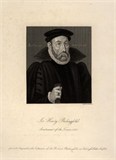
Henry Bedingfield
My 13th great-grandfather was instrumental in placing Mary Tudor on the throne of England.
Son of Edmund Bedingfield and his wife Grace, dau. of Henry Marney, first B. Marney. He was the grandson of Sir Edmund Bedingfield who had served in the Wars of the Roses, and to whom were granted by Edward IV for his faithful service letters patent authorizing him “to build towers, walls, and such other fortifications as he pleased in his manors of Oxburgh, together with a market there weekly and a court of pye-powder”. Henry’s father, other Edmund, had been Catalina of Aragon’s custodian during her last sad years at Kimbolton Castle.
Sir Henry Bedingfield and his fellow-Member Sir William Drury were included in Cecil’s list of gentlemen who were expected to transact ‘affairs for Queen Jane’, but in the event both rallied to Mary. Sir Henry was mainly instrumental, together with Sir Henry Jerningham, in placing Mary Tudor on the throne. In ‘The Chronicle of Queen Jane and of two years of Queen Mary’, the anonimous author said:
‘… The 12. of Jul word was brought to the Councell, being then at the Tower with the lady Jane, that the Lady Mary was at Keninghall castle in Norfolk, and with her the earle of Bath, sir Thomas Wharton sonne to the lord Wharton, sir John Mordaunt sonne to the lord Mordaunt, sir William Drury, sir John Shelton, sir Henry Bedingfield, master Henry Jerningham, master John Sulierde, master Richard Freston, master sergeant Morgan, master Clement Higham of Lincolnes inne, and divers others; and also that the earle of Sussex and master Henry Ratcliffe his sonne were comming towards her…’
He proclaimed her at Norwich, and for his loyalty received an annual pension of £100 out of the forfeited estates of Sir Thomas Wyatt. Ultimately he became Lieutenant of the Tower of London and Captain of the Yeomen of the Guard.
As jailer of Princess Elizabeth, who was suspected of complicity in Wyatt’s rebellion, he has been persistently misrepresented by Foxe and others. On 5 May 1554, Sir John Gage was relieved of his office as Constable of the tower and Sir Henry Bedingfield placed in his room. Bedingfield marched in to take over command of the Tower bringing with him a hundred men in blue liveries, and Elizabeth’s reacción to this ‘sudden mutation’, at least as described by John Foxe, clearly illustrates her state of mind. The arrival of Sir Henry, being ‘a man unknown to her Grace and therefore the more feared’, seems to have induced a fit of panic. She demanded to be told ‘whether the Lady Jane’s scaffold were taken away or no?’ Reassured on this point, but still not entirely satisfied, she went on to ask who Sir Henry Bedingfield was and whether, ‘if her murdering were secretly committed to his charge, he would see the execution thereof?’
On 19 May, at one o’clock in the afternoon he joined Sir John Williams and Sir Leonard Chamberlain to escort Elizabeth from the Tower to Woodstock. Foxe, in his “The myracolous preservation of Lady Elizabeth, nowe Queen” said:
“… In conclusión, on Trinitie Sonday being the 19. day of Maye, she was remooved from the Tower, the Lorde Treasurer being then there for the lading of her Cartes and discharging the place of the same. Where Syr Henry Benifielde (being appoynted her Gailer) did receive her wyth a companie of rakehelles to Garde her, besides the Lorde of Darbies bande, wayting in the Countrey about for the mooneshine on the water. Unto whome at length carne my Lorde of Tame, ioyned in Commission with the sayd Syr Henry, for the guiding of her to prisone: and they together conveied her grace to Woodstock, as hereafter followeth…”
Foxe’ s narrative contains many circumstantial anecdotes of her imprisonment, intended to emphasise her constant danger, and the boorish behaviour of Sir Henry. In fact, he seems to have been nomore than conscientious, and Elizabeth herself understood that. The whole history of his custodianship of Elizabeth is contained in a series of letters addressed to the Queen and the Privy Council, and in their replies. This correspondence, which has been published by the Norfolk and Norwich Archæological Society, completely exonerates Sir Henry from either cruelty or want of courtesy in his treatment of the royal captive.
Thomas Parry, the princess cofferer had to provide for her household but on 26 May, three days after her arrival at Woodstock, the Council told Bedingfield that there was no reason for Parry to stay there. Elizabeth’s guardian communicated this decision to Parry, who baffled him by staying in the town. Parry now proceeded to make Bedingfield’s life a misery. He first objected to the provisioning of his retinue out of Elizabeth’s resources, until Bedingfield was commanded to supply them by a special warrant. This was simply a harassing tactic, for books were being conveyed to Elizabeth, some of which Bedingfield suspected of being seditious, and when Parry sent him two harmless ones he was forced to return them for want of explicit instructions. Bedingfield complained that he was helpless, as ‘daily and hourly the said Parry may have and give intelligence’, and once again the cofferer’s position was referred to the Council. Early in Jul Parry was at the Bull inn, ‘a marvellous colourable place to practise in’, receiving every day as many as 40 men in his own livery, besides Elizabeth’s own servants. At length the Council forbade such large meetings and, from Bedingfield’s subsequent silence on the point, it seems that the order was obeyed.
Sir Henry Bedingfield also informed the Council of a meeting at Woodstock, Oxfordshire, between Francis Verney and a servant of the late Duke of Suffolk and cited Sir Leonard Chamberlain’s judgement that “if there be any practice of ill within all England, this Verney is privy to it”. Bedingfield apologised to the Council for the fact that he was being ‘enforced, by the importunate desires of this great lady, to trouble your lordships with more letters than be contentful to mine own opinion’. In Apr 1555 Henry Bedingfield, escort Elizabeth to Hampton Court, where she met the Queen. A weeks later ended a period of close restraint for the Princess, which had lasted just over fifteen months. It would probably be difficult to say whether prisoner or jailer was the more relieved.
On Elizabeth’s accession he retired to Oxborough and was called upon in a letter, in which the Queen addressed him as “trusty and well-behaved”, to furnish a horse and man armed, as his contribution to the defence of the country against an expected invasion of the French.
When, however, the penal laws against Catholics were enforced with extreme severity, Sir Henry Bedingfield was not spared. He was required to pay heavy monthly fines for non-attendance at the parish church, while his house was searched for priests and church-furniture, and his servants dismissed for refusing to comform to the new state religion. Together with his fellow-Catholics, he was a prisoner within five miles of his own house and might pass that boundary only by a written authorization of the Privy Council.
In his will of 24 Jul 1561 Sir Richard Southwell bequeathed over 10,000 sheep to members of his family and left his personal armour to his ‘cousin and friend’ Sir Henry Bedingfield.
He died 22 Aug 1583, and was buried in the Bedingfeld chantry at Oxborurgh.
Family and Education
b. by 1509, 1st s. of Sir Edmund Bedingfield of Oxborough by Grace, da. of Henry Marney, 1st Baron Marny. educ. L. Inn, adm. 1528. m. by 1535, Catherine, da. of Sir Roger Townshend of Raynham, Norf., 5s. 5da. Kntd. by July 1551; suc. fa. June 1553.1
J.p. Norf. 1538-53, q. 1554-58/59, q. Suff. 1554-58/59; commr. relief, Norf. 1550; other commissions Norf., Suff. 1534-60 PC Aug. 1553-Nov. 1558; lt. Tower Oct. 1555-c.Sept. 1556; v.-chamberlain of the Household and capt. of the guard Dec. 1557-Nov. 1558.2
Henry Bedingfield came from an old Suffolk family with extensive estates in East Anglia. After his marriage to the daughter of one of the most favoured crown officials in the region he was named to the Norfolk bench; however, while his father lived he was not outstanding in either national or county affairs, although in 1544 he led a troop of his tenants to the army at Boulogne. In 1549 he helped the Marquess of Northampton to put down Ket’s rebellion, but was himself captured and only released after its suppression. Bedingfield seems to have supported or at least acquiesced in the Duke of Northumberland’s rise to power, for he was recommended by the Council as knight of the shire for Suffolk to the second Parliament of Edward VI’s reign. Although noted by Cecil on a list of those thought to be sympathetic to Lady Jane Grey he was one of the first to rally to Mary. His decisiveness during the succession crisis earned for him the trust of the Queen and a place on her Council. As one close to her and a major landowner in his own right following his father’s death he was elected one of the knights of the shire for Norfolk to the first Parliament of the new reign and re-elected to its successor early in 1554. When after Wyatt’s rebellion the Queen sought a stricter guardian for her sister, she found in Bedingfield the qualities necessary—honesty, loyalty, obedience and perhaps a certain lack of initiative. Possibly she realized the touch of irony in her setting as guard over Elizabeth the son of the man who had been her own mother’s custodian. Bedingfield remained at Woodstock as guardian of the princess from May 1554 to April 1555. His correspondence with the Council and Queen concerning his duties hardly bears out Foxe’s accusation of cruel treatment of his charge. It shows, rather, a severe and rigid man of limited imagination and lacking in humour, but by no means cruel; it also indicates that he had much to endure from Elizabeth’s temper and her constant importunity.3
In June 1556 Bedingfield surrendered an annuity of £100 (granted to him for his services in July 1553), together with two Yorkshire manors, receiving in return the manor of Uphall and the reversion of numerous other lands in Norfolk. His promotion at court in December 1557 marked a further stage in the growth of his power and influence, and preceded his re-election for a third and final time as a knight of the shire for Norfolk. There seemed no obvious limit to his career when the death of Mary and the accession of his former charge brought his career to an abrupt close. He asked Elizabeth’s forgiveness for his treatment of her at Woodstock; the Queen showed no malice but hinted that she would prefer not to see him at court. In 1569 he refused to subscribe to the Act of Uniformity, and had to enter into a bond for his good behaviour. Nine years later he was accused of refusing to attend services and giving refuge to papists, and bound over in £500 to remain at Norwich: not long afterwards he was summoned to London but excused on account of ill-health. The last years of his life were troubled by similar actions against him, but he was fortunate in having at court a son-in-law, Henry Seckford, who in December 1581 obtained permission to take the old man into his own home ‘until he may pass over the remembrance of the lady his wife, lately deceased’. Bedingfield made his will on 16 Aug. 1583. He had previously settled some of his lands on his younger sons and he divided his goods between them and his daughters, apart from some heirlooms which were to descend with Oxborough manor. Bedingfield died on 22 Aug. and was buried at Oxborough.4
Ref Volumes: 1509-1558Author: Roger Virgoe
Henry Bedingfield (1509 – 1583)
is my 13th great grandfather
Edmund Bedingfield (1534 – 1585)
son of Henry Bedingfield
Nazareth Bedingfeld (1561 – 1622)
daughter of Edmund Bedingfield
Elishua Miller Yelverton (1592 – 1688)
daughter of Nazareth Bedingfeld
Yelverton Crowell (1621 – 1683)
son of Elishua Miller Yelverton
Elishua Crowell (1643 – 1708)
daughter of Yelverton Crowell
Yelverton Gifford (1676 – 1772)
son of Elishua Crowell
Ann Gifford (1715 – 1795)
daughter of Yelverton Gifford
Frances Congdon (1738 – 1755)
daughter of Ann Gifford
Thomas Sweet (1759 – 1844)
son of Frances Congdon
Valentine Sweet (1791 – 1858)
son of Thomas Sweet
Sarah LaVina Sweet (1840 – 1923)
daughter of Valentine Sweet
Jason A Morse (1862 – 1932)
son of Sarah LaVina Sweet
Ernest Abner Morse (1890 – 1965)
son of Jason A Morse
Richard Arden Morse (1920 – 2004)
son of Ernest Abner Morse
Pamela Morse
I am the daughter of Richard Arden Morse


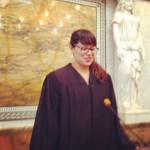

I had a magical experience that changed my life last year. During the government shut down my friends and I were treated to a tour of a working monument to justice in San Francisco. The very special building, which is owned by the taxpayers, was still open for business while the irresponsible part of the federal government was having an irrational fit at the taxpayers’ expense. We each had a chance to put on a robe and pose with the babes of justice, as my friend who works with them calls them. We all felt very special and talked later about being so lucky and having so much fun that day. Sometimes events take on more meaning as time reveals a larger meaning. I was being baptized on that bench and accepting a big mission that I recognize now. We were joking and laughing, really being free and happy, but a vow to liberate others through justice was happening at the same time. Let me explain:
My first teacher of Buddhism was Claude D’Estree, a monk who hangs tight with the Dalai Lama of Tibet. When we were lucky enough to receive teachings from his holiness in September of 1993 Claude flew down from Denver once a month for a year before his arrival to initiate us to Tibetan Buddhist teachings in preparation. We had classes at St Phil’s in the Hills Episcopal Church, and held retreats on that beautiful campus to learn about the three jewels. The subject was new to me, but Claude is an excellent teacher. From the dedication of merit to dependent arising, he covered the material in such a way that very complex concepts became clearer. I will never forget an example he used to explain compassion, using his own personal life experience.
He had worked as a federal prosecutor, who has the obvious job of defending justice and fighting evil. This job exposed him to egregious wrongdoing. As a monk he has the job of using compassion to save the world from pride, delusion, and anger by practicing patience. This seems like a paradox, and it is. He taught us that the most compassionate thing to do for people who are delusional, destructive and angry is to stop them. The trick about doing it as a prosecutor-monk, or monk-prosecuter is to do it without any attachments or aversions, in other words, without anger. Compassion turns anger into patience, an alchemical process that takes much dedication and study to achieve. He had to prosecute very serious criminals in the line of duty. He had also taken the Bodhisattva vow to return to earth until all beings are free and happy. He has undertaken this giant mission to meditate and cultivate diligence for those whose minds are slack and wondering ( a seemingly unending group). Since we all were given the rare opportunity to tread the path of buddhahood Claude was showing us how to meditate and turn our own merit into bliss for others who are suffering. I think of him and his teaching often when my patience is challenged.
The year of study and retreat was a deeply religious experience, but did not require the student to become a proclaimed Buddhist, or join any group or movement. The teachings were given to help us comprehend the even deeper experience of our time with his holiness. We were initiated to Green Tara and introduced to Shantideva. These are deep teachings that can take lifetimes to comprehend, but the Dalai Lama encouraged the women in the class by telling us that we have a better chance of spontaneous or instant enlightenment than the guys. We learned the mantra for Green Tara, who has the specialty of speed. She is the Mother of all Buddhas who saves us from our envy, wrong view and avarice.
For years I have been involved in an anger/patience/justice drama about my home. Now I am going to have to do some serious patience practice while I sue the flaming pants off the city of Tucson for violating federal revenue law and obstructing justice like crazy fire. I am calling on Green Tara to save me from attachment and doubt in order to liberate our neighborhood from evil. I have taken the vows too, and have a responsibility. Green Tara and I are now both babes of justice. Wish me luck as I walk through the valley of the shadow of anger.
I am thrilled to find a new and fabulous source of high quality sustainable food. Much to my surprise my favorite olive oil supplier has expanded and is now offering delicious cheese. Since I enjoy tasting more than stuffing myself this place was completely designed for me. It is about discovery and quality. My partner Bob will certainly love to taste the fancy meats they carry at the new restaurant, while I can indulge myself with exotic cheeses. The store is located close to home, and the Mercado San Augustin is becoming the hottest real estate in the city. I believe the deli/restaurant will be worth a visit, and will thrive in that location next to our finally becoming more hip downtown. Blu is my new favorite place. I have been to fancy cheese stores in Paris, but I like Nancy better than any of the French cheesemongers I have met. She is enthusiastic as well as knowledgeable.
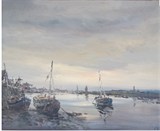
Norfolk, England
My 9th Great Grandfather was probably the earliest Brit settler in Yarmouth, on Cape Cod. He was from Norfolk, England:
On the south side, West Yarmouth became populated with the descendants of the earliest settler Yelverton Crowe(ll). (Crowell remained the most prominent surname in the village well into the 20th century.) Although the Crowells were joined by other families, and married into many of the northside families, the village itself remained small and rural in nature. Homes with large acreage for subsistence farming dotted the county road (now Route 28) which ran from Parker’s River to Hyannis’ Main Street. A fulling mill in the village, established in the late 17th century, was the first known mill in Yarmouth. The Baxters, who operated the mill, also built a gristmill along the shores of Mill Creek in West Yarmouth — a mill which is still in working order and now an historic site owned by the town. Stores, however, were few and tradesmen were fewer. Many villagers transacted business in nearby Hyannis or in Yarmouth Port. Since the village remained rural and undeveloped throughout much of the 18th and 19th century, it presented a blank palette for developers who were to arrive with the turning of the twentieth century.
Yelverton Crowell (1621 – 1683)
is my 9th great grandfather
Elishua Crowell (1643 – 1708)
daughter of Yelverton Crowell
Yelverton Gifford (1676 – 1772)
son of Elishua Crowell
Ann Gifford (1715 – 1795)
daughter of Yelverton Gifford
Frances Congdon (1738 – 1755)
daughter of Ann Gifford
Thomas Sweet (1759 – 1844)
son of Frances Congdon
Valentine Sweet (1791 – 1858)
son of Thomas Sweet
Sarah LaVina Sweet (1840 – 1923)
daughter of Valentine Sweet
Jason A Morse (1862 – 1932)
son of Sarah LaVina Sweet
Ernest Abner Morse (1890 – 1965)
son of Jason A Morse
Richard Arden Morse (1920 – 2004)
son of Ernest Abner Morse
Pamela Morse
I am the daughter of Richard Arden Morse
He fought in King Philip’s War against my Wampanoag ancestors:
According to the book “History of Cape Cod: Annals of Barnstable County, Vol 2 by author Frederick Freeman: Both John Crowell and Yelverton Crowell fought with Distinction in King Phillip’s war at the battle of Mount Hope in the year 1675. John Crowell is listed as having lost one horse.
The son of an older Presbyterian minister and his much younger wife, Sylvester Graham became an orphan early in his life. His mother was committed to an insane asylum and his father died. He was admitted to Amherst, but left without graduating. He met the Reverend William Metcalf, founder of the first vegetarian church in Philadelphia, known as The Bible Christians. He was convinced to try vegetarianism and soon pronounced it to be the remedy for alcoholism. Graham was a crusader for the use of whole grains. He was outraged that beer and distilled spirits were using grains to create alcohol rather than whole grain foods. He was angry with bakers for using what was known as the “bolting cloth” a process that removed the bran from the flour. In 1837 he called physicians vampires in lectures given to his followers in Boston. He denounced the butchers and the bakers of the city, causing a revolt on the part of the aforementioned.
Today we know his name because the graham cracker is part of our American cuisine. The corn flake and other whole grain cereals followed the lead of Graham crackers. He became an ordained Presbyterian minister and an ardent opponent of the consumption of both alcohol and flesh. Since legal prohibition had been repealed in 1933 his views on alcohol were out of step with the times, and certainly nobody wanted to hear him go off on vegetarian diet when it was more unpopular. His hatred for the “bolting cloth” moved him to call it America’s shroud. Now that so many suffer from saccharine disease, his extreme beliefs that the removal of bran may seem prophetic. What is crazy is that the Graham cracker of today contains no whole grain. Unbleached white flour and sugar are the tasty main ingredient in our key lime pie crust, which would have made Sylvester freak out all over the place.
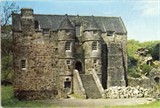
Rowallan Castle
Rowallan Castle is an ancient castle located near Kilmaurs, at NS 4347 4242, about 5 kilometres (3.1 mi) north of Kilmarnock, East Ayrshire, Scotland. The castle stands on the banks of the Carmel Water, which may at one time have run much closer to the low eminence upon which the original castle stood. The castle and barony has been owned or held by the medieval Mure family, the (Boyle) Earls of Glasgow, the (Campbell) Earls of Loudoun, the (Corbett) Barons Rowallan, and by Historic Scotland. It is said that the earliest piece of Lute music was written at Rowallan. It is said to have been visited by the unfortunate King James I of Scotland when on his way from Edinburgh to England. The first Mure holder, Sir J. Gilchrist Mure was buried in the Mure Aisle at Kilmarnock The original castle is thought to date back into the 13th century. Rowallan was said to be the birth place of Elizabeth Mure(Muir), first wife of Robert, the High Steward, later Robert II of Scotland.[6] She was mother to the Duke of Albany, and the Earls of Carrick, Fife and Buchanan. In 1513 the Rowallan Estate took its present day form. In about 1690 the estate was home to the Campbells of Loudoun, who held it into the 19th century
Row Allan, row!
A tale is told of one Allan of Stewarton
who was rowing a Scottish
chief off the Ayrshire coast.
The weather made a turn for
the worse and the chief became
anxious. The chief in his fear of
the ocean said to Allan, Row, Allan row! Bear me to safety and you will have the
rich lands of Carmelside,
wuth silver to build yourself
a castle. Hill and valley and
rivers of fish will be yours …. but just row, Allan, row!
Allan won his prize and named
the estate ‘Rowallan’ after his
adventure. The same story is
told in the form of a poem written
by the Rev. George Paxton from
Kilmaurs, pastor of a Secession Church from 1789 – 1807
…David de More, of the house of Polkelly, Renfrewshire, appears as a witness to a charter of Alexander II. Willielmi de Mora and Laurentii de Mora also occur in two charters granted by Robert the Bruce.The first on record of the family is stated to have been the above-named David de More. His successor is supposed to have been Sir Gilchrist More, the first of the name mentioned in the family ‘Historie.’
In the beginning of the reign of Alexander III., Sir Walter Cumyn took forcible possession of the house and living of Rowallan, “the owner thereof, Gilchrist More, being redacted for his safety to keep close in his castle of Pokellie.”The latter distinguished himself at the battle of Largs in 1263, and for his bravery was knighted. “At which time,” says the ‘Historie,’ “Sir Gilchrist was reponed to his whole inheritance, and gifted with the lands belonging to Sir Walter Cuming before mentioned, a man not of the meanest of that powerful tribe, which for might and number have scarcelie to this day been equaled in this land.”
He married Isobel, daughter and heiress of the said Sir Walter Cumyn, and in the death of his father-in-law, he found himself secured not only in the title and full possession of his old inheritance, but also in the border lands wherein he succeeded to Sir Walter Cuming, within the sheriffdom of Roxburgh. Sir Gilchrist “disponed to his kinsman Ranald More, who had come purposlie from Ireland for his assistance: in the time of his troubles, and also at the battle of Largs, the lands of Polkellie, which appear to have been the original inheritance of the family.
He died “about the year 1280, near the 80 year of his age,” and was buried “with his forfathers in his own buriell place in the Mures Isle at Kilmarnock.”
He had a son, Archibald, and two daughters, Elizabeth, the wife of Sir Godfrey Ross, and Anicia, married to Richard Boyle of Kelburne, ancestor of the earls of Glasgow.In the Ragman Roll, among those barons who swore fealty to Edward I. in 1296, we find the names of Gilchrist More of Craig and Reginald More de Craig, that is, the Craig of Rowallan. The former is stated to have been the ancestor of the Mures of Polkellie, who, Nisbet thinks, were “the stem of the Mures, and an ancienter family than the Rowallan.” The latter was in 1329 chamberlain of Scotland.
William More, the son and successor of Archibald, married a daughter of the house of Craigie, then Lindsay, and with two daughters, had a son, Adam, who succeeded him. Of William honourable mention is made in an indenture of truce with England in the nonage of King David, wherein he is designated Sir William.
He died about the time when King David was taken prisoner at the battle of Durham, fought 17th October 1346. There is supposed to have been an older son than Adam, named Reynold. The editor of the ‘Historie,’ on the authority of Crawford’s Officers of State, (vol. i. p. 290), says in a note: Reynold, son and heir of Sir William More, was one of the hostages left in England at David’s redemption.
This is certainly the same Sir William mentioned above, but whether of Rowallan seems still doubtful; If so, he must have lived long after 1348. There is a William More, Miles, mentioned in M’Farlane’s MS., as living in 1363. Supposing this Sir William More to have been of Rowallan, Reynold probably never returned from England, and thus the estate may have fallen to Sir Adam, a younger son. During the long protracted payment of the king’s ransom, many of the hostages died in confinement.
Sir Adam More, who, “in his father’s auld age,” had the management of all his affairs, both private and public, considerably enlarged and improved the estate. He married, in his younger years, Janet Mure, heiress of Polkellie, granddaughter of Ranald More, and thus restored that estate to the family. By this marriage he had two sons, Sir Adam, his successor, and Andrew, and a daughter, Elizabeth, married in 1348, to Robert, the high steward, afterwards King Robert II.
She was a lady of great beauty and rare virtues, and attracted the high steward’s regard in his younger years when living in concealment about Dundonald castle during Edward Baliol’s usurpation.
There was long considerable doubt as to this marriage, and Buchanan and earlier historians were of opinion that none had ever taken place. The fact of her marriage, however, is now set beyond all question, and the author of the ‘Historie’ says, “Mr. John Learmonth, chaplain to Alexander, archbishop of St. Andrews, hath left upon record, in a deduction of the descent of the house of Rowallan, collected by him at command of the said archbishop, that Robert, great steward of Scotland, having taken away the said Elizabeth, drew to Sir Adam her father ane instrument that he should take her to his lawful wife, which myself have seen, saith the collector, as also ane testimonie, written in Latin by Roger M’Adam, priest of our Ladie Marie’s chapel, (‘Our Lady’s Kirk of Kyle,’ in the parish of Monktown,) that the said Roger married Robert and Elizabeth foresaids.”
The editor of the ‘Historie’ remarks in a note: “Mr. Lewis Innes, principal of the Scots college at Paris, first completely proved the fallacy of Buchanan’s account of King Robert’s marriages, by publishing in 1694, a charter granted by him in 1364, which charter showed that Elizabeth More was the first wife of Robert, and made reference to a dispensation granted by the pope for the marriage. That dispensation was long sought for in vain, but was at length discovered in 1789, at which time a dispensation for the marriage with Euphemia Ross was also found. These discoveries have decided the question. The dispensation for the marriage with Elizabeth More is dated in December, in the sixth year of the pontificate of Clement VI. He was elected pope in 1342; this dispensation must therefore have been granted in December 1347. The dispensation for the marriage with Euphemia Ross is dated in the third year of the pontificate of Innocent VI. He was elected pope in 1352; this dispensation must therefore have been given in 1355.”
Sir Adam, the eldest son, had on his own resignation, a new charger from Robert III., of the barony of Rowallan and whole lands holden of the crown, as also of the barony of Polkellie, &c., with very ample privileg4es, the designation given him by the king being ‘consanguineus.’
He married Joan, daughter of Danielston of that ilk, and by her had three sons. “Caried away,” says the ‘Historie,’ “as appears with emptie surmises and hopes founded on court favors, he made unawares a new rent in his estate and provided his second son, Alexander, to the barronie of Pokellie, together with the lands of Limflare and Lowdonehill, wherein his lady was infeft in liferent, and wer given out by him, now the second time, to the great damage and prejudice of his house and posteritie. However, at that time the court seemed to smile upon him, his proper estate considerable, his friendship strong, and of the greatest of these times. He gave a quartered coat of the arms of Mure and cumin.
The hoarseness and asperitie of the Irish pronunciation of his title and lands is forgot, and Rigallane is now Rowallane, Pothkellath is now Pokellie, &c., and More is now Mure by the court dialect.

Elizabeth Mure
Elizabeth Mure (1320 – 1355)
Elizabeth Mure (died before May 1355) was mistress and then wife of Robert, High Steward of Scotland, and Guardian of Scotland (1338 – 1341 and from October 1346), who later became King Robert II of Scotland.
History
Elizabeth Mure (Muir) was said to be born at Rowallan Castle. Her parents were Sir Adam Mure of Rowallan and Joan Cunningham.
She initially became the Steward’s mistress. He married her in 1336 but the marriage was criticised as uncanonical, so he remarried her in 1349 following a papal dispensation dated at Avignon 22 November 1347.
She died before her husband inherited the crown at the rather advanced age of 54, and he married again (Papal Dispensation dated 2 May 1355), so she was never queen of Scotland.
On 27 March 1371, “–The Lord John (who later took the title of King Robert III, changing his name because of what he saw as John de Baliol’s unpatriotic desecration of the name John), Earl of Carrick and Steward of Scotland, first-born son of King Robert II–” was declared heir to the Crown by Parliament in Scone Abbey.
They had at least ten children – some accounts say thirteen. Doubts about the validity of her marriage led to family disputes over her children’s right to the crown.
* Robert III, born John Stewart, Earl of Carrick
* Walter Stewart, Lord of Fife
* Robert Stewart, Duke of Albany
* Andrew Stewart, Earl of Buchan
* Margaret Stewart, married John of Islay, Lord of the Isles
* Marjorie Stewart, married (1), John Dunbar, 5th Earl of Moray, and (2), Alexander Keith
* Johanna Stewart, married (1), Sir John Keith, (2), Sir John Lyon, and (3) in 1384, Sir James Sandilands.
* Isabella Stewart, married (1), James Douglas, 2nd Earl of Douglas, and (2), David Edmonstone
* Katherine Stewart, married Sir Robert Logan of Grugar and Restalrig, Lord High Admiral of Scotland
* Elizabeth Stewart, married Sir Thomas Hay, Lord High Constable of Scotland

Alexander Stewart

tartan
The Stewart Stewards of Scotland were powerful. Alexander took over as Steward from his father. Although there is some question about the parentage of his wife, there is no doubt about his children:
ALEXANDER Stewart, son of WALTER FitzAlan High Steward of Scotland & his wife — (-1283). The Liber Pluscardensisnames “dominus Alexander Stevart de Dundonald, pronepos primi Walteri Stewart”[1101]. The Visitation of Cambridge 1575 names “Alexander Stuart secundo genitus Gualt, Senescalli Scotie”[1102]. He succeeded his father as High Steward of Scotland. “Alexander filius Walteri Scotie senescallus” donated flour from “firma mea de Inchynnan” to Paisley monastery by charter dated Jan 1286 (presumably misdated)[1103]. The seal of “Alexandri filii Walterii senescalli regis Scotie” is appended to a charter under which “Alexander Stuart” donated lands at Machline and Carentabel to Melrose by charter dated to [1226] (presumably misdated)[1104]. John of Fordun´s Scotichronicon (Continuator) records the death in 1281 of “Alexander senescallus Scotiæ, avus…Walteri generi domini Roberti Bruce regis”[1105].
m JEAN, daughter of —. Balfour Paul names Jean of Bute heiress of the Isles of Bute and Arran, daughter of James Lord of Bute and Arran & his wife —, and records her marriage to Alexander Stewart, but does not cite the corresponding primary source[1106]. Andrew McEwen suggests that there is no evidence to indicate that the wife of Alexander Stewart was the daughter of James Lord of Bute[1107]. He adds that what evidence there is “suggests a double marriage alliance…about 1240 between Sir Walter fitz Alan II and Richard Comyn by which the Steward´s son and heir Alexander married Comyn´s daughter Joanna, while Comyn´s son and heir John married Sir Walter´s daughter Eva”, but he does not cite the nature of the evidence in question[1108].
Alexander Stewart & his wife had [six] children:
1. [JAMES Stewart (-young). The Visitation of Cambridge 1575 names “Jacobus Styward” as eldest son of “Alexander Stuart secundo genitus Gualt, Senescalli Scotie”, adding that he died young[1109].
2. JAMES Stewart ([1243]-16 Jul 1309). The Visitation of Cambridge 1575 names “Johannes Steward” as second son of “Alexander Stuart secundo genitus Gualt, Senescalli Scotie”, adding that he was killed in battle “ad variu´ Sacella”[1110]. He succeeded his father as High Steward of Scotland. He was appointed one of the six guardians of the kingdom on the death of King Alexander III in 1286[1111]. King Edward I confirmed the grant of “castro de Roo” made by “Ricardus de Burgo comes Ultoniæ et dominus Connactensis” to “Jacobo Senescallo Scotiæ et Egidiæ sorori ipsius comitis” by charter dated 10 Oct 1296[1112]. John of Fordun´s Scotichronicon (Continuator) records the death “XVII Kal Aug” in 1309 of “dominus Jacobus senescallus Scotie, pater…Walteri, generi regis Roberti Bruce”[1113]. [m firstly CECILIA de Dunbar, daughter of PATRICK Earl of Dunbar & his wife Cecilia —. Symson records that James Stewart married “Cecilia daughter to Patrick Earl of Dunbar…the first of that family who quitted that title and assumed that of March”, adding that Cecilia was the mother of James´s children. without citing the corresponding primary source[1114]. Andrew McEwen indicates that “no documentary evidence has been found” to support this statement, but adds that “though hardly free from error, Symson´s work is always deserving of respect”, and highlights that “it is highly unlikely that Muriel of Strathearn, whom he married in 1278, was James´s first wife”[1115].] [m secondly (before Jan 1279, [divorced before 1291]) as her second husband, MURIEL of Strathearn, widow of WILLIAM Earl of Mar, daughter of MALISE Earl of Strathearn & his first wife Marjory de Muschamp of Wooler ([1244]-[16 May/12 Nov] 1291). The evidence for this possible second marriage is indicated by an assize roll dated “7 Edw I” [Nov 1278/Nov 1279] which records a claim relating to the barony of Muschamp brought by “Jacobus filius Alexandri et Muriella uxor eius” and “Maria uxor Nicholai de Grame”, both represented by “Stephanum de Muschaump vel Thomam de Hagarston”, against “Thomam de Rok”[1116]. Pleas taken at Newcastle 20 Jan 1279 (N.S.) include a jury finding that “the heirs of Muschampe hold their barony by service of four knights, and making suit to the county of Newcastle”[1117]. Andrew MacEwen indicates that “Muriella…Maria” were the two daughters of Malise Earl of Strathearn by his first wife Marjory de Muschamp, and identifies “Jacobus filius Alexandri”, the husband of Muriel, as James Stewart the future High Steward of Scotland, although he cites no primary source which confirms that the latter identification is correct[1118]. The absence of any reference to Muriel´s husband “James” in the document dated 16 May 1291, which records the homage sworn to King Edward by “Muriellæ quæ fuit uxor Willelmi quondam comitis de Mar, filiæ et heredis Margeriæ filiæ Roberti de Muschaumps defunctæ” for the lands of “Margeria mater sua”[1119], suggests that her second marriage to “James” must have terminated before that date by divorce or annulment.] m [thirdly] EGIDIA de Burgh, daughter of WALTER de Burgh Earl of Ulster & his wife Aveline FitzJohn ([1260/70]-). King Edward I confirmed the grant of “castro de Roo” made by “Ricardus de Burgo comes Ultoniæ et dominus Connactensis” to “Jacobo Senescallo Scotiæ et Egidiæ sorori ipsius comitis” by charter dated 10 Oct 1296[1120]. The Visitation of Cambridge 1575 records that “Johannes Steward”, second son of “Alexander Stuart secundo genitus Gualt, Senescalli Scotie”, married “heredem de Bouthill”[1121]. According to Burke, James Stewart married “Cecilia, daughter of Patrick de Dunbar 7th Earl of Dunbar & March” by whom he fathered Walter Stewart[1122]. James Stewart & his [third] wife had [five] children:
a) ANDREW Stewart ([after 1290]-after 25 Aug 1306). The fact that Andrew was his father´s oldest [surviving] son is confirmed by a notarial confirmation dated 9 Aug 1306 which attested the verity of various documents, including one indicating that William Bishop of St Andrews had delivered “Andrew son and heir of Sir James the Steward of Scotland” to Robert de Brus[1123]. Malise Earl of Strathearn and John de Inchmartyn were ordered to produce “Andrew son of the Steward of Scotland and John son of John Earl of Athol” by charter dated 25 Aug 1306[1124]. These two documents presumably indicate that Andrew was still a minor in 1306, which confirms that he must have been from his father´s marriage to Egidia de Burgh.
b) WALTER Stewart ([1292]-9 Apr [1326/29]). The Liber Pluscardensis names “dominus Alexander Stevart de Dundonald, pronepos primi Walteri Stewart” as “proavus…nobilis Walteri Stevart qui filiam Roberti de Broys desponsavit”[1125]. He succeeded his father as High Steward of Scotland.
c) EGIDIA Stewart . Her parentage and marriage are confirmed by the charter under which “Alexandro de Meyners militi et Egidie Senescalli sponse sue” renounced “totam baroniam de Dorsidere” {Durrisdeir} in favour of her brother James, dated to [1315/21][1126]. m ALEXANDER de Meyners, son of —.
d) [JOHN Stewart (-killed in battle Dundalk 1318). “…Johe Senescallo…” witnessed a charter dated 9 Jul 1316 under which “Thomas Ranulphi comes Morauie et dns Mannie” confirmed a donation to Newbattle abbey[1127]. Andrew McEwen states that “if there was such a son [John], he must have been illegitimate”, but he does not explain his reasoning for this statement[1128].]
e) JAMES Stewart of Durisdeer (-after Nov 1330). “…Domino Malcolmo Flemyng, domino Jacobo senescallo fratre quondam domini Walteri quondam senescalli Scotie, domino Alano Senescallo…” subscribed the charter dated Nov 1330 under which “Malcolmus comes de Levenax” donated “ecclesiam de Kylpatrick” to Paisley monastery[1129].
3. ELIZABETH Stewart . The primary source which confirms her parentage and marriage has not yet been identified. Balfour Paul records her parentage and marriage without citing a precise source[1130]. The marriage is suggested by Barbour´s The Brus which records that “Walter Steward” and “Douglas” were “cosynis in ner degre”[1131]. m as his first wife, Sir WILLIAM Douglas “the Hardy” of that Ilk, son of Sir WILLIAM Douglas of Douglas & his wife — (-London in prison 1298).
4. [ANDREW Stewart (-after 1350). m — Beith, daughter of JAMES Beith & his wife —. The Visitation of Cambridge 1575 records the marriage of “Andreas Stuard iunior filius” (of Alexander Stuart secundo genitus Gualt, Senescalli Scotie) and “filiam Jacobi Bethe”, adding that he was decorated with a military swordbelt by “Johanne Francor´ Rege” and naming “Alexander Styward unicus filius Andree” who was awarded military honours by “Carolus rex Francor” (together with eight generations of Alexander´s alleged descendants in East Anglia)[1132]. The chronology of this entry is extremely shaky and it is unlikely that Andrew was the son of Alexander.]
5. Sir JOHN Stewart of Bonkyl (-killed in battle Falkirk 1298). A charter dated 15 May 1296 records the submission of “Johan le Seneschal frere Mons James Seneschal d Escoce” to Edward I King of England[1133]. m as her first husband, MARGARET Bonkyl, daughter and heiress of Sir ALEXANDER Bonkyl of that Ilk & his wife —. She married secondly as his first wife, David de Brechin. Sir John & his wife had six children:
a) Sir ALEXANDER Stewart of Bonkyl (-1317). m —. The name of Sir Alexander’s wife is not known. Sir Alexander & his wife had one child:
i) JOHN Stewart (-9 Dec 1331). He succeeded his father in 1319 at Bonkyl, co. Berwick. He was created Earl of Angus before 15 Jun 1329, when he is styled as such in a charter[1134].
Alexander 4th High Steward Stewart (1214 – 1298)
Alexander Stewart (c.1214-c.1283) was the hereditary High Steward of Scotland from c.1241 until his death. He was a member of the House of Stewart (later known as Stuart). Alexander was a son of Walter Stewart, 3rd High Steward of Scotland and his wife Bethóc of Angus. Bethóc was daughter of Gille Críst, Earl of Angus.
Alexander Stewart was instrumental in the Battle of Largs on October 2, 1263.
Marriage and Issue
The Stewart married Jean, daughter of James, Lord of Bute. They were parents to at least three children:
James Stewart, 5th High Steward of Scotland (c. 1243 – 1309).
Sir John Stewart, Lord of Bonkyl (before 1269 – 1298). Killed while fighting in the Battle of Falkirk.
Elizabeth Stewart.(d. before 1288) Married Sir William Douglas the Hardy, mother of the Good Sir James Douglas
Through their eldest son James, Alexander and Jean were the great-grandparents of King Robert II, the first Stewart to be King of Scots, and thus an ancestor of all subsequent Scottish monarchs and the later and current monarchs of Great Britain.
Alexander and Jean were also the direct male-line ancestors, through their second son, of Henry Stuart, Lord Darnley.
 mermaidcamp