mermaidcamp
Keeping current in wellness, in and out of the water
You can scroll the shelf using ← and → keys
You can scroll the shelf using ← and → keys
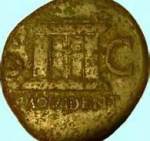
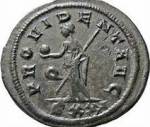
The Roman goddess of forethought, Providentia, represents the ability to use foresight in human affairs. People study trends in markets today with extreme gravity. Currency exchanges, Bitcoin, and all participants in commerce want to know where markets will go in the future. We know nothing in commerce is static; Graphs and charts can advise us about momentum and direction. There is still an element of divine providence in all transactions, acknowledged or not.
Providentia is a philosophical element, a force, a power. A combination of study and meditation is required to make prudent plans for the future. We may not know what will happen, but if we quiet our mind and listen rather than busy ourselves to distraction, we develop awareness that can guide us. Her image has been used on coins to show that the coin itself is a symbolic gesture. Abundance, wealth, and good fortune all depend on the whim of providence. You can plan to engage this energy by:
In order to trust in providence one must be in touch with it. Remember times when you received surprise support and encouragement, or a special financial windfall. The element of surprise can be used to spread your good luck. Look for ways to use your resources to uplift the lives of others.
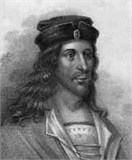
James Stewart
James Stewart (d 1309), high steward of Scotland, was the son of Alexander, high steward, by Jean, daughter and heiress of James, son of Angus Macrory or Roderick, lord of Bute. He succeeded his father in 1283, and the same year was present in the assembly which acknowledged the maid of Norway as heir to the throne. After the death of Alexander III on 9 March 1286, he was on 11 April chose one of the six guardians of the kingdom under Queen Margaret. The same year he signed the band of Robert Bruce and other nobles for mutual defence. In the war which followed between Balliol and Bruce he took part on the side of Bruce. He attended in 1290 the parliament at Brigham at which a marriage was arranged between Prince Edward of England and the Maid of Norway; but her death in Orkney in October of the same year completely altered the political outlook. Being continued one of the guardians of the kingdom after her death, he agreed with the other guardians to submit the rival claimes of the competitors for the Scottish throne to the arbitration of Edward I of England; but he afterwards joined with the party who resolved at all hazards to break with Edward, and his seal as a baron is appended to the ratification of the treaty with France in 1295. On 7 July 1297 he, however, came to terms with Edward, and, having on 9 July confessd his rebellion and placed himself at Edward’s disposal, he became a guarantor for the loyalty of the Earl of Carrick, until he delivered up his daughter Marjory as hostage. The service he had rendered Edward, in inducing many barons to submit, caused Edward to place considerable confidence in his loyalty; but this confidence was soon belied. On the outbreak shortly afterwards of the rebelion under Wallace, he pretended to side with the English, and before the battle of Stirling was, along with the Earl Of Lennox, sent by Surrey, the English commander, to treat with Wallace; but probably his main purpose was rather to supply Wallace with information than induce him to make submission. At any rate the negotiations failed, and as soon as the tide of battle turned in favour of the Scots he joined in the pursuit. Consequently, on 31 Aug 1298, he was deprived of his lands, which were granted by Edward to Alexander De Lindsay. In 1302 he was, with six other commissioners, sent to Paris to endeavour to secure that the interests of Scotland would be respected in the proposed treaty between England and France, but the mission was unsuccessful. On 17 Feb 1303-4 he had a safe-conduct to go to England to treat of peace; and having submitted himself absolutely to the king’s will in November 1305, he on 23 Oct 1306 subscribed an oath of submission and fealty. Nevertheless he was one of the Scots barons who on 16 March 1309 wrote to Philip, king of France, recognising Bruce’s right to the Scottish throne. He died on 16 July 1309, and was buried at Paisley.
Source: Dictionary of National Biography (XVIII:1181-1182).
James 5th high steward Stewart (1243 – 1309)
is my 21st great grandfather
Walter the High Steward Stewart (1293 – 1326)
son of James 5th high steward Stewart
Robert II, King of Scotland, Stewart (1316 – 1390)
son of Walter the High Steward Stewart
Robert Scotland Stewart (1337 – 1406)
son of Robert II, King of Scotland, Stewart
James I Scotland Stewart (1394 – 1434)
son of Robert Scotland Stewart
Joan Stewart (1428 – 1486)
daughter of James I Scotland Stewart
John Gordon (1450 – 1517)
son of Joan Stewart
Robert Lord Gordon (1475 – 1525)
son of John Gordon
Catherine Gordon (1497 – 1537)
daughter of Robert Lord Gordon
Lady Elizabeth Ashton (1524 – 1588)
daughter of Catherine Gordon
Capt Roger Dudley (1535 – 1585)
son of Lady Elizabeth Ashton
Gov Thomas Dudley (1576 – 1653)
son of Capt Roger Dudley
Anne Dudley (1612 – 1672)
daughter of Gov Thomas Dudley
John Bradstreet (1652 – 1718)
son of Anne Dudley
Mercy Bradstreet (1689 – 1725)
daughter of John Bradstreet
Caleb Hazen (1720 – 1777)
son of Mercy Bradstreet
Mercy Hazen (1747 – 1819)
daughter of Caleb Hazen
Martha Mead (1784 – 1860)
daughter of Mercy Hazen
Abner Morse (1808 – 1838)
son of Martha Mead
Daniel Rowland Morse (1838 – 1910)
son of Abner Morse
Jason A Morse (1862 – 1932)
son of Daniel Rowland Morse
Ernest Abner Morse (1890 – 1965)
son of Jason A Morse
Richard Arden Morse (1920 – 2004)
son of Ernest Abner Morse
Pamela Morse
I am the daughter of Richard Arden Morse

headstone
My 12th great-grandfather was born in London and died in the Massachusetts Colony. He arrived under dire circumstances and established himself as a joiner, or furniture maker. He was famous for an act of courage walking 25 miles in the snow to tell Miles Standish his village was in peril of being attacked.
May, 1622 The Sparrow, at Maine from England, sent passengers in a boat to Plymouth, New England.
Fishing vessel, Master Rogers
A boat arrived at the Plymouth Plantation from the Sparrow
(fishing vessel at Maine, hired and sent out by Thomas Weston and
John Beauchamp, salter of London, for their personal profit) with
7 men passengers sent by Weston to work for him in New England.
They remained at Plymouth until the Charity and the Swan
moved them to “Wessagusset” (Weymouth, Massachusetts) where they were
to establish a settlement.
Weston’s settlers, May, 1622 – June 1622
In 1622 Thomas Weston sent a fishing vessel, the Sparrow, to Massachusetts Bay, with a small party of seven men to find the most suitable place for a colony. They were to prepare for the arrival of a large group of single men whom he proposed to send out. Weston was one of the leaders of the London merchant adventurers who sponsored the establishment of Plymouth Colony, but who was now independently setting up his own. The site eventually chosen was at Wessagusset (modern Weymouth, some thirty miles north of Plymouth). The ship anchored at the Damaris Cove Islands off the coast of Maine, and a group of ten, including some crew from the Sparrow, sailed down to Plymouth in a shallop, arriving there on May 31, 1622, just as Massasoit’s men were demanding that Squanto be handed over to them for execution. They brought letters to the Governor from Weston, but no provisions for which the settlement was in desperate need. Phineas Pratt was one of Weston’s settlers, and he and his six companions were given hospitality in Plymouth until the Charity and the Swan arrived with the main party of Weston’s settlers at the end of July or early August 1622.
The two ships, the Charity and the Swan, temporarily added sixty more “lusty men” to the eighty-odd colonists living in Plymouth village. They stayed for the months of July and August. The settlement at Weymouth was a failure, and the men had to be rescued by Capt. Standish and some of his men. Phineas Pratt, on the breakup of the settlement moved to Plymouth, and later married Mary Priest, niece of Isaac Allerton.
Weymouth Settlement Edit
In July 1622, two ships, (Swan and Charitie) arrive at Plymouth with a different group of adventures. They stay a couple of months before moving to establish a nearby at Weymouth (or Wessagusset). This groups is financed by Mr Wesson. They are joined by a 3rd ship (Sparrow). This groups fares badly with the Indians and is forced to abandon their settlement after a rescue by Plymouth militia.
In Sept 1623, the ship Katherine arrives with a group of settlers financed by Sir Ferdinando Gorges. They stop shortly at Plymouth before continuing onwards to the Weymouth Settlment.
One settler from the Sparrow, Phineas Pratt (1590-1680), after the breakup of the first Weymouth settlment, joins the group at Plymouth and marries Mary Priest, a niece of Isaac Allerton (1586-1658).
Phineas Pratt was a member of a company of men sent from England by Thomas Weston. They arrived in New England in 1622 on three ships : the Sparrow, Charity and Swan (Pratt was a passenger on the Sparrow, the first to arrive). The approximately 67 men, many of them ailing, arrived with no provisions. The Pilgrims supported them throughout the summer of 1622.
In the fall of 1622, the Weston men left to colonize an area north of Plymouth called Wessagusset. They soon fell into difficulties through behaving, generally, in a very foolish and improvident fashion. They also severely angered the local Native Americans by stealing their corn.
Massasoit, sachem of the Wampanoags, informed the Plymouth colonists that there was a conspiracy among the Natives of the Wessagusset area to massacre the Weston men. Myles Standish prepared to head north with a small company of Plymouth men to rescue Weston’s men.
The same message was also delivered by one of Weston’s men, who came to Plymouth in March of 1623 “from the Massachusetts with a small pack at his back.”
Phineas Pratt was the man with the backpack. He had secretly snuck out of the Wessagusset settlement, traveling for several days without food through a snowy landscape on his 25-mile journey.
Myles Standish and a small contingent (minus Phineas, who was still recovering from his arduous journey) headed to Wessagusset to recognize Weston’s men. The Plymouth contingent killed several Native Americans in the process (for which, they were roundly scolded by their pastor, John Robinson). Soon afterwards, Weston’s group abandoned Wessagusset. Sometime in late 1623, Phineas joined the Plymouth settlement.
Sometime before May of 1648, when he purchased a house and garden in Charlestown (now a part of Boston), Pratt left Plymouth. In 1662, Pratt presented to the General Court of Massachusetts a narrative entitled “A declaration of the affairs of the English people that first inhabited New England” to support his request for financial assistance. The extraordinary document is Phineas Pratt’s own account of the Wessagusset settlement and its downfall.
Phineas Pratt was by profession a “joiner.” “Joining” was the principle method of furniture construction during the 17th century. “Joiners” were highly skilled craftsmen who specialized in this work; their skills were valued more highly than those of a carpenter.
Phineas Pratt married Mary Priest, daughter of Degory and Sarah Allerton Vincent Priest (the sister of Mayflower passenger Isaac Allerton, Sarah had been married to Jan Vincent and widowed before she married Degory Priest). Degory Priest journeyed to Plymouth on the Mayflower, his wife and two daughters intended to join him later. Priest died during the first winter. Before sailing for America, the widowed Sarah Allerton Vincent Priest married Godbert Godbertson, who became Mary Priest’s stepfather. The family (mother, stepfather and two daughters) were among the passengers of theAnne and Little James, arriving in Plymouth in 1623.
Phineas was probably born about 1593, Mary was probably born about 1612. It seems likely, given the probably age of their oldest child at the time of her death, that they married about 1631 or 1632. Phineas and Mary Pratt had 8 children.
According to his gravestone in the old Phipps Street Cemetery, in the Charlestown area of Boston, “Phinehas Pratt, agd about 90 yrs, decd April ye 19, 1680 & was one of ye first English inhabitants of ye Massachusetts Colony.” (Mayflower Descendant, Vol. 6, p. 1-2).
Mary Pratt outlived her husband; the date of her death is not certain but she did receive stipends from the Town of Charlestown in 1683/4 and 1686/7 (Robert Charles Anderson, The Great Migration Begins, Vol. 3, p. 1516
Phineas PRATT (1590 – 1680)
is my 12th great grandfather
Daniel Pratt (1640 – 1680)
son of Phineas PRATT
Henry Pratt (1658 – 1745)
son of Daniel Pratt
Esther Pratt (1680 – 1740)
daughter of Henry Pratt
Deborah Baynard (1720 – 1791)
daughter of Esther Pratt
Mary Horney (1741 – 1775)
daughter of Deborah Baynard
Esther Harris (1764 – 1838)
daughter of Mary Horney
John H Wright (1803 – 1850)
son of Esther Harris
Mary Wright (1816 – 1873)
daughter of John H Wright
Emiline P Nicholls (1837 – )
daughter of Mary Wright
Harriet Peterson (1856 – 1933)
daughter of Emiline P Nicholls
Sarah Helena Byrne (1878 – 1962)
daughter of Harriet Peterson
Olga Fern Scott (1897 – 1968)
daughter of Sarah Helena Byrne
Richard Arden Morse (1920 – 2004)
son of Olga Fern Scott
Pamela Morse
I am the daughter of Richard Arden Morse
Memories, traditions, and the ghost of Christmas Past visit everyone this time of year. Sometimes it is sad to compare the reality of rushing, spending, gifting, and manic activity with an ideal celebration to honor this time. Nostalgia for earlier times is not helpful in bringing about a better spirit of sharing now. How can we contribute to a brighter, more uplifting celebration?
This message was brought to you by citizens for a Clearer Holiday Purpose.

Seal of Sandwich
My 12th great-grandfather was born in Sandwich, MA, on Cape Cod, in 1623. He served as a constable in Sandwich. There is some confusion about Myles Black/Michael Blackwell records in Sandwich, which seem to indicate they are one in the same man:
Title: MICHAEL BLACKWELL OF SANDWICH, MASS. (c. 1620-1710)
URL: http://members.dencity.com/ccblack/genealogy/micheal.html
Author: LYDIA B. (PHINNEY) BROWNSON, Of Duxbury, Mass. and MACLEAN W. MCLEAN, Of Pittsburgh, Pa
No attempt has been made by the present writers to investigate possible connections between Michael Blackwell and others of the name in England or America. It certainly would be interesting to know whether the Sandwich family was in any way related to the Rulling Elder Francis Blackwell of the Separatist Church whose recantation William Bradford criticized. Actually it is by no means certain that the family name was originally Blackwell. The Sandwich list of men between 16 and 60 able to bear arms in 1643 includes one Myles Black. James Savage in his Genealogical Dictionary of The First Settlers in New England, 1860, vol. 1, p. 191, says “hardly can I doubt that this man called by Savage
“Michael or Myles Blackwell” is he designated in the Col. list of those able to bear arms 1643, as Miles Black” (THE REGISTER, vol. 4, p. 257,
July 1850). This Question puzzled also Thomas Spooner, the compiler of the Memorial of William Spooner, 1871, who corresponded with the Rev. Frederick Freeman author of The History of Cape Cod, 1858. Spooner quotes Freeman as saying: “The Blackwells of Sandwich were generally called Black. Even since my remembrance the latter name was used for those who wrote the name Blackwell and in some early instances of recorthe same Liberty was taken. The progenitor himself is in one instance at least on record as Black” (p: 60:61 footnotes.It seems to us that the evidence, while not conclusive, strongly suggesthat Miles Black and Michael Blackwell were one and the same person. The reader may speculate for himself from the data available. Conclusive proof of identity doubtless would have been found in the Barnstable County land records, but these were destroyed in the 1827 fire. Fortunately Michael Blackwell and his son, and grandsons left wills and probate records which are unusually complete. The earliest reference we find has to do with Miles Blacke who was a creditor in the amount of 7 shillings due from the estate of William Swift, Sr., 29 Jan. 1642 (Plymouth Colony Probate, Liber 1, p. 44, in May. Des., 8:170, December 1900). This first reference, by the way, poses a second problem of confusion of identities, namely.the fact that there was in New England early date a gentleman of some wealth and influence called “Mr. John Blackwell.” This complication will be discussed under the account of John Blackwell. For the moment it is enough to point out the really extraordinary co-incidence that the Swift estate should have been indebted to both Miles Black of Sandwich and to “Mr. Blackwell,” since so far as we can find the latter was of Boston and co. Middlesex, England, and had no interest in Sandwich.In 1643 Miles Black’s name appears on the list of Sandwich men aged between 16 and 60, able to bear arms (The Register, Op. Cit.), but
Michael Blackwell’s name does not appear. Yet 7 June 1648 “Mycaell Blackwell” served on the grand inquest; and the following October “Micaell Blackwell” served as grand juror in the infanticide case of
Alice Bishop (Nathaniel B. Shurtleff, ed., Records of the Colony of New Plymouth . . . , 2:134, cf. p. 124, where his name appears as Mycaell Blackwell). An agreement was made 17 Jan. 1652 by the town of Sandwich “with Daniel Wing & Michael Blackwell for the taking of fish in Herring River” (Frederick Freeman, “Annals of Sandwich” in his History of Cape Cod, 1858, 2:50).
Note:
“Myles Blacke” was appointed, 3 June 1656, constable of Sandwich (Shurtleff, op. cit., 3: 100). On the 1658 list of Sandwich land holders the name of Michaell Blackwell appears, but not that of Miles Black
(Freeman, op. cit., 2:59). Yet it would seem unlikely that the town’s constable was not a land owner. It is interesting to note here that this Miles Black or Blackwell held the post of Constable in Sandwich
immediately preceding the inauguration in 1657 of what Amos Otis called “a system of terrorism” there, under the enthusiastic leadership of the notorious Sandwich Marshall George Barlow, to whom the Colony Court gave “full power to act as constable in all things in the town of Sandwich” (C.- F. Swift, Genealogical Notes of Barnstable Families, 1888, p. 258-259). No reference is made anywhere that we have seen which would indicate that Black or Blackwell was involved in persecution of the Quakers in this period, though the Blackwell family seems to have been active members of the Sandwich Congregational Church, and not to have had family connections with the Quaker element.
Note:
On 13 June 1660 “A parcell of meadow was granted to Myles BIacke att Mannomett.” And in the following March he and Thomas Burges, Sr., were brought to court for fraudulently obtaining meadow land there (Shurtlefop. cit., 3:194, 208). These entries are perhaps significant in view of the fact that Michael Blackwell’s will refers to land adjoyning Jacob Burges, principal heir to Thomas Burges, Sr.
Note:
We come now to two entries which refer to “Myles Blackwell.” The first shows that “Myles Blackwell” served on the Grand jury 4 Oct. 1664 (Shurtleff, op. cit., 7: 1 19). The second shows that Myls Blackwell was chosen surveyor of highways in Sandwich 3 June 1668. Oddly enough the same source shows that Miacaell Blackwell served on the Grand Jury 5 Ju 1667 (ibid., 4:148, 181). Micacll Blackwell served 5 June 1671 on a committee “to view damage done to the Indians by the horses and hoggs of the English” (ibid.-, 5:62).
Note:
In 1672 “Mr. Edmund Freeman Senr., William Swift, Thomas Wing Senr., Thomas Dexter Senr., Michaell Blackwell & William Newland were constituted a committee to go forward in settling & confirming the bounof the township with the Sachem of Mannomet . . .” (Freeman, op. cit., 2:67). Joseph Burges petitioned the Court, 5 June 1673, regarding “a way that goes through lands of Myles Blackwell … att Sandwich” (Shurtleff, op. cit., 5:116). The list of “all those who have just rights to the priviledges of the Town” in 1675 shows Michaell Blackwell and his son John Blackwell, and does -not show a Miles Black (Freeman, op. cit., 2:68) In 1680 Michaell Blackwell served once more on the Grand Inquest
and in 1672 he took the inventory of the estate of Edmund Freeman. His will shows that he deeded land in 1705 to his son Joshua and it is to be inferred that he had done the same for his elder son.
Note:
His will is of considerable genealogical value. Firstly, it proves that Michael Blackwell’s wife had predeceased him. It seems strange that there is not the slightest reference to the wife of either Miles Black or Michael Blackwell. Secondly, the testator in his intense desire to be the founder of a dynasty patterned upon the model of the landed gentold England gives proof of one or two relationships which otherwise would
have remained obscure, as will be seen. The Sandwich vital records in the town hall are copies of the originals. The entry of Michael Blackwell’s death reads 6 January, the date of the year having been torn away, but the careful copy made by the late George E. Bowman of the Massachusetts Society of Mayflower Descendants notes that 1710 was added – in pencil, and as we now see, this notation is correct (May. Des., 29: 22 footnote, January 1931). With the exception of the son Michael, no dates of the births or baptisms of Michael Blackwell’s children have been found. The order of birth of the sons is clear from the father’s will, although the daughter Jane (whose husband was born in 1644) may have be older than Michael.
Michael Blackwell (1623 – 1709)
is my 12th great grandfather
John Blackwell (1645 – 1688)
son of Michael Blackwell
Elizabeth Blackwell (1662 – 1691)
daughter of John Blackwell
Thomas Baynard (1678 – 1732)
son of Elizabeth Blackwell
Deborah Baynard (1720 – 1791)
daughter of Thomas Baynard
Mary Horney (1741 – 1775)
daughter of Deborah Baynard
Esther Harris (1764 – 1838)
daughter of Mary Horney
John H Wright (1803 – 1850)
son of Esther Harris
Mary Wright (1816 – 1873)
daughter of John H Wright
Emiline P Nicholls (1837 – )
daughter of Mary Wright
Harriet Peterson (1856 – 1933)
daughter of Emiline P Nicholls
Sarah Helena Byrne (1878 – 1962)
daughter of Harriet Peterson
Olga Fern Scott (1897 – 1968)
daughter of Sarah Helena Byrne
Richard Arden Morse (1920 – 2004)
son of Olga Fern Scott
Pamela Morse
I am the daughter of Richard Arden Morse
When he died he owned quite a bit of land around Sandwich:
Michael Blackwell’s will, dated 29 Nov 1709 of “Michael Blackwell of Sandwich” gives “… unto my grand son John Blackwell, the eldest son of my son John Blackwell, deceased, all those lands, marsh and meadow ground . . . in the town of Sandwich, lying on the Northeasterly side of Skussett River . . . on part of which upland ye dwelling house of my sd. Grand son now standeth . . . adjoyning in part upon the messuage in ye tenour or occupation of Jacob Burges . . . as well as one parcell of meadow lying adjoyning Jireh Swift . . . and by the land of Irish Swift . . . on condition that my said grand son John Blackwell dye leaveing a male heire surviving, lawfully begotton of his own bodie. And that he do also pay unto Caleb Blackwell his naturall brother, the sum of 5 pounds . . . And if it shall so happen” (that said John dies without a male heir, then the testator directs the youngest brother Nathaniel, shall inherit). The will then provides that if John Blackwell survives his brothers, Caleb and Nathaniel, and finally die without male issue, the then male children of my son Joshua Blackwell shall inherit all. “Item: . . . unton my grand son Benjamin Gibbs, on half part of all upland at Waynonsett . . . lands in Sandwich adjoying land formerly belonging to John Gibbs and other lands in Sandwich and lands I formerly bought of Robert Bartlett in Plymouth township. Item: . . . unto my grand son Samuel Blackwell, son on my son Joshua Blackwell, the other half of my lands before given to Benjamin Gibbs. Item: . . . unto my daughter Jane Gibbs, that nine pounds which her husband formerly borrowed and me and which he yet oweth to me. Item: . . . unto the three sons and six daughters of my son Joshua Blackwell or to so many of them as shall survive mee, all that shall remain of my personal estate . . . to be equally divided between them. Item: . . . to my said son Joshua Blackwell the other half of my land that I bought of Robert Bartlett . . . and I do confirm unto him and unto his son Michael Blackwell all those lands, swamp & meadow ground to which I have given by deed of gift, dated 3 Aug 1705, only that he pay to my grandson Nathaniel Blackwell 10 pounds & to each of the sisters of ye said Nathaniel Blackwell, being the daughters of my said son John Blackwell, deceased, the sum of 40s in current passable pay within one year after my decease.”
Michael’s son Joshua Blackwell was named sole executor. The will was signed by a mark and was witnessed by William Bassett, Sr., William Bassett, Jr., and Nathan Bassett. The witnesses were sworn 26 Jan and administration ordered 29 Jan. 1709/10. The date of Michael Blackwell’s death is 6 Jan 1710.
~New England Historic and Genelogical Register, July, 1963, pages 180-183

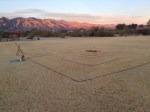



The practice of drawing and walking labyrinths is ancient and has been found all over the world. Today there is an interest in this form of meditation, and full moon is a perfect time to commemorate a moment in time by walking one. In Tucson there is a group hosting a full moon labyrinth walk each month and just recently they decided to become mobile. Rather than center the walks at a Unitarian Church with a lovely permanent labyrinth the design is now drawn on the ground for a temporary portal. Last night was the last full moon of the year, just a few days before the winter solstice. The labyrinth was constructed of ropes on the lawn, a shiny center with LED lights, and rattles for those who wanted to borrow them.
The weather was mild so we enjoyed the meditation and stayed to share cookies one of the ladies brought. Everyone expressed a feeling a full presence and appreciation. I have normally liked to go on these alone, but the drumming and the shared reverence, not to mention to rainbow around the full moon as we said good night, gave a depth to the moment that was very special. People of all ages, shapes, sizes, and cultures came to participate and commemorate the season. It was perfect.
The artist reaches just beyond the normal senses to bring creation into being. There is strong motivation and emotion driving the artist to produce. The medium is not as important as full artistic expression. Some of us are not making any money from art, but still live our lives involved with creating. Cooking, gardening, and all normal day to day tasks can be done in artful ways. Art truly is in the eye of the beholder; A strong desire to design and deliver creativity to the world is all that is needed to be an artist.
Making a living at art is risky, and yet rewarding. The starving artist and the crazed genius artist are examples of the shadow aspect of this archetype. I used to make my living as a potter. I worked at a school mixing glazes and firing the kiln. I was paid in clay, glazes and firing; I had to turn that into money by selling my work. I was very good at being a starving artist and never starved at all. I remember that time as an extremely abundant phase, full of friends, travel, and unlimited creative freedom. Clay is a fast medium initially. Throwing a pot on a wheel is pure zen. It must be centered and formed quickly so the clay body does not get too wet and collapse. The pot must be dried slowly to avoid cracking. The glaze firing is an alchemical process that has slightly different results each time it is done. From the first time you touch the clay you know that some of your pots will not make it. If you are lucky the problem occurs when the clay has not been fired, so you can just turn it into wet clay and try it again. I used to take finished pots I thought were too ugly to sell out to the desert and shoot them with a 22 pistol to destroy the evidence. I used to joke that anthropologists in the future will wonder what kind of civilization felt the need to shoot pottery. I am glad I still have a few pieces I made that have survived, and equally glad I shot the ugly ones.
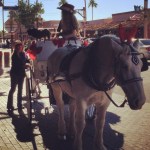
There is an arch rivalry between the cities of Phoenix and Tucson. We Tucsonans know that people outside the state have no way to distinguish the two and often confuse them. Politics aside (which would be impossible for Arizonans), there are extreme differences in the tourism and hospitality styles of these two towns. Tourists are attracted to the golf tournaments in both Maricopa and Pima Counties. Baseball spring training has all moved up there, and brings in millions. Bowl games and the Phoenix Suns brighten the economic situation for them too. The typical Tucson tourist is much less interested in shopping and is more likely to be spending time involved in outdoor sports of all kinds. Scottsdale is not afraid to step up and cover that niche offering the shopper from back east a wester phantasy phree phun time. Phree parking in old town allows these people to leave the car and ride around in a horse-drawn wagon for an exorbitant price. Everyone is excited to be way out west. The city of Scottsdale hires the trusty horse Dusty and Gary J Sprague, the singing cowboy, to serenade the crowd 1-4 on Saturdays. They are a huge hit.
I am inspired to drive to the Valley of the Sun for the phabulous phood scene. The AZ Slow Food newsletter informed me recently about the existence of a special highly rare date variety growing only in Scottsdale known as the Black Sphinx. The market was established in 1951 selling a date that developed there from seed and was distinct from all others. The extremely thin skin makes it a poor candidate (pun intended) for shipping. The fresh dates require refrigeration and are extremely delicate. After shopping the Scottsdale Pharmer’s market where I scored amazing produce and preserved items, we visited the date store, which features Arizona products of high gourmet quality. Bob bought beers brewed in Arizona, one of which was a stout that contained the dates from the Sphinx Pharm. We both agree the Black Sphinx is the best date we have ever tasted, and before Bob ate it he told me he does not like dates…a convert. We also tried a very good date cookie and some chocolate covered Medjools that are scrumptious. We came home loaded with gourmet groceries and exotic citrus. We have to admit we had phun.







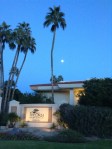
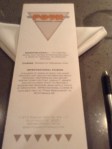









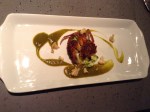







Our first meal at Posh in Scottsdale was so memorable we have wanted to return for more. The first two weeks of December are low season in tourism the world around, so we made the trip our holiday party. The menu lists assorted groceries on hand, and the guest indicates any type of meat not desired in the meal. I am a vegetarian, which is all they need to know about me. The chef then creates culinary improvisation around the guest’s wishes.
We like to sit up at the bar because we talk to the chefs and watch while they are cooking the food. The night started with fresh potato chips with seaweed and drinks. Each plate was packed with flavor and art. All the presentations are appealing and imaginative. Bob enjoyed the exotic boar bacon and perfectly cooked scollops. The ginger wasabi slaw on top of ramen noodle cakes were a highlight, but all of mine were enjoyable and unusual. We know when we come to enjoy our dinner at Posh we will be given a sensual treat and be served with impeccable professionalism. It remains on a very high pedestal in my mind. The experience is superior to regular menu/dining in many ways. I have tried combinations I would not have ordered, but discovered I like. It is more of an adventure than just a meal. You can choose as many courses as you care to taste, add extras, and wine pairings a la carte. When you go home they give you a tiny take home sweet to remind you of what a jewel of a restaurant it is.

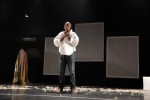
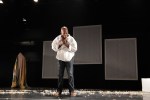
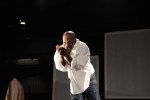

I met Elisio Pitta 20 years ago when he visited Rancho la Puerta to teach and do a capoeira demonstration. I had never seen capoeira before and was fascinated by the grace and power of the movements. He taught us some Brazilian folkloric dance also. We were all beginners, but he managed to get us all moving and enthusiastic in the few days he was our teacher. I have had the opportunity to learn from excellent teachers, but his talent to both teach and move was beyond compare. I never really attempted to learn the form, but I never forgot it either.
His career in dance has taken him around the world from his hometown, Bahia. He lives on a hill with a fantastic view of the Atlantic and has very deep cultural roots in the city. He has been performing a new dance of his own creation there this week, and soon will take the show on the road. Next month he will perform Othello in Shakespeare’s own country, in Liverpool England. Using Brazilian music and original choreography by Elisio he interprets the classic story of jealousy and regret. He dances the part of Othello and projects the other characters onto the stage in preproduced segments to tell the story of Desdemona’s ill fated murder and his subsequent remorse. He is using contemporary props and costuming in the production to go with his digital cast members. I asked him why he decided to be Othello and he told me that it is the Year of Shakespeare and he always wanted to do it. Classy.
I admire his extreme creativity and dedication to the art of dance. His natural talent is obvious, but he has used his talents and his strong cultural lineage to transcend boundaries. I think Shakespeare is proud of him. I am pleased to know such a talented and artistically ambitious man.
 mermaidcamp