mermaidcamp
Keeping current in wellness, in and out of the water
You can scroll the shelf using ← and → keys
You can scroll the shelf using ← and → keys
The Latin phrase a posteriori refers to the process of inductive reasoning. It means “from what comes after” or a proposition based on experience. A close relative, also used in philosophical arguments, is a priori, which is knowledge based on previous understanding of the concept. It means literally from what comes before. A priori can be a mathematical equation, or any other agreed upon fact deriving from the agreement. It would be correct to call the statement “It is cloudy outside.” a posteriori because I looked outside and can see the fact that it is cloudy now. The statement, “Cumulous clouds are the harbinger of rain.” is an assumption based on scientific agreement, and therefore is a priori. We agree on the definition of cumulous clouds without the need to experience them directly. “That bow is red” is another a priori belief. We all have agreed on what red is (except the colorblind).
A posteriori is based on empirical evidence, direct contact with the facts. A priori is based on logic previously accepted as sound. On the surface it might seem that a posteriori is the only valid way to defend a position. I have learned from my studies of ancestry and history that both methods can fail miserably. My grandmother thought she knew her birth year, but there was no certificate. Later in life she forgot, and then nobody really knew, or bothered to look it up because it did not matter. She had no way to remember her own birth, so her a priori birthday was a year off the real date. Many “facts” in records from the past have been recorded incorrectly. Census records that list step mothers as natural parents, step children as children, and other errors can throw a wrench in the works for investigators trying to follow a lineage.
Be careful, gentle reader. Logic and truth are tricky subjects. Check your logic, and double-check your data before you make any big conclusions. Caveat emptor.

red
My 9th great-grandfather was a baker who arrived in Connecticut in 1638. He was an original settler in that colony. He landed in Massachusetts then moved to New Haven. He signed the New Haven Plantation Covenant on June 4, 1639.
“The Story of the Early Settlers of Stamford, Connecticut, 1641 – 1700” by Jeanne Majdalany (including genealogies comp. with Edith M. Wicks), page 152: “Peter Brown was born 1610, died 1658, married 1 Elizabeth Smith(d1657); m2 1658 Unice/Unica Buxton…Peter Brown was of Concord, MA in 1632 and of New Haven in 1639 where he was a baker. In 1647 he was in Stamford. He probably was a brother of Francis. He lived on the west side of “River Street”.

Brown Coat of Arms
Peter Brown (1610 – 1658)
9th great-grandfather
Deliverance Brown (1656 – 1727)
son of Peter Brown
Rachel Brown (1700 – 1716)
daughter of Deliverance Brown
Mary Mead (1724 – 1787)
daughter of Rachel Brown
Abner Mead (1749 – 1810)
son of Mary Mead
Martha Mead (1784 – 1860)
daughter of Abner Mead
Abner Morse (1808 – 1838)
son of Martha Mead
Daniel Rowland Morse (1838 – 1910)
son of Abner Morse
Jason A Morse (1862 – 1932)
son of Daniel Rowland Morse
Ernest Abner Morse (1890 – 1965)
son of Jason A Morse
Richard Arden Morse (1920 – 2004)
son of Ernest Abner Morse
Pamela Morse
You are the daughter of Richard Arden Morse
Peter Brown was one of the Governor Theophilus Eaton and Rev. John Davenport Company, that made a settlement at New Haven in the spring of 1638. This company was partly from the City of London, where Rev. John Davenport had been a celebrated minister, and partly from the counties of York, Hertford, Kent, Surry and Sussex, and sailed from London, England, in the ship Hector, which arrived at Boston on the twenty-sixth day of June, 1637. Peter Brown signed the compact appertaining to the government of the New Haven Colony, in 1639. He sold out in 1647, and removed to Stamford, Connecticut, where his wife, Elizabeth, died Sept. 21, 1657, and his son, Ebenezer, Aug. 19, 1658. He married again at Stamford, May 25, 1658, Unity, widow of Clement Buxton, and died there Aug. 22, 1658. His widow afterwards married, March 9, 1659, Nicholas Knapp.
From the book One Life at a Time: A New World Narrative by R. Thomas Collins, Joseph Wood
Peter Brown was born 1610 in Hastings, England. A baker, Peter was a member of the immigrant company organized by London merchant Theophilus Eaton and the Puritan divine, Rev. John Davenport. Peter Brown was one of the signatories of the New Haven Plantation Covenant on June 4, 1639.
Peter Brown was one of the many townsmen to seek opportunity elsewhere after the failure of the Great Shippe. In 1647, Peter moved to Stamford. Peter, who died in 1648, and his first wife had at least one son, Hackaliah (#51). Peter’s second wife, Unity, widowed, later married Nicholas Knapp (#2) in Stamford.

Bellvue

Parade Platz
The sophisticated and cosmopolitan city of Zurich was the scene of a terrorist shooting at a mosque yesterday. I always admire Swiss tolerance, but know that recently they have been concerned about the immigration problems plaguing all of Europe. Zurich is my favorite city on earth, and Switzerland my favorite country. The form of government just thrills me because they leave decision making and almost all the taxes in the hands of local cantons. The arrangement is called a confederation. It was formed for the sole purpose of self defense back in feudal times. They speak 4 official languages, and typically don’t bother to learn the other three that are not their mother tongue. The exception to this rule is Romansh, a language that much resembles Latin, spoken by a few Alpine hillbillies. The Romansh speakers have to learn Swiss German to communicate with the outside world. I heard Romansh a lot when I first went to Gruadbunden in 1985. I found it easier than German because I studied Latin. It is now slipping into history, but a few pockets of speakers still use it, mostly in isolated villages. Localism is the theme and the heart of governance for the Swiss. They may have been thrust just a little too quickly into their own version of globalism.
I had some visitors last winter who teach school in Zurich. They teach German language, and speech pathology respectively. We talked about the changing attitudes toward foreign workers inside the country. The tensions they described did not exist when I spent time there. They took as many refugees as they possibly could and put them all to work. They created special businesses just to give them jobs. They are trained in language and job skills. Now the system has been strained to the maximum, and the population is changing. The strength of their currency and economy continues to be a magnet for immigrants from everywhere. My friends reported a large number of kids in school who don’t speak the language and become disruptive. They never had this kind of thing in classrooms in the past. It is a sign of some kind of breakdown.
The city of Zurich is the economic, but not the political, capitol. The nickname of the city is Downtown Switzerland because of the undeniable sophistication it has. These terror incidents can happen anywhere now, but I am shocked and dismayed to learn that a mosque was attacked near the main train station. It makes me very sad to know that even the Swiss are now living with this threat.

choose cash
Many have commented on the year 2016 with great remorse and sorrow. We lost many great lives and some people also lost elections. The situation on the ground is restless and tense. Many are organizing protests and boycotts to show their disdain. Somewhere in excess of 41% of American registered voters did not vote in the presidential election. It is equally tragic to not have the right to vote as it is to not bother to use the right to vote. Our issues are bigger than the trivial excuses given for the status quo. We are on the verge of some political and economic changes of great proportion, in my opinion.
The phrase beggars can’t be choosers works for me in our political atmosphere because so many refused to make any choice. I hear a lot of loose talk about civil rights, freedom, and the run of the mill American token slogans about what we the people deserve or need to demand. If we could demand that our fellow citizens participate in our democracy we would be wise. Without participation, without any involvement with the political process the citizenry forfeits any right to equal treatment under the law. Protesting makes some kind of statement, but will not address the ignorance and lack of trust running rampant.
I believe that to improve the lives of Americans across the country we need to involve everyone. Choosers are not beggars, but since we passed up that option we will go around with begging bowls for years. We beg to fill the political party coffers once more to begin this process of electing our leaders. I don’t think this is a positive way to remedy our problems. If we involve and engage with our community right where we live and act with discernment and ethical will we can make positive change. End this begging, whining, complaining, and ragging on “the other side”. Go to work learning what you can to be able to make a real choice. Make choosing a priority to replace judging. Make smart decisions about the food you eat, the entertainment you consume, the content you read, and the contacts with whom you associate. Decide to pay with cash rather than build up interest debt. Free yourself from that burden so many carry. Choose wisely, choose constantly, and choose with care. Exercise your right to choose with discernment, and refine that ability.

choose wisely

hair flip
If we were having coffee today I would tell you how I ended up teaching a holiday session of mermaid camp for a lovely young lady. Some of you have noticed that my blog is officially named mermaidcamp, and may have wondered why. Sit down by the wood stove and put your feet up on the ottoman while I serve you a hot cup of tea, coffee, or holiday cheer. Tell me about your week while I prepare for my young student’s arrival later this morning.
Last week at a holiday gathering a friend told me she thought about buying her 9 year old daughter a mermaid tail for Christmas. I told her that being a mermaid is about so much more than just a tail, and since the child is not a strong swimmer yet it may prove dangerous. I have seen people buy expensive costume tails for kids without thought to how strong one must be to swim dolphin kick. It is no joke. First one needs to be able to handle flippers, then flippers with feet and legs close together. These steps take time and practice. Very few adults swim the butterfly stroke well because it requires strength and coordination. I tried to convince her mom to outfit her with a merskirt..a tail free costume that clearly indicated life under the sea. She is an excellent seamstress and costumer who can craft a really custom look for her daughter. I was able to gift her a big load of sequin fabric for the mer skirt project in return for an agreement to skip the tail this year. The tail is awkward and hard to construct, but a merskirt is whatever you make it. Real serious professional mermaids, such as Cate Vail of Sirens Photography in Reno, respect the merskirt. The mermaids up there are sometimes connected to Burning Man, so they take costuming very seriously. I was lucky to be invited to a fundraising fiesta in Reno where I met many very cool mermaid personas. The real key is never cut your hair.


If we were having coffee I would tell you how one thing lead to another and before long I had decided to take on the task of essential education a mermaid needs before owning a tail. This morning my little pupil will be at my house while her mom sews her merskirt back at her house. We will be preparing lunch with a mermaid theme, doing some art work, and chalking her hair. We have Treasure Island by Robert Louis Stevenson cued up on Alexa so she can read to us while we work. We will learn all the words to “Under the Sea” by Sebastian the Crab for Karaoke performances later in the day. When the parents come back in the afternoon we will wow them with our deep knowledge of Neptune and his realm, and some mermaid themed appetizers. I am pretty sure this will be more fun than a barrel of monkeys. Stick around if you want me to chalk your hair. I am hoping this will lead to a sincere desire to be in the Tucson Parks and Recreation synchronized swimming program next summer. The program is excellent, and I believe she would have a great time. First things first…costuming and initiation, then some serious practice on the swimming skills. That is how we make mermaids, one child at a time.
Thanks for visiting me today in Tucson. Drop by Diana’s blog to read, write, or shuffle through this week’s offerings. We thank Diana for keeping the good times rolling every weekend.

There are many more gastronomically interesting options available at Christmas time, but I’m still always drawn to the reassuringly traditional sage and onion stuffing. Nowadays, in addition to stuffing poultry, sage is most commonly used to flavour other meat dishes (particularly sausages in British cuisine). However, its scientific name, Salvia officinalis, shows its heritage as a […]
via #AdventBotany – Getting stuffed at Christmas: Sage — Herbology Manchester

homicide

heart disease
I just found a site with an interactive map of statistics about life expectancy in the United States. I am delighted to see that Arizona is light to moderate in the heart disease category, but this map looks bleak under homicide. Pima County’s rate is lower than some. Apache County is the worst place for death by homicide in Arizona, followed by Navajo County. At a glance the national map for homicide is telling. The highest rates stretch across the southern states, with interesting pockets in west Texas of low probability. I think that is because nobody lives there.
I wonder how this will change over time. My guess is that it will only intensify in the way it appears now. Arizona is in terrible shape under death by liver disease, and I can guess that is all about alcohol. I tend to think of health in personal terms, but when I see these figures I see we are in a public health crisis of epic proportions. I urge you to look up your county and state to see what is happening. I am surprised, and I believe you will be too, gentle reader. How can we work to improve these statistics? This is a bigger question than health insurance and drug companies bring to our attention.

There are many “worst” Christmas songs. Esquire says it’s “Wonderful Christmas Time” by Paul McCartney and Wings, a “song whose awesome black hole of musicality is almost powerful enough to suck the life out of everything McCartney did before,” while Paste and the Daily Dot counter with “Grandma Got Run Over By a Reindeer,” which,…
via Stephen Colbert And Norah Jones Have Written The Worst Christmas Song Ever — Real Stories – UPROXX

Veridis Duchess Austria Visconti
My 17th great-grandmother was born into a noble family in trouble with the papacy. Veridis ( sometimes spelled Viridis) was born in Milan in 1352. Her father was excommunicated 1363 for opposing the Pope in Rome. She is buried at the Cistercian monastery in Sittich ,Obcina, Ljubljana, in modern and Slovenia. Her husband, the duke, died in Lucerne Switzerland, leaving her a widow at the age of 34.

Veridis Duchess Austria Visconti
Veridis Duchess Austria Visconti (1352 – 1414)
17th great-grandmother
Ernst I “Ironside” Archduke of Austria Habsburg (1377 – 1424)
son of Veridis Duchess Austria Visconti
Katharina Archduchess Austria Von Habsburg (1420 – 1493)
daughter of Ernst I “Ironside” Archduke of Austria Habsburg
Christof I VanBaden (1453 – 1527)
son of Katharina Archduchess Austria Von Habsburg
Beatrix Zahringen (1492 – 1535)
daughter of Christof I VanBaden
Sabine Grafin VonSimmern (1528 – 1578)
daughter of Beatrix Zahringen
Marie L Egmond (1564 – 1678)
daughter of Sabine Grafin VonSimmern
Richard Sears (1590 – 1676)
son of Marie L Egmond
Silas Sears (1638 – 1697)
son of Richard Sears
Silas Sears (1661 – 1732)
son of Silas Sears
Sarah Sears (1697 – 1785)
daughter of Silas Sears
Sarah Hamblin (1721 – 1814)
daughter of Sarah Sears
Mercy Hazen (1747 – 1819)
daughter of Sarah Hamblin
Martha Mead (1784 – 1860)
daughter of Mercy Hazen
Abner Morse (1808 – 1838)
son of Martha Mead
Daniel Rowland Morse (1838 – 1910)
son of Abner Morse
Jason A Morse (1862 – 1932)
son of Daniel Rowland Morse
Ernest Abner Morse (1890 – 1965)
son of Jason A Morse
Richard Arden Morse (1920 – 2004)
son of Ernest Abner Morse
Pamela Morse
You are the daughter of Richard Arden Morse
Viridis Visconti (1352–1414) was an Italian noblewoman, a daughter of Bernabò Visconti and his wife Beatrice Regina della Scala. By her marriage to Leopold III, Duke of Austria, Viridis was Duchess consort of Austria, Styria and Carinthia, she was also Countess consort of Tyrol.
Viridis was born in Milan, Italy and was the second of seventeen children.
Her sister, Taddea Visconti married Stephen III, Duke of Bavaria and was mother of Isabeau of Bavaria, wife of Charles VI of France. Viridis and the rest of her sisters secured politically-advantageous marriages.
Her maternal grandparents were Mastino II della Scala and his wife Taddea da Carrara. Her paternal grandparents were Stefano Visconti and his wife Valentina Doria.
Viridis’ father, Bernabò was described as a cruel and ruthless despot. He was also an implacable enemy of the Church. He seized the papal city of Bologna, rejected the Pope and his authority, confiscated ecclesiastical property, and forbade any of his subjects to have any dealings with the Curia. He was excommunicated as a heretic in 1363 by Pope Urban V, who preached crusade against him. When Bernabò was in one of his frequent rages, only the children’s mother, Beatrice Regina was able to approach him.
Viridis married Leopold III, Duke of Austria, son of Albert II, Duke of Austria and his wife Johanna of Pfirt. The couple had six children:
William
Leopold
Ernest the Iron
Frederick
Elisabeth (1378–1392)
Katharina (1385–?) Abbess of St. Klara in Vienna
Viridis was widowed in 1386 and so their eldest son, William became Duke of Austria.
William was engaged to Jadwiga of Hungary, youngest daughter of the neighboring king, was one of the first attempts of the House of Habsburg to extend their sphere of influence in Eastern Central Europe by marrying heiresses, a practice that gave rise to the phrase Bella gerant alii: tu felix Austria nube (Let others make war: thou happy Austria, marry). The wedding was broken off.
Viridis died in 1 March 1414 and out-lived at least three of six children, since her younger daughter, Katherine’s date of death is unknown. Viridis is buried in Sittich in Lower Carniola.
Source, Wikipedia
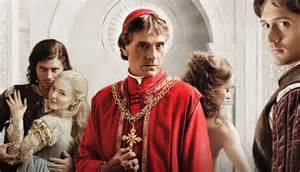
The Borgias
The Latin phrase qui bono means as benefit to whom? In legal cases it is used to determine who might be responsible for criminal acts. I have been watching the series on Showtime, The Borgias, an accurate portrayal of the family and history of Italy. The key figure in the drama is Rodrigo Borgia, who reigned as Pope of Rome Alexander VI. He was Pope from 11 August 1492 until his death on 18 August 1503. He was a highly controversial figure who ruled the Roman Catholic Church with an iron fist and very little respect for church doctrine. His personal excesses were epic, and his bastard children were all lavished with money and power.
The politics of Italy were complex and treacherous, with the Vatican serving as king maker and power broker. Alliances and secret plots were rampant. They Borgias made enemies of many of the families, the most prominent of which was the Sforza clan. First the Pope’s daughter Lucrezia is wed to a Sforza, but obtains annulment from her father a few months into the marriage. Her husband is later murdered by her brother Cesare. Castles are placed under siege and bloody battles are fought between the Sforzas and the papal army. Intrigue inside and outside the Vatican was rampant. The Borgias were known to be masters of the art of lethal poison. A plot nearly succeeds to kill Rodrigo with a glass of wine, but his daughter administers charcoal and saves his life. It was a wild game of liar’s poker.
As I watch the crazy politics unfold in 15th Century Rome and the church I can’t help but be reminded of present day politics. Spies, traitors and terrorists determined the outcome of Borgia power struggles. It appears we are wrapped in a double or triple plot in real time with much subterfuge and mystery clouding our election results. When enemies of enemies betray friends we need to ask a basic question: “Who benefits from this?” This concept was alive in ancient Rome because it points to the cause rather than to the red herrings intended to confuse.
If 400 pound hackers, of Russian or other origin, can change the election results in the United States the question is “Qui bono?” What do you think, gentle reader?

Qui bono
 mermaidcamp