mermaidcamp
Keeping current in wellness, in and out of the water
You can scroll the shelf using ← and → keys
You can scroll the shelf using ← and → keys

Tattershall Coat of Arms
My tenth great-grandfather was born 1572 in Wininick, Lancashire, England, and died 1597 in Wininick, Lancashire, England. He married Ann Hyde on 11 Sep 1593 in Winewick, England, daughter of Robert Hyde and Beatrice Cleverly. His father was in the muster of soldiers in the County of Lancaster August 16, 1574, required to serve the Queen.
Richard Tattershall (1572 – 1597)
10th great-grandfather
Joanne Tattershall (1598 – 1635)
daughter of Richard Tattershall
Mary Greene (1633 – 1686)
daughter of Joanne Tattershall
Benoni Sweet (1663 – 1751)
son of Mary Greene
Dr. James Sweet (1686 – 1751)
son of Benoni Sweet
Thomas Sweet (1732 – 1813)
son of Dr. James Sweet
Samuel Thomas Sweet (1765 – 1844)
son of Thomas Sweet
Valentine Sweet (1791 – 1858)
son of Samuel Thomas Sweet
Sarah LaVina Sweet (1840 – 1923)
daughter of Valentine Sweet
Jason A Morse (1862 – 1932)
son of Sarah LaVina Sweet
Ernest Abner Morse (1890 – 1965)
son of Jason A Morse
Richard Arden Morse (1920 – 2004)
son of Ernest Abner Morse
Pamela Morse
I am the daughter of Richard Arden Morse
This family resided in Lancashire for several centuries before Richard was born. His daughter Joanne sailed to America with her husband and family but died either at sea or shortly after arrival in Boston.
The Lancashire Tattershalls
According to ‘Memories of Hurstwood’ the earliest records of Tattersalls in Lancashire begin with in the year 1380. In the year 1402 that is about 22 years after the death of Robert Tattersall of the Holme Extwistle, and Briercliff, we find the names of Richard and Edmund Tattersall as signatories to the costumale which is called the magna carta of Blackburnshire. Richard and John Tattersall who we find from this charter held an important position in the district in the year 1402 held their lands according to the custom and manner and honour of Lincoln. This fact links the Lincolnshire and Lancashire Tattersalls.
A list of all persons assessed to the Royal Subsidy in the township of Burnley in 1522, included Richard Tattersall 20s 12d. Richard Tattersall died in 1524 on 20th December. When he died he had 4 messuages, 80 acres of land, 16 acres of meadow, 40 acres of pasture, 10 acres of wood, 20 acres of moor and turbary, with their appurtenances in the towns of Brereclif and Burnley in the County of Lancaster. His son Christopher aged 36 inherited. His son Richard Tattersall died a very old man in 1587. He married a Barcroft of Barcroft Hall. He had three sons, Edmund, Richard and John and several daughters.
In the muster of soldiers in the County of Lancaster August 16, 1574 (Harl.MSS.1926) Richard Tattersall along with other local yeoman had each to furnish 1 longbowe, one sheffe of arrowes, one skull (or steel cap) and one bill for the use of Her Majesty. His youngest son John was a poor scholar at Oxford.
A copy of Richard Tattersall’s Will is preserved in the Probate Court of Chester dated 6th December, 1587 in which he is described as Richard Tattersall of Brearcliffe.

a rose is a rose
The phrase quid pro quo literally means something for something in Latin. When it was first used in the English language it referred to substitution of one medicine for another. The apothecary who switched the patient’s remedy for another one may have acted out of ignorance, or may have done so intentionally. Fraud may be involved in a quid pro quo arrangement, but it is not necessarily mendacious or premeditated. It merely suggests an exchange. There are plenty of beneficial exchanges and trades, so why does this term sound so creepy and illicit?
The usage extended from the pharmacy into legal matters. In this case the exchange of one thing for another may be used for favors, appropriate or inappropriate. Now it is common to use this phrase when we suspect some kind of financial hanky panky that smells like an illegal deal. Ponzi schemes and predatory lending might fall into this category. The Clinton Foundation has been in the news recently for possibly giving favors for donations. The issue is in the intent of both givers. If they both intend to evade the law through the trade, they may be acting criminally. I am sure this is hard to prove in court, but it is done all the time, nonetheless.
In personal business we have quid pro quo understandings with bosses, landlords, colleagues, and clients. It is good to examine them carefully to be sure that you have not entered an agreement that you can’t or don’t want to fulfill. There are both written and unwritten contracts that bind people. Healthy happy something for something trades are good for the community. Can you think of both good and bad examples from your past? If you are a good judge of character (caveat emptor) and value you can make sure you get a fair deal. Pay attention to the deals you make, gentle reader, and what you accept in trade.

a rose is a rose

Virgo constellation
The sun has just moved into Virgo for the transitional month between summer and fall. In just a month’s time it will be equinox. This month is perfect for cleaning and clearing space, time, and clutter of any kind. Virgo month is also the ideal time to upgrade daily health and fitness regimes. I have returned to a study that requires intense reading, meditation, and writing. I had fallen out of the discipline needed to finish the course, but now I am enjoying the material and looking forward to doing my homework. Virgo is all about discipline, order, and maybe a little bit of fussiness over details. This is the right time to take up journaling and daily meditation in order to ground body and mind. This is the month to put everything neatly in order, and keep it that way.
I believe that habits require 40 days to become a part of life. After the equinox I need to be vigilant and orderly with my newly established practices in order to secure them. Before the equinox I plan to do a major purge and tidy program in my home and garden. By cleaning and clearing space I will also clear some time for myself. Less stuff requires less maintenance. I am convinced that I will be happier owning far fewer books, pieces of clothing, papers, and personal mementos. I am going to listen to the joy of tidy book again because I still have a month of audible for free, and I think I need to hear it all one more time. I know the author is right about junk representing unresolved issues form the past. Physical space has a direct impact on physical as well as mental health. Clearing closets has the effect of clearing cobwebs from the mind.
To honor the virgin of the harvest in my own way I will use her energy to:
This will be an excellent jump start to the fall season. Establishing healthy habits and clean clear space is a gift that will go on giving through the end of the year.

Masterson Coat of Arms
My 10th great-grandfather was a deacon of the church in Leiden, Holland. He arrived in Plymouth in 1629 and died four years later.
Richard Masterson lived in Sandwich, Kent. He and several others were brought before church courts for criticizing the Church of England and the Book of Common Prayer, as well as for non-attendance at services. He was excommunicated several times. Richard Masterson was in Leiden by 7 Oct 1611. He was a wool comber by occupation. He bought a house on the Uiterstegracht on 2 Jan 1614, the sale of which was the subject of years of negotiation by his wife’s second husband. With four others, he wrote a letter from Leiden to William Bradford in 1625 about their hopes of emigrating to New England. From Michael Paulick’s research, it would seem that Masterson traveled between Leiden and Sandwich. Richard Masterson arrived in New England in 1629 from Leiden. Nathaniel Morton in his history of the Plymouth church described Masterson as a “holy man” and “experienced saint,” “the said Richard Masterson having bin officious with parte of his estate for publick Good; and a man of Abillitie as a second steven to defend the truth by sound argument Grounded on the scriptures of truth…” He died in 1633 in the epidemic of infectious fever and Mary Masterson married Rev. Ralph Smith, the minister for Plymouth until 1636. They moved to Manchester by 1645, and Ipswich by 1652.
Richard Masterson (1590 – 1633)
10th great-grandfather
Sarah Masterson (1612 – 1714)
daughter of Richard Masterson
Margaret Wood (1635 – 1693)
daughter of Sarah Masterson
Elizabeth Manchester (1667 – 1727)
daughter of Margaret Wood
Dr. James Sweet (1686 – 1751)
son of Elizabeth Manchester
Thomas Sweet (1732 – 1813)
son of Dr. James Sweet
Samuel Thomas Sweet (1765 – 1844)
son of Thomas Sweet
Valentine Sweet (1791 – 1858)
son of Samuel Thomas Sweet
Sarah LaVina Sweet (1840 – 1923)
daughter of Valentine Sweet
Jason A Morse (1862 – 1932)
son of Sarah LaVina Sweet
Ernest Abner Morse (1890 – 1965)
son of Jason A Morse
Richard Arden Morse (1920 – 2004)
son of Ernest Abner Morse
Pamela Morse
I am the daughter of Richard Arden Morse
Richard and Mary were among the Puritans in Leyden, Holland, but did not immigrate until 1629 on the second “Mayflower.” Their nephew John Ellis also made the voyage.
!Initial source: Family group sheet in the FGRA collection of the Family History Library, Salt Lake City, Utah, submitted by Edith Haddon
Littleford, 330 E 19th St, Idaho Falls, Idaho. Her source: Rec of Jewell David, Rt1 Box 822, Kent, Washington.
In “NEHGR” vol. 119 pg 162 is the extracted record of the marriage, “Archives of Leyden – Banns: the 1st; Nov. 9, 1619 – Richard
Masterson,woolcomber from Sandwich in England, accompanied by Wiliam Talbot and John Ellis, his brother-in-law with Mary Goodall, spinster, from Leiston , in England acc. by Elisabeth Keble and Mary Wing her acquaintnces.” The second banns were published Nov. 16th, the third banns Nov. 23rd and the marriage was performed “before Alpphen and Tetrolde, bailiffs this XXiii November 1619.” There is an article in “NEHGR” vol 144 (1990) pg 24, titled “The Mary Atwood Sampler”. It has an account of Richard and Mary (Goodall) Masterson which says “Richard Masterson, who was in Leyden, Holland, as early as 1611, was a woolcomber from Sandwich, England, according to the record of his marriage in Leyden 23 November 1619 to Mary Goodall, a spinster from ‘Leessen,’ England [perhaps Leiston in Suffolk?] (D. Plooij and J. Rendel Harris, “Leyden Documents Relating to the Pilgrim Fathers” [Leyden, 1920], IX, XL).
Richard died in 1633 when an ‘infectious fever of which many fell very sick and upwards of 20 persons died’ struck the Plymouth settlement (Samuel Eliot Morison, “Of Plymouth Plantation: 1620-1647 by William Bradford” [New York, 1975], 160). Mary (Goodall) Masterson married, second, before 1 July 1633 Rev. Ralph Smith of Plymouth. Mary, who ‘in 1650, according to a note of [Ralph] Smith, was sixty years old, died in 1659’ (D. Plooij, “The Pilgrim Fathers from the Dutch Point of View” [New York, 1932], 116.
An article, “The Sandwich Separatists”, by Michael R. Paulick, published in”NEHGR” vol 154 pg 353-369, names, on page 355, the wife of John Ellis, who was called brother-in-law in the Leiden marriage record of Richard Masterson. It quotes the parish register of St. Peter’s, Sandwich, Kent, England, giving the marriage of John Ellys and Blandyna Maistersonne. However, it says no baptismal record has been found for either of them but the baptisms of six of their children were listed. This article gives more detail about the separatist” movement in Sandwich and some of the activities of Richard Masterson. It quotes a 1977 history of Kent by Peter Clark that “by 1600 there was a signigicant group of vociferous left-wing radicals and separatists standing outside the mainstream of Kentish Puritanism.”
On page 358 is a quote from the records of the Sandwich Deanery: “To the 2 and 3 article wee presente Thomas Allen and Thomas Baker and
Richard Masterson for affirming that the forme of gods worshipp in the Churche of England established by lawe and contained in the booke of Common Prayer and administracion of the sacraments is a corrupt & unlawfull worshipp and repugnant to the scriptures and that the rites and ceremonyes in the Churche of England by lawe established are wicked anechristin & superstitious and suche as religiows godlie menn cannott neather maye with good conscience use or approve of. To the 65 article wee presente the saide Thomas Allen Thomas Baker
Richard Masterson & Abigaell Atkins for not frequenting there parishe churche one sondayes to heere divine service.
To the 66 (article) wee presente the saide Thomas Allen Thomas Baker & Richard Masterson & Abigaell Atkins for recusants which forebears to come to churche to common prayer & to heere gods word preached.” The article goes on to say “Richard Masterson was summoned but failed
to appear on 2 and 26 July, 22 October, 3 and 13 December 1613, and was excommunicated 17 January 1613/14 along with Allen, Baker, and
Atkins, the sentence delivered 13 February 1613[/14] by Harimus White, minister. [“Comperta and Detecta Book,” Sandwich Deanery, f59v,
ff59v-60r, f60v, f61r.]”
“The Book of Common Prayer established the form of Protestant worship and was enforced by the 1559 Act for the Uniformity of Common Prayer and Divine Service. This Act required ‘strict church attendance and rigid adherence to the Book of Common Prayer.’ All ministers of any parish were required to follow the written order of service for matins (morning service), evensong, and the administration of the sacraments. Substantial fines were imposed on any citizen who declared or spoke ‘anything in the derogation, depraving, or despising of the same book…’ or who refused to attend church services. [David Cressy and Lori Anne Ferrell, “Religion & Society in Early Modern England” (…1996), 56-59.] Separatists held the view that only services that were contained in the scriptures should be followed and all other forms of worship of man’s invention were ‘antechristin’.”
It quotes a letter written by the rector of St. Peter’s and other Sandwich ministers in 1613 to the Privy Council of James I, which said “many notablesectes and heresies” were being spread among the people “by such as have recourse unto the towns of Amsterdam, and other partes beyond the seaes” and among the “chiefest sowers” were “Richard Masterson the ellder and Richard Masterson the younger, Thomas Allen and John Ellis”
The article says “The reference to two Richard Mastersons is puzzling; so far, examination of the parish registers of Sandwich shows no trace of a Richard Masterson elder or younger. These terms were commonly – but by no means always – used for father and son or uncle and Nephew. Richard Masterson of St. Peter’s appears only in the ecclesiatical court records. Richard of Leiden was unmarried until 1619 so he had no children to baptize.[36] The note indicated by this number says “It should be noted that the St. Peter’s and St. Mary’s registers are particularly difficult to read, illegible in some areas. A John Maisterson is named in St. Peter’s parish register but his will of 1620 does not indicate any connection with Richard or Blandyna …” “It is possible that the Privy Council confused a Richard Marston with Richard Masterson. The pronunciation of both names with an English long ‘a’ might have sounded similar and perhaps led to a mix-up. Marston apparently had a Separatist reputation….”
The article went on to quote a warning letter to the mayor and stated that the law prohibited these activities and that those accused were fortunate in receiving only an “admonishon and reprehension”. However, “Richard Masterson was summoned 4 and 14 November 1614, and
excommunicated on 28 November 1614.” Still he continued and “had soon returned from Leiden as a professed Brownist or Separatist.” He
was summoned again 10 June 1616 with the following: “To the 2 article wee have one Richard Masterson whoe refuseth to come to our church
traduceth our service and ceremonyes ys a professed Brownest or Separest and hathe formerlye ben often presented and stubbornelye hath stood longe excommunicated and continuallye endeavoreth to infecte others with the same leavin soe that we are greived that the
performaunce of our duetyes herein hat noe better effecte.” He was excommunicated again on the 28th, and yet again on 20 December.
Further in the article it says “When Richard Masterson died in 1633 he was described by Bradford as one of the ‘ancient friends which have lived in Holland.’ If there was a single Richard Masterson, there is evidence that he might have been moving between Leiden and Sandwich. He is recorded in both locations at various times as follows:
7 Oct. 1611 betrothat in Leiden; called acquaintance of Isaac Allerton
2 July 1613 excommunicated in Sandwich with Allen, Baker, and Atkins
4 Nov. 1614 At Sandwich, ‘Lyeinge at Mr. Varall’s,’ excommunicated
22 Jan 1614/15 Leiden, various lawsuits 1612-1615 [Register 143:206]
Jan. 1615 Leiden, purchased house from Roger Wilson 10 Jun 1616 Sandwich, excommunicated as ‘Brownist or Separatist’ Dec. 1616 Sandwich, excommunicated with Mary Plofer for slander 4 Sept. 1618 Letter from Sabin Staresmore in London to John Carver March 1619 Leiden, certificate of good behavior includes Roger Wilson Perhaps his master, Christopher Verrall, who was wealthy and had powerful connections in Sandwich, had actually ‘underhand may[n]teyned and protected the offendors,’ as the Privy Council had accused him of doing. If Richard Masterson was not working with Verrall’s permission it is difficult to understand how he could maintain employment as a servant and travel back and forth between Sandwich and Leiden before Verral’s death in 1615. It is unlikely that any of those who had ‘recourse’ to Leiden made the trip between the two countries without the full knowledge of the other Leiden Separatists.”
The will of Christopher Verral is included in “Appendix” at the end of the article. It is long and difficult to understand but one sentence says “I do forgive my man Richard Masterson all the money which he oweth me and I give him 20s. to make him a ring in token of my good will.”
Letter sent to William Bradford and William Brewster by Richard Masterson and others
To our most dear, and entirely beloved bretheren, Mr. William Bradford and Mr. William Brewster, grace mercy and true peace be multiplied, from God our Father, through our Lord Jesus Christ. Amen.
Most dear christian friends and brethren, as it is no small grief Unto you, so is it no less unto us, that we are constrained to live thus disunited each from other, especially considering our affections each unto other, for the mutual edifying and comfort of both, in these evil days wherein we live: if it pleased the Lord to bring us again together, than which as no outward thing could be more comfortable unto us, or is more desired of us, if the Lord see it good; so see we no hope of means of accomplishing the same, except it come from you, and therefore, must with patience rest in the work and will of God, performing our duties to him and you assunder; whom we are not any way able to help, but by our continual prayers to him for you, and sympathy of affections with you, for the troubles which befal you; till it please the Lord to reunite us again. But our dearly beloved brethren, concerning your kind and respective letter, howsoever written by one of you, yet as we continue with the consent (at least in afection) of you both, although we cannot answer your desire and expectation, by reason it hath pleased the Lord to take to himself out of this miserable world our dearly beloved pastor, yet for ourselves we are minded as formerly, to come unto you, when and as the Lord affordeth means, though we see little hope thereof at present, as being unable of ourselves, and that our friends will help us we see little hope. And now, brethren, what shall we say further unto you; our desires and prayers to God, is (if such were his good will and pleasure) we might be reunited for the edifying and mutual comfort of both, which, when he sees fit, he will accomplish. In the mean time, we commit you unto him and to the word of his grace; whom we beseech to guide and direct both you and us, in all his ways, according to that, his word, and to bless all our lawful endeavours, for the glory of his name and good of his people. Salute, we pray you, all the church and brethren with you to whom we would have sent this letter. If we knew it could not be prejudicial unto you, as we hope it cannot; yet fearing the worst, we thought fit either to direct it to you, our two beloved brethen, leaving it to your goodly wisdom and discretion, to manifest our mind to the rest of our loving friends and brethren, as you see most convenient. And thus intreating you to remember us in your prayers, as we also do you; we for this time command you and all your affairs to the direction and protection of the Almighty, and rest,
Your assured loving friends
And brethren in the Lord,
FRANCIS JESSOPP,
THOMAS NASH,
THOMAS BLOSSOM,
ROGER WHITE,
RICHARD MAISTERSON.

State of the Moon is a semi-regular, bimonthly check in with the universe. This is my first post that focuses on the moon, on astrology, on how what’s happening in the heavens impacts us on earth. I am still learning about astrology, but I process information through writing. I will also include links to blog […]
via State of the Moon: Full Moon in Aquarius — Northern Lights Witch
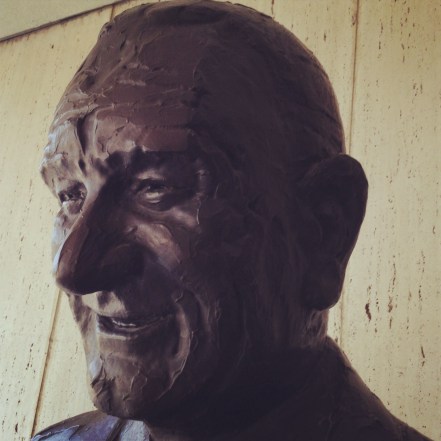
LBJ
I have been watching the HBO John Adams series about the American Revolution and the first American continental congress in Philly. It helps me see that our politicians are not in the worst situation in our history. Neither are they less favorably aligned than in the nation’s past. This congress we have today is about the same as all ruling bodies have always been, since the Roman Senate. The use of power by humans on earth has been punctuated with misery and cruelty. Conquest, political or military, has been imposed on nations, colonies, and entire continents. War and Peace have hung in the balance more times than we know, but always for the same reasons. War is an archetypal situation that repeats itself.
When we say history repeats itself we mean that archetypal events continue to occur. In the arch of recorded history we have seen the pendulum of power swing from feudalism to anarchy. Leaders have been both born and created in the struggle to survive. We think of those leaders as the representatives of the entire culture, but they may merely be the most famous. We know less about how the common person lived than we do about the fancy and well born. I know this very well from my study of my own ancestry. I learn more all the time about America by studying my ancestors’ lives. None of my forefathers was famous during the American Revolution, but many did fight in it. Power does flow through the events of man, but my religious ancestors would all say that fate is sealed by divine providence. Man is just a player on the eternal stage.
I am hearing the same message from all the books and posts I read these days. In a world that conforms all too easily it is essential to be particularly true to one’s self. My teacher Chris Brogan just hit me this morning with some excellent thoughts on what is lost when one fits in with the crowd these days. Popularity and authenticity are not the same thing, and sometimes are completely opposed to each other. Our politics reflect a chaos and lack of discipline that runs through society. Mob mentality seems to be taking over our thinking in America.
I wonder if we can step back and take individual action to change the crazy status quo in our country. I wonder if we can stand up for law and order and for justice at the same time. We have reached a tipping point that demands we be awake and aware of the reality we are creating. What do you think, gentle reader? Obviously vote. What else can we do?
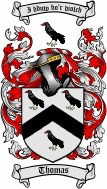
Thomas Coat of Arms
David Thomas is thought to have been born in Wales about 1620, David probably arrived in America about 1640-1 on the ship “Sampson”. It certainly is a fact that a session of the Quarterly Courts at Salem on 8th July 1645 “David Thomas” is a witness in a suit for defamation of character brought by John Bartoll against Alice, wife of John Peach, Jr, for having said that the plaintiffs wife, Parnell Bartoll, had “committed adultery with the Boatswain of the ship “Sampson” in the cabin of Parnell about four years ago.” This is the first record that we know of for David Thomas in America.
David lived in that part of Salem which is about to become the town of Marblehead. David left Marblehead probably early 1661, and removed to the part of Salem which later became Beverly. Two known maps showed the location of the Salem property of David Thomas agree that David owns Lot 16, which seems to have had no dwellings on it while David owned it.
It is significant that his wife Joanna executed her consent to the sale of the Beverly property by an instrument dated at Plymouth 14th July 1669. (Essex County Deeds book 3, pages 57 and 189). It seems this must have been the year David and Joanna Thomas moved to Middleborough. The birth of his son Edward Thomas on 6th February 1669 is the first entry in the Town Records of Middleborough, even though that entry may have been made at a later date, since the Town Records are said to have been destroyed by the Indians during King Philip’s War of 1675.
David is a Farmer at “Middlebury” and his family is one of the 16 families that constituted this Town in 1675. During this year when Indians attacked “Middlebury’s” new white inhabitants, forcing these settlers back into the Old Plymouth Colony Village. After this war ended these early settlers returned and 28th June 1677 those who had owned lands there, numbering 68 persons, met and agreed to re-settle “Middlebury” presently what is now called Middleborough.
David Thomas’s house at Middleborough (not standing anymore) is a little distance southeast of the town proper at the end of what is now Thomas Street at the area that became well known as “Thomastown”.
David Thomas (1620 – 1689)
9th great-grandfather
Mary Thomas (1664 – 1754)
daughter of David Thomas
Ann Northup (1696 – 1772)
daughter of Mary Thomas
Ann Gifford (1715 – 1795)
daughter of Ann Northup
Frances Congdon (1738 – 1755)
daughter of Ann Gifford
Samuel Thomas Sweet (1765 – 1844)
son of Frances Congdon
Valentine Sweet (1791 – 1858)
son of Samuel Thomas Sweet
Sarah LaVina Sweet (1840 – 1923)
daughter of Valentine Sweet
Jason A Morse (1862 – 1932)
son of Sarah LaVina Sweet
Ernest Abner Morse (1890 – 1965)
son of Jason A Morse
Richard Arden Morse (1920 – 2004)
son of Ernest Abner Morse
Pamela Morse
I am the daughter of Richard Arden Morse
David Thomas and his wife came from Salem to Middleboro soon after 1668, the of he selling his land in Salem. They settled in Thomastown, where their descedants are still living. He bought into the Twenty-six Men’s purchase.
He had sveral children, David, Joanna, William, Jeremiah, and Edward, the last born February 6 1669, the first birth in the early records of the town.
Source: History of the Town of Middleboro.
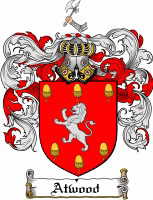
Atwood Coat of Arms
John Wood, the oldest immigrant ancestor of the Wood family, came to Massachusetts in 1635 aboard the ship Matthew. Most of his adult children followed him to America soon after.
John Wood is also known as John Atwood in some records; his baptismal name is “Johanem Wood” according to E. F. Atwood; however, I have yet to locate that record, so it may be a mistake. In the Sanderstead parish birth records his name is recorded as “Johannes” (not Johanem) with a date of 4 Feb 1582. Johannes is the Latinized version of John, often used in official records. He was a twin to Dericke who died in infancy. His baptism was recorded in both Sanderstead and Gatton parishes. It is not known why his birth was recorded at Gatton (a parish that is also located in Surrey, about three miles from Reigate), but it leads me to speculate that John’s mother may have originally come from that parish.
From the Sanderstead Parish Register of baptism records:
1582 Feb 4, Johannes t Dericke Woode gemille Nicholaj Woode
translation: 1582 Feb 4, John and twin Derick Wood born to twin bearing (father) Nicholas Wood
Since John Wood was baptised in Sanderstead, Surrey, England on 4 February 1582, it is likely that he was born about that time because it was customary to baptise infant children. He was probably born in Sanderstead since that is where his father, Nicholas and mother Olive (Harman) had a home. The Wood family had been associated with Sanderstead since about 1400 and had constructed a manor house there known as “Sanderstead Court.” The title to the lands in Sanderstead are somewhat confusing at this point in time and it is not entirely clear whether the family was actually living at Sanderstead Court or in one of the other houses in the parish.
John Wood married Joan Coleson of Saint Martin’s Parish, London in the summer of 1612. They had at least seven children, all born in England, five were sons and two were daughters. Johanna and Agnes are questionable children; they are included here until their ancestry is confirmed fully. Philip is sometimes included as a child of John and Joan, however, this is not the case. Most of the other children were baptised at St. Martins in the Fields church in London. E. F. Atwood believes that after the birth of his second son, John (in 1613), he and his family moved to Chancery Lane in London. He does not provide documentation for this assertion, however.
John was a “leather seller” in England. A notation in The Gentleman’s Magazine in 1848 indicates that John Atwood was a member of the Leatherseller’s Company on 22 January 1628; he sponsored a man with a highly unusual name to membership in the guild–Praysgod Barbone. Leather sellers were involved in selling, whiting, sorting and staking leather, and they belonged to a guild in London that regulated the trade; their guild hall was a large and elaborate building and they derived both social and financial benefits from belonging to the guild. Leather craftsmen making leather goods and parchment could also belong to this guild. Leather was an essential product with many uses during this time.
When John’s father, Nicholas, died in 1586, he left his estate to his youngest son Richard. Normally the oldest son would inherit his father’s estate, so this was an unusual bequest. Richard died 17 years later in about 1603 and his estate was inherited by the oldest brother in the family, Harman. According to court documents summarized by E. F. Atwood in Ancestry of Harman Atwood, John sued his older brother on 1 Feb 1631 saying he should be the heir of the estate, not Harman:
“Harman Atwood doth confess that he hath a copy of a Court role, dated 37 Henry 8 (1546-47) which proves that Nicholas Wood was the heir, that Thomas Wood, a young son, had certain manor lands settled on him by his father, John Wood, and that on the death of said Thomas, Nicholas Wod was possessed of said lands, according to the custom of said manor.”
Atwood maintains that this proceeding was used to simply sort out ownership of various Wood/Atwood lands, and that it was not filed in anger over John’s perceived disinheritence. King Henry had taken some lands belonging to the Wood/Atwood family some years before when he dissolved the monastaries in England. The land the Wood/Atwood family owned had previously belonged to the monastary, and it may well have been a legal maneuver by the Wood/Atwood family to clarify their rightful ownership of lands in Sanderstead parish and elsewhere. It is probably from this incident that E. F. Atwood says that some of John’s descendants claim he left for America after being disinherited.
I believe that Atwood is probably correct because if John was unhappy with his brother Harman after Richard’s death it seems unlikely that he would have named his own son “Harman” in 1612. E. F. Atwood’s conclusion is that this suit was merely a legal technicality to sort out ownership rights of Sanderstead. This conclusion would indicate that John did not leave England because of dissatisfaction with his inheritance, but for other reasons–possibly religious, possibly financial, or possibly for adventure.
It is not known what prompted John to leave England for the new colonies in America in 1635, but we can make a few guesses based on John’s personal circumstances as well as the political and religious climate in England at the time. James I, the English King (1566 – 1625), faced opposition on many fronts. James did not trust the growing Puritan movement in England, and viewed it as a threat to his royal control of the church. Tensions continued to increase after James was succeeded by his son, Charles I, and finally reached a breaking point with the English Civil Wars.
Many Puritans, who became known as Dissenters, faced discrimination and persecution in England. They sought to “purify” the Church of England and objected to many of its ceremonies such as exchanging rings during marriage, inviting “evil doers” to share in communion, using the sign of the cross in baptism, etc. Many of the Dissenters’ preachers were driven to ruin by the King through excessive taxation. This persecution lead to the first of several exoduses of Puritans, the first of which was to Leyden, Netherlands in about 1605. Most Puritans only stayed in the Netherlands for 10-15 years, however, and many eventually moved to America. The first group of Puritans arrived on the Mayflower in 1620 and founded the Plymouth Colony.
John may have well have been prompted by religious convictions to leave his English homeland and settle in the predominatly Puritan Plymouth Colony. We know that three of his sons married into staunch Puritan families after arriving in America. At least one leather seller in London was persecuted by the King for his beliefs and burned at the stake while John lived in London.
John may have also been motivated by financial considerations. As a younger son, John had been forced to fend for himself financially. It seems that his older brother, also named John (born 1576) had knowledge of the Plymouth Colony for he was recognized by the Treasurer of the stock company that funded the colony as a “special friend.” John’s brother’s relationship to the Plymouth Colony may have had an impact on John. It is also possible that since he had not been successful in his law suit against his brother Harman for a share in his father’s estate, John may have felt that the New World offered more oppotunity than London.
It is believed that John left England on 21 May 1635 aboard the Matthew. John’s name appears in the ship’s register in London, with 131 others; they were first transported to Saint Christopher’s Island (now known as St. Lucia), an island in the Leeward chain in the Caribbean. Richard Goodladd, owner and master of the Matthew per a warrant from the Earl of Carlisle. Before they were allowed to leave England they were compelled to take an oath of allegiance that they would be loyal to their King and their mother country.
Shortly after arriving in Plymouth, he was admitted as a freeman on 3 Jan 1636 which meant that he took an oath of allegiance to the Colony and could vote in elections and participate in the governemntal life of the colony:
“Mr. John Atwood, John Jenkin, John Weekes, Josiah Cooke, Willm Paddy, Robte Lee, Nathaniell Morton, Edward Forster, Georg Lewes, and Barnard Lumbard were made free this Court and sworn accordingly.” (The Wood family relationship with the Morton family would continue for many years.)
John’s wife, Joan, also came to America, but it appears that she did not sail with him on the Matthew since her name is not listed on the ship’s manifest. She came over on a later voyage, however, it is not clear which ship brought her.
From records of land transactions we know that John purchased land in Plymouth next to John Dunham shortly after his arrival. The land was granted to John Wood on 7 November 1636:
“had divers porcons allowed them, 3 acres in breadth & two in length, next to the land of John Dunham the elder…” The others were John Dunham Jr., John Wood, Samuell Eedy, Web Addy, Josiah Cooke, Thomas Atkinson, and Joshua Pratt, “All wch psons haue or are to build in the towne of Plym., and these lands to belong to their dwelling howses there, & not to be sold fro their howses.”
Citation: 7 Nov 1636 Plymouth Colony Records, Vol. 1:46
The following summer, in 1638, William Bradford describes an interesting incident that undoubtedly would have made an impression on John:
“This year, aboute the 1. or 2 or June, was a great and fearfull earthquake; it was in this place heard before it was felte. it came with a rumbling noyse, or low murmure, like unto remoate thunder; it came from the norward, and passed southward. As the noyse aproached nerer, they earth began to shake, and came at lenght with that violence as caused platters, dishes, and such like things a stoode upon shelves to clatter an d fall downe; yea, persons were afraid of the houses themselves. It so fell oute that at the same time diverse of the cheefe of this towne were mett together at one house, conferring withsome of their friends that wre upon their removall from the place, (as if the Lord would herby shew the signes of his displeasure, in their shaking a peeces and removalls one from an other.) How ever it was very terrible for the time, and as the men were set talking in the house, some women and others were without the dores, and the earth shooke with that vilence as they could not stand without catching hould of the posts and pails that stood next them; but the vilence lasted not long. And about halfe an hower, or less, came an other noyse and shaking, but nether so loud nor strong as the former, but quickly passed over; and so it ceased. it was not only on the sea coast, but the Indeans felt it with in land; and some ships that wre upon the coast were shaken by it. So powerfull is the mighty hand of the Lord, as to make both the earth and sea to shake, and the mountaines to tremble before him, when he pleases; and who can stay his hand?”
Citation: Bradford, Of Plymouth Plantation
Four of John’s adult sons also came to America after him:
Stephen went to Eastham, Mass. in about 1648-50
John to Plymouth, Mass. in about 1636
Henry to Middleborough, Mass. in about 1641
Harman to Boston, Mass. in about 1642
It is possible that his other son, William, also came to Charlestown, Mass. (this is based on speculation by E. F. Atwood in Ye Atte Wode Annals).
Three of John’s sons married into prominent Puritan families:
John Wood married Sarah Masterson in 1642 in Plymouth. She was the daughter of Richard Masterson who had been a Deacon at Leyden, Holland, the first home of the Puritans.
Henry married Abigail Jenney in 1644 in Plymouth. She was the daughter of Capt. John Jenney and Sarah Carey who had first gone to Leyden, Holland before coming to America.
Stephen married Abigail Dunham in 1644 in Plymouth. She was the daughter of John Dunham and Abigail Barlow who had originally gone to Leiden, Holland and married there on 22 Oct 1622.
John only lived eleven years in his new American homeland. He died on 27 Feb 1644 in the Plymouth Colony. His will is dated 20 Oct 1643, and was proved on 5 Jun 1644.
E. F. Atwood in Ye Atte Wode Annals (1930) has provided a copy of the suit John filed against Harman in London in 1631. In this suit he is identified as the son of Nicholas and is also identified as a “leather seller:”
Chrles iw. 15-33. Wood Alias Atwood Vs. Atwood. Feb 1, 1631.
Humbly comlayning, your orator, John Wood, alias Attwood, of the City of London, leather seller, that whereas Nicholas Wood, alias Attwood, late of Sanderstead cum Longhurst, County Surrey, deceased father to your orator, was siezed of lands, etc., in Sanderstead, and did, about 28 Elizabeth [1586], convey on parcel of lands called Mancocke and another parcel lying by Parkland, in the bottom towards Comes Wood Head, and a parcel lying by Mitheley, Great Burye, called Opeley, and one close lying at Ledowne, and one parcel abutting upon the house of Henrie Best, all which lands, the said Nicholas Wood alias Atwood, did convey for the use of Oliphe, his wife, for her life, and for the use of Ritchard Wood alias Attwood, his youngest sonne, and after the death of the said Nicholas and Ritchard, the said Oliphe, about 1603, also died; after whose death, the lands descended unto your orator, as youngest sonne of the said Nicholas. But now Harman Wood, alias Attwood, being the eldest son of your orator’s father, and lord of the said manor of Sanderstead cum Longhurst, hath entered the said premises and pretends to disenherit your orator of the same.
ANSWER of Harman Atwood, Gent., Says bill of complaint it devised by the complainant without just cause and denies that he combined with Thomas Collett, the steward of said manor, concerning any controversy and says the complainant has no right or title to said premises. he doth confess that he hath a copy of a Court Role, dated 37 Henry 8 (1546-7) which proves that Nicholas Wood was the heir, that Thomas Wood, a younger son, had certain manor lands settled on him by this father, John Wood, and that on the death of said Thomas, Nicholas Wood was possessed of said lands, according to the custom of said manor.
Note [by E. F. Atwood]: “The above is merely an abstract made for genealogical purposes, hence does not always conform to exact wording of the original. It seems clear that the leather seller was never meant by Nicholas to inherit these lands, but thence comes our traditions of disinheritance, etc. As (Sanderstead manor was confiscated a few years earlier, yet John and Nicholas were left undisturbed in possession of lands bought by Peter in 1346, a Court Roll was necessary to avoid confusion as to titles of the two lands called Sanderstead Manor, one owned by the Greshams and one by the Wood-Atwoods.”
Born John Attwood, John was was the last in his direct line to have a coat of arms. He was descended from knights of the shire, bodyguards of English kings and members of parliament. He was a younger son of his father, Nicolas Atwood. Therefore, he did not expect to inherit an estate. John chose to seek his fortune in the American colony of Plymouth. When John learned that his older brothers had died without eligible issue for his father’s title, he sailed to England to claim it. But his youngest brother, who had remained in England, had secured it from the courts before John was able to to gain his rightful title and estate. John returned to Plymouth, and his name was changed to Wood. Some of his American relatives kept the the name Atwood. He, his son Henry Wood, and grandson John Wood were sometimes called Atwood and confused with people
John Atwood (1582 – 1644)
10th great-grandfather
John Thomas Wood (1614 – 1675)
son of John Atwood
Margaret Wood (1635 – 1693)
daughter of John Thomas Wood
Elizabeth Manchester (1667 – 1727)
daughter of Margaret Wood
Dr. James Sweet (1686 – 1751)
son of Elizabeth Manchester
Thomas Sweet (1732 – 1813)
son of Dr. James Sweet
Samuel Thomas Sweet (1765 – 1844)
son of Thomas Sweet
Valentine Sweet (1791 – 1858)
son of Samuel Thomas Sweet
Sarah LaVina Sweet (1840 – 1923)
daughter of Valentine Sweet
Jason A Morse (1862 – 1932)
son of Sarah LaVina Sweet
Ernest Abner Morse (1890 – 1965)
son of Jason A Morse
Richard Arden Morse (1920 – 2004)
son of Ernest Abner Morse
Pamela Morse
I am the daughter of Richard Arden Morse
My tenth great-grandfather immigrated to American in 1635 in the Pilgrim ship the “Mathew”.
John Wood, imigrant ancestor, 1635, arrived at Plymouth Colony; married Joan Coleson of Saint Martin’ England, who did not come with her husband, but later ship. John’s name appears in the register in London, with others; they were first transported to Saint Christophers, in the ship, Mathew, Richard Goodladd, owner and master, 21st May 1635. Before they were allowed to leave England they were compelled to take the oath of allegiance that they would be true to their mother country– “ye oath of allegiance supreme”. During the reign of Queen Elizabeth the Puritans fared badly in England, many men and women being arrested and thrown into prison because they sought to retain their own religious beliefs which were deemed contrary to the teachings of the Church of England. Many of them fled to Holland. On the death of Queen Elizabeth, she was succeeded by King James who was more lenient with the Puritans and freely allowed them to emigrate to America, the first settlement etablished in Virginia being called Jamestown. Later (1620) the Puritans came to Plymouth. Still later, many settled in Boston and Boston became the capital of Massachusetts Bay Colony.
John Wood landed first at Boston, but soon removed to Plymouth. The record of his baptism in England gives the date 24th December 1614. He became “propr.” of Plymouth Massachusetts, 1635-36; he owned land, was constable and on the grand jury. March 25th was recognized as New Year in England and her colonies. His wife Joan Coleson dying soon thereafter he removed to another section of Plymouth which later became the town of Plympton. While there the son John Wood married Sarah Masterson, daughter of Richard Masterson, who had been a deacon at Leyden, Holland, and whose wife was Mary Goodsell of Lancaster (married 26th November 1619). John Wood later moved to Portsmouth on the Island of New Port which was then a part of Massachusetts. Children of John and Sarah (Masterson) were: Thomas, Henry, Walter, William, John, Elizabeth. The records most frequently mention the sons Thomas and John. The father died in 1643-44, The son John Wood, died about 1675.
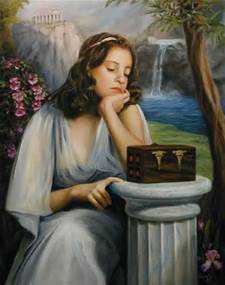
Pandora and box
The myth of Pandora is a Greek creation story. Zeus ordered Hephaestus (blacksmith of the gods) to make the first woman. He did this using water and earth. Her name means all gifted because various gods gifted her with talents. She was married to Epimethius as a major prank. She was designed to punish disobedient humans. She was irresistible. She arrived with a box which was not to be opened. We know the part of the story in which she does open the box and evil and suffering escapes. In fact, evil runs rampant on earth as a result of Pandora’s weakness of curiosity. She has something in common with Eve, the first woman who just had to try the forbidden fruit in the garden.
When Pandora sees that she has released illness and evil on the earth she attempts to close the box quickly. In the original story she came with a jar (pithos). Later translations from the Greek changed the jar to a box. Either way, she managed to close the container with hope trapped inside. I feel this myth is pertinent to our world situation today. The evil, the misery, the illness has been released into our atmosphere. It is swirling all around us everywhere. Hope is often obscured, as if it is enclosed in some secret vessel.

Pandora and box

