mermaidcamp
Keeping current in wellness, in and out of the water
You can scroll the shelf using ← and → keys
You can scroll the shelf using ← and → keys
Magnesium is an essential nutrient that keeps us clam. The GABA receptors in the brain require magnesium to do their job, which is to switch off the stress. When we are low in magnesium our bodies respond with insomnia, daytime jitters, and other unpleasant symptoms. This uncomfortable situation can be addressed by taking supplements. Another way to introduce extra magnesium into the body is by bathing in epsom salts. I have used them for foot baths when I have sore feet, and occasionally for tub baths, but now I am trying a new technique to improve my sleep. By using honey before bed I have made some improvements in deeper more uninterrupted sleep. Last night when I woke to let the dog outside at 2 in the morning I decided to try a bath recipe I saw to test the effects. It was nothing short of spectacular.
I ran a hot bath and used about 1 and a half cups of epsom salt, about 1/2 cup baking soda, and 2 cups strong ginger tea. The ginger makes you sweat while you are in the tub, and for a few minutes after you exit. The recommended time for maximum benefits is an hour, but I was falling back to sleep in about 20 minutes. I did fall deeply back into dreamland and awoke this morning feeling very well rested. My fitbit reports that I had a very good night of sleep, just over 8 hours.
This is such an easy and pleasant cure I plan to incorporate it into my routine every day. One of the effects one can expect to see is lower blood pressure. Pharmaceutical drugs are one reason we become magnesium deficient in the first place. I don’t take any drugs and hope to stay that way. Isn’t it good to know that both insomnia and high blood pressure, very common today, can often be completely cured in the bathtub? Have you used epsom salts to get a better night’s sleep, gentle reader? I highly recommend it. The addition of the ginger adds anti-inflamatory properties, again an easy and cheap cure for the entire body. There are no harmful side effects, and the evidence shows that this bath might be just what the doctor should have ordered.

Amazon app
Apple has rolled out the new streaming music subscription service. They are offering it for a three month’s free trail to everyone. I decided that there is no reason not to use if for three months. I also determined right away that I would not want to pay $10 a month for this, so I have already disabled the future paid subscription. My friend Carolyn Nicander at the Wonders of Tech blog taught me all the important things I need to know, such as turning off the subscription before I am charged. If you are considering it, do read her informative post to help you navigate wisely. One important point she makes is that the phone uses data minutes to stream the music when not connected to WiFi. This could make a big difference for some people.
My iPhone 4 will not be able to upgrade to the new operating system, meaning I can not have it on my phone. I downloaded it to my iPod touch, which I use liberally. Since this is my second day I have only tried a couple of playlists and beats radio. The playlists for cooking and chilling sound interesting. I wonder how well the music for various activities will suit my own taste. I have saved barbecue music playlist to test this idea. The playlists are curated by DJ’s and music critics and writers. This feature will be the most interesting to me, I believe. However, I am a happy customer of Amazon Prime. The music service already included in my Prime membership is loaded as an app on my phone. I use it daily since I started trying it, adding new material a couple of times week to my cloud collection. I can start to delete some if I decide I have heard them too often. My Amazon strategy is to add and then select shuffle recently added songs. This gives me all I need in a streaming service without paying extra. Apple service works in a similar way, giving you access to the tracks you select for your own collection . When I quit the Apple service all the material I have chosen will be lost, so I am not bothering to download anything. I am using this free time to discover and or remember artists and genres I like to hear. If I like them enough I can always buy their material. I still do that.
Are you using Apple Music yet? What are your impressions of the service? I think it is well worth the zero dollars I will pay for it. I am thrifty, but not cheap. I plan to live it up for the next three months and then happily go back to my Amazon app.

Rev. Robert Miller, patriot
My 5th great-grandfather was a Presbyterian minister from Scotland who served as chaplain in South Carolina during the Revolutionary War. The Presbyterians were active during the war because they had no love for the Brits or their religion. The following passage gives us insight into his early life:
The following is a sketch of the life of Rev. Robert Miller, which according to Minos E. Miller was written by himself and which was copied from the original by Hugh Reid Miller several years before the Civil War.
“I was born of religious and creditable parents, my father possessed of a small fortune in land not far from where I was born. Early they bestowed an education upon me. At nine years of age I went to school to Mr. Patrick Reid, Schoolmaster, at Aberdeen, and then began to read Latin. Continued at school with some few intermissions till I was about the age of eighteen. I then proposed to apply myself to some lawful calling, for support in the world and to [?] daily bread. Being engaged with a Physician in aldy, he desired my father to send me to school to learn Greek, to qualify more for the business I was engaged in. I therefore went to school; and in the meantime contracted such a desire to stay still at school, my father consented, and after I had read Latin and Greek some time, he sent me to the college, where I continued till I had gone through my studies in Philosophy, after which by the advice of some, I applied myself to the study of Divinity, and attended the Lectures of the Rev. Mr. Mear Mon[?] Professor of Divinity. In which Profession I made such Proficiency, as at last, after trials by him, was approved and presented by him to the Presbytery for future trials; after going through the ordinary course in the Presbytery of Edinburgh.
I pretty early began to think much, and was privileged with the blessing of a valuable gospel minister, as well as a pious example set before by my parents, with many good advices and instructions from both. I went along to a solemn occasion at Glendovan, when I heard Mr. Wardrobe preach upon that text, Eph. 6:13-14 “having done all to stand, stand therefore,”

Presbyterians and the revolution
Patriotism depends on the sentiment at the time. When Protestant thinking set Europe on a path toward political change, the wheels started rolling toward America. The Brits represented the past and corruption of religion. Factions create patriotism. It is an emotional trend that surpasses logic. My very badass 5th great-grandfather was an example of early American patriotism. His descendants would fight for the Confederacy against the United States. After the Civil War those descendants moved to East Texas to start new lives and found a Baptist church. Religion played a strange part in all that patriotic and anti-patriotic behavior. I still do not grasp how heavy-duty Christians own slaves. Today patriotism comes dangerously close to fear and suspicion of foreigners and nothing more.
Rev. Robert Miller (1730 – 1821)
is my 5th great-grandfather
Margaret Miller (1771 – 1853)
daughter of Rev. Robert Miller
Philip Oscar Hughes (1798 – 1845)
son of Margaret Miller
Sarah E Hughes (1829 – 1911)
daughter of Philip Oscar Hughes
Lucinda Jane Armer (1847 – 1939)
daughter of Sarah E Hughes
George Harvey Taylor (1884 – 1941)
son of Lucinda Jane Armer
Ruby Lee Taylor (1922 – 2008)
daughter of George Harvey Taylor
Pamela Morse
I am the daughter of Ruby Lee Taylor
SGT. ROBERT MILLER, CHAPLAIN IN THE AMERICAN REVOLUTIONARY WAR 1) Sgt. Robert Miller served as a Presbyterian minister, in civilian life. During the American Revolutionary War, he served as a Chaplain. The photo above is from an online pamphlet which is short, and easy to read. It gives a good overview of how the people of the Presbyterian Church in America played a vital role in the American Revolutionary War. It also explains how the Protestant Reformation of the 1500’s in France, led to Protestant French Huguenots emigrating away from France and over to England, Scotland, and other countries in Europe. Later on some of their descendants left Europe and immigrated into America. The Protestant religions in America have always had deep roots to the northwestern area of France, especially the area around the Province of Normandy. This can be puzzling, and complicated. One connection can be seen between the various Protestant religions in the USA, leading back to the work of a young man who was named Jehan Cauvin. http://en.wikipedia.org/wiki/John_Calvin He was born in 1509 in Noyon, Picardie, France. When he grew up, he lived in Switzerland, where he was known as John Calvin. His religious ideas had a profound effect in many other countries in Europe, such as Germany and the Netherlands. Perhaps this is part of the reason why America has always had such a complicated relationship with France, especially in times of war. The photo of the ebook is entitled: Presbyterians and the Revolution. By the Rev. W. P. Breed. Published 1876 by Presbyterian Board of Publication in Philadelphia. The copyright on this book has now expired, and it is now in the public domain. Source: https://archive.org/stream/presbyteriansrev01bree#page/82/mode/2up/search/pickens *** 2) Here is a link to a short article that provides a good background history for Mecklenburg County, NC and the counties to the south of it in SC during the American Revolutionary War. Rev. Robert Miller was in a part of SC that saw some serious fighting, to the east of Abbeville County. The article can be found here: http://www.sciway3.net/clark/revolutionarywar/1780-Huck_noframes.html The title of this article is “THE 1780 PRESBYTERIAN REBELLION AND THE BATTLE OF HUCK’S DEFEAT” by Sam Thomas, Curator of History, Culture & Heritage Commission of York County. *** 3) There were many different families named Miller who lived in Scotland in the 1700’s, and they are virtually impossible to untangle. Many of these families appear to have adopted the last name of Miller as a means of indicating a political alliance, and they did not originally use the family surname of Miller/Millar. Family surnames were not used in Europe prior to the 1800’s the same way they are now used in modern Europe and in America. People were much more casual about their last names back then, and many families changed their last names in order to indicate the geographical place where they lived, or what political group/clan they were affiliated with at the moment. When Rev. Robert Miller immigrated to America, he visited Bucks County, PA, which was located near Philadelphia, PA and Baltimore, MD. Bucks County was a popular area for Presbyterian immigrants from Scotland and Ulster to settle in colonial America. At least three early Presbyterian settlements were in Bucks County, PA: the HUNTER SETTLEMENT, NESHAMINY, and the IRISH/CRAIG SETTLEMENT. See memorial page number 129350647 for a history of the area, including some links to ebooks. Rev. Robert Miller married a young lady whose parents lived near the Scots-Irish settlement of NESHAMINY, PA. Her name was Jean Pickens. They were married in Paxton Township of Bucks County, PA, which was about halfway between the HUNTER SETTLEMENT to the north, and the town of NESHAMINY to the south. Later on the name of this part of Bucks County, PA changed to Northampton County, PA. After he and his bride married in PA, they joined a large Scots-Irish expedition of colonists who moved down to a new Scots-Irish settlement called the Waxhaws, around the year 1751. His in-laws were part of the same expedition. At the time the Waxhaws was located in Anson County, NC, but later on the boundary survey between NC and SC was determined to be incorrect. At that point the Waxhaws became part of Abbeville County, SC. During the American Revolutionary War, he served as Chaplain in his brother-in-law’s military unit in SC. Presbyterian ministers played a vital role in the war. In addition to playing a role as a Chaplain, many of them were also elected by their men to serve as active duty officers. They were popular leaders, who were good at planning and strategy. *** 4) 300 ACRE LAND GRANT “34. Land plat for ROBERT MILLER for a tract of land containing 300 acres and surveyed by Patrick Calhoun 7 DEC 1762 on the waters of Long Cain in the county of Granville, said Long Canes being waters of the Savannah River and lands bounded by the lands of the Hamilton Grant and by lands of Robert Pickens. “I am sure that this must be the Rev. ROBERT MILLER who came first to the Waxhaws and later to Abbeville on the Long Canes. He was for a time in Tennessee and as a Presbyterian minister. He was married to Jane Pickens sometime prior to 1758. (Land grant indicates a wife and 4 children.)” Author: LEONARDO ANDREA Source: http://trees.ancestry.com/tree/15555824/person/20076042723/storyx/2ac4d7e4-69de-4719-b4f8-c9e7851c3f86?src=search *** RIP Added by: MarthaHopscotch 9/05/2014
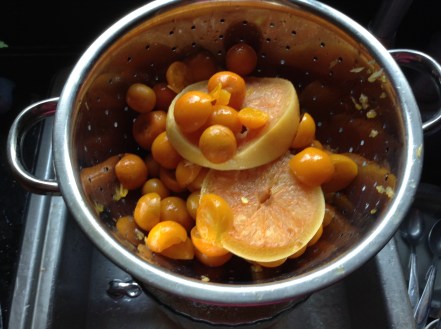
grapefruit and calamondin
It is time for the Food Conspiracy Coop’s eat local challenge. The concept is key to saving the planet in my opinion. I do some gardening and shop at farmers’ markets, but I can’t say I eat 100% locally grown or produced food. When I turn my attention to this challenge, as I have in the past years, I notice how much I still buy in jars and bottles. By shipping my food around in heavy glass containers I add to the cost, but not really to the value, of my selections. I make an effort to use less and less from jars, and I very rarely buy any product in a can. If I can start form scratch I prefer it. Some condiments and ethnic delicacies are beyond my abilities to create at home, so I take pleasure in selecting tasty treats from foreign lands that are either a new sensation, or a serious favorite from the past. Truth be told some of those exotic pricey packaged products are sold at the coop along with locally sourced groceries. That is why the 1-14 of July is an extra special time to head down to Food Conspiracy.
First Fridays are always a day of 10% discounts throughout the store. This month in addition to that discount, all local foods will be on sale for 10% off for two weeks, 1-14 July. This is a chance to kick start the local eating habit with some helpful discounts. A contest will also be held on instagram. Using the hashtag #TucsonEatsLocal, and tagging @foodconspiracy contestants can enter shots of gardens, markets, and dishes prepared with local ingredients to win prizes. The t shirts and $50 gift certificate to the store are cool prizes, but the real prize is the satisfaction of starting a habit that is good for everyone. If this concept caught on in a big way factory farming would become obsolete. Processed foods would give way to fresh and organic because the costs in the long run are lower. By participating in the eat local challenge we bring our attention to how easy it is to do. Have you ever tired to be a locavore, gentle reader? Some places it is much easier than others. I still have citrus vodka I made from our fruits last winter..waste not want not.

citrus hootch
Earlier in the year I made a plan to provide a spa vacation to myself without leaving town this summer. My dog needs me frequently, and the heat is now upon us, so the stay in town has evolved into stay home in the air-conditioning most of the time. I am happy I had started with a plan because the dog care giving could be a depressing situation without it. She is resting most of the time without any apparent pain. I spoke to my cousin this week who is dealing with the end of life issues of her dad. This conversation reminded me how, although the loss is sad and similar, the parent care is a lot more complicated than pet care. I am lucky to have the time and means to be able to stay home with my dog to make her comfortable. I have made some changes to my original plan:
What has been working well at my stay at home spa is the fun with food prep and the use of helpful apps that track my movement and pace. I started using Endomondo while I was still walking outside each morning. It uses GPS to measure distance and speed. I find that my speed dancing a mile is the same as walking outside for a mile. The fitbit has been very helpful to increase my sleep at night, even though I get up for the dog many times. I now use honey to deepen my sleep. By trying the honey method I have increased the average time I sleep each night. This is a very important aspect of keeping my mood positive. With enough movement and enough sleep I can withstand all kinds of stress.
I am also taking advantage of this time to be creative in my own kitchen. I am making new recipes and trying new techniques I have learned from the food preppers. I made refrigerator pickles for the first time. This could be a really fun little hobby as well as a tasty way to keep food from spoiling. I am also working my way through all the chilled soups that look good to me. I have time to write, read, to work on my family history, or do whatever feels good at the time. This too shall pass, but for now I am making it work and reminding myself of the comedy and creativity available to us in life.


Most Auspicious

Venus passes close to Jupiter in the western evening sky during late June and early July in a dazzling celestial display. The image above shows the planets in 2012 when they passed within about 3 degrees of each other. During the 2015 conjunction, the planets appear 9 times closer. This article outlines the circumstances of conjunctions between Venus and Jupiter, the events of this conjunction, and concludes with a list of future Venus-Jupiter conjunctions.
See this article for more as Venus as an Evening Star.
Conjunctions of the bright planets occur when they appear to move past each other in the sky. Sometimes they seem to nearly meet, although they are millions of miles apart. A Venus-Jupiter conjunction occurs between 34 days and 449 days, depending on the relative positions of the three planets (including Earth). Venus revolves around the sun once in about 225 days…
View original post 1,390 more words
I like to use as much fresh produce as possible in all my meals. This summer I have become fascinated with cold soups. I have been a fan of gazpacho forever, and have tried small variations on that theme. Today, thanks to the ever informative index of everything, Pinterest, I am finding new ways to innovate this dish. I was inspired initially by a large haul of fresh plum tomatoes and some bell peppers. They were ripe and needed to be enjoyed. I found a great article in the New York Times by Mark Bittman, one of my favorite food writers. He inspired me to start the summer soup adventure with Romesco style red gazpacho, but also broadened my horizons. Green and red gazpacho can be made more interesting by adding other fruits, herbs, and nuts. Using hazelnut rather than almond in my Romesco recipe gave me the rich taste I love in the classic Spanish sauce of the same name. This is a perfect place to improvise and shape the basic taste profiles to suit you and your garden.
The texture is matter of taste. Some people blend everything until smooth, others prefer some smooth, and some chunks. I am a fan of the smooth with good looking garnishes. Salmorejo is a variation, also popular in Spain in the summer, known as salmorejo. The ingredients are similar, and no cooking is involved. The classic garnish used in Cordoba, the place of this yummy concoction’s origin, is hard boiled egg slices, and sometimes ham. This beautiful vegetarian version uses smokey flavored oil to achieve the Spanish ham effect. I will be happy with bacos, one of my processed food thrills. The grapes and almonds do look appetizing, but chives, parsley, or any herb in the garden would work well too.
Both gazpacho and salmorejo can be made with beets, which is a riff on the tasty borscht from Europe. There is a cold beet soup from Poland call ed Chlodnik involving horseradish cream. The beet goes on.
I am on a roll with new ideas and delicious results. I have cucumbers and tomatoes to use this week. I have already grilled some peppers, chiles, and plum tomatoes. I am trying the strawberry tomato basil gazpacho this afternoon. Sounds intriguing, since I like those things independently. Do you have a favorite chilled soup recipe, gentle reader? I am very interested in collecting more variations on this theme because in Tucson this is the perfect summer diet.

White House
The United States is reeling from yet another mass shooting. The prayer group interrupted by violence is etched into the soul of the country, no matter where we live, no matter what our own religious affiliations. The idea that sanctuaries are not safe is a chilling reminder. While the world watched the church showed the meaning of Christianity and compassion. The city of Charleston displayed solidarity and strength in the face of the tragedy in one of the most significant structures in town. This flow of forgiveness and faith witnessed from the victims’ friends and families has been powerful in its simplicity. They managed to overcome the natural feelings of betrayal and loss by practicing what they preach. They defer judgement to God and pray for peace that surpasses all understanding. I am overwhelmed with gratitude to the congregation of Mother Emmanuel for teaching the country how to mourn, and how to move past sorrow into great compassion. We all need to heed this lesson. These people seem like saints, and indeed they may be. They have a powerful message of hope for us. Nothing is black and white. Nothing is really even under our control. Remember the first commandment when you think you might need to right some wrongs…this is clearly not your personal job.
Meanwhile, right before Gay Pride Weekend in many parts of the country, same sex marriage has become the law of the land. With rainbows flying and floating and projecting everywhere the party to celebrate these new civil rights began. The rainbows appeared early in the morning on Friday and by nightfall the projected rainbows fell on buildings and natural wonders of the world. Other countries celebrated with us by lighting structures to tweet with the hashtag #LoveWins. Twitter supplies a rainbow heart for each #LoveWins, adding to the colorful festive digital fiesta. I found the switch from our black and white racial and political divides to an all out rainbow nation to be refreshing. We need to have a reason to be proud, to embrace the happiness of others, and to actually celebrate equality. Rainbows signify our diversity and our harmony. Let us keep the faith that this nation still has the spirit and the will to make sure that #LoveWins in our future.
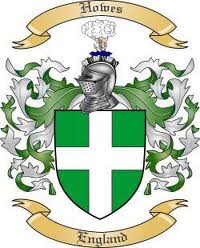
Howes Coat of Arms
My 13th great-grandmother was arrested in London for her religious beliefs. She moved to Barnstable, on Cape Cod with her extended family.
It is claimed that this family descends from one John de Huse who had a large manorial property in Basthorpe, Norfolk, England in 1065.
Penninahs father was a Reverend, Rector of Eastwell, Kent. Penninah and her brother Samuel Howes were arrested in 1632 in London in connection with the prosecution of Rev John Lothrop and his flock of Dissenters who had been meeting in Blackfriars, London. Penninah Howes was called and required to take her oath but she refused. The prosecutor asked “Will you trust Mr Lathropp and believe him rather than the Church of England?” She replied “I referre myself to the Word of God, whether I maie take this oath or now.”
Jemimah Peninah Howse (1589 – 1633)
is my 13th great grandmother
Sarah Linnell (1603 – 1652)
daughter of Jemimah Peninah Howse
Thomas Ewer (1593 – 1638)
son of Sarah Linnell
Mary Ewer (1637 – 1693)
daughter of Thomas Ewer
Mehitable Jenkins (1655 – 1684)
daughter of Mary Ewer
Isaac Hamblin (1676 – 1710)
son of Mehitable Jenkins
Eleazer Hamblin (1699 – 1771)
son of Isaac Hamblin
Sarah Hamblin (1721 – 1814)
daughter of Eleazer Hamblin
Mercy Hazen (1747 – 1819)
daughter of Sarah Hamblin
Martha Mead (1784 – 1860)
daughter of Mercy Hazen
Abner Morse (1808 – 1838)
son of Martha Mead
Daniel Rowland Morse (1838 – 1910)
son of Abner Morse
Jason A Morse (1862 – 1932)
son of Daniel Rowland Morse
Ernest Abner Morse (1890 – 1965)
son of Jason A Morse
Richard Arden Morse (1920 – 2004)
son of Ernest Abner Morse
Pamela Morse
I am the daughter of Richard Arden Morse
The Howes, Lothrops, and Linnells of Kent and London, England, and Scituate
and Barnstable, Massachusetts
By Dan R. McConnell
Published by the Cape Cod Genealogical Society Bulletin, Fall 2007
The family of Reverend John Howes [also House, Howse], whose children, kin, and friends, were brought before the Royal Court of the High Commission in London, England in the 1630’s, were persecuted and imprisoned for their religious beliefs. These beliefs also had political effects, which we will explain. Some fled to America, first to Scituate, then Barnstable, both of which were in Plymouth Colony in that time, a place friendly to their Separatist beliefs. Others remained in England and played a key role in the emergence of non-conformist churches, the disputes in Parliament, and the English Civil War.
In the 17th Century, for ordinary people, a lengthy confinement in London prisons such as Newgate, Clink, Fleet or Bridewell was tantamount to a death sentence due to crowded, filthy, disease-ridden conditions. Such dangerous confinement, for religious non-conformity, under the arbitrary rules of the High Commission, became a driving force for like minded people to flee to America. English resentment to the many breaches of Common Law led to the rise of Parliament in opposition, and ultimately to the abolishment of the High Commission in 1641 and the Civil war in the 1640’s. After the “Glorious Revolution’ in 1688, the English Bill of Rights was enacted to specifically forbid such practices, echoed famously in our own Bill of Rights, the First Ten Amendments to the U.S Constitution.
For the Howes family and their kin, the road to prison and to America began in Kent. The Reverend John Howes matriculated at St. John’s College, Cambridge in 1590. He is listed in the Alumni Cantabrigienes as such with the further note that he was rector at Eastwell, Kent in 1610. In the Bishop’s Transcripts for Canterbury he is also given as Curate for Egerton, 1592-6. From his location at the time of the baptism of his children, he is likely to have also been Curate for Eastwell from 1603 to his death in 1630. He performed the marriage ceremony for his daughter Hannah, in her marriage to Rev. John Lothrop [also Lothropp] in Eastwell, 16 October, 1610. In his will, dated 1630, he is described as Minister, Eastwell. In his will, his wife’s name is given as Alice.
Children of the Reverend John Howes:
Elizabeth Howes, Bapt, unkn. Married, Eastwell to John Champion, of Little Chart, 28 September 1607
Hannah Howes, Bapt. Egerton, 5 May, 1595. Died between 1632 and 1634, London, while her husband, Rev Lothrop, was in prison. Married,Eastwell to Rev. John Lothrop, 16 October 1610.
Peninah Howes, Bapt, Egerton, 11 April, 1596. Died after 1669, Barnstable, Massachusetts.
Married between 1632 and 1638 to Robert Linnell, probably in London.[The will of her brother Thomas Howes, in 1643 gives her name as Peninah Linnell [also Lynell]. In the High Commission proceedings in 1632, she is given as Peninah Howes].
Druscilla Howes. Bapt., unkn. Married, Eastwell, to Simon Player 17 April 1637 John Howes. Bapt. Eastwell 19 June, 1603. Married Eastwell to Mary Osborn of Ashford, 18 September, 1623.
Priscilla Howes. Bapt Eastwell 25 August, 1605. Buried, Eastwell 28 Nov 1618
Thomas Howes. Bapt. Eastwell, 21 August, 1608. Died 1644 London. In his will, dated 18 October 1643, he lists his wife Elizabeth, his brother Samuel [of Scituate and Barnstable, Mass. See Great Migration Series, Vol. III, I634-5, page 424-8], his sister Peninah Lynell, his sister Druscilla Player.
He also lists as administrators, the famous Puritan Praise God Barbon [Speaker of Parliament during the Commonwealth period, known as “Barebones Parlaimant”, and William Granger, who was brought up before the High Commission along with Barbon’s wife Sara. All were members of Rev. Lothrop’s congregation in London]
Samuel Howes. Bapt Eastwell, 10 June, 1610. Died 12 September 1667, Mass. Married about April 1636 to Ann Hammond of Watertown, Mass. He emigrated to America in 1634, joined Rev Lothrop’s church in Scituate then Barnstable, and returned to Scituate.
Henry Howes. Bapt. Eastwell, 28 June, 1612.
Note. There has been great confusion in the American record to the effect that Robert Linnell’s first wife was a Jemimah Howes, presumably another daughter to Rev. John Howes. This has been compounded by an LDS record of the supposed marriage of a Jemimah Howes to Robert Linnell in 1621 in Ashford, Kent. There are no records to support this.
John Lothrop, son of Thomas Lothrop, bapt, Etton, Yorkshire, 20 Dec, 1584, first entered Oxford, then withdrew and matriculated at Queen’s College, Cambridge, graduating with a B.A 1606, M.A. 1609. He was curate at Little Chart 1609, Egerton 1610, serving until his resignation between 1621 and 1624. In 1625, he succeeded Henry Jacob as Minister to the first Independent Church in London, founded in 1616, and one of the five oldest independent [non-conformist]
churches in England. The principles or covenant of the Jacob/Lothrop church were essentially Separatist and were very close to those of the Rev. John Robinson in Leiden [Pilgrims]. During a period of exile before 1616, Henry Jacob resided with the Robinson congregation in Leiden. These
churches were illegal, as the Church of England, under the King and his appointed Archbishop of Canterbury was the only legal church. The Jacob/Lothrop church met in private, in the homes of congregants. These secret meetings for the purpose of praying preching and interpreting the Bible, were called conventicles.
In 1632, Rev. Lothrop was arrested in the house of one of his congregants along with 42 of his congregation, and was brought before the Court of the High Commission. He, and they, were charged with sedition and holding conventicles. The political nature of the charge of sedition [“an insurrection against established authority”], and the antique language of “conventicle’ [ a
private meeting to hear illegal preaching] renders the charges unclear to modern ears. The charges were, however, deadly serious and the court proceedings unimaginable. The accused had none of the rights of modern citizens. The court was an inquisition, where the accused were forced to testify against themselves, with our counsel. The process was so intimidating that many people were driven to flee. It was one of the driving forces in the Great Migration to New England.
It was no dispute over prayer books and vestments. It was about life, death, and salvation. First, what was the Court of the High Commission? It, along with the Court of the Star Chamber, was a Royal Prerogative Court [King’s Rights], originally created in the time of Henry VII [1485-1509]. These courts were separate from the Civil Courts, or Common Law Courts, which
operated on the basis of precedent, and the rights of English people under the Common Law.
Originally, these courts were established under the King’s right to protect individuals from abuse in Common Law Courts. Under the Elizabeth I and the Stuart Kings [James I and Charles I], these courts were used by the Church of England to suppress those who sought to reform the church, or to seek a different path to salvation, using court rules that were in clear violation with the Common Law. They came down, with extreme severity, on Separatists in particular. Because of
their covenant relationship, Separatists believed that every congregation could be a church unto itself, and could elect it’s own Ministers, by vote of it’s elders, based upon the model of the early Christian church [pre-Constantine]. To do so meant they had no need of the Church of England, and did not accept the authority of the Bishops. This was unacceptable to the Crown. As famously said by King James I, “ No Bishop, no King”. Since the King was the head of the Church of England,
and appointed the Archbishop, he wanted one church with order and conformity. To the King, the Separatists position implied anarchy and chaos, and must be stopped. As James I said further, “ I will harry them out of the land”.
Under Charles I and his Archbishop, William Laud, the screws were tightened much more. Laud was the Chief Judge of the High Commission. In his zeal to suppress nonconformists, he scrapped several principles of English Common Law, including [1] protection against selfincrimination, 2] the right to confront one’s accusers, [3] the right to produce witnesses in one’s
own defense, [4] the right to a prompt hearing in court, so one did not languish in a dangerous jail without a trial, and [5] cruel and unusual punishments. All of these rights were suspended for those, such as the members of Rev. Lothrops congregation, who were brought before the Court of the High Commission in May 1632.
The Ministers and there flock faced brutal treatment. For the high crime of publishing tracts critical of the Bishops many ministers had their ears cut off, their faces branded and were confined to prison for life, which meant death within a few months or a few years at most. When one was brought before the court, the requirement was to sign an oath of Allegiance to the
Church of England, to forswear any contrary belief or practice and to answer any question posed by the judges,consisting of Laud and five other Bishops. To do so meant to abandon their right to choose their own Minister, to hear preaching and to attend Bible study with a Minister of their choice. They believed their own souls to be at stake. They were not allowed any of the basics of a fair trial, and certainly faced cruel punishment. So what did they do? They refused to swear the oath and were jailed. Some died in prison, some were released and fled to America, and some fought for Parliament in the English Civil War.
Now, hear the voices of Archbishop Laud, of Rev. John Lothrop and of the Howes and their friends [from the Proceedings of the Court of the High Commission]:
“ 5 May, 1632. This day were brought to the court out of prison diverse persons whixh were taken on Sunday last at a conventicler met at the House of Barnet, a brewer’s clerk, dwelling in the precinct of Black Friars: By name, John Lothrop, their Minister, Humphrey Barnard, Henry Dod, Samuel Eaton, William Granger, Sara Jones, Sara Jacob, Peninah Howes, Sara Barbon, Susan Wilson and diverse others”—
Statement by the Archbishop—“ You show your selves to be unthankful to God, to the King and to the Church of England, that when, God bbe praised, through his Majesties care and ours that you have preaching in every church, and men have liberty to join in prayer and participation in the sacrements and have catechizing to enlighten you, you in an unthankful manner cast off all this yoke, and in private unlawfully assemble yourselves together making rents and divisions in the church.—You are unlearned men that seek to make up a religion of your own heads!”—“you are desperately heretical”
“Then came in Mr. Lothrop, who is asked by what authority he had to preach and keep this conventicler.” Laud,–“How many women sat cross legged upon the bed, while you sat on one side and preached and prayed most devoutly?” Lothrop. “I keep no such evil company” “Will you lay your hand upon the book and take your oath?’ Lothrop. “I refuse the oath.”
Peninah Howes “ I dare not swear this oath till I am better informed of it, for which I desire time”;;;”I will give an answer of my faith, if I be demanded, but not willingly forswear myself”
Sara Barbon “ I dare not swear, I do not understand it. I will tell the truth without swearing”
Then they were then all taken to the New Prison.
“8 May, 1632. Laud to Sara Jones—“ This you are commanded to do of God who says you must obey your superiors.” Sara Jones “That which is of God is according to God’s Word and the Lord will not hold him guiltless that takes His name in vain”
‘Lothrop. I do not know that that I have done anything which might cause me justly to be brought before the judgement seat of man, and for this oath, I do not know the nature of it”
Laud “You are accused of Schism”
To Samuel Howes ‘Will you take your oath?’ Howes I am a young man and do not know what this oath is”
Peninah Howes is then asked to take the oath, but she refused. Laud “Will you trust Mr Lothrop and believe him rather than the Church of England?’
Because women were not able to hold property she had to sue the court in 1669 for her husband’s estate:
Robert, called “my Brother,” by Mr. John Lothrop, adm. chh. scituate with his wife Sept. 16. 1638, “having a letter of dismission from the church in London.: Took oath of allegaince 1 Feb. 1638. Propr. at Barnstable 22 jan 1638-9. ch. Hannah (m. 15 March, 1648, John Davis of Bar.,) Abigail, (m. May 1650, Joshua Lombard,) David, (m. March 9, 1652, Hannah Shelley).
He made will 23 Jan. 1662, prob. 12 March, 1662-3; beq. to wife; to son David; to Abigail and Bethys; to John Davis. The widow Penninnah petitioned the Court 29 Oct. 1669, to recover the house her husband had left her from the hands of David L.

monsoon clouds
The Aztecs worshiped the sun, but in Arizona we worship the rain. Our rainy season is dramatic and somewhat predictable. Summer heat draws moisture up from the Sea of Cortez to form clouds. The monsoon season lasts from late June until August, shifting slightly from year to year. Winter rains are scattered at best, but in the heat of our dry summer we are guaranteed to get some rain. Tropical style thunder storms fly around, dropping a big loads of water and filling the sky with lightening. They can be dangerous because of lightening strikes. Almost every year someone here is stuck by lightning on a golf course. The most severe safety issue that comes with rainy season is flash flooding. Washes fill with water and swell so quickly that anyone in the bed has to hustle in order to avoid being swept away. The rivers that flow through the city can flood the banks and cause damage along the shore, but normally it just carries debris and silt down from the mountains rapidly. Hiking this time of year carries with it risk that other seasons just don’t have. There is erosion of the soil because the surface becomes so compacted that the rain does not sink into the earth when it begins to rain. If we are lucky we will have many afternoons that run in to thunder storms for a few hours. It is rare that it would rain all day. These tropical events are short and sweet.

desert
I catch water from my roof in a rain container in my backyard. It is empty and ready to receive. For those who live in cloudy places it is hard to explain the full significance of these first glimpses of our holy rainy season. It holds promise and humidity for the future. We know that we spend more water resources than we can afford, but for a brief period every summer we can immerse ourselves in storms and lightening, floods and washes overflowing. Water, water, everywhere….but not for long. Here is to a glorious monsoon that sinks into the ground and makes everything bloom with happiness.

ocotillo

 mermaidcamp