mermaidcamp
Keeping current in wellness, in and out of the water
You can scroll the shelf using ← and → keys
You can scroll the shelf using ← and → keys

Forster Coat of Arms
My 13 Great Grandfather was born in England and died in Long Island. He came to America at the age of about 35. He was a founder of the town of Lynn,MA before moving to New York.
Christopher Foster — He came from England in the “Abigail”, in 1635, age 32, with his wife Frances, age 25, and children Rebecca, Nathaniel, and John. The “Abigail” embarked from London, June 4, 1635 and arrived in Boston about Oct. 8, 1635 with small pox aboard. He was made Freeman in Boston, April 17, 1637. In the same year, he was a resident of Lynn, MA, where in 1638, sixty acres of land were alloted to him. He came to Southampton in 1651. He had a previous spouse name unknown who died in 1628. Sally’ s Family Place-Wheeler Christopher Foster was born in July 1603 (Ewell, Surrey, England); He married there 24 Dec 1628 Frances Stevens, born 1 July 1610 daughter of Alice Stevens (will 1645) of Ewell in Surrey, England. Chrostopher Foster styled himself a husbandman on his shipping, embarked in London, June 17, 1635 in the “Abigail.” “In the Abigail from the minister of their conformitie and from the Justices, that they are no susidy men. Christopher foster ae 32, Bxofr ffrancis ffoster ae 25, Rabecca ffoster ae 5, Nathaniel ffoster ae 2, Jo, ffoster ae1, Alice Steevens 11, Tho Steevens 12. New pp. C. E. Banks in the book Planter of the Commonwealth, “which traces 2,646 emigrants to America for whom there is a clear record says that Christoper Fostrer was a “husbandman (farmer) of Ewell, County Surrey,” and that Alice Stevens was “probably sister of Mrs. Foster.” He adds the following about the “Abigail” on which others of the passengers were John Winthrop Jr. age 27 and his wife Elizabeth and son Deane. “Abigail of London, Richard Hackwell, Master. She listed passengers fo New England from June 4 until July 24, and sailed from Plymouth as her last port of departure about Aug 1, with two hundred and twenty persons aboard, and many cattle. She arrived in Boston about Oct. 8, 1635, infected with smallpox. among those coming in this ship, but not listed, were Sir Henry Vane, son and heir to Sir Henry Vane, Comptroller of the King’s Household, traveling incognite, the Revernd Hugh Peter, pastor of the English Church at Rotterdam, and the Reverend John Wilson, who was returning to Boston, with his wife, hr first appearance in New England. They were part of the Puritan migration and Hugh Peters, later Cromwell’s chaplain, was on the same ship and helped form the church congregation to which Christopher belonged. Some of the passengers with Christopher Foster are also connected to Sir Thomas Foster. Sir Henry Vane’s son who is the Comptroller of the King’s Household is connected to Sir Thomas Foster household because of the Comtroller for King Henry VIII is entombed next to Sir Thomas Foster. This is amking a clear connection to the royal family especially with Governor Winthrop’s son aboard also and Christopher Foster with them. Further Info on Christopher: He was made a freeman at Boston (or Lynn) April 17 1637. In the same year he was a resident of Lynn where in 1638 sixty acres were allotted to him. At one time, the Fosters lived in Nahant St., Lynn. In 1647, he went to Hempstead, and then to Southampton in 1650, both in New York. In October of 1650, we find him as a townsman or selectman to manage the affairs of the town, being one of the 41 propietors. He mny have been part of the originlal Lynn group that setled Southampton LI; Christopher first appears in records of Southampton in 1651 and he was living there in 1670. His son Nathaniel removed to Hungington LI and their resided. Christopher Foster died 1687; he resided Lynn, MA. and Southamptoin LI (Long Island, NY).
Christopher Lynn Foster (1603 – 1687)
is my 13th great grandfather
John Christopher Foster (1634 – 1687)
son of Christopher Lynn Foster
Rachel Foster (1675 – 1751)
daughter of John Christopher Foster
Abraham Sr Reeves (1699 – 1761)
son of Rachel Foster
Hannah Reeves (1720 – 1769)
daughter of Abraham Sr Reeves
John McGilliard Jr (1759 – 1832)
son of Hannah Reeves
John McGilliard III (1788 – 1878)
son of John McGilliard Jr
Mary McGill (1804 – 1898)
daughter of John McGilliard III
John Wright (1800 – 1870)
son of Mary McGill
Mary Wright (1814 – 1873)
daughter of John Wright
Emiline P Nicholls (1837 – )
daughter of Mary Wright
Harriet Peterson (1856 – 1933)
daughter of Emiline P Nicholls
Sarah Helena Byrne (1878 – 1962)
daughter of Harriet Peterson
Olga Fern Scott (1897 – 1968)
daughter of Sarah Helena Byrne
Richard Arden Morse (1920 – 2004)
son of Olga Fern Scott
Pamela Morse
I am the daughter of Richard Arden Morse
He first came to Boston, where he was a Freemen on 17 April 1637. In 1638, he moved to Lynn, Massachusetts. In 1647, he went to Hempstead, and then to Southampton in 1650, both in New York. In October of 1650, we find him as a townsmen or selectmen to manage the affairs of the town, being one of the 41 proprietors.
HISTORY: Christopher Lynn Foster is the son of Sir Knight Thomas Foster (FORSTER). He (Thomas)changed his name because he married a close cousin named Susanna FORSTER. They had the same Great Great Great Grandfather. This family tree goes back to Sir Knight John Forster and Sir Knight Richard Foster. Sir John rode with King Richard I the Lion Heart to Palestine in the late 1100’s. This family was given the Bamburg Castle by Queen Elizabeth I. The family went bankrupt in the 1700 or 1800 hundreds and sold the castle the the Armstrong family of Adderstone, Northumberland, England which is where the castle is located. The FORSTER FAMILY came to England in the 1000 AD time frame to escape the Saxon invasion into Flanders. The Forster family changed from FORESTER (THE FAMILY were the Counts of Flanders) and evolved from the de FORRESTER of Belgium. The de FORRESTER FAMILY was by record the Prince of Dijon, Belgium in 740 AD. The Counts of Flanders (Anacher Great FORESTER, BALWIN I through the V, Arnulf Forester had marriages to Princess of England, Princess of France, Princess of Luxemboroug, etc. One of the Baldwin’s daughters married William the Conquer. Her name was Matilda. (Info received from Leroy Foster Nov 2002)
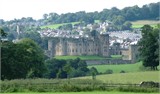
Alnwick Castle
My 16th great grandfather was born into a fancy Scottish family. Politics, diplomacy and treason were part of life in Scotland under King James III:
Robert Boyd (d.c.1470) Lord Boyd, was a Scottish Statesman.
A son of Sir Thomas Boyd (d. 1439), Robert Boyd belonged to an old distinguished family, of which one earlier Sir Robert Boyd, had fought with Sir William Wallace and Robert the Bruce.
Created Lord Boyd in 1454, he was one of the Regents during the minority of King James III, in 1460. He conspired with his brother, Sir Alexander Boyd, and obtained possession of the King’s person in 1466 and was made by Act of Parliament sole Governor of the Realm.
He negotiated the marraige between James and Margaret of Norway in 1469 and secured with it the cession of the Orkney Islands by Norway. He was appointed Great Chamberlain for life, and Lord Justice General in 1467.
Conflict broke out between the King and Boyd family. Robert, and his son Thomas Boyd, 1st Earl of Arran (who was married to Princess Mary), were out of the country involved in diplomatic activities when their regime was overthrown. Robert, 1st Lord Boyd was pronounced guilty of treason and fled firstly to Alnwick, Northumberland. His brother and assistant, Sir Alexander Boyd, was captured and beheaded on November 22, 1469.
Robert 1st Lord Boyd fought in the English service in the French wars, and died in exile.
He married Mariotta, daughter of Sir John Maxwell of Calderwood, and had numerous issue. One of his daughters, Elizabeth, married Archibald Douglas, 5th Earl of Angus.
Robert Boyd (1425 – 1470)
Lord Boyd conspired with his brother, Sir Alexander Boyd, and obtained possession of the young King’s person in 1466 and was made by Act of Parliament sole Governor of the Realm; and Great Chamberlain for life, and Lord Justice General in 1467.[4] Early in that year he procured the marriage of his eldest son, Thomas, (created Earl of Arran for that occasion) with Mary, elder sister of James III, which aroused the jealousy of the other nobles[1] and made his eventual downfall inevitable since the King regarded the marriage as an unforgivable insult.
Lord Boyd obtained the cession of the Orkney Islands to Scotland, 8 September 1468, from Christian I, King of Norway, for whose daughter Margaret, he negotiated a marriage with James III. While absent for that purpose he and his son Thomas (the Earl of Arran) and his brother (and coadjutor) Sir Alexander Boyd, were attainted for high treason, whereby his peerage became forfeited. He was living Easter 1480/1, and died before October 1482, it is said, at Alnwick in Northumberland where he had fled in 1469.[1]
James III’s biographer sums Boyd up as an unscrupulous political gambler and an inveterate optimist. To forcibly assume guardianship of an underage King was, indeed, a familiar path to power in mediaeval Scotland, but it was also a dangerous path. Boyd underestimated the dangers, overestimated his support, and made the fatal mistake of marrying his son to the King’s sister, an insult the King would not forgive.[5]
FamilyRobert Boyd belonged to an old and distinguished family, of which one earlier Sir Robert Boyd, had fought with Sir William Wallace and Robert The Bruce.[4] He was the son and heir of Sir Thomas Boyd of Kilmarnock (died 9 July 1439).[1] Robert married Mariot (or Janet), daughter of Sir Robert Maxwell of Calderwood. She died after 25 June 1472, apparently early in 1473.[1] They had three sons:[6]
[ edit] References
Attribution
 This article incorporates text from a publication now in the public domain: Chisholm, Hugh, ed. (1911). “Boyd, Robert Boyd”. Encyclopædia Britannica. 4 (11th ed.). Cambridge University Press. pp. 353,354. http://www.archive.org/stream/encyclopaediabri04chisrich#page/353/mode/1up. This article incorporates text from a publication now in the public domain: Cokayne, George Edward, ed. (1912). Complete peerage of England, Scotland, Ireland, Great Britain and the United Kingdom, extant, extinct or dormant (Bass to Canning). 2. London: The St. Catherine Press, ltd.. pp. 260,261. http://www.archive.org/details/completepeerageo02coka. This article incorporates text from a publication now in the public domain: Balfour, Paul, James (1904). The Scots peerage; founded on Wood’s edition of Sir Robert Douglas’s peerage of Scotland; containing an historical and genealogical account of the nobility of that kingdom. 5. Edinburgh: D. Douglas. pp. 145,146.
Peerage of ScotlandPre ceded byNew Creation Lord Boyd1454–1482Succeeded byJames Boyd





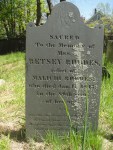

Since I study history through my ancestors’ perspective when I can, my dreams have become full of the characters from whom I descend. The way war and conflict are taught in school ,winners and the vanquished divide spoils and define conquest as history progressed. Places, however, record, digest, and reflect history on a different level. Environment and social structure result from human use of land and resources. If ownership and preservation of historical culture is valued and given high priority, the place is subject to less wasteful development. Pawtuxet, RI preserves history by keeping homes from the past in tact. Seeing places my ancestors have lived and died brings history to life for me, and fills my dreams with the struggles and joys they experienced.
The village of Pawtuxet is a place where local residents function as the tourist board. I was directed by local ladies at the cafe to drive up Post Road and start to look for Malachi Rhode’s home. I found it right away and saw the current resident in his back yard. I resisted the temptation to ask him if I could go into his back yard since my family had owned the home in the 1700’s. I had visited the larger new cemetery with graves that included Rhodes in great number. The small ancient graveyard on the Post Road was even more peaceful and special. I found Malachi there, within walking distance of his house. His life is honored and his place in history kept as a treasure that belongs to the place. Seeing and feeling the place put me in touch with the spirit of all my relations.

William Kirkcaldy
My 13th great grandfather lived in Scotland when religion was making life very difficult for all involved. Mary Stuart reigned as a Catholic. Life was uneasy and brutal:
Biography from Wikipedia:
“Sir William Kirkcaldy of Grange (c. 1520 – 3 August 1573), Scottish politician and general, was the eldest son of Sir James Kirkcaldy of Grange (d. 1556), a member of an old Fife family. The house of the Grange lands was Halyards Palace.
Sir James was lord high treasurer of Scotland from 1537 to 1543 and was a determined opponent of Cardinal Beaton, for whose murder in 1546 he was partly responsible. William Kirkcaldy assisted to compass this murder, and when the castle of St Andrew’s surrendered to the French in July 1547 he was sent as a prisoner to Normandy, whence he escaped in 1550.
He was then employed in France as a secret agent by the advisers of Edward VI, being known in the cyphers as Corax; and later he served in the French army, where he gained a lasting reputation for skill and bravery. The sentence passed on Kirkcaldy for his share in Beaton’s murder was removed in 1556, and returning to Scotland in 1557 he came quickly to the front; as a Protestant he was one of the leaders of the lords of the congregation in their struggle with the regent, Mary of Guise, and he assisted to harass the French troops in Fife. He opposed Queen Mary’s marriage with Darnley, being associated at this time with Moray, and was forced for a short time to seek refuge in England.
Returning to Scotland, he was an accessory to the murder of Rizzio, but he had no share in that of Darnley, and he was one of the lords who banded themselves together to rescue Mary after her marriage with Bothwell. After the fight at Carberry Hill the queen surrendered herself to Kirkcaldy, and his generalship was mainly responsible for her defeat at the Battle of Langside. Kirkcaldy sailed to Orkney as Lord High Admiral of Scotland in pursuit of Bothwell, but his ship, the Lion, ran aground.[1] He seems, however, to have believed that an arrangement with Mary was possible, and coming under the influence of William Maitland of Lethington, whom in September 1569 he released by a stratagem from his confinement in Edinburgh, he was soon vehemently suspected by his fellows.
After the murder of Moray, Kirkcaldy ranged himself definitely among the friends of the imprisoned queen. About this time he forcibly released one of his supporters from imprisonment, a step which led to an altercation with his former friend John Knox, who called him a murderer and throat-cutter. Defying the regent Lennox, Kirkcaldy began to strengthen the fortifications of Edinburgh castle, of which he was governor, and which he held for Mary, and early in 1573 he refused to come to an agreement with the regent Morton because the terms of peace did not include a section of his friends.
After this some English troops arrived to help the Scots, and in May 1573 the castle surrendered. Strenuous efforts were made to save Kirkcaldy from the vengeance of his foes, but they were unavailing; Knox had prophesied that he would be hanged, and he was hanged on the 3rd of August 1573.”
William Kirkcaldy (1520 – 1573)
is my 13th great grandfather
Janet Kirkcaldy (1520 – 1572)
daughter of William Kirkcaldy
William Carr (1542 – 1655)
son of Janet Kirkcaldy
Benjamin Carr (1592 – 1635)
son of William Carr
Caleb Carr (1623 – 1695)
son of Benjamin Carr
Sarah Carr (1682 – 1765)
daughter of Caleb Carr
John Hammett (1705 – 1752)
son of Sarah Carr
MARGARET HAMMETT (1721 – 1753)
daughter of John Hammett
Benjamin Sweet (1722 – 1789)
son of MARGARET HAMMETT
Paul Sweet (1762 – 1836)
son of Benjamin Sweet
Valentine Sweet (1791 – 1858)
son of Paul Sweet
Sarah LaVina Sweet (1840 – 1923)
daughter of Valentine Sweet
Jason A Morse (1862 – 1932)
son of Sarah LaVina Sweet
Ernest Abner Morse (1890 – 1965)
son of Jason A Morse
Richard Arden Morse (1920 – 2004)
son of Ernest Abner Morse
Pamela Morse
I am the daughter of Richard Arden Morse
If I learned one thing on my ancestry quest in Massachusetts it is that the record keeper is the author of history. I have realized this by finding census and other documents that conflict with each other while studying my ancestors. Never has it been so clear. I believed that the tribe would have the information on the tribe in Mashpee, so I went straight to the museum to inquire. Because they rely on records kept by the Europeans the family trees are reconstructed using English last names. They use what they have. The records looked like they started in the 1800’s.


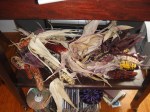


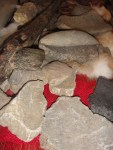
I was unhappy about the state of affairs. The tiny tribal museum has little funding, and can open only a few hours, a couple of days a week. I then traveled to the big well funded museum at Plimouth Plantation. Wow, what a difference!!!
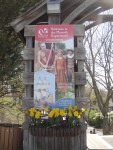
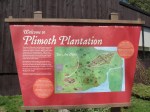



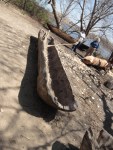



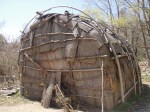

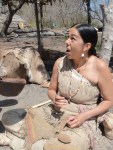


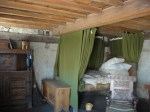


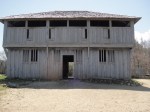

The museum at Plimouth Plantation is doing some revisionist history in order to correct many of the assumptions and erroneous stories that exist about the Mayflower and the native people. The Pilgrims play characters in period costume, expressing the beliefs of the time and place. The Pilgrims were religious prudes who considered themselves religiously superior to all other religions. They also felt entitled to take anything they wanted from the native people because they had permission from the King of England. Their church was fortified on top with cannons in all directions. I guess they felt that God and the King needed some back up. Although I had a few Pilgrims and only one ( I think) Wampanoag ancestor, I distinctly disliked the pretend Pilgrims when I met them. I am, however, glad they kept some records at the time.
The moon, the way we view it ,and the power it holds have been studied for all of history. The phases of the moon are significant in agriculture as well as business. Lunar calendars were used to measure time until the Catholics went Gregorian on the Euros. Since the Julian calendar , created by Julius Caesar in 46 BC was inaccurate in terms of the planets, the Pope became concerned that Easter was sliding into summer. Catholic calendar year is key to the liturgy practice and costuming. The whole system supporting the Easter Bonnet was slowly slipping away with each new year. Astronomers were hired to deal with the issue. The Greek Orthodox religion uses the Julian calendar now, as do the Berbers, the Ethiopians, and others concerned with historical continuity.
The Pope as a symbol was resisted by the Protestants. The idea that Pope Gregory would now change the way they counted time was not going to go over with the new religions that sprung up precisely to combat Popery. At his death the Vatican treasury was empty, but Gregory XIII had left his mark on time. For this reason the Gregorian style was not adopted at the same time. The Swiss used both calendars simultaneously for more than 100 years. The Catholic cantons adopted it when they got the bull from the Pope in 1582. The Protestants kept the Julian style rather than agree with a Catholic concept. The Protestant cantons gave in to the new calendar in 1700. The canton of St Gallen was the last hold out, continuing on the lunar side of life until 1724. The Chinese succumbed in 1949, but they still use their own lunar calendar.
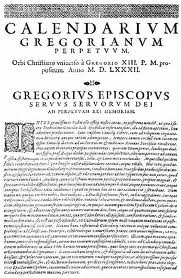
News from Pope Gregory XIII
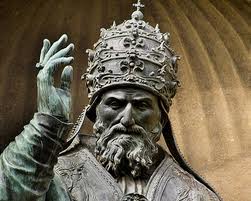
Gregory XIII in elaborate Easter Bonnet
The celebration of Women’s History Month will take place in March, 2013 with a theme about innovation and imagination. A salute to women in engineering, math and science must include the women who broke into those and other fields after a struggle to be educated. By following a timeline we can see the contributions women have made. The Queen archetype, both in history and in mythology has power to rule with wisdom when she is at her best. Queens inherit the power and responsibility of ruling people wisely. The shadow queen is ruled by her own heart and lacks boundaries.
It is obvious that without women there could be no history, no men, and no archetypes. Our collective consciousness is full of both reality and projections. To create a better and more wholesome future it behooves us to sort out delusions in order to enlighten both men and women. When archetypes are understood well the need to perceive the world by using stereotypes can vanish. Stereotypes are cliche. Archetypes are infinitely instructive. When you look around the world do you notice examples of both? How do you avoid being a stereotype?
Space and time are the first two elements of fine festivity. A party, gentle reader, must have room to breathe and become what it wants to be. One can always have impeccable timing if one takes time to consider the elements and the goals. My party in Providence, RI is to celebrate with the living and the dead. I will visit some of my ancestors who lived there in the early 1600’s and discover people who live there now. For me , this is an excellent balance. I like both groups equally.
The city contains historic buildings and museums that will please me a great deal, but I have also perceived some excellent night life and party opportunities downtown. I will visit Plymouth Colony, Martha’s Vineyard, and the Wampanoag village before returning to Providence to party. I will probably need a day to myself in the Rhode Island School of Design Museum, after which I believe I will feel like painting Rhode Island red (a little rooster humor). I love nothing better than historic architecture put to modern artful uses. I am highly attracted to the whole state because it is so tiny and well preserved. It appears to have fabulous taste and a high fun factor, not to mention a history of wealth and power. I am looking forward to discovering what Providence has in store for me.
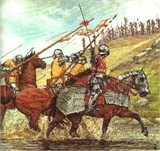
Battle of Blore Heath
My 15th great grandfather was a knight involved with Brit royalty. He lost his life defending it in a battle called Blore Heath. They were fighting about roses (red and white, although I am still not sure what the symbols meant) and the right to the throne. They were royals. They were angry. Things got bloody nasty:
The Battle of Blore Heath
September 23, 1459
After four years of uneasy peace the King presided over a wasting realm. No parliament had been summoned for three years, the country was sadly divided and distressed. The Yorkists were armed, armies were marching across all England. Lord Audley had recently raised a Lancastrian army centered round Market Drayton, and the Queen -through whom the King ruled- sent him orders to intercept Lord Salisbury, who was marching from Yorkshire to join the Duke of York at Ludlow. The two armies met head on two and a half miles east of Market Drayton at a place called Blore Heath. Salisbury, with 3,000 troops, was outnumbered by more than two to one, but could not avoid giving battle.
Audley took up a position just west of a little stream that crossed the Market Drayton-Newcastle-under-Lyme road, and Salisbury’s men were drawn up about 150 yards east of the present Audley Cross, which marks the spot where Lord Audley fell. The Yorkist left rested upon the boggy edge of a wood, but their right was in the air, and Salisbury made a laager of his wagons to protect this flank. Whether Salisbury feigned retreat in order to draw Audley on is not certain, but the Lancastrian commander was definitely the one to attack. Two cavalry charges were repulsed, the first with heavy loss to the Lancastrians, and then they mounted an infantry attack up the hill to the Yorkist position. But this too failed; there was no support from the cavalry, Lord Audley had already fallen and 500 Lancastrians chose this moment to desert to the enemy. Salisbury’s victory was complete and in the pursuit, which continued for two miles, the slaughter was very heavy. Possibly 2,000 Lancastrians perished in this battle, but fewer than 200 Yorkists fell.
For more information on the Battle of Blore Heath, contact Blore Heath 1459 online at http://www.bloreheath.org
YORKISTS LANCASTRIANS
Sir Christopher Conyers of Sokebourne, Durham
Sir Henry Bromflete, Wymington, Bedford
Sir John Conyers of Hornby, Yorkshire
Sir Robert del Booth of Wilmslow, Cheshire (killed in battle)
Sir Walter Devereux of Weobley, Herefordshire (killed in battle)
Sir John Bourchier of West Horsley, Surrey
Sir Richard Grey of Powis, Powis
Sir Hugh Calveley of the Lea, Cheshire (killed in battle)
Sir Richard Hamerton of Hamerton, Yorkshire
Sir William Catesby (Sr.) of Ashby St. Legers, Northamptonshire
Sir Thomas Harrington, Lancashire
Sir John Dawne of Cheshire
Sir Roger Kynaston of Hordley, Shropshire
Sir Jerkin Done of Wickington, Cheshire (killed in battle)
Sir Thomas Lumley of Lumley, Durham
Sir Robert Downes of Shrigley, (killed in battle)
Thomas Meering of Tong
Sir Thomas Dutton of Dutton, Cheshire (killed in battle)
Sir James Metcalfe of Nappa, Yorkshire
Sir John Dwnn of Cheshire, killed in battle
Sir John Middleton of Belsay Castle, Northumberland
Sir John Egerton of Egerton, Cheshire (killed in battle)
Sir Thomas Mountford of Hackforth, Yorkshire
Sir Nicholas of Eyton of Eyton, Shropshire
Sir Richard Neville (Earl of Salisbury) of Middleham, Yorkshire (fled to Calais)
Sir Richard Fitton of Gawsforth, Cheshire
Sir Richard Neville (Earl of Warwick) of Middleham, Yorkshire (fled to Calais)
Thomas Fitton, fate unknown
Sir Thomas Neville of Thornton Bridge, Durham
Sir John Haigh, killed in battle
Sir Robert Ogle of Ogle, Northumberland
Sir Edmund Hampden of Hampden, Buckinghamshire
Sir Thomas Parr of Kendal, Westmoreland
Sir Thomas Hesketh of Rufford, Lancashire
Richard Plantagenet, Duke of York, fled to Ireland
Sir Henry Holland of Darlington, Devon
Sir William Pudsey of Selaby, Durham
Sir John Legh of Booths, Cheshire (killed in battle)
Sir James Strangeways of Whorlton, Yorkshire
Sir Philip Maunsell of Scrurlage, Glamorgan
Sir Walter Strickland of Sizergh, Westmoreland
Sir Richard Molyneux of Sefton, Lancashire (killed in battle)
Sir John Wandesford of Kirklington, Yorkshire
Sir John Neville of Raby, Durham
Sir John Wenlock of Wenlock, Shropshire
Sir Ralph Shirley of Shirley, Sussex
Sir Walter Wrottesley of Wrottesley, Shropshire
Sir John Skidmore of Mochas, Herefordshire
Sir John Stanley of Pipe, Staffordshire
Sir Edmund Sutton of Dudley, Westmoreland
Sir John Sutton of Dudley, Westmoreland
Sir William Troutbeck of Dunham-on-the-Hill, killed in battle
James Touchet (Lord Audley) of Markeaton, Derbyshire (killed in battle)
Sir Hugh Venables of Kinderton (killed in battle)
©The Richard III Foundation, Inc.
Sir Richard Earl Sefton Molyneux (1422 – 1459)
is my 15th great grandfather
Thomas Sir 8th Earl of Sefton Molyneux (1445 – 1483)
Son of Sir Richard Earl Sefton
Lawrence Castellan of Liverpool Mollenaux (1490 – 1550)
Son of Thomas Sir 8th Earl of Sefton
John Mollenax (1542 – 1583)
Son of Lawrence Castellan of Liverpool
Mary Mollenax (1559 – 1575)
Daughter of John
Francis Gabriell Holland (1596 – 1660)
Son of Mary
John Holland (1628 – 1710)
Son of Francis Gabriell
Elizabeth Holland (1652 – 1737)
Daughter of John
Richard Dearden (1645 – 1747)
Son of Elizabeth
George Dearden (1705 – 1749)
Son of Richard
George Darden (1734 – 1807)
Son of George
David Darden (1770 – 1820)
Son of George
Minerva Truly Darden (1806 – )
Daughter of David
Sarah E Hughes (1829 – 1911)
Daughter of Minerva Truly
Lucinda Jane Armer (1847 – 1939)
Daughter of Sarah E
George Harvey Taylor (1884 – 1941)
Son of Lucinda Jane
Ruby Lee Taylor (1922 – 2008)
Daughter of George Harvey
Pamela Morse
I am the daughter of Ruby Lee
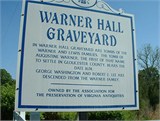
My Dead Peeps
I have traveled in person only once to visit my dead ancestors and look for local records of their lives. I went to Tulsa, where I was born, and my grandparents are buried, but I can not find their graves. After my cousin went back to Iowa I did more investigation in the town where my father was born, Independence, KS. I drove to the small rural town of Ladore, where many of my ancestors settled when they came from Ohio and New York. I found the grave of one of my 2nd great grandmother while looking for somebody else. It made the hair stand up on my neck even in sweltering humid July in Kansas. I have been all over the world on all kinds of journeys, but this is a whole new way to look at travel…visiting history by combining the ancestors and geography. Kinky, and very cool.
I have accumulated and am trying to geographically arrange data on ancestors around Plymouth Colony, MA and around Jamestown, VA. I will go to both destinations eventually, but have to choose one to be the first. The peeps are mostly very fancy in both places and we know how to find many of the graves, some homes, etc. I am not really into them for the royal blood and fame, I just like them because they survived. It is nothing like visiting living relatives. They are past judgement and are all very low maintenance. They are what you might call spooky. I just learned from a local that Virginia is a vortex for ticks, which makes graves in Massachusetts instantly sound so much more appealing. I am thinking now of flying to tick free, but cold Boston. Someday I will procure the right tick graveyard gear to safely visit my Virginians…like Mary, who is in the private and elite graveyard at Warner Hall with a lot of my other ancestors:
The walled family cemetery of the Warner and Lewis families is located on the Warner Hall property, southeast of Warner Hall. Access to the Graveyard is from the road North of Warner Hall and not from Warner Hall or the Driveway to Warner Hall located West of the Graveyard. The cemetery is the final resting place for many of the Warner and Lewis family members. The family cemetery, is also the resting place for such well known ancestors of George Washington, Robert E. Lee, The Queen Mother of England, and Queen Elizabeth II. Queen Elizabeth has visited Gloucester where she placed a wreath upon her ancestor’s grave. The cemetery has thirteen graves and plaques in memory of all the family. The cemetery is owned and maintained by the Association for Preservation of Virginia Antiquities (A.P.V.A.). The A.P.V.A. acquired the cemetery at Warner Hall in 1903, since which time the Association’s Gloucester Branch, now known as the Joseph Bryan Branch, has zealously maintained it.
There are thirteen graves in the Warner Hall Grave Yard. they are:1 Mary Warner (believed to be Mary Towneley Warner), 1614 – 16622 Augustine Warner I, 1611 – 16743 Augustine Warner II, 1642 – 16814 Mildred Reade Warner (wife of Augustine Warner II), 16945 Augustine Warner III, 1666 – 16866 Elizabeth Warner Lewis (d/o Augustine Warner II w/o Col John Lewis), 1672 – 17197 Col John Lewis (s/o John & Isabella Lewis h/o Elizabeth Warner), 1669 – 17258 Mary Chiswell Lewis (d/o John & Elizabeth Randolph Chiswell w/o Warner Lewis II, 1748 – 17769 Warner Lewis II (s/o Warner Lewis I & Eleanor Bowles Gooch Lewis & grandson of Col John Lewis & Elizabeth Warner Lewis), 1747 – 179110 Juliana Clayton (d/o Dr. Thomas & Isabella Lewis Clayton), 1731 – 173411 Isabella Lewis Clayton (d/o Col John Lewis & Elizabeth Warner w/o Dr. Thomas Clayton), 1706/7 – 1742 (the dates 1706/7 is exactly what is engraved on her stone)12 (Dr.) Thomas Clayton (h/o Isabella Lewis), 1701 – 173913 Caroline Lewis Barrett (d/o Warner Lewis II), 1783 – 1811

Private Graveyard at Warner Hall
 mermaidcamp