mermaidcamp
Keeping current in wellness, in and out of the water
You can scroll the shelf using ← and → keys
You can scroll the shelf using ← and → keys
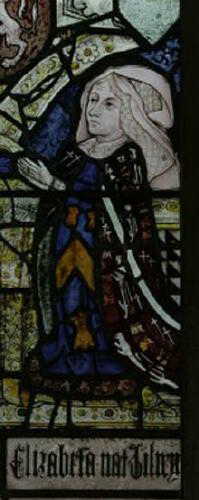
My 17th great-grandmother was married twice. She was the great-grandmother of Anne Boleyn, Jane Seymour, and Catherine Howard, who all met an unfortunate end as wives of Henry VIII. That is really a coincidence, I think. She was buried with her second husband St. Augustine church at Broxbourne.

Elizabeth Cheney (1420 – 1473)
17th great-grandmother
Elizabeth Tilney (1450 – 1497)
Daughter of Elizabeth Cheney
Lord Thomas Howard (1473 – 1554)
Son of Elizabeth Tilney
Lady Katherine Howard Duchess Bridgewater (1495 – 1554)
Daughter of Lord Thomas Howard
William ApRhys (1522 – 1588)
Son of Lady Katherine Howard Duchess Bridgewater
Henry Rice (1555 – 1621)
Son of William ApRhys
Edmund Rice (1594 – 1663)
Son of Henry Rice
Edward Rice (1622 – 1712)
Son of Edmund Rice
Lydia Rice (1649 – 1723)
Daughter of Edward Rice
Lydia Woods (1672 – 1738)
Daughter of Lydia Rice
Lydia Eager (1696 – 1735)
Daughter of Lydia Woods
Mary Thomas (1729 – 1801)
Daughter of Lydia Eager
Joseph Morse III (1756 – 1835)
Son of Mary Thomas
John Henry Morse (1775 – 1864)
Son of Joseph Morse III
Abner Morse (1808 – 1838)
Son of John Henry Morse
Daniel Rowland Morse (1838 – 1910)
Son of Abner Morse
Jason A Morse (1862 – 1932)
Son of Daniel Rowland Morse
Ernest Abner Morse (1890 – 1965)
Son of Jason A Morse
Richard Arden Morse (1920 – 2004)
Son of Ernest Abner Morse
Pamela Morse
I am the daughter of Richard Arden Morse
Elizabeth Cheney (April 1422 – 25 September 1473), later known as Elizabeth, Lady Tilney and Elizabeth, Lady Say, was an English aristocrat, who, by dint of her two marriages, was the great-grandmother of Anne Boleyn, Jane Seymour, and Catherine Howard, three of the wives of King Henry VIII of England, thus making her great-great-grandmother to King Edward VI, the son of Henry VIII and Jane Seymour, and Elizabeth I, the daughter of Henry VIII and Anne Boleyn. Her first husband was Sir Frederick Tilney, and her second husband was Sir John Say, Speaker of the House of Commons. She produced a total of nine children from both marriages.
Born in Fen Ditton, Cambridgeshire in April 1422, she was the eldest child of Laurence or Lawrence Cheney or Cheyne, Esq. (c. 1396 – 1461), High Sheriff of Cambridgeshire and Elizabeth Cokayn or Cokayne Her paternal grandparents were Sir William Cheney and Katherine Pabenham, and her maternal grandparents were Sir John Cockayne, Chief Baron of the Exchequer and Ida de Grey, the daughter of Reginald Grey, 2nd Baron Grey de Ruthyn and Eleanor Le Strange of Blackmere.
On an unknown date, Elizabeth married her first husband Sir Frederick Tilney, of Ashwellthorpe, Norfolk, and Boston, Lincolnshire. He was the son of Sir Philip Tilney and Isabel Thorpe. They made their principal residence at Ashwellthorpe Manor. The couple had one daughter:
Elizabeth Tilney (before 1445 – 4 April 1497), married firstly in about 1466, Sir Humphrey Bourchier, by whom she had three children; and secondly on 30 April 1472, Thomas Howard, Earl of Surrey, who later became the 2nd Duke of Norfolk, by whom she had nine children. These children included Thomas Howard, 3rd Duke of Norfolk, Elizabeth Howard, mother of Anne Boleyn, and Lord Edmund Howard, father of Catherine Howard.
Sir Frederick Tilney died in 1445, leaving their young daughter Elizabeth as heiress to his estates. Shortly before 1 December 1446, Elizabeth Cheney married secondly Sir John Say, of Broxbourne, Hertfordshire, Speaker of the House of Commons, and a member of the household of King Henry VI. He was a member of the embassy, led by William de la Pole, which was sent to France in 1444 to negotiate with King Charles VII for the marriage between King Henry and Margaret of Anjou. Her father settled land worth fifty marks clear per annum upon the couple and their issue before Candlemas, 1453. They made their home at Broxbourne, Hertfordshire.
Sir John Say and Elizabeth had three sons and four daughters:
Sir William Say (1452- 1529), of Baas (in Broxbourne), Bedwell (in Essendon), Bennington, Little Berkhampstead, and Sawbridgeworth, Hertfordshire, Lawford, Essex, Market Overton, Rutland, etc., Burgess (M.P.) for Plympton, Knight of the Shire for Hertfordshire, Sheriff of Somerset and Dorset, 1478–9, Sheriff of Essex and Hertfordshire, 1482–3, Justice of the Peace for Hertfordshire, 1486–1506, and, in right of his 1st wife, of East Lydford, Radstock, Spaxton, Wellesleigh, and Wheathill, Somerset, and, in right of his 2nd wife, of Wormingford Hall (in Wormingford), Essex, Great Munden, Hertfordshire, etc. He married (1st) before 18 November 1472 (date of letters of attorney) Genevieve Hill, daughter/heiress of John Hill, of Spaxton, Somerset. She was still alive in 1478. He married (2nd) shortly after 18 April 1480 Elizabeth Fray, widow of Sir Thomas Waldegrave, by whom he had two daughters, Mary Say and Elizabeth Say.
Mary, the eldest daughter married Henry Bourchier, 1st Earl of Essex and 6th Baron Bourchier, by whom she had one daughter, Anne Bourchier, 7th Baroness Bourchier
Thomas Say, of Liston Hall, Essex.
Leonard Say, clerk, Rector of Spaxton, Somerset. See Testamenta Eboracensia, 4 (Surtees Soc. 53) (1869): 86–88 (will of Leonard Say, clerk).
Anne Say (died 1478/1494), married Henry Wentworth, K.B., of Nettlestead, Suffolk, Goxhill, Lincolnshire, Parlington and Pontefract, Yorkshire, and of London, Esquire of the Household, Knight of the Body, Sheriff of Norfolk and Suffolk, 1481–82, Sheriff of Yorkshire, 1489–90, 1492, Knight of the Shire for Yorkshire, 1491–92, by whom she had issue, including Margery Wentworth, mother of Jane Seymour.
Mary Say, married Sir Philip Calthorpe, Knt., by whom she had issue.
Margaret Say, married Thomas Sampson, Esq.
Katherine Say, married Thomas Bassingbourne.
On 25 September 1473, aged 51, Elizabeth Cheney died. She was buried in the church at Broxbourne. Following her death, John Say remarried to Agnes Danvers. He died five years later on 12 April 1478. Sometime after 1478, Elizabeth’s eldest son, Sir William Say, married his second wife, Elizabeth Fray, a daughter of his stepmother Agnes, by her first husband, Sir John Fray (1419- 1461), Chief Baron of the Exchequer.
Sources
John Smith Roskell, Parliament and Politics in Late Medieval England, Vol. 2, Google Books, accessed 9 September 2009
References
Lundy, Darryl. “p.335.htm#3342”. The Peerage.
Ida Ashworth Taylor, Lady Jane Grey and Her Times, page 8, Google Books, accessed 3 September 2009
John Smith Roskell, Parliament and Politics in Late
 Sir John Say, 1478, and wife Elizabeth, 1473, Broxbourne, Hertfordshire.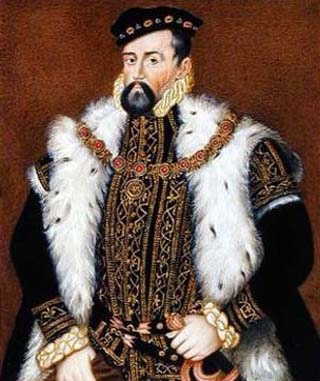
William Pembroke Herbert
My 18th great-grandfather was mixed up in that War of the Roses business that obsessed the British for so long. He was beheaded, as several of my other ancestors were, during those tricky Tudor years. HIs castle, Raglan, can still be visited today.

Raglan Castle
How does one begin to describe the handsome majesty that is Raglan Castle? Raglan, with its great multi-angular towers and Tudor-styling, is unlike any other castle in Wales. There were only three times during our vacation, when visiting a site, I said to myself, “this is why we came to Wales.” The first time was while viewing Conwy Castle from the spur wall near the Quay. The second was upon seeing the cathedral and Bishop’s Palace at St. Davids, and the last was while standing in front of the double-towered gatehouse at Raglan.
The main stone used in construction of the castle is sandstone, but of two different types. The 15th century castle is characterized by pale, almost yellowish sandstone from Redbrook on the Wye river, three miles away. The other sandstone is local Old Red Sandstone, red, brown or purplish in color, used in the Tudor work. A paler stone was also used in the fireplaces. From a distance, Raglan seemed to have a reddish cast, although on approaching the gatehouse, the castle’s yellow sandstone becomes obvious.
The castle is probably most closely associated with William ap Thomas, who fought with King Henry V at the Battle of Agincourt in 1415. In 1426, ap Thomas was knighted by Henry VI, becoming known to his compatriots as “the blue knight of Gwent.” Sir William Herbert, Earl of Pembroke, was the next owner of the castle, and it is Herbert who is responsible for Raglan’s distinctive Tudor-styling. The castle was also the boyhood home of Henry Tudor, later King Henry VII. As a boy he bided his time at Raglan, while his uncle Jasper agitated a Lancastrian return to the throne in the person of young Henry.
Both William ap Thomas and William Herbert fought in France, and undoubtedly, the castles that they saw in that country influenced their work at Raglan. The elaborately decorated polygonal keep, as well as the double-drawbridge arrangement of the keep, unique in Britain, demonstrate French influence. In 1492, Elizabeth Herbert married Sir Charles Somerset, a natural son of Henry Beaufort, third duke of Somerset, and it is to the Somerset family as earls of Worcester that we owe the final architectural touches of the castle.
On approaching the gatehouse, we passed Raglan’s Great Tower, surrounded by its apron wall and beautiful moat. Pink wildflowers spring from the apron wall, creating an unforgettable image. The wall has six corner turrets, one of which has a postern door to the moat. The Great Tower, known as “The Yellow Tower of Gwent,” is the most striking feature at Raglan. It was begun by Sir William ap Thomas and was designed very much in contemporary French style. Unfortunately, the tower was largely destroyed by Parliamentary forces during the English Civil War. The tower and moat are outside the main body of the castle. The Great Gate leading to the Pitched Stone Court lies next to The Great Tower. It was raised by Sir William Herbert, and served as the main entrance to the castle after 1460, however, we chose to continue surveying The Great Tower from the outside, via the park surrounding the moat, finally entering the castle from the South Gate.
Through the South Gate, we entered the main Apartments. The porch and Grand Stair lead to the apartments in the Fountain Court. The Grand Stair reminded us of a similar structure at Carew Castle. The two most impressive rooms at Raglan are The Hall and Long Gallery. The hall is the finest and most complete of the castle’s surviving apartments. A plaque over the dais in the hall bears the distinctive arms of the third earl of Worcester, as Knight of the Garter. Viewing the Great Tower from the apartments, we saw a finely carved shield and badge over the first floor chamber, a good example of the castle’s surviving detail. The Long Gallery has been called one of the finest rooms of Tudor rebuilding in Britain. Once a showcase of Tudor elegance, the gallery contained handsome paintings, tapestries and sculptures. During this time, Raglan was one of Britain’s social centers. Important guests were entertained until the early hours of the morning. The gallery had a series of windows overlooking the Fountain Court, and an ornate Renaissance fireplace. The remains of the fireplace, clearly showing two carved human figures, are a major highlight of the castle.
Re-entering the castle through the Great Gate, we entered the Pitched Stone Court, a large cobblestone area. Standing at the end of the court gives a magnificent view of the rear of the gatehouse and the Attic. The Attic, with its stunning Tudor-style windows, housed another gallery running along the rear of the gatehouse range. The building once held the castle’s extensive library, which was also destroyed by Cromwell’s soldiers. The wonderful thing about Raglan is that there are so many parts of the castle retaining detail and beauty, that you could spend an hour or so just admiring the beauty of any one area. A green park with benches surrounds most of the castle, giving visitors the chance to sit and contemplate the magnificence before them. There are several on-site exhibits explaining the history of the castle, and an extensive giftshop is planned for the future.
We could have easily spent a half day at Raglan, to properly survey the castle. By the time we finished looking at the exhibit rooms, it was late afternoon and time to find lodging for the night. Still, I had to take just one more walk around the moat and Great Tower. I used the excuse that I had not yet seen the back of the castle to prolong our stay. As I took my final walk around the moat, my eyes were fixed on the castle, not on the ground before me. I knew it would be quite some time before I’d experience a site such as this, and I wanted to burn this view of the castle into my memory forever. I was probably lucky I didn’t fall into the moat! Raglan was like a fairy tale castle I was afraid would disappear if I looked away. Carew had its aspects of beauty, but stately Raglan is a handsome, unique structure in every detail. I knew that our trip to Raglan would be a highlight of the trip, but if I had known just how magnificent the site was, I would have certainly set aside more time than the two hours we were there. If you ever travel to south Wales, make seeing Raglan Castle your number one priority. If necessary, drop all other plans, just don’t miss seeing Raglan! Once you visit this wonder of medieval architecture, you’ll understand why.
Cadw 1990
Raglan, stately and handsome, is perhaps deceptive. The might of its angular towers bears comparison with the great castles of Edward I, and suggests its origins lay in the bitter conflicts of the later 13th century. In face it belongs mainly to the 15th century, and was as much a product of social aspiration as it was of military necessity.
It was begun by Sir William ap Thomas, a veteran of the French wars, who grew wealthy through exploiting his position as a local agent of the duke of York in south-east Wales. About 1435 he began building the Great Tower, subsequently known as the Yellow Tower of Gwent, probably on the site of a much earlier Norman motte-and-bailey castle. Surrounded by a water-filled moat, the unusual hexagonal plan of the tower, together with its elaborate drawbridge arrangements, are more easily paralleled in France than in Britain. Within, there was a single large room to each floor, and the entire structure echoed the power and influence of its builder.
Following ap Thomas’s death he was succeeded by his son William Herbert who continued to develop Raglan. As a prominent Yorkist, he played a major role in securing the throne for Edward IV in 1461, and was raised to the peerage as Lord Herbert of Raglan. Eventually rising to earl of Pembroke, his political career is reflected in his sumptuous building. Under Herbert, Raglan became a veritable palace, unmatched in the 15th century southern March. He added the great gatehouse, the Pitched Stone Court and also rebuilt the Fountain Court with a series of formal state apartments for himself and his household. All of these repay careful examination. Notice, for example, the circular gun ports in the lower part of the gatehouse. The great kitchen lay in the tower at the corner of the Pitched Stone Court, and its huge ovens and fireplaces remain.
Herbert was beheaded following his defeat at the battle of Edgecote in 1469, and there were no further major alterations to Raglan until the ownership of William Somerset, earl of Worcester (1548-89). In the main, he was responsible for extensive changes to the hall, which remains the finest and most complete of all apartments in the castle. The huge fireplace survives, as does the tracery of the beautiful windows. These were once filled with heraldic glass, and the roof was built of Irish oak. Earl William also added the long gallery, without which no great Elizabethan house was complete.
At the outbreak of the Civil War, Raglan was garrisoned for the king. Henry, the new earl, and later marquess of Worcester, poured his fortune into the royal cause. By 1646 the castle was under siege, one of the longest of the Civil War. It was pounded by heavy artillery under the command of Sir Thomas Fairfax, and finally the elderly marquess was forced to surrender.
The fall of Raglan virtually marked the end of the Civil War, and Cromwell’s demolition engineers were soon at work reducing the great walls. However, the strength of the Great Tower was almost great enough to defy them. Only after ‘tedious battering the top thereof with pickaxes’, did they eventually undermine the walls and two of its six sides were brought crashing down in a mass of falling masonry.
written by Jeff Thomas, 1994


William Pembroke Herbert (1423 – 1469)
18th great-grandfather
Maud Countess of Northumberland Herbert (1453 – 1485)
Daughter of William Pembroke Herbert
Eleanor Dutchess Buckingham Percy (1474 – 1530)
Daughter of Maud Countess of Northumberland Herbert
Elizabeth Dutchess Norfolk Stafford Howard (1497 – 1558)
Daughter of Eleanor Dutchess Buckingham Percy
Lady Katherine Howard Duchess Bridgewater (1495 – 1554)
Daughter of Elizabeth Dutchess Norfolk Stafford Howard
William ApRhys (1522 – 1588)
Son of Lady Katherine Howard Duchess Bridgewater
Henry Rice (1555 – 1621)
Son of William ApRhys
Edmund Rice (1594 – 1663)
Son of Henry Rice
Edward Rice (1622 – 1712)
Son of Edmund Rice
Lydia Rice (1649 – 1723)
Daughter of Edward Rice
Lydia Woods (1672 – 1738)
Daughter of Lydia Rice
Lydia Eager (1696 – 1735)
Daughter of Lydia Woods
Mary Thomas (1729 – 1801)
Daughter of Lydia Eager
Joseph Morse III (1756 – 1835)
Son of Mary Thomas
John Henry Morse (1775 – 1864)
Son of Joseph Morse III
Abner Morse (1808 – 1838)
Son of John Henry Morse
Daniel Rowland Morse (1838 – 1910)
Son of Abner Morse
Jason A Morse (1862 – 1932)
Son of Daniel Rowland Morse
Ernest Abner Morse (1890 – 1965)
Son of Jason A Morse
Richard Arden Morse (1920 – 2004)
Son of Ernest Abner Morse
Pamela Morse
I am the daughter of Richard Arden Morse

William Pembroke Herbert
SIR WILLIAM HERBERT, EARL OF PEMBROKE, was elder son of William Herbert of Raglan Castle, called also William ap Thomas, and in Welsh Margoah Glas, or Gumrhi, who fought in France under Henry V, and was made a knight-banneret in 1415. Herbert’s mother was Gladys, daughter and heiress of David Gam, and widow of Sir Robert Vaughan. Sir Richard Herbert of Colebrook was a younger brother. Sir William’s grandfather, Thomas ap Gwillim ap Jenkin (d.1438), secured Raglan Castle on his marriage with Maud, daughter and heiress of Sir John Morley.
The Herbert family claimed descent from ‘Herbertus Camerarius,’ a companion of William I, and his son ‘Henry Thesaurarius,’ both of whom were tenants in capite in Hampshire.1 The descendants of Henry Thesaurarius in the fifteenth-century claimed that he was ‘son natural of King Henry the First,’ and that they were thus connected with ‘the Royal Blood of the Crown of England,’2 but the pretension contradicts established fact. Peter, the great-grandson of Henry Thesaurarius, seems to have been the first of the family to settle in Wales. He received from John in 1210 many grants of land there forfeited by William of Braose, Peter’s descendants by intermarriages with Welsh heiresses acquired very large estates in South-east Wales, and practically became Welshmen.
Herbert was a warrior from his youth. He was knighted by Henry VI in 1449, and in 1450 was on active service in France under the Duke of Somerset. He was taken prisoner at the battle of Formigny in 1450, but was apparently soon released. He played a prominent part on the side of the Yorkists in the Wars of the Roses. In Wales he did very notable service against Jasper Tudor, Earl of Pembroke, Henry, Duke of Exeter, and James, Earl of Wiltshire.
On 1 May 1457 it was reported that the Lancastrians had offered him his life and goods if he would come to Leicester and ask pardon of Henry VI; but the Yorkists were still strong, and he remained faithful to them.3 On Edward IV’s accession Herbert was made a privy councillor (10 March 1461). On 8 May following he was granted the offices of chief justice and chamberlain of South Wales, and some sub-ordinate posts; on 7 Sept. he was made steward of those castles, including that of Brecknock in South Wales, which had belonged to Humphrey, Duke of Buckingham. On 4 Nov. he was created Baron Herbert, and received in consideration of his services the castle, town, and lordship of Pembroke, with numerous manors and castles on the Welsh marches.
On 29 April 1462 he appeared in the House of Lords, and was made a knight of the Garter. Shortly afterwards he joined Edward IV in an expedition to the north of England, where Lancastrians still held out. In 1463 he was appointed justice in Merionetshire, and received new grants of land, including Dunster, and those manors in Devonshire and Suffolk which had been forfeited by Sir James Luttrell. On 3 June 1466 he was in London, and accompanied Edward IV on a visit to the Archbishop of York. In 1467 he was nominated chief justice of North Wales for life, and made constable of Carmarthen and Cardigan castles.
In August 1468 Pembroke and his brother, Sir Richard, advanced against the castle of Harlech, the last Lancastrian stronghold in Wales, where Jasper Tudor, with his young nephew Henry (afterwards Henry VII), still resisted the power of Edward IV. After a siege the castle, although strongly fortified, surrendered, but Sir Richard promised the governor to do what he could to save his life. Sir Richard petitioned Edward IV to that effect, and the request was unwillingly granted. Herbert seems to have taken Prince Henry prisoner, and he was appointed his guardian; but a plan to marry Henry to his daughter Maud failed.
He was advanced to the dignity of Earl of Pembroke (8 Sept. 1468), after the attainder of Jasper Tudor, and received the manor of Haverfordwest and the offices of chief forester of Snowdon and constable of Conway Castle. Soon afterwards the two brothers proceeded to Anglesey to apprehend seven brothers who had been guilty of ‘many mischiefs and murders.’ The mother pleaded strongly with Pembroke to spare the lives of two of her sons. Richard seconded her prayer, but Pembroke refused to yield, and executed all. Whereupon the mother cursed him on her knees, ‘praying God’s mischief might fall to him in the first battle he should make.’4
Meanwhile Pembroke and the Earl of Warwick had quarrelled. Pembroke, it is said, desired to marry his infant son to the daughter of Lord Bonvile, and Warwick opposed the arrangement. Pembroke thenceforth sought to widen the breach which was threatening the king’s relations with Warwick, and as early as 1466 he had captured in Wales a messenger of Queen Margaret of Anjou, with whom he showed that Warwick was intriguing. In January 1467 the disagreement seemed subsiding, and Pembroke and Warwick both attended a meeting of the king’s council.
But in July 1469 a rebellion, which was largely fomented by Warwick, broke out in the north. The rebels declared for Henry VI, and rapidly marched south. Pembroke readily prepared an army of Welshmen to resist their progress. He and his brother were ordered with their army to join at Banbury a strong detachment of archers under the command of Humphrey Stafford, Earl of Devonshire, and to intercept the enemy there. The first part of the manoeuvre was successfully accomplished. But a skirmish between a detachment of Pembroke’s army under Sir Richard and some rebel troops ended in the total rout of the former.
Immediately afterwards Pembroke and Devonshire encamped at Hedgecote, near Banbury. A quarrel between the commanders, however, caused Devonshire to lead his archers away, almost in presence of the enemy. On 26 July Pembroke, with his strength thus seriously impaired, was forced to give battle [Battle of Edgecote]. Panic seized his Welsh followers. He and his brother fought desperately. Sir Richard is said to have twice passed through the ‘battail of his adversaries,’ armed with a poleaxe, and ‘without any mortal wound returned.’But the defeat was decisive, and both brothers were taken prisoners.
Pembroke pleaded for his brother’s life in vain, on the ground of his youth; he declared that he was willing to die. On 27 July he made his will, giving directions for his funeral, making many pious bequests to Tintern Abbey and other religious foundations, and providing almshouses for the relief of six poor men. On 28 July Pembroke and Sir Richard were brought to Northampton and beheaded there. Pembroke was buried in Tintern Abbey, and Sir Richard in Abergavenny Church, where his wife Margaret was also buried.5
Pembroke married Anne, daughter of Sir Walter Devereux, Lord Ferrers of Chartley, and had by her four sons, William, Walter, George, and Philip, and six daughters. By a mistress, Maud, daughter of Adam ap Howell Graunt, he had some illegitimate issue, including Sir Richard Herbert, father of Sir William, first Earl of Pembroke of the second creation (1501?-1570).

Eleanor Dutchess Buckingham Percy
Eleanor Percy, Duchess of Buckingham (ca. 1474 – 13 February 1530), also known as Alianore, was a daughter of Henry Percy, 4th Earl of Northumberland by his wife Lady Maud Herbert, herself a daughter of the first Earl of Pembroke. She married Edward Stafford, 3rd Duke of Buckingham, who was beheaded in 1521 on false charges of plotting to overthrow the king, Henry VIII. As a result, the Buckingham title and estates were forfeited, and her children lost their inheritance.
She was born about 1474 in Leconfield, Yorkshire. On 14 December 1490, at about sixteen years of age, Eleanor married Edward Stafford, 3rd Duke of Buckingham, who was five years old when his father, the rebellious 2nd Duke of Buckingham, was attainted and executed for high treason. Edward Stafford’s mother, Catherine Woodville, went on to marry the first Duke of Bedford and thirdly, Richard Wingfield. Two years after his father’s execution, when Henry VII ascended the throne, the attainder was reversed, and the title and estates of Edward’s father were restored to him. At seven, Edward became the third Duke of Buckingham and also the ward of King Henry VII’s mother, Lady Margaret Beaufort.
After Edward’s death, Eleanor remarried to John Audley. Her second marriage was childless.
Eleanor bore her husband, Edward Stafford, four children:
Mary (born abt. 1495), married George Nevill, 5th Baron Bergavenny, parents of Mary Nevill, Baroness Dacre
Elizabeth (1497 – 30 November 1558), married Thomas Howard, 3rd Duke of Norfolk.
Catherine (born abt. 1499 – 14 May 1555), married Ralph Neville, 4th Earl of Westmorland.
Henry (18 September 1501 – 30 April 1563), 1st Baron Stafford, married Ursula Pole, daughter of Margaret Pole, 8th Countess of Salisbury.
Eleanor Dutchess Buckingham Percy (1474 – 1530)
16th great-grandmother
Elizabeth Dutchess Norfolk Stafford Howard (1497 – 1558)
Daughter of Eleanor Dutchess Buckingham Percy
Lady Katherine Howard Duchess Bridgewater (1495 – 1554)
Daughter of Elizabeth Dutchess Norfolk Stafford Howard
William ApRhys (1522 – 1588)
Son of Lady Katherine Howard Duchess Bridgewater
Henry Rice (1555 – 1621)
Son of William ApRhys
Edmund Rice (1594 – 1663)
Son of Henry Rice
Edward Rice (1622 – 1712)
Son of Edmund Rice
Lydia Rice (1649 – 1723)
Daughter of Edward Rice
Lydia Woods (1672 – 1738)
Daughter of Lydia Rice
Lydia Eager (1696 – 1735)
Daughter of Lydia Woods
Mary Thomas (1729 – 1801)
Daughter of Lydia Eager
Joseph Morse III (1756 – 1835)
Son of Mary Thomas
John Henry Morse (1775 – 1864)
Son of Joseph Morse III
Abner Morse (1808 – 1838)
Son of John Henry Morse
Daniel Rowland Morse (1838 – 1910)
Son of Abner Morse
Jason A Morse (1862 – 1932)
Son of Daniel Rowland Morse
Ernest Abner Morse (1890 – 1965)
Son of Jason A Morse
Richard Arden Morse (1920 – 2004)
Son of Ernest Abner Morse
Pamela Morse
I am the daughter of Richard Arden Morse

Henry Stafford, Duke of Buckingham
Henry Stafford, Second Duke of Buckingham, (1454-1483), was the son of Humphrey Stafford, killed at the first battle of St. Albans in 1455, and grandson of Humphrey the 1st Duke (cr. 1444), killed at Northampton in 1460, both fighting for Lancaster. The first duke, who bore the title of Earl of Buckingham in right of his mother, was the son of Edmund, 5th Earl of Stafford, and of Anne, daughter of Thomas, Duke of Gloucester, youngest son of Edward III; Henry’s mother was Margaret Beaufort, daughter of Edmund Beaufort, 2nd Duke of Somerset,* grandson of John of Gaunt. Thus he came on both sides of the Blood Royal, and this, coupled with the vastness of his inheritance, made the young duke’s future of importance to Edward IV.
He was recognized as duke in 1465, and next year was married to Catherine Woodville, the queen’s [Elizabeth Woodville] sister. On reaching manhood he was made a Knight of the Garter in 1474, and in 1478 was high steward at the trial of George, Duke of Clarence. He had not otherwise filled any position of importance, but his fidelity might seem to have been secured by his marriage. However, after Edward’s death; Buckingham was one of the first persons worked upon by Richard, Duke of Gloucester. It was through his help that Richard obtained possession of the young king [Edward V], and he was at once rewarded with the offices of Justiciar and Chamberlain of North and South Wales, and Constable of all the royal castles in the principality and Welsh Marches. In the proceedings which led to the deposition of Edward V he took a prominent part, and on the 24th of June 1483 he urged the citizens at the Guildhall to take Richard as king, in a speech of much eloquence, “for he was neither unlearned and of nature marvellously well spoken” (Sir Thomas More).
At Richard’s coronation he served as chamberlain, and immediately afterwards was made Constable of England and confirmed in his powers in Wales. Richard might well have believed that the duke’s support was secured. But early in August Buckingham withdrew from the court to Brecon. He may have thought that he deserved an even greater reward, or possibly had dreams of establishing his own claims to the crown. At all events, at Brecon he fell somewhat easily under the influence of his prisoner, John Morton, who induced him to give his support to his cousin Henry Tudor, Earl of Richmond. A widespread plot was soon formed, but Richard had early warning, and on the 15th of October, issued a proclamation against Buckingham. Buckingham, as arranged, prepared to enter England with a large force of Welshmen. His advance was stopped by an extraordinary flood on the Severn, his army melted away without striking a blow, and he himself took refuge with a follower, Ralph Bannister, at Lacon Hall, near Wem. The man betrayed him for a large reward, and on the 1st of November, Buckingham was brought to the king at Salisbury. Richard refused to see him, and after a summary trial had him executed next day (2nd of November 1483), though it was a Sunday.
Buckingham’s eldest son, Edward Stafford (1478-1521), eventually succeeded him as 3rd Duke, the attainder being removed in 1485; the second son, Henry, was afterwards Earl of Wiltshire. The 3rd Duke played an important part as Lord High Constable at the opening of the reign of Henry VIII, and is introduced into Shakespeare’s play of that king, but he fell through his opposition to Wolsey, and in 1521 was condemned for treason and executed (17th of May); the title was then forfeited with his attainder, his only son Henry (1501-1563), who in his father’s lifetime was styled Earl of Stafford, being, however, given back his estates in 1522, and in 1547 restored in blood by parliament with the title of Baron Stafford, which became extinct in this line with Roger, 5th Baron, in 1640. In that year the barony of Stafford was granted to William Howard (1614-1680), who after two months was created Viscount Stafford; he was beheaded in 1680, and his son was created Earl of Stafford in 1688, a title which became extinct in 1762; but in 1825 the descent to the barony of 1640 was established, to the satisfaction of the House of Lords, in the person of Sir G. W. Jerningham, in whose family it then continued
Henry Stafford, 2nd Duke of Buckingham, KG (4 September 1455 – 2 November 1483) played a major role in King Richard III’s rise and fall. He is also one of the primary suspects in the disappearance (and presumed murder) of the Princes in the Tower. Buckingham was related to the royal family of England in many different ways, but his connections were all through daughters of younger sons. His chances of inheriting the throne would have seemed remote, but he played the role of a ‘kingmaker’ for Richard III and, unsuccessfully, for Henry VII
Buckingham was the son of Humphrey Stafford, Earl of Stafford, and Margaret Beaufort, Countess of Stafford. Three of his four grandparents were descended from Edward III of England:
Buckingham’s paternal grandfather was Humphrey Stafford, 1st Duke of Buckingham, who was the son of Anne of Gloucester, daughter of Thomas of Woodstock, 1st Duke of Gloucester, the youngest son of Edward III.
Buckingham’s paternal grandmother was Lady Anne Neville, a daughter of Joan Beaufort, Countess of Westmorland, while Buckingham’s maternal grandfather was Edmund Beaufort, 2nd Duke of Somerset, the youngest son of John Beaufort, 1st Earl of Somerset. John and Joan Beaufort were illegitimate children of John of Gaunt, 1st Duke of Lancaster, (the third son of Edward III) and Katherine Swynford. (They were later legitimized by John of Gaunt but were not in the direct line and could not claim the throne).
Thus, Buckingham was closely related to the royal families of England and Scotland. Five of his near relations became King of England – his (Lancaster) second cousin, once removed Henry VI, his (Beaufort/Neville) first cousins, once removed Edward IV and Richard III, his second cousin Edward V, and his (Beaufort/Holland) second cousin, once removed Henry VII – while two relations became Queen consorts of England: his (Beauchamp) first cousin, once removed (and Beaufort/Neville second cousin) Lady Anne Neville and his (Beaufort/Neville) second cousin, Elizabeth of York. His (Beaufort/Holland) first cousin, once removed was James II of Scotland.
His father, Humphrey Stafford, Earl of Stafford, supported the House of Lancaster in the initial phase of the Wars of the Roses. He died in 1458 of wounds after First Battle of St Albans, and his paternal grandfather, Humphrey Stafford, 1st Duke of Buckingham, another leading Lancastrian, was killed at the Battle of Northampton (10 July 1460). After his grandfather’s death, Henry was recognized as Duke of Buckingham. The new Duke eventually became a ward of Queen Elizabeth Woodville, consort of Edward IV of England.
Sometime before the Queen’s coronation in May 1465 he was married to her sister Catherine Woodville, Duchess of Buckingham and Bedford (b.1458). Both parties were children at the time; they were carried on squires’ shoulders at the coronation ceremony and were reared in the queen’s household together. According to Dominic Mancini, Buckingham resented his wife and the other Woodvilles because of his marriage to a woman of a lower status.
In 1483, a conspiracy arose among a number of disaffected gentry, supporters of Edward IV. They originally planned to depose Richard III and place Edward V back on the throne. When rumours arose that Edward and his brother (the Princes in the Tower) were dead, Buckingham intervened, proposing instead that Henry Tudor return from exile, take the throne and marry Elizabeth of York. For his part, Buckingham would raise a substantial force from his estates in Wales and the Marches.
Richard eventually put down the rebellion; Henry’s ships ran into a storm and had to go back to Brittany, and Buckingham’s army was greatly troubled by the same storm and deserted when Richard’s forces came against them. Buckingham tried to escape in disguise but was turned in for the bounty Richard had put on his head, and he was convicted of treason and beheaded in Salisbury on 2 November. A monument in nearby Britford Church has been identified as his. Following Buckingham’s execution, his widow, Catherine, married Jasper Tudor.
 Nicholas (Mayor) Sotherton
My eleventh great-grandfather, Nicholas Sotherton, was a grocer by trade. He married Agnes, by whom he had six sons and five daughters.
Nicholas was sheriff in 1530 and Mayor in 1539. For twelve years he was a magistrate over which period he amassed a considerable fortune. He owned properties in both the Maddermarket parish (Strangers Hall), Hellesdon and Ludham
The Sothertons moved to the “Strangers Hall” after Thomas Caus. The property is now open to the public who can view Nicholas’s handiwork.. In particular in the 1530s he installed a crown-post roof and a stone-mullioned bay window in the Great Hall. He also had the external stone steps and porch built to give direct access to the hall without passing through the cellars beneath. Sotherton’s merchant’s mark and coat of arms can still be seen on the screen and on the carved roof timbers.
He has also left his merchant’s mark carved on the right-hand side of the oak fireplace beam in the “Sotherton Room.”
The undercroft at Strangers’ Hall is thought to date from the 1320s when Ralph de Middelton owned a house on this site. The undercroft was used to securely store, and possibly display, goods for sale.
The house on this site was seen as a prestigious dwelling and many merchants and mayors made their mark on the building – remodelling and extending it to reflect their wealth and status.
It is thought that the Great Hall was built during the 15th century, when William Barley, a mercer (cloth merchant) lived here.
During the 16th century, the house was owned by Norwich grocer and mayor, Thomas Sotherton and it is as a result of his entrepreneurism that the house eventually became known as Strangers’ Hall.
The first ‘strangers’ were Dutch, Walloon and Flemish refugee weavers who fled the low countries in the 16th century as a result of the persecution of Dutch Calvinists by their Spanish (Catholic) rulers.
Under Elizabeth I, England was a Protestant country and so welcomed the refugees. The asylum seekers first settled in Sandwich, Kent, in 1565. However Thomas Sotherton was keen to encourage these skilled workers to settle in Norwich because their skills in textile weaving made the immigrants of immense economic value. Documents show that some may have lodged at Strangers’ Hall and much of the prosperity of Norfolk after this period can be traced to this influx of refugees.
The Sotherton family made extensive improvements to the house, installing the crown post roof and stone-mullioned bay window. The front door, vaulted porch and steps were added to give direct access to the Great Hall without passing through the cellars.
Nicholas died in 1540 and is buried in St John Maddermarket , Agnes survived until 1576. In his will Nicholas directed a priest “honest and well learned to sing for him and to preach the word of God for three years ”
From Website: Norwich Historic Churches
http://www.norwich-churches.org/monuments/Nicholas%20Sotherton%201540/Nicholas%20Sotherton.shtm
Nicholas (Mayor) Sotherton (1485 – 1540)
11th great-grandfather
Thomas Sotherton (1523 – 1583)
son of Nicholas (Mayor) Sotherton
Augustine Jarnigo Sotherton (1553 – 1585)
son of Thomas Sotherton
Elizabeth Southerton (1582 – 1628)
daughter of Augustine Jarnigo Sotherton
Margaret Warner (1615 – 1649)
daughter of Elizabeth Southerton
Captain William GARTON (1635 – 1709)
son of Margaret Warner
Margaret Garton (1678 – 1773)
daughter of Captain William GARTON
Thomas Morris (1730 – 1791)
son of Margaret Garton
Joanna Morris (1762 – 1839)
daughter of Thomas Morris
John Samuel Taylor (1798 – 1873)
son of Joanna Morris
William Ellison Taylor (1839 – 1918)
son of John Samuel Taylor
George Harvey Taylor (1884 – 1941)
son of William Ellison Taylor
Ruby Lee Taylor (1922 – 2008)
daughter of George Harvey Taylor
Pamela Morse
I am the daughter of Ruby Lee Taylor
He and Agnes are buried at St. John Baptist’s Church in Madder-Market, where this very fancy monument can be found today:
 St. John Baptist’s Church in Madder-Market
 St. John Baptist’s Church in Madder-Market
On a mural monument on the south side of the altar,
Effigies of a man and woman, Sotherton quartering Steward,Norwich city, and nebulé a chief quarterly, one and four, a lion of England, two and three or, two roses gul. on each quarter.
Lege, Vir, ac Uxor, Titulo Nicolaus et Agnes, Gente Sothertoni, Quos humus una tegit, Sexta ad viginti confecit Junius illam Nona November Luce peremit eum. Illum annus Domini qui quadragesimus auxit Mille et quingentos jussit adire deum. Octo hijs trigintaque Annos super addidit illa, Quos omnes Viduo vidit abire thoro, Ille Urbis fuerat Pretor cum viveret hujus, Et bis sex Capitum non sine laude Pater; E quibus occumbens natos sex, Filiolasque Quatuor, Uxori liquerat ille sue.
http://www.british-history.ac.uk/topographical-hist-norfolk/vol4/pp287-329
Cleopatra married Opechancanough who was her father’s adopted brother and her adopted uncle
Matachanna traveled to England to be with her half-sister, Pocohontas, before she died. Matachanna went back to Virginia where she lived and died.
Cleopatra Powhatan the Shawano was born in 1590, near Jamestown colony, and died in 1680
Cleopatra Powhatan was half sister of Pocahontas
Going back to the era of John Smith . . . In the late 1500s/early 1600s a Powatan chief name Wahunsunacock [one of numerous variant spellings] had united some 30 Alonquian tribes into a powerful confederation. He had created the empire through conquest and alliances. He actually ruled as an emperor, not just a tribal chief. When the Jamestown colonists arrived, Wahunsunacock’s domain encompassed the entire region that was to become Virginia. Wahunsunacock did not use a title other than chief of the Powhatans. The colonists referred to him as simply “The Powhatan”, denoting his position as emperor over numerous tribal chiefs of the Powhatan nation. The Powhatan was not friendly toward the colonists, seeing them as encroachers.
Wahunsunacock’s younger brother, or half-brother, Opechanacanough, was the tribal chief who captured John Smith. He immediately took the captive Smith to Emperor Wahunsunacock who imposed the death sentence. Tradition holds that Wahunsunacock’s daughter Matoaka “LIttle Snow Feather”, nicknamed Pocahantas or “Playful One”, pleaded for her father to spare John Smith’s life. Pocahantas became an emissary between her father and the colonists and as such was instrumental in providing the food which saved them during the hard winter. The colonists, in turn, showed their appreciation by capturing and holding Pocahantas for ransom. After they had extracted the full ransom from Wahunsunacock, then they forged an alliance with him by marrying Pocahantas to John Wolfe, a planter in the Jamestown colony who is credited with introducing tobacco as a cash crop.
That much is familiar history. Then comes the chapter that is really relevant to our family. At the death of the elderly Wahunsunacock, his younger brother [it’s uncertain if he was a brother or a half-brother] Opchanacanough became successor to Wahunsunacock as emperor. As such, he is frequently also called The Powhatan. To distinguish between the two men I have chosen to use the technically accurate term “Emperor” for Wahunsunacock and “Chief” for Opechanacanough, since Opechanacanough was promoted from a “chief” to succeed Wahunsunacock who had forged the “empire”. In reading other histories, however, it is necessary to note that some writers use the term Powhatan for both brothers interchangeably which is unnecessarily confusing and actually incorrect. Sometimes I get the impression that some genealogy researchers do not grasp that they are two different men.
Emperor Wahunsunacock perhaps had hundreds of wives and children. Several of them are noted in historical documents, but none so well as Pocahantas and, to our benefit, her sister Cleopatra. Not only was Cleopatra a daughter of the Emperor, she was wife to the successor Chief/Emperor Opechanacanough. Now if you were paying attention and recall that Opehanacanough and Wahusunacock were brothers/half-brothers, you might realize that she was also Opechanacanough’s niece [or half-niece as the case may be]. They were a royal dynasty and keep in mind that the family lineage was preserved by most Native Americans, as they still do now, through the matriarchal line.
The relationship of Cleopatra and Pocahantas as full sisters is fully documented. After the death of Pocahantas, Pcahantas’ son had to apply for rights to get to visit his Indian relatives and in his written legal request specifically asks to visit his “mother’s sister Cleopatra” by name. Cleopatra obviously was not her Indian name, but rather what she was called by the colonists because since her husband was the successor ruling Chief/Emperor she was in fact Queen. The title seemed especially apropos to the colonists since not only was she Queen, but her exotic dark looks and elaborate trappings also seemed very regal, and reminiscent of the Egyptian queen.
Only I and probably 30 million other people descend from this royal hierarchy. While everyone is eager to prove their ancestry to Pocahantas because of her fame, Cleopatra was the only one to ascend to actual Queen. Pocahantas, for all her fame, was a mere Princess. The modern day Native American line of this family adapted the surname Powhatan from very early times.
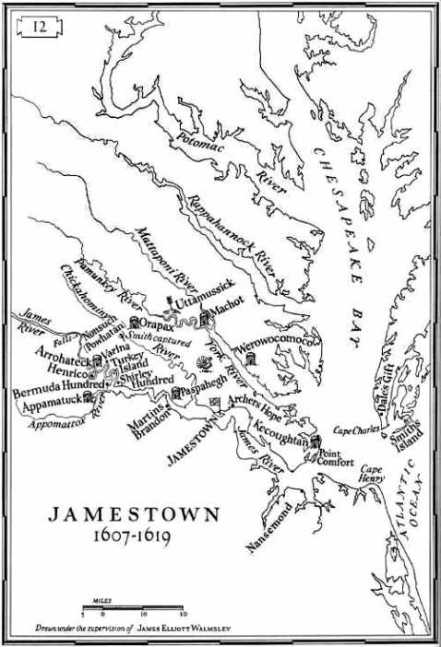
Jamestown

Spotswood Headrights
My seventh great-grandfather came to Virginia in 1717 with a group of Lutheran immigrants. Their unscrupulous ship captain not only landed at the wrong port, but sold them into indentured servitude. Captain Andrew Tarbett had spent the passage given him by the Germans, then took them to Virginia rather than their promised destination, Pennsylvania. He sold them to Lt.Governor Alexander Spotswood.
Lieutenant Governor Alexander Spotswood’s lawsuits against his indentured servants. From 1723 through 1726, Spotswood claimed that several Germans had failed to carry out the terms of their “contract” with him. My ancestor was sued in 1924. He proved his importation in 1926 with his wife on the ship Scott. He patented land on June 24, 1926.
These emigrants left their villages in southern Germany (Baden and Württemberg) about 12 Jul 1717 enroute for Pennsylvania by way of London. Starvation took the lives of several of the passengers (probably 50 people perished, most of them children) who had been swindled by their captain who was retained in London. The ship held about 138 passengers and did not land in Pennsylvania but to Virginia where the passengers were sold as indentured servants to Governor Spotswood.
The base for this reconstructed list comes from:
Research by Zimmerman & Cerny has shown that several who were thought to have come to Virginia in 1719-1720 were actually more likely part of the 1717 group. The strongest evidence for this is the absence of any references to each of these families in Germany after 1716 and the fact that they would have left from others from the same town at that time.
Note: Hans is short for Johannes which is John in English
Below research provided courtesy of Tom Bowen:
“From “Before Germanna,” by Johni Cerni and Gary J. Zimmerman, No. 5,
January 1990, The Ancestry of the Sheible, Peck, Milker Smith and Holt Families:
“The Evangelical Lutheran minister [for Gemmingen, Baden] began a new set of parish registers in 1693, and the marriage entries of the Schmidt brothers are recorded therein:
married 21 January 1710 Hanns Michael Schmid, son of Michael Schmid, deceased, court official here, step-son of Alt [Old]
Hans Hecker, to Anna Margaretha, daughter of deceased Josoph Sauter, deceased courth official here.”
On 12 July 1717 the minister at Gemmingen listed in the parish death register the “parents, together with their children, [who] expect to move away from here, wanting to take ship to Pennsylvania, and there in the hardship of the wilderness better their piece of bread than they could here.” Included were:
Hans Michael Schmidt, age 28
wife Anna Margaretha, same age,
son Hans Michael, age 5 1/2
son Christopher, age 1/2
his in-laws.
Also listed was Matthäus Schmidt, age 25/30, wife Regina Catherina, same age, son Matthäus, age 3 1/2 and daughter Anna Margaretha, age 1/2.
They arrived in Virginia near Germanna in then Essex Co., now Culpeper Co., in late 1717 or early 1718 according to today’s calendar, being members of the so-called second Germanna Colony of 1717. The colony moved about 25 miles west to the Robinson River area of Spotsylvania Co. in 1725. This area became Orange Co. in 1734, Culpeper Co. in 1748, and Madison Co. in 1793.”
We have a copy of his will:
25 Feb. 1760, from Culpeper Co. Will Book A, p. 243:
In the name of God Amen, I John Michael Smith of the Parish of Brumfield in Culpeper County being old weak & helpless, but thanks be unto God of perfect Mind and Memory, & calling unto Mind the Mortality of my Body & knowing it is appointed for all men once to die, do make & ordain this my last will and Testament. That is to say principally & first of all I give & recommend my Soul into the Hands of Almighty God that gave it, & my Body I recommend to the Earth to be buried in decent Christian Burial nothing doubting that at the General Resurrection I shall receive the same again, by the mighty Power of God. and as touching such worldly Estate wherewith it hath pleased God to bless me in this Life, I do give demise & dispose of the same in the following manner & form, viz.
I do give bequeath & make over unto my dearly beloved only Son John Michael Smith Junior & his heirs forever all my Estate personal as well as real, that he may take the sole & full Possession of it, & all the Lands Goods & Chattels forever after my decease, reserving unto me only the Claim to my Estate as long as I live, & thereby I do revoke & disannull all Wills made before by me & I do acknowledge to be this my last Will & Testament never to be revoked
Signed Sealed & delivered Witness my Hand & Seal
in the presence of us
in the year of our Lord God Michael Schmid?
1760. 25th of February (signed in German)
Adam (AY) Jager,
Henry Ayler
At Court held for the County of Culpeper on Thursday the 19th day of February 1761 This last Will and Testament of John Michael Smith decd was exhibited to the Court by John Michael Smith his only son & heir and the Executor therein named and was proved by the oaths of Adam Yeager & Henry Aylor Witnesses thereto and ordered to be recorded and on the motion of the said Executor Certificate is granted him for obtaining a Probate thereof he giving Bond & Security according to Law and also took the oath of an Executor.
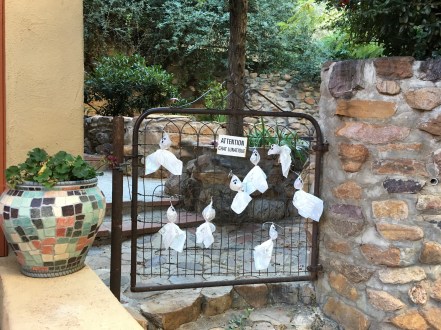
haunted gate
Contrary and contorted, the inquisitor retreated
To study the rules and regulations for details
To bribe the authorities to seek the maximum
Penalty for betraying the monarchy and the court
Treason and heresy had been found in high places
Now the entire population had to fear for the future
Chaos had consumed the wealth and the wisdom
Once widely respected in this now violent place
Leaving widows, orphans, haunted institutions
Of what was once called being on the right side of history

The Inquisitor

Halloween car
I love living in Arizona. I used to travel around the world all the time. In fact, I was a travel agent for years, living the good life on the gravy train of the travel industry. The market has changed significantly and the service on airlines is not as great as it was in the past. I used miles to upgrade my international flights to business class back in the day, but those seats are never available with miles now. The super gold elite platinum members suck those all down for themselves. I no longer fly or collect airline miles for the future. I am happy as a tourist in my own spectacular state. We have it all, including the Grand Canyon.
I recently downsized my possessions and bought a Mini Cooper to drive. The change brings money into my budget and a fun tiny car that meets my needs perfectly. I drove the car recently to Phoenix for the Cannabis Expo weekend. It is super easy to park and easy to drive. My wanderlust for the open road has been revived by my new wheels. When I first saw the car I did not like it because it is orange and black. I have come to adore the colors, and think it is a snazzy sporty look. I will drive it down to Tombstone and Bisbee tomorrow for a Halloween weekend visit. Bisbee is all about haunting and history. Tombstone is all about gunslinging, Doc and Wyatt.
The drive is an easy two hours, about the same as Phoenix, from home. I will stop in Tombstone on the way down then take a day trip to Douglas on Saturday. Douglas was once a very wealthy smelter town for the Bisbee copper mine. The Louis Comfort Tiffany Window in the Hotel Gadsden is a remnant of those high rolling times. It is worth the drive to Douglas to see that window. Tombstone, Bisbee, and Douglas grew up around mines. The history of the wild west is still celebrated, particularly around Halloween. It will be a fantastic retreat, as well as a bargain for the cost. I feel lucky to have so many excellent and varied destinations to discover by a short drive.

Believe That
If we were having coffee this weekend I would offer you iced tea and some succotash I just made. I have been listening to a wonderful audio course about this culinary and cultural history of humanity. I heard the part about American colonists adopting crops from natives very quickly because many crops they brought from England did not grow over here. Succotash (a word borrowed from a native language) is a stew of corn, beans, onions, peppers, and tomatoes. It can be made with only corn and beans if need be. I realized I had those groceries on hand in the fridge so I whipped up a batch. It is a heavenly, and truly American dish. Help yourself. I am working on reminding myself of all the noble and beautiful parts of having been born in the US. Succotash is one of those.
If we were having coffee I know many of you live in other countries and are wondering what in the world is happening to the government in Washington, DC. As taxpaying citizens, believe me, we wonder even more than you do. Some people choose to stay away from news of current events, and honestly I am happy to be working with millennials who virtually never discuss anything current or political. I don’t think it is because they lack sympathy, but they really lack all the information. I am loathe to bring up any news at work because it is all so shockingly bad. Who am I to bum them out by letting them in on current events? I really like my colleagues at work. Maybe ignoring current events is the secret of their charm.
I wrote this week, but was still a little lame about production. I did a poem for Sue Vincent’s #writephoto on Thursday. I wrote a factual biography of my great-grandfather who fought for the Confederacy in the Civil War. I also have ancestors who fought for the Union and even worked on the underground railroad. I am not in any way attracted to these “historic monuments” causing all this dispute. I don’t think they were such a good idea in the first place, since Americans tend to be fairly ignorant of our own history. We just don’t need images to glorify people and events nobody even understands. I know this is not true for all of us, but I am frequently appalled at the total lack of knowledge about geography and history I encounter in Americans.
The one category in which we are still held in some esteem is comedy. SNL is the world leader that demonstrates that we do still live in a free country. Some of our freedom is being used to endanger and incarcerate part of the population. Thank God we still have Weekend Update. For any of you who have not seen #sheetcaking by Tina Fey, please enjoy this peek at our still thriving sense of humor. If we don’t laugh we will cry.
Please join us for the Weekend Coffee Share every week. Our hostess Diana brings us together from New Orleans her blog PartTimeMonster to share our feelings, our progress, and our digital beverages. Thanks for reading, writing, or commenting this week.

#WeekendCoffeeShare
 mermaidcamp