mermaidcamp
Keeping current in wellness, in and out of the water
You can scroll the shelf using ← and → keys
You can scroll the shelf using ← and → keys
 Stafford Castle
Humphrey married Margaret Beaufort, daughter of Edmund Beaufort, 2nd Duke of Somerset and Eleanor Beauchamp. Her maternal grandparents were Richard de Beauchamp, 13th Earl of Warwick and his first wife, Elizabeth Beauchamp, 4th Baroness Lisle. She was also a first cousin to Anne Neville, 16th Countess of Warwick and through her cousin-by-marriage to Richard Neville, 16th Earl of Warwick, the so-called “Kingmaker” during the Wars of the Roses. Humphrey and Margaret had a single son Henry Stafford, 2nd Duke of Buckingham (4 September 1455 – 2 November 1483).
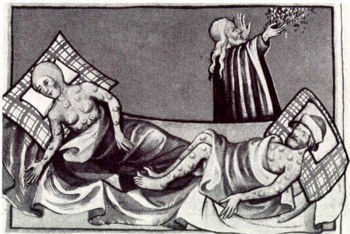
Humphrey fought under his father-in-law in support of the House of Lancaster during the First Battle of St Albans. He appears to have been badly wounded at this battle but actually survived for a least another 2–3 years. This may account for his disappearance from the contemporary records of the time. In 1458 he died from the plague.
The First Battle of St Albans, fought on 22 May 1455 at St Albans, 22 miles (35 km) north of London, traditionally marks the beginning of the Wars of the Roses. Richard, Duke of York and his ally, Richard Neville, Earl of Warwick, defeated the Lancastrians under Edmund, Duke of Somerset, who was killed. York also captured Henry VI, who appointed him Constable of England.
The Lancastrian army of 2,000 troops arrived at St Albans first, and proceeded to defend it by placing troops along the Tonman Ditch and at the bars in Sopwell Lane and Shropshire Lane. The 3,000-strong Yorkist army arrived and camped in Keyfield to the east. Lengthy negotiations ensued with heralds moving back and forth between the rival commanders. After several hours, Richard, despairing of a peaceful solution, decided to attack. The bulk of Henry’s forces were surprised by the speed of Richard’s attack; most of the army was expecting a peaceful resolution similar to the one at Blackheath in 1452. However, two frontal assaults down the narrow streets against the barricades made no headway and resulted in heavy casualties for the Yorkists.
Warwick took his reserve troops through an unguarded part of the town’s defences, through back lanes and gardens. Suddenly the Earl appeared in the Market Square where the main body of Henry’s troops were talking and resting. There is evidence they were not yet expecting to be involved in the fighting, as many were not even wearing their helmets. Warwick charged instantly with his force, routing the Lancastrians and killing the Duke of Somerset.
On the Earl’s orders, his archers then shot at the men around the King, killing several and injuring the King and the Duke of Buckingham. The Lancastrians manning the barricades realised the Yorkists had ouflanked them, and fearing an attack from behind abandoned their positions and fled the town.
The First Battle of St Albans was relatively minor in military terms, but politically was a complete victory for York and Warwick: York had captured the King and restored himself to complete power, while his rival Somerset and Warwick’s arch-enemies Henry Percy, 2nd Earl of Northumberland, and Lord de Clifford both fell during the rout.
.
His maternal grandparents were Ralph de Neville, 1st Earl of Westmorland and Joan Beaufort, Countess of Westmorland. His maternal uncles included (among others) Richard Neville, 5th Earl of Salisbury (father ofWarwick, the Kingmaker), Robert Neville who was first Bishop of Salisbury and then Bishop of Durham, William Neville, 1st Earl of Kent and Edward Nevill, 3rd Baron Bergavenny. His most prominent maternal aunt was Cecily Neville, wife of Richard Plantagenet, 3rd Duke of York and mother to among others Edward IV of England, Edmund, Earl of Rutland, George Plantagenet, 1st Duke of Clarence and Richard III of England.
Lord Stafford fought under his father-in-law in support of the House of Lancaster during the First Battle of St Albans. He appears to have been badly wounded at this battle, but either eventually died of his wounds or from the plague, predeceasing his own father in 1458.
Stafford married Lady Margaret Beaufort, daughter of Edmund Beaufort, 2nd Duke of Somerset and Lady Eleanor Beauchamp. Her maternal grandparents were Richard de Beauchamp, 13th Earl of Warwick and his first wife Elizabeth Berkeley. By her father, she was a niece of Joan Beaufort, Queen of Scots and a cousin to Lady Margaret Beaufort (mother of King Henry VII). By her mother, Lady Margaret was a niece of Anne de Beauchamp, 16th Countess of Warwick and as such, a cousin to Isabel, Duchess of Clarence and queen consort Anne Neville.
Lord and Lady Stafford had a single son, Henry (4 September 1455 – 2 November 1483). Henry was styled Earl of Stafford on his father’s death, and succeeded his paternal grandfather as Duke of Buckingham in June 1473, following the latter’s death at the Battle of Northampton on 10 July 1460.
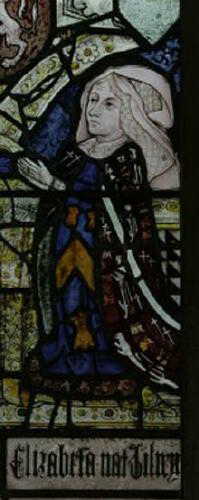
My 17th great-grandmother was married twice. She was the great-grandmother of Anne Boleyn, Jane Seymour, and Catherine Howard, who all met an unfortunate end as wives of Henry VIII. That is really a coincidence, I think. She was buried with her second husband St. Augustine church at Broxbourne.

Elizabeth Cheney (1420 – 1473)
17th great-grandmother
Elizabeth Tilney (1450 – 1497)
Daughter of Elizabeth Cheney
Lord Thomas Howard (1473 – 1554)
Son of Elizabeth Tilney
Lady Katherine Howard Duchess Bridgewater (1495 – 1554)
Daughter of Lord Thomas Howard
William ApRhys (1522 – 1588)
Son of Lady Katherine Howard Duchess Bridgewater
Henry Rice (1555 – 1621)
Son of William ApRhys
Edmund Rice (1594 – 1663)
Son of Henry Rice
Edward Rice (1622 – 1712)
Son of Edmund Rice
Lydia Rice (1649 – 1723)
Daughter of Edward Rice
Lydia Woods (1672 – 1738)
Daughter of Lydia Rice
Lydia Eager (1696 – 1735)
Daughter of Lydia Woods
Mary Thomas (1729 – 1801)
Daughter of Lydia Eager
Joseph Morse III (1756 – 1835)
Son of Mary Thomas
John Henry Morse (1775 – 1864)
Son of Joseph Morse III
Abner Morse (1808 – 1838)
Son of John Henry Morse
Daniel Rowland Morse (1838 – 1910)
Son of Abner Morse
Jason A Morse (1862 – 1932)
Son of Daniel Rowland Morse
Ernest Abner Morse (1890 – 1965)
Son of Jason A Morse
Richard Arden Morse (1920 – 2004)
Son of Ernest Abner Morse
Pamela Morse
I am the daughter of Richard Arden Morse
Elizabeth Cheney (April 1422 – 25 September 1473), later known as Elizabeth, Lady Tilney and Elizabeth, Lady Say, was an English aristocrat, who, by dint of her two marriages, was the great-grandmother of Anne Boleyn, Jane Seymour, and Catherine Howard, three of the wives of King Henry VIII of England, thus making her great-great-grandmother to King Edward VI, the son of Henry VIII and Jane Seymour, and Elizabeth I, the daughter of Henry VIII and Anne Boleyn. Her first husband was Sir Frederick Tilney, and her second husband was Sir John Say, Speaker of the House of Commons. She produced a total of nine children from both marriages.
Born in Fen Ditton, Cambridgeshire in April 1422, she was the eldest child of Laurence or Lawrence Cheney or Cheyne, Esq. (c. 1396 – 1461), High Sheriff of Cambridgeshire and Elizabeth Cokayn or Cokayne Her paternal grandparents were Sir William Cheney and Katherine Pabenham, and her maternal grandparents were Sir John Cockayne, Chief Baron of the Exchequer and Ida de Grey, the daughter of Reginald Grey, 2nd Baron Grey de Ruthyn and Eleanor Le Strange of Blackmere.
On an unknown date, Elizabeth married her first husband Sir Frederick Tilney, of Ashwellthorpe, Norfolk, and Boston, Lincolnshire. He was the son of Sir Philip Tilney and Isabel Thorpe. They made their principal residence at Ashwellthorpe Manor. The couple had one daughter:
Elizabeth Tilney (before 1445 – 4 April 1497), married firstly in about 1466, Sir Humphrey Bourchier, by whom she had three children; and secondly on 30 April 1472, Thomas Howard, Earl of Surrey, who later became the 2nd Duke of Norfolk, by whom she had nine children. These children included Thomas Howard, 3rd Duke of Norfolk, Elizabeth Howard, mother of Anne Boleyn, and Lord Edmund Howard, father of Catherine Howard.
Sir Frederick Tilney died in 1445, leaving their young daughter Elizabeth as heiress to his estates. Shortly before 1 December 1446, Elizabeth Cheney married secondly Sir John Say, of Broxbourne, Hertfordshire, Speaker of the House of Commons, and a member of the household of King Henry VI. He was a member of the embassy, led by William de la Pole, which was sent to France in 1444 to negotiate with King Charles VII for the marriage between King Henry and Margaret of Anjou. Her father settled land worth fifty marks clear per annum upon the couple and their issue before Candlemas, 1453. They made their home at Broxbourne, Hertfordshire.
Sir John Say and Elizabeth had three sons and four daughters:
Sir William Say (1452- 1529), of Baas (in Broxbourne), Bedwell (in Essendon), Bennington, Little Berkhampstead, and Sawbridgeworth, Hertfordshire, Lawford, Essex, Market Overton, Rutland, etc., Burgess (M.P.) for Plympton, Knight of the Shire for Hertfordshire, Sheriff of Somerset and Dorset, 1478–9, Sheriff of Essex and Hertfordshire, 1482–3, Justice of the Peace for Hertfordshire, 1486–1506, and, in right of his 1st wife, of East Lydford, Radstock, Spaxton, Wellesleigh, and Wheathill, Somerset, and, in right of his 2nd wife, of Wormingford Hall (in Wormingford), Essex, Great Munden, Hertfordshire, etc. He married (1st) before 18 November 1472 (date of letters of attorney) Genevieve Hill, daughter/heiress of John Hill, of Spaxton, Somerset. She was still alive in 1478. He married (2nd) shortly after 18 April 1480 Elizabeth Fray, widow of Sir Thomas Waldegrave, by whom he had two daughters, Mary Say and Elizabeth Say.
Mary, the eldest daughter married Henry Bourchier, 1st Earl of Essex and 6th Baron Bourchier, by whom she had one daughter, Anne Bourchier, 7th Baroness Bourchier
Thomas Say, of Liston Hall, Essex.
Leonard Say, clerk, Rector of Spaxton, Somerset. See Testamenta Eboracensia, 4 (Surtees Soc. 53) (1869): 86–88 (will of Leonard Say, clerk).
Anne Say (died 1478/1494), married Henry Wentworth, K.B., of Nettlestead, Suffolk, Goxhill, Lincolnshire, Parlington and Pontefract, Yorkshire, and of London, Esquire of the Household, Knight of the Body, Sheriff of Norfolk and Suffolk, 1481–82, Sheriff of Yorkshire, 1489–90, 1492, Knight of the Shire for Yorkshire, 1491–92, by whom she had issue, including Margery Wentworth, mother of Jane Seymour.
Mary Say, married Sir Philip Calthorpe, Knt., by whom she had issue.
Margaret Say, married Thomas Sampson, Esq.
Katherine Say, married Thomas Bassingbourne.
On 25 September 1473, aged 51, Elizabeth Cheney died. She was buried in the church at Broxbourne. Following her death, John Say remarried to Agnes Danvers. He died five years later on 12 April 1478. Sometime after 1478, Elizabeth’s eldest son, Sir William Say, married his second wife, Elizabeth Fray, a daughter of his stepmother Agnes, by her first husband, Sir John Fray (1419- 1461), Chief Baron of the Exchequer.
Sources
John Smith Roskell, Parliament and Politics in Late Medieval England, Vol. 2, Google Books, accessed 9 September 2009
References
Lundy, Darryl. “p.335.htm#3342”. The Peerage.
Ida Ashworth Taylor, Lady Jane Grey and Her Times, page 8, Google Books, accessed 3 September 2009
John Smith Roskell, Parliament and Politics in Late
 Sir John Say, 1478, and wife Elizabeth, 1473, Broxbourne, Hertfordshire.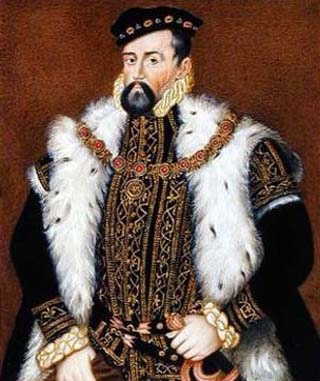
William Pembroke Herbert
My 18th great-grandfather was mixed up in that War of the Roses business that obsessed the British for so long. He was beheaded, as several of my other ancestors were, during those tricky Tudor years. HIs castle, Raglan, can still be visited today.

Raglan Castle
How does one begin to describe the handsome majesty that is Raglan Castle? Raglan, with its great multi-angular towers and Tudor-styling, is unlike any other castle in Wales. There were only three times during our vacation, when visiting a site, I said to myself, “this is why we came to Wales.” The first time was while viewing Conwy Castle from the spur wall near the Quay. The second was upon seeing the cathedral and Bishop’s Palace at St. Davids, and the last was while standing in front of the double-towered gatehouse at Raglan.
The main stone used in construction of the castle is sandstone, but of two different types. The 15th century castle is characterized by pale, almost yellowish sandstone from Redbrook on the Wye river, three miles away. The other sandstone is local Old Red Sandstone, red, brown or purplish in color, used in the Tudor work. A paler stone was also used in the fireplaces. From a distance, Raglan seemed to have a reddish cast, although on approaching the gatehouse, the castle’s yellow sandstone becomes obvious.
The castle is probably most closely associated with William ap Thomas, who fought with King Henry V at the Battle of Agincourt in 1415. In 1426, ap Thomas was knighted by Henry VI, becoming known to his compatriots as “the blue knight of Gwent.” Sir William Herbert, Earl of Pembroke, was the next owner of the castle, and it is Herbert who is responsible for Raglan’s distinctive Tudor-styling. The castle was also the boyhood home of Henry Tudor, later King Henry VII. As a boy he bided his time at Raglan, while his uncle Jasper agitated a Lancastrian return to the throne in the person of young Henry.
Both William ap Thomas and William Herbert fought in France, and undoubtedly, the castles that they saw in that country influenced their work at Raglan. The elaborately decorated polygonal keep, as well as the double-drawbridge arrangement of the keep, unique in Britain, demonstrate French influence. In 1492, Elizabeth Herbert married Sir Charles Somerset, a natural son of Henry Beaufort, third duke of Somerset, and it is to the Somerset family as earls of Worcester that we owe the final architectural touches of the castle.
On approaching the gatehouse, we passed Raglan’s Great Tower, surrounded by its apron wall and beautiful moat. Pink wildflowers spring from the apron wall, creating an unforgettable image. The wall has six corner turrets, one of which has a postern door to the moat. The Great Tower, known as “The Yellow Tower of Gwent,” is the most striking feature at Raglan. It was begun by Sir William ap Thomas and was designed very much in contemporary French style. Unfortunately, the tower was largely destroyed by Parliamentary forces during the English Civil War. The tower and moat are outside the main body of the castle. The Great Gate leading to the Pitched Stone Court lies next to The Great Tower. It was raised by Sir William Herbert, and served as the main entrance to the castle after 1460, however, we chose to continue surveying The Great Tower from the outside, via the park surrounding the moat, finally entering the castle from the South Gate.
Through the South Gate, we entered the main Apartments. The porch and Grand Stair lead to the apartments in the Fountain Court. The Grand Stair reminded us of a similar structure at Carew Castle. The two most impressive rooms at Raglan are The Hall and Long Gallery. The hall is the finest and most complete of the castle’s surviving apartments. A plaque over the dais in the hall bears the distinctive arms of the third earl of Worcester, as Knight of the Garter. Viewing the Great Tower from the apartments, we saw a finely carved shield and badge over the first floor chamber, a good example of the castle’s surviving detail. The Long Gallery has been called one of the finest rooms of Tudor rebuilding in Britain. Once a showcase of Tudor elegance, the gallery contained handsome paintings, tapestries and sculptures. During this time, Raglan was one of Britain’s social centers. Important guests were entertained until the early hours of the morning. The gallery had a series of windows overlooking the Fountain Court, and an ornate Renaissance fireplace. The remains of the fireplace, clearly showing two carved human figures, are a major highlight of the castle.
Re-entering the castle through the Great Gate, we entered the Pitched Stone Court, a large cobblestone area. Standing at the end of the court gives a magnificent view of the rear of the gatehouse and the Attic. The Attic, with its stunning Tudor-style windows, housed another gallery running along the rear of the gatehouse range. The building once held the castle’s extensive library, which was also destroyed by Cromwell’s soldiers. The wonderful thing about Raglan is that there are so many parts of the castle retaining detail and beauty, that you could spend an hour or so just admiring the beauty of any one area. A green park with benches surrounds most of the castle, giving visitors the chance to sit and contemplate the magnificence before them. There are several on-site exhibits explaining the history of the castle, and an extensive giftshop is planned for the future.
We could have easily spent a half day at Raglan, to properly survey the castle. By the time we finished looking at the exhibit rooms, it was late afternoon and time to find lodging for the night. Still, I had to take just one more walk around the moat and Great Tower. I used the excuse that I had not yet seen the back of the castle to prolong our stay. As I took my final walk around the moat, my eyes were fixed on the castle, not on the ground before me. I knew it would be quite some time before I’d experience a site such as this, and I wanted to burn this view of the castle into my memory forever. I was probably lucky I didn’t fall into the moat! Raglan was like a fairy tale castle I was afraid would disappear if I looked away. Carew had its aspects of beauty, but stately Raglan is a handsome, unique structure in every detail. I knew that our trip to Raglan would be a highlight of the trip, but if I had known just how magnificent the site was, I would have certainly set aside more time than the two hours we were there. If you ever travel to south Wales, make seeing Raglan Castle your number one priority. If necessary, drop all other plans, just don’t miss seeing Raglan! Once you visit this wonder of medieval architecture, you’ll understand why.
Cadw 1990
Raglan, stately and handsome, is perhaps deceptive. The might of its angular towers bears comparison with the great castles of Edward I, and suggests its origins lay in the bitter conflicts of the later 13th century. In face it belongs mainly to the 15th century, and was as much a product of social aspiration as it was of military necessity.
It was begun by Sir William ap Thomas, a veteran of the French wars, who grew wealthy through exploiting his position as a local agent of the duke of York in south-east Wales. About 1435 he began building the Great Tower, subsequently known as the Yellow Tower of Gwent, probably on the site of a much earlier Norman motte-and-bailey castle. Surrounded by a water-filled moat, the unusual hexagonal plan of the tower, together with its elaborate drawbridge arrangements, are more easily paralleled in France than in Britain. Within, there was a single large room to each floor, and the entire structure echoed the power and influence of its builder.
Following ap Thomas’s death he was succeeded by his son William Herbert who continued to develop Raglan. As a prominent Yorkist, he played a major role in securing the throne for Edward IV in 1461, and was raised to the peerage as Lord Herbert of Raglan. Eventually rising to earl of Pembroke, his political career is reflected in his sumptuous building. Under Herbert, Raglan became a veritable palace, unmatched in the 15th century southern March. He added the great gatehouse, the Pitched Stone Court and also rebuilt the Fountain Court with a series of formal state apartments for himself and his household. All of these repay careful examination. Notice, for example, the circular gun ports in the lower part of the gatehouse. The great kitchen lay in the tower at the corner of the Pitched Stone Court, and its huge ovens and fireplaces remain.
Herbert was beheaded following his defeat at the battle of Edgecote in 1469, and there were no further major alterations to Raglan until the ownership of William Somerset, earl of Worcester (1548-89). In the main, he was responsible for extensive changes to the hall, which remains the finest and most complete of all apartments in the castle. The huge fireplace survives, as does the tracery of the beautiful windows. These were once filled with heraldic glass, and the roof was built of Irish oak. Earl William also added the long gallery, without which no great Elizabethan house was complete.
At the outbreak of the Civil War, Raglan was garrisoned for the king. Henry, the new earl, and later marquess of Worcester, poured his fortune into the royal cause. By 1646 the castle was under siege, one of the longest of the Civil War. It was pounded by heavy artillery under the command of Sir Thomas Fairfax, and finally the elderly marquess was forced to surrender.
The fall of Raglan virtually marked the end of the Civil War, and Cromwell’s demolition engineers were soon at work reducing the great walls. However, the strength of the Great Tower was almost great enough to defy them. Only after ‘tedious battering the top thereof with pickaxes’, did they eventually undermine the walls and two of its six sides were brought crashing down in a mass of falling masonry.
written by Jeff Thomas, 1994


William Pembroke Herbert (1423 – 1469)
18th great-grandfather
Maud Countess of Northumberland Herbert (1453 – 1485)
Daughter of William Pembroke Herbert
Eleanor Dutchess Buckingham Percy (1474 – 1530)
Daughter of Maud Countess of Northumberland Herbert
Elizabeth Dutchess Norfolk Stafford Howard (1497 – 1558)
Daughter of Eleanor Dutchess Buckingham Percy
Lady Katherine Howard Duchess Bridgewater (1495 – 1554)
Daughter of Elizabeth Dutchess Norfolk Stafford Howard
William ApRhys (1522 – 1588)
Son of Lady Katherine Howard Duchess Bridgewater
Henry Rice (1555 – 1621)
Son of William ApRhys
Edmund Rice (1594 – 1663)
Son of Henry Rice
Edward Rice (1622 – 1712)
Son of Edmund Rice
Lydia Rice (1649 – 1723)
Daughter of Edward Rice
Lydia Woods (1672 – 1738)
Daughter of Lydia Rice
Lydia Eager (1696 – 1735)
Daughter of Lydia Woods
Mary Thomas (1729 – 1801)
Daughter of Lydia Eager
Joseph Morse III (1756 – 1835)
Son of Mary Thomas
John Henry Morse (1775 – 1864)
Son of Joseph Morse III
Abner Morse (1808 – 1838)
Son of John Henry Morse
Daniel Rowland Morse (1838 – 1910)
Son of Abner Morse
Jason A Morse (1862 – 1932)
Son of Daniel Rowland Morse
Ernest Abner Morse (1890 – 1965)
Son of Jason A Morse
Richard Arden Morse (1920 – 2004)
Son of Ernest Abner Morse
Pamela Morse
I am the daughter of Richard Arden Morse

William Pembroke Herbert
SIR WILLIAM HERBERT, EARL OF PEMBROKE, was elder son of William Herbert of Raglan Castle, called also William ap Thomas, and in Welsh Margoah Glas, or Gumrhi, who fought in France under Henry V, and was made a knight-banneret in 1415. Herbert’s mother was Gladys, daughter and heiress of David Gam, and widow of Sir Robert Vaughan. Sir Richard Herbert of Colebrook was a younger brother. Sir William’s grandfather, Thomas ap Gwillim ap Jenkin (d.1438), secured Raglan Castle on his marriage with Maud, daughter and heiress of Sir John Morley.
The Herbert family claimed descent from ‘Herbertus Camerarius,’ a companion of William I, and his son ‘Henry Thesaurarius,’ both of whom were tenants in capite in Hampshire.1 The descendants of Henry Thesaurarius in the fifteenth-century claimed that he was ‘son natural of King Henry the First,’ and that they were thus connected with ‘the Royal Blood of the Crown of England,’2 but the pretension contradicts established fact. Peter, the great-grandson of Henry Thesaurarius, seems to have been the first of the family to settle in Wales. He received from John in 1210 many grants of land there forfeited by William of Braose, Peter’s descendants by intermarriages with Welsh heiresses acquired very large estates in South-east Wales, and practically became Welshmen.
Herbert was a warrior from his youth. He was knighted by Henry VI in 1449, and in 1450 was on active service in France under the Duke of Somerset. He was taken prisoner at the battle of Formigny in 1450, but was apparently soon released. He played a prominent part on the side of the Yorkists in the Wars of the Roses. In Wales he did very notable service against Jasper Tudor, Earl of Pembroke, Henry, Duke of Exeter, and James, Earl of Wiltshire.
On 1 May 1457 it was reported that the Lancastrians had offered him his life and goods if he would come to Leicester and ask pardon of Henry VI; but the Yorkists were still strong, and he remained faithful to them.3 On Edward IV’s accession Herbert was made a privy councillor (10 March 1461). On 8 May following he was granted the offices of chief justice and chamberlain of South Wales, and some sub-ordinate posts; on 7 Sept. he was made steward of those castles, including that of Brecknock in South Wales, which had belonged to Humphrey, Duke of Buckingham. On 4 Nov. he was created Baron Herbert, and received in consideration of his services the castle, town, and lordship of Pembroke, with numerous manors and castles on the Welsh marches.
On 29 April 1462 he appeared in the House of Lords, and was made a knight of the Garter. Shortly afterwards he joined Edward IV in an expedition to the north of England, where Lancastrians still held out. In 1463 he was appointed justice in Merionetshire, and received new grants of land, including Dunster, and those manors in Devonshire and Suffolk which had been forfeited by Sir James Luttrell. On 3 June 1466 he was in London, and accompanied Edward IV on a visit to the Archbishop of York. In 1467 he was nominated chief justice of North Wales for life, and made constable of Carmarthen and Cardigan castles.
In August 1468 Pembroke and his brother, Sir Richard, advanced against the castle of Harlech, the last Lancastrian stronghold in Wales, where Jasper Tudor, with his young nephew Henry (afterwards Henry VII), still resisted the power of Edward IV. After a siege the castle, although strongly fortified, surrendered, but Sir Richard promised the governor to do what he could to save his life. Sir Richard petitioned Edward IV to that effect, and the request was unwillingly granted. Herbert seems to have taken Prince Henry prisoner, and he was appointed his guardian; but a plan to marry Henry to his daughter Maud failed.
He was advanced to the dignity of Earl of Pembroke (8 Sept. 1468), after the attainder of Jasper Tudor, and received the manor of Haverfordwest and the offices of chief forester of Snowdon and constable of Conway Castle. Soon afterwards the two brothers proceeded to Anglesey to apprehend seven brothers who had been guilty of ‘many mischiefs and murders.’ The mother pleaded strongly with Pembroke to spare the lives of two of her sons. Richard seconded her prayer, but Pembroke refused to yield, and executed all. Whereupon the mother cursed him on her knees, ‘praying God’s mischief might fall to him in the first battle he should make.’4
Meanwhile Pembroke and the Earl of Warwick had quarrelled. Pembroke, it is said, desired to marry his infant son to the daughter of Lord Bonvile, and Warwick opposed the arrangement. Pembroke thenceforth sought to widen the breach which was threatening the king’s relations with Warwick, and as early as 1466 he had captured in Wales a messenger of Queen Margaret of Anjou, with whom he showed that Warwick was intriguing. In January 1467 the disagreement seemed subsiding, and Pembroke and Warwick both attended a meeting of the king’s council.
But in July 1469 a rebellion, which was largely fomented by Warwick, broke out in the north. The rebels declared for Henry VI, and rapidly marched south. Pembroke readily prepared an army of Welshmen to resist their progress. He and his brother were ordered with their army to join at Banbury a strong detachment of archers under the command of Humphrey Stafford, Earl of Devonshire, and to intercept the enemy there. The first part of the manoeuvre was successfully accomplished. But a skirmish between a detachment of Pembroke’s army under Sir Richard and some rebel troops ended in the total rout of the former.
Immediately afterwards Pembroke and Devonshire encamped at Hedgecote, near Banbury. A quarrel between the commanders, however, caused Devonshire to lead his archers away, almost in presence of the enemy. On 26 July Pembroke, with his strength thus seriously impaired, was forced to give battle [Battle of Edgecote]. Panic seized his Welsh followers. He and his brother fought desperately. Sir Richard is said to have twice passed through the ‘battail of his adversaries,’ armed with a poleaxe, and ‘without any mortal wound returned.’But the defeat was decisive, and both brothers were taken prisoners.
Pembroke pleaded for his brother’s life in vain, on the ground of his youth; he declared that he was willing to die. On 27 July he made his will, giving directions for his funeral, making many pious bequests to Tintern Abbey and other religious foundations, and providing almshouses for the relief of six poor men. On 28 July Pembroke and Sir Richard were brought to Northampton and beheaded there. Pembroke was buried in Tintern Abbey, and Sir Richard in Abergavenny Church, where his wife Margaret was also buried.5
Pembroke married Anne, daughter of Sir Walter Devereux, Lord Ferrers of Chartley, and had by her four sons, William, Walter, George, and Philip, and six daughters. By a mistress, Maud, daughter of Adam ap Howell Graunt, he had some illegitimate issue, including Sir Richard Herbert, father of Sir William, first Earl of Pembroke of the second creation (1501?-1570).

Henry Stafford, Duke of Buckingham
Henry Stafford, Second Duke of Buckingham, (1454-1483), was the son of Humphrey Stafford, killed at the first battle of St. Albans in 1455, and grandson of Humphrey the 1st Duke (cr. 1444), killed at Northampton in 1460, both fighting for Lancaster. The first duke, who bore the title of Earl of Buckingham in right of his mother, was the son of Edmund, 5th Earl of Stafford, and of Anne, daughter of Thomas, Duke of Gloucester, youngest son of Edward III; Henry’s mother was Margaret Beaufort, daughter of Edmund Beaufort, 2nd Duke of Somerset,* grandson of John of Gaunt. Thus he came on both sides of the Blood Royal, and this, coupled with the vastness of his inheritance, made the young duke’s future of importance to Edward IV.
He was recognized as duke in 1465, and next year was married to Catherine Woodville, the queen’s [Elizabeth Woodville] sister. On reaching manhood he was made a Knight of the Garter in 1474, and in 1478 was high steward at the trial of George, Duke of Clarence. He had not otherwise filled any position of importance, but his fidelity might seem to have been secured by his marriage. However, after Edward’s death; Buckingham was one of the first persons worked upon by Richard, Duke of Gloucester. It was through his help that Richard obtained possession of the young king [Edward V], and he was at once rewarded with the offices of Justiciar and Chamberlain of North and South Wales, and Constable of all the royal castles in the principality and Welsh Marches. In the proceedings which led to the deposition of Edward V he took a prominent part, and on the 24th of June 1483 he urged the citizens at the Guildhall to take Richard as king, in a speech of much eloquence, “for he was neither unlearned and of nature marvellously well spoken” (Sir Thomas More).
At Richard’s coronation he served as chamberlain, and immediately afterwards was made Constable of England and confirmed in his powers in Wales. Richard might well have believed that the duke’s support was secured. But early in August Buckingham withdrew from the court to Brecon. He may have thought that he deserved an even greater reward, or possibly had dreams of establishing his own claims to the crown. At all events, at Brecon he fell somewhat easily under the influence of his prisoner, John Morton, who induced him to give his support to his cousin Henry Tudor, Earl of Richmond. A widespread plot was soon formed, but Richard had early warning, and on the 15th of October, issued a proclamation against Buckingham. Buckingham, as arranged, prepared to enter England with a large force of Welshmen. His advance was stopped by an extraordinary flood on the Severn, his army melted away without striking a blow, and he himself took refuge with a follower, Ralph Bannister, at Lacon Hall, near Wem. The man betrayed him for a large reward, and on the 1st of November, Buckingham was brought to the king at Salisbury. Richard refused to see him, and after a summary trial had him executed next day (2nd of November 1483), though it was a Sunday.
Buckingham’s eldest son, Edward Stafford (1478-1521), eventually succeeded him as 3rd Duke, the attainder being removed in 1485; the second son, Henry, was afterwards Earl of Wiltshire. The 3rd Duke played an important part as Lord High Constable at the opening of the reign of Henry VIII, and is introduced into Shakespeare’s play of that king, but he fell through his opposition to Wolsey, and in 1521 was condemned for treason and executed (17th of May); the title was then forfeited with his attainder, his only son Henry (1501-1563), who in his father’s lifetime was styled Earl of Stafford, being, however, given back his estates in 1522, and in 1547 restored in blood by parliament with the title of Baron Stafford, which became extinct in this line with Roger, 5th Baron, in 1640. In that year the barony of Stafford was granted to William Howard (1614-1680), who after two months was created Viscount Stafford; he was beheaded in 1680, and his son was created Earl of Stafford in 1688, a title which became extinct in 1762; but in 1825 the descent to the barony of 1640 was established, to the satisfaction of the House of Lords, in the person of Sir G. W. Jerningham, in whose family it then continued
Henry Stafford, 2nd Duke of Buckingham, KG (4 September 1455 – 2 November 1483) played a major role in King Richard III’s rise and fall. He is also one of the primary suspects in the disappearance (and presumed murder) of the Princes in the Tower. Buckingham was related to the royal family of England in many different ways, but his connections were all through daughters of younger sons. His chances of inheriting the throne would have seemed remote, but he played the role of a ‘kingmaker’ for Richard III and, unsuccessfully, for Henry VII
Buckingham was the son of Humphrey Stafford, Earl of Stafford, and Margaret Beaufort, Countess of Stafford. Three of his four grandparents were descended from Edward III of England:
Buckingham’s paternal grandfather was Humphrey Stafford, 1st Duke of Buckingham, who was the son of Anne of Gloucester, daughter of Thomas of Woodstock, 1st Duke of Gloucester, the youngest son of Edward III.
Buckingham’s paternal grandmother was Lady Anne Neville, a daughter of Joan Beaufort, Countess of Westmorland, while Buckingham’s maternal grandfather was Edmund Beaufort, 2nd Duke of Somerset, the youngest son of John Beaufort, 1st Earl of Somerset. John and Joan Beaufort were illegitimate children of John of Gaunt, 1st Duke of Lancaster, (the third son of Edward III) and Katherine Swynford. (They were later legitimized by John of Gaunt but were not in the direct line and could not claim the throne).
Thus, Buckingham was closely related to the royal families of England and Scotland. Five of his near relations became King of England – his (Lancaster) second cousin, once removed Henry VI, his (Beaufort/Neville) first cousins, once removed Edward IV and Richard III, his second cousin Edward V, and his (Beaufort/Holland) second cousin, once removed Henry VII – while two relations became Queen consorts of England: his (Beauchamp) first cousin, once removed (and Beaufort/Neville second cousin) Lady Anne Neville and his (Beaufort/Neville) second cousin, Elizabeth of York. His (Beaufort/Holland) first cousin, once removed was James II of Scotland.
His father, Humphrey Stafford, Earl of Stafford, supported the House of Lancaster in the initial phase of the Wars of the Roses. He died in 1458 of wounds after First Battle of St Albans, and his paternal grandfather, Humphrey Stafford, 1st Duke of Buckingham, another leading Lancastrian, was killed at the Battle of Northampton (10 July 1460). After his grandfather’s death, Henry was recognized as Duke of Buckingham. The new Duke eventually became a ward of Queen Elizabeth Woodville, consort of Edward IV of England.
Sometime before the Queen’s coronation in May 1465 he was married to her sister Catherine Woodville, Duchess of Buckingham and Bedford (b.1458). Both parties were children at the time; they were carried on squires’ shoulders at the coronation ceremony and were reared in the queen’s household together. According to Dominic Mancini, Buckingham resented his wife and the other Woodvilles because of his marriage to a woman of a lower status.
In 1483, a conspiracy arose among a number of disaffected gentry, supporters of Edward IV. They originally planned to depose Richard III and place Edward V back on the throne. When rumours arose that Edward and his brother (the Princes in the Tower) were dead, Buckingham intervened, proposing instead that Henry Tudor return from exile, take the throne and marry Elizabeth of York. For his part, Buckingham would raise a substantial force from his estates in Wales and the Marches.
Richard eventually put down the rebellion; Henry’s ships ran into a storm and had to go back to Brittany, and Buckingham’s army was greatly troubled by the same storm and deserted when Richard’s forces came against them. Buckingham tried to escape in disguise but was turned in for the bounty Richard had put on his head, and he was convicted of treason and beheaded in Salisbury on 2 November. A monument in nearby Britford Church has been identified as his. Following Buckingham’s execution, his widow, Catherine, married Jasper Tudor.
The ship Planter, under Master Nicholas Trerice/Travice, sailed from London April 2 or 11, 1635, arriving at Boston June 7, 1635. My tenth great-grandfather was 21 years old when he sailed to America on that ship.
Lt. Francis Peabody, the ancestor of the American Peabodys, was born at St. Albans, Hertfordshire, England, in 1614. He came to America in 1635 ; lived first in Lynn, and then in Ipswich, in then Massachusetts Bay colony. In 1639, he removed to Hampton, N.H., where he lived until 1657, when he came to Topsfield, Mass. He was useful in the new place, and was chosen to the office of selectman, as well as town clerk, both of which offices he held many years.
March 4, 1664, the town voted that Lt. Peabody have liberty ” to set up a grist mill and to flow so much of the town’s common as is needful for a mill so long as the mill does stand and grind for the town.”
The next year (1665), Mr. Peabody established the mill on Pyebrook. Who can estimate the joy of the inhabitants at that early period of having a grist mill to accommodate them in the grinding of their rye and corn! It marked a new era in the history of the Topsfield commoners.
March 7, 1671, the town voted that it was “willing that Lieut. Peabody shall set up a saw mill provided it does not do damage to any of the townsmen in their meadows.” The saw mill was built in 1672.
So far as the writer is able to learn, everything pertaining to these mills went along smoothly until 1691, when, the business having increased on account of the growth of the surrounding district, there was not a sufficient head of water during a part of the year to run the mills. Hewlett’s brook, a branch of Pye brook, left the latter stream and ran off to the northeastward, a short distance above the Peabody mills. As, at that time, there was no mill on Hewlett’s brook, Mr. Peabody was granted by the town the privilege of building a dam across this branch a few rods below its parting from the main stream, providing he pay satisfactory damages to the adjoining owners by reason of his flowing their meadows. The records speak of damages being received the following year by Thomas Dorman and sons, who had in 1690 erected a house within a few rods of the parting of the brook.* There was probably water power enough at the mills after the building of the dam as there are no papers showjng the want of it for more than fifty years afterwards.
During the year 1698 (?), after faithfully serving his day and generation, Lt. Francis Peabody passed away full of years and honors. By his will, dated Jan. 20, 1695, he gives his son Isaac Peabody the mills and mill-yard, the dwellinghouse by the mill, and other property.
Lieut Francis Peabody (1614 – 1697)
10th great-grandfather
Lydia Peabody (1640 – 1715)
daughter of Lieut Francis Peabody
Mary Howlett (1664 – 1727)
daughter of Lydia Peabody
John Hazen (1687 – 1772)
son of Mary Howlett
Caleb Hazen (1720 – 1777)
son of John Hazen
Mercy Hazen (1747 – 1819)
daughter of Caleb Hazen
Martha Mead (1784 – 1860)
daughter of Mercy Hazen
Abner Morse (1808 – 1838)
son of Martha Mead
Daniel Rowland Morse (1838 – 1910)
son of Abner Morse
Jason A Morse (1862 – 1932)
son of Daniel Rowland Morse
Ernest Abner Morse (1890 – 1965)
son of Jason A Morse
Richard Arden Morse (1920 – 2004)
son of Ernest Abner Morse
Pamela Morse
I am the daughter of Richard Arden Morse
 Frances Peabody’s signature
It is possible today to visit the home of my 11th great-grandfather, Augustine Steward. He was a successful mercer and mayor or Norwich.
Augustine Steward (1491 – 1571)
11th great-grandfather
Elizabeth Steward (1528 – 1575)
daughter of Augustine Steward
Augustine Jarnigo Sotherton (1553 – 1585)
son of Elizabeth Steward
Elizabeth Southerton (1582 – 1628)
daughter of Augustine Jarnigo Sotherton
Margaret Warner (1615 – 1649)
daughter of Elizabeth Southerton
Captain William GARTON (1635 – 1709)
son of Margaret Warner
Margaret Garton (1678 – 1773)
daughter of Captain William GARTON
Thomas Morris (1730 – 1791)
son of Margaret Garton
Joanna Morris (1762 – 1839)
daughter of Thomas Morris
John Samuel Taylor (1798 – 1873)
son of Joanna Morris
William Ellison Taylor (1839 – 1918)
son of John Samuel Taylor
George Harvey Taylor (1884 – 1941)
son of William Ellison Taylor
Ruby Lee Taylor (1922 – 2008)
daughter of George Harvey Taylor
Pamela Morse
I am the daughter of Ruby Lee Taylor
Augustine Steward was born in 1491 in the Tombland house opposite the Erpingham Gate of Norwich Cathedral. His father, Geoffrey, was a Norwich mercer and alderman. Shortly after Augustine’s birth the family moved from Tombland to a prestigious, stone-built house (Suckling House) in St. Andrews. Augustine was apprenticed to his father, who died in 1504. Augustine’s mother then married John Clerk, a rich merchant and grocer. John was mayor of Norwich in 1505 and in 1510. Augustine’s mother traded as Cecily Clerk with her own registered merchant’s mark.
A successful mercer
Augustine, known as Austen, became a highly successful Norwich mercer, who signed himself Awstyne Styward. He married twice and lived in the Tombland house where he was born. His first wife was Elizabeth Read of Beccles with whom he had a family of two sons and six daughters. His second wife, Alice Repps, from West Walton gave him a son and two daughters. Augustine was a Norwich councillor from 1522 to 1525, an alderman from 1526 to 1570 and Sheriff in 1526, He was Mayor in 1534, 1546 and 1556, a record that was only equalled by two other men within the sixteenth century. Augustine was also M.P for Norwich in 1542 and a Burgess in Parliament in 1547. During the sixteenth century, the office of mayor meant undertaking a demanding, full-time task for a year. A mayor’s own business had to be successful and so arranged that it could run without him. The mayor was expected to use his personal funds for some civic hospitality. However, the Corporation did stage a three-part show to mark Steward’s third term in office. It was recognised that Augustine had ‘allwayes ben a good and modest man, hee was beloved of poore and rich’.
Rebuilding the Guildhall
Steward’s influence was prominent in the 1534 rebuilding of the Council Chamber of Norwich Guildhall. He was involved with purchasing Black Friars Church, (St. Andrew’s Hall), from the Crown, for Norwich. A 1540 charter conveyed the Black Friar’s Monastery to the city for £81, paid by ‘our beloved Augustine Steward, of our city of Norwich, merchant.’ A portrait of Augustine in his mayoral robes can be seen in the Blackfriar’s wing of St. Andrew’s Hall.
Kett’s Rebellion
During Kett’s Rebellion in 1549, Augustine Steward played a leading part in negotiations between the rebels and the King’s army. Mayor Thomas Codde, who had been taken prisoner on Mousehold Heath by the rebels, appointed Steward his deputy. The Marquis of Northampton, representing the King, was entertained in Steward’s house. A plaque on the cathedral wall marks the spot, not far from Augustine’s house, where the rebels killed Lord Sheffield and Sir Thomas Cornwallis. Some of Kett’s followers ransacked Steward’s house but did not harm him. The Earl of Warwick used the house as his headquarters when he put down the rebellion.
Augustine Steward House
Steward’s home, opposite the cathedral, is a fine, surviving example of a successful Tudor merchant’s trading-house with goods stored in the stone undercroft and a shop or workshop at street level. The family lived in the upper storeys. Augustine’s house is jettied, and the timbers have warped over time giving the house a crooked appearance. An upper wing of brick, timber and plaster is built across Tombland Alley. Here you can see Augustine’s merchant mark and that of the mercer’s guild embossed on a corner stone, together with the date, 1549. Through the arch, the old house timbers are exposed and the carpenters’ marks can be seen, denoting the order in which the timbers were assembled on-site after being pre-cut in a timber yard. After Steward’s death in 1571, the house became in turn, a butcher’s, a broker’s, an antique dealer’s, a bookshop and a coffee house. At present it houses several antique dealers. Allegedly, there are underground passages leading from the crypt to the Cathedral and also to St. Gregory’s church. The ghost of a ‘Lady in Grey,’ a 1578 plague victim, is said to haunt the house.
A man of property
Augustine Steward owned Norfolk manors at Gowthorpe and at Welborne. His estate around Tombland extended along the north and west sides of St. George’s churchyard into Prince’s Street and included the site of an ancient inn. In later life he resided in a large, quadrangle house that he had built on Elm Hill, on the site of Paston Place originally owned by the Paston family. In 1507 all the houses on Elm Hill, except the modern Briton’s Arms, had been destroyed by fire. Augustine’s new house occupied the area now sub-divided into numbers 20, 22, 24 and 26. The carved beam over the archway of Crown Court bears Augustine Steward’s merchant mark on the right and the arms of the mercer’s guild on the left. Augustine Steward was buried in the church of St Peter Hungate.
Footnote
The house on Tombland where Augustine Steward was born still exists and has been called Augustine Steward House. It is generally reputed to date to 1530, however Marion Hardy, in an unpublished biography of Steward, discloses an earlier date for the house in the 1504 will of Augustine’s father, in which the house was mentioned as the location of Steward’s birth in 1491. Perhaps the 1491 house was damaged in the 1507 fires of Norwich and Augustine Steward re-built in 1530.
Further Reading
Blomefield F, The History of the City and County of Norwich, Volume 2. (Norwich 1745).
Hardy, M. Austen Steward of Norwich, unpublished partial manuscript.
Jones, W. H. A Quaint Corner of Old Norwich: Samson and Hercules and AugustineSteward’s Houses, Norwich, 1900.
Kennet, H. Elm Hill, Norwich: The Story of its Tudor Buildings and the People who Lived in them, ecollectit Ltd, Harleston, 2006.
Rawcliffe, C. and R. Wilson, (eds), Medieval Norwich, Hambledon and London, London, 2004.
Solomons, G. Stories Behind the Plaques of Norwich, Capricorn Books, Cantley,1981.
From “Genealogies of Virginia Families” vol. 5, page 546. Eldest son, Mercer, sheriff 1526, mayor 1534, 1546, 1556, M.P. 1541. Buried 1571 St. Peter Hungate.
 Nicholas (Mayor) Sotherton
My eleventh great-grandfather, Nicholas Sotherton, was a grocer by trade. He married Agnes, by whom he had six sons and five daughters.
Nicholas was sheriff in 1530 and Mayor in 1539. For twelve years he was a magistrate over which period he amassed a considerable fortune. He owned properties in both the Maddermarket parish (Strangers Hall), Hellesdon and Ludham
The Sothertons moved to the “Strangers Hall” after Thomas Caus. The property is now open to the public who can view Nicholas’s handiwork.. In particular in the 1530s he installed a crown-post roof and a stone-mullioned bay window in the Great Hall. He also had the external stone steps and porch built to give direct access to the hall without passing through the cellars beneath. Sotherton’s merchant’s mark and coat of arms can still be seen on the screen and on the carved roof timbers.
He has also left his merchant’s mark carved on the right-hand side of the oak fireplace beam in the “Sotherton Room.”
The undercroft at Strangers’ Hall is thought to date from the 1320s when Ralph de Middelton owned a house on this site. The undercroft was used to securely store, and possibly display, goods for sale.
The house on this site was seen as a prestigious dwelling and many merchants and mayors made their mark on the building – remodelling and extending it to reflect their wealth and status.
It is thought that the Great Hall was built during the 15th century, when William Barley, a mercer (cloth merchant) lived here.
During the 16th century, the house was owned by Norwich grocer and mayor, Thomas Sotherton and it is as a result of his entrepreneurism that the house eventually became known as Strangers’ Hall.
The first ‘strangers’ were Dutch, Walloon and Flemish refugee weavers who fled the low countries in the 16th century as a result of the persecution of Dutch Calvinists by their Spanish (Catholic) rulers.
Under Elizabeth I, England was a Protestant country and so welcomed the refugees. The asylum seekers first settled in Sandwich, Kent, in 1565. However Thomas Sotherton was keen to encourage these skilled workers to settle in Norwich because their skills in textile weaving made the immigrants of immense economic value. Documents show that some may have lodged at Strangers’ Hall and much of the prosperity of Norfolk after this period can be traced to this influx of refugees.
The Sotherton family made extensive improvements to the house, installing the crown post roof and stone-mullioned bay window. The front door, vaulted porch and steps were added to give direct access to the Great Hall without passing through the cellars.
Nicholas died in 1540 and is buried in St John Maddermarket , Agnes survived until 1576. In his will Nicholas directed a priest “honest and well learned to sing for him and to preach the word of God for three years ”
From Website: Norwich Historic Churches
http://www.norwich-churches.org/monuments/Nicholas%20Sotherton%201540/Nicholas%20Sotherton.shtm
Nicholas (Mayor) Sotherton (1485 – 1540)
11th great-grandfather
Thomas Sotherton (1523 – 1583)
son of Nicholas (Mayor) Sotherton
Augustine Jarnigo Sotherton (1553 – 1585)
son of Thomas Sotherton
Elizabeth Southerton (1582 – 1628)
daughter of Augustine Jarnigo Sotherton
Margaret Warner (1615 – 1649)
daughter of Elizabeth Southerton
Captain William GARTON (1635 – 1709)
son of Margaret Warner
Margaret Garton (1678 – 1773)
daughter of Captain William GARTON
Thomas Morris (1730 – 1791)
son of Margaret Garton
Joanna Morris (1762 – 1839)
daughter of Thomas Morris
John Samuel Taylor (1798 – 1873)
son of Joanna Morris
William Ellison Taylor (1839 – 1918)
son of John Samuel Taylor
George Harvey Taylor (1884 – 1941)
son of William Ellison Taylor
Ruby Lee Taylor (1922 – 2008)
daughter of George Harvey Taylor
Pamela Morse
I am the daughter of Ruby Lee Taylor
He and Agnes are buried at St. John Baptist’s Church in Madder-Market, where this very fancy monument can be found today:
 St. John Baptist’s Church in Madder-Market
 St. John Baptist’s Church in Madder-Market
On a mural monument on the south side of the altar,
Effigies of a man and woman, Sotherton quartering Steward,Norwich city, and nebulé a chief quarterly, one and four, a lion of England, two and three or, two roses gul. on each quarter.
Lege, Vir, ac Uxor, Titulo Nicolaus et Agnes, Gente Sothertoni, Quos humus una tegit, Sexta ad viginti confecit Junius illam Nona November Luce peremit eum. Illum annus Domini qui quadragesimus auxit Mille et quingentos jussit adire deum. Octo hijs trigintaque Annos super addidit illa, Quos omnes Viduo vidit abire thoro, Ille Urbis fuerat Pretor cum viveret hujus, Et bis sex Capitum non sine laude Pater; E quibus occumbens natos sex, Filiolasque Quatuor, Uxori liquerat ille sue.
http://www.british-history.ac.uk/topographical-hist-norfolk/vol4/pp287-329

Landcaster County
Garton Bible records show Capt. William Garton’s father to be John Garton born 1615 and died 1698. He may be the son of a John Garton of Kingston-Upon-Hull (a wealthy merchant) who married Ann Hobson in 1614,
This Bible has an unbroken chain of possession in the same family. Captain William Garton was a planter, residing in Lancaster County, where he bought land in 1673. He is the oldest proven Garton in the line.
Will Of Captain William Garton, Will Book 10, pages 63-66, rec’d 8 Feb 1710.
“In the name of God, Amen, I Will Garton, of the parish of Christ Church in the County of Lancaster in Virginia, being sick, but in perfect memory, God be praised, I do make this my last will and testament, in manner and form following.
First – I bequeath my soul to Almighty God that made it, hoping to be saved by the meritorious death and resurrection of our Saviour Jesus Christ, my redeemer.
Item – to my son URIAH GARTON I bequeath a parcel of land beginning at a Pine tree at the head of the first long branch issuing out of Nanty Poyson Creek, running northeast to a corner tree at the first little branch that issues out of Deuber Cove.
Item – to my son JAMES GARTON I bequeath a parcel of land beginning in Black Sows Neck near Carel’s line so running up Carel’s line to a corner Maple northeast upon a marked line to a corner Red Oak thence northeast to the head of Deuber Cove concluding all within the said lines aforesaid.
Item- to my son ANTHONY GARTON I bequeath a parcel of land beginning at a corner Red Oak from thence to a corner stone in Tark [or Tarll].
Item – to my daughter KATHERINE GARTON I bequeath a parcel of land beginning at a Red Oak at the head of the spring branch issuing out of Tab’s Creek, all concluding within the aforesaid courses and corner line.
Item – All my land bequeathed to my sons and daughter aforementioned I bequeath to them and their heirs forever.
Item – It is my will that my three negroes shall tarry upon the plantation I now live upon, till my debts is paid and then to be equally divided along with my personal estate among my sons and daughters MARGARET and KATHERINE GARTON.
Item – to ESTHER MUGG, I bequeath a full share of my personal estate with my sons and daughters aforementioned if she comes.
I do appoint my sons and daughters aforementioned to see this my last will and testament performed.
Witness my hand and soul this twentieth day of December One Thousand Seven Hundred and Nine.
his
Will [+] Garton
Witnesses mark –
Murler [+] Noulin
William Buttery
Katherine (+) Buttery
Elizabeth [+] Rebelow
Item – To my sons and daughters I bequeath all bounds of Thomas Thompson’s patent lying between Tab’s Creek and Nanty Poyson Creek.
Item – To my son-in-law, Will Cutter, I bequeath more ______ which is on my plantation.
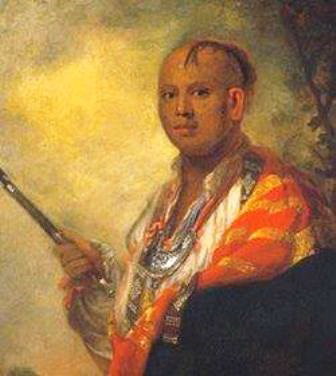
Chief Amatoya “Water Conjurer”

Chief Amatoya “Water Conjurer”
My 11th great-grandfather was half British and half Shawnee. He married a Shawnee woman and lived as a leader of her tribe. Natives were treated very badly by the colonists, who normally thought of them as inferior. This is one success story I am pleased to have in my family’s history.
Trader Carpenter (Amatoya / Moytoy I) married a Shawnee named Locha in 1668. Trader’s sister Pasmere Carpenter married the grandfather of Cornstalk Hokolesqua (Shawnee) in 1660. That same year the clan was driven south by the Iroquois. They moved along the Tennessee river, starting the villages of Running Water (where Thomas died in 1675), Nickajack, Lookout Mountain, Crowtown and Chota. Chota was created as a merging place of refuge for people of all tribes, history or color. It became similar to a capital for the Cherokee Nation. These villages had grown to about 2000 people by 1670 when the Carpenter clan moved to Great Tellico. Here Trader (Amatoya / Motoy I) married Quatsy of the Wolf Clan in 1680. Though Amatoya (Trader) was chief of the above mentioned villages, it was his son Moytoy II (sometimes called “Trader-Tom”) most people refer to as Moytoy and who many claim was crowned “Emperor of the Cherokee”.
CHRONOLOGY
1540
Hernando De Soto’s expedition to the Mississippi River is the first time Europeans are seen by American Indians in Kentucky.
1629
British colonists in Virginia establish a trade network with Cherokee living in the Appalachian Mountains.
1690
King William’s War begins.
1697
The Ryswick Treaty is signed at the end of King William’s War. Territories remain the same as before the War.
1702
The Cherokees and Creeks side with the French during Queen Anne’s War.
1716
Cherokee strengthen their alliance with the British.
1717
This date is engraved in a sandstone rockshelter in eastern Kentucky.
1730
Cherokee Chiefs Attakullakulla, Clogoittah, Kollannah, Onancona, Oukah Ulah, Skalilosken Ketagustah, and Tathtowe travel to Great Britain with Alexander Cuming.
1722
The Treaty of Albany is made between the Haudenosaunee and Great Britain. The Haudenosaunee are joined by the Tuscarora and they expand by alliance and conquest to control an area from southern Canada to Kentucky.
Chief Amatoya “Water Conjurer” (Trader Tom CARPENTER) aka MOYTOY I (1635 – 1693)
11th great-grandfather
Aganonitsi Quatsy Woman Wolf ClanTellico Cherokee Tellico (1650 – 1692)
daughter of Chief Amatoya “Water Conjurer” (Trader Tom CARPENTER) aka MOYTOY I
Delaware Indian Fivekiller (1674 – 1741)
son of Aganonitsi Quatsy Woman Wolf ClanTellico Cherokee Tellico
Solomon John Cherokee Kimborough (1665 – 1720)
son of Delaware Indian Fivekiller
Mourning Kimbrough (1689 – 1756)
daughter of Solomon John Cherokee Kimborough
Jane Jeanette Little (1713 – 1764)
daughter of Mourning Kimbrough
Andrew Armour (1740 – 1801)
son of Jane Jeanette Little
William Armor (1775 – 1852)
son of Andrew Armour
William Armer (1790 – 1837)
son of William Armor
Thomas Armer (1825 – 1900)
son of William Armer
Lucinda Jane Armer (1847 – 1939)
daughter of Thomas Armer
George Harvey Taylor (1884 – 1941)
son of Lucinda Jane Armer
Ruby Lee Taylor (1922 – 2008)
daughter of George Harvey Taylor
Pamela Morse
I am the daughter of Ruby Lee Taylor
Amatoya Trader Moytoy was a half white half Shawnee who went on to be a prominent chief and leader for the Cherokee people. His family line would lead the Cherokee for many years to come. This was a testement to the views of the Cherokee people before being abused by the English for many years. They took in a English settler as one of there own, He wed a Shawnee woman and became a member of the tribe.

Can you feel it? It’s a CHIRON-ic week and month, dear Astro~News Reader! Quick flash-back for context: CHIRON crossed over the Spring Equinox a.k.a. ‘Emergence’ Point on APR 17, to ‘Come Alive’ in ARIES. Here’s a link to the blog post for CHIRON’s entry into ARIES – The Medicine of Being Authentically YOU. It’s a try-on […]
 mermaidcamp