mermaidcamp
Keeping current in wellness, in and out of the water
You can scroll the shelf using ← and → keys
You can scroll the shelf using ← and → keys
When I graduated from high school in Texas I went to work for the summer in an outdoor drama called “Unto These Hills” produced in Cherokee, North Carolina. I was a singer in the chorus and a costumer. It was my first job, and I enjoyed it very much. I was 17 years old, the youngest and the lowest paid member of the company. I learned about the history of the Cherokee people, since the play was all about that. I can still sing the eagle dance in Cherokee language, if required (but usually when it is neither required nor requested). I spent a lot of time and money chasing clues about my father’s Cherokee heritage, which has no legs. My grandfather lived on the Cherokee res in Oklahoma in 1900, but our ancestors on my father’s side did not marry Native Americans. Now I am discovering that my mother’s side descends from the east coast Cherokee people, before the trail of tears forced them to Oklahoma Indian Territory. I was born in Tulsa. People tell me I look like a Native American–just as many tell me I look like a Russian. I always liked the idea of Native ancestors. Now, thanks to DNA clues I received from ancestry.com about common lineage, I am happy to say I found some.
This Englishman who sailed to Jamestown and married my eleventh great-grandmother was trained to be a water witch!!!! His progeny inherited the skill to find water. I LOVE that. I think it is wonderfully ironic that his grave is a few miles from the place I worked when I was 17. I can also recite the 23rd psalm in Cherokee, which now seems perfectly apt. It pays to study your ancestors.
Thomas Pasmere “Corn Planter” Carpenter (1607 – 1675)
12th great-grandfather
Trader Tom Amatoya Carpenter Moytoy (1635 – 1693)
son of Thomas Pasmere “Corn Planter” Carpenter
Aganonitsi Quatsy Woman Wolf ClanTellico Cherokee Tellico (1650 – 1692)
daughter of Trader Tom Amatoya Carpenter Moytoy
Delaware Indian Fivekiller (1674 – 1741)
son of Aganonitsi Quatsy Woman Wolf ClanTellico Cherokee Tellico
Solomon John Cherokee Kimborough (1665 – 1720)
son of Delaware Indian Fivekiller
Mourning Kimbrough (1689 – 1756)
daughter of Solomon John Cherokee Kimborough
Jane Jeanette Little (1713 – 1764)
daughter of Mourning Kimbrough
Andrew Armour (1740 – 1801)
son of Jane Jeanette Little
William Armor (1775 – 1852)
son of Andrew Armour
William Armer (1790 – 1837)
son of William Armor
Thomas Armer (1825 – 1900)
son of William Armer
Lucinda Jane Armer (1847 – 1939)
daughter of Thomas Armer
George Harvey Taylor (1884 – 1941)
son of Lucinda Jane Armer
Ruby Lee Taylor (1922 – 2008)
daughter of George Harvey Taylor
Pamela Morse
I am the daughter of Ruby Lee Taylor
Thomas Pasmere Carpenter was descended from the noble Anglo-Norman family of Vicomte Guillaume de Melun le Carpentier. Thus, Moytoy’s European lineage can be traced to the Frankish Duke Ansegisel of Metz Meroving, Peppin II, and Charles Martel. This ancestry also makes the Cherokee Moytoys cousins to the Carpenter Earl of Tyrconnell, and thus related to the current British royal family.
The Carpenter family of Devonshire & Plymouth England were small sailing ship owners, many of which were leased out to the East India Trading Company, an affiliation dating to the formation of that company December 31, 1600. Documented ownership of fifteen different ships owned by the Carpenter family, those of which were involved with moving furs between the Gulf Ports & Glasgow, or Dublin, and trade goods for North America. These ships usually made stops both directions at Barbados where the family had banking connections set up. These ships were small and fast, often able to make the crossing from Scotland and Ireland in less than thirty days. They were shallow draft ships, capable of handling shallow water ports with ease. The first documented trip made by Thomas Pasmere Carpenter occurred April 1640, sailing from Maryland to Barbados aboard the Hopewell, and returning on the Crispian in September 1640. He made another trip in March 1659 departing Charleston South Carolina aboard the Barbados Merchant, returning on the Concord in August 1659.
Twenty year old Thomas Pasmere Carpenter came to Jamestown, Virginia from England in 1627, living in a cave near the Shawnee. Thomas was called “Cornplanter” by the Shawnee, derived from their sign language that matched as near as possible to the work of a carpenter. He married a Shawnee woman named “Pride” and bore a son around 1635 named Trader Carpenter.
Trader was taught to “witch” for water with a willow stick by the Shawnee. He married a Shawnee named Locha in 1658 and the clan grew quickly. In 1660, they were driven south by the Iroquois. They moved along the Tennessee River, starting the villages of Running Water (where Thomas died in 1675), Nickajack, Lookout Mountain, Crowtown and Chota. He was Chief of Chota, which was created as a merging place of refuge for people of all tribes, history or color. It became similar to a capital for the Cherokee nation. These villages grew to about 2000 people by 1670 when the Carpenter clan moved to Talikwa (Great Tellico) where the Tellico River emerges from the Appalachian Mountains. Here Trader married a Cherokee, Quatsy of the Wolf Clan in 1680. He had become so adept at water witching that the Cherokee called him “water conjurer” or Ama Matai (Ama is Cherokee for water). Ama Matai eventually became pronounced as Amatoya. It was later shortened to “Moytoy”, so he is known as Moytoy I.
In 1730, his son, Trader-Tom (Moytoy II) took over as Chief, receiving what was described as the “Crown of Tannassy”. Tanasi was where the previous Chief resided and the traditional headdress was passed on to him. The fur trading Carpenter family owned many ships. Though he served as Cherokee Chief, Thomas made several trips to Barbados over the years where the Carpenters did banking, and even to Scotland and Ireland. On occasion he took Trader, and Trader Tom with him. They traded furs and healing herbs brought from America.
Cherokee traded furs for cloth. The cloth was not only used for clothing, but also to pay the Shamans for treatment. Though the medicine men did not charge for medical practice, they required a form of payment for performing love charms, hunting ceremonials, and other conjures. Beads were used in many instances, which the patient was required not only to furnish the beads, but also a certain quantity of new cloth upon which to place them. At the close of the ceremony the medicine man would roll up the cloth, beads and all, and take it with him. Custom required that he not use the cloth, but had to be sold. The practice was sometimes repeated over a period of days, each time requiring new cloth. Some Shamans would sell the required cloth to the patient himself, then take the used cloth with him.
The Cherokee, Shawnee and other Shamans (medicine men) traded secrets when they met. These were passed on orally before the Sequoya method of writing was developed. According to archeologist James Mooney “It was the practice when one shaman met another whom he thought might give him some valuable information, would say to him, “Let us sit down together.” This was understood by the other to mean, “Let us tell each other our secrets.” It was necessary to cultivate a long memory, as none were repeated more than once for his benefit. It was considered that one who failed to remember after the first hearing was not worthy to be accounted a shaman.”[1] When illness struck the white settlers and traditional methods of healing failed, they sometimes turned to friendly Cherokee nearby. This also provided the medicine men with new opportunities to obtain cloth and other goods from them in return. These methods were soon incorporated into the beliefs the settlers brought with them from Europe.
The Cherokee believed in at least two types of witches. The “Night Goer” or “sûnnâ’yï edâ’hï “ came at night to bring to the home. Alternatively, what might be called a good witch, “u’ya igawa’stï “ saturated the medicine given by the medicine man and by counteracting the spell, killed the Night Goer.[2] The settlers absorbed these ideas into their lives to the point that even milk that soured could be caused by the “evil eye” or the look of a witch. Soured milk came to be called “blinked milk”.
The settlers combined elements of their own witchcraft traditions with those of the native Cherokee. Some witches in this tradition specialized in dowsing, or healing and midwifery.
The isolation of mountain communities protected the traditions of Appalachian Granny Magic from alteration or persecution from outside. The people of the Appalachians lived a farming life that changed little from the 1700s to the 1900s, and their close connection to the earth kept Appalachian Granny Magic relevant throughout this time.
Beliefs and Traditions
The Scottish and Irish settlers believed that their fairy folk and leprechauns followed them to the new country. In addition, the Cherokee had little neighbors of their own who were called “Yunwi Tsunsdi,” meaning “The Little People.” The Appalachian Mountain Witches give offerings to the wee people daily. A granny woman will make offerings by leaving a bowl of cream at the back door. She will throw a bit of cornbread cake out of her window before serving the rest to her family. The Appalachian Witches also believe in spirits of the dead and seek out the guidance of ancestral spirits. One type of ancestral spirit that is feared are the angry “Haints”. One spell that protects a home against haints requires that its doors be painted Haint Blue, which is a baby blue color with a slight tint of periwinkle.
Many of the older Granny Magic spells are sung and danced; clogging is one of the forms of dance. Appalachian spells are also known to have chants, gigs, and lullabies. During Samhain and funerals the song “Auld Lang Syne” is sung. It is also sung during the secular new year.
Divination is popular with Granny Witches. Appalachian Granny Witches read tea leaves, tarot cards and regular playing cards, and clouds. They will also use bowls of dirt, sand, or water for scrying. Rods made from dogwood or other types of flowering tree such as an apple or peach tree are used for water dowsing, and metal rods are used for energy dowsing. A cauldron is usually preferred over a chalice by an Appalachian Witch. A cauldron displayed in a granny witch’s front yard lets people know that her services are available. Brooms, pottery, candles, mirrors and baskets, all made by hand in the home, are other tools used in this tradition. Appalachian witches have usually considered ritual clothing to be impractical, but some modern Appalachian Witches have begun to use ritual clothing in order to preserve their way of life and religion for future Appalachian Granny Witches.
^ Sacred Forumulas of the Cherokee Shamans by James Mooney. Cherokee Heritage Documentation Center (2008). Retrieved on 2008-06-22.
^ Sacred Formulas of the Cherokees by James Mooney. Cherokee Heritage Documentation Center (2008). Retrieved on 2008-06-22.
Retrieved from “http://en.wikipedia.org/wiki/Appalachian_Granny_Magic”
Cleopatra married Opechancanough who was her father’s adopted brother and her adopted uncle
Matachanna traveled to England to be with her half-sister, Pocohontas, before she died. Matachanna went back to Virginia where she lived and died.
Cleopatra Powhatan the Shawano was born in 1590, near Jamestown colony, and died in 1680
Cleopatra Powhatan was half sister of Pocahontas
Going back to the era of John Smith . . . In the late 1500s/early 1600s a Powatan chief name Wahunsunacock [one of numerous variant spellings] had united some 30 Alonquian tribes into a powerful confederation. He had created the empire through conquest and alliances. He actually ruled as an emperor, not just a tribal chief. When the Jamestown colonists arrived, Wahunsunacock’s domain encompassed the entire region that was to become Virginia. Wahunsunacock did not use a title other than chief of the Powhatans. The colonists referred to him as simply “The Powhatan”, denoting his position as emperor over numerous tribal chiefs of the Powhatan nation. The Powhatan was not friendly toward the colonists, seeing them as encroachers.
Wahunsunacock’s younger brother, or half-brother, Opechanacanough, was the tribal chief who captured John Smith. He immediately took the captive Smith to Emperor Wahunsunacock who imposed the death sentence. Tradition holds that Wahunsunacock’s daughter Matoaka “LIttle Snow Feather”, nicknamed Pocahantas or “Playful One”, pleaded for her father to spare John Smith’s life. Pocahantas became an emissary between her father and the colonists and as such was instrumental in providing the food which saved them during the hard winter. The colonists, in turn, showed their appreciation by capturing and holding Pocahantas for ransom. After they had extracted the full ransom from Wahunsunacock, then they forged an alliance with him by marrying Pocahantas to John Wolfe, a planter in the Jamestown colony who is credited with introducing tobacco as a cash crop.
That much is familiar history. Then comes the chapter that is really relevant to our family. At the death of the elderly Wahunsunacock, his younger brother [it’s uncertain if he was a brother or a half-brother] Opchanacanough became successor to Wahunsunacock as emperor. As such, he is frequently also called The Powhatan. To distinguish between the two men I have chosen to use the technically accurate term “Emperor” for Wahunsunacock and “Chief” for Opechanacanough, since Opechanacanough was promoted from a “chief” to succeed Wahunsunacock who had forged the “empire”. In reading other histories, however, it is necessary to note that some writers use the term Powhatan for both brothers interchangeably which is unnecessarily confusing and actually incorrect. Sometimes I get the impression that some genealogy researchers do not grasp that they are two different men.
Emperor Wahunsunacock perhaps had hundreds of wives and children. Several of them are noted in historical documents, but none so well as Pocahantas and, to our benefit, her sister Cleopatra. Not only was Cleopatra a daughter of the Emperor, she was wife to the successor Chief/Emperor Opechanacanough. Now if you were paying attention and recall that Opehanacanough and Wahusunacock were brothers/half-brothers, you might realize that she was also Opechanacanough’s niece [or half-niece as the case may be]. They were a royal dynasty and keep in mind that the family lineage was preserved by most Native Americans, as they still do now, through the matriarchal line.
The relationship of Cleopatra and Pocahantas as full sisters is fully documented. After the death of Pocahantas, Pcahantas’ son had to apply for rights to get to visit his Indian relatives and in his written legal request specifically asks to visit his “mother’s sister Cleopatra” by name. Cleopatra obviously was not her Indian name, but rather what she was called by the colonists because since her husband was the successor ruling Chief/Emperor she was in fact Queen. The title seemed especially apropos to the colonists since not only was she Queen, but her exotic dark looks and elaborate trappings also seemed very regal, and reminiscent of the Egyptian queen.
Only I and probably 30 million other people descend from this royal hierarchy. While everyone is eager to prove their ancestry to Pocahantas because of her fame, Cleopatra was the only one to ascend to actual Queen. Pocahantas, for all her fame, was a mere Princess. The modern day Native American line of this family adapted the surname Powhatan from very early times.
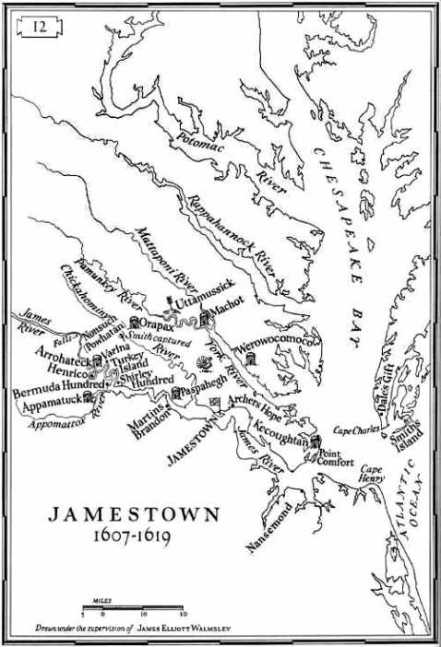
Jamestown
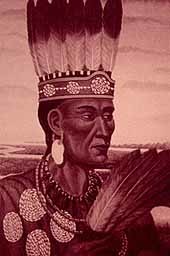 Powhatan 1545-1618
I recently received an advisory of a DNA match from my ancestry.com account that has brought me to a very exciting destination. This very famous Native American, the very same one we learned about in grade school, is my ancestor. I am excited, but want to verify all my results with more evidence. The DNA was from the Little family, and they brought me the information about all these Native American ancestors. I have not had a DNA test that has found any Native DNA. These results area combination of DNA, and record keeping (which can be faulty and has brought me to felonious conclusions in the past). I hope I can conclusively prove all the data, but in the meantime I am excited! It looks like my mother is descended from Pocahantas’ sister, Cleopatra.
Powhatan (born June 17, 1545; died April 1618), whose proper name was Wahunsenacawh (alternately spelled Wahunsenacah, Wahunsunacock or Wahunsonacock), was the paramount chief of Tsenacommacah, an alliance of Algonquian-speaking Virginia Indians in the Tidewater region of Virginia at the time English settlers landed at Jamestown in 1607.
Powhatan, alternately called “King” or “Chief” Powahatan by the English, led the main political and military power facing the early colonists, was probably the older brother of Opechancanough, who led attacks against the English in 1622 and 1644. He was the father of Pocahontas, who eventually converted to Christianity and married the English settler John Rolfe.
Captain John Smith described Powhatan as “…a tall well proportioned man… his head some what grey…. His age near 60; of a very able and hardy body to endure any labour. What he commandeth they dare not disobey in the least thing.”
 Powhatan’s Cloak in a museum at Oxford
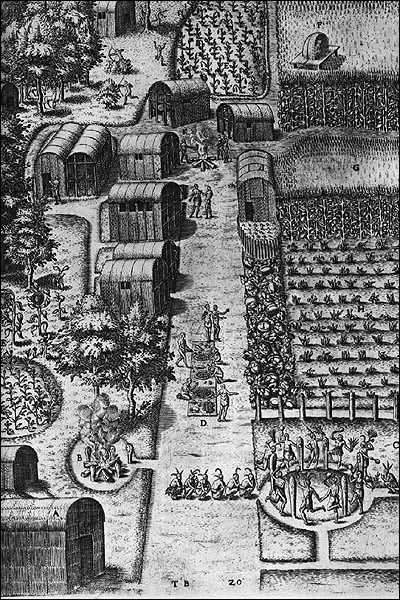 Powhatan Village called Towne of Secoton
Powhatan. The ruling chief and practically the founder of the Powhatan confederacy (q. v.) in Virginia at the period of the first English settlement. His proper name was Wahunsonacock, but he was commonly known as Powhatan from one of his- favorite residences at the falls of James r. (Richmond). According to Smith, of some 30 cognate tribes subject to his rule in 1607, all but six were his own conquests. At the time of the coming of the English, Powhatan is represented to have been about 60 years of age, of dignified bearing, and reserved and stern disposition. His first attitude toward the whites was friendly although suspicious, but he soon became embittered by the exactions of the newcomers. On the treacherous seizure of his favorite daughter, Pocahontas (q. v.), in 1613, he became openly hostile, but was happily converted for the time through her marriage to Rolfe. He died in 1618, leaving the succession to his brother, Opitchapan, who however was soon superseded by a younger brother, the noted Opechancanough.
Chief Wahunsonacock Powhatan (1547 – 1618)
14th great-grandfather
Princess Cleopatra Shawano Powhatan (1590 – 1680)
daughter of Chief Wahunsonacock Powhatan
Pride Chalakahatha Elizabeth (Cornstalk) Shawnee (1615 – 1679)
daughter of Princess Cleopatra Shawano Powhatan
Trader Tom Amatoya Carpenter Moytoy (1635 – 1693)
son of Pride Chalakahatha Elizabeth (Cornstalk) Shawnee
Quasty Woman (1650 – 1692)
daughter of Trader Tom Amatoya Carpenter Moytoy
Delaware Indian Fivekiller (1674 – 1741)
son of Quasty Woman
SOLOMON JOHN CHEROKEE KIMBOROUGH (1665 – 1720)
son of Delaware Indian Fivekiller
Mourning Kimbrough (1689 – 1756)
daughter of SOLOMON JOHN CHEROKEE KIMBOROUGH
Jane Jeanette Little (1713 – 1764)
daughter of Mourning Kimbrough
Andrew Armour (1740 – 1801)
son of Jane Jeanette Little
William Armor (1775 – 1852)
son of Andrew Armour
William Armer (1790 – 1837)
son of William Armor
Thomas Armer (1825 – 1900)
son of William Armer
Lucinda Jane Armer (1847 – 1939)
daughter of Thomas Armer
George Harvey Taylor (1884 – 1941)
son of Lucinda Jane Armer
Ruby Lee Taylor (1922 – 2008)
daughter of George Harvey Taylor
Pamela Morse
I am the daughter of Ruby Lee Taylor

memorial
My 8th great-grandfather was born in Virginia Colony in 1643. His parents were both killed in the Jamestown Massacre when he was an infant.
Godfrey Ragsdale I was the first generation emigrant to America. He came sometime before 1641. He and his wife were killed in an Indian massacre on April 18, 1644. Their baby, Godfrey II, was spared. He evidently came at his own expense with intent to inhabit the land, for no grant has been found to him, but there is a record of a purchase of 300 acres of land by deed from John Butler, 25 Feb 1642. This land lay on the north side of the Appomatox River in Henrico Co. Virginia. Source: “Godfrey Ragsdale From England to Henrico Co. Virginia” by Caroline Nabors Skelton; 1969; and Henrico Co. Records; Bk. 6; p. 21.
Godfrey Ragsdale II (1643 – 1703)
8th great-grandfather
Ann Wragsdale (1659 – 1724)
daughter of Godfrey Ragsdale II
Benjamin Abraham Vesser (1740 – 1779)
son of Ann Wragsdale
Samuel Harris Vassar (1757 – 1846)
son of Benjamin Abraham Vesser
Mary Vessor (1801 – 1836)
daughter of Samuel Harris Vassar
Margaret Mathews (1831 – 1867)
daughter of Mary Vessor
Julia McConnell (1854 – 1879)
daughter of Margaret Mathews
Minnie M Smith (1872 – 1893)
daughter of Julia McConnell
Ernest Abner Morse (1890 – 1965)
son of Minnie M Smith
Richard Arden Morse (1920 – 2004)
son of Ernest Abner Morse
Pamela Morse
I am the daughter of Richard Arden Morse
The Ragsdale family name is said to come from Ragdale, England, meaning either “valley at the pass” or “dweller in the valley where the lichen grows.” Henry Ragsdale was born in Leicestershire, England about 1450, his son Robert was born about 1485 in Ragsdale, Leicestershire, England. He died about 1559 and some of his children were Henry, Thomas R. and John R. Henry was born about 1510; he married Elizabeth Oglethorpe about 1532 , and their children were William, Dorothy, Elizabeth, Margaret, Owen and Catherine. Henry died in 1559. William was born in 1575; he married a woman named Heathcote, about 1615; they had a son, Godfrey I, who married Lady Mary Cookney and they both came to America.
Godfrey Ragsdale I and his wife, Lady Mary Cookney arrived in Virginia some time late in the summer of 1638. They were some of the first Ragsdales to come to America. Godfrey Ragsdale I ands his wife, Lady Mary Cookney lived in Henrico County Virginia on a 300 acre plantation on February 25, 1642, upon the north side of the Appomattox River.
On April 18, 1644 afterwards known as “Opechancanough Day” the Pamunkee Indians and several tribes in the Indian Federation went on a rampage. There was a carnage that was greater than the one in the Norfolk area in 1622. The Indians slaughtered no less than 500 Englishman. This massacre fell almost entirely upon the frontier Counties at the head of the great rivers, and upon the plantations on the south side of the James River. Both Godfrey I and his wife Lady Mary were killed and scalped.
From documents we know that Godfrey and Lady Mary had a son named Godfrey Ragsdale II, who was born in 1644. Because his mother and father had been killed in the “Jamestown Massacre”, Godfrey II’s next door neighbors raised him and later became his in-laws. Historians say that most Ragsdales in America came from Godfrey II.

Ragsdales in Virginia

Lower Surry Church
Lawnes Creek Parish Church was the first church erected on Hogg Island in 1628 for the citizens of James City County who lived on the south side of the James River. Surry formed from James City County and the first parish for the area now encompassed by Surry County was known as “Lawnes Creek.”
The parish church members would have been buried at their place of worship as was the custom in those days.
This site is now occupied by the Surry Nuclear Plant.
No access permitted.
LAWNES CREEK PLANTATION, Rts 650 & 628
The peninsula of land about 2 miles in width and 8 in length between Lower Chippoakes Creek and Lawnes Creek and south of Hog Island, was, together with the lands adjoining upper Chippoakes Creek and opposite Jamestown, the first to be settled in Surry away from the James River. Virtually all this land had been patented before 1635, mainly by William Spencer, Captain William Pierce, Roger Delke, and Captain Lawrence Baker.
My 8th great-grandfather, John Holt was born in 1664 in Surry County, Virginia, a British colony. He died in 1705 Surry County, Virginia, hung by his own hand. His 8th great-grandson, George Harvey Taylor, committed the same “Felonious homicide of a man’s self” by drinking carbolic acid in 1941. George Harvey was my maternal grandfather. It is said that suicide reoccurs in families.
He was listed in the 1687 Cavalry of Surrey County, Virginia. John M. Holt was born in 1664 in Lawnes Creek Parish, Hog Island, Surry County, VA. John died 1705 at the age of 41 in Surry County, VA. John Holt committed suicide.
On Feb 24, 1685 Mr. John Holt and his wife were fined for not going to church by the Surry County Court. (This may have been rather harsh as she most probably was pregnant.)
In 1703 he petitioned the Legislature to be Keeper of the Ferry settled on James River to Archer’s Hope Creek on the north side. Appears on the 1704 Rent Roll for Surry County, VA On November of 1706 the Surry County Court Records state that “John Holt upon his petition is admitted to keep a ferry in Hog Island pursuant to a Law made to that purpose and for his better compliance therewith ordered that he forthwith provide and maintain one substantial flat bottom boat of at least fifteen feet by the keel for carrying over of horses as also one other boat of at least twelve or thirteen feet by keel for passengers with three able men constantly to attend the said service ant that he enter into a bond with good and sufficient security duly to perform the same. In May of 1710 John Holt petitioned the Court and they “exempted him from payment from his bond for keeping a ferry at Hog Island. (Surry County, Virginia Court Records, 1707-1711, Book VI
By 1704 the Holt family would own 2,768 acres in Surry County. Of this, 1,450 acres were controlled by Elizabeth Holt, wife of Randall Holt, Jr.. The remainder was owned by the sons of Randall and Elizabeth..
John Holt (1664 – 1705)
8th great-grandfather
David Holt (1685 – 1749)
son of John Holt
Sarah Holt (1740 – 1792)
daughter of David Holt
James Truly (1755 – 1816)
son of Sarah Holt
Elizabeth Betsy Truly (1782 – 1851)
daughter of James Truly
Minerva Truly Darden (1806 – 1837)
daughter of Elizabeth Betsy Truly
Sarah E Hughes (1829 – 1911)
daughter of Minerva Truly Darden
Lucinda Jane Armer (1847 – 1939)
daughter of Sarah E Hughes
George Harvey Taylor (1884 – 1941)
son of Lucinda Jane Armer
Ruby Lee Taylor (1922 – 2008)
daughter of George Harvey Taylor
Pamela Morse
I am the daughter of Ruby Lee Taylor
By 22 September 1705 John Holt “laid violent hands upon himself”
Suicide was against the law. Without regard to the rights of the heirs, the estate and property of the perpetrator reverted back to the crown. Govenor of Virginia Colony was Edward Nott decribes John as a man “who being under some indisposition of mind lately hanged himself…troubled with lunacy and distraction of mind.”
John’s eldest son David, had already received a substantial land grant from his grandfather David Crafford prior to David’s twenty-first birthday. John’s sons John Jr., Charles, Benjamin, and Joseph attended the hearing. The deposition of the court read in part: “Having labor’ d long under a very great Indisposition of Mind, and at last layd violent hands upon himself”, a coroner’s jury found that his estate was forfeited as “Felo de Se.” {Latin for “Felonious homicide of a man’s self”}
Governor Edward Nott appealed to the Crown for the family. He inventoried the estate at: 159I, 16s, 6d, and “his Five Surviving Children are fit Objects of Our Mercy and Compassion.”.
Queen Anne commanded the restoration of his estate to them on 7 Jan. 1706. “the said estate consisting chiefly in cattle proper for plantations and other perishable good is hereby to be restored to his five children John, David, Charles, Joseph and Benjamin. ibid, p.512.”
Source: I want to Especially THANK Charles Lindley Holt for sending me his research on this Virginia Colony HOLT family. THANK YOU. I used his dates and many of his ” ” ‘s.
Also:: Familysearch had some of this “(taken from the book “Adventurers of Purse and Person”.}” .

Pam and the Fam on the farm
I study my ancestry and family history. This fascinating subject consumes as much of my time as I allot to it. I have spent six years on Ancestry.com working on my tree. I am more skeptical now than I was in the beginning because I have been burned by specious data. It is painful to discover an error in one’s research, yet it is better to know sooner than later. I once had a magical surprise experience in Rhode Island at a very special private family home from the 1600’s. I was treated to a tour of the home and grounds since I announced that I was a Carr descendent. I was given instructions to find the family graves by my long-lost “cousin” who still lives on the property. I was in heaven. It turns out I was also delusional about my connection to that family because I had made a mistake a couple of generations earlier in my research. I discovered this error after I had returned home from my trip, and had to laugh about it. I also had to start again to retrace the lineage. That correction was easy because I had some good documentation to verify the facts. Other problems I have discovered or had pointed out to me have left me with a dead-end when I removed the phantom limb.
The odd phantom feeling after chopping off limbs and branches is caused my the attachment formed while studying them. There are several very common names in my tree including Scott. When I began my sturdy I started with notes written by my maternal great-grandmother about her knowledge of the family. She stated that my 2nd great-grandfather, Thomas Scott, was a soldier in the Union army during the Civil War. Even though we know his full name, Thomas Ewing Scott, born in 1842 in Ohio, I can find no decisive record of his military service. There are too many Thomas Scotts from Ohio for me to be sure. My maternal 2nd great-grandfather was, indeed, a soldier for the Confederacy. I am positive about that because I have a copy of his service record as well as his Confederate pension application that he made late in his life in Texas. After his death his wife also applied for a pension as a surviving spouse. I have her application documenting her husband’s service also.
If you find written documents of a private source they may or may not be accurate. Only when you can back up your story with official documents do you have a solid case. I have learned the hard way to verify all the connections fully before jumping back to another generation. There are many trees on the Ancestry.com site that have unverified connections. Copying the work of others without making sure of it can lead to bigger and longer errors. This is not even as safe as the cold war when we trusted by verified. Don’t trust until you verify. This practice may save you many hours of wasted time. After I have recovered from the vexation of discovering I had been wrong I still had certain affection for those people who turned out not to be related to me. My philosophy now is that I learned about history while I was out on the wrong limbs, and I have never claimed to be a professional genealogist. I am more of a time traveller. Do you know any of your family history, gentle reader? How did you learn about it?


Jamestown
My 10th great-grandfather sailed to America in 1610, settling in Virginia. He became the official interpreter for the colony, and served in many other public service capacities.
John Flood (1595 – 1658)
Notes- John Flood alias Fludd sailed from London aboard the ship “SS Swan(n)” in the summer of 1610 and landed at Jamestowne, Virginia, America in the same year. The passenger list describes him as “a gent” (gentleman). He took with him a considerable supply of provisions, including “corn, pease and beanes”, and also firearms and ammunition. He was the son of Nicholas Fludd, who was a younger son of Sir Thomas Fludd, a wealthy land owner living at Millgate, Bearsted, Kent. Nicholas married Elizabeth Davis at St. Andrews Church, Canterbury, Kent in February 1588/9.Initially John would have worked for various employers but he is known to have been employed in 1616 by The Reverend Alexander Whitaker, in Charles City, a settlement just to the west of Jamestowne, who is reputed to have converted Princess Pocahontas to Christianity in c1613. She is said to have been married to John Rolfe by Reverend Bucke at about this time. John was to marry Margaret Finche, widow, in c1624/5. She had arrived in Jamestowne in 1620 aboard the “SS Supply” with her husband William Finche and their daughter Frances. In September 1620 they are recorded as each holding fifty acres of land, but by 1624 William had passed away and John had married the widow Finche and they were living in Jordan’s Journey with their children Frances Finche and William Flood.By 1638 John had accumulated a considerable amount of land including that of his wife by right of marriage, and he was declared an Ancient Planter such that he was entitled to another 100 free acres of land. He was also granted a Patent of 2100 acres of land, where he established his plantation, located on the south side of the James River just opposite the town of Jamestowne. Here their other children were born, John c1627, Thomas c1629, and Mary c1635.His wife Margaret died c1644, leaving John with the young children. A year or so later he married Fortune Jordan, sister of Col. George Jordan, legislator, a member of a well known and influential family of Virginia. Their first daughter Jane, was born soon after and son Walter was born in 1656 when John was aged sixty-four.John served as a Representative in the Virginia House of Burgesses for twenty-two years, representing the areas of Flowerdieu Hundred, Westover and Weyanoke and served at least one term as their Speaker. By 1643 he was one of the representatives of James City County. In 1655 as Colonel John Flood, he was serving as a member of the local militia.At his death in 1658 he was Chairman of the Surry County Commission which held Court and administered the affairs of the County.John survived many hardships including the Indian uprising and massacre of 1644 which caused a break in the Colony’s fur trade. The Indian Treaty of 1646 gave the trade some protection with the erection of 4 forts along the frontier to which the Indians were permitted to come and trade. One of them, Fort Henry, was located on the south side of the James River, on the Appomattox. Across the river from the fort was the home of Captain John Flood, as he was then, who was appointed to the post of official interpreter for the colony.The Grand Assembly held at James City October 5, 1646, enacted the following: “that upon any occasion of a message to the Governor or trade, the said Necotowance and his people the Indians doe repair to fforte Henery, alias Appmattucke fforte, or to the house of Capt. John ffloud, and to no other place or places of the south side of the river, att which places the aforesayd badges of striped stuffe are to be and remaine. Indians found in ceded lands who were not wearing special striped coats picked up at the designated forts were to be killed on sight, and any white illegally entertaining Indians was to be punished severely. Be it also enacted that Capt. John ffloud be interpreter for the collony, and that for his service therin and transporting such Indians as shall be employed from time to tyme to the Gov=r in a message or otherwise, he is to be allowed from the publique the salary of four thousand pounds of tob’o yeerly.”. (The farming of tobacco was so widespread that it was used as a basis for money and trade).FLOOD(from page 301; “VIRGINIA HISTORICAL GENEALOGIES”, by Boddie)Col. John Flood (ca 1595-1658), of James City and Surry Counties, Va., arrived in 1610. In the “Muster Rolls, of Settlers in Virginia, 1624/5” is; “The MUSTER of John Fludd: John Fludd arrived in the ‘Swan’ 1610, Margaret, his wife, in the ‘Supply’ 1620. Frances Finch, her daughter, in the ‘Supply’ 1620, William Fludd, his son, aged 3 weeks”. John Flood was living in Charles City in 1616 and at “Jordan’s Journey” in 1625; in 1638 he patented land and settled in James City County just across the river from Jamestown in the section which in 1652 became Surry County.The above mentioned patent, dated May 12, 1638, was issued to “John Fludd, Gent,” and was for 2100 acres “E. upon land of Capt. Henry Browne, N. upon the maine river, S. into the maine woods & W. upon Benjamine Harrisons marked trees being upon the W. side of Sunken Marsh Cr.”, for transportation of 42 person. On June 7, 1650, “Capt. John Flood, Gent.” surrendered this patent and was given another of 1100 acres “on S. side the river, bounded S.E.S. upon land of Capt. Henry Browne, N.W. by N. upon land of Mr. Charles Foord and Richard Baven.” Among his headrights were listed: John Flood, an Ancient Planter, Margt., his wife, Frances Finch her daughter, John Flood, Junr., Eliza. Browne, John Lawrence, John Wright, Wm. Wood, and others. (“Cavaliers and Pioneers”, pages 86 and 194).On Jan 16, 1643/4, John Flood witnessed the will of Capt. Thomas Pawlett (owner of Westover) who left one silver spoon and one sow shote apiece to his godchildren, Wm. Harris, John Woodson, Tho. Aston, Thomas Fludd, Henry Richley, John Bishop, Tho. Woodward, Tho. Boyse, Tho. Poythers, and William Bayle. (“Title of Westover”, by Dr. Lyon G. Tyler, in Wm & Mary Qrtly, Vol 4, p 151).The Grand Assembly held at James City October 5, 1646, enacted – “That upon any occasion of message to the Gov’r. or trade, the said Necotowance and his people the Indians doe repair to fforte Henery alias Appmattucke fforte, or to the house of Capt. John ffloud, and to no other place or places of the south side of the river, att which places the aforesayd badges of striped stuffe are to be and remaine.” ***”Be it also inacted that Capt. John ffloud be interpreter for the collony, and that for his service therein and transporting such Indians as shall be employed from time to time to the Gov’r. In message or otherwise, he is to be allowed from the publique the salarey of four thousand pounds of tob’o yeerly.”The Grand Assembly held at James City July 5, 1653, ordered – “And the commissioners of York are required that such persons as are seated upon the land of Pamunkey or Chickahominy Indians be removed according to a late act of Assembly made to that purpose, and Coll. John Fludd to go to Tottopottomoy to exam the preceedings of business and to deliver it upon his oath.”John Flood was only a boy when he came to Virginia but he was active and energetic and rose to high honors. He was Burgess for Flowerdieu Hundred in 1630, for Westover, Flowerdewe in September 1632; he was one of the Burgesses for James City County in 1643, 1645, and 1654. He was Captain in 1643 (and probably earlier), Lieutenant-Colonel in 1652, and Colonel in 1653. At his death in 1658, he was Chairman of the Surry County Commission which held Court and administered the affairs of the county; the other commissioners at that time were Lt. Col. Thomas Swann, Capt. George Jordan, Capt. Benjamin Sidway, Mr. George Stephens, Mr. Thomas Warren and Mr. James Mason. He was also Speaker of the House of Burgesses in 1652. (5 V. 185) Spouses1 Margaret Unknown, F Death Date1644Death PlaceVAMarr Dateabt 1624Marr PlaceVAChildrenMary , F (~1635-~1678)2Fortune Jordan, F Birth Date abt 1623 Birth Place England Death Date14 Jul 1668 Age: 45Death Place VA Father Arthur Jordan , MMother? Unknown , F Marr Date 1645 Marr Place VA Children Walter , M (-1722)


In 1635 My 10th great-grandfather participated in a political act in the Virginia Colony that landed him in trouble:
A Principal in the Overthrow of a Capricious Ruler
York History Series #A-5, April 1997by (the late) Dick Ivy, Honorary NMDA Member
Hearing of secret and unlawful meetings since January by some of his councilors concerning decisions of his rulership of Virginia, Governor Sir John Harvey apprehended and committed their “chief actors” William English, Nicolas Martiau and Francis Pott. On Apr. 28, 1635, the Governor’s Councilors Samuel Matthews, John Utie, Thomas Harwood, William Perry, William Farrer, William Peirce, George Menefie and Dr. John Pott came to the governor-called council meeting at his house. John Utie of Yorke’s Chiskiak Parish hit the governor hard on his shoulder and declared he was under arrest for treason. The others held him secure and told him to go back to England to answer the complaints against him. They set Martiau and others free and called for their force of 50 musketmen waiting at a short distance. On May 7, 1635, the councilors met at James Town, opened the floor to complaints, and elected Capt. John West as governor. The complaint included the giveaway to please the King of the Isle of Kent to Maryland by a willing Harvey for persecuted Catholics from England, ignoring the ownership claim by William Claiborne who was trading with the Indians here. A war ensued between forces from Maryland and Claiborne when the latter refused to become a Catholic, it is said. Martiau was granted 1,600 acres of land that year. The King reinstated Harvey and the rebels were ordered to appear at the King’s Star Court, but were never tried for an unknown reason. Finally, Harvey was recalled over another incident of poor judgment.
Capt Nicolas Martiau (1591, France-1657) & Jane Page Berkeley
Capt. Martiau [also recorded as Marlier, Martue, Martin, Martian] was a French Huguenot (in church of Threadneedle St.) from the Island of Ré. He was in the service of Henry Hastings, Earl of Huntingdon and member of the Virginia Company, and educated as a military engineer. He was naturalized as an Englishman by royal decree. He came to Jamestown aboard the “Francis Bona Venture” in 1620, legally representing the Earl to plan fortifications. He led a foray against the Indians at Falling Creek after the 1622 massacre. He joined the liberal party committed to the Virginia outlook, pleading for continuance of the House of Burgesses in 1623/4. He, with Captain George Utie and Captain Samuel Mathews, was responsible for sending the tyrant governor Harvey back to England.
There is some question about his wives. His first wife was Elizabeth, last name and date of death unknown. She was most likely the mother of Elizabeth (born 1625). Jane was the widow of Lt. Edward Berkeley, who died in 1625; they had a child named Jane. . After her death, Nicholas married Isabella, widow of Robert Felgete & George Beech, in 1646.
Martiau’s defense of the French king in an argument with Capt. Thomas Mayhew forced him to take a loyalty oath in Jamestown in 1627. He was granted 600 acres as Chiskiack, which became Yorktown (in 1644, the Cheskiack Indians were moved to the Pianketank, where they would be forced out by Augustine Warner; the tribe seems to have vanished at that point.) He served as Burgess 1632-33, and Justice for York Co. 1633-57. “He, with George Utie and Captain Samuel Matthews, sent the tyrant governor, Harvey, close prisoner back to England.” Harvey returned, bringing George Reade–Martiau’s future son-in-law–with him, but he was forced back to England again, leaving Reade as Acting Governor. Martiau moved to the present Yorktown site in 1630 on 600 acres, plus 700 for headrights, where he grew tobacco. On this land Cornwallis surrendered his troops to Martiau’s great-great-great-grandson, General George Washington in 1781. Martiau later was granted 2000 acres on the south side of the Potomac River, which he gave to Col. George Reade in 1657. (See John Baer Stoudt, Nicolas Martiau, The Adventurous Huguenot, The Military Engineers, and the Earliest American Ancestor of George Washington.)
Nicholas French Huguenot Martiau (1591 – 1657)
Martin, Marten, Martens, Martyn (French, Spanish, English) Descendant of Martinus [belonging to the god Mars, the god of war]; one who came from Martin, the name of places in Spain and France. The popularity of the name in Western Europe is due to St. Martin of Tours, the fourth century French saint.
Source: New Dictionary of American Family Names by Elsdon C. Smith, Gramercy Publishing Company, New York, 1988.
Nicolas Martiau – The Immigrant
This portion of the Family Roots and Branches is dedicated to the study of Nicolas Martiau (pronounced Mar-ti-o) and his descendants.
“The Adventurous Huguenot” and the father of Yorktown, Virginia, was born in France 1591, came to Virginia in 1620 and died in 1657 at Yorktown, Virginia. He was a Captain in the Jamestown militia during the Indian uprisings, a member of the Colonial Virginia House of Burgesses, and Justice of the County of York. In 1635 he was a leader in the thrusting out of Governor Harvey which was the first opposition to British Colonial Policy. He is the original patentee for Yorktown. He is buried at the Grace Church in Yorktown, Virginia.
Descendants of Nicolas are through his daughters, Mary (married Lt. Colonel John Scarsbrook), Sarah (married Captain William Fuller, Puritian governor of Maryland), and Elizabeth (married Lt. Col. George Reade). Nicolas is the earliest American ancestor of our first President George Washington.
Among the descendants of Nicolas Martiau we find – in addition to Washington – one Vice President of the United States, two Justices of the Supreme Court, three ministers to foreign countries, three cabinet officers, six governors of states, eight senators, eleven generals involved in the War Between the States, fifteen congressman, forty commissioned officers who served in the American Revolution,
2 of 3
2/6/13 12:24 PM
and a veritable host of men and women prominent in national life. Such names as General Thomas Nelson, a signer of the Declaration of Independance; Meriwether Lewis, explorer of Lewis and Clark fame; Duff Green; Thomas Nelson Page and Amelia Rives are of special interest.
In the early 20th century the registrar of the Colonial Dames of America in the state of Virginia contains the names of more than four hundred women who could trace their lineage to Nicolas Martiau.
Nicolas Martiau is my 15th great grandfather and one of two of my earliest American ancestors. Here is my line of descendent from that adventurous Hugenout – Nicolas Martiau:
Larry Van Horn, NMDA Member #174 (Scar(s)brook-Condon-Wills)
1. Nicolas Martiau & Jane ? (Berkley)
2. John Scar(s)brook & Mary Martiau
3. David Condon & Elizabeth Scar(s)brook
4. Elias Wills & Mary Condon
5. John Wills & Susanna Robertson
6. James Cole & Mary Wills
7. James Cole & Fanny Chisman Wills
8. Ware Oglesby & Elizabeth Dancy Cole
9. Aaron Redus & Lucy Ann Oglesby
10. James Ware Redus Jr & Leah Magee
11. Alexander Hamilton David Hurt & Mary Susan Redus 12. James Ira Hurt & Johanna Himena Schneider
13. Witt Lange Van Horn and Jeanette Iris Hurt
Nicolas Martiau Descendants – The First Six Generations
The link below is to an Adobe Acrobat PDF Descendants Chart that shows six generations of Nicolas Martiau Descendants. If you are a descendant of any of the below listed in this chart you are eligible for membership in the Nicolas Martiau Descendant Association (see below). The lines represented on this chart are lines that are accepted for membership in the NMDA. As more information is entered into our genealogy database, new charts will be placed on this website and the NMDA website. Be sure to check for these pages for future updates.
Nicolas Martiau Six Generation Descendants Chart (Adobe Acrobat format) The NMDA Lineage SocietyNicolas Martiau Descendant Association
Genealogist who can prove descend from Nicolas Martiau are eligible for membership in the Nicolas Martiau Descendant Association (NMDA). The NMDA was started in 1991. Two first cousins from California went to Yorktown to meet Dick Ivy (recently deceased), the Towne Crier and Historian, for a tour of the Martiau Family sites. One cousin fell and injured a knee, was propped up by the wall of the Grace Church cemetery. A lone man was in the mist, reading inscriptions. He paused at theColonel George Reade/Elizabeth Martiau stone, not aware of the Martiau Family buried there without a marker. This one act prompted the chain of events culminating in the first Tribute to Martiau held in 1993 and the 1997 grave marker dedication. A second Tribute was held in the Spring of 2000 and the third was held Spring 2004 in Yorktown. The cousins were Lee Yandell and Marty Dale. (Reade- Reade-Wattington).
The NMDA had over 182 members nationwide. I have the honor of serving as the National Registrar for this proud and prestigous lineage based organization. You can get more information on the NMDA by contacting me, Larry Van Horn, via email (link at bottom of this webpage) or visiting the official NMDA website at:
Nicolas Martiau Descendant Association
At this website you can download lineage and application formsin pdf format to aid you in the application process. On the website you will find selected members lineages, news, events, history and much more.

Seal of Jamestown
Randall Holt was born in Cheshire, England. His son John killed himself in Virginia, which made a big fat mess. Queen Anne stepped in to save his land for his family.
RANDALL HOLT (1607 – 1650)
is my 10th great grandfather
Randolph Holt (1638 – 1679)
son of RANDALL HOLT
John Holt (1664 – 1705)
son of Randolph Holt
David Holt (1685 – 1749)
son of John Holt
Sarah Holt (1740 – 1792)
daughter of David Holt
James Truly (1755 – 1816)
son of Sarah Holt
Elizabeth Betsy Truly Payne Darden (1782 – 1851)
daughter of James Truly
Minerva Truly Darden (1806 – )
daughter of Elizabeth Betsy Truly Payne Darden
Sarah E Hughes (1829 – 1911)
daughter of Minerva Truly Darden
Lucinda Jane Armer (1847 – 1939)
daughter of Sarah E Hughes
George Harvey Taylor (1884 – 1941)
son of Lucinda Jane Armer
Ruby Lee Taylor (1922 – 2008)
daughter of George Harvey Taylor
Pamela Morse
I am the daughter of Ruby Lee Taylor
Randall Holt was born about 1607 in Prestbury, England, the son of Randall/Randolph and Elizabeth (Pott) Holt, who were wed in the Prestbury church. Randall was probably a nephew of Dr. Pott(s), the Virginia Colony physician who later became governor.
Several Holt family christenings, weddings and burials have taken place at St. Peter’s Church in Prestbury. It is about 700 years old. Nearby in the churchyard there is an even older Norman chapel.
The Randall Holt FamilyRandall Holt’s is the first mention of the Holt family found in the American colonies. The court ordered that upon release from his indenture he was to be given “one suit apparel from head to foot and three barrels of corn.”
Randall was released from his indenture in 1625 and in 1628 he married Mary Bailey, who also may have been from Prestbury. It was a fortunate match. She was the sole heir of John Bailey of Hog Island, one of the richest men in the Virginia Colony.
The Bailey Family LegacyThe Council of Jamestown had appointed Robert Evers as Mary’s guardian at her father’s death and ordered that 490 Hog Island acres be deeded to her. Randall and Mary settled on this island in the James River. He added 400 acres to his wife’s property in 1636 and another 400 acres in 1639.
In 1650, Randall Holt Jr. obtained a grant for 1022 Hog Island acres as “son and lawful heir”. He received a major’s commission in the British Colonial forces and was a member of the governing House of Burgesses. In 1668, Randall Holt Jr. was appointed Justice for Surry County. In 1679, the year he died, he was granted a patent for 1,450 acres on Hog Island.
Queen Intervenes to Help Holt DescendantsJohn Holt inherited all the lands his father, Randall Jr., had owned, was listed in the 1687 Cavalry of Surry County, and was granted the right to operate the ferry between Hog Island and the mainland. By 1704, the Holt family owned 2,768 acres in Surry County. Of this, 1,450 acres were controlled by Elizabeth, the widow of Randall Holt Jr. The remainder was owned by the sons of Randall and Elizabeth.
Read on
John Holt committed suicide in 1707. Because suicide was unlawful, his land reverted to the crown. Son David had received a substantial land grant from his grandfather, David Crafford. The other sons—John Jr., Charles, Benjamin and Joseph—attended a court hearing on the matter. The court deposition read that the coroner’s jury found that his estate was forfeited. However, Gov. Edward Nott, representing the Crown, made the finding that “his five surviving children are fit objects of our mercy and compassion” and said Queen Anne had commanded the restoration of their father’s estate to them.
Read more at Suite101: Line of Descent from Randall Holt of Virginia: Grandson’s Suicide Prompted the Queen’s Intervention http://www.suite101.com/content/line-of-descent-from-randall-holt-of-virginia-a181274#ixzz0xlAgYO00
Descendants of Randall Holt are eligible for membership in the Jamestowne Society.
 mermaidcamp