mermaidcamp
Keeping current in wellness, in and out of the water
You can scroll the shelf using ← and → keys
You can scroll the shelf using ← and → keys
ROW80
Our 80 day writing exercise has flown by quickly for me. I planned to write a poem every day, but have managed to do so about half the time. I am not at all discouraged by this result because I have also managed to expand my repertoire of subjects and formats in my poetry. Last April I wrote daily and all of my poems were inspired by works of art, ekphrastic in nature. This was fun because I visited artist friends and took photos to use as the subjects. When I began this challenge all of my poems were ekphrastic, but I created the art myself rather than finding it. First I tired making the art followed by the words, then I tried it in reverse. It does not seem to matter which way I do it now, which is sort of silly to me. If you are inspired by it, it seems like it should exist before you write…but I am practicing both ways, trying them both to monitor results.
Lately I am happy because I attempted very unusual subjects and did some slightly representational drawing about them. I wrote about a lady who was ditched by her Euro-spy boyfriend in a restaurant. She was presented with a giant plate of raw meat, steak tartare, and a note saying her boyfriend had never existed. Now this might seem macabre or in bad taste, and perhaps it is. What is interesting is that I finally put a character and plot into a poem. My first attempt at this involved a swarm of ladybugs around a cabin. These might not have come up if I had not been following my fiction writing friends who work on plot and character all the time. My desire to make poems from historical figures and history itself lends itself to this practice. If I want to turn my dead ancestors into epic poems I need to employ some of the devices used to flesh out characters and thicken the plot. Since I endeavor to bring dream images into my poetry my technique will now expand to outlining plots and characters, then working on lucid dreaming to give me some vivid imagery with which to work. I can embellish the true stories of my family in my dreams and use the impressions to create poetic versions of historical events.
As the solar eclipse tomorrow brings us a dramatic illustration of light and shadow, I see a metaphor for the known and the unknown. What is obscured from view is often the most important part of the plot, and revealing it is the point of the story. What I do not know about my ancestors leaves room for invention and fancy. Here are some of the real people I think can become interesting poems:
I also have a true contemporary story I want the public to hear and remember. The Emperor’s New Neighborhood Watch is a rap poem about city government running amok. If I do this with rhyme and humor it will be more impactful. A good (digital) friend of mine told me this week that hexameter was the form used by Homer in his classic epics, not because it was great language, but so the actors could easily remember it. I have written about just the facts in this case for years, but what this story needs is some memorable rhyming truth. After the solar eclipse I will start outlining these stories for Poetry Month in April. It is a fun new way for me to paint with words. I am grateful to my fellow writers for teaching my some of their process. Check out the diversity of this group here. There is a lot of talent in this creative group of people. Thanks for sharing these 80 days with a beginner. Your support has been very inspirational. I aspire to be like you.

reaching higher
My front yard
I am a fan of many of the British detective shows featuring the clergy and other citizen detectives. Father Brown is lavishly produced and beautifully filmed with all the period details in tact. I like James Bond and the other real detectives on the silver screen as well. Now that I have started to think about story writing and composition of fictional characters I think it might be fun to try my hand at some kind of mystery story, not necessarily a murder. The spy/espionage element is always exciting, and can express certain political sentiments without stating them. I have been turning around some ideas about the end of the Civil War and spies on both sides, perhaps some of them deserting or worse, telling secrets. It might be fun to weave true known historical facts with some fictional spies or detectives. My personal detective skills are needed now for a mundane and not very mysterious task, to catch a petty thief.

scene of the crime
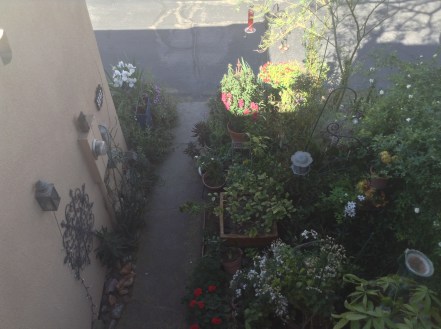
Here in Tucson there is a problem with random vandalism and petty theft. My front yard is small and visible from the street. This week one of my hummingbird feeders was stolen, leaving a shiny track of sugar water leading toward the street. This kind of random theft happens in my yard at least once a year, and usually they haul is more valuable than a single used hummingbird feeder. The most recent act has spurred me to order a surveillance camera to focus on my walkway to catch the next punk who does damage or steals my stuff. Prices have come down significantly and apps support all kinds of functions for home security now. Motion activation and night vision HD capture results in high resolution video to identify culprits. I ordered a deluxe set up from Amazon which will arrive in two days, and works on my home WiFi. When evidence is collected it can be submitted in a report to the cops and shared with our neighbors on Nextdoor.com.
I am not sure why I waited so long to install this camera. I think of myself as Detective Chief Inspector Morse in my own head, although I am much closer to Nancy Drew in reality. I read the Nancy Drew books when I was in elementary school and can remember imitating her while playing. We made up fantasy cases and followed clues, but now I don’t remember any of them. We liked Nancy because she was a girl, and she always solved the case. This was a contrast to Dick Tracy, Superman and the Lone Ranger, men with guns or superpowers, who also solved mysteries. She has made a comeback in modern times once again on the teen detective beat. I believe Nancy would be proud of me for installing my own remote system to watch my yard. I feel once again like my childhood idol. I like the feeling much better than helplessly allowing random petty crime to disrupt my peace and quiet. Do you ever think of yourself as a detective, gentle reader? Which one is your favorite?
ROW80
We have no idea what tomorrow will bring, but today is overflowing with potential.
Allan Lokos
Through the Flames
This quote by Mr Lokos perfectly describes my current position on my poetic future. By starting to investigate life and learning through poetry I have opened a vast area of artistic and intellectual study that I am just beginning to understand. Turning my attention to it has automatically turned some poets’ attention to me. One or two people post poems on my Facebook wall every day, which adds a social element to the mix. I don’t believe these writers have read any of my poems, but they have decided to share theirs directly to/with me. I follow more poets all the time who blog. Calligraphy with word significance has also come to my attention. This is a wonderful way to make words larger than life and more colorful than just typing. I have not tried it myself but am thinking of doing some writing by hand instead of always on a keyboard. It may stimulate something new.
I have thought about working with my ancestors as characters to create epic poems or stories, and have done a little work in that direction. People work with notes and written outlines, but I have yet to put these to work for me. I still contemplate images in my head for a while before I begin, but think I can benefit from a notebook with handwritten notes and drawings. When this 80 days has come to a full circle I plan to start a notebook and handwriting practice. I want to see if random idea trapping and tracking will help me kill my darlings and move on to deeper subjects. If I start pages for different times in history or branches of my family tree I think I can develop some themes from which to write fiction or poetry. I like mind mapping, but have not employed it to the task of writing. I believe it can unlock a boat load of potential material using this method. I have no idea what I may do with it, but it will be fun to find it.
Allan Lokos was in a plane that crashed and burned leaving him injured. His book was written to help others find compassion and patience in the face of challenging circumstances. His attitude about potential is key because every day is full of potential. Many of our lives contain too much repetition, little true bliss, and a lack of compassion. We are all recovering from something, although normally nothing so severe as an airplane crash. Honoring potential today by writing is a tribute to collective creativity. Rarely do plans for tomorrow work out exactly as we imagined. Writing creates a trail of breadcrumbs for the soul to trace its’ way. Poetry celebrates the way each of us is gifted with our own set of talents and perspectives. Leaving our stories and thoughts recorded for others to read may turn out to be uplifting or helpful to someone. This journey has contributed greatly to my ability to tap into the overflowing potential all around us. I appreciate the chance to interact with magic, words, and power. Cheers, gentle readers!

cocktail that wants to be a poem


I know why I love museums. They contain great art and beauty not for sale. Taking in an exhibition is different from going to a gallery opening with a possibility of purchasing something to take home. Botanical gardens and flower conservatories are even more attractive because they are maintained in ways I could never do at home. The extravagance of collections on display to the public makes me very happy. I never mind paying a fee to tour a museum because I know the expense for the establishment goes far beyond what they can collect at the door. Volunteers, donors, patrons and members keep the bills paid and the events continuing. Plans are made years in advance to show collections and feature artists at special opening galas. What does this have to do with my regular life at home?
In December I cleared out my bedroom, giving my closet an extreme make over. I jettisoned mass quantities of clothing to make my surroundings both pleasant and well-organized. This purge of possessions has proven to be very satisfying and easy to maintain. I am not tempted to over fill my space with objects or delay dusting. I feel great about my five star hotel style bedroom. We bought a new bed, new covers and pillows which add to the comfort. I am sure I don’t miss all the clothes I gave away, and am still loaded with wardrobe items for all occaisions.
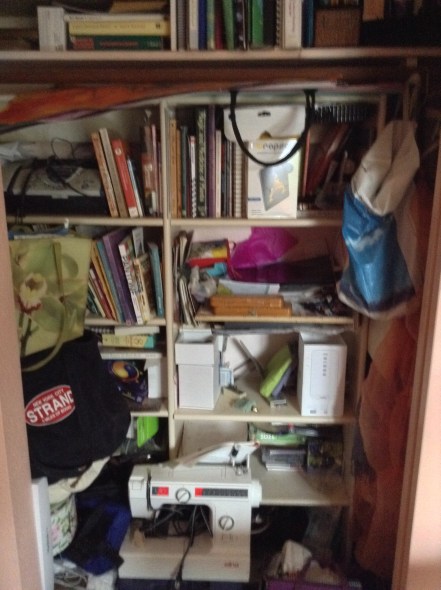
I have turned my attention to my office now. I started to look for something recently and found many useless things stuffed into my office closet. I began to eliminate, file, move, and generally tidy up my work space finding art, art supplies, sewing, fabric, patterns, and all manner of buttons, remnants and sequin trim. I also have stored both framed and unfinished art I have created by stuffing it into spaces on the bookshelf. The place is a mess, but it will not require as much work to reform as my clothing did. I finished my taxes today and feel I need to do this organizing task. I don’t honestly need to keep papers all over my desk while I organize taxes, but I seem to do that each year. Now there is no excuse. Next week I will have a clearly organized office that reflects my highly organized life. I believe that the space can create more order or more disorder all by itself. If I have a tiny pile of mail it becomes a big pile just because there is a place to stick envelopes I don’t want to open at the moment. I will turn this tide of unruly ownership of items into a fabulous collection of art and art supplies that would thrill any muse. I want to be able to find, use, then easily store everything in its place, just as Maria Montessori wants me to do. It would have been too shocking to show before and after shots of my clothes, but I am showing you the disgraceful state of my belongings now. I will impress you next week with the spanking new space. I am acting in time before they find me and put my office closet on one of those hoarder shows. Wish me luck on my new museum quality office.
closet in question
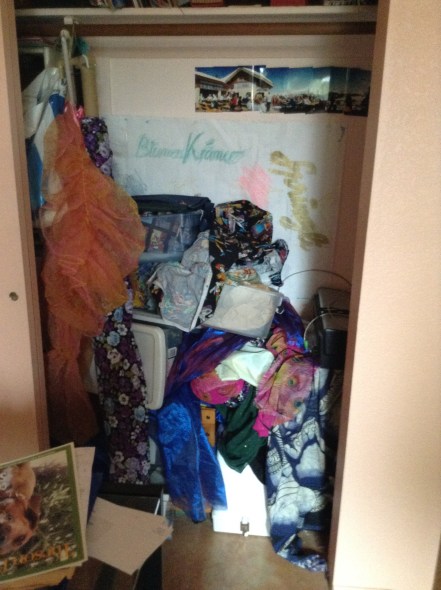
closet in question
ROW80
Writers make good company in person or long distance. In our 80 days together writing about writing I have made the acquaintance of interesting and talented people. Like social exchanges in person we represent a very diverse set of interests and geographic situations. The faithful participants check in twice weekly to report progress on goals which range from studying story architecture to editing novels to posting on twitter. At the same time I have been joining my on line colleagues I have been hanging out at least once a week with poets. One of my goals at the start of the 80 days was to become a regular at the U of A Poetry Center. This goal had been an unstated wish for over a year, and yet I had not worked it into my routine. Now that I made it a conscious part of my practice as a writer I am really happy. Being present for the readings and taking in the atmosphere of the crowds who attend the poetry events is a blast. All this free entertainment that is right up my alley has been waiting for me right around the corner from my home. I am glad I have made it a habit to go because it is a remarkable resource. I will probably work up to taking a workshop eventually.
Although I set no number of books, poems or poets to read during the challenge I have been very active absorbing poetry in print and by app. The Poetry Foundation app and others keep me busy finding new writers from all periods of history. I have developed some favorites in this short time of sampling different kinds of poetic work. Translated poetry is interesting to me. I like hearing it in the original language then in English, to hear the sound before the meaning. Haiku is written by all kinds of people in many languages around the world a great app to learn more about those is The Haiku Foundation’s Haiku app. Shake your iPhone and a new (not your grandfather’s) haiku appears ready to tweet or read. In general I like short pithy poems, but am also fond of epic stories if they contain humor. I am on a general exploratory venture into every poem and all poets. I have thought a lot about the relationship between poetry and music, and how they shape popular culture. I am reading Dorothy Parker Drank Here, a novel about the ghost of the great witty woman. Dorothy Meister presents a funny set of circumstances at the Algonquin Hotel in New York where Mrs. Parker is a haunting the bar as a way of telling about her life and personality. I am enjoying the read, and also noticing what a great device a ghost is to frame a story about anyone in history. I am planning to try it with some of my dead ancestors.
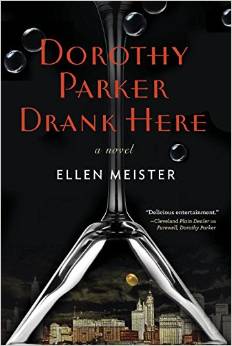
Dorothy Parker Drank Here
My poetry is chugging along, which I think is an accomplishment. I write almost every day, and expand my subject matter horizons. When I began this adventure I wanted to warm up and work on poetry for a better outcome in this year’s Poetry Month, NaPoWriMo challenge. I feel ready and able to write a poem every day in April, and I am now in the practice of illustrating what I post. I am proud to have developed this habit. It has no unwanted side effects, and I think I can only improve as I practice. Sometimes the inspiration comes from what I am thinking or doing in life, and other times it comes from some distant part of the universe. It always feels good to hit publish. To be in the company of writers is a honor and a privilege I appreciate. Check out my fellow writers and their adventures here.
ROW80
This week I bought a book of poetry that has been created by illiterate women in Pakistan and Afghanistan. These cultural specialties of the Pashtun tribe are biting commentary on life. Since they live in a war-torn state, to say the least, and their rights are severely limited because they are female, their point of view contains irony and stinging truth about love, war, grief, homeland, and separation. They tackle these subjects with depth and witty metaphor which they have learned from other women. The special right to express themselves is frequently withdrawn if the males in a family learn about it. The book I am reading, I am the Beggar of the World, was inspired by a young girl’s suicide when she was forbidden to create landays and share them on a telephone hot line in Kabul. The journalists who composed the images and couplets are veteran reporters who had been in the area during years of war, covering just the facts. They were emotionally and creatively blown away by the density and artfulness of this pastime/folk literature. The Poetry Foundation helped fund the expedition and Poetry magazine published some of the works. The response from the magazine’s readers was overwhelming. People want to see more of this kind of primal undiscovered poetry that is hidden and unknown to outsiders. It has touched me deeply and makes excellent meditation material.
As a writer I am taking on new subjects. My poems are still simplistic, but I am stretching to find subjects, characters, and perhaps real events that spark my imagination. I have considered how fresh and essential the landays are because of the restrictions of illiteracy and the need to remain anonymous. They are wisecracks, jokes, and political farce all rolled into a few words, like a comic distillation of the concept. Like the work of Dorothy Parker which I am reading, admire, and want to emulate, these jokes are intricate and require some practice to make them work. They pack a lot of editorial punch into 22 syllables, as Mrs. Parker did in her short witty quips. Subjects that are taboo can be handled with humor in such a way as to make emphatic points without confronting issues directly. The discovery of landays and the women who create them leads me to want to take on more difficult subjects. Politics, art and poetry overlap in any era, and the result can be revealing. I am working to develop some good cosmic jokes that resonate with my gentle readers on many levels.
As a practice writing poems is revealing and confidence building. I take zero risks typing away on my iPad saying anything that pops into my mind. In comparison to the Pashtun ladies I suffer very little for my art. I can publish it, tweet it, change it, illustrate it, and it is free to travel wherever people care to read it. I am starting to have an appreciation of the opportunity as well as the responsibility that situation creates. I wonder if I can say something funny and profound that has the power to stick in the mind and change it. For me the ROW80 challenge continues to be more about what I read and learn than it is about what I am writing now. The stepping stones to better work are contained in the works of other poets. They inspire me to look for subjects that matter.

poppy
The book I am the Beggar of the World is a collaborative effort by Eliza Griswold and Seamus Murphy. Last night at the U of A Poetry Center Seamus was present for the opening of an exhibit on the book. He spoke to the audience about the process they had followed to find the landays in the book. He explained the cultural significance and historical tradition of these spoken couplets specific to Pashtun women in Pakistan and Afghanistan. The two journalists had served in the region as reporters. They wanted to bring a deeper insight into culture and life than they could offer in a news story. Their investigative trip involved finding women who know the poems and convincing them to share them. Ms. Griswold handled the interview tasks while Mr Murphy shot photos and video footage of the region. They did not attempt to shoot the women reciting themselves for various reasons. This poetry is spoken, forbidden, and often critical. Any image of the women identified with landay might cause them great danger.
There are about 40,000 landays in use at any given time. They are 22 syllables, 9 in the first line, and 13 in the second. They are general statements on life from a woman’s point of view. They remind me of the Mexican dicho, a short philosophical statement that explains the situation at hand. My favorite dicho (saying) is, “Cuando hay dinero baila el perro.” When there is money the dog dances (anything is possible). Landays do sometimes contain great humor, but in general I think they are more haunting and pithy than dichos. Here is one example translated into English: “When sisters sit together, they always praise their brothers. When brothers sit together they sell their sisters to others.” The repression of women is a theme, since this real problem plagues family life. The landay is a way to express emotions as well as outrage at the political systems that are unfair to women.
One of my favorite poets, Piet Hein, wrote short works like these called Grooks. He started in Danish, and worked his way into English. The reception last night was catered with beautiful food and wine for the guests. They had outrageously ripe strawberries and chunks of fresh pineapple, which I enjoyed immensely while standing in line to purchase a copy of the book. I was reminded of what may be my favorite poem of all time, a Grook. “Love is like a pineapple, sweet and undefinable.” I had amazing dreams in my sleep last night. I was wandering around in some other ethnic zone searching for poets, just like in the book. I found some and there was great dreamy party about saving the poems and being anthropologically correct. I was in a fancy tent with a spread that look suspiciously like the food at the reception. I woke up with no pineapple, but a distinct taste of liberation in my mouth. I have my copy of the book to savor and enjoy. I would recommend it to anyone. This is a story of inspiration from history and daily life. The most important thing to remember about them is that their authors are illiterate. This sentiment is shot straight from the heart with no filter, publisher, or even permission. This is the birthplace of all poetry. Edited over centuries, these couplets reflect an accurate and poignant view of Pashtun women and their culture. I believe any reader would enjoy the book.

book cover


My 20th great-grandfather was given a castle to marry my 20th great-grandmother. Sir James LeBotiller Butler, 1st Earl of Ormond was born in 1305 in Arklow, County Wicklow, Ireland. He died Jan. 6, 1338 in Gowran, County Kilkenny, Ireland. In his short life he had three children and founded a Franciscan friary. He had some fabulous wigs, it seems.
James Butler, 1st Earl of Ormond. Knight of the Garter, Knight of Knocktopher, Kilkeney, Nenah and Thurles, Tipperary, Aylesbury, Grewt Lindford and Rotherfield Peppard, Buckinghamshire. Of Sopley, Hampshire, of LaVacherie and Shere, Surrey, of Weeton, Lancashire. Hereditary Chief Butler of Ireland, Lieutenant of Ireland.
Son and heir of Sir Edmund Butler, Earl of Carrick, Justiciar of Ireland and Joan FitzThomas.
First husband of Eleanor de Bohun, 2nd surviving daughter of Humphrey de Bohun and Elizabeth of England. They had two sons and one daughter: John, James, Pernel.
He was only three when he served as a hostage for his father, held in Dublin Castle in 1317. His father’s will was dated 1321, and death the same year, listed James, who would be the 7th Chief Butler of Ireland, from long line of ancestors named FitzWalter, adopting the surname of Butler. He received protection (permission) to cross to Ireland in 1326. In 1327, Eleanor was offered to James with an arrangement of the castle and manor of Kilpeck, Herefordshire for life.
King Edward III created him the first Earl of Ormond by patent, bearing date 2 November 1328 at Salisbury with the creation fee of £10 a year. At the same time, the king created Roger Mortimer as the 1st Earl of March.
In 1336 he founded the friary of Carrick-Begg for Franciscan Friars. On 3 June of that year, he gave the friars his castle and estate of Carrick, of which they took possession on Sunday the feast of SS. Peter and Paul.
James died 06 Jan 1338 and was buried at Gowran. His widow would remarry to Sir Thomas de Dagworth.

Sir James LeBotiller Butler, 1st Earl of Ormond
Sir James LeBotiller Butler, 1st Earl of Ormond (1304 – 1338)
is your 20th great grandfather
Sir James “The Noble Earl” Butler, 2nd Earl of Ormond, Lord Justice of Ireland (1331 – 1382)
son of Sir James LeBotiller Butler, 1st Earl of Ormond
James Butler (1361 – 1405)
son of Sir James “The Noble Earl” Butler, 2nd Earl of Ormond, Lord Justice of Ireland
James Butler (1392 – 1452)
son of James Butler
Elizabeth Butler (1420 – 1473)
daughter of James Butler
Isabel Talbot (1444 – 1531)
daughter of Elizabeth Butler
Sir Richard Ashton (1460 – 1549)
son of Isabel Talbot
Sir Christopher Ashton (1493 – 1519)
son of Sir Richard Ashton
Lady Elizabeth Ashton (1524 – 1588)
daughter of Sir Christopher Ashton
Capt Roger Dudley (1535 – 1585)
son of Lady Elizabeth Ashton
Gov Thomas Dudley (1576 – 1653)
son of Capt Roger Dudley
Anne Dudley (1612 – 1672)
daughter of Gov Thomas Dudley
John Bradstreet (1652 – 1718)
son of Anne Dudley
Mercy Bradstreet (1689 – 1725)
daughter of John Bradstreet
Caleb Hazen (1720 – 1777)
son of Mercy Bradstreet
Mercy Hazen (1747 – 1819)
daughter of Caleb Hazen
Martha Mead (1784 – 1860)
daughter of Mercy Hazen
Abner Morse (1808 – 1838)
son of Martha Mead
Daniel Rowland Morse (1838 – 1910)
son of Abner Morse
Jason A Morse (1862 – 1932)
son of Daniel Rowland Morse
Ernest Abner Morse (1890 – 1965)
son of Jason A Morse
Richard Arden Morse (1920 – 2004)
son of Ernest Abner Morse
Pamela Morse
I am the daughter of Richard Arden Morse

LeBotiller coat of arms
ROW80
I still publish short quickly composed poems with art. This practice that I set up here has been a good platform for discovery of my strengths and weaknesses. I need to keep the mojo going by posting a poem almost daily. This is the first step to being constant and nourishing to my poet persona. First of all I need to convince myself that creative writing is within my ability. In order to move up from my current level of unpolished, slightly redundant writing I need to follow more steps and enjoy deleting at least as much as I enjoy first drafting. I improvise well in many modes. In real life this leads to using creativity to approach many things that I do. I like to play chef and meet the creative challenge of using all the left-overs to make something delicious. I like to eat the result and start on something new. My preference for finishing fast is an impediment to becoming a better writer. I don’t need to count words as much as I need to spend more time editing and improving the initial writing. I have learned that from both my own critique of my situation as a poet, and from reading the works and works in progress presented by my fellow ROW80 writers.
The time we have spent has gone by quickly, with only a couple of weeks left in our 80 day challenge. Each writer has a different style of check in. Some are describing works in progress and sometimes sharing excerpts. There are novelists, poets and fantasy writers here, each with a different point of view, environment, and level of experience. As one of the least experienced participants I am lucky to hear from those of you who have wisdom to share. You give me confidence as well as tools for the job before me. After the challenge has ended your inspiration will still be with me forever. I believe I can go right into NaPoWriMo, the poetry challenge for April, with better preparation than ever before. This challenge is simply to write a poem daily during National Poetry Month (April). I started as a fluke two years ago, but last year I thought I needed to do it again. Now I am looking forward to it this time with happy anticipation. It will not be a chore, but part of this regular practice I have established.
Thank you all for inspiring and challenging me to discover more about the crafty and powerful world of words!! The fun has just begun. As a tribute to the importance of editing I am going on a big clean/clear/organize binge in my office. I did this to my bedroom in December with spectacular results. I expect cleaning out the office can only bring joy and space to operate. This is a spring cleaning of both a physical and mental kind. This edit is a metaphor for the editing I will do in my process in the future. Less really is more.

icelandic poppies



My week has been graced by the presence of a real writer. I went to hear the poet Simon Ortiz who was in Tucson for a reading of his work. I was deeply moved and highly impressed with his writing, which he delivered with lavish explanations about his process. He is now writing an epic poem, an idea he joked about by saying there is no real rule about exactly how long an epic has to be. He will include within the epic some of his older works, which he shared with the group who had come to the U of A Poetry Center to listen to him. I purchased his book, Sand Creek, which he signed for me after the reading. I told him how much I loved hearing him and he responded that he really loved reading to us. His genuine joy in sharing his work was evident. We were all truly blessed to be there. Some of his poems are funny, and some carry tragic stories from history, like Sand Creek.
The Poetics and Politics of Water series has evolved. Dr. Ofelia Zepeda is a poet and professor who collaborates to put together this very special program of Native American writers. She and her colleague Larry Evers introduced Politics and Poetics in 1992. I look forward to the next reading which will be given by Dr. Zepeda herself. She uses her native language from this region, Tohono O’odham, to welcome the visitors to her land and bless the participants. It is beautiful. She translates the traditional greeting in to English when she is done.

Ofelia Zepeda introduction
I have written and read some this week with mixed results. I believe the most profound thing that happened to set my poetic self on the path was my chance to hear Mr Ortiz. He said prose and poetry are all the same, and in the end, all language is poetry. He certainly was all poetic in every part of his being. He talked about his own recovery from alcoholism, and his father’s inability to recover from it. His identity as Acoma with deep religious and cultural heritage is important to him. His father exposed Simon to sorrow through addiction, but he also taught him his traditional language and mystical history. The last poem he read to us was about his father’s death. It was sung as a song, a chant, a rhythmic tribute to the spirit of his father and all he had inherited. It was a wonderful way to show his talent and end on a solemn, serious, meaningful note.
 mermaidcamp