mermaidcamp
Keeping current in wellness, in and out of the water
You can scroll the shelf using ← and → keys
You can scroll the shelf using ← and → keys
ROW80
This week I bought a book of poetry that has been created by illiterate women in Pakistan and Afghanistan. These cultural specialties of the Pashtun tribe are biting commentary on life. Since they live in a war-torn state, to say the least, and their rights are severely limited because they are female, their point of view contains irony and stinging truth about love, war, grief, homeland, and separation. They tackle these subjects with depth and witty metaphor which they have learned from other women. The special right to express themselves is frequently withdrawn if the males in a family learn about it. The book I am reading, I am the Beggar of the World, was inspired by a young girl’s suicide when she was forbidden to create landays and share them on a telephone hot line in Kabul. The journalists who composed the images and couplets are veteran reporters who had been in the area during years of war, covering just the facts. They were emotionally and creatively blown away by the density and artfulness of this pastime/folk literature. The Poetry Foundation helped fund the expedition and Poetry magazine published some of the works. The response from the magazine’s readers was overwhelming. People want to see more of this kind of primal undiscovered poetry that is hidden and unknown to outsiders. It has touched me deeply and makes excellent meditation material.
As a writer I am taking on new subjects. My poems are still simplistic, but I am stretching to find subjects, characters, and perhaps real events that spark my imagination. I have considered how fresh and essential the landays are because of the restrictions of illiteracy and the need to remain anonymous. They are wisecracks, jokes, and political farce all rolled into a few words, like a comic distillation of the concept. Like the work of Dorothy Parker which I am reading, admire, and want to emulate, these jokes are intricate and require some practice to make them work. They pack a lot of editorial punch into 22 syllables, as Mrs. Parker did in her short witty quips. Subjects that are taboo can be handled with humor in such a way as to make emphatic points without confronting issues directly. The discovery of landays and the women who create them leads me to want to take on more difficult subjects. Politics, art and poetry overlap in any era, and the result can be revealing. I am working to develop some good cosmic jokes that resonate with my gentle readers on many levels.
As a practice writing poems is revealing and confidence building. I take zero risks typing away on my iPad saying anything that pops into my mind. In comparison to the Pashtun ladies I suffer very little for my art. I can publish it, tweet it, change it, illustrate it, and it is free to travel wherever people care to read it. I am starting to have an appreciation of the opportunity as well as the responsibility that situation creates. I wonder if I can say something funny and profound that has the power to stick in the mind and change it. For me the ROW80 challenge continues to be more about what I read and learn than it is about what I am writing now. The stepping stones to better work are contained in the works of other poets. They inspire me to look for subjects that matter.
poppy
This weekend the transporter cloaks are outfitted with time travel capabilities. We are able to zoom through both space and time at will now. I figured once we had warmed up,why not go on an excellent adventure with these cloaks? I spend a lot of time studying my family tree. It is a fascination of mine that teaches me history as well as how my own family members were acting at various times. I have started to think beyond what I know, beyond the facts that have been recorded, in each of the personal dramas of my ancestors. I have been thinking about the role that Selma, Alabama played in my mother’s ancestry. Her ancestors lived there and some fought for the Confederacy in the Civil War. They were a religious group who founded a Baptist church in Texas after the war. I keep contemplating how religious people could believe in slavery. I can come up with no logic for that situation. If we were having coffee this weekend I am afraid we would have to take up some heavy subjects like racism and liberation.
I grew up in Pittsburgh and was living in Venezuela when the first march on Selma took place 50 years ago. My own exposure to racism and class divisions was played out in the petroleum camp where I lived in South America. I lived a privileged life of an imperialistic overlord, and was enthusiastically in favor of it because I was 13 years old. I now believe that immature societies take advantage of weakness and corruption rather than building up the core strength of the population. Dictators and now terrorists make it a goal to dominate, control, and torture others. I am not sure if this is relatively new, or if people have always used power to harm others.
I invite you for coffee in 1865 in Selma, Alabama at Elizabeth Langley, my 3rd great-grandmother’s house. Maybe she can answer some of the questions many of us must have about slavery and emancipation. I hope she will help us make sense of the seeming contradiction between Christian faith and the Confederacy. I want to ask her about the day 100 years before the 1965 march with Dr. Martin Luther King, when General James Wilson was followed by the liberated slaves on the exact same route followed in 1965. I want her to tell us what it was like to hear about black men marching behind the army that freed them. I am sure Elizabeth will whip up a mean batch of biscuits for all who are hungry. Her southern hospitality will not fail to make us feel at home, I am sure. There will be rocking chairs out on the porch for rest and conversation before we cloak back to this century. I look forward to hearing about your week and your take on life in 1865. Thanks, as always, for your company.

#Weekendcoffeeshare
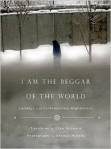
The book I am the Beggar of the World is a collaborative effort by Eliza Griswold and Seamus Murphy. Last night at the U of A Poetry Center Seamus was present for the opening of an exhibit on the book. He spoke to the audience about the process they had followed to find the landays in the book. He explained the cultural significance and historical tradition of these spoken couplets specific to Pashtun women in Pakistan and Afghanistan. The two journalists had served in the region as reporters. They wanted to bring a deeper insight into culture and life than they could offer in a news story. Their investigative trip involved finding women who know the poems and convincing them to share them. Ms. Griswold handled the interview tasks while Mr Murphy shot photos and video footage of the region. They did not attempt to shoot the women reciting themselves for various reasons. This poetry is spoken, forbidden, and often critical. Any image of the women identified with landay might cause them great danger.
There are about 40,000 landays in use at any given time. They are 22 syllables, 9 in the first line, and 13 in the second. They are general statements on life from a woman’s point of view. They remind me of the Mexican dicho, a short philosophical statement that explains the situation at hand. My favorite dicho (saying) is, “Cuando hay dinero baila el perro.” When there is money the dog dances (anything is possible). Landays do sometimes contain great humor, but in general I think they are more haunting and pithy than dichos. Here is one example translated into English: “When sisters sit together, they always praise their brothers. When brothers sit together they sell their sisters to others.” The repression of women is a theme, since this real problem plagues family life. The landay is a way to express emotions as well as outrage at the political systems that are unfair to women.
One of my favorite poets, Piet Hein, wrote short works like these called Grooks. He started in Danish, and worked his way into English. The reception last night was catered with beautiful food and wine for the guests. They had outrageously ripe strawberries and chunks of fresh pineapple, which I enjoyed immensely while standing in line to purchase a copy of the book. I was reminded of what may be my favorite poem of all time, a Grook. “Love is like a pineapple, sweet and undefinable.” I had amazing dreams in my sleep last night. I was wandering around in some other ethnic zone searching for poets, just like in the book. I found some and there was great dreamy party about saving the poems and being anthropologically correct. I was in a fancy tent with a spread that look suspiciously like the food at the reception. I woke up with no pineapple, but a distinct taste of liberation in my mouth. I have my copy of the book to savor and enjoy. I would recommend it to anyone. This is a story of inspiration from history and daily life. The most important thing to remember about them is that their authors are illiterate. This sentiment is shot straight from the heart with no filter, publisher, or even permission. This is the birthplace of all poetry. Edited over centuries, these couplets reflect an accurate and poignant view of Pashtun women and their culture. I believe any reader would enjoy the book.

book cover


My 20th great-grandfather was given a castle to marry my 20th great-grandmother. Sir James LeBotiller Butler, 1st Earl of Ormond was born in 1305 in Arklow, County Wicklow, Ireland. He died Jan. 6, 1338 in Gowran, County Kilkenny, Ireland. In his short life he had three children and founded a Franciscan friary. He had some fabulous wigs, it seems.
James Butler, 1st Earl of Ormond. Knight of the Garter, Knight of Knocktopher, Kilkeney, Nenah and Thurles, Tipperary, Aylesbury, Grewt Lindford and Rotherfield Peppard, Buckinghamshire. Of Sopley, Hampshire, of LaVacherie and Shere, Surrey, of Weeton, Lancashire. Hereditary Chief Butler of Ireland, Lieutenant of Ireland.
Son and heir of Sir Edmund Butler, Earl of Carrick, Justiciar of Ireland and Joan FitzThomas.
First husband of Eleanor de Bohun, 2nd surviving daughter of Humphrey de Bohun and Elizabeth of England. They had two sons and one daughter: John, James, Pernel.
He was only three when he served as a hostage for his father, held in Dublin Castle in 1317. His father’s will was dated 1321, and death the same year, listed James, who would be the 7th Chief Butler of Ireland, from long line of ancestors named FitzWalter, adopting the surname of Butler. He received protection (permission) to cross to Ireland in 1326. In 1327, Eleanor was offered to James with an arrangement of the castle and manor of Kilpeck, Herefordshire for life.
King Edward III created him the first Earl of Ormond by patent, bearing date 2 November 1328 at Salisbury with the creation fee of £10 a year. At the same time, the king created Roger Mortimer as the 1st Earl of March.
In 1336 he founded the friary of Carrick-Begg for Franciscan Friars. On 3 June of that year, he gave the friars his castle and estate of Carrick, of which they took possession on Sunday the feast of SS. Peter and Paul.
James died 06 Jan 1338 and was buried at Gowran. His widow would remarry to Sir Thomas de Dagworth.

Sir James LeBotiller Butler, 1st Earl of Ormond
Sir James LeBotiller Butler, 1st Earl of Ormond (1304 – 1338)
is your 20th great grandfather
Sir James “The Noble Earl” Butler, 2nd Earl of Ormond, Lord Justice of Ireland (1331 – 1382)
son of Sir James LeBotiller Butler, 1st Earl of Ormond
James Butler (1361 – 1405)
son of Sir James “The Noble Earl” Butler, 2nd Earl of Ormond, Lord Justice of Ireland
James Butler (1392 – 1452)
son of James Butler
Elizabeth Butler (1420 – 1473)
daughter of James Butler
Isabel Talbot (1444 – 1531)
daughter of Elizabeth Butler
Sir Richard Ashton (1460 – 1549)
son of Isabel Talbot
Sir Christopher Ashton (1493 – 1519)
son of Sir Richard Ashton
Lady Elizabeth Ashton (1524 – 1588)
daughter of Sir Christopher Ashton
Capt Roger Dudley (1535 – 1585)
son of Lady Elizabeth Ashton
Gov Thomas Dudley (1576 – 1653)
son of Capt Roger Dudley
Anne Dudley (1612 – 1672)
daughter of Gov Thomas Dudley
John Bradstreet (1652 – 1718)
son of Anne Dudley
Mercy Bradstreet (1689 – 1725)
daughter of John Bradstreet
Caleb Hazen (1720 – 1777)
son of Mercy Bradstreet
Mercy Hazen (1747 – 1819)
daughter of Caleb Hazen
Martha Mead (1784 – 1860)
daughter of Mercy Hazen
Abner Morse (1808 – 1838)
son of Martha Mead
Daniel Rowland Morse (1838 – 1910)
son of Abner Morse
Jason A Morse (1862 – 1932)
son of Daniel Rowland Morse
Ernest Abner Morse (1890 – 1965)
son of Jason A Morse
Richard Arden Morse (1920 – 2004)
son of Ernest Abner Morse
Pamela Morse
I am the daughter of Richard Arden Morse

LeBotiller coat of arms
ROW80
I still publish short quickly composed poems with art. This practice that I set up here has been a good platform for discovery of my strengths and weaknesses. I need to keep the mojo going by posting a poem almost daily. This is the first step to being constant and nourishing to my poet persona. First of all I need to convince myself that creative writing is within my ability. In order to move up from my current level of unpolished, slightly redundant writing I need to follow more steps and enjoy deleting at least as much as I enjoy first drafting. I improvise well in many modes. In real life this leads to using creativity to approach many things that I do. I like to play chef and meet the creative challenge of using all the left-overs to make something delicious. I like to eat the result and start on something new. My preference for finishing fast is an impediment to becoming a better writer. I don’t need to count words as much as I need to spend more time editing and improving the initial writing. I have learned that from both my own critique of my situation as a poet, and from reading the works and works in progress presented by my fellow ROW80 writers.
The time we have spent has gone by quickly, with only a couple of weeks left in our 80 day challenge. Each writer has a different style of check in. Some are describing works in progress and sometimes sharing excerpts. There are novelists, poets and fantasy writers here, each with a different point of view, environment, and level of experience. As one of the least experienced participants I am lucky to hear from those of you who have wisdom to share. You give me confidence as well as tools for the job before me. After the challenge has ended your inspiration will still be with me forever. I believe I can go right into NaPoWriMo, the poetry challenge for April, with better preparation than ever before. This challenge is simply to write a poem daily during National Poetry Month (April). I started as a fluke two years ago, but last year I thought I needed to do it again. Now I am looking forward to it this time with happy anticipation. It will not be a chore, but part of this regular practice I have established.
Thank you all for inspiring and challenging me to discover more about the crafty and powerful world of words!! The fun has just begun. As a tribute to the importance of editing I am going on a big clean/clear/organize binge in my office. I did this to my bedroom in December with spectacular results. I expect cleaning out the office can only bring joy and space to operate. This is a spring cleaning of both a physical and mental kind. This edit is a metaphor for the editing I will do in my process in the future. Less really is more.

icelandic poppies


My week has been graced by the presence of a real writer. I went to hear the poet Simon Ortiz who was in Tucson for a reading of his work. I was deeply moved and highly impressed with his writing, which he delivered with lavish explanations about his process. He is now writing an epic poem, an idea he joked about by saying there is no real rule about exactly how long an epic has to be. He will include within the epic some of his older works, which he shared with the group who had come to the U of A Poetry Center to listen to him. I purchased his book, Sand Creek, which he signed for me after the reading. I told him how much I loved hearing him and he responded that he really loved reading to us. His genuine joy in sharing his work was evident. We were all truly blessed to be there. Some of his poems are funny, and some carry tragic stories from history, like Sand Creek.
The Poetics and Politics of Water series has evolved. Dr. Ofelia Zepeda is a poet and professor who collaborates to put together this very special program of Native American writers. She and her colleague Larry Evers introduced Politics and Poetics in 1992. I look forward to the next reading which will be given by Dr. Zepeda herself. She uses her native language from this region, Tohono O’odham, to welcome the visitors to her land and bless the participants. It is beautiful. She translates the traditional greeting in to English when she is done.

Ofelia Zepeda introduction
I have written and read some this week with mixed results. I believe the most profound thing that happened to set my poetic self on the path was my chance to hear Mr Ortiz. He said prose and poetry are all the same, and in the end, all language is poetry. He certainly was all poetic in every part of his being. He talked about his own recovery from alcoholism, and his father’s inability to recover from it. His identity as Acoma with deep religious and cultural heritage is important to him. His father exposed Simon to sorrow through addiction, but he also taught him his traditional language and mystical history. The last poem he read to us was about his father’s death. It was sung as a song, a chant, a rhythmic tribute to the spirit of his father and all he had inherited. It was a wonderful way to show his talent and end on a solemn, serious, meaningful note.
Alex Seotewa was our guide to the mission church he had painted in Zuni pueblo. We had driven there to see the interior of the mission church with the spectacular kachina murals which I had seen once briefly with a Catholic priest. My fascination with this epic work of art started when I saw a television special, maybe even the program above, about Zuni, kachinas, and Alex. I convinced my erstwhile father-in-law to land his private plane in Zuni to see the mural. At that time the church was locked and there was a heavy smell of smoke damage because there had been a fire in the building. I guess that was about 1988. A priest had the key and showed us the inside of church for about 10 minutes, with no background information. There were buffalo heads on sides of the altar. It struck me as not only amazing art but a highly sacred place. It was obviously not in use, and the priest did not expect it would be used in the future.
I tried to see it once again, while driving back to Tucson from a ski trip in Colorado. I jumped out of the car in my pink fluffy ski jumpsuit and asked the people at the convenience store at the turn off for Zuni on the highway for directions to get to the church to see the interior. They insisted there was no church with kachinas. I was adamant that I had been to it. They became highly annoyed with me. I finally got the message that I had behaved badly in that culture and was not welcome. I was confused, but nothing ventured, nothing gained. The mystery of the access to the kachinas in that mission church continued to intrigue me. On my third visit the kachinas themselves must have arranged special treats for us. We had a loft bedroom at a small hotel run by a French guy who runs the general store. We arrived in the late evening. At the tourist office in town I asked the young woman at the desk how I could see the kachina mural in the mission church. She said she had never seen it, so I had little chance of being so lucky. This was a real surprise, since she was a member of the tribe about 20 years old. I wondered why it was so difficult.
In the morning I headed downstairs for coffee and encountered fellow residents gearing up to go hunting with a Zuni guide. They were eating breakfast, so I joined them for a cup of coffee. The group had flown in from Atlanta for the privilege of hunting there. They were all excited because they would be in the company of the local expert, which one of them had done previously. I asked this hunting guide if he had any idea how I could arrange to see the inside of the mission, since that was our mission. He made a phone call to his wife and arranged for his father, Alex Seotewa, to meet us at the church and give us a tour. He left us a phone number to reach his father later, since it was only about 6 am, then took the happy hunters off in his truck. I knew this intervention had to be a special reward for holding the images of the kachinas in my mind for so many years. They must have answered my desire to see them again.
Alex was in poor health, but obviously enjoyed telling the story of his art work, his tribal culture, and his calling to preserve his traditional heritage. He spent about an hour with us answering questions and telling us about his life and work. I will cherish the time we spent in his presence because the kachinas came to life with his explanations. There has been controversy and dissent within the community between Catholic and traditional use of the mission. When Alex’s father was a child the church was in disrepair, but it had punitive kachinas painted on the walls. An agreement was made to restore the images between Alex and a priest who thought it was a good idea. Subsequent Catholic clerics have not been as enthusiastic about preserving Zuni religious practice within, or consecutively with their own practices. Alex stopped attending services held by Catholics, but continued to feel his work depicting the kachinas was eucharistic, and a gift given from above. He was a buffalo dancer in ceremony. He described choosing the buffalo to kill and creating the heavy mask he wore for hours. He told us what the importance of the buffalo was to his people, and why it was his responsibility not just to wear that mask, but to become a buffalo in spirit to keep his religion alive. I have a strong memory of the authenticity of his thinking, his truly welcoming appreciation of our visit, and of the moment he showed us his spirit as a buffalo. The old man turned his head away from us then slowly brought his upper body to face us with a steady, fierce gaze. This was not an impersonation of an animal spirit…it was the spirit inside the man. It was touched and grateful to be given the special gift. I consider our time with Alex to be a kind of miracle. Have you ever had an experience of an extraordinary spiritual nature?
This week I invite you all to join me for Saturday brunch at Maker House downtown Tucson. They serve very good coffee and tea all the time. On Saturday there is a special brunch menu and mimosas are on special for $1. A DJ plays in the courtyard, and vendors are set up selling art,clothing, jewelry, and more. This is, by far, the most hipster of hip places to be in town. Please join me outside to enjoy the warm cloudy weather. There are plenty of tables, and some are equipped with paper and tins of colored pencils for our amusement. In the announcement I read for the event art classes were advertised, but I saw no evidence that they were being taught. This may happen later in the day. I had a good time drinking a cappuccino and doodling to the music. Other drinking doodlers soon appeared, some with coffee and others with mimosas. Those on a budget could buy 4 mimosas for the price of a cappuccino, so they are popular with many of the customers. Since your are arriving by transporter cloak they will be digital, so you can have as many as you like and still cloak home. I can highly recommend the breakfast sandwich on the house made croissant. Everything I have ever ordered here has been fresh and delicious. Next time I plan to try the breakfast pizza.





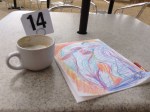


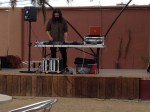
I look forward to hearing about your week and seeing your drawings. It feels good to enjoy the music and take time to relax. I am in no rush. The week has been low key. My tax preparation is in order for the accountant, so I feel accomplished if not giddy. I don’t know why I always dread the tax thing..it is really not all that bad. When I am done for the year it is supremely liberating to me. Other than that mundane task I have written poetry and attended a wonderful poetry reading by Simon Ortiz at the U of A Poetry Center. That was the highlight of my week. I bought his book Sand Creek and he signed it for me. He said he can’t tell the difference between poetry and prose. That was liberating for me and I thanked him for it as well as his beautiful reading.
Before you leave Tucson I hope you will look around the historic mansion that is Maker House. It has special murals and wonderful detail, like copper ceilings. There is a classic game arcade, free wifi, and craft beer. We love the events they host and their constantly evolving food service. Now they deliver food, coffee and beer downtown, which should prove to be popular. We are happy the architecture is being preserved while serving a diverse and extremely hip customer base. It is one reason our downtown has become much more desirable. If you have cloaked in from up north you will probably like the weather best of all. It is rodeo week for those of you who want to feel that you have truly been way out west. Head south and buzz the rodeo grounds on your way home for a total Tucson tour. We hope you will like your digital visit enough to come in real life someday.
#Weekendcoffeeshare
ROW80
I am amazed to find such a vast network of poets and poetry exchanges on the internet. This #ROW80 has enlightened me, encouraged me, and introduced me to resources I might never have discovered on my own. One of the most interesting sites I have found for writers is Mindlovemisery’s Menagerie. This group creates a daily writing challenge of a different nature. Today a short story about an imaginary dinner party in 500 words or less stimulates the imagination, but other days poetry or fairy tales are featured. The regular assignments are all geared toward teaching participants to improve their skills, exactly like this literary soiree in which we find ourselves. I believe the best result for me here is the idea of stepping outside my comfort zone, reporting facts. I sometimes include opinions in my posts, but I see the merit in using creative writing to express both opinions and emotions. Strong impressions can be made by using literary devices. “Just the facts, ma’am” can become kind of flat, especially after a while.
When I was in 9th grade I attended a small school run by an oil company in Venezuela. The teachers came from the US and were all vastly more eccentric that the teachers I had known in Pennsylvania. Our English teacher, the memorable Pina Sue Sturdavant, was also our physical education instructor. She was from the panhandle of Texas and had such a strong and ridiculous accent that it would have been impossible not to make fun of it. She was unpopular with the students because she was just too weird for us. She announced we would study propaganda in our English class for 6 weeks. We thought she was insane because in the 1960’s propaganda was something we thought was for Russians who lied to the public. She proceeded to teach us the principals of advertizing, which have served me well since that time. She explained that certain methods of persuasion could convince us to want things we did not naturally want. This is, of course, rhetorical truth, of which we hear so much around political election time. Not all of it is subliminal. Alliteration is a favorite device because it sticks in the mind and on the tongue. Libby’s, Libby’s Libby’s on the label, label, label was the example Pina Sue used to illustrate successful use of alliteration. Dr Seuss is a liberal user of this device, to great effect.
Marketing logans and jingles are carefully designed to be catchy. In the old days rhyme was used more profusely than it is today: Winston tastes good like a cigarette should. These marketing devices also work in poetry. A poem sells an idea, or a personal glimpse of reality, an interpretation. Tonight I will attend another reading at the Poetry Center on the politics and poetics of water…they have already used alliteration in the title of the seminar. My goal this week is to continue writing poems and work to use alliteration within them. It was always my favorite device. Starting with this one, I may continue to enjoy other structural restraints. It would be fitting if I could write a poem about Pina Sue herself…We shall see. She does have those two S sounds at the end of her name, and I remember her vividly.
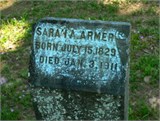
Shiloh Baptist Church
My second great grandmother was born in Alabama. Her parents came from Mississippi and they owned slaves. In the 1840 census, when Sarah was 11 years of age, her mother was already dead. Her household contained 4 white persons and 44 slaves. 27 of them were involved with agriculture. I guess they grew cotton.
In 1845 Sarah’s father died and she married Thomas Armer, my 2nd great-grandfather. She had 13 children, 8 of whom were still alive in 1900. My great-grandmother was her oldest daughter. In 1850, when her daughter was 3, she and her husband lived in Lowdnes County, Alabama. Her husband’s occupation was listed as overseer. Everyone on the census page is either a planter or an overseer by trade. This is extremely creepy because they must be growing cotton and Thomas Armer was a slaver overseer. This was the time in which they lived, but it seems like such an outrage to think about it.

1860 census
The Black Panther Party was born as the Lowdnes Country Freedom Organization. In 1965 the county was 80% black, but not a single black citizen was registered to vote. Between 1850 and 1965 not that much had really changed.

lowdnes county
By 1860 the family had moved to Old Town Dallas, and Thomas was listed as a farmer. No planters are listed on the page with them. Engineers, physicians, and other farmers are their neighbors. No slaves are listed in the household. I think they have moved away from plantation life and started to farm for themselves. When the war broke out Thomas was conscripted to work in the Shelby Iron Works steel mill from 1861-1865.

Shelby Iron Works
After the war in 1870 the Armers moved to Waller County in east Texas, traveling in ox carts with their extended family. In 1871 they founded the Shiloh Baptist Church with other veterans of the war in the membership. Thomas died in August of 1900 at the age of 75, leaving Sarah a widow. She applied for a Confederate pension based on his service:

Confederate pension application
Sarah E Hughes (1829 – 1911)
is my 2nd great grandmother
Lucinda Jane Armer (1847 – 1939)
daughter of Sarah E Hughes
George Harvey Taylor (1884 – 1941)
son of Lucinda Jane Armer
Ruby Lee Taylor (1922 – 2008)
daughter of George Harvey Taylor
Pamela Morse
I am the daughter of Ruby Lee Taylor
Sarah is buried with her husband and some of her children at the Shiloh Baptist Church, in Prairie View, Waller County, Texas.
 mermaidcamp