mermaidcamp
Keeping current in wellness, in and out of the water
You can scroll the shelf using ← and → keys
You can scroll the shelf using ← and → keys
The activity on Empire Avenue resembles the stock market, but Wall Street does not have recreational investment games on the weekends. I like the Avenue because it allows me to meet and find new people writing all kinds of great content. The games are intended to socially introduce the members to each other in a non competitive way. Embedded treasure hunts are followed at your own pace. Reward bucks and accomplishment badges are the prizes given for participation, but the true reward is the exposure to the other players. One way I learn about the other players is by completing missions, for which I am paid in Empire bucks. This straightforward approach is better, in my opinion, than all the quid pro quo schemes I have seen in LinkedIn (like my page and I will like yours). As any investor wants his stock to increase in value, so on the Avenue you want the scores and stock prices of the players you hold in your portfolio to do well. If they quit or loose interest you can sell the stock without any problem. If they quit entirely you are given a refund in the amount of your shares invested in that person. There are commissions, and ways to save on them, but since they are all imaginary bucks I don’t stress over that particular issue. These are some of the ways Empire Avenue differs from other social media sites:
In a little less than a year I have built up almost 80 million Empire bucks in wealth. It is satisfying to watch your shares become more valuable and your portfolio rise in value too. Some of the same due diligence you do for the stock market is necessary. It is not such a good idea to buy and hold blindly. Things change. You need to stay current on your investments, just like real life. I have been thinking of inviting my fiduciary to join just to see how well he would do, but I really want him to concentrate on my money, so maybe that is a silly idea. I will let him handle calculated financial risks. I will enjoy being a mogul on #EmpireAvenue while he sticks to Wall Street.
Artemis is an independent spirit, choosing solitary activities. She is a hunter who feels at home in the woods and with nature. Her social life is limited, and she remains single. She loves a group women who are her companions, all sworn to chastity. These are the original wild women, happy in the forrest, hunting and living in accord with natural rhythm. The story of Callisto illustrates how seriously Artemis took the privacy and chastity of her followers. Artemis’ own father Zeus seduced Callisto and made her pregnant. When Artemis discovered the pregnancy she changed Callisto into a bear.
Her protective nature makes her the guardian of childbirth and children. She is Apollo’s twin sister. It is said that she was born first, then assisted in the birth of her brother the sun god. Her strength and confidence come from her powers of discernment. Hunters learn the ways of the prey in order to be successful in a hunt. Artemis is physical prowess and natural instinct combined in a strong feminine being. Her positive force is derived from loving herself without reservation. She is not influenced by the opinions of others, and rarely condescends to take part in arguments. She has abilities to discern the motives of those around her. She is happy, free, and physically in tune with nature. Her fitness and poise come from a life of natural exertion. She has enough self confidence to protect, inspire and enlighten others.
To get in touch with Artemis use the herb Artemisia vulgaris. It can be purchased as essential oil, although a good quality oil is hard to find of this herb. Use it very sparingly because the oil is very potent. It needs to be diluted with a carrier oil like jojoba. On full or new moons the Artemis energy is high because she is a moon goddess. Inhaling the scent or using the diluted oil on the temples of the head increases the connection to the magical huntress. Choose a meditation or journaling exercise that invites animals into your imagination. By setting a scene, perhaps a lake, or a shady spot, in your mind’s eye, wait to see the wildlife that comes into the picture. Notice if the animals are healthy or seem stressed. Just observe what they do, how they act, and what you think they desire. By going deeper into these images you will make a connection with the Artemis in you. Follow her instincts. Her refined intuition makes a wonderful guide through the woods of life.

My 20th great-grandmother was the ancestor of many famous people:
The PEDIGREE of
Bonacossa (Bonacosta) BORRI
Born: abt. 1249 Died: 1321
HM George I’s 9-Great Grandmother. HRE Ferdinand I’s 6-Great Grandmother. U.S. President’s 18-Great Grandmother. PM Churchill’s 19-Great Grandmother. HM Margrethe II’s 17-Great Grandmother. Gen. Pierpont Hamilton’s 19-Great Grandmother. Otto von Bismarck’s 15-Great Grandmother. Red Baron' Richthofen's 16-Great Grandmother.the Great’ VISCONTI
Husband/Partner: Matteo I
Children: Stefano (di) VISCONTI ; Galeazzo I VISCONTI
She and several members of her family are buried in Milan in a chapel. This would be a very special grave to visit.
Bonacossa Borri (1254 – 1321)
is my 20th great grandmother
Stefan Visconti (1289 – 1327)
son of Bonacossa Borri
Bernabo Lord Milan di Visconti (1319 – 1385)
son of Stefan Visconti
Veridis Duchess Austria Visconti (1352 – 1414)
daughter of Bernabo Lord Milan di Visconti
Ernst I “Ironside” Archduke of Austria Habsburg (1377 – 1424)
son of Veridis Duchess Austria Visconti
Katharina Archduchess Austria Von Habsburg (1420 – 1493)
daughter of Ernst I “Ironside” Archduke of Austria Habsburg
Christof I VanBaden (1453 – 1527)
son of Katharina Archduchess Austria Von Habsburg
Beatrix Zahringen (1492 – 1535)
daughter of Christof I VanBaden
Sabine Grafin VonSimmern (1528 – 1578)
daughter of Beatrix Zahringen
Marie L Egmond (1564 – 1584)
daughter of Sabine Grafin VonSimmern
Richard Sears (1590 – 1676)
son of Marie L Egmond
Silas Sears (1638 – 1697)
son of Richard Sears
Silas Sears (1661 – 1732)
son of Silas Sears
Sarah Sears (1697 – 1785)
daughter of Silas Sears
Sarah Hamblin (1721 – 1814)
daughter of Sarah Sears
Mercy Hazen (1747 – 1819)
daughter of Sarah Hamblin
Martha Mead (1784 – 1860)
daughter of Mercy Hazen
Abner Morse (1808 – 1838)
son of Martha Mead
Daniel Rowland Morse (1838 – 1910)
son of Abner Morse
Jason A Morse (1862 – 1932)
son of Daniel Rowland Morse
Ernest Abner Morse (1890 – 1965)
son of Jason A Morse
Richard Arden Morse (1920 – 2004)
son of Ernest Abner Morse
Pamela Morse
I am the daughter of Richard Arden Morse
Bonacossa Borri, also known as Bonaca, or Bonaccossi Bonacosta (1254–1321), was Lady of Milan by marriage from 1269 to 1321.
Biography
Bonacossa was the daughter of Squarcina Borri (1230–1277, also called Scarsini), captain of exiles from Milan fom the advent of the Torriani family, and a loyal supporter of the Visconti, and Antonia (1236 -?), of unknown lineage, who married in 1254. Borri’s family, originally from the town of Santo Stefano Ticino together with some feudal lands of nearby Corby. The Borri family was one of the most respected of Milan, and counted among its ranks a saint, Monas of Milan, Bishop of Milan.
Once the Visconti had conquered Milan, Squarcina Borri gave his daughter in marriage to Matteo I Visconti, Lord of Milan in 1269 to cement those bonds essential to maintaining the rule of the Visconti.
Bonacossa and her husband co-founded of the chapel of St. Thomas in the Basilica of Sant’Eustorgio of Milan, where they were buried, along with their son Stefano and his two daughters Beatrice and Catherine, and the brother of Matteo, Uberto III Visconti.
She died in Milan on 13 January 1321 .
Descendents
Galeazzo I Lord of Milan. He married Beatrice d’Es
Beatrice (b. 1280)
Caterina (b. 1282)
Luchino (b. 1285) Lord of Milan, married Violante di Saluzzo
Stefano (b. 1287) Count of Arona , married Valentina Doria
Marco (b. 1289)
Giovanni (b. 1291), Archbishop of Milan
Zaccaria (b. 1295)
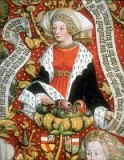
Gertrude of Austria
My 24th great-grandmother died at age 30 after she had 4 children.
Gertrude of Babenberg (c. 1118 – 8 April 1150) was the first wife of Vladislaus II of Bohemia and the Duchess of Bohemia. She was the daughter of count Leopold III, Margrave of Austria and his wife Agnes of Germany.
Gertrude married Duke of Bohemia in 1140. Through her mother, she was half-sister of Conrad III of Germany, so she was a good catch for Vladislaus. In the time of siege of Prague by Conrad II of Znojmo (1142) she successfully defended Prague Castle, together with her brother-in-law Děpolt, while Vladislaus asked Conrad III of Germany for help.
She was took share in Vladislaus founding activity and thanks to her the duke invited to Czech lands new religious orders. She gave birth to four children and died in 1150, at the age of 30.
Issue
Frederick, Duke of Bohemia
Svatopluk, married a daughter of Geza II of Hungary
Vojtech, archbishop of Salzburg as Adalbert III
Agnes (died 7 June 1228), abbess of St George of Prague
Literature
ŽEMLIČKA, J. Čechy v době knížecí 1034–1198. Praha : NLN, 2002. 660 p. ISBN 80-7106-196-4.
Gertrud Austria (1119 – 1150)
is my 24th great grandmother
Fredrich Bohemia (1141 – 1189)
son of Gertrud Austria
Lidmila Bohemia (1170 – 1240)
daughter of Fredrich Bohemia
OTTO II Wittelsbach of Bavaria (1206 – 1253)
son of Lidmila Bohemia
Elisabeth Wittelsbach Duchess Bavaria (1227 – 1273)
daughter of OTTO II Wittelsbach of Bavaria
Consort Elisabeth the Romans Carinthia (1263 – 1313)
daughter of Elisabeth Wittelsbach Duchess Bavaria
Albrecht Albert II ‘The Wise’ Duke of Austria Habsburg (1298 – 1358)
son of Consort Elisabeth the Romans Carinthia
Leopold III “Duke of Austria” Habsburg (1351 – 1386)
son of Albrecht Albert II ‘The Wise’ Duke of Austria Habsburg
Ernst I “Ironside” Archduke of Austria Habsburg (1377 – 1424)
son of Leopold III “Duke of Austria” Habsburg
Katharina Archduchess Austria Von Habsburg (1420 – 1493)
daughter of Ernst I “Ironside” Archduke of Austria Habsburg
Christof I VanBaden (1453 – 1527)
son of Katharina Archduchess Austria Von Habsburg
Beatrix Zahringen (1492 – 1535)
daughter of Christof I VanBaden
Sabine Grafin VonSimmern (1528 – 1578)
daughter of Beatrix Zahringen
Marie L Egmond (1564 – 1584)
daughter of Sabine Grafin VonSimmern
Richard Sears (1590 – 1676)
son of Marie L Egmond
Silas Sears (1638 – 1697)
son of Richard Sears
Silas Sears (1661 – 1732)
son of Silas Sears
Sarah Sears (1697 – 1785)
daughter of Silas Sears
Sarah Hamblin (1721 – 1814)
daughter of Sarah Sears
Mercy Hazen (1747 – 1819)
daughter of Sarah Hamblin
Martha Mead (1784 – 1860)
daughter of Mercy Hazen
Abner Morse (1808 – 1838)
son of Martha Mead
Daniel Rowland Morse (1838 – 1910)
son of Abner Morse
Jason A Morse (1862 – 1932)
son of Daniel Rowland Morse
Ernest Abner Morse (1890 – 1965)
son of Jason A Morse
Richard Arden Morse (1920 – 2004)
son of Ernest Abner Morse
Pamela Morse
I am the daughter of Richard Arden Morse
“Even pudding needs a theme.”- Winston Churchill. He could not have ben more insightful. Americans often use freedom as a theme for national celebrations. We repeat themes in our lives without awareness, but how would it make a difference if we embraced themes? Leonardo da Vinci pioneered mind mapping by drawing similarities between seemingly unrelated things. His essential belief in Connessione broadened his thinking and increased his creativity. He took notes constantly, drew pictures and diagrams that we are lucky enough to be able to see today. His notebooks are full of connections, discovery and contemplations.
“every part is disposed to unite with the whole, that it may thereby escape from its own incompleteness”-Leonardo da Vinci. If we think in terms of unification, or connectedness it is obvious that no part of life exists by itself, on its own, with no assistance. Our social connections are different from our commercial connections, and our survival connections are a different group. We rely on systems, nature, people, and cultural beliefs to keep our lives running. By taking a theme for a day we can start to see how connections are at least as important as single relationships. Every relationship touches other relationships, and so it goes. Within the personality of each person there may be dynamic tension or power struggles daily. There are themes within those dramas too. Pick one and observe it for a day, or a week.
Choosing to observe sabotage might reveal deep meaning. We certainly sabotage others and are sabotaged by others. It is also true that we sabotage ourselves and pretend others have done it. Drawing a timeline of the history of self sabotage can be interesting, but why not look at this phenomena in real-time? Check out daily habits that dilute health, happiness or finances. The theme of saboteur is well-known in fiction because everyone has this common issue in real life. If you take time to observe your inner saboteur at work notice how it is connected to those who seem to sabotage you from the outside. Are they in secret alliance? How do they know your weaknesses so well? Are you in cahoots? What are the themes your inner and outer saboteurs use to stay connected to you?
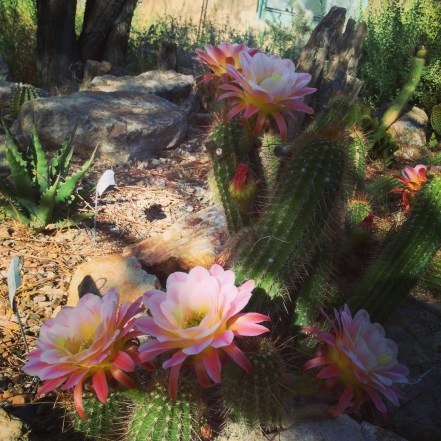
cactus blooming
Our memories are not accurate. Our self images are not well aligned with reality, and our sense of time is warped. This is true for almost everyone. I have embarked on some time line drawing exercises that have proven to me how far off base I am with a lot of my beliefs about my life and myself. The course in archetypes asks that I draw a time line for each of my dominant archetypes, including first meeting and how their powers entered and left the scene. I am surprised about the details I recall when I focus on only one aspect. This is also true if I draw a time line that includes all my physical injuries, surgeries, and illnesses. I have lead a healthy life, but I do see a pattern when I study the tendencies I have had. My doctors ask me to outline my injuries and illnesses, but I had never drawn them out on a paper with dates before. This chart alone tells a big story about your health and your life. There are other valuable time lines to draw for self knowledge:
When you have drawn these lines (all in the same scale) line up the sheets of paper under one another to see if they have any sequential patterns. Putting them all in a row shows detail that can sort out patterns in our lives. We tend to think of time in various delusional ways. We believe we have always been like this (whatever this may be), for instance. We often believe we were innocent when we were guilty, and sometimes believe just the opposite. The time line describes turning points and events that were pivotal in our development. If we then overlay the archetypes in our personalities, and which ones were dominant at what times the portrait becomes even clearer and more detailed. I started with the assignment of the archetype timelines, which is the most intricate and difficult of them all. By doing the easy ones above first we become accustomed to the focus it takes to really remember accurately. Then we are warmed up to question who was in charge and when. Time lines contain a great deal of power while still holding mystery in the line where it says nothing. Obviously there were constant events, but only some can be brought to mind. More practice brings better proficiency in stringing it all into place.

Empress Irini Augusta Dukaina Dukas
Empress Irini Augusta Dukaina Dukas’ seal
My 29th great-grandmother was married when she was 11 years old. By this marriage she became Empress Mother of the Byzantine Empire. Her daughter Anna recorded history, perhaps revisionist. Empress Irini is an ancestor of Ann Dudley Bradstreet, another woman who recorded history and wrote poetry. I have noticed that Mistress Bradstreet has the most impressive pedigree of important powerful women. This one, like many other royals who are embroiled in political intrigue, landed in a convent under mild house arrest at the end of her life.
Irene Doukaina or Ducaena (Greek: Ειρήνη Δούκαινα, Eirēnē Doukaina) (c. 1066 – February 19, 1123 or 1133) was the wife of the Byzantine emperor Alexios I Komnenos, and the mother of the emperor John II Komnenos and of the historian Anna Komnene.
Empress Irini Augusta Dukaina Dukas (1066 – 1133)
is my 29th great grandmother
Theodora Comnena (1096 – 1116)
daughter of Empress Irini Augusta Dukaina Dukas
Andronikos Dukas Angelos (1122 – 1185)
son of Theodora Comnena
Alexios Emperor Byzantine Empire (1153 – 1204)
son of Andronikos Dukas Angelos
Empress Anna Komnene Angelina Nicaea (1176 – 1212)
daughter of Alexios Emperor Byzantine Empire
MARIA Laskarina (1206 – 1270)
daughter of Empress Anna Komnene Angelina Nicaea
King of Hungary Stephen V (1240 – 1277)
son of MARIA Laskarina
Marie DeHungary (1257 – 1323)
daughter of King of Hungary Stephen V
Marguerite Sicily Naples (1273 – 1299)
daughter of Marie DeHungary
Jeanne DeVALOIS (1294 – 1342)
daughter of Marguerite Sicily Naples
Philippa deHainault (1311 – 1369)
daughter of Jeanne DeVALOIS
John of Gaunt – Duke of Lancaster – Plantagenet (1340 – 1399)
son of Philippa deHainault
Philippa Plantagenet (1370 – 1415)
daughter of John of Gaunt – Duke of Lancaster – Plantagenet
Beatrix DePinto (1403 – 1447)
daughter of Philippa Plantagenet
John Fettiplace (1427 – 1464)
son of Beatrix DePinto
Richard Fettiplace (1460 – 1511)
son of John Fettiplace
Anne Fettiplace (1496 – 1567)
daughter of Richard Fettiplace
Mary Purefoy (1533 – 1579)
daughter of Anne Fettiplace
Susanna Thorne (1559 – 1586)
daughter of Mary Purefoy
Gov Thomas Dudley (1576 – 1653)
son of Susanna Thorne
Anne Dudley (1612 – 1672)
daughter of Gov Thomas Dudley
John Bradstreet (1652 – 1718)
son of Anne Dudley
Mercy Bradstreet (1689 – 1725)
daughter of John Bradstreet
Caleb Hazen (1720 – 1777)
son of Mercy Bradstreet
Mercy Hazen (1747 – 1819)
daughter of Caleb Hazen
Martha Mead (1784 – 1860)
daughter of Mercy Hazen
Abner Morse (1808 – 1838)
son of Martha Mead
Daniel Rowland Morse (1838 – 1910)
son of Abner Morse
Jason A Morse (1862 – 1932)
son of Daniel Rowland Morse
Ernest Abner Morse (1890 – 1965)
son of Jason A Morse
Richard Arden Morse (1920 – 2004)
son of Ernest Abner Morse
Pamela Morse
I am the daughter of Richard Arden Morse
Succession of Alexios and Irene
Irene was born in 1066 to Andronikos Doukas and Maria of Bulgaria, granddaughter of Ivan Vladislav of Bulgaria. Andronikos was a nephew of Emperor Constantine X and a cousin of Michael VII.
Irene married Alexios in 1078, when she was still eleven years old. For this reason the Doukas family supported Alexios in 1081, when a struggle for the throne erupted after the abdication of Nikephoros III Botaneiates. Alexios’ mother, Anna Dalassene, a lifelong enemy of the Doukas family, pressured her son to divorce the young Irene and marry Maria of Alania, the former wife of both Michael VII and Nikephoros III. Irene was in fact barred from the coronation ceremony, but the Doukas family convinced the Patriarch of Constantinople, Kosmas I, to crown her as well, which he did one week later. Anna Dalassene consented to this but forced Kosmas to resign immediately afterwards; he was succeeded by Eustratios Garidas.
Alexios’ mother Anna continued to live in the imperial palace and to meddle in in her son’s affairs until her death 20 years later; Maria of Alania may have also lived in the palace, and there were rumours that Alexios carried on an affair with her. Anna Komnene vociferously denied this, although she herself was not born until December 1, 1083, two years later.
Character
Anna may have been whitewashing her family history; she has nothing but praise for both of her parents. She describes her mother in great detail:
“She stood upright like some young sapling, erect and evergreen, all her limbs and the other parts of her body absolutely symmetrical and in harmony one with another. With her lovely appearance and charming voice she never ceased to fascinate all who saw and heard her. Her face shone with the soft light of the moon; it was not the completely round face of an Assyrian woman, nor long, like the face of a Scyth, but just slightly oval in shape. There were rose blossoms on her cheeks, visible a long way off. Her light-blue eyes were both gay and stern: their charm and beauty attracted, but the fear they caused so dazzled the bystander that he could neither look nor turn away…Generally she accompanied her words with graceful gestures, her hands bare to the wrists, and you would say it was ivory turned by some craftsman into the form of fingers and hand. The pupils of her eyes, with the brilliant blue of deep waves, recalled a calm, still sea, while the white surrounding them shone by contrast, so that the whole eye acquired a peculiar lustre and a charm which was inexpressible.”
It “would not have been so very inappropriate,” Anna writes, to say that Irene was “Athena made manifest to the human race, or that she had descended suddenly from the sky in some heavenly glory and unapproachable splendour.”
Irene was shy and preferred not to appear in public, although she was forceful and severe when acting officially as empress (basileia). She preferred to perform her household duties, and enjoyed reading hagiographic literature and making charitable donations to monks and beggars. Although Alexios may have had Maria as a mistress early in his reign, during the later part of his reign he and Irene were genuinely in love (at least according to their daughter Anna). Irene often accompanied him on his expeditions, including the expedition against Prince Bohemund I of Antioch in 1107 and to the Chersonese in 1112. On these campaigns she acted as a nurse for her husband when he was afflicted with gout in his feet. According to Anna she also acted as a sort of guard, as there were constant conspiracies against Alexios. Alexios’ insistence that Irene accompany him on campaigns may suggest that he did not fully trust her enough to leave her in the capital. When she did remain behind in Constantinople, she acted as regent, together with Nikephoros Bryennios, Anna’s husband, as a counselor.
Death of Alexios
Irene frequently suggested that Alexios name Nikephoros and Anna as his heirs, over their own younger son John. According to Niketas Choniates, who depicts her more as a nagging shrew than a loving wife, she “…threw her full influence on the side of her daughter Anna and lost no opportunity to calumniate their son John… mocking him as rash, pleasure-loving, and weak in character.” Alexios, preferring to create a stable dynasty through his own son, either ignored her, pretended to be busy with other matters, or, at last, lost his temper and chastized her for suggesting such things.
Irene nursed Alexios on his deathbed on 1118, while at the same time still scheming to have Nikephoros and Anna succeed him. Alexios had already promised the throne to John, and when John took his father’s signet ring Irene accused him of treachery and theft. When Alexios finally died, she felt genuine grief, and wore the mourning clothes of her daughter Eudokia, whose own husband had died previously. However, she soon conspired with Anna against John, but their plots were unsuccessful and both Irene and Anna were then forced into exile at the monastery of Kecharitomene, which Irene had founded a few years previously. It was not a harsh exile, and Irene lived there in peace, distributing food to the poor and educating young orphan girls. Irene may have inspired the history written by her son-in-law Nikephoros Bryennios and corresponded with or patronized several important literary figures, including Theophylact of Ohrid and Michael Italikos.
In Literature
The great modern Greek poet Constantine Cavafy includes a reference to Irene Doukaina in his poem “A Byzantine Nobleman in Exile Composing Verses”, which refers to Doukaina “that viper Irini Doukaina” and that as the cause of the titular nobleman’s exile, “may she be cursed”. It is a clear reference to her reputation as a plotter.
Children
Irene died on February 19, in either 1123 or 1133, most likely the latter. With Alexios I Komnenos she had nine children:
Anna Komnene (1083–1153)
Maria Komnene
John II Komnenos (1087–1143)
Andronikos Komnenos
Isaac Komnenos
Eudokia Komnene
Theodora Komnene, who married Constantine Angelos. Among their children were John Doukas (who took his grandmother’s surname) and Andronikos Angelos, father of the emperors Alexios III Angelos and Isaac II Angelos.
Manuel Komnenos
Zoe Komnene
Sources
The Oxford Dictionary of Byzantium, Oxford University Press, 1991.
Anna Comnena, The Alexiad, trans. E.R.A. Sewter. Penguin Books, 1969.
Nicetas Choniates, O City of Byzantium: Annals of Niketas Choniates, trans. Harry J. Magoulias. Wayne State University Press, 1984.
Georgina Buckler, Anna Comnena: A Study. Oxford University Press, 1929.
Thalia Goumia-Peterson, “Gender and Power: Passages to the Maternal in Anna Komnene’s Alexiad “, in Anna Komnene and Her Times, ed. Thalia Goumia-Peterson. Garland Publishing, 2000.
Warren Treadgold, A History of the Byzantine State and Society. Stanford University Press, 1997.
Royal titles
Preceded by
Maria of Alania
Byzantine Empress consort
1081–1118
Succeed ed by
Piroska of Hungary
Empress-Mother of the Byzantine Empire
1118–February 19, 1133
Shared title with Piroska of Hungary from 1122 until 1133.







I had just learned about the #TucsonEatsLocal challenge from the Food Conspiracy when I ran into Cindy as she was about to open the Flying Leap Vineyards tasting room. I decided to step in and taste 6 Arizona wines. The quality has improved over the years, but I have been waiting for Arizona wines to really get good. There is excellent news….they have!! I enjoyed spending time focused on these very well balanced and delicious wines. I tasted:
All of the wines pleased me in their own way. The reds, which are really my favorite, had unusually broad flavors. They could all be drunk by themselves for enjoyment, but would bring out extra pleasure and flavor if enjoyed with food. I like the idea that our local wineries produce a wide variety of superb wines. The Flying Leapers will soon break ground in Elgin on a distillery. That is the new frontier in Arizona, distilled spirits. We are returning to our roots, and in a very tasty way. If you are in Tucson and want to sample wine from Arizona I encourage you to drop by the Flying Leap and take a leap into flavor town.

Citrus pardisii
My grapefruit tree is healthy and bears very well for months each winter. We enjoy fresh juice daily from January until about the end of March. The intoxicating aroma of the blossoms fills the air for about a month in March. The plant is ruled by the sun, like all citrus fruits. It has zingy, cooling and cleansing properties that are prized by health lovers. The fruit and the juice are delightful, but the essential oil of grapefruit has very useful qualities. Buy pure unadulterated oil and store it in the dark because it oxidizes quickly, therefore has short shelf life. Using it with a carrier oil, like jojoba, it can be very helpful to warm up and boost circulation. The benefits of using grapefruit in a massage oil include:
To use the oil for aromatherapy delivered by inhalation you can use a diffuser or use a few drops straight up on a handkerchief. The subtle and immediate effects of the inhalation include:
I never get tired of the smell and the flavor of grapefruit. It makes me happy and nourishes me. Cocktails made with grapefruit juice are very high on my favorites list as well. What is your favorite way to experience grapefruit?
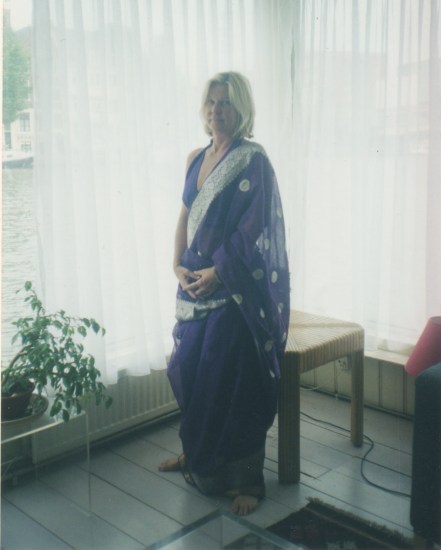
Being Blonde
Our bodies serve us as the vehicle with which and for which we live our lives. If we are strong, flexible, ambidextrous, and well coordinated we are likely to feel good and be healthy. Improving diet and exercise habits can bring about changes in attitude and vice versa. The key to being the best body you can be for your whole life is unconditional gratitude for the body you have now. You may train to become more graceful, more balanced, or more relaxed, but you must work with what you have. Start by loving your skin and everything inside of it. An understanding of basic anatomy is helpful in cultivating well-being. Learning about customs of folk medicine, healing techniques, or diets of foreign cultures can expand the options for self care. Knowledge and understanding are not the key ingredients in radiant health. Acceptance and love for all the ways your body serves you are the foundation on which strong healthy lives are created. What are the different aspects of our physical realm?
The body contains all these different ways of sensing life. Poise, grace, and fitness result from practice. Practice requires focus of mind and body to achieve results. To refine our movements as well as our thoughts we need training. Staying fit and flexible may be the best way to avoid injury. Feeling healthy does uplift the emotions and add to self confidence. Self image is a strong determining factor in the way health is pursued. To clean up and clear up some possible issues from the past answer for yourself these questions:
If you reflect well on these questions and your honest answers to them you may reach some enlightenment. Your thinking, feeling, remembering, and sensing selves can invest in better habits when they are grounded in a healthy self image. First do no harm to your own idea of your body. From there it is possible to heal misguided thoughts about wellness and self care. We deserve the best we can give our bodies for as long as we are in them. Clearing away false judgements from the past makes way for positive changes.

