mermaidcamp
Keeping current in wellness, in and out of the water
You can scroll the shelf using ← and → keys
You can scroll the shelf using ← and → keys
My 9th great grandmother was the first woman poet to be published in America:
Anne Bradstreet (1612-1672) is one of the most important figures in the history of American Literature. She is considered by many to be the first American poet, and her first collection of poems, “The Tenth Muse Lately Sprung Up in America, By a Gentlewoman of Those Parts”, doesn’t contain any of her best known poems, it was the first book written by a woman to be published in the United States. Mrs. Bradstreet’s work also serves as a document of the struggles of a Puritan wife against the hardships of New England colonial life, and in some way is a testament to plight of the women of the age. Anne’s life was a constant struggle, from her difficult adaptation to the rigors of the new land, to her constant battle with illness.
It is clear to see that Anne’s faith was exemplary, and so was her love for children and her husband, Governor Simon Bradstreet. Anne’s poems were written mainly during the long periods of loneliness while Simon was away on political errands. Anne, who was a well educated woman, also spent much time with her children, reading to them and teaching them as her father had taught her when she was young. While it is rather easy for us to view Puritan ideology in a bad light because of it’s attitude towards women and strict moral code, her indifference to material wealth, her humility and her spirituality, regardless of religion, made her into a positive, inspirational role model for any of us.
Another one of Anne’s most important qualities was her strong intuition, although only subtly hinted at in her work, probably for fear of reprisal from the deeply religious Puritan community, one cannot help but feel her constant fascination with the human mind, and spirit, and inner guidance.
Her style is deceptively simple, yet speaks of a woman of high intelligence and ideals who was very much in love, and had unconditional faith. While it was difficult for women to air their views in the 17th Century, Anne Bradstreet did so with ease, as her rich vocabulary and polyvalent knowledge brought a lyrical, yet logical quality to her work which made it pleasant for anyone to read.
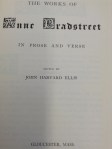

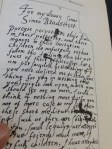
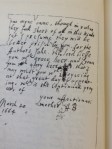







Anne Dudley Bradstreet was protected by her father and husband at a time when women were not supposed to think, let alone write poetry. She wrote history as she lived it as an Englishwoman in New England. I visited the University of Arizona Poetry Center this week to see the word shrine for the dead. I was very happy to also find a big blue book by Anne Bradstreet on the shelves. I enjoyed the wonderful space and visited with my ancestor by reading her works for about an hour. I had seen some of the work before, but since I was thinking of ancestry I really enjoyed the note she wrote to her son Simon (brother of my own ancestor). There is a copy preserved in her own hand, which I love to see. It gives me some intuition into her soul’s journey. Being a Pilgrim was not easy, but if your father and husband were governors you had some obvious advantages.
It is a wonderment of synchronicity to find my ancestor’s work preserved at the Poetry Center very near my home where I can go visit and read her any time.
Selena bears good tidings at the full moon. She rides through the sky in a silver chariot reflecting all that is true and eternal. She was a Titan goddess, predating the Olympians. Selena bathed during the day and rode around the heavens at night. Her love affair with a handsome mortal resulted in 50 daughters. She has the power to control time, mask reality, and expose the truth. She had her lover put to sleep eternally so she could visit him in a cave forever. She is distant, cold, and yet kind.
The full moon is associated with mania and extreme states of mind. The time between the last new moon and the full moon tonight was characterized by the loony government shutdown and all it entailed. When the old men in the Senate had nothing, the women organized to end the stalemate. They shed light on a ridiculous situation. I am reminded of a saying attributed to the Buddha:
“There are three things that will not long stay hidden, the sun, the moon, and the truth.”

Selena
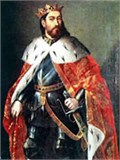
Jaime I Aragon and Mallorc
James I of Aragon was known as the conqueror because he defeated the Moors at Valencia.
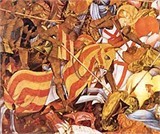
James the Conqueror
Jaime I Pedrez of Aragon and Mallorc (1207 – 1276)
James I the Conqueror (Catalan: Jaume el Conqueridor, Aragonese: Chaime lo Conqueridor, Spanish: Jaime el Conquistador, Occitan: Jacme lo Conquistaire; 2 February 1208 – 27 July 1276) was the King of Aragon, Count of Barcelona, and Lord of Montpellier from 1213 to 1276. His long reign saw the expansion of the Crown of Aragon on all sides: into Valencia to the south, Languedoc to the north, and the Balearic Islands to the east. By a treaty with Louis IX of France, he wrested the county of Barcelona from nominal French suzerainty and integrated it into his crown. His part in the Reconquista was similar in Mediterranean Spain to that of his contemporary Ferdinand III of Castile in Andalusia.
As a legislator and organiser, he occupies a significant place among the Spanish kings. James compiled the Libre del Consulat de Mar,[1] which governed maritime trade and helped establish Aragonese supremacy in the western Mediterranean. He was an important figure in the development of Catalan, sponsoring Catalan literature and writing a quasi-autobiographical chronicle of his reign: the Llibre dels fets.
Contents
1 Early life and reign until majority
2 Acquisition of Urgell
3 Relations with France and Navarre
4 Reconquest
5 Crusade of 1269
6 Patronage of art, learning, and literature
7 Succession
8 Marriages and children
9 Ancestry
10 Notes
11 References
12 External links
Early life and reign until majority
James was born at Montpellier as the only son of Peter II and Mary, heiress of William VIII of Montpellier and Eudokia Komnene. As a child, James was a pawn in the power politics of Provence, where his father was engaged in struggles helping the Cathar heretics of Albi against the Albigensian Crusaders led by Simon IV de Montfort, Earl of Leicester, who were trying to exterminate them. Peter endeavoured to placate the northern crusaders by arranging a marriage between his son James and Simon’s daughter. He entrusted the boy to be educated in Montfort’s care in 1211, but was soon forced to take up arms against him, dying at the Battle of Muret on 12 September 1213. Montfort would willingly have used James as a means of extending his own power had not the Aragonese and Catalans appealed to Pope Innocent III, who insisted that Montfort surrender him. James was handed over, at Carcassonne, in May or June 1214, to the papal legate Peter of Benevento.
James was then sent to Monzón, where he was entrusted to the care of William of Montredon, the head of the Knights Templar in Spain and Provence; the regency meanwhile fell to his great uncle Sancho, Count of Roussillon, and his son, the king’s cousin, Nuño. The kingdom was given over to confusion until, in 1217, the Templars and some of the more loyal nobles brought the young king to Zaragoza.[2]
In 1221, he was married to Eleanor, daughter of Alfonso VIII of Castile and Leonora of England. The next six years of his reign were full of rebellions on the part of the nobles. By the Peace of Alcalá of 31 March 1227, the nobles and the king came to terms.[3]
Acquisition of Urgell
In 1228, James faced the sternest opposition from a vassal yet. Guerau IV de Cabrera had occupied the County of Urgell in opposition to Aurembiax, the heiress of Ermengol VIII, who had died without sons in 1208. While Aurembiax’s mother, Elvira, had made herself a protegée of James’s father, on her death (1220), Guerao had occupied the county and displaced Aurembiax, claiming that a woman could not inherit.
James intervened on behalf of Aurembiax, whom he owed protection. He bought Guerau off and allowed Aurembiax to reclaim her territory, which she did at Lleida, probably also becoming one of James’ earliest mistresses.[4] She surrendered Lleida to James and agreed to hold Urgell in fief from him. On her death in 1231, James exchanged the Balearic Islands for Urgell with her widower, Peter of Portugal.
Relations with France and Navarre
From 1230 to 1232, James negotiated with Sancho VII of Navarre, who desired his help against his nephew and closest living male relative, Theobald IV of Champagne. James and Sancho negotiated a treaty whereby James would inherit Navarre on the old Sancho’s death, but when this did occur, the Navarrese nobless instead elevated Theobald to the throne (1234), and James disputed it. Pope Gregory IX was required to intervene.[5] In the end, James accepted Theobald’s succession.
James endeavoured to form a state straddling the Pyrenees, to counterbalance the power of France north of the Loire. As with the much earlier Visigothic attempt, this policy was victim to physical, cultural, and political obstacles. As in the case of Navarre, he was too wise to launch into perilous adventures. By the Treaty of Corbeil, signed in May 1258, he frankly withdrew from conflict with Louis IX of France and was content with the recognition of his position, and the surrender of antiquated and illusory French claims to the overlordship of Catalonia.
Reconquest
After his false start at uniting Aragon with the Kingdom of Navarre through a scheme of mutual adoption, James turned to the south and the Mediterranean Sea, where he conquered Majorca on 10 September in 1229 and the rest of the Balearic Islands; Minorca 1232; Ibiza 1235) and where Valencia capitulated 28 September 1238. Chroniclers say he used gunpowder in the siege of Museros castle.
During his remaining two decades after Corbeil, James warred with the Moors in Murcia, on behalf of his son-in-law Alfonso X of Castile. On 26 March 1244, the two monarchs signed the Treaty of Almizra to determine the zones of their expansion into Andalusia so as to prevent squabbling between them. Specifically, it defined the borders of the newly-created Kingdom of Valencia. James signed it on that date, but Alfonso did not affirm it until much later. According to the treaty, all lands south of a line from Biar to Villajoyosa through Busot were reserved for Castile.
[edit] Crusade of 1269
The “khan of Tartary” (actually the Ilkhan) Abaqa corresponded with James in early 1267, inviting him to join forces with the Mongols and go on Crusade.[6] James sent an ambassador to Abaqa in the person of Jayme Alaric de Perpignan, who returned with a Mongol embassy in 1269.[7] Pope Clement IV tried to dissuade James from Crusading, regarding his moral character as sub-par, and Alfonso X did the same. Nonetheless, James, who was then campaigning in Murcia, made peace with Mohammed I ibn Nasr, the Sultan of Granada, and set about collecting funds for a Crusade. After organising the government for his absence and assembling a fleet at Barcelona in September 1269, he was ready to sail east. The troubadour Olivier lo Templier composed a song praising the voyage and hoping for its success. A storm, however, drove him off course and he landed at Aigues-Mortes. According to the continuator of William of Tyre, he returned via Montpellier por l’amor de sa dame Berenguiere (“for the love his lady Berengaria”) and abandoned any further effort at a Crusade.
James’ bastard sons Pedro Fernández and Fernán Sánchez, who had been given command of part of the fleet, did continue on their way to Acre, where they arrived in December. They found that Baibars, the Mameluke sultan of Egypt, had broken his truce with the Kingdom of Jerusalem and was making a demonstration of his military power in front of Acre. During the demonstration, Egyptian troops hidden in the bushes ambushed a returning Frankish force which had been in Galilee. James’ sons, initially eager for a fight, changed their minds after this spectacle and returned home via Sicily, where Fernán Sánchez was knighted by Charles of Anjou.
Statue of James I at the Sabatini Gardens in Madrid (J. León, 1753).
Patronage of art, learning, and literature
James built and consecrated the Cathedral of Lleida, which was constructed in a style transitional between Romanesque and Gothic with little influence from Moorish styles.[8]
James was a patron of the University of Montpellier, which owed much of its development to his impetus.[9] He also founded a studium at Valencia in 1245 and received privileges for it from Pope Innocent IV, but it did not develop as splendidly.[10] In 1263, James presided over a debate in Barcelona between the Jewish rabbi Nahmanides and Pablo Christiani, a prominent converso.
James was the first great sponsor and patron of vernacular Catalan literature. Indeed, he may himself be called “the first of the Catalan prose writers.”[11] James wrote or dictated at various stages a chronicle of his own life, Llibre dels fets in Catalan, which is the first self-chronicle of a Christian king. As well as a fine example of autobiography the “Book of Deeds” expresses concepts of the power and purpose of monarchy; examples of loyalty and treachery in the feudal order; and medieval military tactics. More controversially, some historians have looked at these writings as a source of Catalan identity, separate from that of Occitania and Rome.
James also wrote the Libre de la Saviesa or “Book of Wisdom”. The book contains proverbs from various authors going back as far as King Solomon and as close to his own time, such as Albert the Great. It even contains maxims from the medieval Arab philosophers and from the Apophthegmata Philosophorum of Honein ben Ishak, which was probably translated at Barcelona during his reign. A Hebrew translator by the name of Jehuda was employed at James’s court during this period.[12]
Though James was himself a prose writer and sponsored mostly prose works, he had an appreciation of verse.[13] In consequence of the Albigensian Crusade, many troubadours were forced to flee southern France and many found refuge in Aragon. Notwithstanding his early patronage of poetry, by the influence of his confessor Ramon de Penyafort, James brought the Inquisition into his realm in 1233 to prevent any vernacular translation of the Bible.[14]
[edit] Succession
The favour James showed his illegitimate offspring led to protest from the nobles, and to conflicts between his sons legitimate and illegitimate. When one of the latter, Fernán Sánchez, who had behaved with gross ingratitude and treason to his father, was slain by the legitimate son Peter, the old king recorded his grim satisfaction.
In his Will James divided his states between his sons by Yolanda of Hungary: the aforementioned Peter received the Hispanic possessions on the mainland and James, the Kingdom of Majorca (including the Balearic Islands and the counties of Roussillon and Cerdanya) and the Lordship of Montpellier. The division inevitably produced fratricidal conflicts. Always the home de fembres (“lady’s man”), he eloped with the wife of one of his vassals in his final years and was excommunicated for his efforts by Pope Gregory X. In 1276, the king fell very ill at Alzira and resigned his crown, intending to retire to the monastery of Poblet, but he died at Valencia on 27 July.
Mummified head of James, exhumed in 1856
Marriages and childrenAragonese and Valencian Royalty
House of Barcelona
Alfonso IIChildren include Peter (future Peter II of Aragon) Alfonso II, Count of ProvencePeter IIChildren include James (future James I of Aragon, Valencia and Majorca)James I Peter (future Peter III of Aragon and I of Valencia and Sicily) James II of Majorca Violant, Queen of Castile Constance, Infanta of Castile Isabella, Queen of FrancePeter III (I of Valencia and Sicily)Children include Alfonso (future Alfonso III of Aragon and I of Valencia) James (future James I of Sicily and II of Aragon and Valencia) Frederick II of Sicily Elizabeth, Queen of Portugal Yolanda, Duchess of CalabriaAlfonso III (I of Valencia)James II (I of Sicily)Children include Alfonso (future Alfonso IV of Aragon and II of Valencia)Alfonso IV (II of Valencia)Children include Peter (future Peter IV of Aragon and II of Valencia)Peter IV (II of Valencia)Children include Constance, Queen of Sicily John (future John I of Aragon and Valencia) Martin (future Martin II of Sicily and I of Aragon and Valencia) Eleanor, Queen of Castile Isabella, Countess of UrgelGrandchildren include Ferdinand (future Ferdinand I of Aragon, Valencia and Sicily) Isabella, Countess of Urgel and CoimbraJohn I Yolande, Queen of FranceMartin I (II of Sicily)
James first married, in 1221, Eleanor, daughter of Alfonso VIII of Castile and Leonora of England. Though he later had the marriage annulled, his one son by her was declared legitimate:
Alfonso (1229–1260), married Constance of Montcada, Countess of Bigorre
In 1235, James remarried to Yolanda, daughter of Andrew II of Hungary by his second wife Yolande de Courtenay. She bore him numerous children:
Yolanda, also known as Violant, (1236–1301), married Alfonso X of Castile
Constance (1239–1269), married Juan Manuel, Lord of Villena, son of Ferdinand III
Peter (1240–1285), successor in Aragon, Catalonia, and Valencia
James (1243–1311), successor in Balearics and Languedoc
Ferdinand (1245–1250)
Sancha (1246–1251)
Isabella (1247–1271), married Philip III of France
Mary (1248–1267), nun
Sancho, Archbishop of Toledo (1250–1279)
Eleanor (born 1251, died young)
James married thirdly Teresa Gil de Vidaure, but only by a private document, and left her when she developed leprosy.
James (c.1255–1285), lord of Xèrica
Peter (1259–1318), lord of Ayerbe
The children in the third marriage were recognised in his last Will as being in the line of Successon to the Throne, should the senior lines fail.
James also had several lovers, both during and after his marriages, and a few bore him illegitimate sons.
By Blanca d’Antillón:
Ferran Sanchis (or Fernando Sánchez; 1240–1275), baron of Castro
By Berenguela Fernández:
Pedro Fernández, baron of Híjar
By Elvira Sarroca:
 Eleanor of Aquitane
My 25th great-grandmother was extremely powerful. She married the king of France, and then the king of England. She ruled for her son, Richard the Lionhearted, while he was off crusading.
Eleanor of Aquitane (1130 – 1204)
is my 25th great grandmother
Eleanor Spain Plantagenet (1162 – 1214)
daughter of Eleanor of Aquitane
Berenguela CASTILE LEON (1181 – 1244)
daughter of Eleanor Spain Plantagenet
Saint Ferdinand Castile amp Leon (1199 – 1252)
son of Berenguela CASTILE LEON
Alfonso X Wise Castile Leon amp Galicia (1221 – 1284)
son of Saint Ferdinand Castile amp Leon
Sancho Brave Castile Leon (1258 – 1295)
son of Alfonso X Wise Castile Leon amp Galicia
Beatrice Sanchez Infanta Castile (1293 – 1359)
daughter of Sancho Brave Castile Leon
Peter I Portugal Cruel Algarve (1320 – 1367)
son of Beatrice Sanchez Infanta Castile
John I DePinto (1358 – 1433)
son of Peter I Portugal Cruel Algarve
Beatrix DePinto (1403 – 1447)
daughter of John I DePinto
John Fettiplace (1427 – 1464)
son of Beatrix DePinto
Richard Fettiplace (1460 – 1511)
son of John Fettiplace
Anne Fettiplace (1496 – 1567)
daughter of Richard Fettiplace
Mary Purefoy (1533 – 1579)
daughter of Anne Fettiplace
Susanna Thorne (1559 – 1586)
daughter of Mary Purefoy
Gov Thomas Dudley (1576 – 1653)
son of Susanna Thorne
Anne Dudley (1612 – 1672)
daughter of Gov Thomas Dudley
John Bradstreet (1652 – 1718)
son of Anne Dudley
Mercy Bradstreet (1689 – 1725)
daughter of John Bradstreet
Caleb Hazen (1720 – 1777)
son of Mercy Bradstreet
Mercy Hazen (1747 – 1819)
daughter of Caleb Hazen
Martha Mead (1784 – 1860)
daughter of Mercy Hazen
Abner Morse (1808 – 1838)
son of Martha Mead
Daniel Rowland Morse (1838 – 1910)
son of Abner Morse
Jason A Morse (1862 – 1932)
son of Daniel Rowland Morse
Ernest Abner Morse (1890 – 1965)
son of Jason A Morse
Richard Arden Morse (1920 – 2004)
son of Ernest Abner Morse
Pamela Morse
I am the daughter of Richard Arden Morse
Eleanor of Aquitaine
(in French: Aliénor d’Aquitaine, Éléonore de Guyenne) (1122 or 1124 – 1 April 1204) was one of the wealthiest and most powerful women in Western Europe during the High Middle Ages. As well as being Duchess of Aquitaine in her own right, she was queen consort of France (1137-1152) and of England (1154-1189). Eleanor of Aquitaine is the only woman to have been queen of both France and England, with the exception of Margaret of Anjou whose status as Queen of France is disputed. She was the patroness of such literary figures as Wace, Benoît de Sainte-More, and Chrétien de Troyes.
Eleanor succeeded her father as suo jure Duchess of Aquitaine and Countess of Poitiers at the age of fifteen, and thus became the most eligible bride in Europe. Three months after her accession she married Louis VII, son and junior co-ruler of her guardian, King Louis VI of France. As Queen of France, she participated in the unsuccessful Second Crusade. Soon after the Crusade was over, Louis VII and Eleanor agreed to dissolve their marriage, because of Eleanor’s own desire for divorce and also because the only children they had were two daughters – Marie and Alix. The royal marriage was annulled on 11 March 1152, on the grounds of consanguinity within the fourth degree. Their daughters were declared legitimate and custody of them awarded to Louis, while Eleanor’s lands were restored to her.
As soon as she arrived in Poitiers, Eleanor became engaged to Henry II, Duke of the Normans, her cousin within the third degree, who was nine years younger. On 18 May 1152, eight weeks after the annulment of her first marriage, Eleanor married the Duke of the Normans. On 25 October 1154 her husband ascended the throne of the Kingdom of England, making Eleanor Queen of the English. Over the next thirteen years, she bore Henry eight children: five sons, three of whom would become king, and three daughters. However, Henry and Eleanor eventually became estranged. She was imprisoned between 1173 and 1189 for supporting her son Henry’s revolt against her husband, King Henry II.
Eleanor was widowed on 6 July 1189. Her husband was succeeded by their son, Richard the Lionheart, who immediately moved to release his mother. Now queen dowager, Eleanor acted as a regent for her son while he went off on the Third Crusade. Eleanor survived her son Richard and lived well into the reign of her youngest son King John. By the time of her death she had outlived all of her children except for King John and Eleanor, Queen of Castile.

skull and crossbones
The human condition known as revenge is ancient and well documented. The Greek goddess Nemesis represents retribution. She lives in the underworld with Hecate. She feels no remorse and hesitates at nothing to deal out vengeance when it is required. She is a neutral spirit with a balanced approach. She has the task of taking happiness from the undeserving while bringing more joy to those who earn it. She is pictured with a balance scale, doing calculations. She is concerned with issues of money. Her name is related to the word number, and the word economy. She is not vengeful, but is an accountant from the underworld.
The collective as well as your personal consciousness about wealth, money and right livelihood are the province of Nemesis. She keeps the accounts in balance. Abundance and prosperity follow the laws of nature. Knowledge as well as belief influence the outcome of all your earthly investments. Spiritual integrity in work and business ethics are measured against one’s degree of avarice and destructive behavior. Can you find ways that your beliefs about receiving limit you now? Can you think of ways to budget a more secure financial future for yourself through awareness? Some Americans call her “Death and Taxes”, to say she is hard to avoid. She is impossible to avoid, and she is counting all the time. She will deliver what is due from the wheel of karma because that is her job.
Last week in San Francisco my friends and I attended Blind Cafe, an enlightening evening in the dark. This is a show that travels around the country, gathering local volunteers and donations in each city in order to put on the production. None of us knew what to expect, other than a blind tasting and some music. It turned out to be amazing on many levels. Happy hour was in dim light with the guests drinking wine and meeting each other as well as the visiting puppies in training and their guardian/trainers. The two darling golden retriever mix pups were loving and enthusiastic about partying with everyone. Our tickets were arranged in tables with seating numbers so when the time came for us to go into the darkness we lined up with a hand on the shoulder in front of us to be guided to our places. Our group of three briefly met some of our table mates while we were in line.
The room was pitch black and very loud. It seems that when we have no sight we begin to turn up the volume in order to stay in touch. The plate of delicious vegetarian food was set in front of each chair, but the table also was full of other items in the center that could only be discovered by feeling. We were given plastic forks, but they did not last very long for most of us. I was happy to find water bottles in the center, and friends passed me some exquisite bites from other places in the table. Most of the talk was about the food and how to find it, but somehow the person across the table from me started talking about his ultra special diet. Before you could say gluten intolerant I was involved in a heated argument with this stranger in the dark. We were already in an organic vegetarian situation, so I did not want to hear that eating one of the goat cheese roll ups would cause him to become bipolar. Quickly I determined that he took bipolar drugs as well as LSD and copious amounts of alcohol, but that was not enough. He explained that he had a masters’ degree in interpersonal shamanism and was therefore totally aware of the incongruities he presented. He said he agreed that LSD might make him think he is bipolar/bisexual. My friend seated next to me asked me why I was freaking out at this man, and I asked myself the same question. Luckily it was time for us to all do active listening during the comedy and music entertainment, so we had to end the fight. I have wondered why this bipolar/bisexual LSD person was there for me, and what archetypes we both represented in the food fight. I maintained that orthorexia is damaging, and he maintained that goat cheese can potentially cause in his life temporary states of mental breakdown. I will not know his name, and I was careful when we left not to look to see his face. He is a mystery shadow that completely engaged my shadow, but in the dark!!! Who was that????
If you go I doubt that you will encounter any transpersonal analysis sitting across the dinner table from you. This had to be some special San Francisco thing that could not happen again. The food and the fun were beyond compare; Who knew it came with an archetypal lesson?
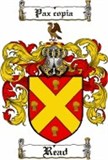
Read Coat of Arms
My 13th great grandfather was
Lord Chief Justice of the Common Pleas from 1506-1519
Originally, the three high common law courts, the Court of Common Pleas, the Court of the King’s (or Queen’s) Bench, and the Court of the Exchequer, each had their own Chief Justice. That of the Exchequer Court was styled as the Lord Chief Baron of the Exchequer, and that of the Common Pleas was Chief Justice of the Common Pleas, leaving the head of the King’s (or Queen’s) Bench to be known simply as the Lord Chief Justice. The courts, however, were combined in 1873, leaving a single Chief Justice.
Robert Read (1440 – 1519)
is my 13th great grandfather
Dorothy Reade (1489 – 1529)
daughter of Robert Read
Sir Knight THOMAS Wooton (1521 – 1587)
son of Dorothy Reade
Thomas Wooton (1585 – 1668)
son of Sir Knight THOMAS Wooton
Elizabeth Wooton (1610 – 1690)
daughter of Thomas Wooton
Sarah Perkins (1657 – 1745)
daughter of Elizabeth Wooton
Mercy Bradstreet (1689 – 1725)
daughter of Sarah Perkins
Caleb Hazen (1720 – 1777)
son of Mercy Bradstreet
Mercy Hazen (1747 – 1819)
daughter of Caleb Hazen
Martha Mead (1784 – 1860)
daughter of Mercy Hazen
Abner Morse (1808 – 1838)
son of Martha Mead
Daniel Rowland Morse (1838 – 1910)
son of Abner Morse
Jason A Morse (1862 – 1932)
son of Daniel Rowland Morse
Ernest Abner Morse (1890 – 1965)
son of Jason A Morse
Richard Arden Morse (1920 – 2004)
son of Ernest Abner Morse
Pamela Morse
I am the daughter of Richard Arden Morse
The History and Topographical Survey of the County of Kent: Volume 3
by Edward Hasted, published 1797
Pages 210-227
British History Online
About the 43d year of king Edward III. he conveyed this manor, with much other land in this county and in Warwickshire, to Sir Walter de Paveley, knight of the Garter, in whose family it remained until the latter end of the reign of king Richard II. when it was conveyed to Vaux, of the county of Northampton, in which name it staid till the reign of king Henry VI. when it was alienated to John Alphegh, or Alphew, of Bore-place, in this parish, who bore for his arms, Argent, a fess between three boars heads couped, sable. He died in 1489, and lies buried in this church, leaving by Isabel, his wife, daughter of Richard Petit, esq. two daughters and coheirs; Elizabeth, who was twice married, first to George Gainsford, esq. a younger son of Sir John Gainsford, of Crowhurst, in Surry; (fn. 8) and secondly to William Brograve, esq. of Beckenham; and Margaret, who married Sir Robert Read, who had this manor allotted to him on the division of their inheritance. He was descended from an antient family in the county of Northumberland, and being bred to the law, was, in 1507, made chief justice of the common-pleas, (fn. 9) and was so highly esteemed by king Henry VII. that he had made him one of his executors. Sir Robert Read bore for his arms, Gules, on a fess wavy, three pheasant cocks sable; which coat, impaling Alphew, is still remaining in a window, in Sergeant’s-inn.
By Margaret, his wife, Sir Robert had one son, Edmund, who was one of the justices of the King’s bench, and dying before him, without issue, in 1501, lies buried in this church, and four daughters; Bridget, wife of Sir Thomas Willoughby; Jane, of John Caryll, esq. sergeant at law; Mary, of Sir William Barringtyne; and Dorothy, of Sir Edward Wotton. He died about the 10th year of the reign of Henry VIII. without issue male; so that his four daughters became his coheirs, and on the partition of their inheritance, this manor, with other estates in this parish, was allotted to the share of Sir Thomas Willoughby and Bridget his wife.
Sir Thomas Willoughby was the fifth and youngest son of Sir Christopher Willoughby, and younger brother of William Lord Willougby, ancestor of the present baroness Willoughby of Eresby, and of Christopher, ancestor of the lords Willoughby of Parham, now extinct; the origin of the family in this kingdom being Sir John de Willoughby, a Norman knight, who had the lordship of Willoughby, in Lincolnshire, by the gift of the Conqueror.
Sir Thomas Willoughby being bred to the law, was knighted in the 29th year of king Henry VIII. was made a chief justice of the common pleas, (fn. 10) and by his wife Bridget, as above mentioned, became entitled to this manor of Chidingstone Burghersh, with his seat called Bore-place, and other estates in this parish. (fn. 11) In the 31st year of that reign he, among others, by an act then passed, procured his lands to be disgavelled.
He died in the 37th year of king Henry VIII. and lies buried with Bridget, his wife, in this church. His arms, being Gules, on a bend wavy argent, three birds sable, impaling argent, a fess between three boars heads couped sable, are still remaining in one of the windows of Sergeant’s inn, in Fleet-street.
His grandson, Sir Thomas Willoughby, was sheriff of this county in the 15th and 32d years of queen Elizabeth, and bore for his arms, Or, fretty azure. He marriedCatharine, daughter of Sir Percival Hart, of Lullingstone, by whom he left several sons and daughters; of whom Percival, the eldest, succeeded to these estates, and was, on the accession of King James I. knighted by that prince. He married Bridget, eldest daughter and coheir of Sir Francis Willoughby of Wollaton-hall, in Nottinghamshire, by which means he not only possessed that mansion, but a large estate in that county, for which he was elected to serve in the first parliament of King James, and was ancestor of the present Henry Willoughby lord Middleton. Being desirous of increasing his interest in Nottinghamshire, he alienated the manor of Chidingstone Burghersh to Mr. John and Robert Seyliard, of Delaware, from whom it descended to John Seyliard, esq. of Delaware, who was created a baronet in 1661, and from him to Sir Thomas Seyliard, bart. who, about the year 1700, conveyed it, with Delaware, above mentioned, to Henry Streatfeild, esq. and he, at his death, bequeathed it to his youngest son, Thomas Streatfeild, esq. of Sevenoke, who devised it to his nephew, Henry Streatfeild, esq. of High-street house, in this parish; since whose death, in 1762, the inheritance of it is become vested in his eldest son, Henry Streatfeild, esq. of High-street house.
BORE-PLACE is a seat here, which, with the MANOR OF MILBROKE, was antiently, as high as the reign of King Henry III. the estate of a family, which assumed its surname from hence, and was called Bore, and assumed a boar for its arms. In the name of Bore this seat and manor continued till John Bore; in the reign of king Henry VI. conveyed them by sale to John Alphew, who rebuilt Bore-place, and died possessed of them both in 1489, leaving two daughters and coheirs; one of whom, Margaret, became the wife of Sir Robert Read, lord chief justice of the common pleas, of whom a full account has already been given; and on a division of their inheritance entitled him to this seat and manor, as well as the rest of her father’s estate in this parish. He resided at Bore-place, which he much enlarged, and dying without male issue surviving, his four daughters became his coheirs; of whom Bridget, the eldest, was married to Sir Thomas Willoughby, chief justice of the common pleas, and on the partition of his estates, had this seat, Milbroke, and his other possessions in this parish, allotted for her share.
Sir Thomas Willoughby likewise resided at Boreplace, and added much to the buildings of it. His grandson, Sir Percival Willoughby, in the beginning of the reign of King James I. alienated Bore-place and Milbroke, to Mr. Bernard Hyde, of London, after wards one of the commissioners of the customs to king Charles I. who was a charitable benefactor, by his will, to several parishes in London, as well as others, in trust to the Skinners company. (fn. 12) His descendant, Bernard Hyde, esq. alienated them about fifty years ago to Henry Streatfeild, esq. of Highstreet house, in this parish; since whose death, in 1762, the inheritance of both Bore-place and Milbroke are become vested in his eldest son, Henry Streatfeild, of High-street house, esq.
There is a court baron held for the manor of Milbroke.
Bowzell, antiently called Boresell, is a manor, the greatest part of which lies in the adjoining parish of Chevening, under which indeed it ought more properly to have been described. It was antiently part of the possessions of that branch of the Cobhams settled at Sterborough castle, in Surry.
Reginald de Cobham died possessed of this manor in the 35th year of Edward III. as did Joane his wife in the 43d year of that reign; from them it descended down to Sir Thomas Cobham, who died possessed of it in the 11th year of king Edward IV. whose only daughter and heir carried it in marriage to Sir Edward Borough, of Gainsborough, in Lincolnshire; she survived her husband, and died anno 20 king Henry VIII. being then possessed, as appears by the inquisition taken after her death, of this manor, among others, held of William, archbishop of Canterbury, as of his honour of Otford, by knights service. (fn. 13) Their descendant, Sir Thomas Borough, lord Burgh, and knight of the Garter, died possessed of it in the 40th year of queen Elizabeth, leaving four daughters his coheirs; Elizabeth, married to George Brooke, esq. brother of Henry lord Cobham; Frances to Francis Coppinger, esq. whose direct descendant, Fysh Coppinger, esq. of West Drayton, in the year 1790, had a licence, under the king’s sign manual, to assume the name of Burgh; Anne, to Sir Drew Drury; and Catharine, afterwards the wife of Thomas Knyvett, esq. by which, though the heir male of this family endeavoured to succeed to the barony, yet he failed in it, and it still continues in abeyance. They some years afterwards, to defray debts and other uses, joined in the sale of it to Thomas of Whitley, near Sevenoke, from which name it again passed by sale to Waterson; from whom, by a female, it was carried in marriage to Bonnell, whose descendant, James Bonnell, esq. of London, about the year 1784, alienated it to the Rev. Richard Rycrost, D.D. rector of Penshurst, in this county; who, on Dec. 10, 1783, was created a baronet. He died possessed of this manor, in 1786; and his son, Sir Nelson Rycrost, bart. is the present owner of it.
Ranesley, formerly spelt Rendesley, is a manor in this parish, lying near the boundaries of Penshurst, the owners of which were in antient deeds, written both Rendesley and Rennesley, but before the end of king Henry VI.’s reign, this family was extinct here, and the possession of it was alienated to Alphew of this parish, whose descendant, John Alphew of Bore-place, dying in 1489, without male issue, one of his daughters and coheirs, Margaret, carried it in marriage toSir Robert Read, chief justice of the common pleas, on the partition of the inheritance, of whose daughters and coheirs this manor fell to the share ofBridget, married to Sir Thomas Willoughby, chief justice likewise of the common-pleas, whose descendant, Robert Willoughby, esq. alienated it to Bond, and Mrs. Anne Bond possessed it in the 1st year of Edward VI. (fn. 14) Her heirs conveyed it to Nathaniel Studley, esq. the son of John Studley of Emborne Minster, in Yorkshire, who bore for his arms, Argent, on a fess vert three stags beads caboshed or. His only son and heir, Nathaniel, succeeded his father in this manor, and in the time of the civil wars of king Charles I. alienated it to Mr. Christopher Knight of Cowdham, (fn. 15) on whose death it came into the possession of his son, Mr. Michael Knight of Westerham; to whom Sir Edward Byshe, clarencieux, in 1662, granted these arms, Party per chevron engrailed sable and argent, three griffins passant, counterchanged, armed, and langued gules. From this family this manor passed, by sale, to Robert Sidney earl of Leicester; after which it continued in his descendants, in like manner as the rest of his estates in this parish, till with them it came into the possession of two female coheirs, Mary and Elizabeth, daughters of colonel Thomas Sidney, and heirs general of Robert earl of Leicester, who was the grandson of Robert, who purchased this manor, and they carried it, by marriage, to Sir Brownlow Sherard, bart. and William Perry, esq. who possessed it in undivided moieties. (fn. 16) The former died in 1748, without issue, and his widow possessed one moiety of this manor till her death, in 1758, when she, by her will, gave it to Anne, widow of Sir William Yonge, bart. with remainder to her son, Sir George Yonge, bart. of Escot, in Devonshire. William Perry, esq. died possessed of the other moiety of this manor in 1757, leaving his wife surviving, who in 1770, purchased of lady Yonge, and her son Sir George, their moiety of it, and thus became owner of the whole of this manor, which she gave by her will, at her death in 1783, to her eldest grandson, John Shelley Sidney, esq. who is the present owner of it.
Footnotes:
10 Coll. Peer. vol. v. p. 559, et seq. Dugd. Bar. vol. ii. p. 33, 83. Hist. Grevile, 70, et seq.
12 Strype’s Stow’s Survey, book ii. p. 36, 46, 48, 64, 81, 170; book iii. p. 62, 100; book v. p. 67.
13 Inquis. post Mort. Harris’s Hist. Kent, p. 75.
14 See particulars of chantries, Aug. Off. title Penshurst chapel.
15 Philipott, p. 114. Visit. Co. Kent, p. 1619. Guillim, 394.
16 See more particular account of the Sidneys, and the descent of their estates, under Penshurst.
PEZ is an Austrian product which originally came in only one flavor, Pfeffermintz..thus the name, an abbreviation of peppermint in German language. E-Bay credits the start of the business to PEZ because the first E-Bay site was created for the wife of the founder to trade her PEZ collection on line. More than 800 distinct designs have been produced since 1950. At the Burlingame Museum of PEZ Memorabilia you can view all 800 of them. The gift shop has all the latest and some vintage dispensers for sale. There are also PEZ flavors with which to fill them, of course. I am an enthusiastic fan of the museum even though owning PEZ dispensers does not really call to me. For collectors I am sure this is a true Mecca.
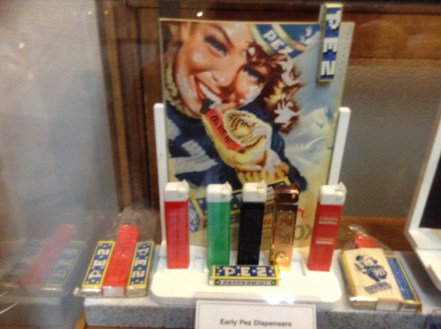
originals

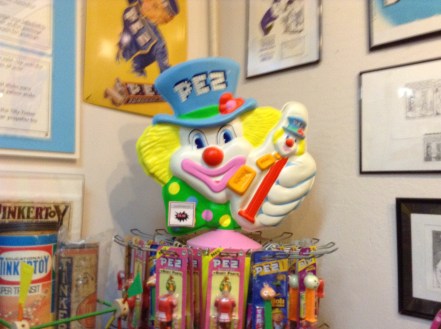
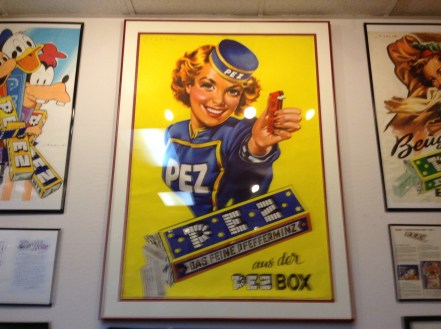
50’s PEZ
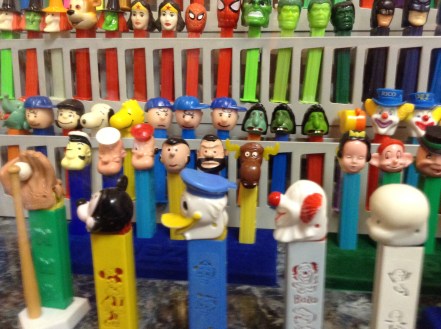
early cartoon PEZ

PEZ gun
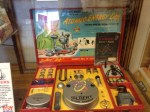
I visited and had the tour, then convinced my friend Donna to experience the museum the following day. I was graciously admitted again, given an extension on my first ticket, to join them on the tour. The great thing about collecting tiny objects is that many can fit in a small space. The museum is packed with PEZ and PEZ art as well as classic toys still in production like Lincoln Logs, and a set of toys that have been taken off the shelves for safety reasons. My favorite of the banned toys is the atomic lab that came with real radioactive material for your child to use. I had all kinds of science kits as a kid, and probably would have had my own atomic lab if my father had known about it.







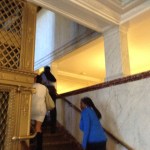
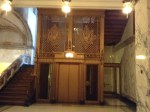
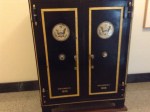
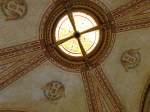
Just when I thought the Federal government had no redeeming qualities I was proven wrong. My friends and I had the privilege of touring one of the classiest buildings the US taxpayer owns, the US Court of Appeals of the 9th Circuit in San Francisco. We were invited by my friend, appellate commissioner Peter Shaw , who has worked in the building for many years. We knew we would see one of the oldest buildings in the city, but none of us was prepared for how cool it actually is. When it was built it also served as the main post office, so some of the teller windows and details that belonged to the post office era have been included in the design today. We met very gracious people who were distinguished and personable to us. The courtrooms are ornate and full of fine stone carving, wooden furniture, and mosaics. The metal throughout the building is beautifully formed. Many of the lighting fixtures are brass, shined to perfection. We truly loved the feeling of being treated to the luxury of the surroundings without being involved in a court case. The big thrill of the day was dressing in Peter’s robe and sitting for photos on the bench, flanked by the babes of justice. He had done this before so he knew how popular this would be. We felt like the luckiest taxpayers in the country. The commissioner is more than an esteemed member of the court. He has a pride and sense of history that he was able to convey to us as we examined the evidence he presented. We all felt much better about our government, if only for an afternoon. I will always remember this opportunity to peek into the distinguished and artful world of jurisprudence.














psyche

psyche
Your health is like a bank account. You deposit and withdraw from your inherited constitution. If you need a loan, there is no place to apply. Your account, like the number of days you will live, is subject to your habits and practices. Diminishing returns are built into the model. Some of us are genetically lucky, while many start life with disadvantages. Accidents and disasters cause permanent damage, mental and physical. There is no way to know how much one will need to withdraw due to illness.
Prehabilitation is more cost effective than rehabilitation because once a system is depleted it may never fully recover. There are ways to make deposits over time that will earn interest. These reserves affect your immune system and your ability to remain calm under pressure. Health is your only real wealth, in the words of Dr. Bronner. Changing lifestyle habits results in changing wellbeing. We need not aim for perfection, since that in itself is cause for stress. Logical, simple additions can be made to daily routine that add up to better health in the long run.
Investments made today will accrue interest as long as you live.
 mermaidcamp