mermaidcamp
Keeping current in wellness, in and out of the water
You can scroll the shelf using ← and → keys
You can scroll the shelf using ← and → keys

marjoram plant
Marjoram has been used medicinally for centuries. The botanical name, Origanum majorana, is derived from Greek words meaning joy (oros) of the mountains (ganos). This culinary herb is commonly used in Mediterranean dishes to add a warm woody flavor. As an herbal remedy the tea made from dried leaves and flowers is used as a treatment for liver disease, vocal chord distress, insomnia, coughs, indigestion, headaches and migraines. The antispasmodic qualities of the herb are used topically in ointments and massage oils to relive muscle soreness.
The marjoram in my garden is highly productive, so I have looked into ways to use my large harvest. I do cook with it, but have not yet tried drinking the tea. On the new moon each month I do a clean sweep ritual. I clean and clear my home of stale energy, throw away or give away items no longer needed, then refresh the marjoram sachets in the 4 corners of my home. The bundles are symbolic as well as aromatic. I meditate on new beginnings and fresh projects while I dispose of the old herbs in the back yard and replace them with freshly harvested marjoram from my front yard. The process only takes about 5 minutes but it establishes a clean start attitude in my home. The fresh scent fades, but the mini ritual refreshes my creativity and wellness.
I have learned that the Egyptians dedicated this planet to the god Osiris, who ruled the afterlife. They used it on the graves of the dead as well as in medicinal preparations. In Greece both marjoram and oregano, cousins with different effects, were created by Aphrodite. Love potions were made with marjoram, and Greeks crowned the bridal couple with wreaths of marjoram at weddings to ensure happiness. Continuing the funeral custom, ancient Greeks believed that if marjoram grows on someone’s grave they are content in the afterlife.
I have been trying techniques to enhance my sleep lately. I developed a couple of small muscular strains yesterday, so I decided to try a marjoram bath in the evening. I have been using Epsom salts in my bath to put me to sleep soundly with great success. I have added ginger as a general tonic, so I thought I would compare that experience to marjoram bathing. I stayed in the first time for about 30 minutes, got out and sweated into my terry cloth robe for about 10 minutes, then soaked again for 20 minutes . The effect was very positive. Not only did I fall deeply and soundly to sleep, but this morning all the little aches had left my body. One of them had been hanging around for weeks, not too painful, just annoying. I have already brewed marjoram tea for my bath tonight, with plans to continue this simple and effective remedy from my garden. I have discovered my own version of the fountain of youth. All I need to do to erase minor pain and alter my level of stress is soak in my own tub. Tonight I may add a cup of tea internally to add to the sedative effects. Do remember that sedative and anti depressant are not the same. This herb, although mild, is used as a downer. If you want a lift try lemon balm in your bath.
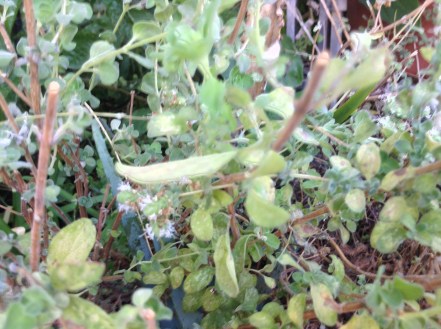
marjoram plant

Ophelia Camera Shy
In Tucson we have a harsh climate and sparse rain, both of which make gardening a challenge. Arizona had thriving agricultural crops until the ground water became too scarce and too deep to pump to the surface for many growers. Around Phoenix one can find large citrus groves abandoned, full of dead mature trees. It is a sad sight. Our large pecan groves are starting to compete for water with the surrounding residential users. Since the water is finite this problem will only increase with time. Our state needs to be very conservative with water, finding solutions to feed the population without depleting the water table. We are lucky that Nogales, Arizona is the main port for Mexican produce into the states. Most of the year we are able to buy deeply discounted produce from Mexico which is brought to Tucson by the Santa Cruz County Food Bank to save it from the landfill.
In Tucson there is a thriving urban agriculture movement. Small growers and producers are encouraged to bring produce to market through some innovative programs operated by the Community Food Bank Southern Arizona . The Food Conspiracy and Native Seed Search are strong supporters of local gardens as well as purveyors of local products. This enriches our community by supporting options that decrease food waste and the costs of food storage and transport. What could be better than allowing fruits to ripen on the vine, then harvesting them for dinner in your own back yard? Not everyone can have a garden, but those who do add to the beauty and sustainability of the neighborhood.
I like to garden, but many folks around town enjoy keeping hens for eggs. My neighbor Heidi had 6 lovely chickens in her back yard for many years. Suddenly the city zoning department demanded that she remove the chickens and tear down their home. This was in response to some complaint which can’t be traced to any neighbor. There are laws on the books that are never enforced unless somebody complains. The chicken rules have been ignored, then randomly enforced when complaints are made. This has become some kind of political football. Finally after many years of working on a new proposal that is more friendly to small time egg farmers the issue will come to a vote by our city council. The final touches of the zoning committee will be presented to the mayor and council for review and decisions. The Tucson Clucks are organizing and hoping that all their illicit coops will be permitted to stay in place. I think it is not only reasonable, but good for the city to promote food growing that does not disturb neighbors. Roosters will still be outlawed because of the potential noise, but responsible chicken owners will no longer be outlaws.

Hammond Coat of Arms
My 10th great-grandfather was an early settler of Watertown, Massachusetts. His father died and he was declared bankrupt in England before he emigrated. William brought part of his family to America to settle before sending for his wife and younger children. By April 1634 they had all arrived in the colony. He frequently was fined for religious infractions and may have been a secret Quaker.
William Hammond
Birth: 1575, Lavenham, Suffolk, England.
Baptized: 30 Oct 1575, Lavenham, Suffolk, England.
Death: 8 Oct 1662, Watertown, Massachusetts. “Aged about ninety-four.
Father: Thomas Hammond, born and died in England.
Mother: Rose Trippe, born and died in Lavenham, Suffolk, England.
1629: On 26 Feb 1629/30, William Hammond was declared bankrupt in England.
1629: On “the 20th of November after that date, he departe[d] the land and fleeth into New England. Information from a 1656 law suit against William Hammond, citing this occurance. This would place him on the “Lyon” which sailed from Bristol on 1 Dec 1630/1631, and arriving in New England the following February.
Emigration: 1631. See above.
The Hammond family came to New England in at least three stages. In late 1630 or early 1631, John Winthrop Jr. noted receipt of £7 5s. from “Goody Hammond to send her husband.” This supports the conclusion that William Hammond was a passenger on the “Lyon” when it sailed from Bristol in late 1631.
On 26 Sept 1633, Governor John Winthrop, wrote to Sir Simonds D’Ewes, informing him that “Yours by young Hamond I received,” indicating that William Hammond Jr. probably sailed for New England in one of the ships that arrived in the fall of 1633. His sister Anne and brother Thomas may also have come at this time, because they are not included, a year later, in the passenger list of the “Francis”, which sailed from Ipswich, in the spring of 1634, with Elizabeth Hammond, (aged 47); Elizabeth Hammond, (aged 15); Sarah Hammond, (aged 10); and John Hammond, (aged 7) on board.
First Residence: William’s first residence was Watertown, Massachusetts.
Occupation: Husbandman.
Religion: Admitted to Watertown Church prior to 25 May 1636, (implied by freemanship.)
1636: Admitted as a Freeman, 25 May 1636.
1636: In his record of admissions to Scituate Church, Rev. John Lathrop, entered on 14 Apr 1636, “Elizabeth Hammon, my sister, having a dismission from the church at Watertown.”
1636: On 25 Jul 1636, William Hammond was granted forty acres in the Great Dividend.
1637: Granted eight acres in the Remote Meadows, 26 Jun 1637.
1641: Granted a farm of one hundred fifty-five acres, 10 May 1642.
1645: In the “year 1645 Rose his mother dyeth … but now in the year 1647 his son Thomas come from New England to be admitted to the land.”
1647: On 22 Nov 1647, “W[illia]m Hamond granted a letter of attorney unto Thomas Hamond, his son, to ask demand of the lord of the manor the possession of certain lands in Lavenham, in Suffolk which were the possession of Rose Steward, his mother.”
1647: William was a Watertown Selectman, 8 Nov 1647.
1656: Along with Isaac Stearns, William was an arbiter in a dispute between John Wincoll and Benjamin Crisp.
1656: “Old Goodman Hammond” was appointed to a committee to assign seats in the meeting house, 17 Nov 1656.
1660: On 6 Non 1660, Watertown Selectmen sent the constables to “Old Hamond to let him know, that contrary to order of town, he had entertained into his family such a person as is likely to prove chargeable, do therefore desire him to rid the town of such an encumbrance or otherwise to bear the burden thereof himself.”
In William’s will, dated 1 Jul 1662 and proved 16 Dec 1662:
“William Hammond of Watertowne … now about ninety years of age” bequeathed to “my loving dear wife Elizabeth Hammond my whole estate” for life;
and after her death, to “my son John Hammond all my houses, lands;”
to “Thomas Hammond son of my son Thomas Hammond, deceased,” £40 when twenty-one, but if he dies before that then “the £40 to be equally divided between the children of my daughter House, daughter Barnes, [i.e., Barron’s], children”; to “daughter Barnes” £30;
to “the four children of my daughter Elizabeth House deceased” £5 apiece; to “Adam Smith son of my daughter Sarah … one mare colt”
and to “my daughter Sarah Smith” £5.
The inventory of the estate of William Hammond totalled £467 16s. 9d., including £318 in real estate:
one dwelling house, an orchard £24;
23 acres of pasture land, £69;
11 acres of broken-up land, £48;
15 acres of meadow, £90;
8 acres of meadow remote, £15;
18 acres of land in lieu of township, £6;
1 Great Dividend, 40 acres, £40;
1 farm, 160 acres, £20; and
a part of a barn, £6.
His inventory also included “one great Bible and 3 other books” valued at 13s.
Married: Elizabeth Paine, baptized in Lavenham 22 Sep 1586. She was the daughter of William and Agnes Neves Paine. Elizabeth arrived in New England in 1634 on the “Francis” with her three youngest children. Elizabeth died 27 Sep 1670, in Watertown, Massachusetts, “aged about ninety years .”
Marriage: 9 Jun 1605, in Lavenham, Suffolk, England.
Children of William Hammond and Elizabeth Paine Hammond:
William Hammond (1575 – 1662)
is my 10th great grandfather
Elizabeth Hammond (1620 – 1703)
daughter of William Hammond
Elishua Crowell (1643 – 1708)
daughter of Elizabeth Hammond
Yelverton Gifford (1676 – 1772)
son of Elishua Crowell
Ann Gifford (1715 – 1795)
daughter of Yelverton Gifford
Frances Congdon (1738 – 1755)
daughter of Ann Gifford
Thomas Sweet (1765 – 1844)
son of Frances Congdon
Valentine Sweet (1791 – 1858)
son of Thomas Sweet
Sarah LaVina Sweet (1840 – 1923)
daughter of Valentine Sweet
Jason A Morse (1862 – 1932)
son of Sarah LaVina Sweet
Ernest Abner Morse (1890 – 1965)
son of Jason A Morse
Richard Arden Morse (1920 – 2004)
son of Ernest Abner Morse
Pamela Morse
I am the daughter of Richard Arden Morse
WILLIAM HAMMOND – ELIZABETH PAINE
(1575-1662) (1586-1676)
William, the emigrant ancestor of this branch of the family in America, was born in Lavenham, County of Suffolk, England, where he was baptized October 30, 1575. He was the only surviving son of Thomas Hammond and Rose Trippe, his younger brother, Thomas, having died in infancy. He was left an orphan by the death of his father in 1589. He married Elizabeth there June 9, 1605 and their children were all born in Lavenham. Elizabeth was born 1586, also in Lavenham, daughter of William Paine.
William, along with his older children, came to America before his wife and younger children, though the exact year is not known. Elizabeth, aged 47 years, with children Elizabeth, aged 15, Sarah, aged 10 and John, aged 7 years embarked at Ipswich, England, in the ship, “Francis,” John Cutting, Master, in April, 1634, and joined her husband in New England.
William Hammond was admitted freeman in Watertown, May 25, 1636, and was grantee of seven lots and purchaser of three lots before 1644. His homestead of 40 acres was situated on the west of Common Street. It was bounded on the east and north by lands of his brother-in-law, Dr. Simon Eire, on the west by John Simson, Isaac Sterne and John Warren, and on the south by Thomas Boyden. Bond’s Hist. of Watertown (p. 1088) says, “It is probable that William Hammond settled first on the Cambridge Road, very near the Cambridge line. Whether this was a grant to him the records do not show. He sold it early and settled on his 40-acre homestall, situated east of Pequusset meadow. He also owned three small lots in Pequusset meadow, one of these granted to him and the other two purchased. This homestall passed to his son (grandson) Thomas.” March 10, 1642, in the division of lands, he was granted lot No. 76, in the 4th Division, containing 165 acres, and this, with his other holdings, made him one of the largest land owners in the town.
The records do not show that he was often an office holder in the town and this may have been due to his independence in religious matters, which may have made him unpopular with his more puritanical neighbors, although he does not appear to have been so unpopular as some of his most intimate friends. His near neighbor and most intimate friend appears to have been John Warren, who came from the same locality in Suffolk County, England, and between whose family and his own there appears to have been considerable intimacy for several generations prior to the settlement in America.
On occasion there were fines “for an offense against the laws concerning baptism,” and “for neglect of publick worship” 14 Sabbaths at 5 shillings each. Warnings were given “for not attending publick worship”.
May 27, 1661, the houses of “old Warren and goodman Hammond” were ordered to be searched for Quakers, for whom they were known to have considerable sympathy. Considerable independence in religious matters, great love of liberty and sympathy for all who are persecuted for conscience sake seem to have been inherent family traits for generations past. It is probable that William Hammond and his intimate friend, Warren, were both inclined toward the religious teaching of Roger Williams, but were too conservative to subject themselves to the persecution that his more radical followers were compelled to endure. This view is supported by the fact that many of their descendants were rigid adherents of the Baptist Church. The tendency, however, in this family has been toward great liberty of thought in religious matters and many of the descendants have been connected with the Unitarian and Universalist denominations, while many in the later generations have held membership in no church.
The will of William Hammond is on file at East Cambridge, Mass., (Middlesex Probate No. 7167), dated July 1662; proved Dec. 16, 1672. He leaves to wife Elizabeth his whole estate during her life. To son, John, all lands, & after her death. To Thomas Hamond, “sonne of my sonne, Thomas Hamond, deceased,” œ40 at the age of 21 years. “If said Thomas, or any for him, oppose this will,” then he is not have the œ40. “Unto daughter (Hannah) Barnes, œ30, the same to remain unto her children.” “In case she again become a widow” she to have wood from his lands during her widowhood. To four children of my daughter, Elizabeth House, deceased, various sums of money. “To Adam Smith, son of daughter, Sarah, if he behave obediently to my wife after my decease, one mare, colt and œ20.” To daughter, Sarah Smith, œ5. Appoints widow, Elizabeth and John executors.
Witnesses– Matthew Bridge and Thomas Longhorne.
Inventory by Hugh Mason and Thomas Hastings, Dec. 16, 1662; œ457-16-9. Contains the following list of real estate:
25 acres of fallow land, 15 acres of broken land, 15 acres of meadow, 60 acres of meadow, &c.,
16 acres of land in low of ye town right, 40 acres in great dividend, 160 acres in a farm. Total, 331 acres.
Each week I will talk about some history of medicine and folklore. Today I am featuring ginger.

Saraswati
The Hindu goddess Saraswati represents creativity and artful expression. Her role as an educator in the arts is combined with her inspirational qualities. She once was a river in India, so her fluidity is natural. Art turns emotional states into keen statements. She is a guide to bring artfulness to all aspects of living. Her inventive spirit sheds new light on the creative process. She is popular in India today. I enjoy seeing all the ways she is depicted. She rides a swan and plays music. Her influence is uplifting and encouraging, helping you to locate your muse. You can invite her into your dreams and meditation in subtle ways. I like to use a visualization which is a combination of some of my favorite techniques rolled into one:
This exercise does not need to include Hindu deities if that disturbs your sensibilities. It may be too much for you to think of hanging out with a goddess riding a swan. This same sequence will work well if you go to the temple and choose any entity, alive or dead, to join you and give you a gift. In reality you are both yourself and the gift giver in this program. The insight comes when you grasp the meaning of the gift and are able to use it to be more inventive and artful.

Congdon Coat of Arms
There are conflicting versions of my 8th great-grandfather’s birth. Some believe he was born in Wales, and others think he was born in Rhode island. My research points to Wales, but I have not worked very hard on his parents. Each generation needs scrutiny to make sure there are no mistakes before proceeding backwards. I have made plenty of family tree errors in the past, and wish to avoid it in future. We are without proof, but I think young Benjamin sailed from Wales when he was very young, perhaps with his parents. He was in Rhode Island early enough to buy land from the native people:
The first notice found of Benjamin Congdon is in the Records of Portsmounth, R.I., under date of June 16th 1670, where he is proposed to become a freeman (or voter). He married Elizabeth Albro, the daughter of Major John Albro; she received as a bequest from her father 50 shillings in English money, 1 bolster case, 1 pair of sheets and 2 pewter platters. Benjamin Congdon bought land of the original proprietors (the Indians) at Potaquamscut, R.I., Sept. 22nd 1671. In his will whihc is dated July 2d, 1715, he mentions his wife, Elizabeth Congdon and his loving sons William, John, Benjamin and James. His daughters were Elizabeth Wells and Susannah Anthony.
Benjamin Congdon (1642 – 1718)
is my 8th great grandfather
Benjamin Congdon (1676 – 1756)
son of Benjamin Congdon
William Congdon (1711 – 1755)
son of Benjamin Congdon
Frances Congdon (1738 – 1755)
daughter of William Congdon
Thomas Sweet (1765 – 1844)
son of Frances Congdon
Valentine Sweet (1791 – 1858)
son of Thomas Sweet
Sarah LaVina Sweet (1840 – 1923)
daughter of Valentine Sweet
Jason A Morse (1862 – 1932)
son of Sarah LaVina Sweet
Ernest Abner Morse (1890 – 1965)
son of Jason A Morse
Richard Arden Morse (1920 – 2004)
son of Ernest Abner Morse
Pamela Morse
I am the daughter of Richard Arden Morse
Benjamin Congdon appears to have first settled in Rhode Island, where, on the 20th day of Sepctember, 1671, he bought of William Brenton, Benedict Arnold, and others, 230 acres of land in Narragansett, but did not occupy it for several years after. He was a made freeman in 1677, being born about 1650. It is not ascertained who his parents were, or whether he was born in this country. In 1679 he received a deed of 200 acres of land in Narragansett, being part of 7,630 acres laid out by Samuel Wilber to Jirch Bull and 24 others. On the 20th day of October, 1683, he sold to John Sheldon the 230 acres he purchased of William Brenton and Benedict Arnold, for 7 pounds. in the deed he styled himself, “late of Porsmouth, planter.”
His signature was made to deeds, etc., by mark Z while his son Benjamin signed by mark O. His will was executed July 2, 1715, and proved in the Probate Court Dec. 10, 1718. His executors were his wife, Elizabeth, and son, John. To sons William, John, Benjamin, and James, 5s. each, they having had their portions. To daughter Elizabeth Wells and Sussanna Northup three cows each, and to granddaughter Elizabeth Wells, a co w at deceased of his wife. To his wife, the household goods at her disposal, and the farm, orchard, and housing for life. To so John, two cows and a heifer. Benjamin Congdon married Elizabeth Albro, dau. of John Albro and Dorothy . He died Jan. 19, 1718. She died Nov. 15, 1720. Both were buried in the Congdon burial ground at Congdon Hill, near Wickford, R.i.
monument
My 9th great-grandfather sailed to America in 1634 when he was only 17. He lived a long and productive life in Rhode Island.
John* (Quaker John) Albro was born 14 JAN 1617 in Warwickshire, England and died 17 DEC 1712 in Portsmouth, Newport Co. Rhode Island at the Quaker settlement (date of death given as November 1, 1712 in “The Greene Family and Its Branches” by Lora S. LaMance, Chapter XXXV, page 220)
John Albro came on the ship “Francis” in 1634 from Ipswich to New England under the care of William Freeborn. His age was called 14, which was not exact but as near as was often the case in making returns to the officials. In 1638 he accompanied William Freeborn to Rhode Island. In 1639 John Albro was a granted a lot if he would build in one year. In 1644 he was made a corporal, rising successively in after years to the office of Lieutenant, Captain and Major. Sometime in 1649 he was made a member of the Town Council, and served frequently as Moderator of town meetings, even into old age.
In 1655, John became a freeman, and a commissioner from 1660-61. On August 24, 1676, he was a member of the court martial held at Newport for the trial of certain Indians. (From the Genealogical Dictionary of Rhode Island) He is an ancestor of Gilbert Stuart (painter of George Washington).
John Albro (1617 – 1712)
is my 9th great grandfather
Elizabeth Albro (1646 – 1720)
daughter of John Albro
Benjamin Congdon (1676 – 1756)
son of Elizabeth Albro
William Congdon (1711 – 1755)
son of Benjamin Congdon
Frances Congdon (1738 – 1755)
daughter of William Congdon
Thomas Sweet (1765 – 1844)
son of Frances Congdon
Valentine Sweet (1791 – 1858)
son of Thomas Sweet
Sarah LaVina Sweet (1840 – 1923)
daughter of Valentine Sweet
Jason A Morse (1862 – 1932)
son of Sarah LaVina Sweet
Ernest Abner Morse (1890 – 1965)
son of Jason A Morse
Richard Arden Morse (1920 – 2004)
son of Ernest Abner Morse
Pamela Morse
I am the daughter of Richard Arden Morse
Major John Albro was one of the most active and influential settlers of Portsmouth, RI. He came from Ipswich, Eng., in the ship Francis, sailing from Ipswich Apr 30, 1634. He was born in England in 1617. He came under the care of William Freeborn and was only seventeen years of age. They landed at Boston and four years later (1638) came to Portsmouth RI. John then being 21 yrs. of age. His fellow townsmen soon began to give him much to do with the affairs of the community. In 1649 he was a member of the town council and he often served as moderator of the town meetings. even into old age. In 1686 King James appointed him as a member of Sir Edmund Andros’ Council for New Eng. and he attended the first meeting of this council in Boston, Dec. 30th of that year. He served as one of the commissioners of the Colony to lay out the W/Eastern? line of the Colony in 1678. During King Phillip’s War he was one of the commissioners to order, watch and ward the the island. He died at Portsmouth, Dec. 14, 1712, and in the 95th years of his age. The Friends’ Records, in recording the death of this useful man state that he “was buried in his own orchard”.
Magnesium is an essential nutrient that keeps us clam. The GABA receptors in the brain require magnesium to do their job, which is to switch off the stress. When we are low in magnesium our bodies respond with insomnia, daytime jitters, and other unpleasant symptoms. This uncomfortable situation can be addressed by taking supplements. Another way to introduce extra magnesium into the body is by bathing in epsom salts. I have used them for foot baths when I have sore feet, and occasionally for tub baths, but now I am trying a new technique to improve my sleep. By using honey before bed I have made some improvements in deeper more uninterrupted sleep. Last night when I woke to let the dog outside at 2 in the morning I decided to try a bath recipe I saw to test the effects. It was nothing short of spectacular.
I ran a hot bath and used about 1 and a half cups of epsom salt, about 1/2 cup baking soda, and 2 cups strong ginger tea. The ginger makes you sweat while you are in the tub, and for a few minutes after you exit. The recommended time for maximum benefits is an hour, but I was falling back to sleep in about 20 minutes. I did fall deeply back into dreamland and awoke this morning feeling very well rested. My fitbit reports that I had a very good night of sleep, just over 8 hours.
This is such an easy and pleasant cure I plan to incorporate it into my routine every day. One of the effects one can expect to see is lower blood pressure. Pharmaceutical drugs are one reason we become magnesium deficient in the first place. I don’t take any drugs and hope to stay that way. Isn’t it good to know that both insomnia and high blood pressure, very common today, can often be completely cured in the bathtub? Have you used epsom salts to get a better night’s sleep, gentle reader? I highly recommend it. The addition of the ginger adds anti-inflamatory properties, again an easy and cheap cure for the entire body. There are no harmful side effects, and the evidence shows that this bath might be just what the doctor should have ordered.

Amazon app
Apple has rolled out the new streaming music subscription service. They are offering it for a three month’s free trail to everyone. I decided that there is no reason not to use if for three months. I also determined right away that I would not want to pay $10 a month for this, so I have already disabled the future paid subscription. My friend Carolyn Nicander at the Wonders of Tech blog taught me all the important things I need to know, such as turning off the subscription before I am charged. If you are considering it, do read her informative post to help you navigate wisely. One important point she makes is that the phone uses data minutes to stream the music when not connected to WiFi. This could make a big difference for some people.
My iPhone 4 will not be able to upgrade to the new operating system, meaning I can not have it on my phone. I downloaded it to my iPod touch, which I use liberally. Since this is my second day I have only tried a couple of playlists and beats radio. The playlists for cooking and chilling sound interesting. I wonder how well the music for various activities will suit my own taste. I have saved barbecue music playlist to test this idea. The playlists are curated by DJ’s and music critics and writers. This feature will be the most interesting to me, I believe. However, I am a happy customer of Amazon Prime. The music service already included in my Prime membership is loaded as an app on my phone. I use it daily since I started trying it, adding new material a couple of times week to my cloud collection. I can start to delete some if I decide I have heard them too often. My Amazon strategy is to add and then select shuffle recently added songs. This gives me all I need in a streaming service without paying extra. Apple service works in a similar way, giving you access to the tracks you select for your own collection . When I quit the Apple service all the material I have chosen will be lost, so I am not bothering to download anything. I am using this free time to discover and or remember artists and genres I like to hear. If I like them enough I can always buy their material. I still do that.
Are you using Apple Music yet? What are your impressions of the service? I think it is well worth the zero dollars I will pay for it. I am thrifty, but not cheap. I plan to live it up for the next three months and then happily go back to my Amazon app.

Rev. Robert Miller, patriot
My 5th great-grandfather was a Presbyterian minister from Scotland who served as chaplain in South Carolina during the Revolutionary War. The Presbyterians were active during the war because they had no love for the Brits or their religion. The following passage gives us insight into his early life:
The following is a sketch of the life of Rev. Robert Miller, which according to Minos E. Miller was written by himself and which was copied from the original by Hugh Reid Miller several years before the Civil War.
“I was born of religious and creditable parents, my father possessed of a small fortune in land not far from where I was born. Early they bestowed an education upon me. At nine years of age I went to school to Mr. Patrick Reid, Schoolmaster, at Aberdeen, and then began to read Latin. Continued at school with some few intermissions till I was about the age of eighteen. I then proposed to apply myself to some lawful calling, for support in the world and to [?] daily bread. Being engaged with a Physician in aldy, he desired my father to send me to school to learn Greek, to qualify more for the business I was engaged in. I therefore went to school; and in the meantime contracted such a desire to stay still at school, my father consented, and after I had read Latin and Greek some time, he sent me to the college, where I continued till I had gone through my studies in Philosophy, after which by the advice of some, I applied myself to the study of Divinity, and attended the Lectures of the Rev. Mr. Mear Mon[?] Professor of Divinity. In which Profession I made such Proficiency, as at last, after trials by him, was approved and presented by him to the Presbytery for future trials; after going through the ordinary course in the Presbytery of Edinburgh.
I pretty early began to think much, and was privileged with the blessing of a valuable gospel minister, as well as a pious example set before by my parents, with many good advices and instructions from both. I went along to a solemn occasion at Glendovan, when I heard Mr. Wardrobe preach upon that text, Eph. 6:13-14 “having done all to stand, stand therefore,”

Presbyterians and the revolution
Patriotism depends on the sentiment at the time. When Protestant thinking set Europe on a path toward political change, the wheels started rolling toward America. The Brits represented the past and corruption of religion. Factions create patriotism. It is an emotional trend that surpasses logic. My very badass 5th great-grandfather was an example of early American patriotism. His descendants would fight for the Confederacy against the United States. After the Civil War those descendants moved to East Texas to start new lives and found a Baptist church. Religion played a strange part in all that patriotic and anti-patriotic behavior. I still do not grasp how heavy-duty Christians own slaves. Today patriotism comes dangerously close to fear and suspicion of foreigners and nothing more.
Rev. Robert Miller (1730 – 1821)
is my 5th great-grandfather
Margaret Miller (1771 – 1853)
daughter of Rev. Robert Miller
Philip Oscar Hughes (1798 – 1845)
son of Margaret Miller
Sarah E Hughes (1829 – 1911)
daughter of Philip Oscar Hughes
Lucinda Jane Armer (1847 – 1939)
daughter of Sarah E Hughes
George Harvey Taylor (1884 – 1941)
son of Lucinda Jane Armer
Ruby Lee Taylor (1922 – 2008)
daughter of George Harvey Taylor
Pamela Morse
I am the daughter of Ruby Lee Taylor
SGT. ROBERT MILLER, CHAPLAIN IN THE AMERICAN REVOLUTIONARY WAR 1) Sgt. Robert Miller served as a Presbyterian minister, in civilian life. During the American Revolutionary War, he served as a Chaplain. The photo above is from an online pamphlet which is short, and easy to read. It gives a good overview of how the people of the Presbyterian Church in America played a vital role in the American Revolutionary War. It also explains how the Protestant Reformation of the 1500’s in France, led to Protestant French Huguenots emigrating away from France and over to England, Scotland, and other countries in Europe. Later on some of their descendants left Europe and immigrated into America. The Protestant religions in America have always had deep roots to the northwestern area of France, especially the area around the Province of Normandy. This can be puzzling, and complicated. One connection can be seen between the various Protestant religions in the USA, leading back to the work of a young man who was named Jehan Cauvin. http://en.wikipedia.org/wiki/John_Calvin He was born in 1509 in Noyon, Picardie, France. When he grew up, he lived in Switzerland, where he was known as John Calvin. His religious ideas had a profound effect in many other countries in Europe, such as Germany and the Netherlands. Perhaps this is part of the reason why America has always had such a complicated relationship with France, especially in times of war. The photo of the ebook is entitled: Presbyterians and the Revolution. By the Rev. W. P. Breed. Published 1876 by Presbyterian Board of Publication in Philadelphia. The copyright on this book has now expired, and it is now in the public domain. Source: https://archive.org/stream/presbyteriansrev01bree#page/82/mode/2up/search/pickens *** 2) Here is a link to a short article that provides a good background history for Mecklenburg County, NC and the counties to the south of it in SC during the American Revolutionary War. Rev. Robert Miller was in a part of SC that saw some serious fighting, to the east of Abbeville County. The article can be found here: http://www.sciway3.net/clark/revolutionarywar/1780-Huck_noframes.html The title of this article is “THE 1780 PRESBYTERIAN REBELLION AND THE BATTLE OF HUCK’S DEFEAT” by Sam Thomas, Curator of History, Culture & Heritage Commission of York County. *** 3) There were many different families named Miller who lived in Scotland in the 1700’s, and they are virtually impossible to untangle. Many of these families appear to have adopted the last name of Miller as a means of indicating a political alliance, and they did not originally use the family surname of Miller/Millar. Family surnames were not used in Europe prior to the 1800’s the same way they are now used in modern Europe and in America. People were much more casual about their last names back then, and many families changed their last names in order to indicate the geographical place where they lived, or what political group/clan they were affiliated with at the moment. When Rev. Robert Miller immigrated to America, he visited Bucks County, PA, which was located near Philadelphia, PA and Baltimore, MD. Bucks County was a popular area for Presbyterian immigrants from Scotland and Ulster to settle in colonial America. At least three early Presbyterian settlements were in Bucks County, PA: the HUNTER SETTLEMENT, NESHAMINY, and the IRISH/CRAIG SETTLEMENT. See memorial page number 129350647 for a history of the area, including some links to ebooks. Rev. Robert Miller married a young lady whose parents lived near the Scots-Irish settlement of NESHAMINY, PA. Her name was Jean Pickens. They were married in Paxton Township of Bucks County, PA, which was about halfway between the HUNTER SETTLEMENT to the north, and the town of NESHAMINY to the south. Later on the name of this part of Bucks County, PA changed to Northampton County, PA. After he and his bride married in PA, they joined a large Scots-Irish expedition of colonists who moved down to a new Scots-Irish settlement called the Waxhaws, around the year 1751. His in-laws were part of the same expedition. At the time the Waxhaws was located in Anson County, NC, but later on the boundary survey between NC and SC was determined to be incorrect. At that point the Waxhaws became part of Abbeville County, SC. During the American Revolutionary War, he served as Chaplain in his brother-in-law’s military unit in SC. Presbyterian ministers played a vital role in the war. In addition to playing a role as a Chaplain, many of them were also elected by their men to serve as active duty officers. They were popular leaders, who were good at planning and strategy. *** 4) 300 ACRE LAND GRANT “34. Land plat for ROBERT MILLER for a tract of land containing 300 acres and surveyed by Patrick Calhoun 7 DEC 1762 on the waters of Long Cain in the county of Granville, said Long Canes being waters of the Savannah River and lands bounded by the lands of the Hamilton Grant and by lands of Robert Pickens. “I am sure that this must be the Rev. ROBERT MILLER who came first to the Waxhaws and later to Abbeville on the Long Canes. He was for a time in Tennessee and as a Presbyterian minister. He was married to Jane Pickens sometime prior to 1758. (Land grant indicates a wife and 4 children.)” Author: LEONARDO ANDREA Source: http://trees.ancestry.com/tree/15555824/person/20076042723/storyx/2ac4d7e4-69de-4719-b4f8-c9e7851c3f86?src=search *** RIP Added by: MarthaHopscotch 9/05/2014
 mermaidcamp