mermaidcamp
Keeping current in wellness, in and out of the water
You can scroll the shelf using ← and → keys
You can scroll the shelf using ← and → keys

Constant Southworth in the Colony
Constant Southworth was born circa 1614 at Leyden, So. Holland, Netherlands. He married Elizabeth Collier, daughter of William Collier and Jane Clarke, on 2-Nov-1637 at Duxbury, Plymouth County, Massachusetts. Constant Southworth died on 10-Mar-1678/79 at Duxbury, Plymouth County, Massachusetts.
Constant Southworth, the son of Edward and Alice (Carpenter) Southworth, was probably born at Leiden ca. 1614-16, for his parents married there 28 May 1613 (Leiden Records, as in MD 10:2). The same records show that Edward Southworth had a brother Thomas then living in Leiden. Edward Southworth died, and his widow Alice came to Plymouth and married Gov. William Bradford on 14 August 1623.
Constant came to Plymouth in 1628, probably on the White Angel, and a contemporary account shows that the Plymouth Company paid twenty shillings for his passage and four shillings, eight pence per week for eleven weeks for his food (MHS Collections, 3rd Series, 1:199). It is assumed that he, and his brother Thomas, who must have come over later, lived with their mother and step-father, Governor Bradford. The Southworth family was apparently of gentle birth, but claims that Edward Southworth was identical with the Edward Southworth, son of Thomas and Rosamond (Lister) Southworth, or Samlesbury Hall, Lancashire, are not adequately supported. Constant Southworth married Elizabeth Coller daughter of William Collier (PCR 1:68). In his will, dated 27 February 1678/79, inventory 15 March 1678/79, he named his wife Elizabeth, son Edward; son Nathaniel; son William; daughter Mercy Freeman; daughter Alice Church, daughter Mary Alden daughter Elizabeth Southworth provided she did not marry William Fobes; daughter Priscilla Southworth; grandson Constant cousin Elizabeth Howland; and his brother Thomas. Constant held many important posts, including treasure, and ensign in the Duxbury military company.
Constant Southworth (1615 – 1679)
10th great-grandfather
Alice Southworth (1645 – 1719)
daughter of Constant Southworth
Elizabeth Church (1665 – 1691)
daughter of Alice Southworth
William Little Jr (1685 – 1756)
son of Elizabeth Church
Jane Jeanette Little (1713 – 1764)
daughter of William Little Jr
Andrew Armour (1740 – 1801)
son of Jane Jeanette Little
William Armor (1775 – 1852)
son of Andrew Armour
William Armer (1790 – 1837)
son of William Armor
Thomas Armer (1825 – 1900)
son of William Armer
Lucinda Jane Armer (1847 – 1939)
daughter of Thomas Armer
George Harvey Taylor (1884 – 1941)
son of Lucinda Jane Armer
Ruby Lee Taylor (1922 – 2008)
daughter of George Harvey Taylor
Pamela Morse
I am the daughter of Ruby Lee Taylor
Constant Southworth was born about 1614, based on his date of marriage. He died on March 11, 1678/9, in Duxbury. His ship was possibly White Angel, 1628
He lived in Holland. Constant Southworth was the son of Edward and Alice (Carpenter) Southworth, married in Leiden on May 28, 1613. His father was a say worker [weaver] there.
The family attempted to emigrate to New England in 1620, but apparently abandoned the voyage at London. In August 1620, Robert Cushman wrote a letter to Edward Southworth, the father, addressing it to Heneage House in London. It is unclear whether Edward Southworth died there or returned to Leiden.
Alice Southworth, the mother, emigrated to Plymouth Colony in 1623, leaving her two sons behind, either in England or Leiden. She probably left them with their Aunt Julia, the aunt who brought them both over in 1628. Alice Southworth married Governor William Bradford as his second wife that same year, soon after arriving.
Constant came to Plymouth in 1628, where he was admitted a freeman on January 1, 1637/8.
Constant Southworth married Elizabeth Collier on November 2, 1637, in Plymouth and had eight children. She died after February 20, 1678/9.
Constant’s brother, Thomas, is my paternal 10th great-grandfather. Their mother, Alice Carpenter, came to Plymouth a widow and married Governor Bradford in the first year after arrival.
Thomas Southworth (1617 – 1669)
10th great-grandfather
Elizabeth Southworth (1645 – 1716)
daughter of Thomas Southworth
Elizabeth Howland (1673 – 1724)
daughter of Elizabeth Southworth
Eleazer Hamblin (1699 – 1771)
son of Elizabeth Howland
Sarah Hamblin (1721 – 1814)
daughter of Eleazer Hamblin
Mercy Hazen (1747 – 1819)
daughter of Sarah Hamblin
Martha Mead (1784 – 1860)
daughter of Mercy Hazen
Abner Morse (1808 – 1838)
son of Martha Mead
Daniel Rowland Morse (1838 – 1910)
son of Abner Morse
Jason A Morse (1862 – 1932)
son of Daniel Rowland Morse
Ernest Abner Morse (1890 – 1965)
son of Jason A Morse
Richard Arden Morse (1920 – 2004)
son of Ernest Abner Morse
Pamela Morse
I am the daughter of Richard Arden Morse
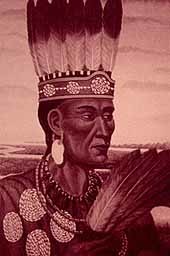 Powhatan 1545-1618
I recently received an advisory of a DNA match from my ancestry.com account that has brought me to a very exciting destination. This very famous Native American, the very same one we learned about in grade school, is my ancestor. I am excited, but want to verify all my results with more evidence. The DNA was from the Little family, and they brought me the information about all these Native American ancestors. I have not had a DNA test that has found any Native DNA. These results area combination of DNA, and record keeping (which can be faulty and has brought me to felonious conclusions in the past). I hope I can conclusively prove all the data, but in the meantime I am excited! It looks like my mother is descended from Pocahantas’ sister, Cleopatra.
Powhatan (born June 17, 1545; died April 1618), whose proper name was Wahunsenacawh (alternately spelled Wahunsenacah, Wahunsunacock or Wahunsonacock), was the paramount chief of Tsenacommacah, an alliance of Algonquian-speaking Virginia Indians in the Tidewater region of Virginia at the time English settlers landed at Jamestown in 1607.
Powhatan, alternately called “King” or “Chief” Powahatan by the English, led the main political and military power facing the early colonists, was probably the older brother of Opechancanough, who led attacks against the English in 1622 and 1644. He was the father of Pocahontas, who eventually converted to Christianity and married the English settler John Rolfe.
Captain John Smith described Powhatan as “…a tall well proportioned man… his head some what grey…. His age near 60; of a very able and hardy body to endure any labour. What he commandeth they dare not disobey in the least thing.”
 Powhatan’s Cloak in a museum at Oxford
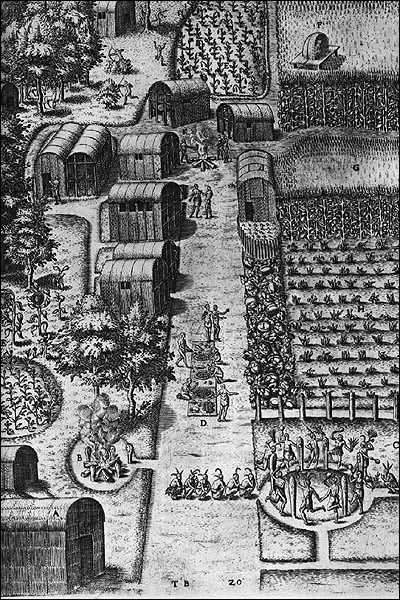 Powhatan Village called Towne of Secoton
Powhatan. The ruling chief and practically the founder of the Powhatan confederacy (q. v.) in Virginia at the period of the first English settlement. His proper name was Wahunsonacock, but he was commonly known as Powhatan from one of his- favorite residences at the falls of James r. (Richmond). According to Smith, of some 30 cognate tribes subject to his rule in 1607, all but six were his own conquests. At the time of the coming of the English, Powhatan is represented to have been about 60 years of age, of dignified bearing, and reserved and stern disposition. His first attitude toward the whites was friendly although suspicious, but he soon became embittered by the exactions of the newcomers. On the treacherous seizure of his favorite daughter, Pocahontas (q. v.), in 1613, he became openly hostile, but was happily converted for the time through her marriage to Rolfe. He died in 1618, leaving the succession to his brother, Opitchapan, who however was soon superseded by a younger brother, the noted Opechancanough.
Chief Wahunsonacock Powhatan (1547 – 1618)
14th great-grandfather
Princess Cleopatra Shawano Powhatan (1590 – 1680)
daughter of Chief Wahunsonacock Powhatan
Pride Chalakahatha Elizabeth (Cornstalk) Shawnee (1615 – 1679)
daughter of Princess Cleopatra Shawano Powhatan
Trader Tom Amatoya Carpenter Moytoy (1635 – 1693)
son of Pride Chalakahatha Elizabeth (Cornstalk) Shawnee
Quasty Woman (1650 – 1692)
daughter of Trader Tom Amatoya Carpenter Moytoy
Delaware Indian Fivekiller (1674 – 1741)
son of Quasty Woman
SOLOMON JOHN CHEROKEE KIMBOROUGH (1665 – 1720)
son of Delaware Indian Fivekiller
Mourning Kimbrough (1689 – 1756)
daughter of SOLOMON JOHN CHEROKEE KIMBOROUGH
Jane Jeanette Little (1713 – 1764)
daughter of Mourning Kimbrough
Andrew Armour (1740 – 1801)
son of Jane Jeanette Little
William Armor (1775 – 1852)
son of Andrew Armour
William Armer (1790 – 1837)
son of William Armor
Thomas Armer (1825 – 1900)
son of William Armer
Lucinda Jane Armer (1847 – 1939)
daughter of Thomas Armer
George Harvey Taylor (1884 – 1941)
son of Lucinda Jane Armer
Ruby Lee Taylor (1922 – 2008)
daughter of George Harvey Taylor
Pamela Morse
I am the daughter of Ruby Lee Taylor

Spotswood Headrights
My seventh great-grandfather came to Virginia in 1717 with a group of Lutheran immigrants. Their unscrupulous ship captain not only landed at the wrong port, but sold them into indentured servitude. Captain Andrew Tarbett had spent the passage given him by the Germans, then took them to Virginia rather than their promised destination, Pennsylvania. He sold them to Lt.Governor Alexander Spotswood.
Lieutenant Governor Alexander Spotswood’s lawsuits against his indentured servants. From 1723 through 1726, Spotswood claimed that several Germans had failed to carry out the terms of their “contract” with him. My ancestor was sued in 1924. He proved his importation in 1926 with his wife on the ship Scott. He patented land on June 24, 1926.
These emigrants left their villages in southern Germany (Baden and Württemberg) about 12 Jul 1717 enroute for Pennsylvania by way of London. Starvation took the lives of several of the passengers (probably 50 people perished, most of them children) who had been swindled by their captain who was retained in London. The ship held about 138 passengers and did not land in Pennsylvania but to Virginia where the passengers were sold as indentured servants to Governor Spotswood.
The base for this reconstructed list comes from:
Research by Zimmerman & Cerny has shown that several who were thought to have come to Virginia in 1719-1720 were actually more likely part of the 1717 group. The strongest evidence for this is the absence of any references to each of these families in Germany after 1716 and the fact that they would have left from others from the same town at that time.
Note: Hans is short for Johannes which is John in English
Below research provided courtesy of Tom Bowen:
“From “Before Germanna,” by Johni Cerni and Gary J. Zimmerman, No. 5,
January 1990, The Ancestry of the Sheible, Peck, Milker Smith and Holt Families:
“The Evangelical Lutheran minister [for Gemmingen, Baden] began a new set of parish registers in 1693, and the marriage entries of the Schmidt brothers are recorded therein:
married 21 January 1710 Hanns Michael Schmid, son of Michael Schmid, deceased, court official here, step-son of Alt [Old]
Hans Hecker, to Anna Margaretha, daughter of deceased Josoph Sauter, deceased courth official here.”
On 12 July 1717 the minister at Gemmingen listed in the parish death register the “parents, together with their children, [who] expect to move away from here, wanting to take ship to Pennsylvania, and there in the hardship of the wilderness better their piece of bread than they could here.” Included were:
Hans Michael Schmidt, age 28
wife Anna Margaretha, same age,
son Hans Michael, age 5 1/2
son Christopher, age 1/2
his in-laws.
Also listed was Matthäus Schmidt, age 25/30, wife Regina Catherina, same age, son Matthäus, age 3 1/2 and daughter Anna Margaretha, age 1/2.
They arrived in Virginia near Germanna in then Essex Co., now Culpeper Co., in late 1717 or early 1718 according to today’s calendar, being members of the so-called second Germanna Colony of 1717. The colony moved about 25 miles west to the Robinson River area of Spotsylvania Co. in 1725. This area became Orange Co. in 1734, Culpeper Co. in 1748, and Madison Co. in 1793.”
We have a copy of his will:
25 Feb. 1760, from Culpeper Co. Will Book A, p. 243:
In the name of God Amen, I John Michael Smith of the Parish of Brumfield in Culpeper County being old weak & helpless, but thanks be unto God of perfect Mind and Memory, & calling unto Mind the Mortality of my Body & knowing it is appointed for all men once to die, do make & ordain this my last will and Testament. That is to say principally & first of all I give & recommend my Soul into the Hands of Almighty God that gave it, & my Body I recommend to the Earth to be buried in decent Christian Burial nothing doubting that at the General Resurrection I shall receive the same again, by the mighty Power of God. and as touching such worldly Estate wherewith it hath pleased God to bless me in this Life, I do give demise & dispose of the same in the following manner & form, viz.
I do give bequeath & make over unto my dearly beloved only Son John Michael Smith Junior & his heirs forever all my Estate personal as well as real, that he may take the sole & full Possession of it, & all the Lands Goods & Chattels forever after my decease, reserving unto me only the Claim to my Estate as long as I live, & thereby I do revoke & disannull all Wills made before by me & I do acknowledge to be this my last Will & Testament never to be revoked
Signed Sealed & delivered Witness my Hand & Seal
in the presence of us
in the year of our Lord God Michael Schmid?
1760. 25th of February (signed in German)
Adam (AY) Jager,
Henry Ayler
At Court held for the County of Culpeper on Thursday the 19th day of February 1761 This last Will and Testament of John Michael Smith decd was exhibited to the Court by John Michael Smith his only son & heir and the Executor therein named and was proved by the oaths of Adam Yeager & Henry Aylor Witnesses thereto and ordered to be recorded and on the motion of the said Executor Certificate is granted him for obtaining a Probate thereof he giving Bond & Security according to Law and also took the oath of an Executor.
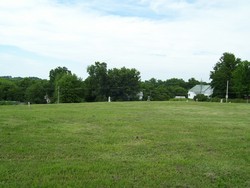
Sunbridge Cemetery
Also known as: City Cemetery, Saint Joseph City Cemetery
Saint Joseph, Buchanan County, Missouri, USA
My fifth great-grandfather was born in Virginia and died in Buchannan County, Missouri after a long and prosperous life. He was a pioneer who crashed with Daniel Boone in his youth.
Samuel Harris Vassar was the son of Abraham Vassar and his wife Rhoda. His birth place lay in the beautiful county of the Flat Creekwatershed of Amelia co. VA. He found his way to Kentucky. Later, after the death of his father in 1779, he learned he had been given 200 acres of the Flat Creek Plantation a a deed of gift that he see to the care of his mother and young sister Delilah after the father was dead.His elder sister Martha Catherine Deaton and her husband Levi lived onthe place until 1803. Levi Deaton had died in 1799 leaving Martha a widow.
On the return trip to Kentucky, Samuel and his mother and sister took refuge in Daniel Boone’s Fort. Later, in 1803, Rhoda Harris Vassar died in Clark Co, KY.
During the time he was in Kentucky, Samuel Harris Vassar acquired a200 acre farm on the south side of the Red River at its mouth and theKentucky river on its east bank. This spot had a workable salt desposit which he developed. In addition to the regular farm crops, hehad a water mill on Calloway Creek which ran along his southern line.
Samuel Harris Vassar met the daughter of Peter and Mary Ann Goossee, named for her mother and nicknamed “Polly”. Samuel was 38. However consent must be had from the father of the child to be married if the child was between the ages of 12 1/2 and 16. Thus, a bond was given as reguired: Clark Co KY; January 21, 1795; Samuel H Vassar to Polly Goossee, the father. Bondsman, Peter Goossee, JR. To this union were born 5 sons and 2 daughters.
In 1818, Simpson R, son of Samuel and Polly, went to Missouri territory as a fur trader for a St Louis based fur company. Upon returning to KY with his wife and new son, he told tales of the newland opening up. These stories led Samuel at the age of 61 to go to Howard Co, MO with his wife and 3 unmarried children. Another son, Samuel Jenkins, became an Indian Trader for the Chouteaus of St Louis. Elizabeth and Benjamin remained with their parents until their marriages in Clay co, MO.
About this time, in 1830, Mary “Polly” the mother died. She is buried near the north county line of Clay co in a graveyard with other Goosey family members. In 1835 Samuel married Cynthia (Simpson) Castile, the widow of Joseph Castile. Both Samuel and Cynthia were advanced in age. Samuel never returned to KY. He sold his holdings there by Power of Attorney. He and his son Benjamin operated a grist mill in Clinton Co, MO. At his death he held many notes. One of thesefor a few hundred dollars was on Joseph Robidoux, the founder of St Joseph MO. This note was never paid. He died 24 Oct 1846 and is buried in the NE corner of Sunbridge Cemetery in Buchanan Co, MO. A statementon file in the Buchanan Probate Papers records that he was “taken inhis 89th year”.
After the death of Samuel, Cynthia, his second wife, lived with a son by her first marriage. The 1850 census shows David Castile, age 36, born TN, to have a wife and 6 children and Cynthia Vassar living with this family. Castile Creek, which headed in the new county of DeKalb, MO and flowed through Clinton and Caly counties emptying eventually into a tributary of the Missouri River was named for Joseph Castile.
Samuel Harris VASSAR (1757 – 1846)
5th great-grandfather
Mary VESSOR (1801 – 1836)
daughter of Samuel Harris VASSAR
Margaret Mathews (1831 – 1867)
daughter of Mary VESSOR
Julia McConnell (1854 – 1879)
daughter of Margaret Mathews
Minnie M Smith (1872 – 1893)
daughter of Julia McConnell
Ernest Abner Morse (1890 – 1965)
son of Minnie M Smith
Richard Arden Morse (1920 – 2004)
son of Ernest Abner Morse
Pamela Morse
I am the daughter of Richard Arden Morse

flight of fancy
Her troubled mind had conjured up some frightening scenarios. She sat for hours wringing the hands that had once been so productive and accomplished. Her memory played cruel tricks on her as she tried to survive without her husband. Ernie had taken care of certain aspects of life that had always been a mystery to her. Although my grandparents ran a farm together, sharing the heavy work load, my grandmother was in the dark about the family finances. When she became a widow and could no longer stay alone at her farm it had been sold. Her life of relative freedom came to an end. She lived in institutions or at her children’s homes, never really settling. She missed independence even though she could barely manage daily tasks without a great deal of assistance. She disliked the feeling of being a houseguest, or even a child, of her son’s family. She had lost her matriarch status, and had to defer to her daughter-in-law. This life in suburban Pittsburgh was foreign, and cold. She rarely went out, and when she did she was fearful, even with her family. She lost her ability to relax. Anxiety was her only companion.
When the sun set she sat in the back yard in silence. This time to herself was spent every day engaging in bird watching. She had little sensitivity to human emotions, but was tuned into nature like a trance. She could feel the spirits of each bird soaring. Their playful flight brought a rush of feelings from her youth, from her most sorrowful, as well as her brightest times. She could sense that her own spirit was close to a threshold. She sometimes thought her spirit left her body and explored the sky above her for a while. As darkness fell the caregiver arrived to guide her into the building. Her lightness of being vanished as the door closed behind her. Perhaps tomorrow will be the day she finally takes off for eternity. She feels as if she has already spent an eternity here.

#writephoto
This fiction is written in response to this week’s photo prompt from Sue Vincent’s Echo. Join us each week to read, write, or submit your own take on the Thursday prompt.

London
Sarah Allerton was born in London in 1588, and died in Plymouth Colony in 1633. She arrived in the new world on the ship Anne with her third husband in 1632 after my 13th great-grandfather had sailed on the Mayflower then died shortly after arrival in the colony. Her brother Isaac was a signer of the Mayflower Compact as well, and assistant to Governor Bradford in America. Isaac later disgraced himself, moved to New Amsterdam, and became known as the first Yankee trader.
Sarah Allerton’s parents are not given but information is provided by unknown sources. Her parents would have been Edward Allerton, b. 1555 St. Dionis, Backchurch, London, England, died 1590 England, and Rose Davis, b. ca. 1559 in St. Peters, Corningshire, died June 1596 in England. Edward’s father was William Allerton, b. 1529. Sarah however certainly had at least two brothers. Isaac’s will also mentions a “brother Breuster”. The two siblings were:
1) Isaac Allerton, b. ca. 1586. He was one of the more famous of the Pilgrim Fathers. He was originally a tailor in London and was married in Leyden, the same day as his sister, 4 November 1611, to Mary Norris of Newbury, England, b. ca. 1588.
He came over on the Mayflower, with his wife and three children, and became First Assistant (1621 to ca. 1631) to Governor Bradford. Mary Norris died in childbirth, with a stillborn son, the first winter. She died 25 February 1620/1 on the Mayflower, while the first houses were still being built at Plymouth. In ca. 1626 he married Fear Brewster, b. 1606 at Scrooby, England , daughter of William and Mary Brewster, William being one of the most famous Pilgrims. Fear had arrived in Plymouth in July 1623, on the Anne, the same ship that brought Mary Priest and her two children.
Isaac was well known for his unscrupulous dealings with fellow Pilgrims and eventually left the colony in disgrace in the 1630’s when he lost the support of William Brewster. “A most enterprising man, he engaged in commercial pursuits at Marblehead and in Maine and later resided at New Amsterdam.” . He is often remembered as “the first Yankee trader”. Fear died in Plymouth before 12 December 1634. Isaac Allerton was probably married a third time to Joanna Swinnerton, before 1644, probably New Haven, CT. There were no known children from this marriage. He died insolvent between 1 and 12 February 1658/9 in New Haven, CT. Joanna was still living in 1684. Isaac’s children were (Sarah and Isaac were by his second wife):
Bartholomew, b. ca. 1612, in Leyden, Holland. Bartholomew returned to England. He first married Margaret _____ and then Sarah Fairfax, prob. in Rumbough, Suffolk, England. He died between 15 October 1658 and 19 February 1658/9, prob. at Bramfield, Suffolk, England. Four children are recorded.
Remember, b. ca. 1614 in Leyden. She m. Moses Maverick, before 6 May 1635 and died between 12 Sept. 1652 and 22 Oct. 1656. Moses lived in Lynn, Salem, and at Marblehead (all MA) in the time they were married. They had seven children, born at Lynn and Salem. Moses remarried in Boston to Eunice (Cole) Roberts by whom he had four children.
Mary, b. June 1616, m. Thomas Cushman, ca. 1636, in Plymouth, MA. Cushman came to Plymouth in 1621 on the Fortune. They had eight children. She died 28 November 1699, Plymouth, MA, the last survivor of those who came on the Mayflower. One of her grandchildren, Allerton Cushman, married in 1726 to Elizabeth Sampson, cousin of Benjamin Sprague.
Child, buried St. Peters, Leyden, 5 February 1620.
Stillborn son, b. 22 December 1620 on the Mayflower, Plymouth Harbor.
Sarah, b. ca. 1627 in Plymouth, died young before 1651.
Isaac Allerton, Jr., b. between 22 May 1627 and 1630, Plymouth, MA. He married first to Elizabeth _____, ca. 1652 (2 children) and then to Elizabeth Willoughby, a widow of Overzee and Colclough, ca. 1663, in Norfolk County, VA. Elizabeth was born in 1635 in England (12). They had three children, all born in Westmoreland Co, VA. Isaac became the first Plymouth student at Harvard (he graduated according to in 1650) and later went into business and made a fortune himself. He died Westmoreland Co., VA in 1702.
As is the case for Degory Priest, a General Society of Mayflower Descendents book is available on the first five generations of Isaac Allerton’s descendents. A somewhat earlier and shorter version, covering four generations, was published in 1996. Isaac Allerton has apparently a relatively small number of descendants compared to other Mayflower passengers, but is an ancestor to Presidents Zachary Taylor and Franklin D. Roosevelt (the latter also descended from Degory Priest through Sarah). The presidents are both thus our very remote (!) relatives: President Zachary Taylor (1784-1850), through Isaac Allerton Jr., was a 5th cousin to Mary (Scott) Wisdom; President Franklin D. Roosevelt (1882-1945), through Degory Priest, was an 8th cousin to Paul Graham.
2) Sarah Allerton, b. ca. 1588 at London . She was first married to John Vincent and then married to Degory Priest as noted above. Having received word of her husband’s death, she remarried on 13 November 1621 in Leyden, to Godbert Godbertson (name used in but also often called Cuthbert Cuthbertson). They arrived in July-August of 1623 on the Anne with their three children (two by Degory Priest). It is possible that there were two additional children with them by the first marriage of Godbertson (I think there is a reference to five children that arrived with them in and see also mention of three Cuthbertson below). Francis Sprague, another of my ancestors, was also a passenger. Godbert (ca. 1590-633), a Dutch Walloon, was a hat-maker in Leyden. He had been married previously in 1617 to Elizabeth Kendall. He became a “purchaser”, i.e., a shareholder in the Pilgrim Company when it was formed in 1626. He died seven years later, in Plymouth, of “infectious fever”. She died in Plymouth before 24 October 1633. On 11 November 1633 their son-in-law Phineas Pratt was appointed “to take possession of the personal property of Cuthbert Cuthbertson and his wife Sarah”.

Mayflower Compact
My 13th great-grandfather was a hatter who sailed to America on the Mayflower, but did not survive the first winter. His wife and children came to Plymouth in 1623 to take over his allotment in the colony.
Degory Priest was one of the Pilgrim passengers on the Mayflower in 1620. His wife, Sarah Allerton, and children Mary and Sarah stayed behind in Holland in Leiden where some of the Pilgrims had moved to escape religious persecution in England. He died during that first desperate winter in Plymouth. His wife and children came to North America on the Anne in 1623. At least one of his grandchildren was an early resident of Nantucket Island. Alternate spellings of his name are “Gregory”, “Degorie”, or “Digorie” Priest. Sarah Allerton’s brother Isaac Allerton and his family were also passengers on the Mayflower.
Degory and Sarah have many notable descendants including Franklin Delano Roosevelt, Maria Mitchell, Pete Seeger, Richard Gere, Dick Van Dyke, and Orson Scott Card.
Degory PRIEST (1579 – 1621)
13th great-grandfather
Mary Priest (1613 – 1689)
daughter of Degory PRIEST
Daniel Pratt (1640 – 1680)
son of Mary Priest
Henry Pratt (1658 – 1745)
son of Daniel Pratt
Esther Pratt (1680 – 1740)
daughter of Henry Pratt
Deborah Baynard (1720 – 1791)
daughter of Esther Pratt
Mary Horney (1741 – 1775)
daughter of Deborah Baynard
Esther Harris (1764 – 1838)
daughter of Mary Horney
John H Wright (1803 – 1850)
son of Esther Harris
Mary Wright (1816 – 1873)
daughter of John H Wright
Emiline P Nicholls (1837 – )
daughter of Mary Wright
Harriet Peterson (1856 – 1933)
daughter of Emiline P Nicholls
Sarah Helena Byrne (1878 – 1962)
daughter of Harriet Peterson
Olga Fern Scott (1897 – 1968)
daughter of Sarah Helena Byrne
Richard Arden Morse (1920 – 2004)
son of Olga Fern Scott
Pamela Morse
I am the daughter of Richard Arden Morse
Degory Priest deposed that he was 40 years old in a document signed in Leiden in April 1619; this would place his birth at about 1579 in England. On 4 November 1611, he was married to Sarah (Allerton) Vincent, the widow of John Vincent, and the sister of Mayflower passenger Isaac Allerton; Isaac Allerton was married to his wife Mary Norris on the same date.
It has been suggested that Degory Priest of the Mayflower may have been the Degorius Prust, baptized 11 August 1582 in Hartland, Devon, England, the son of Peter Prust. However, given that the baptism appears to be about 3 years too late, and the fact that none of the Leiden Separatists are known to have come from Devonshire, I doubt this baptism belongs to the Mayflower passenger. Degory Priest was one of the earliest to have arrived in Leiden, so it is more reasonable to suspect he is from the Nottinghamshire/Yorkshire region, the Sandwich/Canterbury region, the London/Middlesex region, or the Norfolk region: all of the early Separatists in Leiden appear to have come from one of these centers.
Degory and wife Sarah had two children, Mary and Sarah. Degory came alone on the Mayflower, planning to bring wife and children later after the colony was better established. His death the first winter ended those plans. His wife remarried to Godbert Godbertson in Leiden, and they had a son Samuel together. Godbert, his wife Sarah, their son Samuel, and his step-children Mary and Sarah Priest all came on the ship Anne to Plymouth in 1623.
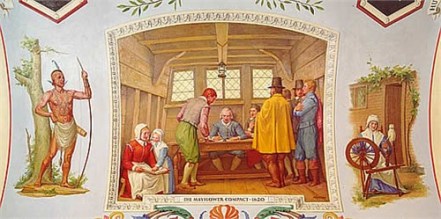
Mayflower Compact

Byzantine Empire
John Komnenos (Greek: Ἰωάννης Κομνηνός; ca. 1015 – 12 July 1067) was a Byzantine aristocrat and military leader. The younger brother of Emperor Isaac I Komnenos, he served as Domestic of the Schools during Isaac’s brief reign (1057–59). When Isaac I abdicated, Constantine X Doukas became emperor and John withdrew from public life until his death in 1067. Through his son Alexios I Komnenos, who became emperor in 1081, he was the progenitor of the Komnenian dynasty that ruled the Byzantine Empire from 1081 until 1185, and the Empire of Trebizond from 1204 until 1461.
Life.
John Komnenos was born ca. 1015 as the younger son of the patrikios Manuel Erotikos Komnenos, a senior military commander in the late reign of Basil II (ruled 976–1025). He is first mentioned in 1057, the year his elder brother Isaac I Komnenos, at the head of a group of generals, rebelled against Michael VI and forced him off the throne. At the time of the revolt, John held the post of doux, but after his brother’s victory, he was raised to the rank of kouropalates and appointed as Domestic of the Schools of the West.
Nothing is known of John’s activities during his brother’s reign, although Nikephoros Bryennios the Younger, who married John’s granddaughter Anna Komnene, says that in his capacity as Domestic of the West he left his (unspecified) acts as an “immortal monument” to the people of the Balkan provinces.
Isaac’s reign was cut short by his clash with the powerful Patriarch of Constantinople,Michael Keroularios, who had been instrumental in securing Michael VI’s abdication, and the powerful civil aristocracy of the capital. Keroularios and his supporters led the opposition against Isaac’s stringent economizing policies, forcing him to resign on 22 November 1059, after which he withdrew to the Stoudios Monastery.
The crown then passed to Constantine X Doukas (r. 1059–67), although Bryennios asserts that it was first offered to John, who refused it, despite the pressure of his wife, Anna Dalassene, to accept. According to the historian Konstantinos Varzos, however, this version is suspect, and may well be a post-fact attempt at legitimizing the eventual usurpation of the throne by John’s son, Alexios I Komnenos (r. 1081–1118).
John is not mentioned in the sources during the reign of Constantine X, perhaps indicating, according to Konstantinos Varzos, that he was in imperial disfavour, despite Bryennios’ assertion that both he and his brother remained much honoured by the new emperor.The late 12th-century typikon of the Monastery of Christ Philanthropos, founded by Alexios I’s wife Irene Doukaina, is the only source to record that John Komnenos retired to a monastery, probably at the same time as his wife, Anna Dalassene. He died as a monk on 12 July 1067.
Family..John Komnenos married Anna Dalassene, the daughter of Alexios Charon, most likely in 1044. Anna, born ca. 1028, long outlived her husband and after his death ran the family as its undisputed matriarch. Anna became involved in conspiracies against the Doukas family, whom she never forgave for taking the throne in 1059. Later she also played a major role in the successful overthrow of Nikephoros III Botaneiates (r. 1078–81) and the rise of her son Alexios to the throne. After that, and for about fifteen years, she served as the virtual co-ruler of the empire along her son. She then retired to a monastery, where she died in 1100 or 1102.
With Anna, John had eight children, five boys and three girls:
IOANNES Komnenos, son of MANUEL Erotikos Komnenos & his wife — ([1015]-12 Jul 1067). Nikephoros Bryennios names “maiori natu Isaacio…iunior Ioannes” as the two sons of “Comneni Manuelis” . His parentage is confirmed by the Alexeiad which describes Emperor Isaakios Komnenos as brother-in-law of Anna Dalassena, an earlier passage naming him Ioannes [43]. Patrikios. Skylitzes records that Emperor Isaakios created “Joannem fratrem et Catacalon Combustum curopalatas” and “fratrem suum magnum domesticum” after his accession, in 1057 . His brother abdicated in his favour 25 Dec 1059, but Ioannes refused the throne. He became a monk as IOANNES. The list of obituaries of Empress Eirene Doukas’s family records the death “12 Jul, monk John father of Emperor”.
m ([1042]) ANNA Dalassena, daughter of ALEXIOS Kharon Prefect of Italy & his wife — Dalassena (-1 Nov/27 Apr 1100/01). Nikephoros Bryennios records the marriage of “Ioanni” and “filia Charonis Alexii…Anna”, recording that her mother was “genus a Dalassenis”. The Alexeiad names “Anna Dalassena, the mother of the Komneni” when recording that she arranged the marriage of “the grandson of Botaneiates and the daughter of Manuel her eldest son”. Despoina 1048/57. Regent of Byzantium 1081 and 1094-1095. She became a nun at Pantopopte convent which she founded. The list of obituaries of Empress Eirene Doukas’s family records the death “1 Nov, Anna, mother of the Emperor”.
Ioannes Komnenos & his wife had eight children:

weeping window
The tower had been built in the time of the beheadings
Torture and murder were the order of the day
They wiped out knights and murdered the queens
Who did not please the monarch by giving him a male heir
Some of my ancestors lost their heads, fortunes, and means
As players in the center of the Tudor dynasty reign of terror
Some spent their last night in confinement writing poetry
To leave a written legacy to the future subjects of the crown
The sorrow and the suffering of every tortured soul is evident
The stones are carved with the names of the doomed who have past
While the window weeps tears of the ghosts who haunt the present
With their unresolved memories of cruel and heartless treatment
Looking from this point of view we can see the harm done by violence
#writephoto
This poem is in response to this week’s photo prompt from Sue Vincent’s Echo. Join writers from around the globe each week to read, comment, or write your own story for #writephoto.
The practice of trash talking with personal insults rather than appeal to reason has dominated our political season. This kind of logic is known as argumentum ad hominem, or ad hominem for short. The personal attack is intended to discredit any statement made by the opponent. It is a logical red herring designed to distract from the business at hand. It is the full time occupation of the Congress of the United States.
Ad hominem tu quoque is to use the “I know you are but what am I?” line of reasoning. It translates to “You do that too.” There is a big difference between a persuasive argument and a statement of fact. In order to reach valid conclusions it is important to distinguish guilt by association or circumstance from cold, hard, empirical facts. All’s fair in marketing and politics. The emotional ad hominem is used freely and frequently to convince people to vote or buy something. We are all being manipulated, like it or not. In order to be an independent thinker one must consider empirical facts at face value, without prejudice. Conversely, if it is our goal to hoodwink or control our audience it appears that trash talking works very well. Next time you find yourself in an argument notice how long it takes for this tactic to be used. It is a very common weapon, gentle reader. Don’t be fooled by association fallacies. They are enormously popular.

Ad hominem tu quoque
 mermaidcamp