mermaidcamp
Keeping current in wellness, in and out of the water
You can scroll the shelf using ← and → keys
You can scroll the shelf using ← and → keys
Angels were common before Jesus was born. There were happy spirits protecting humans all over the pre-Christian world. Some people today debate the powers and presence attributed to angels because we know them through story and legend. Their existence is a rhetorical belief, but there has been no empirical evidence that proves they are here with us. December is a very popular time to display angels and even dress up and portray them in live nativity scenes. In the darkest month of the Northern Hemisphere’s year, angels usher in the light. They often wear white, have white wings and a bright body halo. They are messengers, beings of light, that assist humans on both sides of the grave. They intercede for the benefit of humans.
December is the right time to settle into a hot herbal bath, light a candle, and put out the do not disturb sign for the human element. Around the winter solstice have a conversation with angels. If this is easy and natural for you, pray and get in touch with the angelic realm. If you need some help getting used to the idea of being surrounded by beings of light, do some meditating. Soak in the aromas of your scented tub, breathing deeply and leave thought behind. Have a conversation, out loud or in your mind, with the spirit guardians of your life. Imagining the presence of another dimension, allow yourself to say what is in your heart and ask for help that you know you need. You can do it with eyes open our closed. Using this method is a formula to make wishes come true. Belief in our angels is belief in supernatural powers at work on our behalf. Speaking to angels has been done by all kinds of people without shame or embarrassment for a very long time. The time is right to tell your deepest wishes to the angels, Gentle Readers.
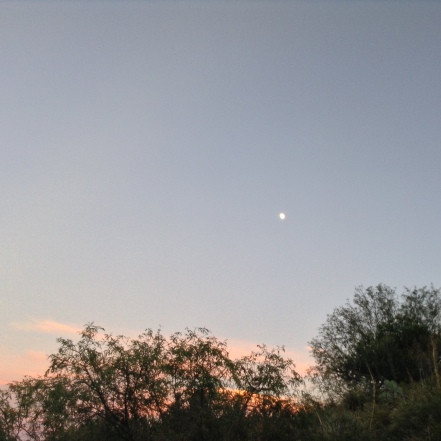
Clarkdale, AZ
I bought the audio book Falling Upward at the suggestion of a fellow student at a conference I attended last June. I encountered the contemplatives for the first time, and had a lot to learn from them. James Finley guided us for a meaningful and educational weekend. I owned an audio book by Dr Finley and Carolyn Myss covering the subject I have already heard at the conference, transcending trauma. This complex idea deserved a review, so on my recent car trip I listed to the trauma book to deepen my understanding. On my trip back home I decided to hear Richard Rohr read his own book, Falling Upward. I started from Clarkdale before dawn and arrived in Tucson about 10 in the morning. Most of the drive was really scenic, but even Phoenix traffic was bearable because I was enjoying the book so thoroughly. I have one disc still to hear, but I am fully ready to recommend this book to anyone, especially to those over 40. This is another way to look at retirement planning, from a spiritual perspective.
Falling Upward explains spirituality as it pertains to the two halves of life. In other words, humans are involved in the giant birth/death/recycle action of the universal field. There is a time for building up, and a very appropriate time for breaking down. All of nature does this constantly. Although Mr Rohr is a Franciscan and a Catholic priest, his point of view is not all presented from a theological stance. He knows history very well and uses his experience in the study of initiation rites of native people around the world to draw large conclusions. His conviction is that humans are capable of taking a grand excursion of the soul. He reminds us that all saints and holy figures leave home on a big crazy journey, only to return to home. The journey represents necessary suffering that teaches the mystery beyond the suffering. In the second half of life this death of the perceived self, or being in the world but not of it, can lead to enlightenment. In our culture many of us cling to the structures we built in our youth as if there is nothing greater or beyond our own creative control. Falling Upward involves letting go to the point that previous reality fades from view as we float to our intended home in eternal bliss. Sound kooky??? Well, it is. All the saints and prophets were considered to be out of their minds. Many were killed. Before the truth sets you free it generally makes you appear to be crazy.
I like to hear authors read their own books to me. I feel like it becomes more personal. This one is very special because I had never heard of Richard Rohr before his fan told me about him last June. Now I am a huge fan too. I invite you to listen, gentle reader. I could make a big difference in the end.

Falling Upward
The Verde Valley north of Phoenix has a very interesting history. I had not visited the area for years and had read about the popular wine trail as a destination. I decided to spend a night in the restored historic section of Cottonwood. It is charming and very laid back. Folks are friendly, and most of the merchandise I saw on offer was of high quality. There are several antique dealers with very large inventories of interesting items. There are excellent restaurants and plenty of wine bars for tasting or evening entertainment. The wineries are doing good business here selling mostly limited small batch varieties. I did a tasting at the Burning Tree Cellars that I enjoyed. I liked all of the reds I tried, to my surprise. The Arizona wine industry has vastly improved the quality of their products in recent years. Some of the Burning Tree wines are made from California grapes, but made and bottled in Camp Verde, AZ. Arizona can be proud of our wine now. It has come a long way, baby. The walkable downtown makes tasting here a breeze. There are four upscale wineries located in a two block area, all very popular.
I don’t drink much wine these days, but am always immersed in history. I like to learn everything I can about places I visit. Knowing what happened in the past brings the place to life for me. I was unaware that Cottonwood had such a famous and checkered past. This tiny town was the bootlegging capitol of the state in the 1920s. There were tunnel systems below the streets leading from one storage place to others. The typical establishment had a pool hall, a barber shop, or another small business in the front and liquor sales in the back of the building. The tunnels were connected to homes and shops, as well as to automotive garages. Cottonwood bootleggers were supercharging cars and filling them with liquor to transport out of the area. It is said the garages had two tanks on the street out front, one with gasoline and another with hootch. Al Capone was once held in the local jail and there is a carving of his name that still remains. A still blew up and caused a very large fire that destroyed many wooden buildings in 1925. I learned all this and more when I took a short walking tour with Karen Leff, Cottonwood businesswoman and enthusiast.
I entered the lobby of the Cottonwood Hotel and found Karen, who is the owner, at the reception desk. She has made a study of the town’s history by questioning old timers who remember, and looking up documents and newspapers from the past. Her knowledge is extensive. She shares it by leading tours for interested groups by organizing Custom Cultural Heritage Tours. It was my lucky day because she had a short window of time to give me a quick version of her walking tour. I had a wonderful time touring some of the rooms in her hotel before we walked around to see the places the bootleggers made famous. Mae West did stay at the hotel, and a charming suite dedicated to her memory is one of the choices for accommodation. The small former rooms have been updated and expanded for modern taste. The balcony is a treat because it gives a full view of Main Street below. The view came in handy for a group of bank robbers who checked in. I fully enjoyed my time learning about history and some present day ghost stories as well. If you are in the area I fully recommend one of the tours Karen offers. She is in love with her town and it shows. You will get in touch with the spirit of the past by looking around historic Cottonwood. Karen added greatly to my appreciation of the town.




I am lucky to have found, right in my neighborhood, a Chi Nei Tsang practitioner of great talent and ability. Her name is Desiree Maultsby and her practice is at Rooted Massage Therapy in Tucson. I wanted to address inflammation in my organs that was discovered at my thermography session. Obviously my lifestyle and diet are under my own control and can be improved. To help me better understand and improve the chi flow in my internal organs I wanted to use Chi Nei Tsang because I know it is effective.
Taoist practices are simple, yet complicated. There is order, but there is a great deal of mystery as well. Chi, universal energy, moves through the body and around it. The way we direct chi, and allow it to flow will determine the state of our health and our mood. The most basic way to think about chi in the abdomen is to bring to mind the proverbial knot in the stomach. Stress, improper habits and diet, and other factors can constrict and block the flow of energy and circulation in the internal organs. Deep breathing is the best way to relieve these constrictions and restore good function to all the organs. With the help of a practitioner a chi nei tsang session can bring dramatic and instant results in healing congestion in the abdomen. There are simple practices of self massage and breathing techniques that can be done between sessions to greatly enhance the results. This is, for practical purposes, a meditation technique. Your awareness will grow from this practice, of both the power of your breath, and the importance of freeing up energy in the organs.
Physical issues that bring pain to the abdomen may very well be related to trauma held in the gut. Breathing techniques and sound vibrations have healing effects on the specific organs. Your practitioner will guide you by giving you meditative instruction as well as reminders about breath. By working very closely together in this way deep psychic wounds you don’t even know you have can be healed. The treatment is not at all like a Swedish massage, which I really like for the pleasurable feeling at the time. This is a full on transformational pursuit. If you want to chat or stay on the surface, then chi nei tsang is not for you. You remain clothed and the treatment takes place on a mat on the floor, to make the best use of gravity. I am very impressed with the progress my body has made in just three sessions with Desiree. I recommend her work to anyone interested in making profound changes. She provides plenty of supplemental information for those who want to do their homework.




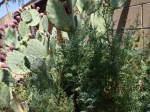
When the Pope sprinkles holy water he dips it in a branch of rue. Ruta graveolens is used medicinally as well as ceremonially. In ancient Rome there were celebratory foods prepared with rue. It is poisonous in large amounts and should not be consumed by pregnant women at all. There is a homeopathic remedy that is very popular made with this plant. Mexican folk medicine prescribes leaves of the plant stuck directly into the ear to cure an earache. In gardening it is prized for its ability to repel insects from the area where it grows, making it a very good companion. I grow it at the back of my garden by the gate because it is a protector plant. It repels any unwanted attention, human, insect, or otherworldly.
The prophet Mohammed blessed this herb and none other. Early Christians used it to exorcise evil spirits. During the Middle Ages it was hung in the doorway to repel evil, the plague, and witches. Italians had a custom of adorning a silver amulet shaped like the top of rue plant, a cimaruta, with symbols of fertility. This magical charm was used to protect the user against the evil eye. Medicinal uses as well as magical ones have been recorded for centuries, but the way I like to use it is in the bath. Make a sachet of rue and create a strong tea in the bathtub by brewing in very hot water for 10 minutes or so before adding water to hit the bath temperature you desire. To add an extra helping of magic to this bath I spread honey on my face and leave it on while I soak in the tub. After rinsing the face feels very soft and the entire body, as well as the aura, is clean and clear. These baths are great before a meditation session or a creative project. Clearing and protecting are positive ways to influence your moods, your focus, and your ability to rest and relax. If you need protection from evil, or just from too much stress, try a rue bath.
“Even pudding needs a theme.”- Winston Churchill. He could not have ben more insightful. Americans often use freedom as a theme for national celebrations. We repeat themes in our lives without awareness, but how would it make a difference if we embraced themes? Leonardo da Vinci pioneered mind mapping by drawing similarities between seemingly unrelated things. His essential belief in Connessione broadened his thinking and increased his creativity. He took notes constantly, drew pictures and diagrams that we are lucky enough to be able to see today. His notebooks are full of connections, discovery and contemplations.
“every part is disposed to unite with the whole, that it may thereby escape from its own incompleteness”-Leonardo da Vinci. If we think in terms of unification, or connectedness it is obvious that no part of life exists by itself, on its own, with no assistance. Our social connections are different from our commercial connections, and our survival connections are a different group. We rely on systems, nature, people, and cultural beliefs to keep our lives running. By taking a theme for a day we can start to see how connections are at least as important as single relationships. Every relationship touches other relationships, and so it goes. Within the personality of each person there may be dynamic tension or power struggles daily. There are themes within those dramas too. Pick one and observe it for a day, or a week.
Choosing to observe sabotage might reveal deep meaning. We certainly sabotage others and are sabotaged by others. It is also true that we sabotage ourselves and pretend others have done it. Drawing a timeline of the history of self sabotage can be interesting, but why not look at this phenomena in real-time? Check out daily habits that dilute health, happiness or finances. The theme of saboteur is well-known in fiction because everyone has this common issue in real life. If you take time to observe your inner saboteur at work notice how it is connected to those who seem to sabotage you from the outside. Are they in secret alliance? How do they know your weaknesses so well? Are you in cahoots? What are the themes your inner and outer saboteurs use to stay connected to you?
Authority issues plague many of us. I am highly suspicious of all authority. There are a few instances that make the exception to the rule, but generally I think that power is a reason to investigate the motives of someone. My own upbringing has a lot to do with the issues I have today, since I grew up with quite a bit of sexism and some rigid nonsensical rules. There was violent insistence on the rules and on the concept that we were a happy family. I don’t think my parents were very happy, and I know I wasn’t pleased with my living conditions during childhood. This social mask imposed to hide the true situation included a strong dress code and many other elements designed to display perfection. I always felt repressed and restrained in various ways. When I was out of my parents’ world I never sought out any status symbols or social signs of belonging. I preferred to be a pleasure-seeking liberated person without the need for social approval. I respected no authority figures of any kind. As I look at it today I see an extreme reaction to rules and regulations, as well as to many institutions.
Trauma lives on in the feelings, thoughts, senses, and memories of everyone. It would be impossible to go through life without any shocking disruptive events. The way we process them depends on our circumstances at the time. If trauma is induced by parent or someone we must depend on for survival we may disassociate from reality in order to survive. Later the trauma continues in the body and the emotions if the appropriate anger is not found and processed for the serious betrayals of the past. Forgiveness is a part of the healing process, but it is not healthy to forgive without recognizing the wrongs and the disrespect we endured in childhood and early adulthood. Our personalities are mostly formed by the time we are 30, although we can have transformative events after that time also. If you draw a timeline of your life and include all the major emotional and physical traumas you have experienced you notice how your current reactive self was formed. We continue to react to the unresolved past, often by rebelling. To heal the trauma and stop the need to react we need to return to the times of greatest stress and damage, acknowledge the ways we were hurt, and come to the rescue of the helpless victim in the story, ourselves. Notice this situation may have been reconstructed a hundred different ways in life. To clean the slate and transform that trauma into understanding we need to look at the truth and take it into our consciousness. To stop repeating patterns that we continue out of reaction to the past we must examine the source and resolve to treat ourselves with confidence and love. We must rebel against unfair and unjust treatment both now and in the past in order to free ourselves from the damage it does.

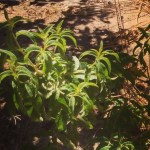
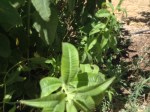
My favorite herb in the garden is lemon verbena. I like to make tea with it all the time, but there are many other uses for this luscious herb. As a bath herb it brightens and refreshes the body and mind. The fragrance is used extensively in perfumery for the lemony zest it adds. In cooking it creates a lemon taste with no bitterness or aftertaste. It can be added to baked goods, salad dressings, drinks, sauces, and fruit salads to brighten a dish. Simple syrup of lemon verbena is useful for many drink and popsicle recipes with or without alcohol. Mixed with citrus fruit it becomes a big flavor enhancer. Rice pilaf, carrot cake, gazpacho, and other dishes can benefit from a pinch of this delicious herb. Store it in a glass jar in the dark to preserve freshness.
I love herbal bathing as retreat and meditative practice. The first one I tried about 20 years ago was rosemary bath. I brewed a strong tea of rosemary and added it to my bath. This method works well, as does the brewing of the tea in the tub by running hot water over a sachet, allowing it to steep, then filling the tub. When you choose the herbs and when you enter the water you can make the entire process a mindfulness experience. Drinking tea made with the same herbs will enhance the aromatic sensory intake. I am planning to take some baths this week with matching beverages and bath herbs. If you have a favorite herb you can try this at home. If the bath is taking place at the cocktail hour I think it is suitable to include the herb in a tasty concoction from the bar that aligns with the indented purposes.
These are ideas for you to design your very own aroma world to enliven your senses and change your mood. There is an art to choosing herbs for the desired mood, but there are very few side effects that inhibit experimentation. If you like an herb you can research it fully or simply determine that it is not toxic, then try it in a bath. The effectiveness may surprise you. When all the pores of your skin are soaking in the active ingredients the results are swift. Bringing to the mind’s eye the results you want to see is the strongest link that brings this practice into the meditational realm. By creating sensory stimulation and awareness at once we step out of our normal situation and into synesthsia of our own design. We use the aroma as an anchor for our meditation. At the least you can enjoy smelling and feeling bit better from the herbal bath. At the most it can be a rebirth and transformation.
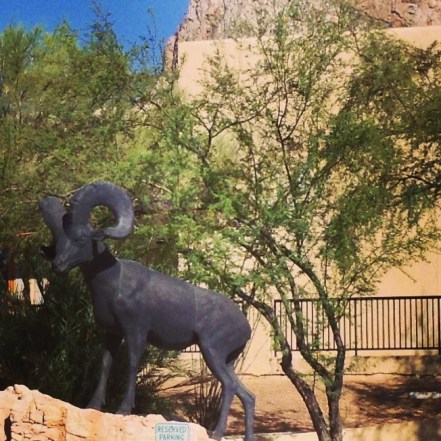
Hilton Big Horn
I was privileged to spend the weekend with a group of about 170 people who came from all over the country to a conference on the Spirituality of Healing taught by James Finley. The group included many mental health professionals and teachers who were earning credits in continuing education in their professions. Many were members of churches with meditation/prayer groups. I was new to the genre, but felt right at home in he congenial student group. I saw an ad for this in a local paper and followed up with some research into James Finley. I ordered a couple of audio books he wrote and signed up for the conference. The resort where it was held is where the Dalai Lama taught in September of 1993, so I have very fond memories of the place. The Hilton El Conquistador was turned into the the El Comtemplador for a couple of days. The hotel is dog friendly so my partner and dog could come along for a staycation away from home. It was a remarkable experience. I did not photograph the sessions or the participants because I did not want to distract myself from the teaching. I am happy I made that decision because those photos would add little to this post.
Dr. Finley is very generous with free resources on his website, His teaching in person is designed to pack the time spent together with dense, rich, profound, yet simplistic and practical ideas. His background allows him to use language of psychotherapy as well as religious language to explain his concepts. He is a brilliant speaker, but the style of presenting really enhances the message he brings. First of all, he establishes silence in the hall where the conference takes place. There is time and space outside the room to talk. On the second day the group broke bad and got noisy, so he asked that we reestablish the silence in the room. He uses humor to make his point many times, and refers to patient/clinician dialogs to shed light with specific examples. In his opening remarks he lets the audience know that trauma is a difficult and personal subject to address. He encouraged each person to leave the room, move around, take breaks as needed. He repeated several times, “To thine own self be true.” This was good for me when I decided the chairs were not sized so well for me, so I took up a spot against the wall where I had support from the wall for sitting or could even lie down. The sessions covered in sequence his Seven Steps of Spiritual Healing, which logically build upon the preceding steps. He speaks for a little over an hour to cover the material and then a 15-20 minute discussion is opened with the students. A short break for everyone is followed by the next lecture. The time is very well ordered and managed to the greatest advantage of the students. I must say the staff at the resort could not have been more pleasant and helpful, which was icing on the very tasty cake.
He shows the highest regard for the integrity of the students in his assignment of homework. He gave us several exercises to do on our own that will require a great deal of time and consideration, and then moved on to his core curriculum. If you practice you reap the benefits of practice. If you don’t, you don’t. Dr. Finley drives this point home in dramatic and impressive ways in his teaching. Not only is the task of enlightenment or healing our own responsibility, but we are doing it as a microcosm of all that is. We can only put ourselves in the position of least resistance for our desired outcome, and then let go. Deep meaning, philosophy, poetry, art and love are contained in each precious moment, available to us, and being created by us. We have all heard such statements somewhere in our past, and may believe them. What Dr. Finley offers is a system, a practice, a devotional idea to stabilize the consciousness in a state of pure love. It requires diligence and patience. He ended by giving us homework for seven years. It was the perfect wrap up for this conference. He showed how to use lexia divina, discursive meditation, and practice to move into and through the seven steps. He assigned us a step each week for seven weeks, then do that seven times (49 weeks) after a short break we were to take it up again from the beginning..seven steps, one step a week , repeated 7 times. Of course, after a break we are to start at the beginning, until we have done this practice for 7 years. I am sure some kind of heavy duty breakthrough would have to take place if we were all to do our homework. I love his optimism in assigning it. If you have a chance to study with these contemplatives, take advantage of it.

palo verde
The options we have for communication now boggle the mind. Some minds seem to be desperately boggled by what it takes to tell a story or get a message out to the world today. It is easier than ever because of all the free platforms we can use. It is harder than ever to reach individuals because the competition has grown to include just about everyone on earth. Our message must be not only short and sweet, but must also strike a universal chord. Leonardo da Vinci, especially toward the end of his life, often wrote about thinking in reverse: “Consider first the end.” and “Think well to the end.” were examples of his frequent statements on this subject. Leonardo left us with designs for flying machines and engineering that had not yet been proven when he died. His legacy is his art, certainly. He also left us a very strong and lasting gift of his philosophy. His practice of connessione refined his sense of mysticism and wholeness. He sought and found deep connection with all creation that inspired his work.
If you feel connected in a big way, or to a power larger than your own, confidence and ease are natural. On the other hand, if you feel disconnected from something greater it is possible to entirely loose touch with a realistic self image. We do not hold onto the same ideas or ideals for our entire life. The concept of connection may replace true connection, or maybe we always felt like we were separate and drifting. Now we can substitute chat/tweet/youtube views for personal relationships. The illusion that these clicks and likes make us part of a clubby group might just be the ruin of true connecting. Take a look at your physical worldly connections (so to speak) and how they relate or substitute for spiritual contact. I don’t think you need to join a religion or go to a certain building to make contemplation and meditation a part of your own practice. I feel connected to spirit whenever I:
This list is only a partial, and ever changing accounting of my own ways to notice connessione, or systems. Once you start to think about it you find that everything does depend on everything else, and we are all connected. If you feel distracted and want to center your thoughts, remember all the ways the universe has collaborated to create you and keep you alive. The systems that create us also sustain us.

aloe
 mermaidcamp