mermaidcamp
Keeping current in wellness, in and out of the water
You can scroll the shelf using ← and → keys
You can scroll the shelf using ← and → keys

reflection in my pool
Summer ends with monsoon season here in Tucson. The humidity builds and storms bless the desert with rain in July and August. September can go either way, but normally it is dry, and just a little cooler. I do love our hot weather and spend time chilling in the pool to stay cool. I wear protective clothing, hats and sunscreen when I am outdoors. Recently my dermatology exam revealed a couple of spots worth of further testing. I had two biopsies taken, one from my shoulder, and another from my forehead. The results have not yet returned, but the physician’s assistant was certain that I am heading for surgery soon for both of them. This is the first year I am glad to see the hours of sunlight receding.
I am freaked out by the idea of cancer growing my skin, but am very happy that I can take care of them now before they become serious. A friend from the beach in California had a similar experience recently, but her medical doctor had to be convinced to examine her spots more carefully. She had to ask for a second opinion, and then was correctly diagnosed. (scary) Dermatologists can recognize the potential problems based on their extensive experience and training. The dot that will be removed from my forehead is practically invisible. It shows itself as a tiny red blotch, no roughness. The spot on my shoulder is a little rough to the touch, but I did not suspect it was cancer. Neither of these seemed like anything to me.
You may guess where this story is going, gentle reader. Sunscreen and hats are no guarantee against damage. We do owe it to our skin to be careful with exposure and use products to guard against damage, but the best defense is regular consultation with your dermatologist. With the expertise they possess and the techniques available now your outcome is likely to be good if you stay on top of your visits and exams. I am lucky my doctor, Dr Hu, at Specialists in Dermatology is located very near my home. I have spoken to a friend who had mohs surgery from Dr Hu for a spot on her nose. She is very grateful also to have nipped it in the bud. In both of our cases the early diagnosis when few apparent signs of danger were obvious to the untrained eye has made a big difference. No matter where you live, plan to visit the dermatology office on a regular basis. The face you save may be your own.

Tucson Sun

Pam and the Fam on the farm
I study my ancestry and family history. This fascinating subject consumes as much of my time as I allot to it. I have spent six years on Ancestry.com working on my tree. I am more skeptical now than I was in the beginning because I have been burned by specious data. It is painful to discover an error in one’s research, yet it is better to know sooner than later. I once had a magical surprise experience in Rhode Island at a very special private family home from the 1600’s. I was treated to a tour of the home and grounds since I announced that I was a Carr descendent. I was given instructions to find the family graves by my long-lost “cousin” who still lives on the property. I was in heaven. It turns out I was also delusional about my connection to that family because I had made a mistake a couple of generations earlier in my research. I discovered this error after I had returned home from my trip, and had to laugh about it. I also had to start again to retrace the lineage. That correction was easy because I had some good documentation to verify the facts. Other problems I have discovered or had pointed out to me have left me with a dead-end when I removed the phantom limb.
The odd phantom feeling after chopping off limbs and branches is caused my the attachment formed while studying them. There are several very common names in my tree including Scott. When I began my sturdy I started with notes written by my maternal great-grandmother about her knowledge of the family. She stated that my 2nd great-grandfather, Thomas Scott, was a soldier in the Union army during the Civil War. Even though we know his full name, Thomas Ewing Scott, born in 1842 in Ohio, I can find no decisive record of his military service. There are too many Thomas Scotts from Ohio for me to be sure. My maternal 2nd great-grandfather was, indeed, a soldier for the Confederacy. I am positive about that because I have a copy of his service record as well as his Confederate pension application that he made late in his life in Texas. After his death his wife also applied for a pension as a surviving spouse. I have her application documenting her husband’s service also.
If you find written documents of a private source they may or may not be accurate. Only when you can back up your story with official documents do you have a solid case. I have learned the hard way to verify all the connections fully before jumping back to another generation. There are many trees on the Ancestry.com site that have unverified connections. Copying the work of others without making sure of it can lead to bigger and longer errors. This is not even as safe as the cold war when we trusted by verified. Don’t trust until you verify. This practice may save you many hours of wasted time. After I have recovered from the vexation of discovering I had been wrong I still had certain affection for those people who turned out not to be related to me. My philosophy now is that I learned about history while I was out on the wrong limbs, and I have never claimed to be a professional genealogist. I am more of a time traveller. Do you know any of your family history, gentle reader? How did you learn about it?


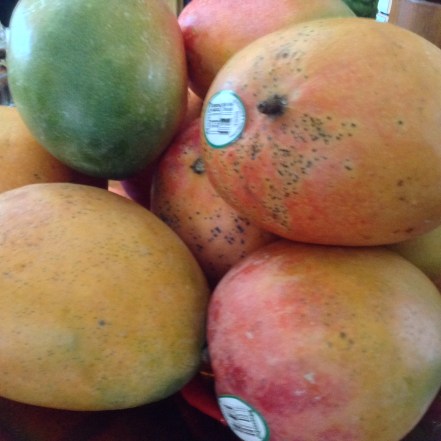
mangos for chutney
This summer I designed a home spa program for myself with an emphasis on positive change. My staycation planning evolved from the original agenda in ways I had not expected. I thought I was in a very artful groove, and needed self expression as a top priority. I listed poetry writing and art as a daily therapy for wholeness because I know these practices do make me healthier. For reasons not yet fully examined my poet and artist have been dormant with no interaction. I have taken a few photos, but what I saw as my big chance to work on my creativity with words and visuals has been channeled in other directions.
I have become a food prepper in my own way. I don’t attempt to pack or create meals for a whole week in one day as the real serious preppers on Pinterest do. I have learned from them to make my own diet healthier by planning and using contrast. My style of food prep involves a constant experimentation and learning new recipes. I have been trying many salad dressings and cold soups that are new to me. I am making a conscious effort to include anti inflammatory foods such as ginger and turmeric in my diet. I am on a huge tea safari of new flavors and types of tea, a journey that will take a lifetime. This summer I have given up coffee and never miss it because I drink tea, often spiked with ginger tea to keep the anti inflammation theme. I have tried more new dishes and teas in the last two months than I did in the previous year. I am hopping enthusiastically out of my culinary rut. I feel good, and find great satisfaction in mastering new cuisines. This afternoon I am making mango chutney for the first time. I might even make an attempt at curry. Who knows where the food muse will lead?
The most successful element of summer spa is the trend toward minimalism. If you knew me in the past you knew one of the biggest maximalists that ever lived on earth. I did everything with way too much over production. I accumulated mass quantities of stuff I never used, and crammed my space with items. I made decisions earlier that have cleaned up much of my act, and I continue to go in this direction. Each time I have the opportunity to donate to the Big Brothers Big Sisters, who provide pick up service, I gather a big bag and leave it outside. Each time I find things that have not been used in years and have little chance of being used. The upgrade is fabulous. I now own…and can find easily in my clean clear space…only things I love. I am in no hurry to fill the space with more items, since I still have more than I really need.
My exercise routine has been enhanced by the free Apple music subscription I am enjoying. I dance around my house for 5 miles in the morning listening to Apple music. By tracking I see that I dance at almost the same pace as I walk outside. My air conditioned house is much more comfortable now than it is outside. The Apple library is vast, so I switch albums and playlists all the time, never listening to the same thing twice. I don’t believe I will cover everything I want to hear in three months, but for now I am having a very good time with it. The good news is that the minimalist in me does not need that giant library and will not mind at all returning to the very big library at Amazon music. I highly recommend that everyone take them up on the free offer just to see how much is available. Even minimalists like free stuff.
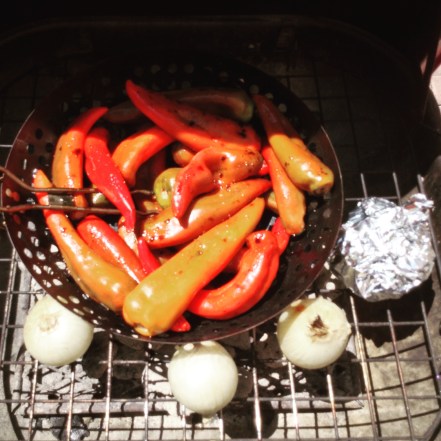
grilling vegetables
Blue laws in Plymouth Colony were created to keep Sabbath exactly the way the Puritans wanted it to be kept. The Puritans had no tolerance for other religious views, or for slacker Puritans. The criminal justice system was used to fine and persecute those found guilty of profaning the Lord’s day. It did not take much to arouse the ire of these founding fathers. The laws evolved very slowly over time, but still represent a will to control what happens on Sunday. In Plymouth you would be fined for walking anywhere but to church from Saturday at sundown until Sunday at sundown. This was a no laughing/no smiling kind of religious day and they were serious about preserving it. The Pilgrims of the Mayflower would freak right out about the televised football games, a tradition many associate with Thanksgiving.

Hammond Coat of Arms
My 10th great-grandfather was an early settler of Watertown, Massachusetts. His father died and he was declared bankrupt in England before he emigrated. William brought part of his family to America to settle before sending for his wife and younger children. By April 1634 they had all arrived in the colony. He frequently was fined for religious infractions and may have been a secret Quaker.
William Hammond
Birth: 1575, Lavenham, Suffolk, England.
Baptized: 30 Oct 1575, Lavenham, Suffolk, England.
Death: 8 Oct 1662, Watertown, Massachusetts. “Aged about ninety-four.
Father: Thomas Hammond, born and died in England.
Mother: Rose Trippe, born and died in Lavenham, Suffolk, England.
1629: On 26 Feb 1629/30, William Hammond was declared bankrupt in England.
1629: On “the 20th of November after that date, he departe[d] the land and fleeth into New England. Information from a 1656 law suit against William Hammond, citing this occurance. This would place him on the “Lyon” which sailed from Bristol on 1 Dec 1630/1631, and arriving in New England the following February.
Emigration: 1631. See above.
The Hammond family came to New England in at least three stages. In late 1630 or early 1631, John Winthrop Jr. noted receipt of £7 5s. from “Goody Hammond to send her husband.” This supports the conclusion that William Hammond was a passenger on the “Lyon” when it sailed from Bristol in late 1631.
On 26 Sept 1633, Governor John Winthrop, wrote to Sir Simonds D’Ewes, informing him that “Yours by young Hamond I received,” indicating that William Hammond Jr. probably sailed for New England in one of the ships that arrived in the fall of 1633. His sister Anne and brother Thomas may also have come at this time, because they are not included, a year later, in the passenger list of the “Francis”, which sailed from Ipswich, in the spring of 1634, with Elizabeth Hammond, (aged 47); Elizabeth Hammond, (aged 15); Sarah Hammond, (aged 10); and John Hammond, (aged 7) on board.
First Residence: William’s first residence was Watertown, Massachusetts.
Occupation: Husbandman.
Religion: Admitted to Watertown Church prior to 25 May 1636, (implied by freemanship.)
1636: Admitted as a Freeman, 25 May 1636.
1636: In his record of admissions to Scituate Church, Rev. John Lathrop, entered on 14 Apr 1636, “Elizabeth Hammon, my sister, having a dismission from the church at Watertown.”
1636: On 25 Jul 1636, William Hammond was granted forty acres in the Great Dividend.
1637: Granted eight acres in the Remote Meadows, 26 Jun 1637.
1641: Granted a farm of one hundred fifty-five acres, 10 May 1642.
1645: In the “year 1645 Rose his mother dyeth … but now in the year 1647 his son Thomas come from New England to be admitted to the land.”
1647: On 22 Nov 1647, “W[illia]m Hamond granted a letter of attorney unto Thomas Hamond, his son, to ask demand of the lord of the manor the possession of certain lands in Lavenham, in Suffolk which were the possession of Rose Steward, his mother.”
1647: William was a Watertown Selectman, 8 Nov 1647.
1656: Along with Isaac Stearns, William was an arbiter in a dispute between John Wincoll and Benjamin Crisp.
1656: “Old Goodman Hammond” was appointed to a committee to assign seats in the meeting house, 17 Nov 1656.
1660: On 6 Non 1660, Watertown Selectmen sent the constables to “Old Hamond to let him know, that contrary to order of town, he had entertained into his family such a person as is likely to prove chargeable, do therefore desire him to rid the town of such an encumbrance or otherwise to bear the burden thereof himself.”
In William’s will, dated 1 Jul 1662 and proved 16 Dec 1662:
“William Hammond of Watertowne … now about ninety years of age” bequeathed to “my loving dear wife Elizabeth Hammond my whole estate” for life;
and after her death, to “my son John Hammond all my houses, lands;”
to “Thomas Hammond son of my son Thomas Hammond, deceased,” £40 when twenty-one, but if he dies before that then “the £40 to be equally divided between the children of my daughter House, daughter Barnes, [i.e., Barron’s], children”; to “daughter Barnes” £30;
to “the four children of my daughter Elizabeth House deceased” £5 apiece; to “Adam Smith son of my daughter Sarah … one mare colt”
and to “my daughter Sarah Smith” £5.
The inventory of the estate of William Hammond totalled £467 16s. 9d., including £318 in real estate:
one dwelling house, an orchard £24;
23 acres of pasture land, £69;
11 acres of broken-up land, £48;
15 acres of meadow, £90;
8 acres of meadow remote, £15;
18 acres of land in lieu of township, £6;
1 Great Dividend, 40 acres, £40;
1 farm, 160 acres, £20; and
a part of a barn, £6.
His inventory also included “one great Bible and 3 other books” valued at 13s.
Married: Elizabeth Paine, baptized in Lavenham 22 Sep 1586. She was the daughter of William and Agnes Neves Paine. Elizabeth arrived in New England in 1634 on the “Francis” with her three youngest children. Elizabeth died 27 Sep 1670, in Watertown, Massachusetts, “aged about ninety years .”
Marriage: 9 Jun 1605, in Lavenham, Suffolk, England.
Children of William Hammond and Elizabeth Paine Hammond:
William Hammond (1575 – 1662)
is my 10th great grandfather
Elizabeth Hammond (1620 – 1703)
daughter of William Hammond
Elishua Crowell (1643 – 1708)
daughter of Elizabeth Hammond
Yelverton Gifford (1676 – 1772)
son of Elishua Crowell
Ann Gifford (1715 – 1795)
daughter of Yelverton Gifford
Frances Congdon (1738 – 1755)
daughter of Ann Gifford
Thomas Sweet (1765 – 1844)
son of Frances Congdon
Valentine Sweet (1791 – 1858)
son of Thomas Sweet
Sarah LaVina Sweet (1840 – 1923)
daughter of Valentine Sweet
Jason A Morse (1862 – 1932)
son of Sarah LaVina Sweet
Ernest Abner Morse (1890 – 1965)
son of Jason A Morse
Richard Arden Morse (1920 – 2004)
son of Ernest Abner Morse
Pamela Morse
I am the daughter of Richard Arden Morse
WILLIAM HAMMOND – ELIZABETH PAINE
(1575-1662) (1586-1676)
William, the emigrant ancestor of this branch of the family in America, was born in Lavenham, County of Suffolk, England, where he was baptized October 30, 1575. He was the only surviving son of Thomas Hammond and Rose Trippe, his younger brother, Thomas, having died in infancy. He was left an orphan by the death of his father in 1589. He married Elizabeth there June 9, 1605 and their children were all born in Lavenham. Elizabeth was born 1586, also in Lavenham, daughter of William Paine.
William, along with his older children, came to America before his wife and younger children, though the exact year is not known. Elizabeth, aged 47 years, with children Elizabeth, aged 15, Sarah, aged 10 and John, aged 7 years embarked at Ipswich, England, in the ship, “Francis,” John Cutting, Master, in April, 1634, and joined her husband in New England.
William Hammond was admitted freeman in Watertown, May 25, 1636, and was grantee of seven lots and purchaser of three lots before 1644. His homestead of 40 acres was situated on the west of Common Street. It was bounded on the east and north by lands of his brother-in-law, Dr. Simon Eire, on the west by John Simson, Isaac Sterne and John Warren, and on the south by Thomas Boyden. Bond’s Hist. of Watertown (p. 1088) says, “It is probable that William Hammond settled first on the Cambridge Road, very near the Cambridge line. Whether this was a grant to him the records do not show. He sold it early and settled on his 40-acre homestall, situated east of Pequusset meadow. He also owned three small lots in Pequusset meadow, one of these granted to him and the other two purchased. This homestall passed to his son (grandson) Thomas.” March 10, 1642, in the division of lands, he was granted lot No. 76, in the 4th Division, containing 165 acres, and this, with his other holdings, made him one of the largest land owners in the town.
The records do not show that he was often an office holder in the town and this may have been due to his independence in religious matters, which may have made him unpopular with his more puritanical neighbors, although he does not appear to have been so unpopular as some of his most intimate friends. His near neighbor and most intimate friend appears to have been John Warren, who came from the same locality in Suffolk County, England, and between whose family and his own there appears to have been considerable intimacy for several generations prior to the settlement in America.
On occasion there were fines “for an offense against the laws concerning baptism,” and “for neglect of publick worship” 14 Sabbaths at 5 shillings each. Warnings were given “for not attending publick worship”.
May 27, 1661, the houses of “old Warren and goodman Hammond” were ordered to be searched for Quakers, for whom they were known to have considerable sympathy. Considerable independence in religious matters, great love of liberty and sympathy for all who are persecuted for conscience sake seem to have been inherent family traits for generations past. It is probable that William Hammond and his intimate friend, Warren, were both inclined toward the religious teaching of Roger Williams, but were too conservative to subject themselves to the persecution that his more radical followers were compelled to endure. This view is supported by the fact that many of their descendants were rigid adherents of the Baptist Church. The tendency, however, in this family has been toward great liberty of thought in religious matters and many of the descendants have been connected with the Unitarian and Universalist denominations, while many in the later generations have held membership in no church.
The will of William Hammond is on file at East Cambridge, Mass., (Middlesex Probate No. 7167), dated July 1662; proved Dec. 16, 1672. He leaves to wife Elizabeth his whole estate during her life. To son, John, all lands, & after her death. To Thomas Hamond, “sonne of my sonne, Thomas Hamond, deceased,” œ40 at the age of 21 years. “If said Thomas, or any for him, oppose this will,” then he is not have the œ40. “Unto daughter (Hannah) Barnes, œ30, the same to remain unto her children.” “In case she again become a widow” she to have wood from his lands during her widowhood. To four children of my daughter, Elizabeth House, deceased, various sums of money. “To Adam Smith, son of daughter, Sarah, if he behave obediently to my wife after my decease, one mare, colt and œ20.” To daughter, Sarah Smith, œ5. Appoints widow, Elizabeth and John executors.
Witnesses– Matthew Bridge and Thomas Longhorne.
Inventory by Hugh Mason and Thomas Hastings, Dec. 16, 1662; œ457-16-9. Contains the following list of real estate:
25 acres of fallow land, 15 acres of broken land, 15 acres of meadow, 60 acres of meadow, &c.,
16 acres of land in low of ye town right, 40 acres in great dividend, 160 acres in a farm. Total, 331 acres.
Each week I will talk about some history of medicine and folklore. Today I am featuring ginger.

Saraswati
The Hindu goddess Saraswati represents creativity and artful expression. Her role as an educator in the arts is combined with her inspirational qualities. She once was a river in India, so her fluidity is natural. Art turns emotional states into keen statements. She is a guide to bring artfulness to all aspects of living. Her inventive spirit sheds new light on the creative process. She is popular in India today. I enjoy seeing all the ways she is depicted. She rides a swan and plays music. Her influence is uplifting and encouraging, helping you to locate your muse. You can invite her into your dreams and meditation in subtle ways. I like to use a visualization which is a combination of some of my favorite techniques rolled into one:
This exercise does not need to include Hindu deities if that disturbs your sensibilities. It may be too much for you to think of hanging out with a goddess riding a swan. This same sequence will work well if you go to the temple and choose any entity, alive or dead, to join you and give you a gift. In reality you are both yourself and the gift giver in this program. The insight comes when you grasp the meaning of the gift and are able to use it to be more inventive and artful.

Congdon Coat of Arms
There are conflicting versions of my 8th great-grandfather’s birth. Some believe he was born in Wales, and others think he was born in Rhode island. My research points to Wales, but I have not worked very hard on his parents. Each generation needs scrutiny to make sure there are no mistakes before proceeding backwards. I have made plenty of family tree errors in the past, and wish to avoid it in future. We are without proof, but I think young Benjamin sailed from Wales when he was very young, perhaps with his parents. He was in Rhode Island early enough to buy land from the native people:
The first notice found of Benjamin Congdon is in the Records of Portsmounth, R.I., under date of June 16th 1670, where he is proposed to become a freeman (or voter). He married Elizabeth Albro, the daughter of Major John Albro; she received as a bequest from her father 50 shillings in English money, 1 bolster case, 1 pair of sheets and 2 pewter platters. Benjamin Congdon bought land of the original proprietors (the Indians) at Potaquamscut, R.I., Sept. 22nd 1671. In his will whihc is dated July 2d, 1715, he mentions his wife, Elizabeth Congdon and his loving sons William, John, Benjamin and James. His daughters were Elizabeth Wells and Susannah Anthony.
Benjamin Congdon (1642 – 1718)
is my 8th great grandfather
Benjamin Congdon (1676 – 1756)
son of Benjamin Congdon
William Congdon (1711 – 1755)
son of Benjamin Congdon
Frances Congdon (1738 – 1755)
daughter of William Congdon
Thomas Sweet (1765 – 1844)
son of Frances Congdon
Valentine Sweet (1791 – 1858)
son of Thomas Sweet
Sarah LaVina Sweet (1840 – 1923)
daughter of Valentine Sweet
Jason A Morse (1862 – 1932)
son of Sarah LaVina Sweet
Ernest Abner Morse (1890 – 1965)
son of Jason A Morse
Richard Arden Morse (1920 – 2004)
son of Ernest Abner Morse
Pamela Morse
I am the daughter of Richard Arden Morse
Benjamin Congdon appears to have first settled in Rhode Island, where, on the 20th day of Sepctember, 1671, he bought of William Brenton, Benedict Arnold, and others, 230 acres of land in Narragansett, but did not occupy it for several years after. He was a made freeman in 1677, being born about 1650. It is not ascertained who his parents were, or whether he was born in this country. In 1679 he received a deed of 200 acres of land in Narragansett, being part of 7,630 acres laid out by Samuel Wilber to Jirch Bull and 24 others. On the 20th day of October, 1683, he sold to John Sheldon the 230 acres he purchased of William Brenton and Benedict Arnold, for 7 pounds. in the deed he styled himself, “late of Porsmouth, planter.”
His signature was made to deeds, etc., by mark Z while his son Benjamin signed by mark O. His will was executed July 2, 1715, and proved in the Probate Court Dec. 10, 1718. His executors were his wife, Elizabeth, and son, John. To sons William, John, Benjamin, and James, 5s. each, they having had their portions. To daughter Elizabeth Wells and Sussanna Northup three cows each, and to granddaughter Elizabeth Wells, a co w at deceased of his wife. To his wife, the household goods at her disposal, and the farm, orchard, and housing for life. To so John, two cows and a heifer. Benjamin Congdon married Elizabeth Albro, dau. of John Albro and Dorothy . He died Jan. 19, 1718. She died Nov. 15, 1720. Both were buried in the Congdon burial ground at Congdon Hill, near Wickford, R.i.
monument
My 9th great-grandfather sailed to America in 1634 when he was only 17. He lived a long and productive life in Rhode Island.
John* (Quaker John) Albro was born 14 JAN 1617 in Warwickshire, England and died 17 DEC 1712 in Portsmouth, Newport Co. Rhode Island at the Quaker settlement (date of death given as November 1, 1712 in “The Greene Family and Its Branches” by Lora S. LaMance, Chapter XXXV, page 220)
John Albro came on the ship “Francis” in 1634 from Ipswich to New England under the care of William Freeborn. His age was called 14, which was not exact but as near as was often the case in making returns to the officials. In 1638 he accompanied William Freeborn to Rhode Island. In 1639 John Albro was a granted a lot if he would build in one year. In 1644 he was made a corporal, rising successively in after years to the office of Lieutenant, Captain and Major. Sometime in 1649 he was made a member of the Town Council, and served frequently as Moderator of town meetings, even into old age.
In 1655, John became a freeman, and a commissioner from 1660-61. On August 24, 1676, he was a member of the court martial held at Newport for the trial of certain Indians. (From the Genealogical Dictionary of Rhode Island) He is an ancestor of Gilbert Stuart (painter of George Washington).
John Albro (1617 – 1712)
is my 9th great grandfather
Elizabeth Albro (1646 – 1720)
daughter of John Albro
Benjamin Congdon (1676 – 1756)
son of Elizabeth Albro
William Congdon (1711 – 1755)
son of Benjamin Congdon
Frances Congdon (1738 – 1755)
daughter of William Congdon
Thomas Sweet (1765 – 1844)
son of Frances Congdon
Valentine Sweet (1791 – 1858)
son of Thomas Sweet
Sarah LaVina Sweet (1840 – 1923)
daughter of Valentine Sweet
Jason A Morse (1862 – 1932)
son of Sarah LaVina Sweet
Ernest Abner Morse (1890 – 1965)
son of Jason A Morse
Richard Arden Morse (1920 – 2004)
son of Ernest Abner Morse
Pamela Morse
I am the daughter of Richard Arden Morse
Major John Albro was one of the most active and influential settlers of Portsmouth, RI. He came from Ipswich, Eng., in the ship Francis, sailing from Ipswich Apr 30, 1634. He was born in England in 1617. He came under the care of William Freeborn and was only seventeen years of age. They landed at Boston and four years later (1638) came to Portsmouth RI. John then being 21 yrs. of age. His fellow townsmen soon began to give him much to do with the affairs of the community. In 1649 he was a member of the town council and he often served as moderator of the town meetings. even into old age. In 1686 King James appointed him as a member of Sir Edmund Andros’ Council for New Eng. and he attended the first meeting of this council in Boston, Dec. 30th of that year. He served as one of the commissioners of the Colony to lay out the W/Eastern? line of the Colony in 1678. During King Phillip’s War he was one of the commissioners to order, watch and ward the the island. He died at Portsmouth, Dec. 14, 1712, and in the 95th years of his age. The Friends’ Records, in recording the death of this useful man state that he “was buried in his own orchard”.
Magnesium is an essential nutrient that keeps us clam. The GABA receptors in the brain require magnesium to do their job, which is to switch off the stress. When we are low in magnesium our bodies respond with insomnia, daytime jitters, and other unpleasant symptoms. This uncomfortable situation can be addressed by taking supplements. Another way to introduce extra magnesium into the body is by bathing in epsom salts. I have used them for foot baths when I have sore feet, and occasionally for tub baths, but now I am trying a new technique to improve my sleep. By using honey before bed I have made some improvements in deeper more uninterrupted sleep. Last night when I woke to let the dog outside at 2 in the morning I decided to try a bath recipe I saw to test the effects. It was nothing short of spectacular.
I ran a hot bath and used about 1 and a half cups of epsom salt, about 1/2 cup baking soda, and 2 cups strong ginger tea. The ginger makes you sweat while you are in the tub, and for a few minutes after you exit. The recommended time for maximum benefits is an hour, but I was falling back to sleep in about 20 minutes. I did fall deeply back into dreamland and awoke this morning feeling very well rested. My fitbit reports that I had a very good night of sleep, just over 8 hours.
This is such an easy and pleasant cure I plan to incorporate it into my routine every day. One of the effects one can expect to see is lower blood pressure. Pharmaceutical drugs are one reason we become magnesium deficient in the first place. I don’t take any drugs and hope to stay that way. Isn’t it good to know that both insomnia and high blood pressure, very common today, can often be completely cured in the bathtub? Have you used epsom salts to get a better night’s sleep, gentle reader? I highly recommend it. The addition of the ginger adds anti-inflamatory properties, again an easy and cheap cure for the entire body. There are no harmful side effects, and the evidence shows that this bath might be just what the doctor should have ordered.

